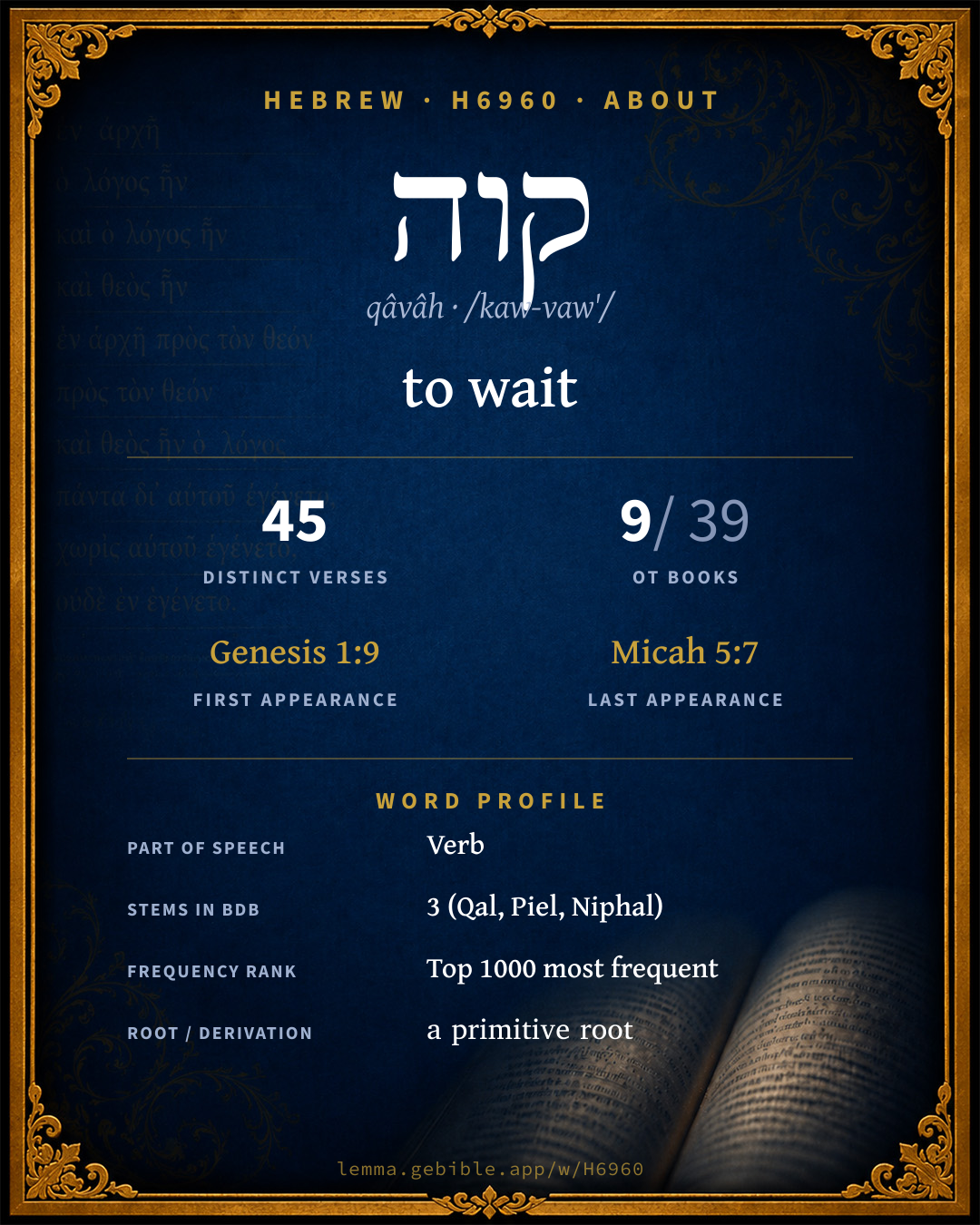
קָוָה
to wait
also: look for, hope, expect fuller range ↓
Full lexicon entry — Brown-Driver-Briggs (BDB)
From Brown-Driver-Briggs (BDB)
Where this word appears
See every Piel verb in the Hebrew Bible →
Grammar key — what these labels mean
Part of speech
- Verb
- An action or state-of-being word.
Stem
- Piel
- An intensive or resultative active stem. Here: ‘wait’
- Qal
- The basic, simple active stem — the plain form of the verb (“he wrote”). Here: ‘pl. those waiting for’
- Niphal
- Usually the simple passive or reflexive of the Qal (“he was written”). Here: ‘be collected’
Form
- Perfect
- A completed action or state — Hebrew marks aspect (completeness) more than strict tense (“he wrote”).
- Imperative
- A direct command (“write!”).
- Imperfect
- An incomplete, ongoing, or future action (“he will / would write”).
- Sequential Imperfect
- An imperfect with prefixed waw — the standard past-narrative form (waw-consecutive imperfect).
- Participle Active
- A verbal adjective expressing ongoing or characteristic action (“writing / one who writes”).
- Infinitive Absolute
- An unbound verbal noun, often intensifying or standing in for a finite verb.
- Sequential Perfect
- A perfect with prefixed waw continuing a preceding imperfect or command (waw-consecutive perfect).
- Jussive
- A third- or second-person volitional form expressing wish or command (“let him write”).
State
- Construct
- A noun bound to a following noun in a possessive / “of” relationship (the construct chain).
Person
- 1st Person
- The speaker (“I / we”).
- 2nd Person
- The one addressed (“you”).
- 3rd Person
- The one spoken about (“he / she / it / they”).
Gender
- Common
- Either gender — not distinguished for this form.
- Masculine
- Grammatically masculine.
- Feminine
- Grammatically feminine.
Number
- Singular
- One.
- Plural
- More than one (in Hebrew, generally three or more).
4 verses where H6960 appears in the Piel stem in the Book of Jeremiah. Filtered view — show all forms. Click any verse to open its interlinear word-by-word view. Verse text shown in the World English Bible for context — . Each verse’s Hebrew form is shown with its reference; the English is not keyword-highlighted, since the data carries no word-level English alignment. Use “Compare translations” on any verse to read it across multiple English versions. This concordance covers the Hebrew Bible; Septuagint (Greek Old Testament) occurrences are not indexed here.
Jeremiah
- Jeremiah 8:15 קַוֵּ֥ה Piel impv 2ms We looked for peace, but no good came; [and] for a time of healing, and, behold, dismay!
- Jeremiah 13:16 וְ/קִוִּיתֶ֤ם conj + Piel wpf 2mp Give glory to Yahweh your God, before he cause darkness, and before your feet stumble on the dark mountains, and, while you look for light, he turn it into the shadow of death, and make it gross darkness.
- Jeremiah 14:19 קַוֵּ֤ה Piel inf.abs Have you utterly rejected Judah? has your soul loathed Zion? why have you struck us, and there is no healing for us? We looked for peace, but no good came; and for a time of healing, and, behold, dismay!
- Jeremiah 14:22 וּ֨/נְקַוֶּה conj + Piel impf 1cp Are there any among the vanities of the nations that can cause rain? or can the sky give showers? Aren't you he, Yahweh our God? therefore we will wait for you; for you have made all these things.
About this entry
At a glance — auto-summarized from this page’s data, not written by a person. Every figure links to its source below. This summary describes the numbers; it doesn’t interpret them.
“to wait” is the headline sense of the Hebrew verb קוה (qâvâh). First canonically at Genesis 1:9, it enters the text early. The Hebrew Bible uses it across 45 verses — moderately common. More than a quarter of its appearances fall in Psalms. Across 3 stems, its meaning turns on the binyan (Qal, Piel). See the sense tree, 45-verse concordance, and the renderings breakdown below.
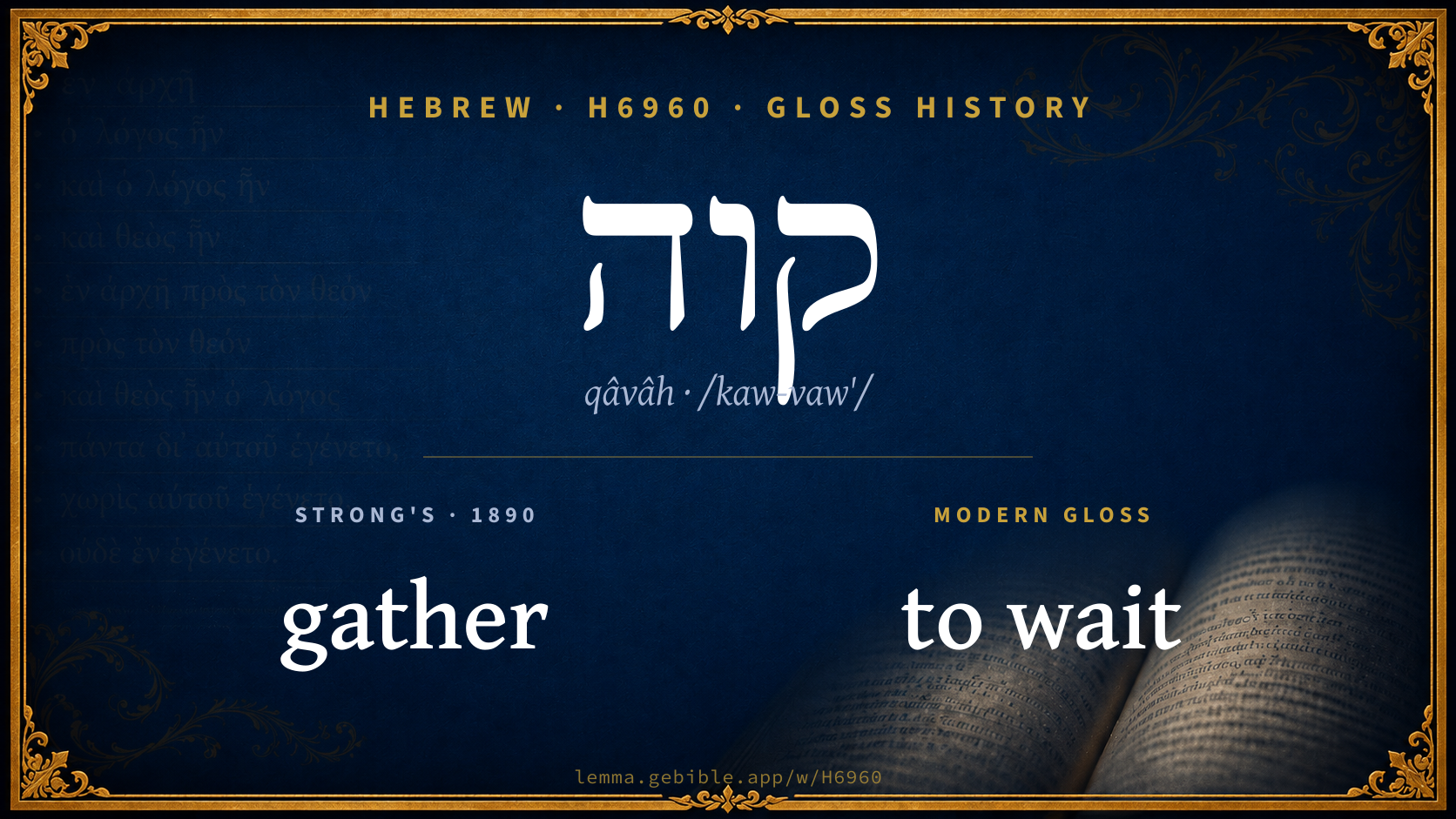
Gloss history
Strong's 1890 vs modern scholarship
About this word
Strong's H6960 catalogs a Hebrew word from the Hebrew Old Testament.
These counts are not copied from any lexicon or concordance. They are computed here, from the morphology-tagged Hebrew Old Testament. What Lemma adds →
- 45
- distinct verses
- The word appears in 45 distinct verses.
- 9 / 39
- OT books
- The word appears in 9 of 39 Old Testament books.
- #752
- by frequency
- Top 1000 most frequent Hebrew words (rank 752 of 8,640 Hebrew words by occurrence).
View all 45 occurrences in the concordance →
By section of the Old Testament
By traditional corpus
Conventional, traditional groupings — biblical authorship is debated, so this is a traditional corpus grouping, not an authorship claim. Each share is this word’s portion of its verses in that division of the Hebrew canon. Each figure is a share of the word’s 45 distinct verses.
- Writings (Ketuvim) 22 verses · 49%
- Prophets (Nevi'im) 21 verses · 47%
- Torah (Pentateuch) 2 verses · 4%
How translations render this word
Counts come from each version’s own published word-to-Strong’s tagging or interlinear alignment — an approximate guide to how each version renders this word, not a word-level alignment the data otherwise carries. Because each total is that version’s own tagged count, the per-version totals vary from one another and need not match the appearance or distinct-verse counts above. These counts may also differ from a printed concordance because Lemma counts each distinctly tagged rendering and does not collapse phrase taggings into a single head-word total. This is a fixed set of word-tagged versions (KJV, ASV, BSB, ULT) and does not change with the reading translation you choose elsewhere. Each version’s license is shown beside its name below (and on Sources).
BDB lists this Strong’s number as 2 distinct words (homographs). Each count above pools all of them and is not split by sense — see the Senses section below. A low-frequency rendering may belong to a different one of those words, not the primary meaning.
- King James Version†: Wait 8×, I looked 3×, I wait 3×
- American Standard Version†: Wait 5×, I looked 2×, Shall wait 2×
- Berean Standard Bible†: Wait 6×, We have waited 3×, Hope 2×
- unfoldingWord Literal Text†: Wait 7×, We wait 3×, He waited 2×
King James Version Public Domain
Renders H6960 across 49† tagged occurrences — most commonly:
Plus 27 renderings that appear only once — usually multi-word phrases or single function words the recovered tagging swept in, not distinct renderings.
American Standard Version Public Domain
Renders H6960 across 49† tagged occurrences — most commonly:
Plus 32 renderings that appear only once — usually multi-word phrases or single function words the recovered tagging swept in, not distinct renderings.
Berean Standard Bible Public Domain
Renders H6960 across 48† tagged occurrences — most commonly:
Plus 31 renderings that appear only once — usually multi-word phrases or single function words the recovered tagging swept in, not distinct renderings. Not rendered by a distinct English word in 1 further occurrence.
unfoldingWord Literal Text CC BY-SA 4.0
Renders H6960 across 52† tagged occurrences — most commonly:
Plus 36 renderings that appear only once — usually multi-word phrases or single function words the recovered tagging swept in, not distinct renderings.
7 senses and sub-senses in the full BDB
Hebrew verbs can shift meaning by stem (binyan): Qal is the basic action, Niphal is often passive or reflexive, Piel often intensifies or makes it factitive, and Hiphil is typically causative. The senses below are grouped under the stem BDB assigns to each.
What do BDB’s symbols mean?
BDB uses these scholarly abbreviations:
| Symbol | Meaning |
|---|---|
| 𝔊 | the Septuagint (the ancient Greek translation, LXX) |
| 𝔙 | the Vulgate (the Latin translation) |
| 𝔖 | the Syriac version (the Peshitta) |
| 𝔗 | the Targum (the Aramaic translation) |
| ψ | the Psalms |
| √ | root (the underlying root or stem) |
| ‖ | parallel passage (a synonymous or contrasted parallel) |
| † | the dagger: every passage where the word occurs is cited |
The 7 senses and sub-senses the full Brown-Driver-Briggs lexicon distinguishes for this word, in lexicon order (not ranked by frequency), with BDB’s own verbatim wording and sub-sense lettering. Shown in Hebrew script with BDB’s own scholarly abbreviations. The condensed entry is in the Lexicon Entry tab. See also the Forms in the corpus table below.
קוה I wait for (prob. orig. twist, stretch, then of tension of enduring, waiting
Qal
- Pt. pl. those waiting for (י׳): cstr. קֹוֵי י׳ ψ 37:9; so Is 40:31 van d. H., and Kt Baer Gi (Qr קוֹיֵי); sf. קֹוָי֑ 49:23, קֹוֶיךָ ψ 25:3; 69:7; קֹוָיו La 3:25 Qr (Kt קוו, i.e. קֹווֹ). e.g. Psalms 37:9
Piel
- Pf. 3 fs. קִוְּתָה ψ 130:5; 1 s. קִוִּיתִי Gn 49:18 + 5 times, קִוֵּיתִי Is 5:4, וְק׳ consec. 8:17; sf. קִוִּיתִיךָ ψ 25:21; 3 pl. קִיּוּ ψ 56:7 +, etc.; Impf. יְקֵוֶּה Mi 5:6; Jb 7:2, juss. יְקַו Jb 3:9, וַיְקַו Is 5:2, 7, etc.; Imv. ms. קַוֵּה Ho 12:7 +; Inf. abs. קַוֹּה ψ 40:2, קַוֵּה Je 8:15; 14:19;— e.g. Psalms 130:5
- 1. wait, or look eagerly, for, c. ל rei Is 5:7; 59:9, 11; Je 8:15, 13:16; 14:19; Jb 3:9; 6:19; לִישׁוּעָֽתְךָ Gn 49:18; c. acc. rei La 2:16 (sf.), Jb 7:2; 30:26 ψ 39:8; obj. rei om. Is 64:2; sq. inf. Is 5:2, 4 ψ 69:21; abs. Jb 17:13; c. acc. י׳ Is 26:8 (sf.), ψ 25:5, 21 (sf.), 40:2 (+ inf. abs.), 130:5, acc. om. v 5, acc. שִׁמְךָ ψ 52:11 (but read prob. אֲחַוֶּה, Hi Che Bae al., v. III. חוה); c. ל of י׳ Is 8:17; 25:9(×2); 33:2; 60:9 (but read prob. צִיִּים יִקָּווּ ships shall gather (II. קוה), so Du CheHpt Di-Kit Marti, cf. Skinner (also Luzz Gei Oort), Je 14:22; Pr 20:22; c. אֶל־אֱלֹהִים Ho 12:7, אֶל־י׳ Is 51:5 ψ 27:14(×2); 37:34. e.g. Isaiah 5:7
- 2. lie in wait for, sq. נַפְשִׁי ψ 56:7; sq. ל pers. ψ 119:95 (+ inf. purpose). e.g. Psalms 56:7
- 3. wait (linger) for c. ל man Mi 5:6 (‖ יְיַחֵל). e.g. Micah 5:6
קוה II collect (NH Hiph. collect)
Niphal
- be collected, Pf. 3 pl. וְנִקְווּ consec. Je 3:17 (of nations); Impf. 3 mpl. יִקָּווּ Gn 1:9 (P; of waters; both c. אֶל loc.); so prob. of ships (c. ל pers.) Is 60:9 (for MT יְקַוּוּ), v. I. קוה e.g. Jeremiah 3:17
Piel
- 1.
Senses from the full Brown-Driver-Briggs lexicon (Brown, Driver, Briggs; Oxford 1906 — public domain), digitized via Sefaria, supplemented by the OpenScriptures HebrewLexicon (CC BY 4.0). Full attribution on Sources.
Word origin
I. vb. wait for (prob. orig. twist, stretch, then of tension of enduring, waiting: Assyrian ḳuʾû ii, i. wait, ḳû, cord; Arabic قَوِىَ be strong, قُوَّةٌ strength, also strand of rope; Syriac ܩܰܘܺܝ endure, remain, await, ܩ̈ܘܳܝܶܐ threads, so 𝔗 קַוִּין spider’s threads, web);—
II. vb. collect (NH Hiph. collect);—
— Brown-Driver-Briggs (Oxford 1906, public domain), digitized via Sefaria, supplemented by the OpenScriptures HebrewLexicon (CC BY 4.0). See Sources.
Origin: a primitive root
Jastrow Dictionary
A second Hebrew/Aramaic lexicon for comparison, covering Aramaic and post-biblical (Talmudic, Targumic, Midrashic) usage that the biblical-Hebrew BDB does not. Matched by lemma rather than by Strong’s number, so a lemma may carry more than one Jastrow headword (shown separately below), and the entries cover usage well beyond the Bible.
קוי
- (b. h.) [to circle, v. קַו,] to cave or heap up, gather. Part. pass. קָווּי. Y. Ber. VI, 10ᵈ ואפי׳ ק׳ לתוך ידו even when the oil is held in the hollow of his hand.
- 1. to gather, to conduct water courses into a common bed. Y. Kil. IX, 32ᶜ bot.; Y. Keth. XII, 35ᵇ bot. דוקל׳ ה׳ נהרות ועשאו Diocletian united several rivers and made it (the bay of Emesa); Midr. Till. to Ps. XXIV (corr. acc.), v. חֲמָץ. Num. R. s. 13 כשה׳ הקב"ה וכ׳ when the Lord, on the third day of creation, gathered all the waters in one place; a. e.
- 2. to add to the capacity of a bath. Tosef. Shek. I, 2 כל מקוה … כשר להַקְווֹת עליו a bath which has the (legally required) capacity of forty S’ah is fit to be added to (by carrying water into it in vessels). Tosef. Mikv. III, 6; a. e.
- to look out (cmp. קַוָּא a. כַּוָּוא) to wait, hope. Gen. R. s. 5 (play on יִקָּווּ, Gen. I, 9) יְקַוּוּ לי המים מה וכ׳ let the waters look out for me (to see) what I shall do &c.; ib. s. 28; Lam. R. to I, 17; Yalk. Gen. 7; Yalk. Ps. 848; [perh. to be read יִקָּווּ Nif.]. Midr. Till. to Ps. VI והיה … מְקַוֶּה לרופא וכ׳ and the patient anxiously waited for the physician (asking), when will he come? &c.; Yalk. ib. 635. Cant. R. to II, 3, v. next w.; a. fr. e.g. Genesis 1:9
A Dictionary of the Targumim, the Talmud Babli and Yerushalmi, and the Midrashic Literature (Marcus Jastrow; London, Luzac, 1903) — Public Domain. Digitized via Sefaria. Digitized via Sefaria. Full attribution on Sources.
Forms in the corpus
The 45 distinct written forms H6960 takes in the Hebrew Bible, most frequent first — each parse links to that stem’s occurrences in the concordance. Hebrew forms include their vowel points and cantillation, so a single lemma takes many written forms.
Same root — word family
Other BDB entries built from the same root as H6960, grouped by Strong’s listed origin. These share a root / origin per the lexicon — not necessarily a shared meaning. Each links to that word’s own entry.
Derived from this word
Compare all same-root words → Showing 4 of 5 — not the complete family. They share a root, not necessarily a meaning.
Septuagint verse parallels
This word appears in 37 verses that also exist in the Greek Old Testament (Septuagint), out of the 45 Hebrew verses it occurs in. You can read those verses in Greek by switching the Old Testament edition to the Septuagint.
Read these verses in the Septuagint
This is a verse-level parallel only — the same verses exist in both the Hebrew and Greek Old Testaments. No word-level Hebrew↔Greek correspondence is claimed: the data carries no such alignment, so no Greek word is shown as this Hebrew word’s translation. Coverage is not total — the Septuagint omits the deuterocanon and renumbers the Psalms, so some Hebrew verses have no direct Greek parallel.