
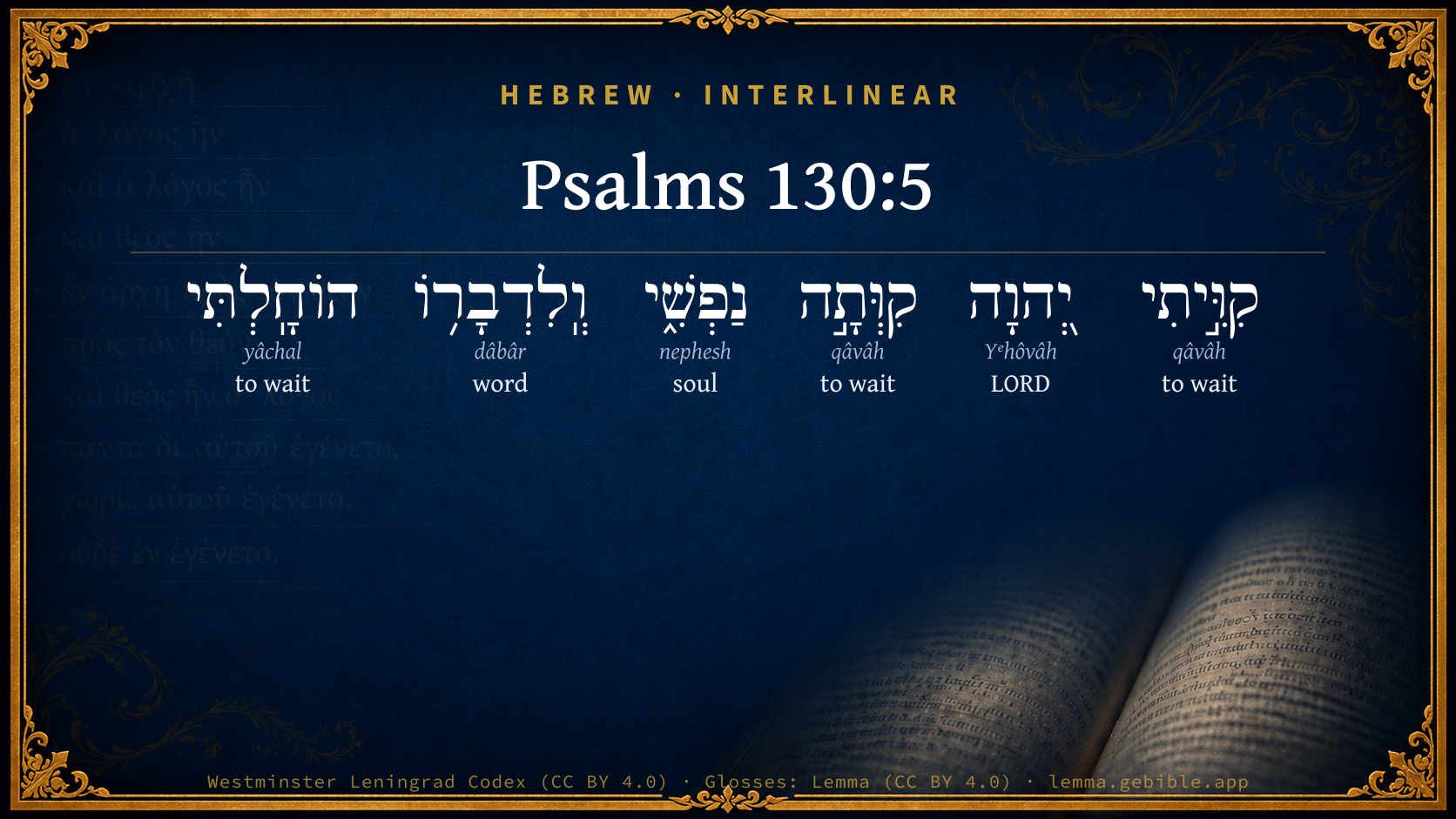
Psalms 130:5

Hebrew (Westminster Leningrad Codex) Psalms 130:5 appears in the Hebrew Old Testament. The text above is from the Westminster Leningrad Codex. Each word links to its Strong’s number, a concise gloss, and parsing drawn from the Open Scriptures Hebrew Bible morphology. Click any word for its full Brown-Driver-Briggs (BDB) entry.
Download image
Cite this verse

Psalms 130:5 (World English Bible). Public Domain. Lemma interlinear Bible study tool, https://lemma.gebible.app/v/psalms/130/5.

Show BibTeX & RIS
BibTeX
RIS
English Translation
I wait for Yahweh. My soul waits. I hope in his word.
World English Bible · Public Domain
Download a study sheet

One document with this verse’s original text, its word-by-word gloss line, the meaning frame, cross-references with their text, attributed commentary, and full source and license credits — printable, and it pastes into notes with its structure intact.

This verse Autodidact and up

Study sheet (.html) Plain text (.txt)

A passage Seminary Student

Up to 50 verses in one chapter. A passage sheet keeps up to 6 commentary sources and 12 cross-references per verse, in the order this page ranks them, and says so on the sheet whenever that leaves anything out. Ask for a single verse and you get the Autodidact verse sheet above.

Everything on this page stays free to read, with no account — the sheet is a download of what is already on screen, not access to it.

Want to remove ads? Support Godless Engineer
Compare translations 3

The same verse in 3 English versions, stacked beneath the original-language interlinear above. Click any original word for its lexicon entry.

Each is an independent rendering of the whole verse — the interlinear is not word-aligned to these translations.

Highlighted words mark where these versions differ — a whole-verse word diff, not a word-by-word alignment.

  • World English Bible Public Domain
    I wait for Yahweh. My soul waits. I hope in his word.
  • King James Version Public Domain
    I wait for the LORD, my soul doth wait, and in his word do I hope.
  • unfoldingWord Literal Text CC BY-SA 4.0
    I wait for Yahweh; my soul waits, and in his word I hope;

unfoldingWord Literal Text — © unfoldingWord, licensed CC BY-SA 4.0. Word-aligned USFM3 via Door43 (git.door43.org/unfoldingWord/en_ult).

Versions to compare (up to 4)

3 of 4 selected

Show all 18 translations

Every available English version of this verse, each an independent rendering of the whole verse.

  • World English Bible Public Domain
    I wait for Yahweh. My soul waits. I hope in his word.
  • Berean Standard Bible Public Domain
    I wait for the LORD; my soul does wait, and in His word I put my hope.
  • Majority Standard Bible Public Domain
    I wait for the LORD; my soul does wait, and in His word I put my hope.
  • King James Version Public Domain
    I wait for the LORD, my soul doth wait, and in his word do I hope.
  • American Standard Version (1901) Public Domain
    I wait for Jehovah, my soul doth wait, And in his word do I hope.
  • Revised Version (1885) Public Domain
    I wait for the LORD, my soul doth wait, and in his word do I hope.
  • Geneva Bible (1599) Public Domain
    I haue waited on the Lord: my soule hath waited, and I haue trusted in his worde.
  • Douay-Rheims (1899) Public Domain
    let them all be confounded and turned back that hate Sion.
  • Young's Literal Translation Public Domain
    I hoped `for' Jehovah -- hoped hath my soul, And for His word I have waited.
  • Literal Standard Version CC BY-SA 4.0
    I hoped [for] YHWH—my soul has hoped, || And I have waited for His word.
  • Unlocked Literal Bible CC BY-SA 4.0
    I wait for Yahweh, my soul waits, and in his word I hope.
  • unfoldingWord Literal Text CC BY-SA 4.0
    I wait for Yahweh; my soul waits, and in his word I hope;
  • Darby Bible Public Domain
    I wait for Jehovah; my soul doth wait, and in his word do I hope.
  • World Messianic Bible Public Domain
    I wait for the LORD. My soul waits. I hope in his word.
  • Webster's Bible Public Domain
    I wait for the LORD, my soul doth wait, and in his word do I hope.
  • Free Bible Version CC BY-SA 4.0
    I'm waiting for the Lord, longingly waiting, for I trust in his word.
  • Bible in Basic English Public Domain
    I am waiting for the Lord, my soul is waiting for him, and my hope is in his word.
  • JPS Tanakh (1917) Public Domain
    I wait for the LORD, my soul doth wait, and in His word do I hope.

Literal Standard Version (2020), Covenant Press — licensed CC BY-SA 4.0. Text via the HelloAO Bible API (eBible.org). Unlocked Literal Bible (unfoldingWord) — licensed CC BY-SA 4.0. Text via the HelloAO Bible API (eBible.org). unfoldingWord Literal Text — © unfoldingWord, licensed CC BY-SA 4.0. Word-aligned USFM3 via Door43 (git.door43.org/unfoldingWord/en_ult). Free Bible Version, Dr. Jonathan Gallagher — licensed CC BY-SA 4.0. Text via the HelloAO Bible API (eBible.org).

Word by word

More ways to search: Search by grammar → Find every occurrence → Compare this word →

Practice this passage: Drill this verse → Learn its vocabulary →

About this verse

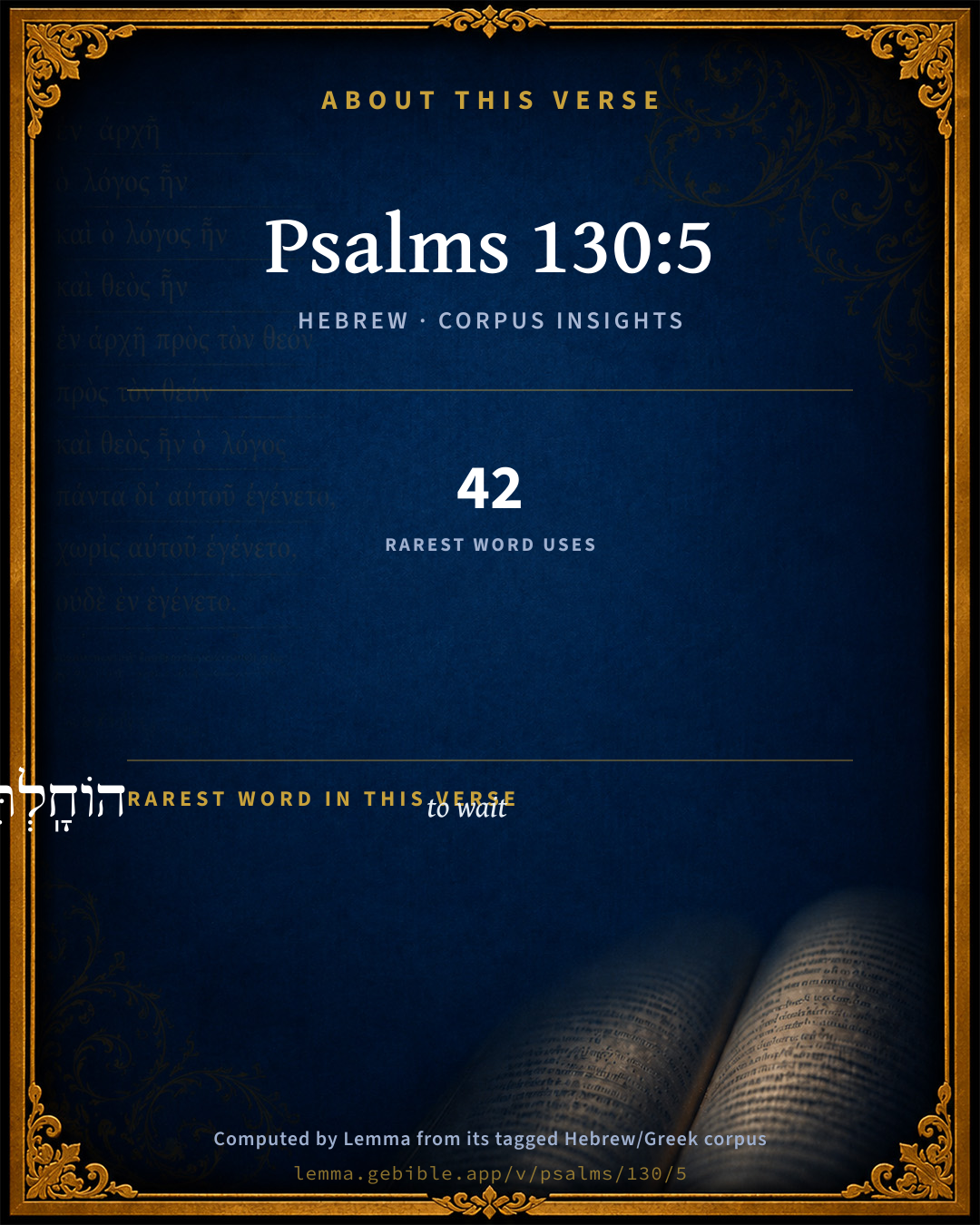
These counts appear in no published source. They are computed here, from the morphology-tagged text and Lemma’s own curated glosses. What Lemma adds →

6
words
5
distinct lemmas
Wisdom
section

Shared distinctive vocabulary

הוֹחָֽלְתִּי to wait H3176 occurs in 41 verses of the Hebrew Bible. Also found in:

Grammatical profile

  • 3 verbs
  • 3 nouns

Verb forms

  • קִוִּ֣יתִי Piel · Perfect
  • קִוְּתָ֣ה Piel · Perfect
  • הוֹחָֽלְתִּי Hiphil · Perfect

Repetition

A word recurs within this verse — often emphatic in Hebrew:

  • קִוִּ֣יתִי to wait H6960 ×2

Hebrew & Septuagint length

In English translation the verse runs 12 words from the Hebrew and 14 from the Septuagint (LXX English) — closely comparable.

A rough comparison of the two English renderings, which tokenize alike — not a word-level alignment.

Word counts can differ between the Hebrew and the Greek without any difference in meaning — e.g. the Hebrew direct-object marker אֵת has no separate Greek word, and Greek often adds the article ὁ.

Cross-references

17

Topical passages linked to Psalms 130:5 in the Treasury of Scripture Knowledge — connected by theme and wording, ordered by reader-vote popularity; previews shown in the World English Bible.

  • Isaiah 30:18 Therefore will Yahweh wait, that he may be gracious to you; and therefore will he be exalted, that he may have mercy on you: for Yahweh is a God of justice; blessed are all those who wait for him.
  • Psalms 33:20 Our soul has waited for Yahweh. He is our help and our shield.
  • Psalms 62:5 My soul, wait in silence for God alone, For my expectation is from him.
  • Psalms 119:81 My soul faints for your salvation. I hope in your word.
  • Psalms 27:14 Wait for Yahweh. Be strong, and let your heart take courage. Yes, wait for Yahweh.
  • Isaiah 8:17 I will wait for Yahweh, who hides his face from the house of Jacob, and I will look for him.
  • Psalms 40:1 I waited patiently for Yahweh. He turned to me, and heard my cry.
  • Psalms 62:1 My soul rests in God alone. My salvation is from him.
  • Psalms 119:74 Those who fear you will see me and be glad, Because I have put my hope in your word.
  • Genesis 49:18 I have waited for your salvation, Yahweh.
  • Isaiah 26:8 Yes, in the way of your judgments, Yahweh, have we waited for you; to your name, even to your memorial [name], is the desire of our soul.
  • Psalms 119:114 You are my hiding place and my shield. I hope in your word.
  • Psalms 119:49 Remember your word to your servant, Because you gave me hope.
  • Luke 2:38 Coming up at that very hour, she gave thanks to the Lord, and spoke of him to all those who were looking for redemption in Jerusalem.
  • Psalms 119:42 So I will have an answer for him who reproaches me, For I trust in your word.
  • Luke 2:25 Behold, there was a man in Jerusalem whose name was Simeon. This man was righteous and devout, looking for the consolation of Israel, and the Holy Spirit was on him.
  • Hebrews 6:18 that by two immutable things, in which it is impossible for God to lie, we may have a strong encouragement, who have fled for refuge to take hold of the hope set before us.

Cross-references courtesy of OpenBible.info (CC BY 4.0).

Hebrew and Greek witnesses Masoretic Hebrew ↔ Greek Septuagint

The same verse in the two great witnesses to the Old Testament, shown verse-for-verse.

You’re reading Greek Psalm 129 (Hebrew Psalm 130). The Septuagint counts the superscription, so verse numbers can differ from the Hebrew — chapter-level alignment, not verse-by-verse. Numbering follows Rahlfs.

These are two independent witnesses, not word-aligned to each other, and the Septuagint is shown in lemma (dictionary) form.

Hebrew Psalms 130:5 Masoretic · Westminster Leningrad Codex

קִוִּ֣יתִי יְ֭הוָה קִוְּתָ֣ה נַפְשִׁ֑י וְֽלִדְבָר֥וֹ הוֹחָֽלְתִּי

I wait for Yahweh. My soul waits. I hope in his word.

World English Bible · Public Domain

Greek LXX Greek Psalm 129:5 Septuagint · lemma form

ἕνεκεν ὁ νόμος σύ ὑπομένω σύ κύριος ὑπομένω ὁ ψυχή ἐγώ εἰς ὁ λόγος σύ

have I waited for you, O Lord, my soul has waited for your word.

LXX2012 (modern English Septuagint) · Public Domain

Hebrew: Westminster Leningrad Codex (CC BY 4.0). Greek: Septuagint (public domain); English from LXX2012 (modern English Septuagint) (Public Domain). How the Septuagint differs from the Hebrew →

Commentary

Notes on Psalms 130:5 from classic Christian and Jewish commentators (each source and its license shown beneath its notes). The classic Christian expositions comment on the surrounding passage and are grouped to its opening verse, so a note may address several verses; the Jewish commentaries on the Tanakh (Rashi and others) are per-verse, so they appear only where the commentator wrote on this verse.

Lemma curates 59 commentaries, every one of them public domain or Creative Commons licensed, each selected and text-cleaned for this edition rather than reprinted as found. About our sources →

Matthew Henry's Commentary

Here, I. The psalmist engages himself to trust in God and to wait for him, Psa 130:5, Psa 130:6. Observe, 1. His dependence upon God, expressed in a climax, it being a a song of degrees, or ascents: "I wait for the Lord; from him I expect relief and comfort, believing it will come, longing till it does come, but patiently bearing the delay of it, and resolving to look for it from no other hand. My soul doth wait; I wait for him in sincerity, and not in profession only. I am an expectant, and it is for the Lord that my soul waits, for the gifts of his grace and the operations of his power." 2. The ground of that dependence: In his word do I hope. We must hope for that only which he has promised in his word, and not for the creatures of our own fancy and imagination; we must hope for it because he has promised it, and not from any opinion of our own merit. 3. The degree of that dependence - "more than those that watch for the morning, who are, (1.) Well-assured that the morning will come; and so am I that God will return in mercy to me, according to his promise; for God's covenant is more firm than the ordinances of day and night, for they shall come to an end, but that is everlasting." (2.) Very desirous that it would come. Sentinels that keep guard upon the walls, those that watch with sick people, and travellers that are abroad upon their journey, long before day wish to see the dawning of the day; but more earnestly does this good man long for the tokens of God's favour and the visits of his grace, and more readily will he be aware of his first appearances than they are of day. Dr. Hammond reads it thus, My soul hastens to the Lord, from the guards in the morning, the guards in the morning, and gives this sense of it, "To thee I daily betake myself, early in the morning, addressing my prayers, and my very soul, before thee, at the time that the priests offer their morning sacrifice."

II. He encourages all the people of God in like manner to depend upon him and trust in him: Let Israel hope in the Lord and wait for him; not only the body of the people, but every good man, who surnames himself by the name of Israel, Isa 44:5. Let all that devote themselves to God cheerfully stay themselves upon him (Psa 130:7, Psa 130:8), for two reasons: - 1. Because the light of nature discovers to us that there is mercy with him, that the God of Israel is a merciful God and the Father of mercies. Mercy is with him; not only inherent in his nature, but it is his delight, it is his darling attribute; it is with him in all his works, in all his counsels. 2. Because the light of the gospel discovers to us that there is redemption with him, contrived by him, and to be wrought out in the fulness of time; it was in the beginning hidden in God. See here, (1.) The nature of this redemption; it is redemption from sin, from all sin, and therefore can be no other than that eternal redemption which Jesus Christ became the author of; for it is he that saves his people from their sins (Mat 1:21), that redeems them from all iniquity (Tit 2:14), and turns away ungodliness from Jacob, Rom 11:26. It is he that redeems us both from the condemning and from the commanding power of sin. (2.) The riches of this redemption; it is plenteous redemption; there is an all-sufficient fulness of merit and grace in the Redeemer, enough for all, enough for each; enough for me, says the believer. Redemption from sin includes redemption from all other evils, and therefore is a plenteous redemption. (3.) The persons to whom the benefits of this redemption belong: He shall redeem Israel, Israel according to the spirit, all those who are in covenant with God, as Israel was, and who are Israelites indeed, in whom is no guile.

Matthew Henry's Commentary on the Whole Bible (1708–1710) — public domain (CC PDM 1.0). Text via the HelloAO Bible API.

Trapp's Complete Commentary

John Trapp

Psa 130:5 I wait for the LORD, my soul doth wait, and in his word do I hope.

Ver. 5. I wait for the Lord] I wait, and wait, viz. for deliverance out of misery, Psa 130:1, being assured of pardoning mercy. Feri, Domine, feri; a peccatis enim absolutus sum, said Luther, Strike, Lord, while thou wilt, so long as my sins are forgiven; I can be of good comfort; I can wait, or want for a need.

And in his word] viz. Of promise, that ground of hope unfailable, Rom 5:5; of faith unfeigned, 1Ti 1:5.

John Trapp, A Commentary or Exposition upon All the Books of the Old and New Testament (1647–1656) — public domain. Text from a community e-Sword module.

The Biblical Illustrator

Joseph S. Exell

Psa_130:5-6

I wait for the Lord.

Waiting, hoping, watching

I. Waiting.

1. This is the constant posture of all the saints of God. Fancy not that in heaven they have no emotion but that of joy; we know that all their emotions are joyous, but among them is this one,--that they, too, are waiting until the Lord shall again manifest Himself, for, in the day of His appearing, those disembodied spirits shall put on their resurrection bodies.

2. The children of God, on earth, are frequently in the posture of waiting as individuals. Do you not wait to be able to serve God better? Are not some of you waiting to have your tongues unloosed,--waiting to have your hearts enlarged,--waiting for better opportunities of doing Gods work, or for more grace to use the opportunities you have,--and waiting for the Divine seal upon the efforts which you have put forth? I know that is so; and if we could get all that, we should still be waiting,--waiting to see all our families saved,--waiting to see all our neighbours saved.

3. It is a very blessed posture, for waiting tries faith, and that is a good thing, because faith grows by trial. Waiting exercises patience, and that is also a good thing, for patience is one of the choice gifts of God. Waling endears every blessing when it comes; and thus we get two joys,--the joy of waiting for the joy, as well as the joy of enjoying the joy when it comes.

II. Hoping.

1. Hope is the reason for waiting.

2. Hope is the strength of waiting.

3. Hope is the sweetener of waiting. But make sure that your hope is a good hope, that it is a well-founded hope, that it is a happy hope, that it is a hope that maketh not ashamed, that it is a hope that fixes itself on Christ alone; for if you have not that hope, you will not wait; and if you do not wait, you will not receive. It is the waiting soul that gets the blessing.

III. Watching. He that waits, and he that hopes, learns to watch. First notice the figure here used, and then observe that the figure is exceeded: My soul waiteth for the Lord more than they that watch for the morning: I say, more than they that watch for the morning.

1. First, what is the figure here used? With steady and weary tramp, the watchman has gone from one tower to another speaking to his brother sentinel as he has met him, keeping to his beat all through the dreary, cold, rainy, windy night; and he says to himself, I wish it were morning. As he exchanges the watchword with his companion, he says, I wish it were morning. My eyelids are heavy; my head begins to ache with this constant watching for the enemy; I wish it were morning. Have you never been in that posture?

2. But the figure is exceeded by the fact, for the text says, My soul waiteth for the Lord more than they that watch for the morning. We have been watching longer than they who guard the city towers. The sentinel has only a few hours night-watch; but some of us have been watching for these thirty years, some of you for these fifty years; ah, some of you for sixty years! I do not wonder that you have a stronger desire for the morning than they have wire have only watched for one night. Besides, you expect so much more than they do, for when the day comes, what does it bring to them? A little ease for the sentinel, a little rest for the nurse; but they will have to go back to the nursing or the watching as soon as the shades of night return. You and I are waiting for a daylight that will bring us endless rest and perfect joy; well may we watch more than they that watch for the morning, for theirs is but the morning of a day, but ours is the morning of an eternity which shall know no end. They do but watch for the sun with his passing beams; we watch for the Sun of Righteousness whose glory makes heaven itself. Well may we grow eager when we think of what is yet to be revealed in us. Well may our hunger increase as we think of the sweets that are reserved for us. (C. H. Spurgeon.)

The quiet life in its dependence

There is a true dependence and a false dependence. The one is the fatalistic faith of the Arabs and those Easterns who have become stolid in character, and who denude death of its horrors, to some extent, by the idea of fate. But faith and fate are different things. There always runs through the Psalms the golden thread of the personality of God. True dependence is in a person, a living God, upon whom weariness can lean, and in whom weakness is made strong.

I. True dependence is restful in God. There are two beings hers--God and the soul. If I am to depend upon God, I must look within upon my own life and see whether I so live that I can fairly lean on the great Father and depend upon Him. It is here that the beautiful question of a childs relationship to the Father comes in. May a wicked man say, I depend upon God; He will bring all things right? Look at this matter fairly. Is our dependence such as ought to characterize one who seeks the help and favour of God? Are our objects His objects? Are our aims His aims? Is the life we are living only an edifice to worldly ambition, or is it a temple fitted for the skies? I am to wait for the Lord. But while I am waiting, what am I? Is it the dependence of a child, seeking to do Gods will; looking thoughtfully around to know how the life may glorify Him? It is waiting that is so difficult. But in our hours of waiting, painful as I deem them to be, God comes very near to us. We pray more at such times. I think that these long trials make the hungry eyes look longingly over the sea to earth sight of the sails of the vessel in which Gods angels are coming! I think the long night makes us hopeful for the dawn of the day. I think that whilst we wait, we learn more of that purifying consciousness of dependence that slays our pride, and feeds our humility. There is much that is disciplinary in this, I wait for the Lord.

II. True dependence is watchful. In this world, when we are dependent upon anything, we always get ready. If houses of business think there is to be a spring trade in something that appertains to artistic beauty or modes of dress, and men are dependent upon this for revival of trade, they watch for every sign of plenty. They can do nothing until the wave comes. But the wave would be no use to them if they had not stocked their warehouses. My soul waiteth for the Lord, more than they that watch for the morning. You like to be watched for. You like the little children in the summer-time to say, Father is coming. The fisherman likes to see his wife and daughter on that old pier watching for him. God likes us to watch for Him.

III. True dependence is hopeful. In His Word do I hope; for God is not a man that He should lie, or the Son of man that He should repent. And in that Word the true believer does hope continually. It is not the testimony of the past only, it is the experience of the children of God to-day, that the promises--and they are greater in number than the stars--all the promises of God in Christ Jesus are yea and amen.

IV. True dependence is complete. He will redeem Israel from all his iniquities. I like to follow that thought out, and to feel that quiet dependence upon God is personal in regard to ones own life of sin and transgression. I like to follow it out in regard to ones family life, and to feel how God will work if we only trust Him. (W. M. Statham.)

Waiting

I. The object of the Christians waiting. He waits for the development of Gods purposes, for the accomplishment of Gods will, for the coming of the Lord to his soul, in all the fulness of His grace to scatter the clouds of ignorance, be overpower the strength of temptation, to silence the upbraidings of conscience, to purge his soul of corruption, to confirm his faith and holy resolutions, and so to deliver him from the dangers of sin, the sharp pang of sorrow, and the misgivings of unbelief.

II. The spirit of the Christians waiting.

1. Patience. To wait for the Lord is to rest in Him, to abide in Him.

2. But this patience is not a mere passive submission, as the slave bows his head under the yoke he cannot throw off. All the active qualities of the Christian life are associated with that waiting for the Lord, which the spirit of patience invests with peace.

3. While he waits for the Lord, he does so with an earnest expectation and desire.

4. With loins girt and lamps burning.

III. The encouragement by which the spirit of waiting is sustained. The faith of man is built upon the faithfulness of God. There is a promise for every need, and certainty in every promise. (A. J. Macleane, M. A.)

The soul waiting for God

I. By whom can this language be appropriated?

1. By the penitent.

2. By the backslider.

3. By the afflicted Christian.

4. By the Christian about to die. As the long absent child, arrived at the door of his fathers house, pants for admittance there, so does the soul of the believer, on the threshold of eternity, wait for its God.

II. On what ground may the language of the text be appropriated with confident expectation.

1. The Word of the Lord, it should never be forgotten, is a tried Word. It has cheered the gloomy, and strengthened the feeble, and animated the dying.

2. The extent of a Christians privileges no mind can embrace. Take him at his worst state, in the difficulties of his first approach to God; in subsequent darkness; or in death; having still an interest in the promises of God, he claims an inheritance which monarchs might envy, and which angels delight to share. (O. A. Jeary.)

The estate and disposition of the holy man after his prayer

Though he had formerly sense of mercy and pardon, yet he waits for more full and sweet apprehension thereof. In them we may observe, first, though God be exceeding gracious, yet there is matter of waiting, so long as we live hero on earth, for He gives not all the fulness of His blessing at once. Though He may give taste of pardon of sin in present, yet not presently deliverance out of danger (Pro_4:18). There is no day that is perfected in an instant; and the reasons hereof may be--

1. To force us be search our souls, whether we be fit for blessing; whether we be thoroughly humbled, and have thoroughly repented or not. Thus dealt he with Jonas, and thus with the children of Israel for Achans cause.

2. It may be a means to stir us up to more earnestness in seeking: to make us like the woman of Canaan, more earnest the more she was repelled.

3. He gives us occasion of waiting, to show the truth and soundness of His graces in us; otherwise should we have no means to try how the grace in us would serve us in time of need.

4. Hereby God doth endear those favours that we want, that it may come the more welcome to us, and we be the more thankful for it. Thus God dealt with this holy man; and thus doth He with His Church. For while we live here we are always children of hope; not miserable, because we have a sweet taste of what we hope for, and not perfectly happy, because we want fulness. Before Christ, they hoped for His coming in the flesh; since Christ, we look for His second coming in glory; in grace we look for glory; and when our souls are in glory, they look for the redemption of the bodies, and for the day of restoring of all things.

5. This should whet in us our desires and prayers for our heavenly estate; and not make our heaven here on earth, but desire earnestly the full harvest, by considering how excellent the first-fruits of glory in this life are; and with the creature (Rom_8:19), wait, and expect, and long, and groan for the time of the dissolution of all things; and make this a note to discern of our estate; for it is a certain infallible token of a good frame of spirit in us, if we can long for that better life in the fulness that we have here; that we can desire to be with Christ. Furthermore, note this as a difference between the estates of the wicked and the godly. The wicked must look for worse and worse continually. His best is here, and while he hath this world; but the godly, their worst is here, their best is to come. (R. Sibbes.)

The Biblical Illustrator, edited by Joseph S. Exell (c. 1880s–1900s) — public domain. Text from a community e-Sword module.

Joseph Benson's Commentary

Psa 130:5. I wait for the Lord — That he would manifest his favour to me in the pardon of my sins, and thereby give me relief and comfort. My soul doth wait — I wait for him in sincerity, and not in profession only; with fervency, and not in a spirit of lukewarmness and indifference. And in his word do I hope — Wherein he hath declared his merciful nature, Exo 34:6-7, and his gracious purpose and promises for the pardoning of sinners.

Joseph Benson's Commentary on the Old and New Testaments (1811–1818) — public domain. Text from a community e-Sword module.

J. A. Alexander on Psalms

Joseph Addison Alexander

5. (Psa 130:5) I wait for Jehovah my soul waits—and in his word do I hope. The last verb also means to wait for his word, i.e. the fulfilment of his promise, as in Psa 119:74; Psa 119:81-82; Psa 119:114; Psa 119:147. My soul waits, I wait with all my soul or heart. My powers and affections are absorbed in this earnest expectation.

Joseph Addison Alexander, The Psalms Translated and Explained (1850) — public domain. Text from a community e-Sword module.

Tyndale Open Study Notes

Tyndale Open Resources

130:5 God’s word imparts hope (119:42-43, 49; 147:11).

Tyndale Open Study Notes — © Tyndale Open Resources, licensed CC BY-SA 4.0. Text via the HelloAO Bible API.

Adam Clarke's Commentary

Verse 5. I wait for the Lord] The word קוה kavah, which we translate to wait, properly signifies the extension of a cord from one point to another. This is a fine metaphor: God is one point, the human heart is the other; and the extended cord between both is the earnest believing desire of the soul. This desire, strongly extended from the heart to God, in every mean of grace, and when there is none, is the active, energetic waiting which God requires, and which will be successful.

Adam Clarke's Commentary on the Bible (1810–1826) — public domain. Text from a community e-Sword/MySword module.

John Calvin's Commentaries

5. I have waited for Jehovah. After having testified in general that God is ready to show mercy to poor sinners who betake themselves to him, the Psalmist concludes that he is thereby encouraged to entertain good hope. The past tense in the verbs wait and trust is put for the present. I have waited for I wait; I have hoped for I hope. The repetition occurring in the first part of the verse is emphatic; and the word soul gives additional emphasis, implying, as it does, that the Prophet trusted in God even with the deepest affections of his heart. From this we also gather that he was not only patient and constant in the sight of men, but that even in the inward feelings of his heart he had maintained quietness and patience before God, which is a very evident proof of faith. Many, no doubt, are restrained by vain glory from openly murmuring against God or betraying their distrust, but there is hardly one in ten who, when removed from the inspection of his fellow-men, and in his own heart, waits for God with a quiet mind. The Psalmist adds, in the concluding clause, that what supported his patience was the confidence which he reposed in the divine promises. Were these promises taken away, the grace of God would necessarily vanish from our sight, and thus our hearts would fail and be overwhelmed with despair. Besides, he teaches us, that our being contented with the word of God alone affords a genuine proof of our hope. When a man, embracing the word, becomes assured of having his welfare attended to by God, this assurance will be the mother of waiting or patience. Although the Prophet here speaks to himself for the purpose of confirming his faith, yet there is no doubt that he suggests to all the children of God like matter of confidence in reference to themselves. In the first place he sets before them the word, that they may depend entirely upon it; and next he warns them that faith is vain and ineffectual unless it frame us to patience.

John Calvin's Commentaries (1540-1563) — public domain. Text from the Calvin Translation Society English edition (1840s-50s) via the Christian Classics Ethereal Library (ccel.org). Calvin's coverage is partial (roughly two-thirds of the Bible); uncommented books and verses are honest gaps, never fabricated. The 19th-century editor's footnotes and remarks are omitted so the notes are faithfully Calvin's own voice.

Ellicott's Commentary for English Readers

(5) I wait.—The Hebrew expresses, I have been waiting, and still wait. Mark the earnestness in the repetition, I wait, my soul waits.

A Bible Commentary for English Readers, edited by Charles John Ellicott (1878–1897) — public domain. Text from a community e-Sword module.

The Cambridge Bible for Schools and Colleges

gen. ed. J. J. S. Perowne

5. I wait … my soul doth wait … do I hope] The perfect tense of the original denotes what long has been, as well as what still is, the attitude of the Psalmist’s mind.

in his word] Of promise (Psa_119:74; Psa_119:81) to pardon and deliver: e.g. such prophecies as those in Jer_31:31-34; Jer_33:8; &c.

5–8. In this confidence that Jehovah is a God of forgiveness the Psalmist can wait with patience and hope, and bid Israel wait, for the redemption that will surely come.

The Cambridge Bible for Schools and Colleges (gen. ed. J. J. S. Perowne; Cambridge University Press, 1878–1918) — public domain. Text from a community e-Sword module.

John Gill's Exposition

My soul waiteth for the Lord,.... This is repeated for the confirmation of it, and to show the vehement and constant disposition of his mind towards the Lord; as well as for the sake of what follows:

more than they that watch for the morning: I say, more than they that watch for the morning; or, "more than the morning watchers, that watch for or until the morning" (h); than watchmen of cities, or the keepers of the wails, as Aben Ezra; those who are upon the last morning watch, and are looking out for the morning light; that they may go off from duty, and lie down and sleep: or than those that sit up with sick persons; who, being solitary and melancholy, as well as want sleep, long for the morning, that they may have some refreshment: or rather than the priests and Levites that watched in the temple, that waited for the morning, that they might be relieved by others; or else than those of that function, who were very diligent to observe the break of day, that they might enter upon their morning sacrifices; of which are many instances in the Misnah (i). So the Targum,

"more than they that observe the morning watches, which they observe to offer up the morning sacrifice:''

and Kimchi's paraphrase is,

"who rise in the morning watches to pray.''

The coming of Christ is said to be as the morning; and the light of God's countenance is comparable to the morning light; the discoveries of pardoning grace are through the bright shining of the sun of righteousness, and is the healing that is in his wings; and salvation and deliverance from any distress Is light that breaks forth as the morning: all and each of these are more desirable, and more to be waited for, than the natural light of the morning; see Sa2 23:4, Hos 6:3.

(h) So Junius & Tremellius, Musculus, Cocceius. (i) See Misn. Yoma, c. 3. s. 1. & Tamid, c. 3. s. 2.

John Gill's Exposition of the Whole Bible (1746–1763) — public domain (CC PDM 1.0). Text via the HelloAO Bible API.

Albert Barnes' Notes on the Bible

I wait for the Lord - That is, in this state of distress and trouble - from these “depths” of woe, and sorrow, and conviction of sin. This implies two things:

(1) that he had no other dependence;

(2) that his soul was actually in a waiting posture, or that he actually looked to the Lord for his interposition.

My soul doth wait - I wait, with all my soul and heart.

And in his word do I hope - In his promise. I believe that he will fulfill that promise, and that I shall find a gracious answer to my prayers. Under conviction for sin, under deep sorrow and distress of any kind, this is the only hope of man. If God does not interpose, there is no deliverer; that he will interpose we may feel assured, if we come to him with a humble, a believing, and a penitent heart.

Albert Barnes' Notes on the Bible (1834–1885) — public domain. Text from a community e-Sword/MySword module.

Matthew Poole's English Annotations

I wait for the Lord, that he would manifest his favour to me in the pardon of my sins.

In his word; wherein he hath declared his merciful nature, Exo 34:6,7, and his gracious purpose and promises for the pardoning of sinners.

Matthew Poole's English Annotations on the Holy Bible (1683–1685) — public domain. Text from a community e-Sword/MySword module.

The Treasury of David

Charles H. Spurgeon

Ver. 5. I wait for the LORD, my soul doth wait. Expecting him to come to me in love, I quietly wait for his appearing; I wait upon him in service, and for him in faith. For God I wait and for him only: if he will manifest himself I shall have nothing more to wait for; but until he shall appear for my help I must wait on, hoping even in the depths. This waiting of mine is no mere formal act, my very soul is in it, "my soul doth wait." I wait and I waitmark the repetition! "My soul waits", and then again, "My soul waits"; to make sure work of the waiting. It is well to deal with the Lord intensely. Such repetitions are the reverse of vain repetitions. If the Lord Jehovah makes us wait, let us do so with our whole hearts; for blessed are all they that wait for him. He is worth waiting for. The waiting itself is beneficial to us: it tries faith, exercises patience, trains submission, and endears the blessing when it comes. The Lord's people have always been a waiting people: they waited for the First Advent, and now they wait for the Second. They waited for a sense of pardon, and now they wait for perfect sanctification. They waited in the depths, and they are not now wearied with waiting in a happier condition. They have cried and they do wait; probably their past prayer sustains their present patience.

And in his word do I hope. This is the source, strength, and sweetness of waiting. Those who do not hope cannot wait; but if we hope for that we see not, then do we with patience wait for it. God's word is a true word, but at times it tarries; if ours is true faith it will wait the Lord's time. A word from the Lord is as bread to the soul of the believer; and, refreshed thereby, it holds out through the night of sorrow expecting the dawn of deliverance and delight. Waiting, we study the word, believe the word, hope in the word, and live on the word; and all because it is "his word, "the word of him who never speaks in vain. Jehovah's word is a firm ground for a waiting soul to rest upon.

Ver. 5. I wait for the LORD, etc. We pronounce this a most blessed posture of the believer. It runs counter to everything that is natural, and, therefore, it is all the more a supernatural grace of the gracious soul. In the first place it is the posture of faith. Here is the gracious soul hanging in faith upon God in Christ Jesus; upon the veracity of God to fulfil his promise, upon the power of God to help him in difficulty, upon the wisdom of God to counsel him in perplexity, upon the love of God to shield him in danger, upon the omniscience of God to guide him with his eye, and upon the omnipresence of God to cheer him with his presence, at all times and in all places, his sun and shield. Oh, have faith in God.

It is also a prayerful posture. The soul waiting for God, is the soul waiting upon God. The Lord often shuts us up to this waiting for his interposition on our behalf, that he may keep us waiting and watching at the foot of his cross, in earnest, believing, importunate prayer. Oh, it is the waiting for the Lord that keeps the soul waiting upon the Lord!

It is also the posture of a patient waiting for the Lord. There is not a more God honouring grace of the Christian character than patience a patient waiting on and for the Lord. It is that Christian grace, the fruit of the Spirit, which will enable you to bear with dignity, calmness, and submission the afflictive dealings of your Heavenly Father, the rebuke of the world, and the wounding of the saints.

It is the posture of rest. A soul waiting for the Lord is a soul resting in the Lord. Waiting and resting! Wearied with traversing in vain the wide circle of human expedients; coming to the end of all your own wisdom, strength, and resources; your uneasy, jaded spirit is brought into this resting posture of waiting on, and waiting for, the Lord; and thus folds its drooping wings upon the very bosom of God. Oh, how real and instant is the rest found in Jesus! Reposing in him, however profound the depth of the soul, however dark the clouds that drape it, or surging the waters that overwhelm it, all is sunshine and serenity within. Condensed from "Soul Depths and Soul Heights", by Octavius Winslow, 1874.

Ver. 5. I wait for the LORD. Waiting is a great part of life's discipline, and therefore God often exercises the grace of waiting. Waiting has four purposes. It practises the patience of faith. It gives time for preparation for the coming gift. It makes the blessing the sweeter when it arrives. And it shows the sovereignty of God, to give just when and just as he pleases. It may be difficult to define exactly what the Psalmist had in his mind when he said, "I wait for the Lord, my soul doth wait, and in his word do I hope. My soul waiteth for the Lord more than they that watch for the morning." It may have been the Messiah, whose coming was a thing close at hand to the mind of the ancient Jews, just as the Second Advent is to us.

It may have been some special interposition of Divine Providence. But more probably, looking at the place which it occupies, and at the whole tenor of the Psalm, and its line of thought, "The Lord" he waited for so intently was that full sense of safety, peace, and love which God's felt presence gives, and which is, indeed, nothing else but the coming of the Lord most sensibly and palpably into an anxious and longing heart.

The picture of the waiting man is a striking one. It is as of one on the ridge of a journey, looking onward on his way, standing on tiptoe, and therefore needing something to lean on, and to support him. "I wait for the Lord", spiritually, with my deepest thoughtsin the very centre of my being"I wait for the Lord, my soul doth wait." And I rest, I stay myself on what thou, O Lord, hast said. "My soul doth wait, and in his word do I hope."

In all your waitings remember two things: Let it not be so much the event which you wait for, as the Lord of the event; the Lord in the event. And take care that you have a promise underneath you, "In his word do I hope", else "waiting" will be too much for you, and after all it may be in vain. James Vaughan.

Ver. 5. I wait...I hope. Waiting and hoping ever attend the same thing. No man will wait at all for that which he hath no hope of, and he who hath hope will wait always. He gives not over waiting, till he gives over hoping. The object of hope is some future good, but the act of hoping is at present good, and that is present pay to bear our charges in waiting. The word implies both a patient waiting and a hopeful trusting. So Christ expounds it (Mt 12:21), rendering that of the prophet (Isa 42:1-4), "The isles shall wait for his law", thus, "In his name shall the Gentiles trust." Joseph Caryl.

Ver. 5-6. In these two verses he doth four times make mention of his hope, and attendance upon God and his word, to let us see how sure a hold we should take on God, and with how many temptations our faith is assaulted, when we can see no reason thereof. Nothing will bear us up but hope. Spero meliora. What encourages husbandmen and mariners against the surges and waves of the sea, and evil weather, but hope of better times? What comforteth a sick man in time of sickness, but hope of health? or a poor man in his distress, but hope of riches? or a prisoner, but hope of liberty? or a banished man, but hope to come home? All these hopes may fail, as oftentimes wanting a warrant. Albeit a physician may encourage a sick man by his fair words, yet he cannot give him an assurance of his recovery, for his health depends on God: friends and courtiers may promise poor men relief, but all men are liars; only God is faithful who hath promised. Therefore let us fix our faith on God, and our hope in God; for he will stand by his promise. No man hath hoped in him in vain, neither was ever any disappointed of his hope. Archibald Symson.

Ver. 5,7. Faith doth ultimately centre in the Deity. God himself in his glorious nature, is the ultimate object where unto our faith is resolved. The promise, simply considered, is not the object of trust, but God in the promise; and from the consideration of that we ascend to the Deity, and cast our anchor there. "Hope in the word" is the first act, but succeeded by hoping in the Lord: "In his word do I hope": that is not all; but, "Let Israel hope in the Lord." That is the ultimate object of faith, wherein the essence of our happiness consists, and that is God. God himself is the true and full portion of the soul. Stephen Charnock, 1628-1680.

Ver. 5-6. Three postures: Waiting, Hoping, Watching.

Ver. 5-6.

1. The seeking sinner.

2. The Christian mourner.

3. The loving intercessor.

4. The spiritual labourer.

5. The dying believer. W. J.

Ver. 5-6.

1. We are to wait on God.

a) By faith: "In his word do I hope."

b) By prayer. Prayer can wait when it has a promise to rest upon.

2. We are to wait for God: "I wait for the Lord." "My soul waiteth for the Lord more", etc.

a) Because he has his own time for giving.

b) Because what he gives is worth waiting for. G. R.

Psalms 130:6*

Charles H. Spurgeon's The Treasury of David (1869–1885) — public domain. Psalms only. Text from a community e-Sword/MySword module.

Whedon's Commentary on the Bible

Daniel D. Whedon

5. I wait for the Lord—Both for his time and method of deliverance, leaving all to his sovereign will. Nothing else could be called waiting for him. From his complaint and his confession of sin and of divine grace, the psalmist now proceeds to declare his confidence and patient waiting for help.

In his word do I hope—God never leaves his people in affliction without a word of promise for their comfort and hope. Psa_119:92

Daniel D. Whedon (gen. ed.), Commentary on the Old and New Testaments (1874–1909) — public domain. Text from a community e-Sword module.

The Pulpit Commentary

I wait for the Lord, my soul doth wait. "Waiting for the Lord" is patiently bearing our affliction, whatever it may be, and confidently looking forward to deliverance from it in God"s good time. The expression, "my soul doth wait," is stronger than "I wait;" it implies heartfelt trust and confidence. And in his word do I hope; i.e. his word of promise.

Vers. 5, 6. Our waiting is a watching.

"In the year 1830, on the night preceding the first of August, the day the slaves in our West Indian colonies were to come into possession of the freedom promised them, many of them, we are told, never went to bed at all. Thousands and tens of thousands of them assembled in their places of worship, engaging in devotional duties and singing praises to God, waiting for the first streak of the light of the morning of that day on which they were to be made free. Some of their number were sent w the hills, from which they might obtain the first view of the coming day, and by a signal intimate to their brethren down in the valley the very first moment of breaking dawn." They "watched for the morning." The kind of watching that comes home to us is the anxious watching by the sick-beds of loved friends. Night-work is especially trying. Sentinel-watching may be also in mind.

I A WAITING THAT IS A WEARY COMPULSION. We do not want to wait. We are made to wait. And the watching for the end of the waiting-time is simply a prolonged agony. Man often deals with his fellow-man thus; and God sometimes finds it needful to put his people into this hard discipline. Whether we like it or not, we must wait. Active man who would do something must do nothing. Illust.: waiting for openings in life.

II A WAITING THAT IS A HOPELESS ENDURANCE. The kind of waiting that belongs to times of uncertainty. We watch vainly, at last almost hopelessly, for the daily post. Tennyson pictures this condition in his "Mariana "She only said, "My life is dreary: He cometh not," she said; She said, "I"m aweary, aweary; I would that I were dead!

Even at such times the hopelessness would pass, though the enduring had to remain, if only the watching had its uplook as well as its onlook. Its calm resting in the infinite wisdom and love that permits, as well as its peering away into the distant east for the first glimpse of morning.

III A WAITING THAT IS A LOVING EXPECTANCY. And that our waiting may always be if we see it to be our Father-Gods call to wait. There is his thought in it, his purpose in it. We may be sure of the "end of the Lord." It is well altogether to dismiss from our minds all such ideas of Divine sovereignty as even suggest that he ever "afflicts willingly." We seem to be waiting for some change in our earthly circumstances, but we are really waiting for God to change our circumstances; and we may wait with the calm, and even joyous, expectancy that he will. R.T.

The Pulpit Commentary (1880–1919), ed. H.D.M. Spence-Jones & Joseph S. Exell — public domain. Text from a community e-Sword module.

John Wesley's Explanatory Notes

I wait - That he would pardon my sins.

John Wesley, Explanatory Notes Upon the Whole Bible (1754–1765) — public domain. Text via the GEBible commentary corpus.

Keil & Delitzsch

C. F. Keil & F. Delitzsch

Therefore the sinner need not, therefore too the poet will not, despair. He hopes in Jahve (acc. obj. as in Psa 25:5, Psa 25:21; Psa 40:2), his soul hopes; hoping in and waiting upon God is the mood of his inmost and of his whole being. He waits upon God's word, the word of His salvation (Psa 119:81), which, if it penetrates into the soul and cleaves there, calms all unrest, and by the appropriated consolation of forgiveness transforms and enlightens for it everything in it and outside of it. His soul is לאדני, i.e., stedfastly and continually directed towards Him; as Chr. A. Crusius when on his death-bed, with hands and eyes uplifted to heaven, joyfully exclaimed: "My soul is full of the mercy of Jesus Christ. My whole soul is towards God." The meaning of לאדני becomes at once clear in itself from Psa 143:6, and is defined moreover, without supplying שׁמרת (Hitzig), according to the following לבּקר. Towards the Lord he is expectantly turned, like those who in the night-time wait for the morning. The repetition of the expression "those who watch for the morning" (cf. Isa 21:11) gives the impression of protracted, painful waiting. The wrath, in the sphere of which the poet now finds himself, is a nightly darkness, out of which he wishes to be removed into the sunny realm of love (Mal 4:2); not he alone, however, but at the same time all Israel, whose need is the same, and for whom therefore believing waiting is likewise the way to salvation. With Jahve, and with Him exclusively, with Him, however, also in all its fulness, is החסד (contrary to Ps 62:13, without any pausal change in accordance with the varying of the segolates), the mercy, which removes the guilt of sin and its consequences, and puts freedom, peace, and joy into the heart. And plenteous (הרבּה, an adverbial infin. absol., used here, as in Eze 21:20, as an adjective) is with Him redemption; i.e., He possesses in the richest measure the willingness, the power, and the wisdom, which are needed to procure redemption, which rises up as a wall of partition (Exo 8:19) between destruction and those imperilled. To Him, therefore, must the individual, if he will obtain mercy, to Him must His people, look up hopingly; and this hope directed to Him shall not be put to shame: He, in the fulness of the might of His free grace (Isa 43:25), will redeem Israel from all its iniquities, by forgiving them and removing their unhappy inward and outward consequences. With this promise (cf. Psa 25:22) the poet comforts himself. He means complete and final redemption, above all, in the genuinely New Testament manner, spiritual redemption.

Keil & Delitzsch — Biblical Commentary on the Old Testament (1861–1891) — public domain (CC PDM 1.0). Text via the HelloAO Bible API. (Old Testament only.)

unfoldingWord translationNotes

Door43 World Missions Community

My soul

"My soul" represents the psalmist. AT: "I" (See: Synecdoche)

My soul waits

The psalmist is spoken of as if he were waiting on something with expectation. AT: "I hope" or "I trust" or "I desire for something" (See: Metonymy)

My soul waits ... more than watchmen wait for the morning

The psalmist speaks of his desire for the Lord to help him as being greater than the desire that those who work all night have for the morning to come. (See: Simile)

watchmen

These are men who guard towns or fields against enemies or robbers. Here it refers to men who have to stay awake at night doing this.

translationWords

soul

word of God

hope

watch

unfoldingWord translationNotes — © Distant Shores Media and the Door43 World Missions Community, licensed CC BY-SA 4.0. Source: git.door43.org/Door43/en_tn.

Rashi

Rabbi Shlomo Yitzchaki (Rashi)

I hoped, O Lord; yea, my soul hoped one hope after another hope, similar to (above 27:14): “Hope for the Lord, be strong and He will give your heart courage, and hope,” and similar to “among those who await the morning, those who await the morning.”

Rashi on the Tanakh — English translations: “The Judaica Press complete Tanach with Rashi, translated by A. J. Rosenberg” (CC BY 4.0); “Pentateuch with Rashi's commentary by M. Rosenbaum and A.M. Silbermann, 1929-1934” (public domain); “The Metsudah Tanach series, Lakewood, N.J” (CC BY 4.0); and “The Book of Joshua, Metsudah Publications, 1997” (CC BY 4.0). Text via Sefaria.

Lesson kit

Teaching starters — assembled from the data on this page, not authored interpretation. Every prompt links to the verse data it draws on. Edit before teaching.

Psalms, in the Wisdom, opens this verse with 6 words (5 distinct Hebrew lemmas). Its most distinctive word is yâchal (“to wait”). A historical commentator’s framing appears above. Read the whole chapter for the surrounding context.

Discussion questions

  1. What does “to wait” (yâchal) contribute to the verse as a whole?
  2. How does Genesis 8:12, which shares the word «to wait», read alongside this verse?
  3. What does the repetition of “to wait” (2× in this one verse) do in this verse?
  4. These translations render this verse differently; the difference is in the English rendering, not the original. What questions does that raise?
  5. «קִוִּ֣יתִי» is a Piel Perfect verb. How does that grammatical form shape the action described?
  6. Compare how Matthew Henry's Commentary and Trapp's Complete Commentary read this verse. Where do they agree or differ?

Things to notice

  • These translations choose different wording for 4 words in this verse.
  • “to wait” occurs 2× in this single verse.
  • 5 distinct Hebrew lemmas span 6 words in this verse.

Reading settings

Reading text

Shown beneath each verse's original-language words.

Old Testament
Old Testament edition

Read the OT as the Masoretic Hebrew (MT) or the Greek Septuagint (LXX).

English shown for the Greek Septuagint (in the Hebrew ↔ Greek comparison).

Comparing translations? Open the Compare panel on any verse page to stack up to four side by side.