
Job 6:19

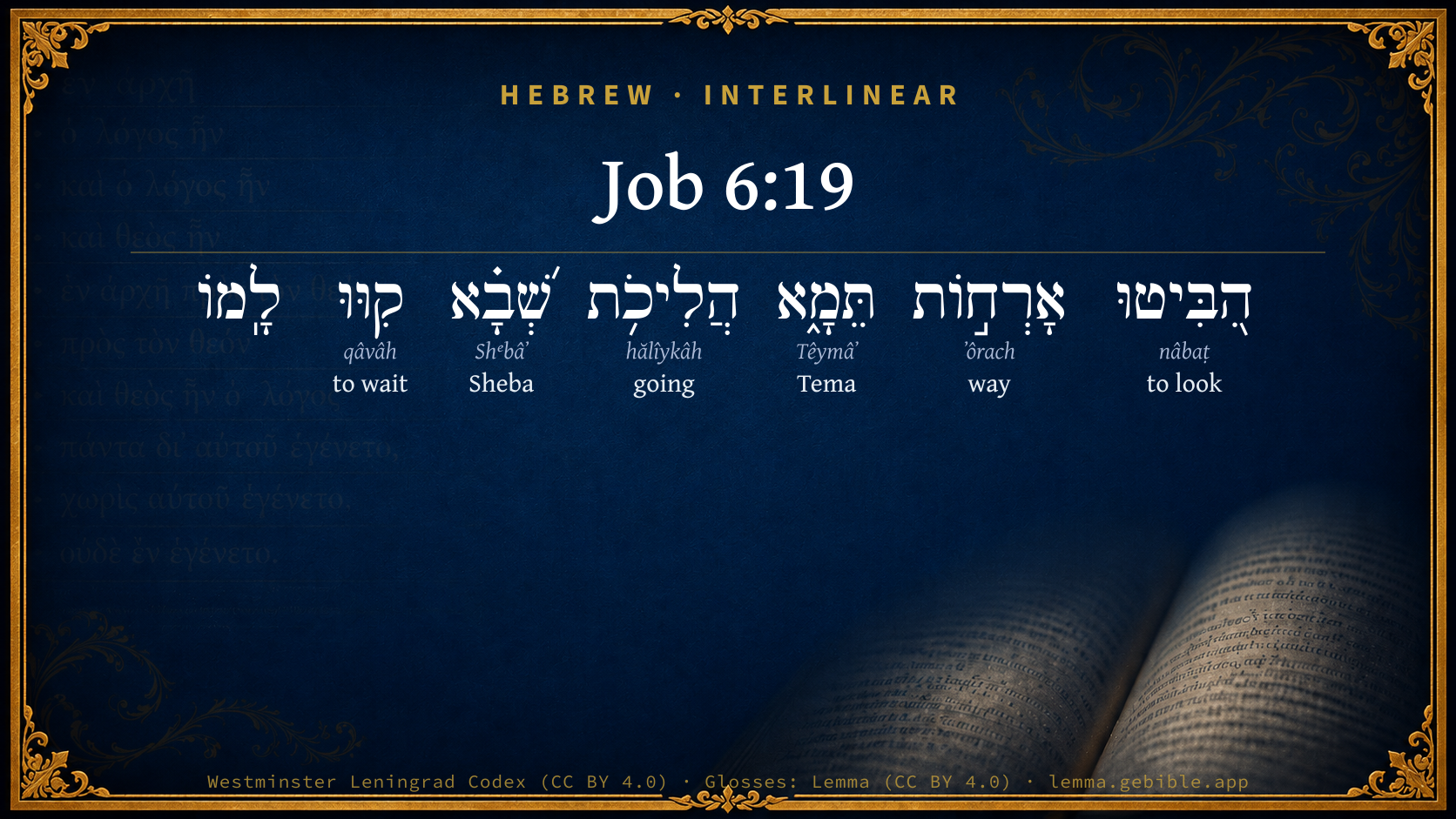
Hebrew (Westminster Leningrad Codex) Job 6:19 appears in the Hebrew Old Testament. The text above is from the Westminster Leningrad Codex. Each word links to its Strong’s number, a concise gloss, and parsing drawn from the Open Scriptures Hebrew Bible morphology. Click any word for its full Brown-Driver-Briggs (BDB) entry.
Download image
Cite this verse

Job 6:19 (World English Bible). Public Domain. Lemma interlinear Bible study tool, https://lemma.gebible.app/v/job/6/19.

Show BibTeX & RIS
BibTeX
RIS
English Translation
The caravans of Tema looked, The companies of Sheba waited for them.
World English Bible · Public Domain
Highlights
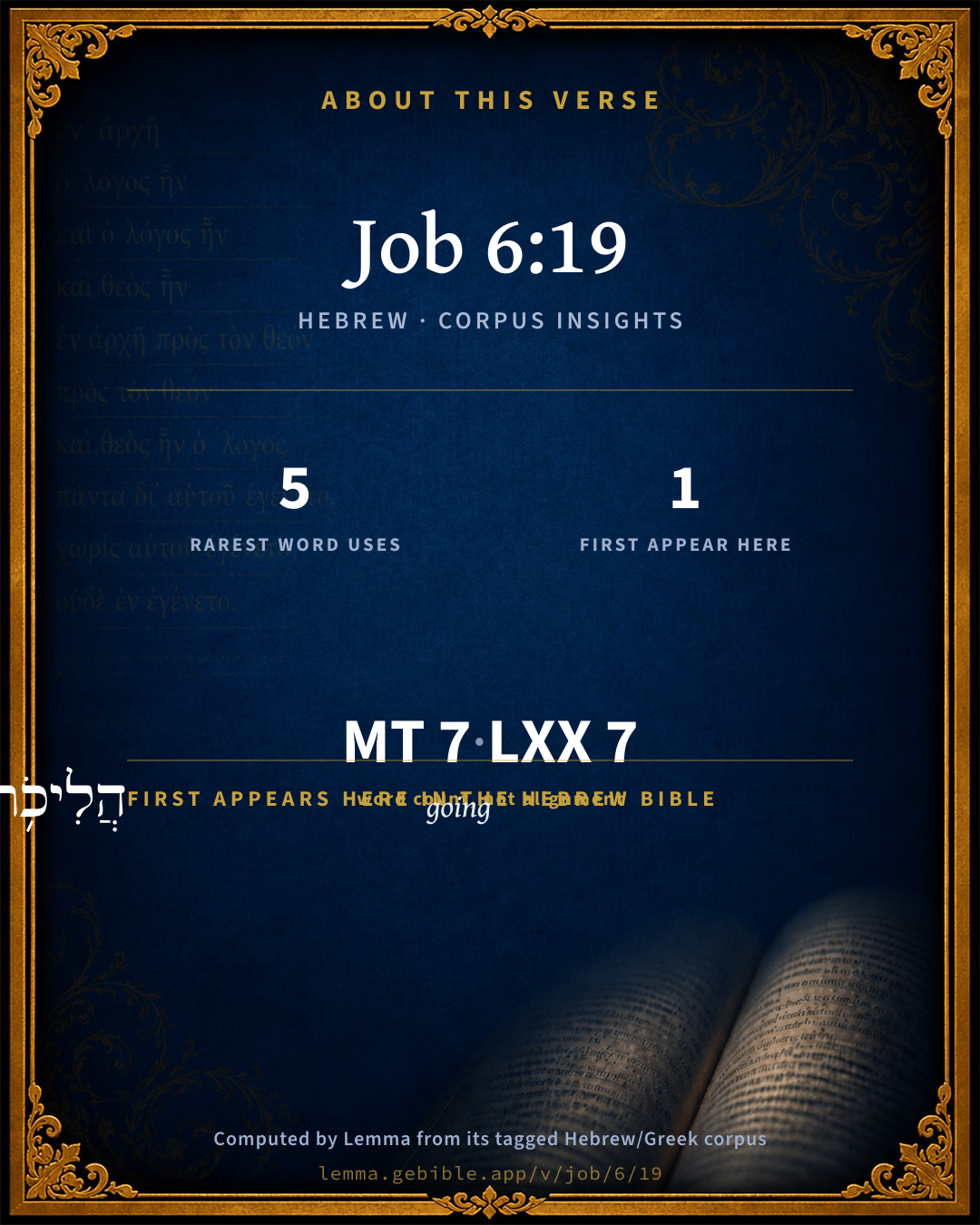
  • 1 first appearance in the Hebrew Bible
Full analysis ↓
Download a study sheet

One document with this verse’s original text, its word-by-word gloss line, the meaning frame, cross-references with their text, attributed commentary, and full source and license credits — printable, and it pastes into notes with its structure intact.

This verse Autodidact and up

Study sheet (.html) Plain text (.txt)

A passage Seminary Student

Up to 50 verses in one chapter. A passage sheet keeps up to 6 commentary sources and 12 cross-references per verse, in the order this page ranks them, and says so on the sheet whenever that leaves anything out. Ask for a single verse and you get the Autodidact verse sheet above.

Everything on this page stays free to read, with no account — the sheet is a download of what is already on screen, not access to it.

Want to remove ads? Support Godless Engineer
Compare translations 3

The same verse in 3 English versions, stacked beneath the original-language interlinear above. Click any original word for its lexicon entry.

Each is an independent rendering of the whole verse — the interlinear is not word-aligned to these translations.

Highlighted words mark where these versions differ — a whole-verse word diff, not a word-by-word alignment.

  • World English Bible Public Domain
    The caravans of Tema looked, The companies of Sheba waited for them.
  • King James Version Public Domain
    The troops of Tema looked, the companies of Sheba waited for them.
  • unfoldingWord Literal Text CC BY-SA 4.0
    Caravans from Tema looked; processions of Sheba hoped in them.

unfoldingWord Literal Text — © unfoldingWord, licensed CC BY-SA 4.0. Word-aligned USFM3 via Door43 (git.door43.org/unfoldingWord/en_ult).

Versions to compare (up to 4)

3 of 4 selected

Show all 18 translations

Every available English version of this verse, each an independent rendering of the whole verse.

  • World English Bible Public Domain
    The caravans of Tema looked, The companies of Sheba waited for them.
  • Berean Standard Bible Public Domain
    The caravans of Tema look for water; the travelers of Sheba hope to find it.
  • Majority Standard Bible Public Domain
    The caravans of Tema look for water; the travelers of Sheba hope to find it.
  • King James Version Public Domain
    The troops of Tema looked, the companies of Sheba waited for them.
  • American Standard Version (1901) Public Domain
    The caravans of Tema looked, The companies of Sheba waited for them.
  • Revised Version (1885) Public Domain
    The caravans of Tema looked, the companies of Sheba waited for them.
  • Geneva Bible (1599) Public Domain
    They that go to Tema, considered them, and they that goe to Sheba, waited for them.
  • Douay-Rheims (1899) Public Domain
    Consider the paths of Thema, the ways of Saba, and wait a little while.
  • Young's Literal Translation Public Domain
    Passengers of Tema looked expectingly, Travellers of Sheba hoped for them.
  • Literal Standard Version CC BY-SA 4.0
    Passengers of Tema looked expectingly, || Travelers of Sheba hoped for them.
  • Unlocked Literal Bible CC BY-SA 4.0
    Caravans from Tema looked there, while companies of Sheba hoped in them.
  • unfoldingWord Literal Text CC BY-SA 4.0
    Caravans from Tema looked; processions of Sheba hoped in them.
  • Darby Bible Public Domain
    The caravans of Tema looked, the companies of Sheba counted on them:
  • World Messianic Bible Public Domain
    The caravans of Tema looked. The companies of Sheba waited for them.
  • Webster's Bible Public Domain
    The troops of Tema looked, the companies of Sheba waited for them.
  • Free Bible Version CC BY-SA 4.0
    Caravans from Tema looked, travelers from Sheba were confident,
  • Bible in Basic English Public Domain
    The camel-trains of Tema were searching with care, the bands of Sheba were waiting for them:
  • JPS Tanakh (1917) Public Domain
    The caravans of Tema looked, the companies of Sheba waited for them —

Literal Standard Version (2020), Covenant Press — licensed CC BY-SA 4.0. Text via the HelloAO Bible API (eBible.org). Unlocked Literal Bible (unfoldingWord) — licensed CC BY-SA 4.0. Text via the HelloAO Bible API (eBible.org). unfoldingWord Literal Text — © unfoldingWord, licensed CC BY-SA 4.0. Word-aligned USFM3 via Door43 (git.door43.org/unfoldingWord/en_ult). Free Bible Version, Dr. Jonathan Gallagher — licensed CC BY-SA 4.0. Text via the HelloAO Bible API (eBible.org).

Word by word

More ways to search: Search by grammar → Find every occurrence → Compare this word →

Practice this passage: Drill this verse → Learn its vocabulary →

About this verse

These counts appear in no published source. They are computed here, from the morphology-tagged text and Lemma’s own curated glosses. What Lemma adds →

7
words
6
distinct lemmas
Wisdom
section

Notable vocabulary

The rarest word here is תֵּמָ֑א Tema H8485 — appearing just 5 times in the whole Hebrew Bible.

First appearance in Scripture

This word makes its first canonical appearance in the Hebrew Bible here:

  • הֲלִיכֹ֥ת going H1979

Shared distinctive vocabulary

תֵּמָ֑א Tema H8485 occurs in 5 verses of the Hebrew Bible. Also found in:

Grammatical profile

  • 2 verbs
  • 4 nouns
  • 1 preposition

Verb forms

  • הִ֭בִּיטוּ Hiphil · Perfect
  • קִוּוּ Piel · Perfect

Hebrew & Septuagint length

In English translation the verse runs 12 words from the Hebrew and 14 from the Septuagint (LXX English) — closely comparable.

A rough comparison of the two English renderings, which tokenize alike — not a word-level alignment.

Word counts can differ between the Hebrew and the Greek without any difference in meaning — e.g. the Hebrew direct-object marker אֵת has no separate Greek word, and Greek often adds the article ὁ.

In the original languages it is 7 Hebrew tokens and 7 Greek tokens — but the two are counted differently (Hebrew bundles its prefixes and suffixes into one token; the Greek is in lemma form), so that isn’t a like-for-like length.

Cross-references

8

Topical passages linked to Job 6:19 in the Treasury of Scripture Knowledge — connected by theme and wording, ordered by reader-vote popularity; previews shown in the World English Bible.

  • Genesis 25:15 Hadad, Tema, Jetur, Naphish, and Kedemah.
  • Isaiah 21:14 To him who was thirsty they brought water; the inhabitants of the land of Tema did meet the fugitives with their bread.
  • Jeremiah 25:23 Dedan, and Tema, and Buz, and all who have the corners [of their hair] cut off;
  • 1 Kings 10:1 When the queen of Sheba heard of the fame of Solomon concerning the name of Yahweh, she came to prove him with hard questions.
  • Genesis 10:7 The sons of Cush: Seba, Havilah, Sabtah, Raamah, and Sabteca. The sons of Raamah: Sheba and Dedan.
  • Genesis 25:3 Jokshan became the father of Sheba, and Dedan. The sons of Dedan were Asshurim, Letushim, and Leummim.
  • Psalms 72:10 The kings of Tarshish and of the isles will bring tribute. The kings of Sheba and Seba shall offer gifts.
  • Ezekiel 27:22–23 The traffickers of Sheba and Raamah, they were your traffickers; they traded for your wares with the chief of all spices, and with all precious stones, and gold.

Cross-references courtesy of OpenBible.info (CC BY 4.0).

Hebrew and Greek witnesses Masoretic Hebrew ↔ Greek Septuagint

The same verse in the two great witnesses to the Old Testament, shown verse-for-verse.

These are two independent witnesses, not word-aligned to each other, and the Septuagint is shown in lemma (dictionary) form.

Hebrew Job 6:19 Masoretic · Westminster Leningrad Codex

הִ֭בִּיטוּ אָרְח֣וֹת תֵּמָ֑א הֲלִיכֹ֥ת שְׁ֝בָ֗א קִוּוּ לָֽמוֹ

The caravans of Tema looked, The companies of Sheba waited for them.

World English Bible · Public Domain

Greek LXX Job 6:19 Septuagint · lemma form

ὁράω ὁδός θαιμάν ἀτραπός σαβαι ὁ διαὁράω

Behold the ways of the Thaemanites, you⌃ that mark the paths of the Sabaeans.

LXX2012 (modern English Septuagint) · Public Domain

Hebrew: Westminster Leningrad Codex (CC BY 4.0). Greek: Septuagint (public domain); English from LXX2012 (modern English Septuagint) (Public Domain). How the Septuagint differs from the Hebrew →

Commentary

Notes on Job 6:19 from classic Christian and Jewish commentators (each source and its license shown beneath its notes). The classic Christian expositions comment on the surrounding passage and are grouped to its opening verse, so a note may address several verses; the Jewish commentaries on the Tanakh (Rashi and others) are per-verse, so they appear only where the commentator wrote on this verse.

Lemma curates 59 commentaries, every one of them public domain or Creative Commons licensed, each selected and text-cleaned for this edition rather than reprinted as found. About our sources →

Jamieson, Fausset & Brown

Robert Jamieson, A. R. Fausset & David Brown

the troops--that is, "caravans."

Tema--north of Arabia-Deserta, near the Syrian desert; called from Tema son of Ishmael (Gen 25:15; Isa 21:14; Jer 25:23), still so called by the Arabs. Job 6:19-20 give another picture of the mortification of disappointed hopes, namely, those of the caravans on the direct road, anxiously awaiting the return of their companions from the distant valley. The mention of the locality whence the caravans came gives living reality to the picture.

Sheba--refers here not to the marauders in North Arabia-Deserta (Job 1:15), but to the merchants (Eze 27:22) in the south, in Arabia-Felix or Yemen, "afar off" (Jer 6:20; Mat 12:42; Gen 10:28). Caravans are first mentioned in Gen 37:25; men needed to travel thus in companies across the desert, for defense against the roving robbers and for mutual accommodation.

The companies . . . waited for them--cannot refer to the caravans who had gone in quest of the waters; for Job 6:18 describes their utter destruction.

Jamieson, Fausset & Brown — Commentary Critical and Explanatory on the Whole Bible (1871) — public domain (CC PDM 1.0). Text via the HelloAO Bible API.

Ellicott's Commentary for English Readers

(19) The troops of Tema.—Fürst says of Tema that it was a tract in the north of the Arabian Desert, on the borders of the Syrian one, where traffic was carried on from the Persian Gulf to the Mediterranean by caravans (Isa_21:14; Jer_25:23; Job_6:19). Sheba, as understood here, was probably a district on the Arabian Gulf (see Job_1:15), where merchants trafficked with the distant cities of the East, as well as enriched themselves with the plunder of their neighbours, as in Job_1:15.

A Bible Commentary for English Readers, edited by Charles John Ellicott (1878–1897) — public domain. Text from a community e-Sword module.

Trapp's Complete Commentary

John Trapp

Job 6:19 The troops of Tema looked, the companies of Sheba waited for them.

Ver. 19. The troops of Tema looked, the companies of Sheba waited for them] The troops, that is, the travellers, the caravan or company of merchants from those parts, passing through dangerous and dry deserts, expected relief from those brooks which they had marked out for themselves against summer; but with what success?

John Trapp, A Commentary or Exposition upon All the Books of the Old and New Testament (1647–1656) — public domain. Text from a community e-Sword module.

Joseph Benson's Commentary

Job 6:19. The troops of Tema looked — This place and Sheba were both parts of the hot and dry country of Arabia; in which waters were very scarce, and therefore precious and desirable, especially to travellers. The word ארחות, orchoth, signifies companies of travellers or merchants, such as that mentioned Gen 37:25, A company of the Ishmaelites came from Gilead, with their camels, &c., or those spoken of Isa 21:13-14, In the forest of Arabia shall ye lodge, O ye travelling companies. The inhabitants of Tema brought water, &c. The Hebrew word, however, properly means ways, or roads; but is here put for travellers in the ways, by a common metonymy. The companies of Sheba waited for them — The Scenitæ, who lived in tents, may here be included, as well as the troops before mentioned, for they removed with their cattle from one place to another for the convenience of pasture and water. It must be observed, men did not there travel singly as we do, but in companies, for their security against wild beasts and robbers. “By a very slight alteration in the pointing, Mr. Heath so translates this verse as to introduce the speaker using a prosopopœia, or addressing himself to the travellers: Look for them, ye troops of Tema, ye travellers of Sheba, expect them earnestly. This gives great life to the poetry, and sets a very beautiful image before the eye: the travellers wasting their time, depending on those torrents for water; but, when they come hither, how great the disappointment!” — Dodd.

Joseph Benson's Commentary on the Old and New Testaments (1811–1818) — public domain. Text from a community e-Sword module.

Tyndale Open Study Notes

Tyndale Open Resources

6:19 The city of Tema in the northern Arabian desert was at the junction of roads from Damascus to Mecca and from the Persian Gulf to Aqaba (Isa 21:14; Jer 25:23). It might have been named after one of Ishmael’s descendants (Gen 25:15). It was not the same as Teman, Eliphaz’s home in Edom. • Sheba, located in southwest Arabia, was a market city for precious commodities (Ps 72:10, 15; Isa 60:6; Jer 6:20; Ezek 27:22-23; 38:13).

Tyndale Open Study Notes — © Tyndale Open Resources, licensed CC BY-SA 4.0. Text via the HelloAO Bible API.

Geneva Bible (1599)

Geneva Bible translators

They that pass thereby to go into the hot countries of Arabia, think to find water there to quench their thirst, but they are deceived.

Geneva Bible (1599) marginal notes — public domain. Text via Bolls.life.

Adam Clarke's Commentary

Verse 19. The troops of Tema looked] The caravans coming from Tema are represented as arriving at those places where it was well known torrents did descend from the mountains, and they were full of expectation that here they could not only slake their thirst, but fill their girbas or water-skins; but when they arrive, they find the waters totally dissipated and lost. In vain did the caravans of Sheba wait for them; they did not reappear: and they were confounded, because they had hoped to find here refreshment and rest.

Adam Clarke's Commentary on the Bible (1810–1826) — public domain. Text from a community e-Sword/MySword module.

The Cambridge Bible for Schools and Colleges

gen. ed. J. J. S. Perowne

19. Tema lies in the northern highlands of Arabia, towards the Syrian desert, Isa_21:14; Jer_25:33. On Sheba see Job_1:15.

The Cambridge Bible for Schools and Colleges (gen. ed. J. J. S. Perowne; Cambridge University Press, 1878–1918) — public domain. Text from a community e-Sword module.

John Gill's Exposition

And they were confounded because they had hoped,.... When they came to the places where they hoped to find water, finding none were ashamed of their vain hope, and reflected upon themselves for being so foolish as to raise their expectations upon such a groundless surmise:

they came thither, and were ashamed; which is the same thing expressed in different words; and aptly enough describes Job's disappointment in not meeting with that relief and comfort he expected from his friends, to whom he makes application of all this in the following words.

John Gill's Exposition of the Whole Bible (1746–1763) — public domain (CC PDM 1.0). Text via the HelloAO Bible API.

Albert Barnes' Notes on the Bible

The troops of Tema looked - That is, looked for the streams of water. On the situation of Tema, see Notes, Job 2:11. This was the country of Eliphaz, and the image would be well understood by him. The figure is one of exquisite beauty. It means that the caravans from Tema, in journeying through the desert, looked for those streams. They came with an expectation of finding the means of allaying their thirst. When they came there they were disappointed, for the waters had disappeared. Reiske, however, renders this, “Their tracks (the branchings of the flood) tend toward Tema;” - a translation which the Hebrew will bear, but the usual version is more correct, and is more elegant.

The companies of Sheba waited for them - The “Sheba” here referred to was probably in the southern part of Arabia; see the notes at Isa 45:14. The idea is, that the caravans from that part of Arabia came and looked for a supply of water, and were disappointed.

Albert Barnes' Notes on the Bible (1834–1885) — public domain. Text from a community e-Sword/MySword module.

Haydock's Catholic Bible Commentary

While. Till the torrents subside, when the caravans from these towns of Arabia may pass on. Job may also address his friends, (Calmet) and bid them consider how few had taken any notice of him. (Menochius) --- Protestants, "the troops of Tema looked, the companies of Sheba waited for them."

George Leo Haydock (1774–1849), Haydock's Catholic Family Bible and Commentary, 1859 edition — public domain. Excludes Psalms (Douay-Rheims chapter numbering differs from Protestant) and Deuterocanonical books (Catholic canon only).

Matthew Poole's English Annotations

The troops, as this word is used, Gen 37:25; Isa 21:13. Heb. the ways, put for the travellers in the ways, by a usual metonymy. And so it must needs be meant here, and in the next clause, because the following verse, They were confounded, &c., plainly showeth that he here speaks of persons, not of senseless things. Tema: this place and

Sheba were both parts of the hot and dry country of Arabia, in which waters were very scarce, and therefore precious and desirable, especially to travellers, who by their motion, and the heat to which they were exposed, were more hot and thirsty than other men.

The companies; as before, the troops. And thus he speaks, because men did not there travel singly, as here we do, but in troops and companies, for their greater security against wild beasts and robbers, of which they had great store.

Matthew Poole's English Annotations on the Holy Bible (1683–1685) — public domain. Text from a community e-Sword/MySword module.

Whedon's Commentary on the Bible

Daniel D. Whedon

19. Troops of Tema — The caravans of Tema. Job now enlarges, according to Oriental usage, upon the thought of the preceding verse, and specifies the mighty caravans of Tema and Sheba. In very remote ages caravan routes lay through Idumaea. Umbreit improperly makes these troops a part of the caravans referred to in Job_6:18, who had gone on and perished. “These,” he says, “await their return and blush over their disappointment.” This is altogether too tame. Tema was the ninth of the sons of Ishmael. (Gen_25:15.) The tribe that bore his name probably resided not far from Idumaea. The prophets speak of a Tema in connexion with Arabia and her kings; Isa_21:14, and Jer_25:23. The Arabs still give the name Taima to a region in the north of Arabia-Deserta, on the borders of Syria. The town Taima lies on the route of the Damascus caravan. It is interesting to remember that it was a company of Ishmaelites that bought Joseph of his brethren and carried him down into Egypt. For Sheba see note on Job_1:15. Job probably alluded to some well-known destruction of a caravan that had failed to find a supply of water at the appointed place.

Daniel D. Whedon (gen. ed.), Commentary on the Old and New Testaments (1874–1909) — public domain. Text from a community e-Sword module.

The Pulpit Commentary

The troops of Tema looked. The Tema were an Arab tribe descended from Ishmael. (Gen_25:15) They are generally conjoined with Dedan, (Isa_21:13, 14 Jer_25:23) another Arab tribe, noted for carrying on a caravan trade. Both tribes probably wandered, and occupied at different periods different portions of the desert. The name, Tema, may linger in the modern city and district of Tayma"on the confines of Syria, and upon the pilgrim-route between Damascus and Mecca. The "troops of Tema" probably looked for the "caravans" of ver. 18 to arrive in their country; but they looked in vain. The desert had swallowed them up. The companies of Sheba waited for them. (On "Sheba," see the comment upon Job_1:15)

The Pulpit Commentary (1880–1919), ed. H.D.M. Spence-Jones & Joseph S. Exell — public domain. Text from a community e-Sword module.

John Wesley's Explanatory Notes

Tema - This place and Sheba were both parts of the hot and dry country of Arabia, in which waters were very scarce, and therefore precious and desirable, especially to travelers. Companies - Men did not there travel singly, as we do, but in companies for their security against wild beasts and robbers.

John Wesley, Explanatory Notes Upon the Whole Bible (1754–1765) — public domain. Text via the GEBible commentary corpus.

Rashi

Rabbi Shlomo Yitzchaki (Rashi)

They look at the paths of Tema The land of Ishmael, which is low, and the water flows there.

they make a line Heb. קוו, an expression of an extended line. Another explanation: it is an expression of (Gen. 1:9) “Let the waters...gather (יקוו).”

Rashi on the Tanakh — English translations: “The Judaica Press complete Tanach with Rashi, translated by A. J. Rosenberg” (CC BY 4.0); “Pentateuch with Rashi's commentary by M. Rosenbaum and A.M. Silbermann, 1929-1934” (public domain); “The Metsudah Tanach series, Lakewood, N.J” (CC BY 4.0); and “The Book of Joshua, Metsudah Publications, 1997” (CC BY 4.0). Text via Sefaria.

Lesson kit

Teaching starters — assembled from the data on this page, not authored interpretation. Every prompt links to the verse data it draws on. Edit before teaching.

Job, in the Wisdom, opens this verse with 7 words (6 distinct Hebrew lemmas). Its most distinctive word is Têymâʼ (“Tema”). A historical commentator’s framing appears above. Read the whole chapter for the surrounding context.

Discussion questions

  1. How does “Tema” (Têymâʼ) shape what this verse is saying?
  2. This is the first place “going” appears in Scripture (first appears here). What does its debut here establish?
  3. How does Genesis 25:15, which shares the word «Tema», read alongside this verse?
  4. These translations render this verse differently; the difference is in the English rendering, not the original. What questions does that raise?
  5. «הִ֭בִּיטוּ» is a Hiphil Perfect verb. How does that grammatical form shape the action described?
  6. Compare how Jamieson, Fausset & Brown and Ellicott's Commentary for English Readers read this verse. Where do they agree or differ?

Things to notice

Reading settings

Reading text

Shown beneath each verse's original-language words.

Old Testament
Old Testament edition

Read the OT as the Masoretic Hebrew (MT) or the Greek Septuagint (LXX).

English shown for the Greek Septuagint (in the Hebrew ↔ Greek comparison).

Comparing translations? Open the Compare panel on any verse page to stack up to four side by side.