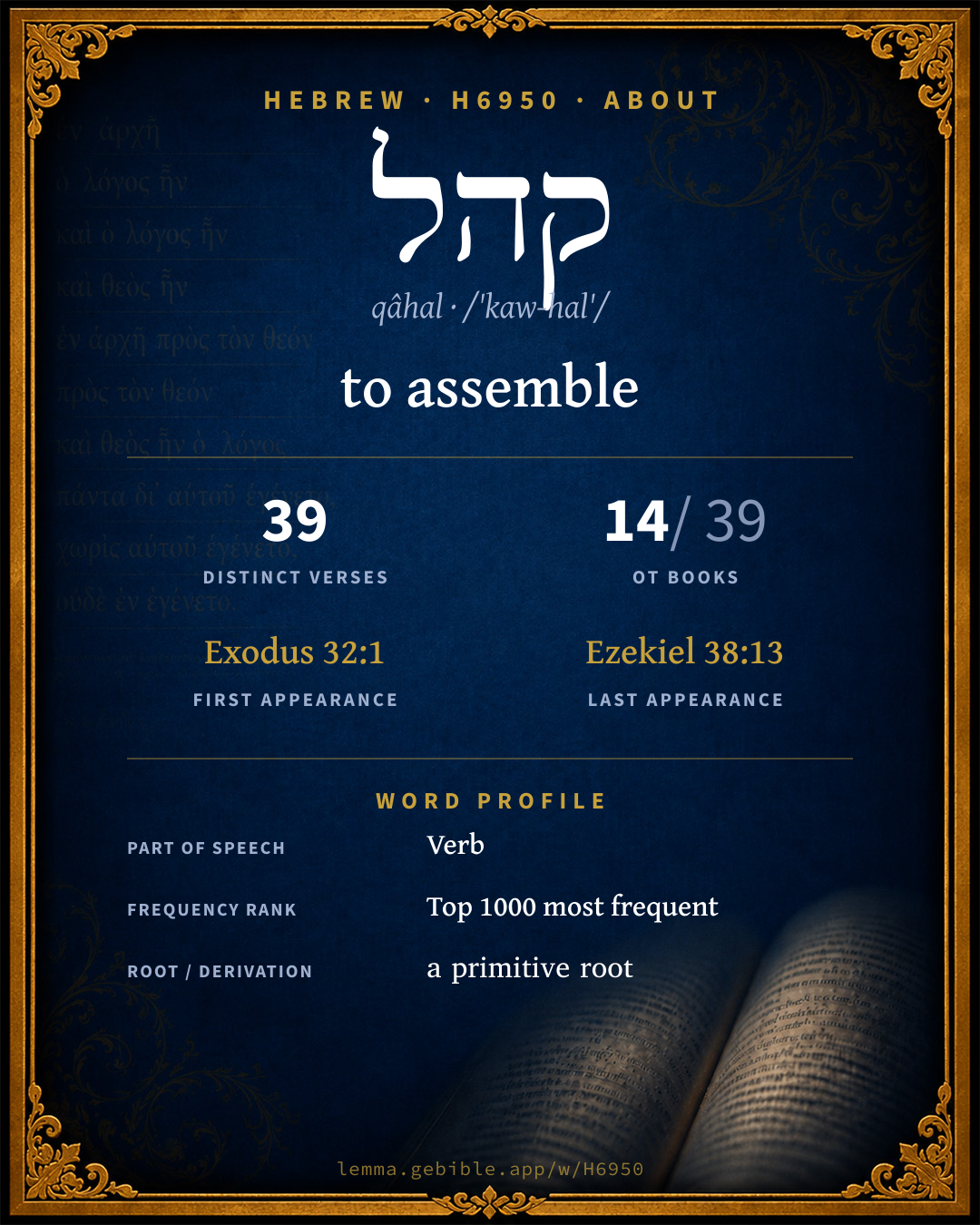
קָהַל
to assemble
‘to assemble’ is one of 3 main senses fuller range ↓
Full lexicon entry — Brown-Driver-Briggs (BDB)
From Brown-Driver-Briggs (BDB)
Where this word appears
See every Hiphil verb in the Hebrew Bible →
Grammar key — what these labels mean
Part of speech
- Verb
- An action or state-of-being word.
Stem
- Niphal
- Usually the simple passive or reflexive of the Qal (“he was written”).
- Hiphil
- The causative active stem (“he caused / brought about”).
Form
- Sequential Imperfect
- An imperfect with prefixed waw — the standard past-narrative form (waw-consecutive imperfect).
- Perfect
- A completed action or state — Hebrew marks aspect (completeness) more than strict tense (“he wrote”).
- Imperative
- A direct command (“write!”).
- Infinitive Construct
- A bound verbal noun, frequently with prepositions (“to write / in writing”).
- Imperfect
- An incomplete, ongoing, or future action (“he will / would write”).
- Sequential Perfect
- A perfect with prefixed waw continuing a preceding imperfect or command (waw-consecutive perfect).
- Participle Passive
- A verbal adjective expressing action received (“written”).
- Jussive
- A third- or second-person volitional form expressing wish or command (“let him write”).
State
- Absolute
- The independent form of a noun, not bound to a following word.
Person
- 3rd Person
- The one spoken about (“he / she / it / they”).
- 2nd Person
- The one addressed (“you”).
Gender
- Masculine
- Grammatically masculine.
- Common
- Either gender — not distinguished for this form.
- Feminine
- Grammatically feminine.
Number
- Plural
- More than one (in Hebrew, generally three or more).
- Singular
- One.
20 distinct verses where H6950 appears in the Hiphil stem, across 9 books. Filtered view — show all forms. Click any verse to open its interlinear word-by-word view. Verse text shown in the World English Bible for context — . Each verse’s Hebrew form is shown with its reference; the English is not keyword-highlighted, since the data carries no word-level English alignment. Use “Compare translations” on any verse to read it across multiple English versions. This concordance covers the Hebrew Bible; Septuagint (Greek Old Testament) occurrences are not indexed here.
Exodus 1 verse
Leviticus 1 verse
Numbers 6 verses
- Numbers 1:18 הִקְהִ֗ילוּ Hiphil pf 3cp They assembled all the congregation together on the first day of the second month; and they declared their ancestry by their families, by their fathers' houses, according to the number of the names, from twenty years old and upward, one by one.
- Numbers 8:9 וְ/הִ֨קְהַלְתָּ֔ conj + Hiphil wpf 2ms You shall present the Levites before the Tent of Meeting. You shall assemble the whole congregation of the children of Israel.
- Numbers 10:7 וּ/בְ/הַקְהִ֖יל conj + prep + Hiphil inf.cs But when the assembly is to be gathered together, you shall blow, but you shall not sound an alarm.
- Numbers 16:19 וַ/יַּקְהֵ֨ל conj + Hiphil wimpf 3ms Korah assembled all the congregation against them to the door of the tent of meeting: and the glory of Yahweh appeared to all the congregation.
- Numbers 20:8 וְ/הַקְהֵ֤ל conj + Hiphil impv 2ms Take the rod, and assemble the congregation, you, and Aaron your brother, and speak you to the rock before their eyes, that it give forth its water; and you shall bring forth to them water out of the rock; so you shall give the congregation and their cattle drink.
- Numbers 20:10 וַ/יַּקְהִ֜לוּ conj + Hiphil wimpf 3mp Moses and Aaron gathered the assembly together before the rock, and he said to them, Hear now, you rebels; shall we bring you forth water out of this rock?
Deuteronomy 3 verses
- Deuteronomy 4:10 הַקְהֶל Hiphil impv 2ms the day that you stood before Yahweh your God in Horeb, when Yahweh said to me, Assemble me the people, and I will make them hear my words, that they may learn to fear me all the days that they live on the earth, and that they may teach their children.
- Deuteronomy 31:12 הַקְהֵ֣ל Hiphil impv 2ms Assemble the people, the men and the women and the little ones, and your foreigner who is within your gates, that they may hear, and that they may learn, and fear Yahweh your God, and observe to do all the words of this law;
- Deuteronomy 31:28 הַקְהִ֧ילוּ Hiphil impv 2mp Assemble to me all the elders of your tribes, and your officers, that I may speak these words in their ears, and call heaven and earth to witness against them.
1 Kings 2 verses
- 1 Kings 8:1 יַקְהֵ֣ל Hiphil juss 3ms Then Solomon assembled the elders of Israel, and all the heads of the tribes, the princes of the fathers' [houses] of the children of Israel, to king Solomon in Jerusalem, to bring up the ark of the covenant of Yahweh out of the city of David, which is Zion.
- 1 Kings 12:21 וַ/יַּקְהֵל֩ conj + Hiphil wimpf 3ms When Rehoboam was come to Jerusalem, he assembled all the house of Judah, and the tribe of Benjamin, a hundred and eighty thousand chosen men, who were warriors, to fight against the house of Israel, to bring the kingdom again to Rehoboam the son of Solomon.
1 Chronicles 3 verses
- 1 Chronicles 13:5 וַ/יַּקְהֵ֤ל conj + Hiphil wimpf 3ms So David assembled all Israel together, from the Shihor [the brook] of Egypt even to the entrance of Hamath, to bring the ark of God from Kiriath Jearim.
- 1 Chronicles 15:3 וַ/יַּקְהֵ֥ל conj + Hiphil wimpf 3ms David assembled all Israel at Jerusalem, to bring up the ark of Yahweh to its place, which he had prepared for it.
- 1 Chronicles 28:1 וַ/יַּקְהֵ֣ל conj + Hiphil wimpf 3ms David assembled all the princes of Israel, the princes of the tribes, and the captains of the companies who served the king by division, and the captains of thousands, and the captains of hundreds, and the rulers over all the substance and possessions of the king and of his sons, with the officers, and the mighty men, even all the mighty men of valor, to Jerusalem.
2 Chronicles 2 verses
- 2 Chronicles 5:2 יַקְהֵ֨יל Hiphil impf 3ms Then Solomon assembled the elders of Israel, and all the heads of the tribes, the princes of the fathers' [houses] of the children of Israel, to Jerusalem, to bring up the ark of the covenant of Yahweh out of the city of David, which is Zion.
- 2 Chronicles 11:1 וַ/יַּקְהֵל֩ conj + Hiphil wimpf 3ms When Rehoboam was come to Jerusalem, he assembled the house of Judah and Benjamin, one hundred eighty thousand chosen men, who were warriors, to fight against Israel, to bring the kingdom again to Rehoboam.
Job 1 verse
Ezekiel 1 verse
About this entry
At a glance — auto-summarized from this page’s data, not written by a person. Every figure links to its source below. This summary describes the numbers; it doesn’t interpret them.
קהל — transliterated qâhal — is a Hebrew verb carrying the sense “to assemble.” Debuting at Exodus 32:1, it then recurs through the corpus. Spanning 39 verses in 14 books, it ranks among the moderately common words of the Hebrew Bible. Its lexical range runs to 3 senses. From the same root come מקהל, קהל and קהלה. See the sense tree, 39-verse concordance, and the renderings breakdown below.
Gloss history
Strong's 1890 vs modern scholarship
About this word
Strong's H6950 catalogs a Hebrew word from the Hebrew Old Testament.
These counts are not copied from any lexicon or concordance. They are computed here, from the morphology-tagged Hebrew Old Testament. What Lemma adds →
- 39
- distinct verses
- The word appears in 39 distinct verses.
- 14 / 39
- OT books
- The word appears in 14 of 39 Old Testament books.
- #922
- by frequency
- Top 1000 most frequent Hebrew words (rank 922 of 8,640 Hebrew words by occurrence).
View all 39 occurrences in the concordance →
Most concentrated in
- Numbers 9 verses 23%
- Esther 5 verses 13%
- 2 Chronicles 4 verses 10%
By section of the Old Testament
By traditional corpus
Conventional, traditional groupings — biblical authorship is debated, so this is a traditional corpus grouping, not an authorship claim. Each share is this word’s portion of its verses in that division of the Hebrew canon. Each figure is a share of the word’s 39 distinct verses.
- Torah (Pentateuch) 16 verses · 41%
- Writings (Ketuvim) 13 verses · 33%
- Prophets (Nevi'im) 10 verses · 26%
How translations render this word
Counts come from each version’s own published word-to-Strong’s tagging or interlinear alignment — an approximate guide to how each version renders this word, not a word-level alignment the data otherwise carries. Because each total is that version’s own tagged count, the per-version totals vary from one another and need not match the appearance or distinct-verse counts above. These counts may also differ from a printed concordance because Lemma counts each distinctly tagged rendering and does not collapse phrase taggings into a single head-word total. This is a fixed set of word-tagged versions (KJV, ASV, BSB, ULT) and does not change with the reading translation you choose elsewhere. Each version’s license is shown beside its name below (and on Sources).
- King James Version: Together 8×, Assembled 5×, Gather 5×
- American Standard Version: Assembled 9×, Gathered themselves together 5×, Assemble 4×
- Berean Standard Bible: Assembled 11×, Assemble 5×, Gathered 5×
- unfoldingWord Literal Text: Assembled 15×, And 13×, Assemble 5×
King James Version Public Domain
Renders H6950 across 47 tagged occurrences — most commonly:
Plus 13 renderings that appear only once — usually multi-word phrases or single function words the recovered tagging swept in, not distinct renderings.
American Standard Version Public Domain
Renders H6950 across 47 tagged occurrences — most commonly:
Plus 18 renderings that appear only once — usually multi-word phrases or single function words the recovered tagging swept in, not distinct renderings.
Berean Standard Bible Public Domain
Renders H6950 across 38 tagged occurrences — most commonly:
Plus 10 renderings that appear only once — usually multi-word phrases or single function words the recovered tagging swept in, not distinct renderings.
unfoldingWord Literal Text CC BY-SA 4.0
Renders H6950 across 55 tagged occurrences — most commonly:
Plus 8 renderings that appear only once — usually multi-word phrases or single function words the recovered tagging swept in, not distinct renderings.
Senses in BDB
The 3 senses BDB distinguishes for this word, in lexicon order (not ranked by frequency or importance). The full entry — with sub-senses — is in the Lexicon Entry tab.
- to assemble, gather
- (Niphal) to assemble
- (Hiphil) to summon an assembly
Word origin
Origin: a primitive root
Jastrow Dictionary
A second Hebrew/Aramaic lexicon for comparison, covering Aramaic and post-biblical (Talmudic, Targumic, Midrashic) usage that the biblical-Hebrew BDB does not. Matched by lemma rather than by Strong’s number, so a lemma may carry more than one Jastrow headword (shown separately below), and the entries cover usage well beyond the Bible.
קָהַל
- to call.
- to assemble. Ber. 61ᵇ; Ab. Zar. 18ᵃ מַקְהִיל קהילות ברבים called public assemblies (to teach). Gen. R. s. 99 כשיַקְהִיל קרח וכ׳ (some ed. כשיַקְהֵל) when Korah will gather his followers for strife, my (Jacob’s) name shall not be joined with them. Yalk. Ex. 408 כדי שילמדו … להַקְהִיל וכ׳ that coming generations may learn from thee to assemble congregations every Sabbath; a. e.
- to be assembled. Gen. R. s. 98 בשעה שהן נִקְהָלִין על וכ׳ when they will be assembled against Moses in the party of Korah &c. Lev. R. s. 24 פרשה … בהִקָּהֵל וכ׳ this section (Lev. XIX) was proclaimed in full assembly (v. ib. 2), because &c. Koh. R. to I, 1, v. קֹהֶלֶת.
- same. Gen. R. s. 99 (ref. to יקהת, Gen. XLIX, 10) מי … מִתְקָהֲלִין עליו he around whom the nations will group themselves.—[Num. R. s. 12 מתקהלא, v. קָהָה.] e.g. Genesis 49:10
קָהָל
- preced.) gathering, congregation. Y. Hor. I, 46ᵃ bot. (ref. to Num. XV, 24, העדה) כל השבטים קרויין ק׳ all tribes together are called ḳahal; כל שבט … ק׳ every tribe for itself is called ḳ.; Bab. Hor. 3ᵃ כגון … רובו של ק׳ וכ׳ when six tribes have sinned, and they form the majority of the congregation (the entire people) &c. Ib. הני הוא דאיקרו ק׳ only they (the entire people) are called ḳ.—Kidd. 73ᵃ קְהַל ודאי a community of Israelites of undoubted legitimacy; קְ׳ ספק of doubtful legitimacy; Y. Yeb. VIII, 9ᵇ bot. קָ׳ ברור; קְ׳ ספק. Ib. [read:] ארבע קְהִילּוֹת אינון קְ׳ יי׳ קְ׳ כהנים וכ׳ four communities are meant by ‘the congregation of the Lord’ (Deut. XXIII, 2; 3; 4; 9): the community of priests, of Levites, of Israelites, and of proselytes. Mish. ib. VIII, 2 ואינן … אלא מלבא בק׳ and they are forbidden only to enter the congregation (to intermarry with Israelites); a. fr.—Pl., v. קְהִלָּה e.g. Numbers 15:24
קָהָל ²
- Targ. Num. XVI, 3. Ib. XX, 4; a. fr.—Kidd. 73ᵃ מחד קהל נפקו ed. (Rashi קהלא) the (laws concerning priests and Levites) are derived from one of the verses (Deut. XXIII, 3; 4; 9) in which ḳahal occurs.—Pl. קַהֲלֵי. Ib. הנהו נמי תרי ק׳ נינהו these (priests and Levites) are also two communities (requiring two verses with the word ḳahal in them); a. e. e.g. Deuteronomy 23:3
A Dictionary of the Targumim, the Talmud Babli and Yerushalmi, and the Midrashic Literature (Marcus Jastrow; London, Luzac, 1903) — Public Domain. Digitized via Sefaria. Digitized via Sefaria. Full attribution on Sources.
Forms in the corpus
The 32 distinct written forms H6950 takes in the Hebrew Bible, most frequent first — each parse links to that stem’s occurrences in the concordance. Hebrew forms include their vowel points and cantillation, so a single lemma takes many written forms.
Same root — word family
Other BDB entries built from the same root as H6950, grouped by Strong’s listed origin. These share a root / origin per the lexicon — not necessarily a shared meaning. Each links to that word’s own entry.
Derived from this word
- מקהל maqhêl H4721 assembly
- קהל qâhâl H6951 assembly
- קהלה qᵉhillâh H6952 congregation
- קהלת qôheleth H6953 preacher
- קלה qâlahh H7035 to assemble
Proper names from this root
People and places named from this root — a name, not an additional meaning of the word.
Compare all same-root words → Showing 4 of 7 — not the complete family. 1 of the same-root words is a proper name (a person or place). They share a root, not necessarily a meaning.
Septuagint verse parallels
This word appears in 38 verses that also exist in the Greek Old Testament (Septuagint), out of the 39 Hebrew verses it occurs in. You can read those verses in Greek by switching the Old Testament edition to the Septuagint.
Read these verses in the Septuagint
- Exodus 32:1
- Leviticus 8:3
- Numbers 1:18
- Deuteronomy 4:10
- Joshua 18:1
- Judges 20:1
- 2 Samuel 20:14
- 1 Kings 8:1
- 1 Chronicles 13:5
- 2 Chronicles 5:2
- Esther 8:11
- Job 11:10
This is a verse-level parallel only — the same verses exist in both the Hebrew and Greek Old Testaments. No word-level Hebrew↔Greek correspondence is claimed: the data carries no such alignment, so no Greek word is shown as this Hebrew word’s translation. Coverage is not total — the Septuagint omits the deuterocanon and renumbers the Psalms, so some Hebrew verses have no direct Greek parallel.