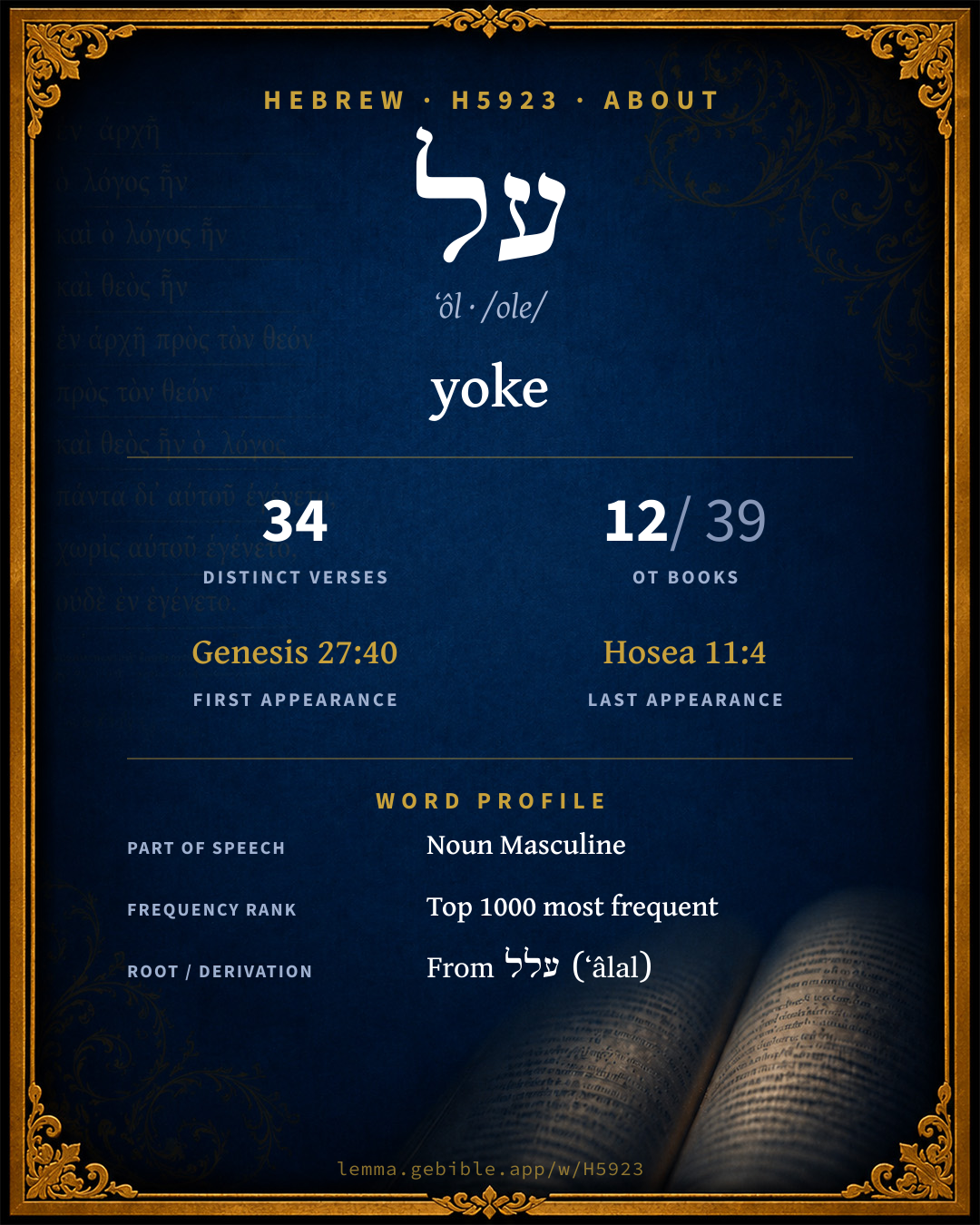
עֹל
yoke
Full lexicon entry — Brown-Driver-Briggs (BDB)
From Brown-Driver-Briggs (BDB)
Where this word appears
See every Construct-state word in the Hebrew Bible →
Grammar key — what these labels mean
Part of speech
- Noun
- A naming word — a person, place, thing, or idea.
Noun type
- Common
- A common noun — a general class of person, place, or thing (“king,” “city,” “water”), not a specific name.
State
- Absolute
- The independent form of a noun, not bound to a following word.
- Construct
- A noun bound to a following noun in a possessive / “of” relationship (the construct chain).
Gender
- Masculine
- Grammatically masculine.
Number
- Singular
- One.
Every verse where H5923 appears in the Book of Jeremiah — 10 distinct verses. Click any verse to open its interlinear word-by-word view. Verse text shown in the World English Bible for context — . Each verse’s Hebrew form is shown with its reference; the English is not keyword-highlighted, since the data carries no word-level English alignment. Use “Compare translations” on any verse to read it across multiple English versions. This concordance covers the Hebrew Bible; Septuagint (Greek Old Testament) occurrences are not indexed here.
Jeremiah
- Jeremiah 2:20 עֻלֵּ֗/ךְ n c ms cs + sfx pers 2fs For of old time I have broken your yoke, and burst your bonds; and you said, I will not serve; for on every high hill and under every green tree you did bow yourself, playing the prostitute.
- Jeremiah 5:5 עֹ֔ל n c ms I will get me to the great men, and will speak to them; for they know the way of Yahweh, and the law of their God. But these with one accord have broken the yoke, and burst the bonds.
- Jeremiah 27:8 בְּ/עֹ֖ל prep + n c ms cs It shall happen, that the nation and the kingdom which will not serve the same Nebuchadnezzar king of Babylon, and that will not put their neck under the yoke of the king of Babylon, that nation will I punish, says Yahweh, with the sword, and with the famine, and with the pestilence, until I have consumed them by his hand.
- Jeremiah 27:11 בְּ/עֹ֥ל prep + n c ms cs But the nation that shall bring their neck under the yoke of the king of Babylon, and serve him, that [nation] will I let remain in their own land, says Yahweh; and they shall till it, and dwell therein.
- Jeremiah 27:12 בְּ/עֹ֣ל prep + n c ms cs I spoke to Zedekiah king of Judah according to all these words, saying, Bring your necks under the yoke of the king of Babylon, and serve him and his people, and live.
- Jeremiah 28:2 עֹ֖ל n c ms cs Thus speaks Yahweh of Hosts, the God of Israel, saying, I have broken the yoke of the king of Babylon.
- Jeremiah 28:4 עֹ֖ל n c ms cs and I will bring again to this place Jeconiah the son of Jehoiakim, king of Judah, with all the captives of Judah, who went to Babylon, says Yahweh; for I will break the yoke of the king of Babylon.
- Jeremiah 28:11 עֹ֣ל n c ms cs Hananiah spoke in the presence of all the people, saying, Thus says Yahweh: Even so will I break the yoke of Nebuchadnezzar king of Babylon within two full years from off the neck of all the nations. The prophet Jeremiah went his way.
- Jeremiah 28:14 עֹ֣ל n c ms cs For thus says Yahweh of Hosts, the God of Israel: I have put a yoke of iron on the neck of all these nations, that they may serve Nebuchadnezzar king of Babylon; and they shall serve him: and I have given him the animals of the field also.
- Jeremiah 30:8 עֻלּ/וֹ֙ n c ms cs + sfx pers 3ms It shall come to pass in that day, says Yahweh of Hosts, that I will break his yoke from off your neck, and will burst your bonds; and strangers shall no more make him their bondservant;
About this entry
At a glance — auto-summarized from this page’s data, not written by a person. Every figure links to its source below. This summary describes the numbers; it doesn’t interpret them.
The Hebrew noun על centers on the idea of “yoke.” Debuting at Genesis 27:40, it then recurs through the corpus. It appears 34 verses across 12 books of the Hebrew Bible, among its moderately common vocabulary. The word gravitates to Jeremiah (29%), then 1 Kings and 2 Chronicles. It shares a root with עלל, מעלל and עליל. For the data behind this summary, explore the sense tree and the renderings breakdown below.
Gloss history
Strong's 1890 vs modern scholarship
About this word
Strong's H5923 catalogs a Hebrew word from the Hebrew Old Testament.
These counts are not copied from any lexicon or concordance. They are computed here, from the morphology-tagged Hebrew Old Testament. What Lemma adds →
- 34
- distinct verses
- The word appears in 34 distinct verses.
- 12 / 39
- OT books
- The word appears in 12 of 39 Old Testament books.
- #909
- by frequency
- Top 1000 most frequent Hebrew words (rank 909 of 8,640 Hebrew words by occurrence).
View all 34 occurrences in the concordance →
Most concentrated in
- Jeremiah 10 verses 29%
- 1 Kings 5 verses 15%
- 2 Chronicles 5 verses 15%
By section of the Old Testament
By traditional corpus
Conventional, traditional groupings — biblical authorship is debated, so this is a traditional corpus grouping, not an authorship claim. Each share is this word’s portion of its verses in that division of the Hebrew canon. Each figure is a share of the word’s 34 distinct verses.
- Prophets (Nevi'im) 22 verses · 65%
- Writings (Ketuvim) 7 verses · 21%
- Torah (Pentateuch) 5 verses · 15%
How translations render this word
Counts come from each version’s own published word-to-Strong’s tagging or interlinear alignment — an approximate guide to how each version renders this word, not a word-level alignment the data otherwise carries. Because each total is that version’s own tagged count, the per-version totals vary from one another and need not match the appearance or distinct-verse counts above. These counts may also differ from a printed concordance because Lemma counts each distinctly tagged rendering and does not collapse phrase taggings into a single head-word total. This is a fixed set of word-tagged versions (KJV, ASV, BSB, ULT) and does not change with the reading translation you choose elsewhere. Each version’s license is shown beside its name below (and on Sources).
BDB lists this Strong’s number as 2 distinct words (homographs). Each count above pools all of them and is not split by sense — see the Senses section below. A low-frequency rendering may belong to a different one of those words, not the primary meaning.
- King James Version†: Yoke 32×, Under the yoke 3×
- American Standard Version†: Yoke 29×, Under the yoke 3×
- Berean Standard Bible†: Yoke 29×, Made our yoke 2×, Under the yoke 2×
- unfoldingWord Literal Text†: Yoke 33×, Yoke of 6×, A 2×
King James Version Public Domain
Renders H5923 across 40† tagged occurrences — most commonly:
Plus 5 renderings that appear only once — usually multi-word phrases or single function words the recovered tagging swept in, not distinct renderings.
American Standard Version Public Domain
Renders H5923 across 40† tagged occurrences — most commonly:
Plus 8 renderings that appear only once — usually multi-word phrases or single function words the recovered tagging swept in, not distinct renderings.
Berean Standard Bible Public Domain
Renders H5923 across 39† tagged occurrences — most commonly:
Plus 6 renderings that appear only once — usually multi-word phrases or single function words the recovered tagging swept in, not distinct renderings. Not rendered by a distinct English word in 1 further occurrence.
unfoldingWord Literal Text CC BY-SA 4.0
Renders H5923 across 44† tagged occurrences — most commonly:
Plus 3 renderings that appear only once — usually multi-word phrases or single function words the recovered tagging swept in, not distinct renderings.
Senses in BDB
The 1 sense BDB distinguishes for this word, in lexicon order (not ranked by frequency or importance). The full entry — with sub-senses — is in the Lexicon Entry tab.
- yoke
Word origin
n.m. 1 K 12:4 yoke;—ע׳ abs. Ho 11:4 +; cstr. Is 9:3 +; sf. עֻלֵּךְ Je 2:20 Is 47:6, עֻלּוֹ Gn 27:40 +, עֻלְּכֶם 1 K 12:11, etc.;—yoke, for cattle, עָלָה עֲלֵיהֶם ע׳ 1 S 6:7, cf. Nu 19:2 (P), מָֽשְׁכָה בְּע׳ Dt 21:3; usually fig. of servitude 1 K 12:4, 10, 11(×2), 14(×2) = 2 Ch 10:4, 10, 11(×2), 14; נָתַן ע׳ עַל 1 K 12:4, 9 = 2 Ch 10:4, 9; וְנָתַן ע׳ בַּרְזֶל עַל־צַוָּארֶ֑ךָ Dt 28:48, so Je 28:14; עַל־זָקֵן הִכְבַּדְתְּ ע׳ Is 47:6; also אֶת־צַוָּארוֹ בְּעֹל (הֵבִיא) נָתַן Je 27:8, 11, 12; שָׁבַר ע׳ break the yoke Je 2:20; 5:5; 28:2, 4, 11; 30:8 (+ מֵעַל צ׳), so מֹטֹת ע׳ Lv 26:13 (H), Ez 34:27 (v. מוֹטָה); פָּרַק ע׳ Gn 27:40 (J; + מֵעַל צ׳); הֵחֵת ע׳ Is 9:3; cf. הֵרִים ע׳ Ho 11:4; also יָסוּר ע׳ מֵעַל צ׳ Is 10:27, and 14:25; fig. of transgressions La 1:14, del. ע׳ 𝔊 𝔙 Löhr Bu, but read עֹל v b (v. id.); of hardship, נָשָׂא ע׳ 3:27.
— Brown-Driver-Briggs (Oxford 1906, public domain), digitized via Sefaria, supplemented by the OpenScriptures HebrewLexicon (CC BY 4.0). See Sources.
Derived from עלל (ʻâlal) (H5953) — to act severely.
Jastrow Dictionary
A second Hebrew/Aramaic lexicon for comparison, covering Aramaic and post-biblical (Talmudic, Targumic, Midrashic) usage that the biblical-Hebrew BDB does not. Matched by lemma rather than by Strong’s number, so a lemma may carry more than one Jastrow headword (shown separately below), and the entries cover usage well beyond the Bible.
עֹל
- , v. עוֹל
עַל
- height; (prepos.) upon, above; about &c.—With suff. (pl.) עָלַי, עָלֶיךָ &c. Ab. I, 2 על שלשה וכ׳ the world stands on three things. Sabb. II, 6 על שלש וכ׳ for three sins &c. Snh. 20ᵃ, a. fr. אמרו עָלָיו על וכ׳ they relate about &c. Nidd. 23ᵇ מי שלבו דוה עליו whose heart within him &c., v. דָּוָה; a. v. fr.—על יד, על ידי, v. יָד; על מנת, v. מְנָת, &c.—Ab. Zar. 30ᵃ, a. e. עָלי ועל צוארי, v. צַוָּאר.
עַל ²
- Targ. Gen. I, 2; a. v. fr.—With suffix (pl.) עֲלַי, עֲלָךְ, עֲלוֹהִי &c. Ib. XXVII, 12; a. v. fr.—Ab. II, 6 על דאטפת, v. טוּף.—ייתי עֲלַי, v. אֲתָא; a. v. fr.
עָל
- verb, v. עוּל, עֲלַל.
*עָל
- (cmp. עִילָא II) plan. Pesik. Vattom., p. 133ᵃ (ref. to Is. V, 19) [read:] ונדע על דמאן היא קיימא על דידן וכ׳ and let us know, whose plan will stand (be executed), our plan or his plan. Ib. הא קמת על דידהון על דידי לא קמת (not היא) now their plan stands, shall mine not stand?; Yalk. Lam. 1033; 1034. e.g. Isaiah 5:19
עֵל
- , v. עֵיל
A Dictionary of the Targumim, the Talmud Babli and Yerushalmi, and the Midrashic Literature (Marcus Jastrow; London, Luzac, 1903) — Public Domain. Digitized via Sefaria. Digitized via Sefaria. Full attribution on Sources.
Forms in the corpus
The 24 distinct written forms H5923 takes in the Hebrew Bible, most frequent first — each parse links to that state’s occurrences in the concordance. Hebrew forms include their vowel points and cantillation, so a single lemma takes many written forms.
Same root — word family
Other BDB entries built from the same root as H5923, grouped by Strong’s listed origin. These share a root / origin per the lexicon — not necessarily a shared meaning. Each links to that word’s own entry.
Derives from
Shares the same root
- מעלל maʻălâl H4611 deed
- עליל ʻălîyl H5948 furnace
- עלילה ʻălîylâh H5949 wantonness
- עלל ʻălal H5954 to go in
- עללה ʻôlêlâh H5955 gleaning
- תעלול taʻălûwl H8586 vexation
Proper names from this root
People and places named from this root — a name, not an additional meaning of the word.
Compare all same-root words → Showing 4 of 9 — not the complete family. 1 of the same-root words is a proper name (a person or place). They share a root, not necessarily a meaning.
Septuagint verse parallels
This word appears in 34 verses that also exist in the Greek Old Testament (Septuagint), out of the 34 Hebrew verses it occurs in. You can read those verses in Greek by switching the Old Testament edition to the Septuagint.
Read these verses in the Septuagint
- Genesis 27:40
- Leviticus 26:13
- Numbers 19:2
- Deuteronomy 21:3
- 1 Samuel 6:7
- 1 Kings 12:4
- 2 Chronicles 10:4
- Isaiah 9:4
- Jeremiah 2:20
- Lamentations 1:14
- Ezekiel 34:27
- Hosea 11:4
This is a verse-level parallel only — the same verses exist in both the Hebrew and Greek Old Testaments. No word-level Hebrew↔Greek correspondence is claimed: the data carries no such alignment, so no Greek word is shown as this Hebrew word’s translation. Coverage is not total — the Septuagint omits the deuterocanon and renumbers the Psalms, so some Hebrew verses have no direct Greek parallel.