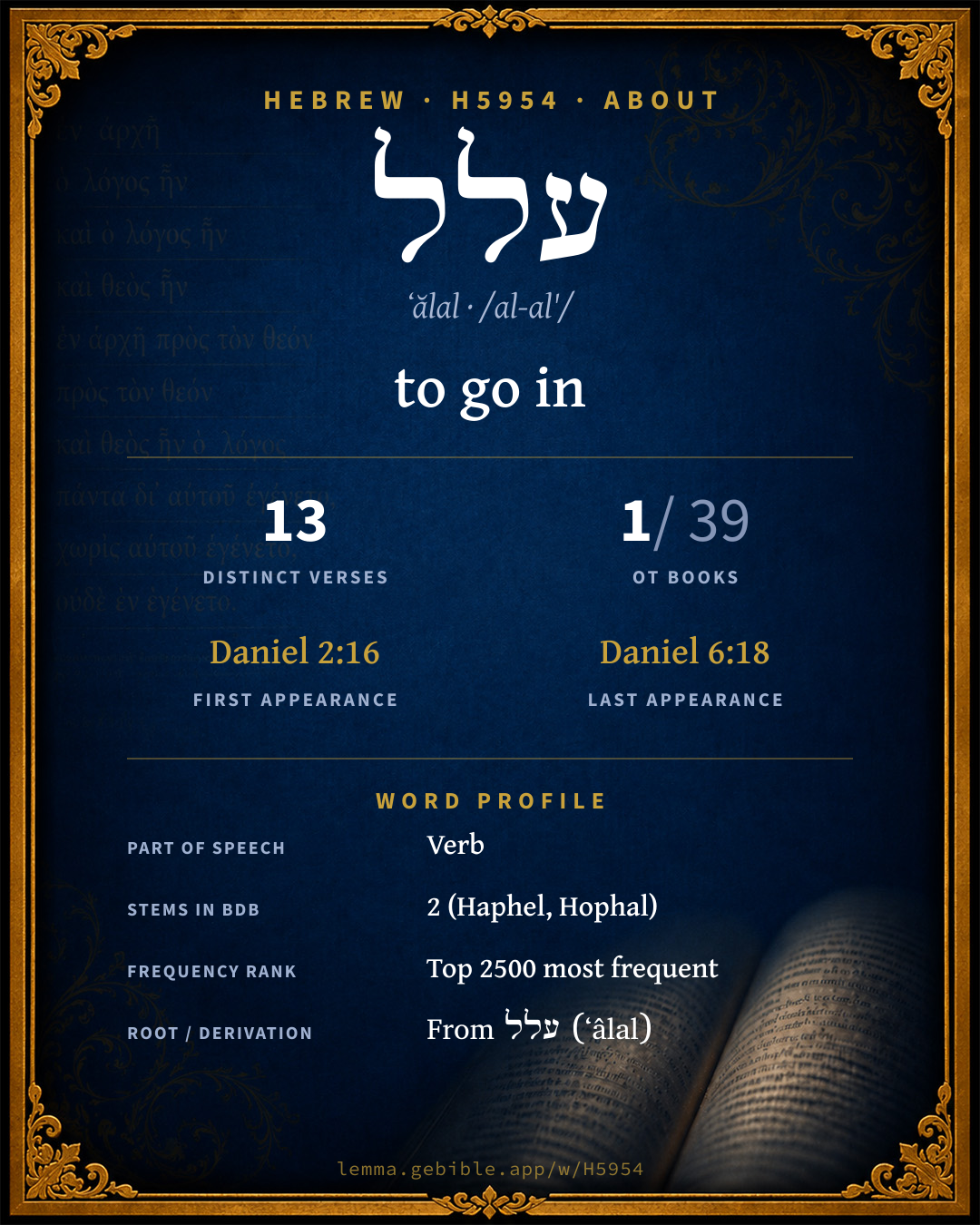
עֲלַל
to go in
‘to go in’ is one of 4 main senses fuller range ↓
Full lexicon entry — Brown-Driver-Briggs (BDB)
From Brown-Driver-Briggs (BDB)
Where this word appears
See every Qal verb in the Hebrew Bible →
Grammar key — what these labels mean
Part of speech
- Verb
- An action or state-of-being word.
Stem
- Qal
- The basic, simple active stem — the plain form of the verb (“he wrote”).
- Hiphil
- The causative active stem (“he caused / brought about”).
- Hophal
- The passive counterpart of the Hiphil (“he was caused to…”).
Form
- Perfect
- A completed action or state — Hebrew marks aspect (completeness) more than strict tense (“he wrote”).
- Participle Active
- A verbal adjective expressing ongoing or characteristic action (“writing / one who writes”).
- Infinitive Construct
- A bound verbal noun, frequently with prepositions (“to write / in writing”).
- Imperative
- A direct command (“write!”).
State
- Absolute
- The independent form of a noun, not bound to a following word.
Person
- 3rd Person
- The one spoken about (“he / she / it / they”).
- 2nd Person
- The one addressed (“you”).
Gender
- Masculine
- Grammatically masculine.
- Feminine
- Grammatically feminine.
Number
- Singular
- One.
- Plural
- More than one (in Hebrew, generally three or more).
Grammatical forms
- Verb, Qal, Perfect, 3rd Person, Masculine, Singular 4 times (24%)
- Verb, Qal, Participle Active, Masculine, Plural, Absolute 4 times (24%)
- Verb, Hiphil, Infinitive Construct 2 times (12%)
- Verb, Hiphil, Perfect, 3rd Person, Masculine, Singular 2 times (12%)
- Verb, Qal, Perfect, 3rd Person, Feminine, Singular 2 times (12%)
- Verb, Hophal, Perfect, 3rd Person, Masculine, Plural 1 time (6%)
- Verb, Hophal, Perfect, 3rd Person, Masculine, Singular 1 time (6%)
- Verb, Hiphil, Imperative, 2nd Person, Masculine, Singular 1 time (6%)
Parsed forms decoded from the imported morphology (morphhb / Westminster Leningrad Codex — WLC text public domain, morphhb tagging CC BY 4.0), counted across 17 parsed occurrences — not distinct verses.
Every verse where H5954 appears — 13 distinct verses across 1 book. Click any verse to open its interlinear word-by-word view. Verse text shown in the World English Bible for context — . Each verse’s Hebrew form is shown with its reference; the English is not keyword-highlighted, since the data carries no word-level English alignment. Use “Compare translations” on any verse to read it across multiple English versions. This concordance covers the Hebrew Bible; Septuagint (Greek Old Testament) occurrences are not indexed here.
Daniel 13 verses
- Daniel 2:16 עַ֖ל Qal pf 3ms Daniel went in, and desired of the king that he would appoint him a time, and he would show the king the interpretation.
- Daniel 2:24 עַ֣ל הַעֵ֨לְ/נִי֙ Qal pf 3ms Hiphil impv 2ms + sfx pers 1cs Therefore Daniel went in to Arioch, whom the king had appointed to destroy the wise men of Babylon; he went and said thus to him: Don't destroy the wise men of Babylon; bring me in before the king, and I will show to the king the interpretation.
- Daniel 2:25 הַנְעֵ֥ל Hiphil pf 3ms Then Arioch brought in Daniel before the king in haste, and said thus to him, I have found a man of the children of the captivity of Judah, who will make known to the king the interpretation.
- Daniel 4:6 לְ/הַנְעָלָ֣ה prep + Hiphil inf.cs Therefore made I a decree to bring in all the wise men of Babylon before me, that they might make known to me the interpretation of the dream.
- Daniel 4:7 עללין עָלִּ֗ין Qal ptcp.act mp Qal ptcp.act mp Then came in the magicians, the enchanters, the Chaldeans, and the soothsayers; and I told the dream before them; but they did not make known to me the interpretation of it.
- Daniel 4:8 עַל֩ Qal pf 3ms But at the last Daniel came in before me, whose name was Belteshazzar, according to the name of my god, and in whom is the spirit of the holy gods: and I told the dream before him, [saying],
- Daniel 5:7 לְ/הֶֽעָלָה֙ prep + Hiphil inf.cs The king cried aloud to bring in the enchanters, the Chaldeans, and the soothsayers. The king spoke and said to the wise men of Babylon, Whoever shall read this writing, and show me the interpretation of it, shall be clothed with purple, and have a chain of gold about his neck, and shall be the third ruler in the kingdom.
- Daniel 5:8 עללין עָֽלִּ֔ין Qal ptcp.act mp Qal ptcp.act mp Then came in all the king's wise men; but they could not read the writing, nor make known to the king the interpretation.
- Daniel 5:10 עללת עַלַּ֑ת Qal pf 3fs Qal pf 3fs [Now] the queen by reason of the words of the king and his lords came into the banquet house: the queen spoke and said, O king, live forever; don't let your thoughts trouble you, nor let your face be changed.
- Daniel 5:13 הֻעַ֖ל Hophal pf 3ms Then was Daniel brought in before the king. The king spoke and said to Daniel, Are you that Daniel, who are of the children of the captivity of Judah, whom the king my father brought out of Judah?
- Daniel 5:15 הֻעַ֣לּוּ Hophal pf 3mp Now the wise men, the enchanters, have been brought in before me, that they should read this writing, and make known to me the interpretation of it; but they could not show the interpretation of the thing.
- Daniel 6:10 עַ֣ל Qal pf 3ms When Daniel knew that the writing was signed, he went into his house (now his windows were open in his chamber toward Jerusalem) and he kneeled on his knees three times a day, and prayed, and gave thanks before his God, as he did before.
- Daniel 6:18 הַנְעֵ֣ל Hiphil pf 3ms Then the king went to his palace, and passed the night fasting; neither were instruments of music brought before him: and his sleep fled from him.
About this entry
At a glance — auto-summarized from this page’s data, not written by a person. Every figure links to its source below. This summary describes the numbers; it doesn’t interpret them.
At its core, עלל (ʻălal) means “to go in.” The word gravitates to Daniel (100%). It appears 13 verses across 1 book of the Hebrew Bible, among its uncommon vocabulary. First canonically at Daniel 2:16, it enters the text early. As a verb its force shifts by stem, across 2 stems (Haphel, Hophal, and more). Each statement above links to its evidence; the full detail follows below.
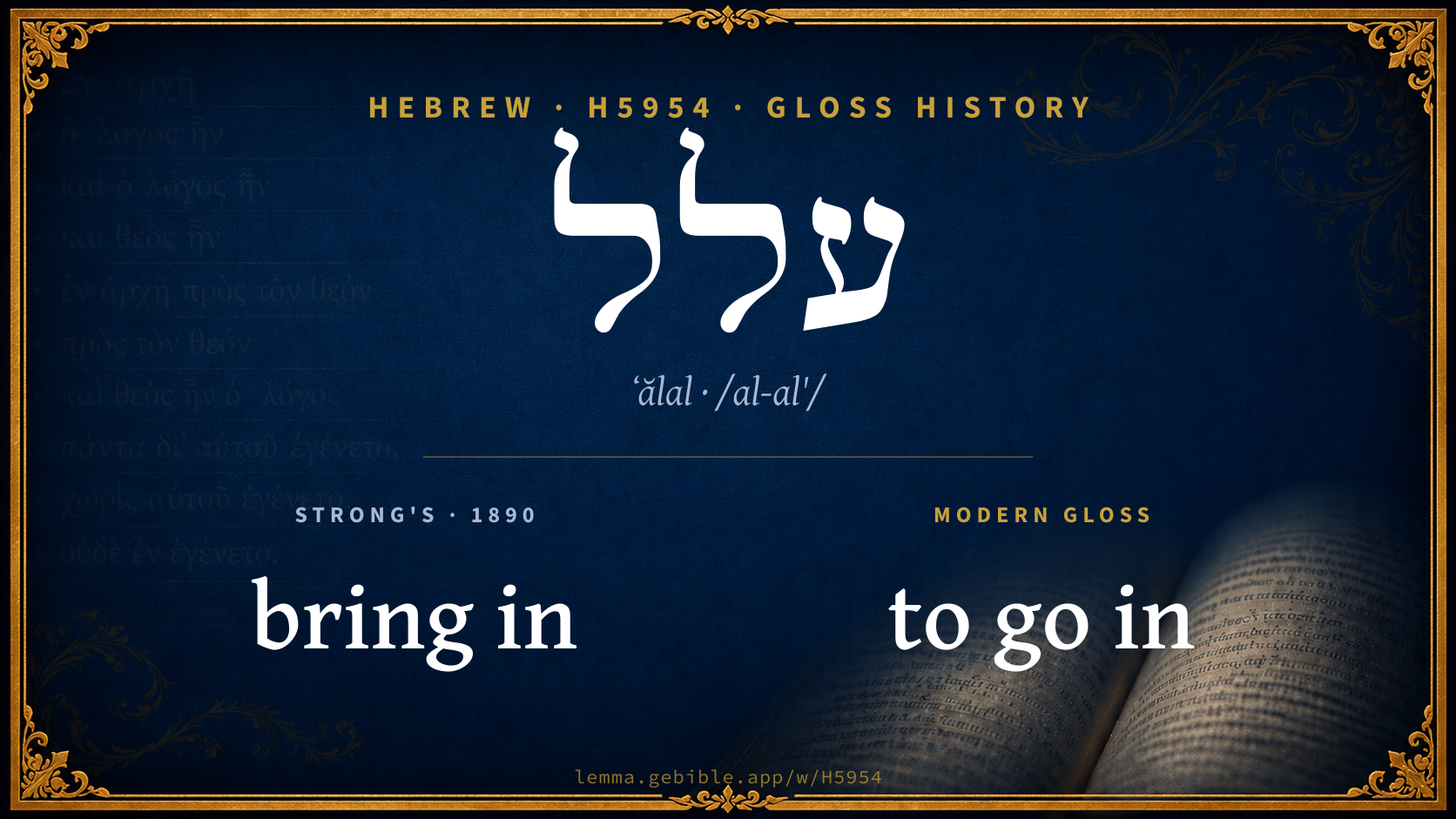
Gloss history
Strong's 1890 vs modern scholarship
About this word
Strong's H5954 catalogs a Hebrew word from the Hebrew Old Testament.
These counts are not copied from any lexicon or concordance. They are computed here, from the morphology-tagged Hebrew Old Testament. What Lemma adds →
- 13
- distinct verses
- The word appears in 13 distinct verses.
- 1 / 39
- OT books
- The word appears in 1 of 39 Old Testament books.
- #1,671
- by frequency
- Top 2500 most frequent Hebrew words (rank 1,671 of 8,640 Hebrew words by occurrence).
View all 13 occurrences in the concordance →
Most concentrated in
- Daniel 13 verses 100%
By section of the Old Testament
By traditional corpus
Conventional, traditional groupings — biblical authorship is debated, so this is a traditional corpus grouping, not an authorship claim. Each share is this word’s portion of its verses in that division of the Hebrew canon. Each figure is a share of the word’s 13 distinct verses.
- Writings (Ketuvim) 13 verses · 100%
How translations render this word
Counts come from each version’s own published word-to-Strong’s tagging or interlinear alignment — an approximate guide to how each version renders this word, not a word-level alignment the data otherwise carries. Because each total is that version’s own tagged count, the per-version totals vary from one another and need not match the appearance or distinct-verse counts above. These counts may also differ from a printed concordance because Lemma counts each distinctly tagged rendering and does not collapse phrase taggings into a single head-word total. This is a fixed set of word-tagged versions (KJV, ASV, BSB, ULT) and does not change with the reading translation you choose elsewhere. Each version’s license is shown beside its name below (and on Sources).
- King James Version: Came 3×, Bring 2×, Brought in 2×
- American Standard Version: Came 3×, Bring 2×, Brought in 2×
- Berean Standard Bible: Came in 2×, Was brought 2×
- unfoldingWord Literal Text: Came in 3×, Went in 2×
King James Version Public Domain
Renders H5954 across 13 tagged occurrences — most commonly:
Plus 4 renderings that appear only once — usually multi-word phrases or single function words the recovered tagging swept in, not distinct renderings.
American Standard Version Public Domain
Renders H5954 across 13 tagged occurrences — most commonly:
Plus 4 renderings that appear only once — usually multi-word phrases or single function words the recovered tagging swept in, not distinct renderings.
Berean Standard Bible Public Domain
Renders H5954 across 14 tagged occurrences — most commonly:
Plus 10 renderings that appear only once — usually multi-word phrases or single function words the recovered tagging swept in, not distinct renderings.
unfoldingWord Literal Text CC BY-SA 4.0
Renders H5954 across 14 tagged occurrences — most commonly:
Plus 9 renderings that appear only once — usually multi-word phrases or single function words the recovered tagging swept in, not distinct renderings.
Senses in the full BDB
Hebrew verbs can shift meaning by stem (binyan): Qal is the basic action, Niphal is often passive or reflexive, Piel often intensifies or makes it factitive, and Hiphil is typically causative. The senses below are grouped under the stem BDB assigns to each. This entry also uses Haphel (the causative Aramaic stem, parallel to Hiphil) and Hophal (the passive of Hiphil).
What do BDB’s symbols mean?
BDB uses these scholarly abbreviations:
| Symbol | Meaning |
|---|---|
| 𝔊 | the Septuagint (the ancient Greek translation, LXX) |
| 𝔙 | the Vulgate (the Latin translation) |
| 𝔖 | the Syriac version (the Peshitta) |
| 𝔗 | the Targum (the Aramaic translation) |
| ψ | the Psalms |
| √ | root (the underlying root or stem) |
| ‖ | parallel passage (a synonymous or contrasted parallel) |
| † | the dagger: every passage where the word occurs is cited |
The 2 senses and sub-senses the full Brown-Driver-Briggs lexicon distinguishes for this word, in lexicon order (not ranked by frequency), with BDB’s own verbatim wording and sub-sense lettering. Shown in Hebrew script with BDB’s own scholarly abbreviations. The condensed entry is in the Lexicon Entry tab. See also the Forms in the corpus table below.
Haphel
- . bring in
Hophal
- . be brought
Senses from the full Brown-Driver-Briggs lexicon (Brown, Driver, Briggs; Oxford 1906 — public domain), digitized via Sefaria, supplemented by the OpenScriptures HebrewLexicon (CC BY 4.0). Full attribution on Sources.
Word origin
[ עֲלַל ] vb. go or come in
— Brown-Driver-Briggs (Oxford 1906, public domain), digitized via Sefaria, supplemented by the OpenScriptures HebrewLexicon (CC BY 4.0). See Sources.
Derived from עלל (ʻâlal) (H5953) — to act severely.
Jastrow Dictionary
A second Hebrew/Aramaic lexicon for comparison, covering Aramaic and post-biblical (Talmudic, Targumic, Midrashic) usage that the biblical-Hebrew BDB does not. Matched by lemma rather than by Strong’s number, so a lemma may carry more than one Jastrow headword (shown separately below), and the entries cover usage well beyond the Bible.
עָלַל
- עוֹלֵל Pol. to bring about) to go about,
- 1. (cmp. סוּר I ch.) to superintend, be busy. Koh. R. to VI, 10 … מלך ומסרו לאריס לַעֲלוֹל בו a King that had a vineyard and gave it in charge of a tenant to attend to it (ed. Wil. לעֹמול).—Part. pass. עָלוּל; f. עֲלוּלָה; pl. עֲלוּלִים, עֲלוּלִין; עֲלוּלוֹת [brought about,] liable, likely (cmp. רָגִיל). Nidd. 7ᵇ ע׳ לקבל טומאה likely to catch uncleanness; Tosef. Makhsh. II, 11.
- 2. (with ל־; cmp. סוּר I) to ascend, land, enter. Koh. R. to VI, 5 למה לא עָלַלְתָּה למדינה why didst thou not visit the city?; ואת שירדת ועָלַלְתָּ and thou who didst go down (leave the ship) and visit; (Yalk. ib. 972 עאל, עלת, עיילת, v. עוּל, a. next w.). Ab. Zar. 71ᵃ עוֹל תחתי לעוצר go for me to the collector (settle with him).
- (b. h.), Nithpa. נִתְעַלֵּל [to busy one’s self,] to sport, abuse. Gitt. 58ᵃ; Yalk. Jer. 276; a. e.
עֲלַל I
- , esp. (corresp. to h. בּוֹא) to enter a town, a house &c.; to come in (interch. with עוּל). Targ. Prov. XI, 2; a. fr.—Y. Taan. I, 64ᵇ bot. מי ע׳ when he was going home. Ib.ᶜ top כד דאנא עָלֵיל וכ׳ when I was coming home from the hill. Ib. כד דאתית למֵיעוֹל when thou wert about to go home. Y. Sabb. VI, 8ᶜ bot. בר קפרא אִיעֲלַל … מי ע׳ וכ׳ B. K. was trying to enter a town; when he entered it &c. Y. Erub. V, beg. 22ᵇ תלת … עבר עָלֵיל קומי וכ׳ thirteen years he spent going in and out before his teacher without need (of his instruction). Koh. R. to I, 3 עָלְלִין ונפקין are brought in and taken out again; a. e.—2) (with שמשא) to set. Targ. O. Gen. XV, 12; a. fr.—3) to be busy, have to do with, (euphem.) to sport. Esth. R. to II, 16 אנא יהיב … ועליל עמה I would give one hundred denars to sport with her; Yalk. Gen. 67; (Gen. R. s. 40 ואִיעֲלַל Ithpa.).
- to go around searching; to glean. Targ. O. Lev. XIX, 10 (ed. Berl. תְעַלִיל; ed. Amst. תְעָליל); Deut. XXIV, 21 תְעַלֵּיל ed. Berl. (ed. Amst. a. Y. תְעָלֵיל). e.g. Deuteronomy 24:21
- (fr. עוּל), אָעוֹל, אֵ׳ to cause to go in; to carry in, bring in. Targ. Gen. VI, 19 (Y. ed. Vien. תֵעוֹל). Targ. Ps. LXVI, 11. Targ. O. Gen. XLVII, 24 אָעוֹלֵי ed. Berl. (oth. ed. אַעוּלֵי, verbal noun). Targ. Hag. I, 9; a. fr.
- to be carried in. Targ. Job X, 19 אֶתְּעָל. Ib. XXI, 32 יִתָּעֵל ed. Wil. (oth. ed. יִתְּעָל). Ib. 30 יִתָּעֲלוּן (some ed. יִתְעֲלוּן Ithpe.). Targ. O. Gen. XLIII, 18 (Y. מִתְעֲל׳, ed. Vien. מִתְעָ׳); a. fr.
- 1. same, v. supra.—2)
- to attempt entrance. Y. Sabb. l. c., v. supra.—3) to busy one’s self, to sport. Gen. R. l. c., v. supra.
עֲלַל II
- (preced.) [that which is brought in; cmp. תְּבוּאָה,] harvest, provision; income. Targ. Job XL, 20 (h. text בול). Targ. Is. XXX, 23. Targ. Lev. XXV, 21; a. fr.—Ḥag. 5ᵃ, v. זוּזָא I. Ned. 55ᵃ פקיד … מן ע׳ דנהר פניא left in his will that they should give Raba thirteen thousand Zuz out of the ʿălalta (income) of N’har Pania; היכי מיקריא ע׳ what is understood by ʿălalta? Ib. תבואה … ע׳ כל מילי משמע by t’buah (= תבואת שדה) we understand only the five kinds of grain, by ʿălalta, anything (income). Ib. שכר בתים … כיון דפחתן לאו ע׳ היא וכ׳ how about the rent from houses or ships? Shall we say, because their value is diminishing by wear and tear, it cannot be called ʿălalta (income), or is it to be called ʿălalta, because the diminution is not noticeable?; a. e.—Pl. עֲלָלָן, עֲלָלָתָא. Targ. Y. II, Deut. XIV, 22. Targ. O. Gen. XLVII, 24 עָלְלָתָא ed. Lsb. (ed. Berl. עָלַלְתָּא; oth. ed. עֲלַלְתָּא, sing.); a. e.
A Dictionary of the Targumim, the Talmud Babli and Yerushalmi, and the Midrashic Literature (Marcus Jastrow; London, Luzac, 1903) — Public Domain. Digitized via Sefaria. Digitized via Sefaria. Full attribution on Sources.
Forms in the corpus
The 15 distinct written forms H5954 takes in the Hebrew Bible, most frequent first — each parse links to that stem’s occurrences in the concordance. Hebrew forms include their vowel points and cantillation, so a single lemma takes many written forms.
Same root — word family
Other BDB entries built from the same root as H5954, grouped by Strong’s listed origin. These share a root / origin per the lexicon — not necessarily a shared meaning. Each links to that word’s own entry.
Derives from
Shares the same root
- מעלל maʻălâl H4611 deed
- על ʻôl H5923 yoke
- עליל ʻălîyl H5948 furnace
- עלילה ʻălîylâh H5949 wantonness
- עללה ʻôlêlâh H5955 gleaning
- תעלול taʻălûwl H8586 vexation
Derived from this word
Compare all same-root words → Showing 4 of 9 — not the complete family. They share a root, not necessarily a meaning.
Septuagint verse parallels
This word appears in 13 verses that also exist in the Greek Old Testament (Septuagint), out of the 13 Hebrew verses it occurs in. You can read those verses in Greek by switching the Old Testament edition to the Septuagint.
Read these verses in the Septuagint
This is a verse-level parallel only — the same verses exist in both the Hebrew and Greek Old Testaments. No word-level Hebrew↔Greek correspondence is claimed: the data carries no such alignment, so no Greek word is shown as this Hebrew word’s translation. Coverage is not total — the Septuagint omits the deuterocanon and renumbers the Psalms, so some Hebrew verses have no direct Greek parallel.