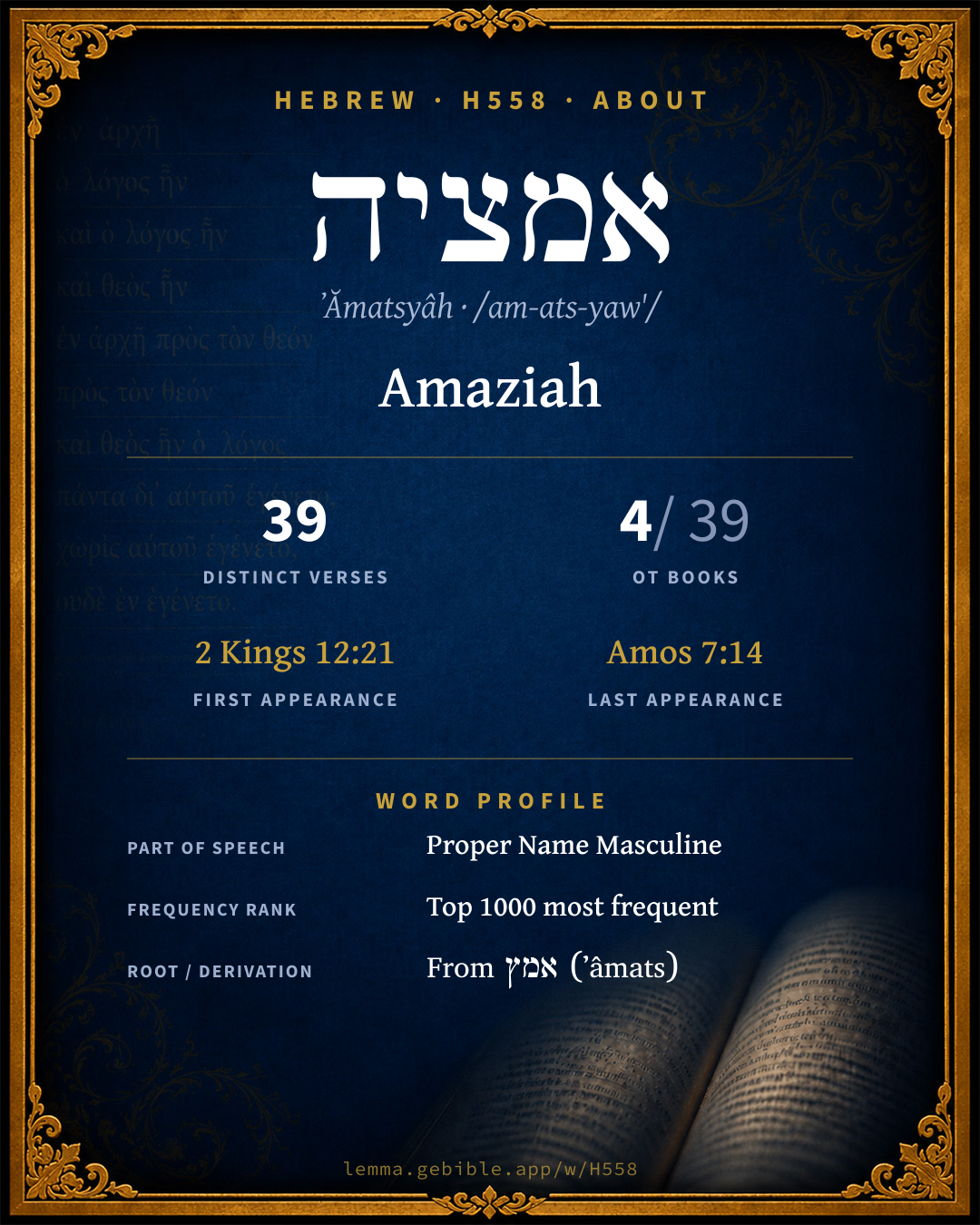
אֲמַצְיָ֫הוּ
Amaziah
BDB lists 5 entries for ‘Amaziah’ fuller range ↓
Full lexicon entry — Brown-Driver-Briggs (BDB)
From Brown-Driver-Briggs (BDB)
Where this word appears
Grammar key — what these labels mean
Part of speech
- Noun
- A naming word — a person, place, thing, or idea.
Noun type
- Proper
- A name of a specific person, place, or people (e.g. Abraham, Zion, Israel).
Every verse where H558 appears — 39 distinct verses across 4 books. Click any verse to open its interlinear word-by-word view. Verse text shown in the World English Bible for context — . Each verse’s Hebrew form is shown with its reference; the English is not keyword-highlighted, since the data carries no word-level English alignment. Use “Compare translations” on any verse to read it across multiple English versions. This concordance covers the Hebrew Bible; Septuagint (Greek Old Testament) occurrences are not indexed here.
2 Kings 14 verses
- 2 Kings 12:21 אֲמַצְיָ֥ה n Proper For Jozacar the son of Shimeath, and Jehozabad the son of Shomer, his servants, struck him, and he died; and they buried him with his fathers in the city of David: and Amaziah his son reigned in his place.
- 2 Kings 13:12 אֲמַצְיָ֣ה n Proper Now the rest of the acts of Joash, and all that he did, and his might with which he fought against Amaziah king of Judah, aren't they written in the book of the chronicles of the kings of Israel?
- 2 Kings 14:1 אֲמַצְיָ֥הוּ n Proper In the second year of Joash son of Joahaz king of Israel began Amaziah the son of Joash king of Judah to reign.
- 2 Kings 14:8 אֲמַצְיָה֙ n Proper Then Amaziah sent messengers to Jehoash, the son of Jehoahaz son of Jehu, king of Israel, saying, Come, let us look one another in the face.
- 2 Kings 14:9 אֲמַצְיָ֣הוּ n Proper Jehoash the king of Israel sent to Amaziah king of Judah, saying, The thistle that was in Lebanon sent to the cedar that was in Lebanon, saying, Give your daughter to my son as wife: and there passed by a wild animal that was in Lebanon, and trod down the thistle.
- 2 Kings 14:11 אֲמַצְיָ֔הוּ וַ/אֲמַצְיָ֣הוּ n Proper conj + n Proper But Amaziah would not hear. So Jehoash king of Israel went up; and he and Amaziah king of Judah looked one another in the face at Beth-shemesh, which belongs to Judah.
- 2 Kings 14:13 אֲמַצְיָ֨הוּ n Proper Jehoash king of Israel took Amaziah king of Judah, the son of Jehoash the son of Ahaziah, at Beth-shemesh, and came to Jerusalem, and broke down the wall of Jerusalem from the gate of Ephraim to the corner gate, four hundred cubits.
- 2 Kings 14:15 אֲמַצְיָ֣הוּ n Proper Now the rest of the acts of Jehoash which he did, and his might, and how he fought with Amaziah king of Judah, aren't they written in the book of the chronicles of the kings of Israel?
- 2 Kings 14:17 אֲמַצְיָ֤הוּ n Proper Amaziah the son of Joash king of Judah lived after the death of Jehoash son of Jehoahaz king of Israel fifteen years.
- 2 Kings 14:18 אֲמַצְיָ֑הוּ n Proper Now the rest of the acts of Amaziah, aren't they written in the book of the chronicles of the kings of Judah?
- 2 Kings 14:21 אֲמַצְיָֽהוּ n Proper All the people of Judah took Azariah, who was sixteen years old, and made him king in the room of his father Amaziah.
- 2 Kings 14:23 לַ/אֲמַצְיָ֥הוּ prep + n Proper In the fifteenth year of Amaziah the son of Joash king of Judah Jeroboam the son of Joash king of Israel began to reign in Samaria, [and reigned] forty-one years.
- 2 Kings 15:1 אֲמַצְיָ֖ה n Proper In the twenty-seventh year of Jeroboam king of Israel began Azariah son of Amaziah king of Judah to reign.
- 2 Kings 15:3 אֲמַצְיָ֥הוּ n Proper He did that which was right in the eyes of Yahweh, according to all that his father Amaziah had done.
1 Chronicles 3 verses
2 Chronicles 19 verses
- 2 Chronicles 24:27 אֲמַצְיָ֥הוּ n Proper Now concerning his sons, and the greatness of the burdens [laid] on him, and the rebuilding of the house of God, behold, they are written in the commentary of the book of the kings. Amaziah his son reigned in his place.
- 2 Chronicles 25:1 אֲמַצְיָ֔הוּ n Proper Amaziah was twenty-five years old when he began to reign; and he reigned twenty-nine years in Jerusalem: and his mother's name was Jehoaddan, of Jerusalem.
- 2 Chronicles 25:5 אֲמַצְיָ֨הוּ֙ n Proper Moreover Amaziah gathered Judah together, and ordered them according to their fathers' houses, under captains of thousands and captains of hundreds, even all Judah and Benjamin: and he numbered them from twenty years old and upward, and found them three hundred thousand chosen men, able to go forth to war, who could handle spear and shield.
- 2 Chronicles 25:9 אֲמַצְיָ֨הוּ֙ n Proper Amaziah said to the man of God, But what shall we do for the hundred talents which I have given to the army of Israel? The man of God answered, Yahweh is able to give you much more than this.
- 2 Chronicles 25:10 אֲמַצְיָ֗הוּ n Proper Then Amaziah separated them, [to wit], the army that had come to him out of Ephraim, to go home again: therefore their anger was greatly kindled against Judah, and they returned home in fierce anger.
- 2 Chronicles 25:11 וַ/אֲמַצְיָ֨הוּ֙ conj + n Proper Amaziah took courage, and led forth his people, and went to the Valley of Salt, and struck of the children of Seir ten thousand.
- 2 Chronicles 25:13 אֲמַצְיָ֨הוּ֙ n Proper But the men of the army whom Amaziah sent back, that they should not go with him to battle, fell on the cities of Judah, from Samaria even to Beth Horon, and struck of them three thousand, and took much spoil.
- 2 Chronicles 25:14 אֲמַצְיָ֨הוּ֙ n Proper Now it happened, after that Amaziah was come from the slaughter of the Edomites, that he brought the gods of the children of Seir, and set them up to be his gods, and bowed down himself before them, and burned incense to them.
- 2 Chronicles 25:15 בַּ/אֲמַצְיָ֑הוּ prep + n Proper Therefore the anger of Yahweh was kindled against Amaziah, and he sent to him a prophet, who said to him, Why have you sought after the gods of the people, which have not delivered their own people out of your hand?
- 2 Chronicles 25:17 אֲמַצְיָ֨הוּ֙ n Proper Then Amaziah king of Judah took advice, and sent to Joash, the son of Jehoahaz the son of Jehu, king of Israel, saying, Come, let us look one another in the face.
- 2 Chronicles 25:18 אֲמַצְיָ֣הוּ n Proper Joash king of Israel sent to Amaziah king of Judah, saying, The thistle that was in Lebanon sent to the cedar that was in Lebanon, saying, Give your daughter to my son as wife: and there passed by a wild animal that was in Lebanon, and trod down the thistle.
- 2 Chronicles 25:20 אֲמַצְיָ֔הוּ n Proper But Amaziah would not hear; for it was of God, that he might deliver them into the hand [of their enemies], because they had sought after the gods of Edom.
- 2 Chronicles 25:21 וַ/אֲמַצְיָ֣הוּ conj + n Proper So Joash king of Israel went up; and he and Amaziah king of Judah looked one another in the face at Beth-shemesh, which belongs to Judah.
- 2 Chronicles 25:23 אֲמַצְיָ֨הוּ n Proper Joash king of Israel took Amaziah king of Judah, the son of Joash the son of Jehoahaz, at Beth-shemesh, and brought him to Jerusalem, and broke down the wall of Jerusalem from the gate of Ephraim to the corner gate, four hundred cubits.
- 2 Chronicles 25:25 אֲמַצְיָ֤הוּ n Proper Amaziah the son of Joash king of Judah lived after the death of Joash son of Jehoahaz king of Israel fifteen years.
- 2 Chronicles 25:26 אֲמַצְיָ֔הוּ n Proper Now the rest of the acts of Amaziah, first and last, behold, aren't they written in the book of the kings of Judah and Israel?
- 2 Chronicles 25:27 אֲמַצְיָ֨הוּ֙ n Proper Now from the time that Amaziah did turn away from following Yahweh they made a conspiracy against him in Jerusalem; and he fled to Lachish: but they sent after him to Lachish, and killed him there.
- 2 Chronicles 26:1 אֲמַצְיָֽהוּ n Proper All the people of Judah took Uzziah, who was sixteen years old, and made him king in the room of his father Amaziah.
- 2 Chronicles 26:4 אֲמַצְיָ֥הוּ n Proper He did that which was right in the eyes of Yahweh, according to all that his father Amaziah had done.
Amos 3 verses
- Amos 7:10 אֲמַצְיָה֙ n Proper Then Amaziah the priest of Beth El sent to Jeroboam king of Israel, saying, "Amos has conspired against you in the midst of the house of Israel. The land is not able to bear all his words.
- Amos 7:12 אֲמַצְיָה֙ n Proper Amaziah also said to Amos, "You seer, go, flee away into the land of Judah, and there eat bread, and prophesy there:
- Amos 7:14 אֲמַצְיָ֔ה n Proper Then Amos answered Amaziah, "I was no prophet, neither was I a prophet's son; but I was a herdsman, and a farmer of sycamore trees;
About this entry
At a glance — auto-summarized from this page’s data, not written by a person. Every figure links to its source below. This summary describes the numbers; it doesn’t interpret them.
אמציה — transliterated ʼĂmatsyâh — is a Hebrew name carrying the sense “Amaziah.” Debuting at 2 Kings 12:21, it then recurs through the corpus. Spanning 39 verses in 4 books, it ranks among the moderately common words of the Hebrew Bible. Its uses concentrate in 2 Chronicles (49% of all occurrences). See 39-verse concordance and the renderings breakdown below.
Gloss history
Strong's 1890 vs modern scholarship
About this word
Strong's H558 catalogs a Hebrew word from the Hebrew Old Testament.
These counts are not copied from any lexicon or concordance. They are computed here, from the morphology-tagged Hebrew Old Testament. What Lemma adds →
- 39
- distinct verses
- The word appears in 39 distinct verses.
- 4 / 39
- OT books
- The word appears in 4 of 39 Old Testament books.
- #909
- by frequency
- Top 1000 most frequent Hebrew words (rank 909 of 8,640 Hebrew words by occurrence).
View all 39 occurrences in the concordance →
Most concentrated in
- 2 Chronicles 19 verses 49%
- 2 Kings 14 verses 36%
- 1 Chronicles 3 verses 8%
By section of the Old Testament
By traditional corpus
Conventional, traditional groupings — biblical authorship is debated, so this is a traditional corpus grouping, not an authorship claim. Each share is this word’s portion of its verses in that division of the Hebrew canon. Each figure is a share of the word’s 39 distinct verses.
- Writings (Ketuvim) 22 verses · 56%
- Prophets (Nevi'im) 17 verses · 44%
How translations render this word
Counts come from each version’s own published word-to-Strong’s tagging or interlinear alignment — an approximate guide to how each version renders this word, not a word-level alignment the data otherwise carries. Because each total is that version’s own tagged count, the per-version totals vary from one another and need not match the appearance or distinct-verse counts above. These counts may also differ from a printed concordance because Lemma counts each distinctly tagged rendering and does not collapse phrase taggings into a single head-word total. This is a fixed set of word-tagged versions (KJV, ASV, BSB, ULT) and does not change with the reading translation you choose elsewhere. Each version’s license is shown beside its name below (and on Sources).
- King James Version: Amaziah 35×, Against amaziah 2×
- American Standard Version: Amaziah 33×, Against amaziah 2×, He and amaziah 2×
- Berean Standard Bible: Amaziah 37×
- unfoldingWord Literal Text: Amaziah 39×
King James Version Public Domain
Renders H558 across 40 tagged occurrences — most commonly:
Plus 3 renderings that appear only once — usually multi-word phrases or single function words the recovered tagging swept in, not distinct renderings.
American Standard Version Public Domain
Renders H558 across 40 tagged occurrences — most commonly:
Plus 3 renderings that appear only once — usually multi-word phrases or single function words the recovered tagging swept in, not distinct renderings.
Berean Standard Bible Public Domain
Renders H558 across 39 tagged occurrences — most commonly:
Plus 2 renderings that appear only once — usually multi-word phrases or single function words the recovered tagging swept in, not distinct renderings. Not rendered by a distinct English word in 1 further occurrence.
unfoldingWord Literal Text CC BY-SA 4.0
Renders H558 across 41 tagged occurrences — most commonly:
Plus 2 renderings that appear only once — usually multi-word phrases or single function words the recovered tagging swept in, not distinct renderings.
Senses in the full BDB
What do BDB’s symbols mean?
BDB uses these scholarly abbreviations:
| Symbol | Meaning |
|---|---|
| 𝔊 | the Septuagint (the ancient Greek translation, LXX) |
| 𝔙 | the Vulgate (the Latin translation) |
| 𝔖 | the Syriac version (the Peshitta) |
| 𝔗 | the Targum (the Aramaic translation) |
| ψ | the Psalms |
| √ | root (the underlying root or stem) |
| ‖ | parallel passage (a synonymous or contrasted parallel) |
| † | the dagger: every passage where the word occurs is cited |
The 4 senses and sub-senses the full Brown-Driver-Briggs lexicon distinguishes for this word, in lexicon order (not ranked by frequency), with BDB’s own verbatim wording and sub-sense lettering. Shown in Hebrew script with BDB’s own scholarly abbreviations. The condensed entry is in the Lexicon Entry tab. See also the Forms in the corpus table below.
- 1. king of Jud., son of Joash, father of Azariah; אֲמַצְיָהוּ 2 K 14:1, 9 + 8 times 2 K 14; 15:3 1 Ch 3:12; 2 Ch 24:27; 25:1 + 15 times 2 Ch 25; 26:1, 4; אֲמַצְיָה 2 K 12:22; 13:12; 14:8; 15:1. e.g. 2 Kings 14:1
- 2. אֲמַצְיָה, a Simeonite 1 Ch 4:34. e.g. 1 Chronicles 4:34
- 3. id., a Levite 1 Ch 6:30. e.g. 1 Chronicles 6:30
- 4. priest of Bethel, under Jerob. II, Am 7:10, 12, 14. e.g. Amos 7:10
Senses from the full Brown-Driver-Briggs lexicon (Brown, Driver, Briggs; Oxford 1906 — public domain), digitized via Sefaria, supplemented by the OpenScriptures HebrewLexicon (CC BY 4.0). Full attribution on Sources.
Word origin
n.pr.m. (י׳ is mighty).
— Brown-Driver-Briggs (Oxford 1906, public domain), digitized via Sefaria, supplemented by the OpenScriptures HebrewLexicon (CC BY 4.0). See Sources.
Derived from אמץ (ʼâmats) (H553) — to be strong.
Forms in the corpus
The 20 distinct written forms H558 takes in the Hebrew Bible, most frequent first — each parse links to that state’s occurrences in the concordance. Hebrew forms include their vowel points and cantillation, so a single lemma takes many written forms.
| Form | Parsing | Example | Uses |
|---|---|---|---|
| אֲמַצְיָ֨הוּ֙ | Noun, Proper | 2 Chronicles 25:5 | 6 |
| אֲמַצְיָ֔הוּ | Noun, Proper | 2 Chronicles 25:1 | 4 |
| אֲמַצְיָ֥הוּ | Noun, Proper | 2 Chronicles 24:27 | 4 |
| אֲמַצְיָ֣הוּ | Noun, Proper | 2 Chronicles 25:18 | 3 |
| אֲמַצְיָה֙ | Noun, Proper | Amos 7:10 | 3 |
| אֲמַצְיָ֖ה | Noun, Proper | 1 Chronicles 6:45 | 2 |
| אֲמַצְיָ֤הוּ | Noun, Proper | 2 Chronicles 25:25 | 2 |
| אֲמַצְיָ֨הוּ | Noun, Proper | 2 Chronicles 25:23 | 2 |
| אֲמַצְיָֽהוּ | Noun, Proper | 2 Chronicles 26:1 | 2 |
| וַ/אֲמַצְיָ֣הוּ | Noun, Proper | 2 Chronicles 25:21 | 2 |
| אֲמַצְיָ֑הוּ | Noun, Proper | 2 Kings 14:18 | 1 |
| אֲמַצְיָ֔ה | Noun, Proper | Amos 7:14 | 1 |
| אֲמַצְיָ֗הוּ | Noun, Proper | 2 Chronicles 25:10 | 1 |
| אֲמַצְיָ֣ה | Noun, Proper | 2 Kings 13:12 | 1 |
| אֲמַצְיָ֥ה | Noun, Proper | 2 Kings 12:21 | 1 |
| אֲמַצְיָ֧הוּ | Noun, Proper | 1 Chronicles 3:12 | 1 |
| אֲמַצְיָֽה | Noun, Proper | 1 Chronicles 4:34 | 1 |
| בַּ/אֲמַצְיָ֑הוּ | Noun, Proper | 2 Chronicles 25:15 | 1 |
| וַ/אֲמַצְיָ֨הוּ֙ | Noun, Proper | 2 Chronicles 25:11 | 1 |
| לַ/אֲמַצְיָ֥הוּ | Noun, Proper | 2 Kings 14:23 | 1 |
Same root — word family
Other BDB entries built from the same root as H558, grouped by Strong’s listed origin. These share a root / origin per the lexicon — not necessarily a shared meaning. Each links to that word’s own entry.
Derives from
Shares the same root
- אמיץ ʼammîyts H533 strong
- אמץ ʼâmôts H554 strong
- אמץ ʼômets H555 strength
- אמצה ʼamtsâh H556 strength
- מאמץ maʼămâts H3981 strength
Proper names from this root
People and places named from this root — a name, not an additional meaning of the word.
Compare all same-root words → Showing 4 of 9 — not the complete family. 2 of the same-root words are proper names (people or places). They share a root, not necessarily a meaning.
Bible dictionary
Public-domain dictionary articles matched to this entry by name (Amaziah). A biblical name can be shared by more than one person or place, so an article may treat several.
Easton's Bible Dictionary · M. G. Easton, 1897
Strengthened by Jehovah. (1.) A Levite, son of Hilkiah, of the descendants of Ethan the Merarite (1 Chr. 6:45).
(2.) The son and successor of Joash, and eighth king of the separate kingdom of Judah (2 Kings 14:1-4). He began his reign by punishing the murderers of his father (5-7; 2 Chr. 25:3-5). He was the first to employ a mercenary army of 100,000 Israelite soldiers, which he did in his attempt to bring the Edomites again under the yoke of Judah (2 Chr. 25:5, 6). He was commanded by a prophet of the Lord to send back the mercenaries, which he did (2 Chr. 25:7-10, 13), much to their annoyance. His obedience to this command was followed by a decisive victory over the Edomites (2 Chr. 25:14-16). Amaziah began to worship some of the idols he took from the Edomites, and this was his ruin, for he was vanquished by Joash, king of Israel, whom he challenged to battle. The disaster he thus brought upon Judah by his infatuation in proclaiming war against Israel probably occasioned the conspiracy by which he lost his life (2 Kings 14:8-14, 19). He was slain at Lachish, whither he had fled, and his body was brought upon horses to Jerusalem, where it was buried in the royal sepulchre (2 Kings 14:19, 20; 2 Chr. 25:27, 28).
(3.) A priest of the golden calves at Bethel (Amos 7:10-17).
(4.) The father of Joshah, one of the Simeonite chiefs in the time of Hezekiah (1 Chr. 4:34).
Smith's Bible Dictionary · William Smith, 1863
(the strength of the Lord).
+ Son of Joash, and eighth king of Judah, reigned B.C. 837-809. He succeeded to the throne at the age of 25, on the murder of his father, and punished the murderers. In order to restore his kingdom to the greatness of Jehoshaphat's days, he made war on the Edomites, defeated them in the Valley of Salt, south of the Dead Sea, and took their capital, Selah or Petra, to which he gave the name of Jokteel, i.e. "God-subdued." Flushed with his success, he challenged Joash king of Israel to battle, but was completely defeated, and himself was taken prisoner and conveyed by Joash to Jerusalem, which opened its gates to the conqueror. Amaziah lived 15 years after the death of Joash; and in the 29th year of his reign was murdered by conspirators at Lachish, whither he had retired from Jerusalem for safety. (2 Chronicles 25:27) + A descendant of Simeon (1 Chronicles 4:34) + A Levite. (1 Chronicles 6:45) + Priest of the golden calf at Bethel who endeavored to drive the prophet Amos from Israel into Judah. (Amos 7:11,12,14)
Hitchcock's Bible Names Dictionary · Roswell D. Hitchcock, 1869
the strength of the Lord
Classic public-domain reference works; full attribution on Sources.
Septuagint verse parallels
This word appears in 39 verses that also exist in the Greek Old Testament (Septuagint), out of the 39 Hebrew verses it occurs in. You can read those verses in Greek by switching the Old Testament edition to the Septuagint.
Read these verses in the Septuagint
This is a verse-level parallel only — the same verses exist in both the Hebrew and Greek Old Testaments. No word-level Hebrew↔Greek correspondence is claimed: the data carries no such alignment, so no Greek word is shown as this Hebrew word’s translation. Coverage is not total — the Septuagint omits the deuterocanon and renumbers the Psalms, so some Hebrew verses have no direct Greek parallel.