Jeremiah 23:39

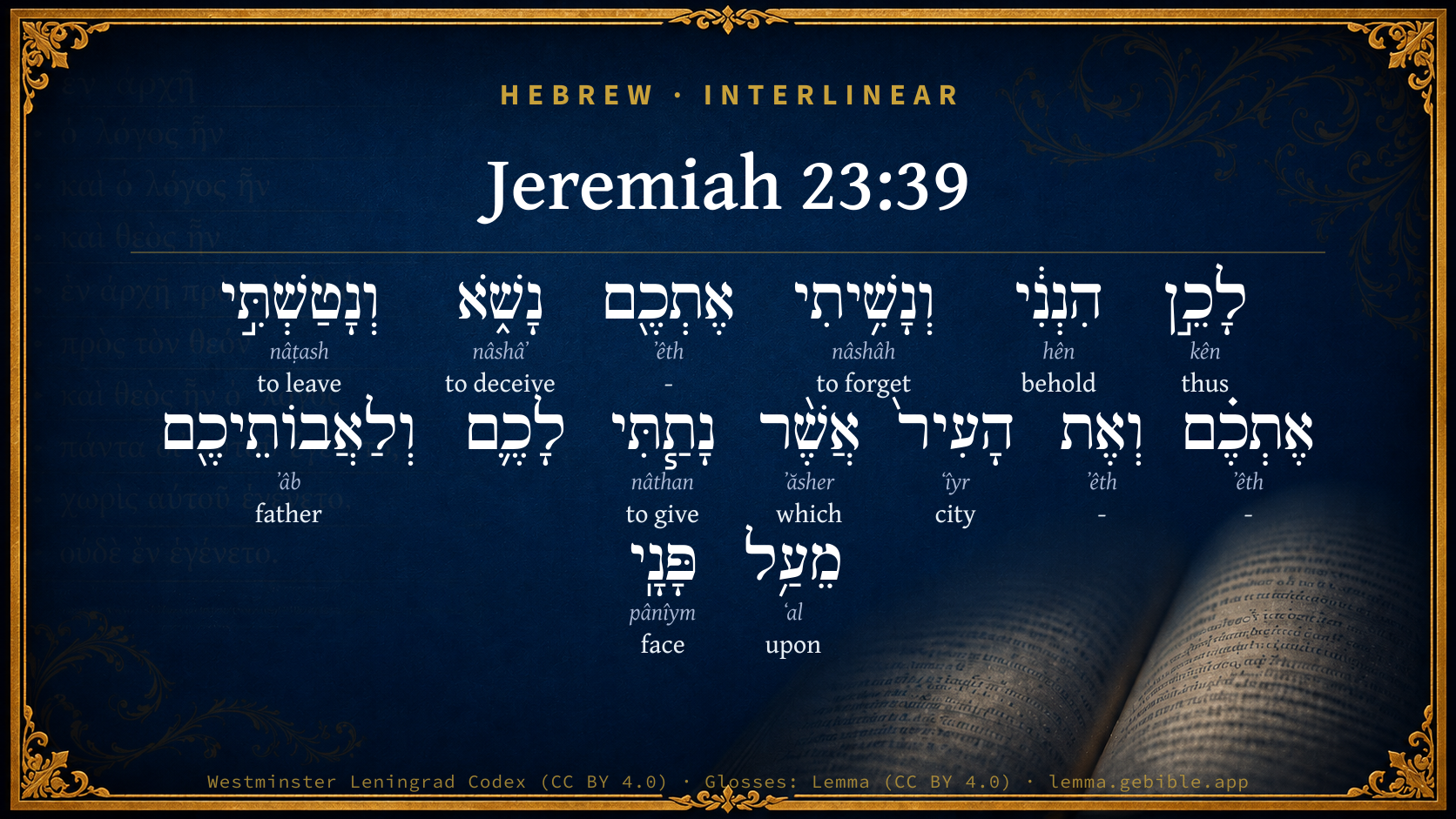
Hebrew (Westminster Leningrad Codex) Jeremiah 23:39 appears in the Hebrew Old Testament. The text above is from the Westminster Leningrad Codex. Each word links to its Strong’s number, a concise gloss, and parsing drawn from the Open Scriptures Hebrew Bible morphology. Click any word for its full Brown-Driver-Briggs (BDB) entry.
Download image
Cite this verse

Jeremiah 23:39 (World English Bible). Public Domain. Lemma interlinear Bible study tool, https://lemma.gebible.app/v/jeremiah/23/39.

Show BibTeX & RIS
BibTeX
RIS
English Translation
therefore, behold, I will utterly forget you, and I will cast you off, and the city that I gave to you and to your fathers, away from my presence:
World English Bible · Public Domain
Download a study sheet

One document with this verse’s original text, its word-by-word gloss line, the meaning frame, cross-references with their text, attributed commentary, and full source and license credits — printable, and it pastes into notes with its structure intact.

This verse Autodidact and up

Study sheet (.html) Plain text (.txt)

A passage Seminary Student

Up to 50 verses in one chapter. A passage sheet keeps up to 6 commentary sources and 12 cross-references per verse, in the order this page ranks them, and says so on the sheet whenever that leaves anything out. Ask for a single verse and you get the Autodidact verse sheet above.

Everything on this page stays free to read, with no account — the sheet is a download of what is already on screen, not access to it.

Want to remove ads? Support Godless Engineer
Compare translations 3

The same verse in 3 English versions, stacked beneath the original-language interlinear above. Click any original word for its lexicon entry.

Each is an independent rendering of the whole verse — the interlinear is not word-aligned to these translations.

Highlighted words mark where these versions differ — a whole-verse word diff, not a word-by-word alignment.

  • World English Bible Public Domain
    therefore, behold, I will utterly forget you, and I will cast you off, and the city that I gave to you and to your fathers, away from my presence:
  • King James Version Public Domain
    Therefore, behold, I, even I, will utterly forget you, and I will forsake you, and the city that I gave you and your fathers, and cast you out of my presence:
  • unfoldingWord Literal Text CC BY-SA 4.0
    therefore, behold, I will surely forget you and abandon you and the city that I gave to you and to your fathers, from at my face.

unfoldingWord Literal Text — © unfoldingWord, licensed CC BY-SA 4.0. Word-aligned USFM3 via Door43 (git.door43.org/unfoldingWord/en_ult).

Versions to compare (up to 4)

3 of 4 selected

Show all 18 translations

Every available English version of this verse, each an independent rendering of the whole verse.

  • World English Bible Public Domain
    therefore, behold, I will utterly forget you, and I will cast you off, and the city that I gave to you and to your fathers, away from my presence:
  • Berean Standard Bible Public Domain
    therefore I will surely forget you and will cast you out of My presence, both you and the city that I gave to you and your fathers.
  • Majority Standard Bible Public Domain
    therefore I will surely forget you and will cast you out of My presence, both you and the city that I gave to you and your fathers.
  • King James Version Public Domain
    Therefore, behold, I, even I, will utterly forget you, and I will forsake you, and the city that I gave you and your fathers, and cast you out of my presence:
  • American Standard Version (1901) Public Domain
    therefore, behold, I will utterly forget you, and I will cast you off, and the city that I gave unto you and to your fathers, away from my presence:
  • Revised Version (1885) Public Domain
    therefore, behold, I will utterly forget you, and I will cast you off, and the city that I gave unto you and to your fathers, away from my presence:
  • Geneva Bible (1599) Public Domain
    Therefore beholde, I, euen I will vtterly forget you, and I will forsake you, and the citie that I gaue you and your fathers, and cast you out of my presence,
  • Douay-Rheims (1899) Public Domain
    Therefore behold I will take you away carrying you, and will forsake you, and the city which I gave to you, and to your fathers, out of my presence.
  • Young's Literal Translation Public Domain
    Therefore, lo, I -- I have taken you utterly away, And I have sent you out, And the city that I gave to you, And to your fathers, from before My face,
  • Literal Standard Version CC BY-SA 4.0
    Therefore, behold, I have utterly taken you away, || And I have sent you out, || And the city that I gave to you, || And to your fathers, from before My face,
  • Unlocked Literal Bible CC BY-SA 4.0
    therefore, behold, I am about to pick you up and throw you away from me, along with the city that I gave you and your ancestors.
  • unfoldingWord Literal Text CC BY-SA 4.0
    therefore, behold, I will surely forget you and abandon you and the city that I gave to you and to your fathers, from at my face.
  • Darby Bible Public Domain
    therefore behold, I will utterly forget you, and I will cast you off, far from my face, and the city that I gave to you and to your fathers.
  • World Messianic Bible Public Domain
    therefore behold, I will utterly forget you, and I will cast you off with the city that I gave to you and to your fathers, away from my presence.
  • Webster's Bible Public Domain
    Therefore behold, I, even I, will utterly forget you, and I will forsake you, and the city that I gave to you and your fathers, and cast you out of my presence:
  • Free Bible Version CC BY-SA 4.0
    now I'm going to pick you up like a burden and throw you away, you and the city that I gave to you and your forefathers.
  • Bible in Basic English Public Domain
    For this reason, truly, I will put you completely out of my memory, and I will put you, and the town which I gave to you and to your fathers, away from before my face:
  • JPS Tanakh (1917) Public Domain
    therefore, behold, I will utterly tear you out, and I will cast you off, and the city that I gave unto you and to your fathers, away from My presence;

Literal Standard Version (2020), Covenant Press — licensed CC BY-SA 4.0. Text via the HelloAO Bible API (eBible.org). Unlocked Literal Bible (unfoldingWord) — licensed CC BY-SA 4.0. Text via the HelloAO Bible API (eBible.org). unfoldingWord Literal Text — © unfoldingWord, licensed CC BY-SA 4.0. Word-aligned USFM3 via Door43 (git.door43.org/unfoldingWord/en_ult). Free Bible Version, Dr. Jonathan Gallagher — licensed CC BY-SA 4.0. Text via the HelloAO Bible API (eBible.org).

Word by word

More ways to search: Search by grammar → Find every occurrence → Compare this word →

Practice this passage: Drill this verse → Learn its vocabulary →

וְנָשִׁ֥יתִי
nâshâh
H5382
“and · to forget”
Conjunction + Verb, Qal, Sequential Perfect, 1st Person, Common, Singular
Part of Speech
Conjunction + Verb
Stem
Qal
Form
Sequential Perfect
Person
1st Person
Gender
Common
Number
Singular
Full BDB Definition

Origin: a primitive root

TWOT: 1428

to forget, deprive - (Qal) to forget - (Niphal) to be forgotten - (Piel) to cause to forget - (Hiphil) to cause to forget, allow to be forgotten
  1. לָכֵ֣ן kên H3651 “to/for · thus” Preposition + Adverb
  2. הִנְנִ֔י hên H2005 “behold · me” Particle, Demonstrative + Suffix, Personal, 1st Person, Common, Singular
  3. אֶתְכֶ֖ם ʼêth H853 “- · you” Particle, Direct Object + Suffix, Personal, 2nd Person, Masculine, Plural
  4. נָשֹׁ֑א nâshâʼ H5377 “to deceive” Verb, Qal, Infinitive Absolute
  5. וְנָטַשְׁתִּ֣י nâṭash H5203 “and · to leave” Conjunction + Verb, Qal, Sequential Perfect, 1st Person, Common, Singular
  6. אֶתְכֶ֗ם ʼêth H853 “- · you” Particle, Direct Object + Suffix, Personal, 2nd Person, Masculine, Plural
  7. וְאֶת ʼêth H853 “and · -” Conjunction + Particle, Direct Object
  8. הָעִיר֙ ʻîyr H5892 “the · city” Particle, Definite Article + Noun, Common, Feminine, Singular, Absolute
  9. אֲשֶׁ֨ר ʼăsher H834 “which” Particle, Relative
  10. נָתַ֧תִּי nâthan H5414 “to give” Verb, Qal, Perfect, 1st Person, Common, Singular
  11. וְלַאֲבוֹתֵיכֶ֖ם ʼâb H1 “and · to/for · fathers · your” Conjunction + Preposition + Noun, Common, Masculine, Plural, Construct + Suffix, Personal, 2nd Person, Masculine, Plural
  12. מֵעַ֥ל ʻal H5921 “from · upon” Preposition + Preposition
  13. פָּנָֽי pânîym H6440 “face(s) · my” Noun, Common, Both, Plural, Construct + Suffix, Personal, 1st Person, Common, Singular

About this verse

These counts appear in no published source. They are computed here, from the morphology-tagged text and Lemma’s own curated glosses. What Lemma adds →

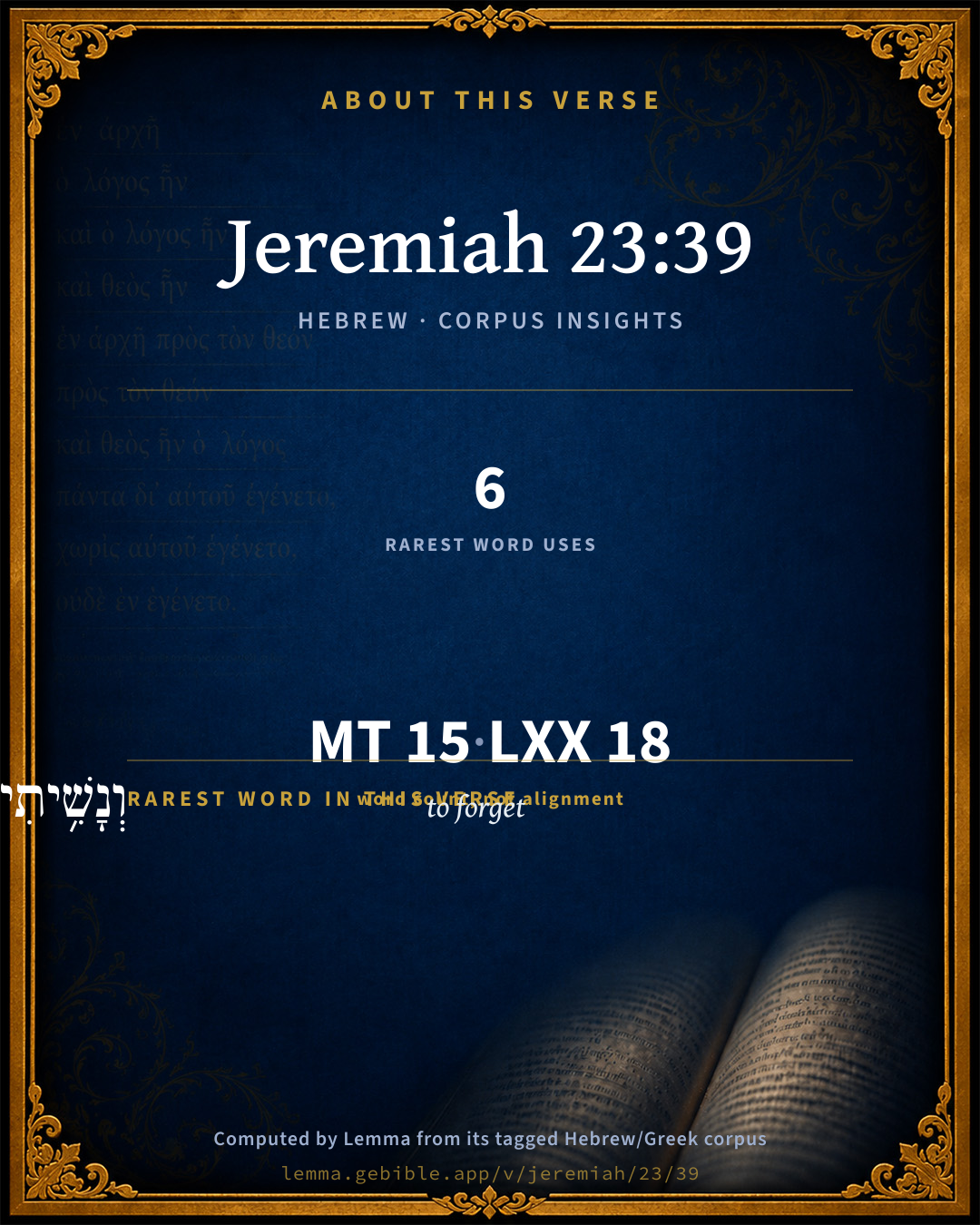
15
words
12
distinct lemmas
Prophets
section

Notable vocabulary

The rarest word here is וְנָשִׁ֥יתִי to forget H5382 — appearing just 6 times in the whole Hebrew Bible.

Shared distinctive vocabulary

וְנָשִׁ֥יתִי to forget H5382 occurs in 6 verses of the Hebrew Bible. Also found in:

Grammatical profile

  • 4 verbs
  • 3 nouns
  • 2 prepositions
  • 1 adverb
  • 5 particles

Verb forms

  • וְנָשִׁ֥יתִי Qal · Sequential Perfect
  • נָשֹׁ֑א Qal · Infinitive Absolute
  • וְנָטַשְׁתִּ֣י Qal · Sequential Perfect
  • נָתַ֧תִּי Qal · Perfect

Hebrew & Septuagint length

In the original languages it is 15 Hebrew tokens and 18 Greek tokens — but the two are counted differently (Hebrew bundles its prefixes and suffixes into one token; the Greek is in lemma form), so that isn’t a like-for-like length.

Cross-references

25

Topical passages linked to Jeremiah 23:39 in the Treasury of Scripture Knowledge — connected by theme and wording, ordered by reader-vote popularity; previews shown in the World English Bible.

  • Jeremiah 23:33 When this people, or the prophet, or a priest, shall ask you, saying, What is the burden of Yahweh? then shall you tell them, What burden! I will cast you off, says Yahweh.
  • Ezekiel 8:18 Therefore will I also deal in wrath; my eye shall not spare, neither will I have pity; and though they cry in my ears with a loud voice, yet will I not hear them.
  • Genesis 6:17 I, even, I do bring the flood of waters on this earth, to destroy all flesh having the breath of life from under the sky. Everything that is in the earth will die.
  • Leviticus 26:28 then I will walk contrary to you in wrath; and I also will chastise you seven times for your sins.
  • Deuteronomy 32:39 See now that I, even I, am he, There is no god with me: I kill, and I make alive; I wound, and I heal; There is none who can deliver out of my hand.
  • Psalms 51:11 Don't throw me from your presence, And don't take your holy Spirit from me.
  • Proverbs 13:13 Whoever despises instruction will pay for it, But he who respects a command will be rewarded.
  • Isaiah 48:15 I, even I, have spoken; yes, I have called him; I have brought him, and he shall make his way prosperous.
  • Isaiah 51:12 I, even I, am he who comforts you: who are you, that you are afraid of man who shall die, and of the son of man who shall be made as grass;
  • Jeremiah 7:15 I will cast you out of my sight, as I have cast out all your brothers, even the whole seed of Ephraim.
  • Jeremiah 32:28–35 Therefore thus says Yahweh: Behold, I will give this city into the hand of the Chaldeans, and into the hand of Nebuchadrezzar king of Babylon, and he shall take it:
  • Jeremiah 35:17 therefore thus says Yahweh, the God of hosts, the God of Israel: Behold, I will bring on Judah and on all the inhabitants of Jerusalem all the evil that I have pronounced against them; because I have spoken to them, but they have not heard; and I have called to them, but they have not answered.
  • Jeremiah 36:31 I will punish him and his seed and his servants for their iniquity; and I will bring on them, and on the inhabitants of Jerusalem, and on the men of Judah, all the evil that I have pronounced against them, but they didn't listen.
  • Jeremiah 52:3 For through the anger of Yahweh did it happen in Jerusalem and Judah, until he had cast them out from his presence. Zedekiah rebelled against the king of Babylon.
  • Lamentations 5:20 Why do you forget us forever, [And] forsake us so long time?
  • Ezekiel 5:8 therefore thus says the Lord Yahweh: Behold, I, even I, am against you; and I will execute judgments in the midst of you in the sight of the nations.
  • Ezekiel 6:3 and say, You mountains of Israel, hear the word of the Lord Yahweh: Thus says the Lord Yahweh to the mountains and to the hills, to the watercourses and to the valleys: Behold, I, even I, will bring a sword on you, and I will destroy your high places.
  • Ezekiel 9:6 kill utterly the old man, the young man and the virgin, and little children and women; but don't come near any man on whom is the mark: and begin at my sanctuary. Then they began at the old men that were before the house.
  • Ezekiel 34:11 For thus says the Lord Yahweh: Behold, I myself, even I, will search for my sheep, and will seek them out.
  • Ezekiel 34:20 Therefore thus says the Lord Yahweh to them: Behold, I, even I, will judge between the fat sheep and the lean sheep.
  • Hosea 4:6 My people are destroyed for lack of knowledge. Because you have rejected knowledge, I will also reject you, That you may be no priest to me. Because you have your God's law, I will also forget your children.
  • Hosea 5:14 For I will be to Ephraim like a lion, And like a young lion to the house of Judah. I myself will tear in pieces and go away. I will carry off, and there will be no one to deliver.
  • Hosea 9:12–17 Though they bring up their children, Yet I will bereave them, so that not a man shall be left. Indeed, woe also to them when I depart from them!
  • Matthew 25:41 Then he will say also to those on the left hand, 'Depart from me, you cursed, into the eternal fire which is prepared for the devil and his angels;
  • 2 Thessalonians 1:9 who will pay the penalty: eternal destruction from the face of the Lord and from the glory of his might,

Cross-references courtesy of OpenBible.info (CC BY 4.0).

Hebrew and Greek witnesses Masoretic Hebrew ↔ Greek Septuagint

The same verse in the two great witnesses to the Old Testament, shown verse-for-verse.

These are two independent witnesses, not word-aligned to each other, and the Septuagint is shown in lemma (dictionary) form.

Hebrew Jeremiah 23:39 Masoretic · Westminster Leningrad Codex

לָכֵ֣ן הִנְנִ֔י וְנָשִׁ֥יתִי אֶתְכֶ֖ם נָשֹׁ֑א וְנָטַשְׁתִּ֣י אֶתְכֶ֗ם וְאֶת הָעִיר֙ אֲשֶׁ֨ר נָתַ֧תִּי לָכֶ֛ם וְלַאֲבוֹתֵיכֶ֖ם מֵעַ֥ל פָּנָֽי

therefore, behold, I will utterly forget you, and I will cast you off, and the city that I gave to you and to your fathers, away from my presence:

World English Bible · Public Domain

Greek LXX Structure differs

In the Septuagint, Jeremiah is about an eighth shorter than the Hebrew and arranges its material differently — the Oracles Against the Nations (Hebrew chapters 46–51) appear in the middle of the Greek book, after 25:13. Because the chapter and verse boundaries do not line up, a verse-for-verse comparison with the Hebrew is not shown.

A verse-for-verse comparison isn’t shown here because the chapters and verses don’t line up. Switch to the LXX edition with the MT / LXX toggle above to read the Greek directly.

On this verse, Joseph Benson's Commentary discusses the Septuagint’s reading. Read the note in Commentary ↓

Hebrew: Westminster Leningrad Codex (CC BY 4.0). Greek: Septuagint (public domain); English from a public-domain English Septuagint. How the Septuagint differs from the Hebrew →

Targum (Aramaic paraphrase)

1

The Targum is the ancient Jewish Aramaic paraphrase of the Hebrew Scriptures — an interpretive translation, not the Hebrew text itself. Onkelos (literal) and Pseudo-Jonathan (expansive) render the Torah, and Jonathan the Prophets. Coverage is partial: where no permissively-licensed English translation exists for a verse, only the Aramaic is shown. This is verse-level text, not a word-by-word alignment to the Hebrew.

  1. Targum Jonathan Prophets (Joshua–Malachi)
    בְּכֵן הָאֲנָא שְׁלַח רוּגְזִי וְאֶרְטוֹשׁ יַתְכוֹן מִרְטַשׁ וְאַרְחֵיק יַתְכוֹן וְיַת קַרְתָּא דִיהָבִית לְכוֹן וְלַאֲבָהַתְכוֹן מִקֳבֵיל מֵימְרִי:

    (no public-domain English translation for this verse)

    Targum Jonathan — Aramaic: “Mikraot Gedolot” (public domain). English: “Sefaria Community Translation” (CC0 1.0 (public-domain dedication)); “London "Chaldee Paraphrase," 1871” (public domain). Text via Sefaria.

Commentary

Notes on Jeremiah 23:39 from classic Christian and Jewish commentators (each source and its license shown beneath its notes). The classic Christian expositions comment on the surrounding passage and are grouped to its opening verse, so a note may address several verses; the Jewish commentaries on the Tanakh (Rashi and others) are per-verse, so they appear only where the commentator wrote on this verse.

Lemma curates 59 commentaries, every one of them public domain or Creative Commons licensed, each selected and text-cleaned for this edition rather than reprinted as found. About our sources →

Trapp's Complete Commentary

John Trapp

Jer 23:39 Therefore, behold, I, even I, will utterly forget you, and I will forsake you, and the city that I gave you and your fathers, [and cast you] out of my presence:

Ver. 39. Therefore, behold, I, even I, will utterly forget you.] I nunc ergo, lude pasquillis et putidis dicteriis, saith one. Go thy ways now, thou that thinkest it a goodly thing to gibe and jeer at God’s ministers and their messages. Consider of this dreadful denunciation, and thereby conceive aright of the heinousness of thy sin; for God doth not use to kill flies upon men’s foreheads with beetles, to threaten heavy punishments for light offences.

John Trapp, A Commentary or Exposition upon All the Books of the Old and New Testament (1647–1656) — public domain. Text from a community e-Sword module.

Joseph Benson's Commentary

Jer 23:39. Therefore, behold, I will utterly forget you — The Vulgate renders this clause, Propterea ecce ego tolam vos portans, Therefore, behold, I will take you away removing you, (taking the verb נשׁה, nashah, in the sense of נשׂא, nasa, as words of a like sound are often of a promiscuous signification,) which makes the sense more pertinent to the foregoing verses. The LXX. interpret the clause to the same purpose, Δια τουτο ιδου εγω λαμβανω και ρασσω υμας, &c. Therefore, behold I take you, and cast you down, or, dash you, to the ground, and the city which I gave to you and to your fathers.

Joseph Benson's Commentary on the Old and New Testaments (1811–1818) — public domain. Text from a community e-Sword module.

Geneva Bible (1599)

Geneva Bible translators

Or, take you away.

Geneva Bible (1599) marginal notes — public domain. Text via Bolls.life.

Jamieson, Fausset & Brown

Robert Jamieson, A. R. Fausset & David Brown

I will . . . forget you--just retribution for their forgetting Him (Hos 4:6). But God cannot possibly forget His children (Isa 49:15). Rather for "forget" translate, "I will altogether lift you up (like a 'burden,' alluding to their mocking term for God's messages) and cast you off." God makes their wicked language fall on their own head [CALVIN]. Compare Jer 23:36 : "every man's word shall be his burden."

Jamieson, Fausset & Brown — Commentary Critical and Explanatory on the Whole Bible (1871) — public domain (CC PDM 1.0). Text via the HelloAO Bible API.

Adam Clarke's Commentary

Verse 39. I will utterly forget you, and I will forsake you and the city] Dr. Blayney translates: - I will both take you up altogether, and will cast you off together with the city. Ye are a burden to me: but I will take you up, and then cast you off. I will do with you as a man weary with his burden will do; cast it off his shoulders, and bear it no more.

Adam Clarke's Commentary on the Bible (1810–1826) — public domain. Text from a community e-Sword/MySword module.

John Calvin's Commentaries

If ye shall say, even when I warn you not to speak in this manner; if then ye persevere in this obstinacy, Behold I, etc.; God here declares that he would take vengeance. As to this sentence, most interpreters derive the verb from נשה, nushe, making ה, he, the final letter; but I doubt the correctness of this; yet if this explanation be adopted, we must still hold that the Prophet alludes to the verb, to take away, which immediately follows. But I am disposed to take another view, that God would by removing remove them. It must be noticed that the word משא, mesha, which has often been mentioned, comes from the same root; משא, mesha, a burden, is derived from נשא, nusha, to remove or take away. As therefore this proverb was commonly used, that prophetic doctrine ever brought some burden and trouble, God answers, “I will take you away;” that is, “ye shall find by experience how grievous and burdensome your wickedness is to me, it shall rebound on your heads; ye have burdened and treated with indignity my word, and I will treat you with indignity,” but in what manner? I will take you away even by taking you away. If any one approves more of the sense of forgetting, let him follow his own judgment; but that explanation appears to me unmeaning, “I will forget you,” except נשא, nusha, be taken in the second place as signifying to take away. “I will forget you, that I may take you away.”

He adds, And I will pluck you up; which some render, “I will forsake you,” but they seem not to understand what the Prophet intended; for he declares something more grievous and more dreadful than before, when he says, I will pluck you up; and yet this sense does not satisfy me. The verb נטש, nuthash, means to extend, and metaphorically to cast far off; and casting off or away seems to suit the passage best. God then would not only remove or take away the Jews from their own place, but would also cast them far off into distant countries. He thus denounces on them an exile, by which they were to be driven as it were into another world. For had they dwelt in the neighborhood, it would have been more tolerable to them, but as they were to be driven away, as by a violent storm to the farthest and remotest regions, it was much more grievous.

He afterwards says, And the city also which I gave to you and to your fathers The verbs, to cast away and to pluck up, do not well suit stones; but as to the sense, it may rightly be said that God would take away the city with its inhabitants, as though they were driven away by the wind. And this was added designedly, for the Jews relying on this promise, “This is my rest for ever, here will I dwell,” thought it impossible that the sanctuary of God would ever be destroyed. As then this vain confidence deceived them, that the city which God had chosen as his habitation would stand always, the Prophet expressly adds that the city itself would perish.

And it is also added, that it was given to them and their fathers He anticipates all objections, and shakes off from the Jews the vain hope by which they were inebriated, even that the city was given perpetually to them, and that God resided there to defend them; “This donation,” he says, “will not keep you nor the city itself from destruction.” He adds, From my presence; for it was customary for them to pretend God’s name, when they sought to harden their hearts against the threatenings of the prophets; but God here answers them and says, from my presence; as though he had said, “In vain do ye harbor the thought respecting the perpetuity of the city and the Temple; for this depends on my will and good pleasure. As ye then stand or fall as it seems right to me, I now declare that ye shall be ejected and wholly removed from my presence.” It follows, —

John Calvin's Commentaries (1540-1563) — public domain. Text from the Calvin Translation Society English edition (1840s-50s) via the Christian Classics Ethereal Library (ccel.org). Calvin's coverage is partial (roughly two-thirds of the Bible); uncommented books and verses are honest gaps, never fabricated. The 19th-century editor's footnotes and remarks are omitted so the notes are faithfully Calvin's own voice.

Ellicott's Commentary for English Readers

(39) I, even I, will utterly forget you . . .—A very slight alteration in a single letter of the Hebrew verb gives a rendering which was followed by the LXX. and Vulgate, and is adopted by many modern commentators, and connects it with the root of the word translated “burden”—I will take you up as a burden, and cast you off. The words in italics, and cast you, in the latter clause have nothing corresponding to them in the Hebrew, but show that some at least of the translators felt that this was the true meaning of the words. This “everlasting reproach” was to be the outcome of these big swelling words of vanity in which they claimed prophetic inspiration.

A Bible Commentary for English Readers, edited by Charles John Ellicott (1878–1897) — public domain. Text from a community e-Sword module.

The Cambridge Bible for Schools and Colleges

gen. ed. J. J. S. Perowne

39. utterly forget you] The alternative in mg. lift you up, as rendering the Hebrew verb from which “burden” is derived, is clearly right, that substantive being the key-word of the passage, and the two verbs being very similar. So LXX, Syr., Vulg. The difficulty which we feel now in understanding why the punishment for the use of the word was to be so terrible doubtless did not exist when the passage was composed.

The Cambridge Bible for Schools and Colleges (gen. ed. J. J. S. Perowne; Cambridge University Press, 1878–1918) — public domain. Text from a community e-Sword module.

John Gill's Exposition

Therefore, behold, I, even I, will utterly forget you,.... That is, so behave towards them, as though they were entirely out of his sight and mind; show no affection to them; take no care of them; bestow no favours upon them; and no more have them under his protection. In the word here used, and rendered "forget", and the word before used for a "burden", there is an elegant play on words (w), which another language will not easily express; no doubt there is an allusion to that word in this;

and I will forsake you; neither vouchsafe them his gracious presence, nor his powerful protecting presence, but give them up to the enemy:

and the city that I gave you and your fathers; the city of Jerusalem, which he had given to them to dwell in, and their fathers before them; but now they having sinned against him, and provoked him; therefore, notwithstanding this grant of the place to them, and which is mentioned that they might not depend upon it, and buoy up themselves with hopes that they should be in safety on that account; as he had forsaken them, he would forsake that, and the temple in it, and give it up into the hand of the Chaldeans:

and cast you out of my presence; as useless and loathsome. The Targum is,

"I will remove you far away, and the city which I save you and your fathers from my word.''

it signifies their going into captivity.

(w) "forgetting I will forget", and "a burden".

John Gill's Exposition of the Whole Bible (1746–1763) — public domain (CC PDM 1.0). Text via the HelloAO Bible API.

Albert Barnes' Notes on the Bible

Translate, “Therefore, behold, I will even take you up (or will burden you), and I will cast you, and the city which I gave you and your fathers, out of my presence.”

Albert Barnes' Notes on the Bible (1834–1885) — public domain. Text from a community e-Sword/MySword module.

Haydock's Catholic Bible Commentary

Take. Hebrew of the Masorets, (Calmet) "I, even I, will utterly forget (Protestants; Haydock) or abandon you." (Chaldean) But the sense of the Septuagint and Vulgate seems preferable. (Calmet)

George Leo Haydock (1774–1849), Haydock's Catholic Family Bible and Commentary, 1859 edition — public domain. Excludes Psalms (Douay-Rheims chapter numbering differs from Protestant) and Deuterocanonical books (Catholic canon only).

Matthew Poole's English Annotations

I will forget you as to my affection, and that is more than if all your friends forgot you. There is a great emphasis in the doubling of the pronoun,

I, even I. I will forsake you as to the presence of my special gracious providence. And do not flatter yourselves that I will not do it, because of your fathers, or because I gave this city to your fathers, for that very city I will withdraw my special providence from, and that land, which heretofore was called the land which the Lord thy God careth for, upon which the eyes of the Lord are always, from the beginning of the year even to the end of the year, Deu 11:12. And I will cast both city and people out of my gracious presence; so as I will no longer do them good as I have done.

Matthew Poole's English Annotations on the Holy Bible (1683–1685) — public domain. Text from a community e-Sword/MySword module.

Whedon's Commentary on the Bible

Daniel D. Whedon

39. I…

will utterly forget you — As you have forgotten me. Another reading of this text is preferred by many, but without sufficient reason.

Daniel D. Whedon (gen. ed.), Commentary on the Old and New Testaments (1874–1909) — public domain. Text from a community e-Sword module.

The Pulpit Commentary

I, even I, will utterly forget you; rather, I will even take you up, and east you off. This involves a slight difference in the pronunciation of the text from that adopted by the Massoretes, but is adopted by the Septuagint, Peshito, Vulgate, a few manuscripts, and most critics; it is, in fact, almost required by the figure which fills the verse. And cast you out of my presence. "And cast you" is not in the Hebrew; nor is it necessary to supply the words, if the preceding clauses be rightly translated.

The Pulpit Commentary (1880–1919), ed. H.D.M. Spence-Jones & Joseph S. Exell — public domain. Text from a community e-Sword module.

Rashi

Rabbi Shlomo Yitzchaki (Rashi)

and I will exile an expression of “the sinew that was dislocated (גִיד הַנָֹּשֶה)” (Gen. 32:33), and an expression of “their might has failed (נָֹשְתָה),” it jumps and moves from place to place.

Rashi on the Tanakh — English translations: “The Judaica Press complete Tanach with Rashi, translated by A. J. Rosenberg” (CC BY 4.0); “Pentateuch with Rashi's commentary by M. Rosenbaum and A.M. Silbermann, 1929-1934” (public domain); “The Metsudah Tanach series, Lakewood, N.J” (CC BY 4.0); and “The Book of Joshua, Metsudah Publications, 1997” (CC BY 4.0). Text via Sefaria.

Lesson kit

Teaching starters — assembled from the data on this page, not authored interpretation. Every prompt links to the verse data it draws on. Edit before teaching.

Jeremiah, in the Prophets, opens this verse with 15 words (12 distinct Hebrew lemmas). Its most distinctive word is nâshâh (“to forget”). A historical commentator’s framing appears above. Read the whole chapter for the surrounding context.

Discussion questions

  1. The word nâshâh carries the sense “to forget.” How does it shape the verse?
  2. Genesis 41:51 shares the word «to forget» with this verse. How do the two illuminate each other?
  3. These translations render this verse differently; the difference is in the English rendering, not the original. What questions does that raise?
  4. The verb «וְנָשִׁ֥יתִי» is Qal Sequential Perfect. How does its form color the action?
  5. Reading how Trapp's Complete Commentary and Joseph Benson's Commentary read this verse, where do the two commentators agree and where do they part?

Things to notice

Reading settings

Reading text

Shown beneath each verse's original-language words.

Old Testament
Old Testament edition

Read the OT as the Masoretic Hebrew (MT) or the Greek Septuagint (LXX).

English shown for the Greek Septuagint (in the Hebrew ↔ Greek comparison).

Comparing translations? Open the Compare panel on any verse page to stack up to four side by side.