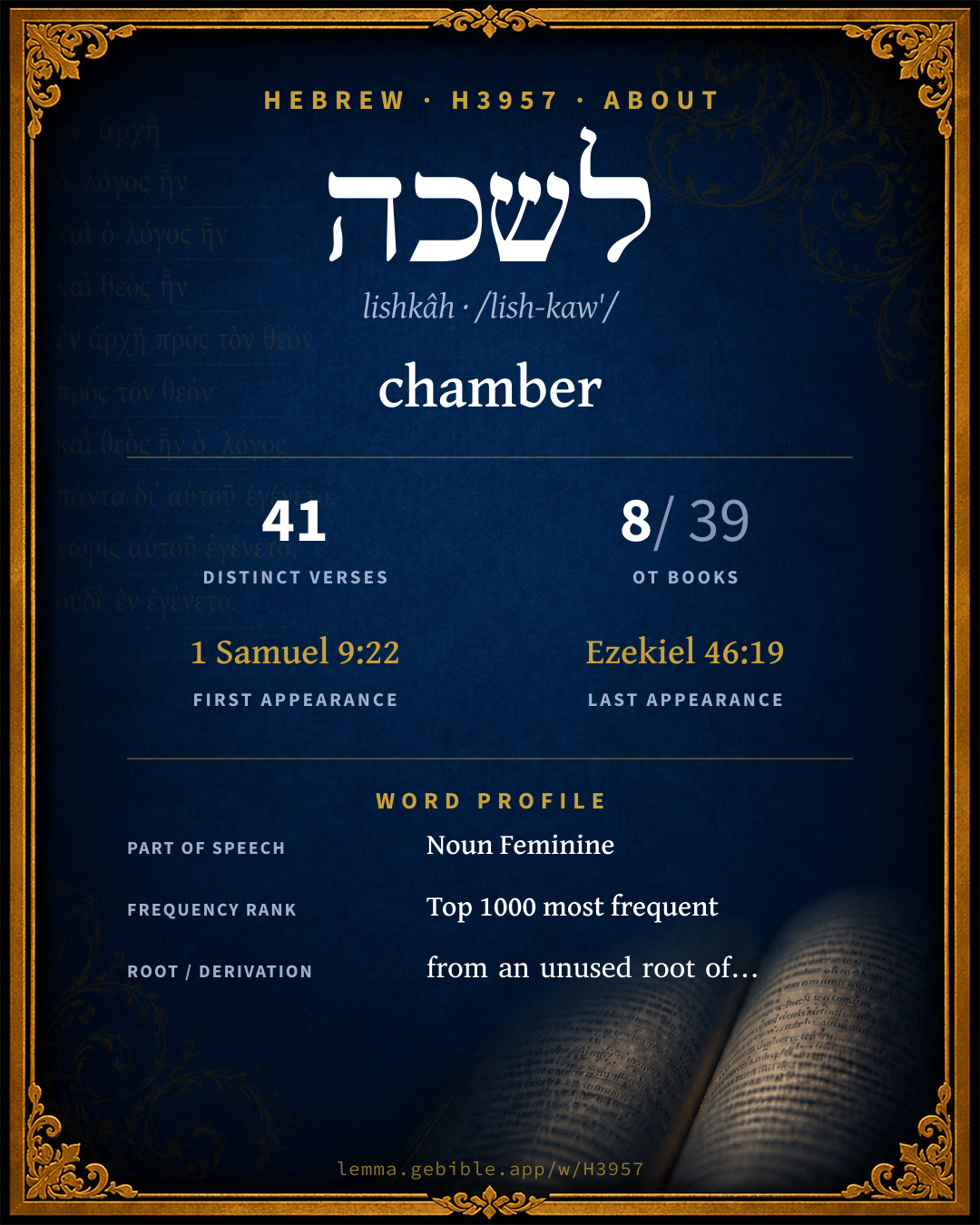
לִשְׁכָּה
chamber
Full lexicon entry — Brown-Driver-Briggs (BDB)
From Brown-Driver-Briggs (BDB)
Where this word appears
See every Absolute-state word in the Hebrew Bible →
Grammar key — what these labels mean
Part of speech
- Noun
- A naming word — a person, place, thing, or idea.
Noun type
- Common
- A common noun — a general class of person, place, or thing (“king,” “city,” “water”), not a specific name.
State
- Absolute
- The independent form of a noun, not bound to a following word.
- Construct
- A noun bound to a following noun in a possessive / “of” relationship (the construct chain).
Gender
- Feminine
- Grammatically feminine.
Number
- Plural
- More than one (in Hebrew, generally three or more).
- Singular
- One.
Every verse where H3957 appears in the Book of Ezekiel — 19 distinct verses. Click any verse to open its interlinear word-by-word view. Verse text shown in the World English Bible for context — . Each verse’s Hebrew form is shown with its reference; the English is not keyword-highlighted, since the data carries no word-level English alignment. Use “Compare translations” on any verse to read it across multiple English versions. This concordance covers the Hebrew Bible; Septuagint (Greek Old Testament) occurrences are not indexed here.
Ezekiel
- Ezekiel 40:17 לְשָׁכוֹת֙ לְשָׁכ֖וֹת n c fp n c fp Then brought he me into the outer court; and, behold, there were chambers and a pavement, made for the court round about: thirty chambers were on the pavement.
- Ezekiel 40:38 וְ/לִשְׁכָּ֣ה conj + n c fs A chamber with the door of it was by the posts at the gates; there they washed the burnt offering.
- Ezekiel 40:44 לִֽשְׁכ֣וֹת n c fp cs Outside of the inner gate were chambers for the singers in the inner court, which was at the side of the north gate; and their prospect was toward the south; one at the side of the east gate having the prospect toward the north.
- Ezekiel 40:45 הַ/לִּשְׁכָּ֗ה ptcl def.art + n c fs He said to me, This chamber, whose prospect is toward the south, is for the priests, the keepers of the charge of the house;
- Ezekiel 40:46 וְ/הַ/לִּשְׁכָּ֗ה conj + ptcl def.art + n c fs and the chamber whose prospect is toward the north is for the priests, the keepers of the charge of the altar: these are the sons of Zadok, who from among the sons of Levi come near to Yahweh to minister to him.
- Ezekiel 41:10 הַ/לְּשָׁכ֜וֹת ptcl def.art + n c fp Between the chambers was a breadth of twenty cubits round about the house on every side.
- Ezekiel 42:1 הַ/לִּשְׁכָּ֗ה ptcl def.art + n c fs Then he brought me forth into the outer court, the way toward the north: and he brought me into the chamber that was over against the separate place, and which was over against the building toward the north.
- Ezekiel 42:4 הַ/לְּשָׁכ֜וֹת ptcl def.art + n c fp Before the chambers was a walk of ten cubits' breadth inward, a way of one cubit; and their doors were toward the north.
- Ezekiel 42:5 וְ/הַ/לְּשָׁכ֥וֹת conj + ptcl def.art + n c fp Now the upper chambers were shorter; for the galleries took away from these, more than from the lower and the middle, in the building.
- Ezekiel 42:7 הַ/לְּשָׁכ֔וֹת הַ/לְּשָׁכ֑וֹת ptcl def.art + n c fp ptcl def.art + n c fp The wall that was outside by the side of the chambers, toward the outer court before the chambers, the length of it was fifty cubits.
- Ezekiel 42:8 הַ/לְּשָׁכ֗וֹת ptcl def.art + n c fp For the length of the chambers that were in the outer court was fifty cubits: and, behold, before the temple were one hundred cubits.
- Ezekiel 42:9 לשכות הַ/לְּשָׁכ֣וֹת n c fp ptcl def.art + n c fp From under these chambers was the entry on the east side, as one goes into them from the outer court.
- Ezekiel 42:10 לְשָׁכֽוֹת n c fp In the thickness of the wall of the court toward the east, before the separate place, and before the building, there were chambers.
- Ezekiel 42:11 הַ/לְּשָׁכ֗וֹת ptcl def.art + n c fp The way before them was like the appearance of [the way of] the chambers which were toward the north; according to their length so was their breadth: and all their exits were both according to their fashions, and according to their doors.
- Ezekiel 42:12 הַ/לְּשָׁכ֗וֹת ptcl def.art + n c fp According to the doors of the chambers that were toward the south was a door at the head of the way, even the way directly before the wall toward the east, as one enters into them.
- Ezekiel 42:13 לִֽשְׁכ֨וֹת לִֽשְׁכ֣וֹת לִֽשְׁכ֣וֹת n c fp cs n c fp cs n c fp cs Then said he to me, The north chambers and the south chambers, which are before the separate place, they are the holy chambers, where the priests who are near to Yahweh shall eat the most holy things: there shall they lay the most holy things, and the meal-offering, and the sin-offering, and the trespass-offering; for the place is holy.
- Ezekiel 44:19 בְּ/לִֽשְׁכֹ֣ת prep + n c fp cs When they go forth into the outer court, even into the outer court to the people, they shall put off their garments in which they minister, and lay them in the holy chambers; and they shall put on other garments, that they not sanctify the people with their garments.
- Ezekiel 45:5 לְשָׁכֹֽת n c fp Twenty-five thousand in length, and ten thousand in breadth, shall be to the Levites, the ministers of the house, for a possession to themselves, [for] twenty chambers.
- Ezekiel 46:19 הַ/לִּשְׁכ֤וֹת ptcl def.art + n c fp cs Then he brought me through the entry, which was at the side of the gate, into the holy chambers for the priests, which looked toward the north: and, behold, there was a place on the hinder part westward.
About this entry
At a glance — auto-summarized from this page’s data, not written by a person. Every figure links to its source below. This summary describes the numbers; it doesn’t interpret them.
לשכה (lishkâh) is a Hebrew noun most often rendered “chamber.” Translators differ — “chambers” in the King James Version, then “rooms” (unfoldingWord Literal Text), as the renderings breakdown shows. With 41 verses in 8 books, it is a moderately common word in the Hebrew Bible. It concentrates in Ezekiel, which alone accounts for 46% of its uses. It first appears in 1 Samuel 9:22. The sections below give every sense, occurrence, and version rendering.
Gloss history
Strong's 1890 vs modern scholarship
About this word
Strong's H3957 catalogs a Hebrew word from the Hebrew Old Testament.
These counts are not copied from any lexicon or concordance. They are computed here, from the morphology-tagged Hebrew Old Testament. What Lemma adds →
- 41
- distinct verses
- The word appears in 41 distinct verses.
- 8 / 39
- OT books
- The word appears in 8 of 39 Old Testament books.
- #767
- by frequency
- Top 1000 most frequent Hebrew words (rank 767 of 8,640 Hebrew words by occurrence).
View all 41 occurrences in the concordance →
By section of the Old Testament
By traditional corpus
Conventional, traditional groupings — biblical authorship is debated, so this is a traditional corpus grouping, not an authorship claim. Each share is this word’s portion of its verses in that division of the Hebrew canon. Each figure is a share of the word’s 41 distinct verses.
- Prophets (Nevi'im) 27 verses · 66%
- Writings (Ketuvim) 14 verses · 34%
How translations render this word
Counts come from each version’s own published word-to-Strong’s tagging or interlinear alignment — an approximate guide to how each version renders this word, not a word-level alignment the data otherwise carries. Because each total is that version’s own tagged count, the per-version totals vary from one another and need not match the appearance or distinct-verse counts above. These counts may also differ from a printed concordance because Lemma counts each distinctly tagged rendering and does not collapse phrase taggings into a single head-word total. This is a fixed set of word-tagged versions (KJV, ASV, BSB, ULT) and does not change with the reading translation you choose elsewhere. Each version’s license is shown beside its name below (and on Sources).
- King James Version: Chambers 24×, Chamber 15×
- American Standard Version: Chambers 19×, Chamber 14×
- Berean Standard Bible: Chambers 16×, Chamber 11×, Storerooms 5×
- unfoldingWord Literal Text: Rooms 14×, Chambers 9×, Room 4×
King James Version Public Domain
Renders H3957 across 47 tagged occurrences — most commonly:
Plus 8 renderings that appear only once — usually multi-word phrases or single function words the recovered tagging swept in, not distinct renderings.
American Standard Version Public Domain
Renders H3957 across 46 tagged occurrences — most commonly:
Plus 13 renderings that appear only once — usually multi-word phrases or single function words the recovered tagging swept in, not distinct renderings.
Berean Standard Bible Public Domain
Renders H3957 across 45 tagged occurrences — most commonly:
Plus 8 renderings that appear only once — usually multi-word phrases or single function words the recovered tagging swept in, not distinct renderings. Not rendered by a distinct English word in 2 further occurrences.
unfoldingWord Literal Text CC BY-SA 4.0
Renders H3957 across 43 tagged occurrences — most commonly:
Plus 11 renderings that appear only once — usually multi-word phrases or single function words the recovered tagging swept in, not distinct renderings.
Senses in the full BDB
What do BDB’s symbols mean?
BDB uses these scholarly abbreviations:
| Symbol | Meaning |
|---|---|
| 𝔊 | the Septuagint (the ancient Greek translation, LXX) |
| 𝔙 | the Vulgate (the Latin translation) |
| 𝔖 | the Syriac version (the Peshitta) |
| 𝔗 | the Targum (the Aramaic translation) |
| ψ | the Psalms |
| √ | root (the underlying root or stem) |
| ‖ | parallel passage (a synonymous or contrasted parallel) |
| † | the dagger: every passage where the word occurs is cited |
The 5 senses and sub-senses the full Brown-Driver-Briggs lexicon distinguishes for this word, in lexicon order (not ranked by frequency), with BDB’s own verbatim wording and sub-sense lettering. Shown in Hebrew script with BDB’s own scholarly abbreviations. The condensed entry is in the Lexicon Entry tab. See also the Forms in the corpus table below.
- 1.
- a. of room connected with a sanctuary (בָּמָה), where sacrif. meal was eaten 1 S 9:22, insert also prob. 1:18 (𝔊 We Dr Klo Bu). e.g. 1 Samuel 9:22
- b. connected with Sol.’s temple, where wine offered to Rechabites Je 35:2, 4, cf. v 4(×2); one where prophecy read 36:10 (both these appar. open, cf. Gie Je 35:2); cf. לִשְׁכַּת נְתַן־מֶלֶךְ הַסָּרִיס.. בַּפַּרְוָרִים 2 K 23:11; used of Levites’ cells 1 Ch 9:33; = store-rooms v 26 (‖ אֹצָרוֹת, 23:28; 28:12 2 Ch 31:11. e.g. Jeremiah 35:2
- c. in Ezek.’s temple, cells for priests, singers, etc. Ez 40:17(×2), 38, 44, 45, 46 + 41:10 (del. Co Bthl), 42:1, 4, 7(×2), 8, 11 + v 12 (del. Co Bthl); in three tiers, cf. הַלְּ׳ הָעֶלְיוֹנֹת 42:5 (vid. v 3), (45:5 read עָרִים לָשֶׁבֶת 𝔊 Sm Co SgfrKauAT Bthl); ל׳ הַקֹּדֶשׁ for sacred uses 42:13(×3); 44:19; 46:19. e.g. Ezekiel 40:17
- d. in second temple, as store-rooms Ezr 8:29 Ne 10:38, 39 (‖ בֵּית הָאוֹצָר), v 40; used by individuals Ezr 10:6 Ne 13:5 (ל׳ גְּדוֹלָה), v 8, in gen. v 4, 9. e.g. Ezra 8:29
- 2. of scribe’s room in royal palace Je 36:12, 20, 21. e.g. Jeremiah 36:12
Senses from the full Brown-Driver-Briggs lexicon (Brown, Driver, Briggs; Oxford 1906 — public domain), digitized via Sefaria, supplemented by the OpenScriptures HebrewLexicon (CC BY 4.0). Full attribution on Sources.
Word origin
n.f. room, chamber, hall, cell, lishka (NH id. 𝔗 לִשְׁכְּתָא; cf. also נִשְׁכָּה; on the lishka v. NowArch. ii. 37, 52, 79; BöGeogr. I, xvii. 438 (ed. Leusd.) comp. Gk. λέσχη, cf. RSSem. i. 236 (2nd ed. 254) al.);—ל׳ Ez 40:38 +; cstr. לִשְׁכַּת 2 K 23:11 +; c. ה loc. לִשְׁכָּ֑תָה 1 S 9:22; pl. לְשָׁכוֹת Ez 40:17 +; cstr. לִשְׁכוֹת Ne 10:38 +;—
— Brown-Driver-Briggs (Oxford 1906, public domain), digitized via Sefaria, supplemented by the OpenScriptures HebrewLexicon (CC BY 4.0). See Sources.
Origin: from an unused root of uncertain meaning
Jastrow Dictionary
A second Hebrew/Aramaic lexicon for comparison, covering Aramaic and post-biblical (Talmudic, Targumic, Midrashic) usage that the biblical-Hebrew BDB does not. Matched by lemma rather than by Strong’s number, so a lemma may carry more than one Jastrow headword (shown separately below), and the entries cover usage well beyond the Bible.
לִשְׁכָּה
- (b. h.) cell, chamber, compartment. Midd. V, 4 לִשְׁכַּת העץ the compartment (in the Temple) for the storage of wood; ל׳ הגולה the compartment containing the pilgrims’ well; ל׳ הגזית, v. גָּזִית.—Esp. הל׳ the Temple treasury for congregational sacrifices. Shek. III, 2 בשלש … תורמין את הל׳ the funds in the treasury are arranged in three piles. Ib. תרומת הל׳ the treasure of &c. Ib. IV, 1 נוטלין שכרן מתרומת הל׳ receive their wages out of the Temple fund; a. fr.—Pl. לְשָׁכוֹת. Midd. V, 3. Tam. III, 3; a. e.
A Dictionary of the Targumim, the Talmud Babli and Yerushalmi, and the Midrashic Literature (Marcus Jastrow; London, Luzac, 1903) — Public Domain. Digitized via Sefaria. Digitized via Sefaria. Full attribution on Sources.
Forms in the corpus
The 36 distinct written forms H3957 takes in the Hebrew Bible, most frequent first — each parse links to that state’s occurrences in the concordance. Hebrew forms include their vowel points and cantillation, so a single lemma takes many written forms.
Same root — word family
Other BDB entries built from the same root as H3957, grouped by Strong’s listed origin. These share a root / origin per the lexicon — not necessarily a shared meaning. Each links to that word’s own entry.
Derived from this word
Compare all same-root words → They share a root, not necessarily a meaning.
Septuagint verse parallels
This word appears in 34 verses that also exist in the Greek Old Testament (Septuagint), out of the 41 Hebrew verses it occurs in. You can read those verses in Greek by switching the Old Testament edition to the Septuagint.
Read these verses in the Septuagint
- 1 Samuel 9:22
- 2 Kings 23:11
- 1 Chronicles 9:26
- 2 Chronicles 31:11
- Ezra 8:29
- Jeremiah 35:2
- Ezekiel 40:17
This is a verse-level parallel only — the same verses exist in both the Hebrew and Greek Old Testaments. No word-level Hebrew↔Greek correspondence is claimed: the data carries no such alignment, so no Greek word is shown as this Hebrew word’s translation. Coverage is not total — the Septuagint omits the deuterocanon and renumbers the Psalms, so some Hebrew verses have no direct Greek parallel.