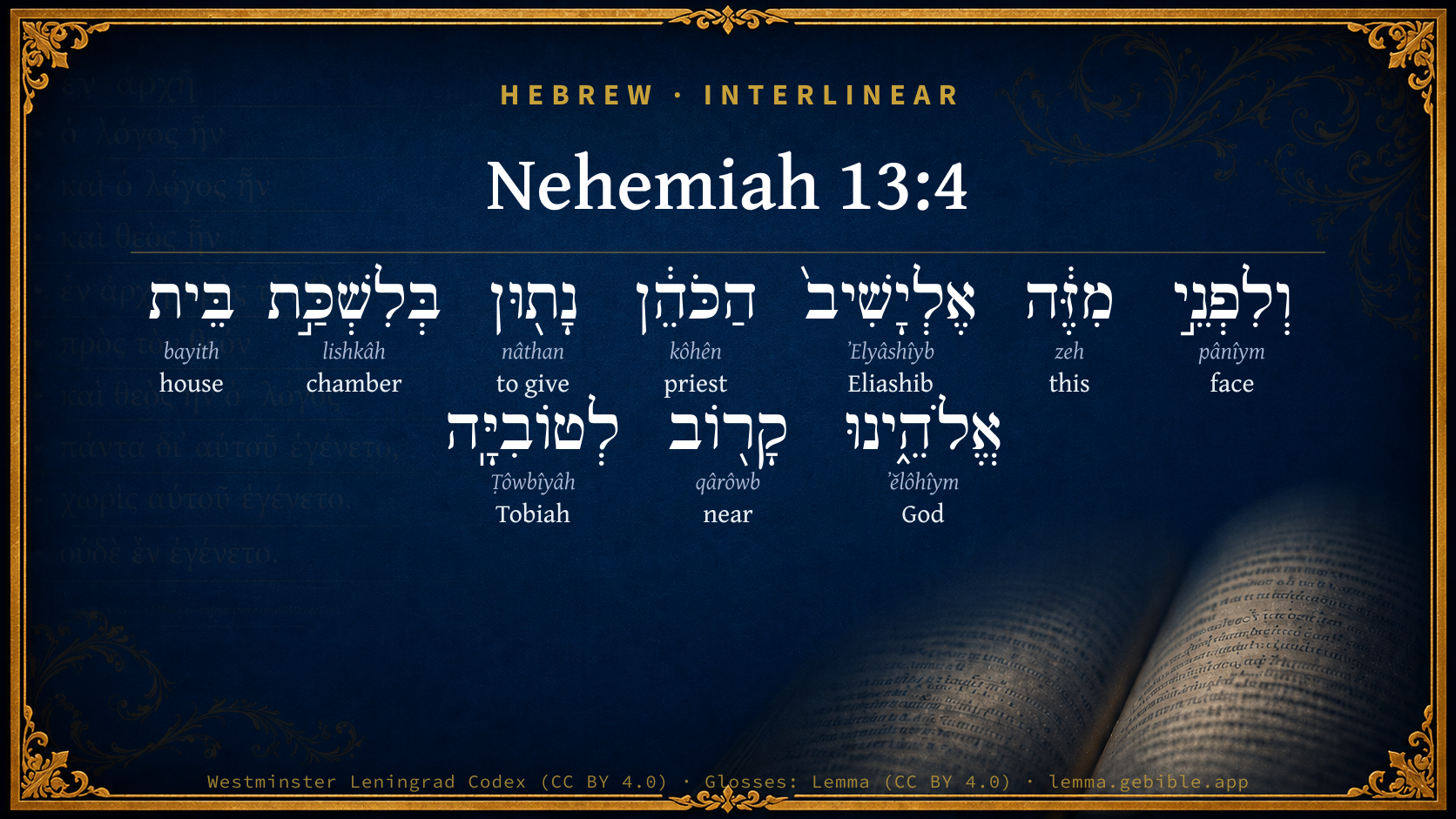
Nehemiah 13:4

Hebrew (Westminster Leningrad Codex) Nehemiah 13:4 appears in the Hebrew Old Testament. The text above is from the Westminster Leningrad Codex. Each word links to its Strong’s number, a concise gloss, and parsing drawn from the Open Scriptures Hebrew Bible morphology. Click any word for its full Brown-Driver-Briggs (BDB) entry.
Download image
Cite this verse

Nehemiah 13:4 (World English Bible). Public Domain. Lemma interlinear Bible study tool, https://lemma.gebible.app/v/nehemiah/13/4.

Show BibTeX & RIS
BibTeX
RIS
English Translation
Now before this, Eliashib the priest, who was appointed over the chambers of the house of our God, being allied to Tobiah,
World English Bible · Public Domain
Download a study sheet

One document with this verse’s original text, its word-by-word gloss line, the meaning frame, cross-references with their text, attributed commentary, and full source and license credits — printable, and it pastes into notes with its structure intact.

This verse Autodidact and up

Study sheet (.html) Plain text (.txt)

A passage Seminary Student

Up to 50 verses in one chapter. A passage sheet keeps up to 6 commentary sources and 12 cross-references per verse, in the order this page ranks them, and says so on the sheet whenever that leaves anything out. Ask for a single verse and you get the Autodidact verse sheet above.

Everything on this page stays free to read, with no account — the sheet is a download of what is already on screen, not access to it.

Want to remove ads? Support Godless Engineer
Compare translations 3

The same verse in 3 English versions, stacked beneath the original-language interlinear above. Click any original word for its lexicon entry.

Each is an independent rendering of the whole verse — the interlinear is not word-aligned to these translations.

Highlighted words mark where these versions differ — a whole-verse word diff, not a word-by-word alignment.

  • World English Bible Public Domain
    Now before this, Eliashib the priest, who was appointed over the chambers of the house of our God, being allied to Tobiah,
  • King James Version Public Domain
    And before this, Eliashib the priest, having the oversight of the chamber of the house of our God, was allied unto Tobiah:
  • unfoldingWord Literal Text CC BY-SA 4.0
    Now, before the face of this, Eliashib the priest, nearly-related to Tobiah, was being put in the chamber of the house of our God.

unfoldingWord Literal Text — © unfoldingWord, licensed CC BY-SA 4.0. Word-aligned USFM3 via Door43 (git.door43.org/unfoldingWord/en_ult).

Versions to compare (up to 4)

3 of 4 selected

Show all 18 translations

Every available English version of this verse, each an independent rendering of the whole verse.

  • World English Bible Public Domain
    Now before this, Eliashib the priest, who was appointed over the chambers of the house of our God, being allied to Tobiah,
  • Berean Standard Bible Public Domain
    Now before this, Eliashib the priest, a relative of Tobiah, had been put in charge of the storerooms of the house of our God
  • Majority Standard Bible Public Domain
    Now before this, Eliashib the priest, a relative of Tobiah, had been put in charge of the storerooms of the house of our God
  • King James Version Public Domain
    And before this, Eliashib the priest, having the oversight of the chamber of the house of our God, was allied unto Tobiah:
  • American Standard Version (1901) Public Domain
    Now before this, Eliashib the priest, who was appointed over the chambers of the house of our God, being allied unto Tobiah,
  • Revised Version (1885) Public Domain
    Now before this, Eliashib the priest, who was appointed over the chambers of the house of our God, being allied unto Tobiah,
  • Geneva Bible (1599) Public Domain
    And before this had the Priest Eliashib the ouersight of the chamber of the house of our God, being kinsman to Tobiah:
  • Douay-Rheims (1899) Public Domain
    And over this thing was Eliasib the priest, who was set over the treasury of the house of our God, and was near akin to Tobias.
  • Young's Literal Translation Public Domain
    And before this Eliashib the priest, appointed over chambers of the house of our God, `is' a relation of Tobiah,
  • Literal Standard Version CC BY-SA 4.0
    And before this Eliashib the priest, appointed over chambers of the house of our God, [is] a relation of Tobiah,
  • Unlocked Literal Bible CC BY-SA 4.0
    Now before this Eliashib the priest was appointed over the storerooms of the house of our God. He was related to Tobiah.
  • unfoldingWord Literal Text CC BY-SA 4.0
    Now, before the face of this, Eliashib the priest, nearly-related to Tobiah, was being put in the chamber of the house of our God.
  • Darby Bible Public Domain
    And before this, Eliashib the priest, who had the oversight of the chambers of the house of our God, a kinsman of Tobijah,
  • World Messianic Bible Public Domain
    Now before this, Eliashib the priest, who was appointed over the rooms of the house of our God, being allied to Tobiah,
  • Webster's Bible Public Domain
    And before this, Eliashib the priest, having the oversight of the chamber of the house of our God, was allied to Tobiah:
  • Free Bible Version CC BY-SA 4.0
    Before all this, Eliashib the priest, who was related to Tobiah, had been put in charge of the storerooms of the Temple of our God.
  • Bible in Basic English Public Domain
    Now before this, Eliashib the priest, who had been placed over the rooms of the house of our God, being a friend of Tobiah,
  • JPS Tanakh (1917) Public Domain
    Now before this, Eliashib the priest, who was appointed over the chambers of the house of our God, being allied unto Tobiah,

Literal Standard Version (2020), Covenant Press — licensed CC BY-SA 4.0. Text via the HelloAO Bible API (eBible.org). Unlocked Literal Bible (unfoldingWord) — licensed CC BY-SA 4.0. Text via the HelloAO Bible API (eBible.org). unfoldingWord Literal Text — © unfoldingWord, licensed CC BY-SA 4.0. Word-aligned USFM3 via Door43 (git.door43.org/unfoldingWord/en_ult). Free Bible Version, Dr. Jonathan Gallagher — licensed CC BY-SA 4.0. Text via the HelloAO Bible API (eBible.org).

Word by word

More ways to search: Search by grammar → Find every occurrence → Compare this word →

Practice this passage: Drill this verse → Learn its vocabulary →

אֶלְיָשִׁיב֙
ʼElyâshîyb
H475
“Eliashib”
Noun, Proper
Part of Speech
Noun
Type
Proper
Full BDB Definition

Origin: from H410 and H7725

TWOT: None

Eliashib = "God restores" - a priest in David's reign - a descendant of David - a high priest in Nehemiah's time - a temple singer with foreign wife - one of the line of Zattu - one of the line of Bani
  1. וְלִפְנֵ֣י pânîym H6440 “and · to/for · face(s) of” Conjunction + Preposition + Noun, Common, Both, Plural, Construct
  2. מִזֶּ֔ה zeh H2088 “from · this” Preposition + Pronoun, Demonstrative, Masculine, Singular
  3. הַכֹּהֵ֔ן kôhên H3548 “the · priest” Particle, Definite Article + Noun, Common, Masculine, Singular, Absolute
  4. נָת֖וּן nâthan H5414 “given” Verb, Qal, Participle Passive, Masculine, Singular, Absolute
  5. בְּלִשְׁכַּ֣ת lishkâh H3957 “in/at · chamber of” Preposition + Noun, Common, Feminine, Singular, Construct
  6. בֵּית bayith H1004 “house of” Noun, Common, Masculine, Singular, Construct
  7. אֱלֹהֵ֑ינוּ ʼĕlôhîym H430 “God(s) · our” Noun, Common, Masculine, Plural, Construct + Suffix, Personal, 1st Person, Common, Plural
  8. קָר֖וֹב qârôwb H7138 “near” Adjective, Adjective, Masculine, Singular, Absolute
  9. לְטוֹבִיָּֽה Ṭôwbîyâh H2900 “to/for · Tobiah” Preposition + Noun, Proper

About this verse

These counts appear in no published source. They are computed here, from the morphology-tagged text and Lemma’s own curated glosses. What Lemma adds →

10
words
10
distinct lemmas
Historical
section

Notable vocabulary

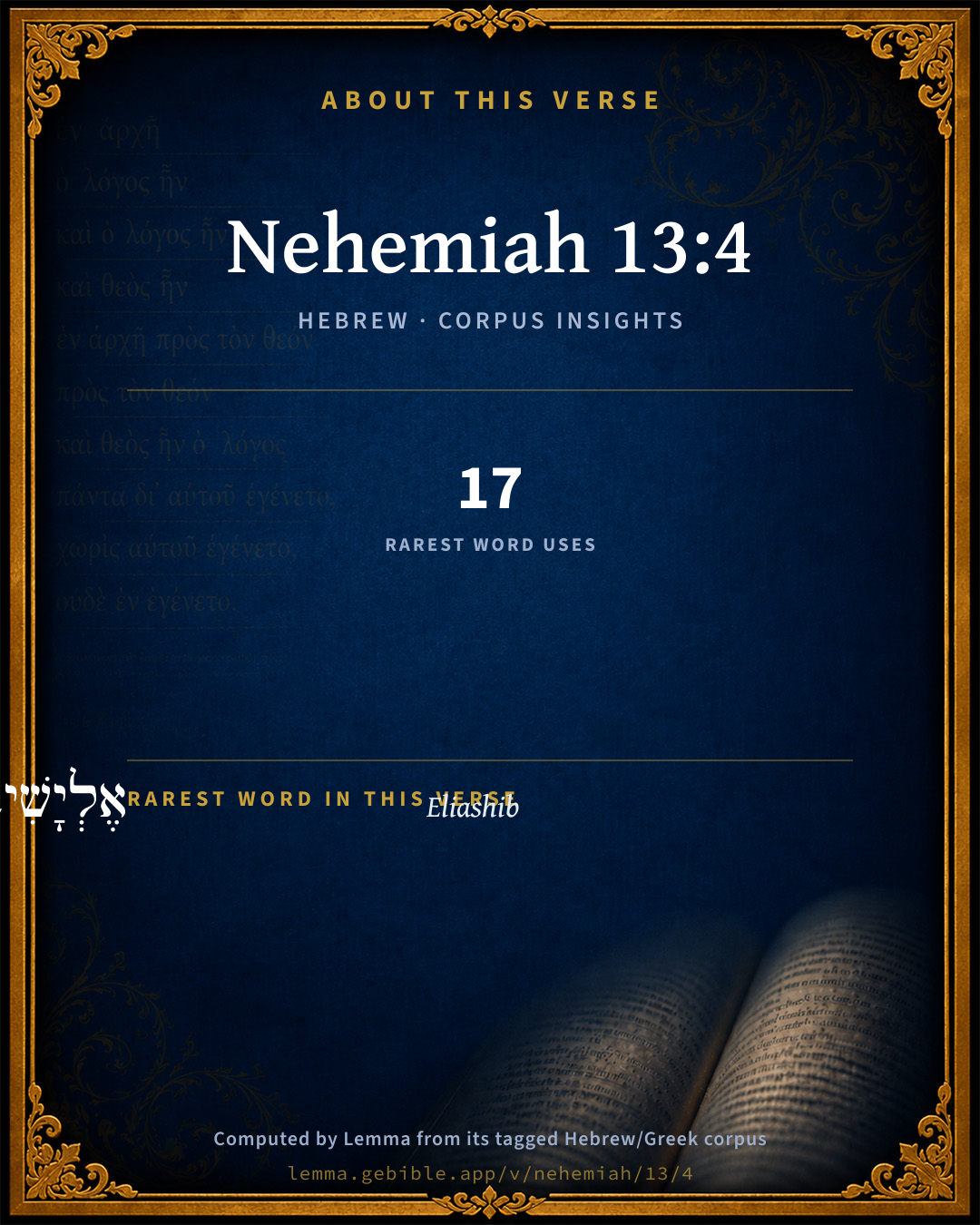
The rarest word here is אֶלְיָשִׁיב֙ Eliashib H475 — appearing just 17 times in the whole Hebrew Bible.

Shared distinctive vocabulary

אֶלְיָשִׁיב֙ Eliashib H475 occurs in 15 verses of the Hebrew Bible. Also found in:

Grammatical profile

  • 1 verb
  • 7 nouns
  • 1 adjective
  • 1 pronoun

Verb forms

  • נָת֖וּן Qal · Participle Passive

Cross-references

5

Topical passages linked to Nehemiah 13:4 in the Treasury of Scripture Knowledge — connected by theme and wording, ordered by reader-vote popularity; previews shown in the World English Bible.

  • Nehemiah 12:44 On that day were men appointed over the chambers for the treasures, for the heave-offerings, for the first fruits, and for the tithes, to gather into them, according to the fields of the cities, the portions appointed by the law for the priests and Levites: for Judah rejoiced for the priests and for the Levites who waited.
  • Nehemiah 2:10 When Sanballat the Horonite, and Tobiah the servant, the Ammonite, heard of it, it grieved them exceedingly, because a man had come to seek the welfare of the children of Israel.
  • Nehemiah 6:17–18 Moreover in those days the nobles of Judah sent many letters to Tobiah, and [the letters] of Tobiah came to them.
  • Nehemiah 13:28 One of the sons of Joiada, the son of Eliashib the high priest, was son-in-law to Sanballat the Horonite: therefore I chased him from me.
  • Nehemiah 12:10 Jeshua became the father of Joiakim, and Joiakim became the father of Eliashib, and Eliashib became the father of Joiada,

Cross-references courtesy of OpenBible.info (CC BY 4.0).

Hebrew and Greek witnesses Masoretic Hebrew ↔ Greek Septuagint

The same verse in the two great witnesses to the Old Testament, shown verse-for-verse.

These are two independent witnesses, not word-aligned to each other, and the Septuagint is shown in lemma (dictionary) form.

Hebrew Nehemiah 13:4 Masoretic · Westminster Leningrad Codex

וְלִפְנֵ֣י מִזֶּ֔ה אֶלְיָשִׁיב֙ הַכֹּהֵ֔ן נָת֖וּן בְּלִשְׁכַּ֣ת בֵּית אֱלֹהֵ֑ינוּ קָר֖וֹב לְטוֹבִיָּֽה

Now before this, Eliashib the priest, who was appointed over the chambers of the house of our God, being allied to Tobiah,

World English Bible · Public Domain

Greek LXX Structure differs

The Septuagint has no separate book of Nehemiah. Its Greek text is the second half of Esdras B (2 Esdras), chapters 11–23; Ezra is the first half (1–10).

A verse-for-verse comparison isn’t shown here because the chapters and verses don’t line up. Switch to the LXX edition with the MT / LXX toggle above to read the Greek directly.

On this verse, The Cambridge Bible for Schools and Colleges discusses the Septuagint’s reading. Read the note in Commentary ↓

Hebrew: Westminster Leningrad Codex (CC BY 4.0). Greek: Septuagint (public domain); English from a public-domain English Septuagint. How the Septuagint differs from the Hebrew →

Commentary

Notes on Nehemiah 13:4 from classic Christian and Jewish commentators (each source and its license shown beneath its notes). The classic Christian expositions comment on the surrounding passage and are grouped to its opening verse, so a note may address several verses; the Jewish commentaries on the Tanakh (Rashi and others) are per-verse, so they appear only where the commentator wrote on this verse.

Lemma curates 59 commentaries, every one of them public domain or Creative Commons licensed, each selected and text-cleaned for this edition rather than reprinted as found. About our sources →

The Cambridge Bible for Schools and Colleges

gen. ed. J. J. S. Perowne

4. And before this] R.V. Now before this. Clearly the date referred to is that of Nehemiah’s return to Jerusalem after his residence at the court described in Neh_13:6-7. We may assume that Nehemiah’s Memoirs embraced the whole interval of twelve years. The Compiler, however, makes no extract from the intervening portion. The words ‘before this’ have therefore no reference to the events of the preceding verses; their retention only shows the exactness with which the extract is reproduced.

Eliashib the priest] There is scarcely any reason to doubt that this is the same as ‘Eliashib the high-priest’ mentioned in Neh_13:28, and in Neh_3:1; Neh_3:20, whose name occurs in the priestly lists (Neh_12:10; Neh_12:22). That he is here called ‘the priest,’ and in Neh_13:28, ‘the high-priest,’ constitutes a certain objection against the identification. On the other hand the incident which here connects ‘Eliashib the priest’ with Tobiah is of so similar a character to that which associates ‘Eliashib the high-priest’ in alliance with Sanballat (Neh_13:28), that it is most natural to suppose the same person is denoted.

The full title is not, as some fancifully suggest, withheld out of respect for the office which was so degraded. It is more probable that Nehemiah is recording the fact that ‘the priest who was appointed over the chambers of the house of God’ happened in this instance to be the high-priest himself: perhaps having been appointed to this duty before his succession to the high-priestly office, he still retained the charge. Again, it may be remembered that in old times ‘the priest’ was the customary title of the high-priest.

If the same as the high-priest, it has been remarked that his name does not appear in chap. 10 among those that signed the covenant. It is however somewhat hazardous to conclude, as commentators have generally done, that he must therefore have refused his signature and have openly opposed the policy of Nehemiah. The names in chap. 10 are most of them the names of houses, and the high-priest’s name is probably represented in the mention of ‘Seraiah.’

having the oversight of] R.V. who was appointed over.

the chamber] R.V. the chambers. Marg. ‘Heb. the chamber’. The singular does not give the right meaning. Eliashib in order to dispose of ‘a great chamber’ to Tobiah, must have had all the Temple chambers under his charge. The proposal to read the plural ‘chambers’ (lishkôth) instead of the singular ‘chamber’ (lishkath) is probably right. See Neh_13:9.

The versions give quite an erroneous turn to the passage; LXX. οἰκῶν ἐν γαζοφυλακίῳ, Vulg. ‘præpositus in gazophylacio.’

was allied] R.V. being allied. A relationship by marriage is intended by this expression, which is the same as that rendered in Rth_2:20, ‘The man is nigh of kin to us.’

In the LXX. ἐγγίων and Vulg. ‘proximus,’ the idea of local vicinity misapprehends the original. We are not told the exact relationship of Tobiah to Eliashib. But in Neh_6:17, it appears that he had married a daughter of Shecaniah; and that his son Jehohanan had married a daughter of Meshullam the son of Berechiah. Both Shecaniah and Meshullam are names mentioned in Neh_3:20; Neh_3:30; and the probability is that they were priests of high rank. It is natural to derive Tobiah’s alliance to Eliashib from his connexion with one or both of these families.

Part IV. NEHEMIAH’S SECOND VISIT

Ch. Neh_13:4-9.

His Vindication of the Sanctity of the Temple.

Neh_13:10-14.

His Provision for the Maintenance of the Levites.

Neh_13:15-22.

His Measures to uphold the Observance of the Sabbath.

Neh_13:23-29.

His Action against Mixed Marriages.

Neh_13:30-31.

His Concluding Words.

4–31. Nehemiah’s memoirs resumed

4–9. An incident twelve years later: Eliashib’s concession of a chamber in the Temple to Tobiah, and its purification by Nehemiah. For Nehemiah’s action and the necessity for it, cf. Mal_2:1-9.

The Cambridge Bible for Schools and Colleges (gen. ed. J. J. S. Perowne; Cambridge University Press, 1878–1918) — public domain. Text from a community e-Sword module.

Trapp's Complete Commentary

John Trapp

Neh 13:4 And before this, Eliashib the priest, having the oversight of the chamber of the house of our God, [was] allied unto Tobiah:

Ver. 4. And before this] Before the commandment came as a lamp, and the law a light, {as Pro 6:23} causing a reformation. As toads and serpents grow in dark and dirty cellars, so do sinful disorders in ignorant places and persons.

Eliashib the priest] The high priest; but such a one as from whom profaneness went forth into all the land, Jer 23:15. The sins of teachers are teachers of sins.

Having the oversight of the chamber] i.e. Of all the chambers of the temple, by virtue of his office; and, therefore, thought belike he might do what he wished with them (now in Nehemiah’s absence) without control.

Was allied unto Tobiah] A bitter enemy to God’s people, but sly and subtle, seeking to insinuate by alliance and letters of persuasion; such as Cardinal Sadolet wrote to the Genevenses, in Calvin’s absence, and Cardinal Lorraine to the Protestant princes of Germany, that he and his brethren, the Guises (those sworn swordmen of the devil), would embrace the reformed religion.

John Trapp, A Commentary or Exposition upon All the Books of the Old and New Testament (1647–1656) — public domain. Text from a community e-Sword module.

Joseph Benson's Commentary

Neh 13:4. And before this — That is, before this separation was made; Eliashib the priest — The high-priest, (Neh 3:1,) or some other priest so called, there being divers persons of this name in or about this time, though the first seems most probable; having the oversight of the chamber — Of the chambers, (Neh 13:9,) the high-priest having the chief power over the house of God, and all the chambers belonging to it; was allied unto Tobiah — The Ammonite, and a violent enemy to God’s people. He had suffered his grandson to marry Sanballat’s daughter, who was the fast friend of Tobiah, and the great enemy of the Jews. This is mentioned as a great blot on Eliashib’s character, and the cause of his other miscarriages, noticed Neh 13:5. We read also in Ezr 10:18, that several of the priests had married strange wives; and, among the rest, some of the sons of the high-priest.

Joseph Benson's Commentary on the Old and New Testaments (1811–1818) — public domain. Text from a community e-Sword module.

Whedon's Commentary on the Bible

Daniel D. Whedon

CLEANSING OF THE CHAMBER OCCUPIED BY TOBIAH, Neh_13:4-9.

4. Before this — Before the separation of the mixed multitude from Israel.

Eliashib the priest — The high priest mentioned in Neh_3:1.

Oversight of the chamber — “Such oversight of the chambers of the temple would certainly be intrusted to no simple priest, though this addition shows that this oversight did not form part of the high priest’s office.” — Keil.

Allied unto Tobiah — In what particular way is unknown. Perhaps the Jewess whom his son Johanan had married (Neh_6:18) was a relative of the high priest. See on Neh_2:10; Neh_6:18.

Daniel D. Whedon (gen. ed.), Commentary on the Old and New Testaments (1874–1909) — public domain. Text from a community e-Sword module.

The Pulpit Commentary

Eliashib the priest. It is questioned whether the high priest of Neh_3:1 is meant, and noted that the expression used priest does not always designate "the high priest" (see ver. 13); but the important charge said to have been assigned to him, the alliance with so great a man as Tobiah, and the important step taken, the assignment to a heathen of a residence within the temple precincts, imply a man of high authority, and suit better with the high priest than with any one of lower rank. Moreover, the fact that Eliashib"s leanings were towards the enemies of Nehemiah accounts for his disappearance from the history from Neh_3:1 to Neh_13:4. Having the oversight. Literally, "being set over perhaps by Nehemiah, who seems to have claimed the appointment to all offices about the temple which were not purely spiritual. (see Neh_12:44 Neh_13:13) Of the chamber. The word "chamber" (lishkah) is here used in a collective sense of the entire building containing the many "chambers" or "treasuries" of Neh_12:44 Neh_13:9, Neh_13:12, Neh_13:13. Was allied unto Tobiah. Karob, the word translated "allied," means a relation," either by blood or marriage. In the present case the relationship must have been by means of a marriage.

Vers. 4-9. An intruder ejected.

In these verses we have an account of a gross abuse, of authority by the high priest, and how it was corrected by Nehemiah.

I THE OFFENCE. Turning rooms in the courts of the temple, intended and used as store-rooms for tithes and offerings, etc., into a residence for Tobiah on his visits to Jerusalem. In ver. 5 we read of "a great chamber;" in ver. 9 of "chambers." Perhaps several rooms were thrown into one; or the word in ver. 5 may be, as in ver. 4, collective.

1. The perversion was itself disgraceful. It may have occasioned the neglect recorded in ver. 10,

2. The person for whom it was committed was not only an alien, but an enemy.

3. The person who committed it was the appointed guardian of the rooms. As high priest, he should have been too jealous of the sanctity of the temple; as "having the oversight of the chamber of the house of God," he should have been too faithful to his duty; as head of the priests and Levites, too concerned for their rights and welfare, to be willing to permit, much less to perpetrate, such an abuse.

II HOW THE OFFENCE CAME TO BE PERMITTED.

1. Nehemiah was absent. In his absence affairs fell rapidly into disorder again. A painful illustration of the superficiality of reforms wrought hastily under the influence of powerful leaders.

2. Tobiah was a great man.

3. He was a relative of Eliashib.

4. Eliashib was unworthy of his office. He was more concerned to stand well with Tobiah than to do his duty to God and his brethren. Probably he was disaffected towards Nehemiah and his reforms, and thought that now he was gone he could do as he pleased.

III HOW THE OFFENCE WAS CORRECTED. Nehemiah, returning to Jerusalem, and being informed of what had been done, was very indignant, and at once took measures to put an end to the scandal. Under his direction

1. Tobiah"s furniture was summarily ejected.

2. The rooms were purified from the ceremonial uncleanness they had contracted.

3. They were restored to their proper use. The narrative suggests

(1) The evil influence sometimes exercised in the Church by rank and wealth, or relationship to those in office. These sometimes go further than character and ability (which should be mainly regarded) to secure for their possessors positions of authority and power in the Church. And those who should protest silently acquiesce in the abuse, or basely connive at it, that they may live in friendship with the unholy intruders into God"s temple, and promote their own worldly ends.

(2) The feelings which such abuses will awaken in good men.

(3) The duty of those who have the power to correct them.

The Pulpit Commentary (1880–1919), ed. H.D.M. Spence-Jones & Joseph S. Exell — public domain. Text from a community e-Sword module.

Keil & Delitzsch

C. F. Keil & F. Delitzsch

Nehemiah, on his return to Jerusalem, reforms the irregularities that had broken out during his absence. - Neh 13:4-9. While Nehemiah was at Babylon with King Artaxerxes, Eliashib the high priest had given up to his relative, Tobiah the Ammonite (Neh 2:10; Neh 4:3, and elsewhere), a large chamber in the temple, i.e., in the fore-court of the temple (v. 7), probably for his use as a dwelling when he visited Jerusalem (see rem. on v. 8). On his return, Nehemiah immediately cast all the furniture of Tobiah out of this chamber, purified the chambers, and restored them to their proper use as a magazine for the temple stores. מזּה לפני, before this (comp. Ewald, 315, c), refers to the beforementioned separation of the ערב from Israel (Neh 13:3). Eliashib the priest is probably the high priest of that name (Neh 3:1; Neh 12:10, Neh 12:22). This may be inferred from the particular: set over (he being set over) the chambers of the house of our God; for such oversight of the chambers of the temple would certainly be entrusted to no simple priest, though this addition shows that this oversight did not absolutely form part of the high priest's office. For נתן, in the sense of to set, to place over, comp. Kg1 2:35; the construction with בּ instead of על is, however, unusual, but may be derived from the local signification of בּ, upon, over. Ewald and Bertheau are for reading לשׁכת instead of the sing. לשׁכּת, because in Neh 13:5 it is not הלּשׁכּה that is spoken of, but a large chamber. לשׁכּת may, however, be also understood collectively. Eliashib, being a relation of Tobiah (קרוב like Rut 2:20), prepared him a chamber. The predicate of the sentence, Neh 13:4, follows in Neh 13:5 with ויּעשׂ, in the form of a conclusion following the accessory sentence of the subject. How Tobiah was related to Eliashib is nowhere stated. Bertheau conjectures that it was perhaps only through the circumstance that Johanan, the son of Tobiah, had married a daughter of Meshullam ben Berechiah (Neh 6:18), who, according to Neh 3:30, was a priest or Levite, and might have been nearly related to the high priest. "A great chamber," perhaps made so by throwing several chambers into one, as older expositors have inferred from Neh 13:9, according to which Nehemiah, after casting out the goods of Tobiah, had the chambers (plural) cleansed. The statement also in Neh 13:5, that there (in this great chamber) were aforetime laid up not only the meat-offerings (i.e., oil and flour, the materials for them), the incense, and the sacred vessels, but also the tithe of the corn, the new wine, and the oil, and the heave-offerings of the priests, seems to confirm this view. This tenth is designated as הלויּם מצות, the command of the Levites, i.e., what was apportioned to the Levites according to the law, the legal dues for which משׁפּט is elsewhere usual; comp. Deu 18:3; Sa1 2:13. The heave-offering of the priest is the tenth of their tenth which the Levites had to contribute, Neh 10:39.

Keil & Delitzsch — Biblical Commentary on the Old Testament (1861–1891) — public domain (CC PDM 1.0). Text via the HelloAO Bible API. (Old Testament only.)

Tyndale Open Study Notes

Tyndale Open Resources

13:4-14 Eliashib the priest (see 12:10, 22; 13:28) had stopped following the practice of excluding the Ammonites and Moabites (13:1), and the people quit giving their tithes to the Levites (13:10-12). Now, Nehemiah corrected these problems.

13:4-5 Eliashib’s family intermarried with the families of Sanballat (13:28) and Tobiah. Both of these men were enemies of the Jewish community (2:10, 19; 4:1). Tobiah’s use of the storeroom meant there was less room to store tithes and gifts for the Temple workers (cp. 10:39; 13:10-12; 2 Chr 31:11) and less space for supplies needed to conduct regular worship at the Temple (Lev 2).

Tyndale Open Study Notes — © Tyndale Open Resources, licensed CC BY-SA 4.0. Text via the HelloAO Bible API.

Geneva Bible (1599)

Geneva Bible translators

That the separation was made.

He was joined in affinity with Tobiah the Ammonite and enemy of the Jews.

Geneva Bible (1599) marginal notes — public domain. Text via Bolls.life.

Jamieson, Fausset & Brown

Robert Jamieson, A. R. Fausset & David Brown

before this--The practice of these mixed marriages, in open neglect or violation of the law, had become so common, that even the pontifical house, which ought to have set a better example, was polluted by such an impure mixture.

Eliashib the priest . . . was allied unto Tobiah--This person was the high priest (Neh 13:28; also Neh 3:1), who, by virtue of his dignified office, had the superintendence and control of the apartments attached to the temple. The laxity of his principles, as well as of his practice, is sufficiently apparent from his contracting a family connection with so notorious an enemy of Israel as Tobiah. But his obsequious attentions had carried him much farther; for to accommodate so important a person as Tobiah on his occasional visits to Jerusalem, Eliashib had provided him a splendid apartment in the temple. The introduction of so gross an impropriety can be accounted for in no other way than by supposing that in the absence of the priests and the cessation of the services, the temple was regarded as a common public building, which might, in the circumstances, be appropriated as a palatial residence.

Jamieson, Fausset & Brown — Commentary Critical and Explanatory on the Whole Bible (1871) — public domain (CC PDM 1.0). Text via the HelloAO Bible API.

Adam Clarke's Commentary

Verse 4. Eliashib the priest] Perhaps this was a different person from Eliashib the high priest; but there is no indubitable evidence that he was not the same. If he was high priest, he was very unfaithful to the high charge which he had received; and a reproach to the priesthood. He had married his grandson to Sanballat's daughter: this produced a connection with Tobiah, the fast friend of Sanballat; in whose favour he polluted the house of God, giving him one of the chambers for his ordinary residence, which were appointed for the reception of the tithes, oblations, &c., that came to the house of God.

Adam Clarke's Commentary on the Bible (1810–1826) — public domain. Text from a community e-Sword/MySword module.

Ellicott's Commentary for English Readers

(4) Eliashib the priest, having the oversight.—Probably the high priest of Neh_3:1, whose office alone would not have given him control over “the chamber:” that is, the series of chambers running round three walls of the Temple. He “was allied unto Tobiah,” but in what way is not stated.

Before this.—That is, before the return of Nehemiah; indeed, there is a suspicious absence of Eliashib’s name throughout the high religious festivities of the preceding chapters.

(4-9) The scandal of the high priest.

A Bible Commentary for English Readers, edited by Charles John Ellicott (1878–1897) — public domain. Text from a community e-Sword module.

John Gill's Exposition

And he had prepared for him a great chamber,.... In the temple, by throwing together several chambers, as Piscator observes:

where aforetime they laid the meat offerings, the frankincense, and the vessels, and the tithes of the corn, the new wine, and the oil, which was commanded to be given to the Levites, and to the singers, and the porters, and the offerings of the priests; see Neh 10:37.

John Gill's Exposition of the Whole Bible (1746–1763) — public domain (CC PDM 1.0). Text via the HelloAO Bible API.

Albert Barnes' Notes on the Bible

The relations of Eliashib, the high priest Neh 3:1, with Tobiah and Sanballat will account for the absence of any reference to him either in Neh. 8–10, or in Neh. 12:27-47.

The chamber - The entire outbuilding, or “lean-to,” which surrounded the temple on three sides 1Ki 6:5-10.

Allied - i. e, “connected by marriage.” Tobiah was married to a Jewess Neh 6:18, who may have been a relation of Eliashib; and his son Johanan was married to another Neh 6:18, of whom the same may be said.

Albert Barnes' Notes on the Bible (1834–1885) — public domain. Text from a community e-Sword/MySword module.

Haydock's Catholic Bible Commentary

Over this things, &c. Or, he was faulty in this thing, or in this kind. (Challoner) --- He was the source of all this evil. Hebrew, "and before this Eliasib," &c. It is probable that he was a different person from the high priest, (Usher) who had married his grandson to the daughter of Sanaballat, the intimate friend of Tobias. (Calmet) --- The latter was a persecutor, and prefigured heretics, as Nehemias did our Saviour, who drove traffickers out of the temple. (Ven. Bede in Esdras, L. iii. 19.) (Worthington)

George Leo Haydock (1774–1849), Haydock's Catholic Family Bible and Commentary, 1859 edition — public domain. Excludes Psalms (Douay-Rheims chapter numbering differs from Protestant) and Deuterocanonical books (Catholic canon only).

Matthew Poole's English Annotations

Eliashib the priest; the high priest, Neh 3:1, or some other priest so called, there being divers Eliashibs in or about this time, Ezr 10:6,24,27,36, though the first seems most probable, by comparing this verse with Neh 13:28, and with Neh 12:10,11.

The oversight of the chamber, i.e. of the chambers, as appears from the following verse, and from Neh 13:9, where it is called chambers, and from the nature of the thing, the high priest having the chief power over the house of God, and all the chambers belonging to it. The singular number for the plural.

Allied unto Tobiah, the Ammonite, and a violent enemy to God’s people. So this is noted as a great blemish to Eliashib, and as the cause of his other miscarriage, noted Neh 13:5.

Matthew Poole's English Annotations on the Holy Bible (1683–1685) — public domain. Text from a community e-Sword/MySword module.

John Wesley's Explanatory Notes

Eliashib - The high-priest. Chamber - Of the chambers, the high-priest having the chief power over the house of God, and all the chambers belonging to it. Tobiah - The Ammonite, and a violent enemy to God's people.

John Wesley, Explanatory Notes Upon the Whole Bible (1754–1765) — public domain. Text via the GEBible commentary corpus.

unfoldingWord translationNotes

Door43 World Missions Community

Eliashib the priest was appointed

This can be translated in active form. AT: "they appointed Eliashib the priest" or "the leaders appointed Eliashib the priest" (See: Active or Passive)

He was related to Tobiah

"Eliashib and Tobiah worked closely together"

Eliashib ... Tobiah

These are the names of men.

Eliashib prepared for Tobiah a large storeroom

"Eliashib prepared a large storeroom for Tobiah to use"

gatekeepers

people assigned to each gate, responsible to control access to the city or temple, as well as to open and close the gates at times and for reasons set by the administrator. See how you translated this in Nehemiah 7:1.

translationWords

priest

appoint

house of God

grain offering

sacrifice

incense

tenth

grain

wine

oil

Levi

unfoldingWord translationNotes — © Distant Shores Media and the Door43 World Missions Community, licensed CC BY-SA 4.0. Source: git.door43.org/Door43/en_tn.

Rashi

Rabbi Shlomo Yitzchaki (Rashi)

Now prior to this Heb. וְלִפְנֵי מִזֶה, before this.

was a kinsman of Tobiah Eliashib the priest was a kinsman of Tobiah the companion of Sanballat, and the priest placed Tobiah’s vessels there.

Rashi on the Tanakh — English translations: “The Judaica Press complete Tanach with Rashi, translated by A. J. Rosenberg” (CC BY 4.0); “Pentateuch with Rashi's commentary by M. Rosenbaum and A.M. Silbermann, 1929-1934” (public domain); “The Metsudah Tanach series, Lakewood, N.J” (CC BY 4.0); and “The Book of Joshua, Metsudah Publications, 1997” (CC BY 4.0). Text via Sefaria.

Lesson kit

Teaching starters — assembled from the data on this page, not authored interpretation. Every prompt links to the verse data it draws on. Edit before teaching.

Nehemiah, in the Historical, opens this verse with 10 words (10 distinct Hebrew lemmas). Its most distinctive word is ʼElyâshîyb (“Eliashib”). A historical commentator’s framing appears above. Read the whole chapter for the surrounding context.

Discussion questions

  1. How does “Eliashib” (ʼElyâshîyb) shape what this verse is saying?
  2. How does 1 Chronicles 3:24, which shares the word «Eliashib», read alongside this verse?
  3. These translations render this verse differently. What is at stake in choosing one wording over another?
  4. «נָת֖וּן» is a Qal Participle Passive verb. How does that grammatical form shape the action described?
  5. Compare how The Cambridge Bible for Schools and Colleges and Trapp's Complete Commentary read this verse. Where do they agree or differ?

Things to notice

Reading settings

Reading text

Shown beneath each verse's original-language words.

Old Testament
Old Testament edition

Read the OT as the Masoretic Hebrew (MT) or the Greek Septuagint (LXX).

English shown for the Greek Septuagint (in the Hebrew ↔ Greek comparison).

Comparing translations? Open the Compare panel on any verse page to stack up to four side by side.