
Ezekiel 40:17

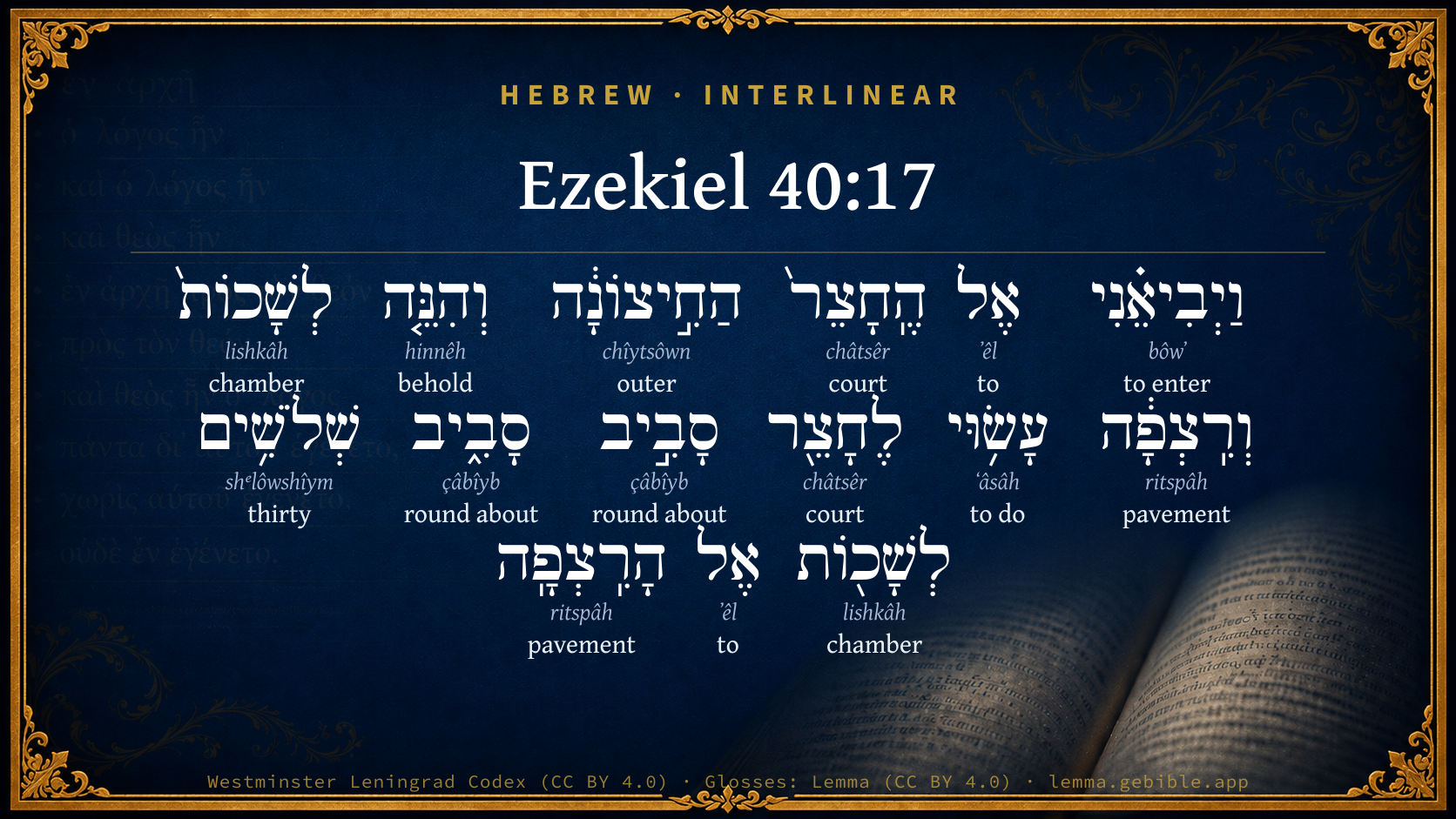
Hebrew (Westminster Leningrad Codex) Ezekiel 40:17 appears in the Hebrew Old Testament. The text above is from the Westminster Leningrad Codex. Each word links to its Strong’s number, a concise gloss, and parsing drawn from the Open Scriptures Hebrew Bible morphology. Click any word for its full Brown-Driver-Briggs (BDB) entry.
Download image
Cite this verse

Ezekiel 40:17 (World English Bible). Public Domain. Lemma interlinear Bible study tool, https://lemma.gebible.app/v/ezekiel/40/17.

Show BibTeX & RIS
BibTeX
RIS
English Translation
Then brought he me into the outer court; and, behold, there were chambers and a pavement, made for the court round about: thirty chambers were on the pavement.
World English Bible · Public Domain
Download a study sheet

One document with this verse’s original text, its word-by-word gloss line, the meaning frame, cross-references with their text, attributed commentary, and full source and license credits — printable, and it pastes into notes with its structure intact.

This verse Autodidact and up

Study sheet (.html) Plain text (.txt)

A passage Seminary Student

Up to 50 verses in one chapter. A passage sheet keeps up to 6 commentary sources and 12 cross-references per verse, in the order this page ranks them, and says so on the sheet whenever that leaves anything out. Ask for a single verse and you get the Autodidact verse sheet above.

Everything on this page stays free to read, with no account — the sheet is a download of what is already on screen, not access to it.

Want to remove ads? Support Godless Engineer
Compare translations 3

The same verse in 3 English versions, stacked beneath the original-language interlinear above. Click any original word for its lexicon entry.

Each is an independent rendering of the whole verse — the interlinear is not word-aligned to these translations.

Highlighted words mark where these versions differ — a whole-verse word diff, not a word-by-word alignment.

  • World English Bible Public Domain
    Then brought he me into the outer court; and, behold, there were chambers and a pavement, made for the court round about: thirty chambers were on the pavement.
  • King James Version Public Domain
    Then brought he me into the outward court, and, lo, there were chambers, and a pavement made for the court round about: thirty chambers were upon the pavement.
  • unfoldingWord Literal Text CC BY-SA 4.0
    Then the man brought me to the outer courtyard of the temple. Behold, there were rooms, and there was pavement in the courtyard, with thirty rooms next to the pavement.

unfoldingWord Literal Text — © unfoldingWord, licensed CC BY-SA 4.0. Word-aligned USFM3 via Door43 (git.door43.org/unfoldingWord/en_ult).

Versions to compare (up to 4)

3 of 4 selected

Show all 18 translations

Every available English version of this verse, each an independent rendering of the whole verse.

  • World English Bible Public Domain
    Then brought he me into the outer court; and, behold, there were chambers and a pavement, made for the court round about: thirty chambers were on the pavement.
  • Berean Standard Bible Public Domain
    Then he brought me into the outer court, and there were chambers and a pavement laid out all around the court. Thirty chambers faced the pavement,
  • Majority Standard Bible Public Domain
    Then he brought me into the outer court, and there were chambers and a pavement laid out all around the court. Thirty chambers faced the pavement,
  • King James Version Public Domain
    Then brought he me into the outward court, and, lo, there were chambers, and a pavement made for the court round about: thirty chambers were upon the pavement.
  • American Standard Version (1901) Public Domain
    Then brought he me into the outer court; and, lo, there were chambers and a pavement, made for the court round about: thirty chambers were upon the pavement.
  • Revised Version (1885) Public Domain
    Then brought he me into the outer court, and, lo, there were chambers and a pavement, made for the court round about: thirty chambers were upon the pavement.
  • Geneva Bible (1599) Public Domain
    Then brought he me into the outwarde court, and lo, there were chambers, and a pauement made for the court round about, and thirtie chambers were vpon the pauement.
  • Douay-Rheims (1899) Public Domain
    And he brought me into the outward court, and behold there were chambers, and a pavement of stone in the court round about: thirty chambers encompassed the pavement.
  • Young's Literal Translation Public Domain
    And he bringeth me in unto the outer court, and lo, chambers and a pavement made for the court all round about -- thirty chambers on the pavement --
  • Literal Standard Version CC BY-SA 4.0
    And he brings me into the outer court, and behold, chambers and a pavement made for the court all around—thirty chambers on the pavement—
  • Unlocked Literal Bible CC BY-SA 4.0
    Then the man brought me to the outer courtyard of the temple. Behold, there were rooms, and there was pavement in the courtyard, with thirty rooms next to the pavement.
  • unfoldingWord Literal Text CC BY-SA 4.0
    Then the man brought me to the outer courtyard of the temple. Behold, there were rooms, and there was pavement in the courtyard, with thirty rooms next to the pavement.
  • Darby Bible Public Domain
    And he brought me into the outer court, and behold, there were cells, and a pavement made for the court round about: thirty cells were upon the pavement.
  • World Messianic Bible Public Domain
    Then he brought me into the outer court. Behold, there were rooms and a pavement made for the court all around. Thirty rooms were on the pavement.
  • Webster's Bible Public Domain
    Then he brought me into the outward court, and lo, there were chambers, and a pavement made for the court around: thirty chambers were upon the pavement.
  • Free Bible Version CC BY-SA 4.0
    He took me into the outer courtyard. I saw rooms and a pavement had been constructed around the courtyard. There were thirty rooms facing the pavement.
  • Bible in Basic English Public Domain
    Then he took me into the outer square, and there were rooms and a stone floor made for the open square all round: there were thirty rooms on the stone floor.
  • JPS Tanakh (1917) Public Domain
    Then brought he me into the outer court, and, lo, there were chambers and a pavement, made for the court round about; thirty chambers were upon the pavement.

Literal Standard Version (2020), Covenant Press — licensed CC BY-SA 4.0. Text via the HelloAO Bible API (eBible.org). Unlocked Literal Bible (unfoldingWord) — licensed CC BY-SA 4.0. Text via the HelloAO Bible API (eBible.org). unfoldingWord Literal Text — © unfoldingWord, licensed CC BY-SA 4.0. Word-aligned USFM3 via Door43 (git.door43.org/unfoldingWord/en_ult). Free Bible Version, Dr. Jonathan Gallagher — licensed CC BY-SA 4.0. Text via the HelloAO Bible API (eBible.org).

Word by word

More ways to search: Search by grammar → Find every occurrence → Compare this word →

Practice this passage: Drill this verse → Learn its vocabulary →

וְרִֽצְפָ֔ה
ritspâh
H7531
“and · pavement”
Conjunction + Noun, Common, Feminine, Singular, Absolute
Part of Speech
Conjunction + Noun
Type
Common
Gender
Feminine
Number
Singular
State
Absolute
Full BDB Definition

Origin: from H7529

TWOT: 2210a , 2211a

pavement - glowing stone or coal, live coal
  1. וַיְבִיאֵ֗נִי bôwʼ H935 “and · to enter · me” Conjunction + Verb, Hiphil, Sequential Imperfect, 3rd Person, Masculine, Singular + Suffix, Personal, 1st Person, Common, Singular
  2. אֶל ʼêl H413 “to” Preposition
  3. הֶֽחָצֵר֙ châtsêr H2691 “the · court” Particle, Definite Article + Noun, Common, Both, Singular, Absolute
  4. הַחִ֣יצוֹנָ֔ה chîytsôwn H2435 “the · outer” Particle, Definite Article + Adjective, Adjective, Feminine, Singular, Absolute
  5. וְהִנֵּ֤ה hinnêh H2009 “and · behold” Conjunction + Particle, Demonstrative
  6. לְשָׁכוֹת֙ lishkâh H3957 “chambers” Noun, Common, Feminine, Plural, Absolute
  7. עָשׂ֥וּי ʻâsâh H6213 “done” Verb, Qal, Participle Passive, Masculine, Singular, Absolute
  8. לֶחָצֵ֖ר châtsêr H2691 “to/for the · court” Preposition, Determined + Noun, Common, Both, Singular, Absolute
  9. סָבִ֣יב çâbîyb H5439 “round about” Noun, Common, Both, Singular, Absolute
  10. סָבִ֑יב çâbîyb H5439 “round about” Noun, Common, Both, Singular, Absolute
  11. שְׁלֹשִׁ֥ים shᵉlôwshîym H7970 “thirty” Adjective, Cardinal number, Both, Plural, Absolute
  12. לְשָׁכ֖וֹת lishkâh H3957 “chambers” Noun, Common, Feminine, Plural, Absolute
  13. אֶל ʼêl H413 “to” Preposition
  14. הָרִֽצְפָֽה ritspâh H7531 “the · pavement” Particle, Definite Article + Noun, Common, Feminine, Singular, Absolute

About this verse

These counts appear in no published source. They are computed here, from the morphology-tagged text and Lemma’s own curated glosses. What Lemma adds →

15
words
10
distinct lemmas
Prophets
section

Notable vocabulary

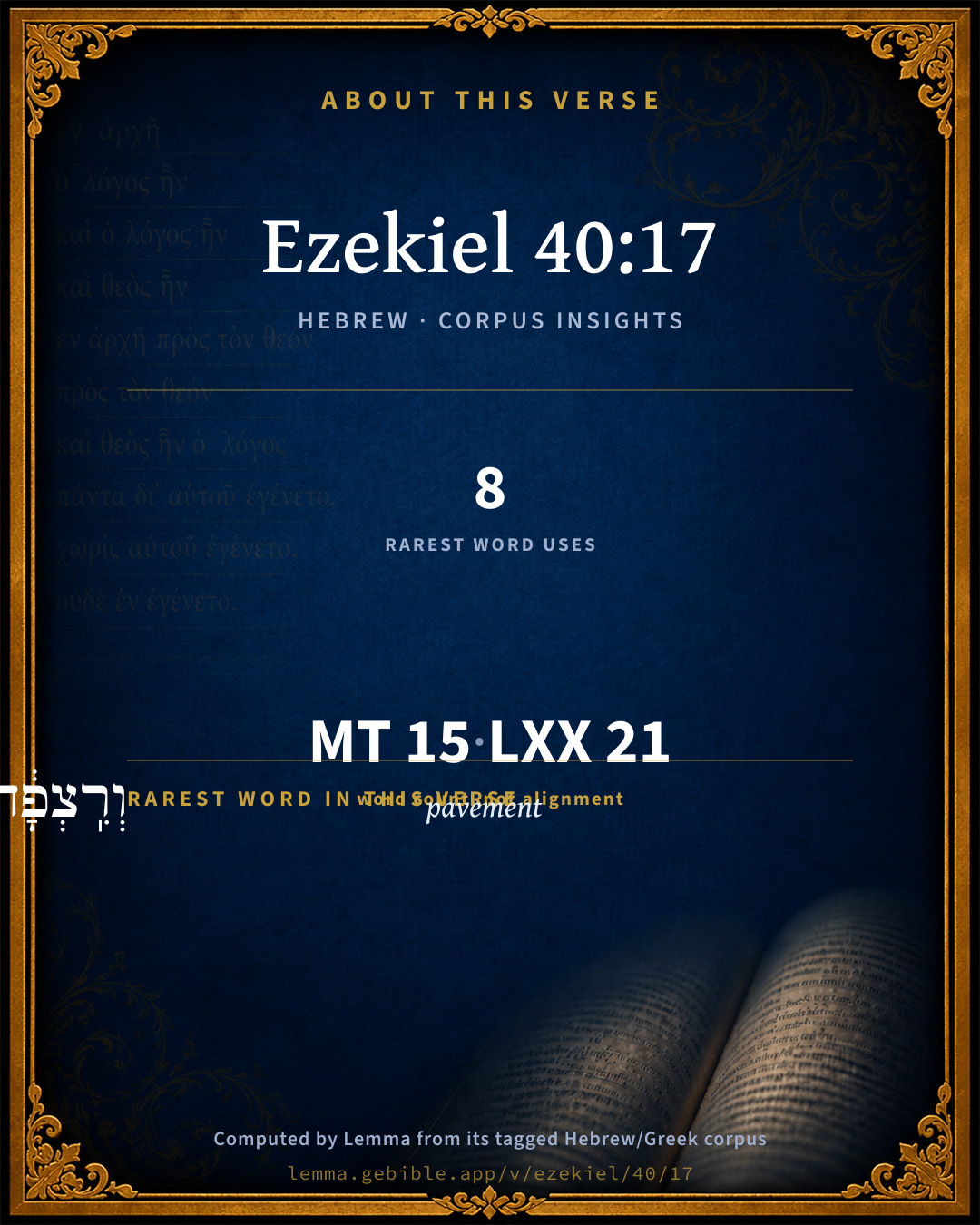
The rarest word here is וְרִֽצְפָ֔ה pavement H7531 — appearing just 8 times in the whole Hebrew Bible.

Shared distinctive vocabulary

וְרִֽצְפָ֔ה pavement H7531 occurs in 6 verses of the Hebrew Bible. Also found in:

Grammatical profile

  • 2 verbs
  • 8 nouns
  • 2 adjectives
  • 2 prepositions
  • 1 particle

Verb forms

  • וַיְבִיאֵ֗נִי Hiphil · Sequential Imperfect
  • עָשׂ֥וּי Qal · Participle Passive

Repetition

Words recur within this verse — often emphatic in Hebrew:

  • הֶֽחָצֵר֙ court H2691 ×2
  • לְשָׁכוֹת֙ chamber H3957 ×2
  • וְרִֽצְפָ֔ה pavement H7531 ×2
  • סָבִ֣יב round about H5439 ×2
  • אֶל to H413 ×2

Hebrew & Septuagint length

In English translation the verse runs 28 words from the Hebrew and 26 from the Septuagint (LXX English) — closely comparable.

A rough comparison of the two English renderings, which tokenize alike — not a word-level alignment.

Word counts can differ between the Hebrew and the Greek without any difference in meaning — e.g. the Hebrew direct-object marker אֵת has no separate Greek word, and Greek often adds the article ὁ.

In the original languages it is 15 Hebrew tokens and 21 Greek tokens — but the two are counted differently (Hebrew bundles its prefixes and suffixes into one token; the Greek is in lemma form), so that isn’t a like-for-like length.

Cross-references

13

Topical passages linked to Ezekiel 40:17 in the Treasury of Scripture Knowledge — connected by theme and wording, ordered by reader-vote popularity; previews shown in the World English Bible.

  • Ezekiel 42:1 Then he brought me forth into the outer court, the way toward the north: and he brought me into the chamber that was over against the separate place, and which was over against the building toward the north.
  • Revelation 11:2 Leave out the court which is outside of the temple, and don't measure it, for it has been given to the gentiles. They will tread the holy city under foot for forty-two months.
  • 1 Chronicles 9:26 for the four chief porters, who were Levites, were in an office of trust, and were over the chambers and over the treasuries in the house of God.
  • 1 Chronicles 23:28 For their office was to wait on the sons of Aaron for the service of the house of Yahweh, in the courts, and in the chambers, and in the purifying of all holy things, even the work of the service of the house of God;
  • 2 Chronicles 31:11 Then Hezekiah commanded to prepare chambers in the house of Yahweh; and they prepared them.
  • Ezekiel 10:5 The sound of the wings of the cherubim was heard even to the outer court, as the voice of God Almighty when he speaks.
  • Ezekiel 45:5 Twenty-five thousand in length, and ten thousand in breadth, shall be to the Levites, the ministers of the house, for a possession to themselves, [for] twenty chambers.
  • Ezekiel 46:21 Then he brought me forth into the outer court, and caused me to pass by the four corners of the court; and, behold, in every corner of the court there was a court.
  • 1 Kings 6:5 Against the wall of the house he built stories round about, against the walls of the house round about, both of the temple and of the oracle; and he made side-chambers round about.
  • 2 Kings 23:11 He took away the horses that the kings of Judah had given to the sun, at the entrance of the house of Yahweh, by the chamber of Nathan-melech the chamberlain, which was in the precincts; and he burned the chariots of the sun with fire.
  • Ezekiel 40:38 A chamber with the door of it was by the posts at the gates; there they washed the burnt offering.
  • Ezekiel 41:6 The side-chambers were in three stories, one over another, and thirty in order; and they entered into the wall which belonged to the house for the side-chambers round about, that they might have hold [therein], and not have hold in the wall of the house.
  • Ezekiel 42:4 Before the chambers was a walk of ten cubits' breadth inward, a way of one cubit; and their doors were toward the north.

Cross-references courtesy of OpenBible.info (CC BY 4.0).

Hebrew and Greek witnesses Masoretic Hebrew ↔ Greek Septuagint

The same verse in the two great witnesses to the Old Testament, shown verse-for-verse.

These are two independent witnesses, not word-aligned to each other, and the Septuagint is shown in lemma (dictionary) form.

Hebrew Ezekiel 40:17 Masoretic · Westminster Leningrad Codex

וַיְבִיאֵ֗נִי אֶל הֶֽחָצֵר֙ הַחִ֣יצוֹנָ֔ה וְהִנֵּ֤ה לְשָׁכוֹת֙ וְרִֽצְפָ֔ה עָשׂ֥וּי לֶחָצֵ֖ר סָבִ֣יב סָבִ֑יב שְׁלֹשִׁ֥ים לְשָׁכ֖וֹת אֶל הָרִֽצְפָֽה

Then brought he me into the outer court; and, behold, there were chambers and a pavement, made for the court round about: thirty chambers were on the pavement.

World English Bible · Public Domain

Greek LXX Ezekiel 40:17 Septuagint · lemma form

καί εἰςἄγω ἐγώ εἰς ὁ αὐλή ὁ ἐσώτερος καί ἰδού παστοφόριον καί περίστυλον κύκλος ὁ αὐλή τριάκοντα παστοφόριον ἐν ὁ περίστυλον

And he brought me into the inner court, and, behold, there were chambers, and peristyles round about the court; thirty chambers within the ranges of columns.

LXX2012 (modern English Septuagint) · Public Domain

Hebrew: Westminster Leningrad Codex (CC BY 4.0). Greek: Septuagint (public domain); English from LXX2012 (modern English Septuagint) (Public Domain). How the Septuagint differs from the Hebrew →

Targum (Aramaic paraphrase)

1

The Targum is the ancient Jewish Aramaic paraphrase of the Hebrew Scriptures — an interpretive translation, not the Hebrew text itself. Onkelos (literal) and Pseudo-Jonathan (expansive) render the Torah, and Jonathan the Prophets. Coverage is partial: where no permissively-licensed English translation exists for a verse, only the Aramaic is shown. This is verse-level text, not a word-by-word alignment to the Hebrew.

  1. Targum Jonathan Prophets (Joshua–Malachi)
    וְאָעֲלַנִי לְדַרְתָּא בָּרַיְתָא וְהָא לִשְׁכָּן וְרִצְפְּתָא עֲבֵיד לְדַרְתָּא סְחוֹר סְחוֹר תְּלָתִין לִשְׁכָּן עַל רִצְפְּתָא:

    (no public-domain English translation for this verse)

    Targum Jonathan — Aramaic: “Mikraot Gedolot” (public domain). English: “Sefaria Community Translation” (CC0 1.0 (public-domain dedication)); “London "Chaldee Paraphrase," 1871” (public domain). Text via Sefaria.

Commentary

Notes on Ezekiel 40:17 from classic Christian and Jewish commentators (each source and its license shown beneath its notes). The classic Christian expositions comment on the surrounding passage and are grouped to its opening verse, so a note may address several verses; the Jewish commentaries on the Tanakh (Rashi and others) are per-verse, so they appear only where the commentator wrote on this verse.

Lemma curates 59 commentaries, every one of them public domain or Creative Commons licensed, each selected and text-cleaned for this edition rather than reprinted as found. About our sources →

Ellicott's Commentary for English Readers

The prophet is now taken across the outer court, which he describes on the way (Eze_40:17-19), to the north gate (Eze_40:20), and then to the south gate (Eze_40:24).

(17) Outward court.—The Temple of Ezekiel has two courts, an outer and an inner; but there is no appropriation of these courts to the special use of any classes. It may be assumed that the inner court, from its size and arrangements, was for the priests engaged in the sacrifices, and the outer for the people generally.

A pavement.—Comp. 2Ch_7:3; Est_1:6. The word is generally understood to mean a tesselated or mosaic pavement.

Thirty chambers.—The size and location of these chambers is not given. In accordance with the general symmetry of the arrangements, it may be assumed that there were ten on each of the three sides not occupied by the Temple buildings, and that five were on each side of the gate. They are conjecturally indicated on Plan II. (page 124 [Eze_40:44-49]) by DD. They are drawn as if joined together; but this is not certain. Such chambers for the use of officiating priests and Levites, and for the storage of the tithes, are mentioned both in connection with Solomon’s Temple and with that of the restoration (see Jer_35:4; Jer_36:10; 1Ch_9:26; Neh_10:38-39).

A Bible Commentary for English Readers, edited by Charles John Ellicott (1878–1897) — public domain. Text from a community e-Sword module.

Trapp's Complete Commentary

John Trapp

Eze 40:17 Then brought he me into the outward court, and, lo, [there were] chambers, and a pavement made for the court round about: thirty chambers [were] upon the pavement.

Ver. 17. Then brought he me into the outward court.] In this temple were more courts and more chambers than ever were in Solomon’s. Heaven is large, and full of mansions. {Joh 14:2}

And a pavement made.] More costly and stately than that of Ahasuerus. {Est 1:6} God’s people are said to be living stones; {1Pe 2:5} more precious than sapphires; {Isa 54:11} firm as a pavement by faith, and low by humility; submitting to their teachers, {Heb 13:17} and obeying from the heart the form of doctrine delivered unto them. {Rom 6:17}

John Trapp, A Commentary or Exposition upon All the Books of the Old and New Testament (1647–1656) — public domain. Text from a community e-Sword module.

Albert Barnes' Notes on the Bible

The “outward” or outer “court” (o, Plan II) corresponds to what was in Herod’s temple the court of Women, into which all Jews, but not Gentiles were admitted.

Eze 40:17

Chambers - (I) See Jer 35:2.

A pavement - (H) Of mosaic work 2Ch 7:3; Est 1:6 which formed a border of forty-four cubits. On each side of the court in which there were gates, i. e., on east, north, and south. It was called the “lower pavement” to distinguish it from the pavement of the inner court; the outer court being lower than the inner Eze 40:31.

Eze 40:19

There were eastern, northern, and southern gates of entrance from the outer to the inner court (B).

Without - Not as in the margin, but looking outward, i. e., the outward front of the inner gate toward the outer court.

Albert Barnes' Notes on the Bible (1834–1885) — public domain. Text from a community e-Sword/MySword module.

Joseph Benson's Commentary

Eze 40:17. Then brought he me into the outward court — There were two courts belonging to Solomon’s temple; the outward for the people, the inward for the priests. It is probable that Solomon built only the inner court: see 1Ki 6:36, compared with chap. 1Ki 8:64 : and that the outer court was built after his time, whereupon it is called the new court, (2Ch 20:5,) after which time there is particular mention of the two courts of the house of the Lord, 2Ki 21:5. A third court, called the court of the Gentiles, was afterward added by Herod, when he rebuilt the temple. And lo, there were chambers — These chambers were over the cloister, and supported by it: see Eze 40:14, and Eze 42:8. They might be for the use of the priests, and likewise store-houses for tithes and offerings: see 1Ch 28:12. And a pavement made for the court round about — A beautiful floor made with checker-work. The whole floor of this court was thus paved. Thirty chambers were upon the pavement — That is, fifteen on the south side of the gate, and fifteen on the north side, built over the pavement.

Joseph Benson's Commentary on the Old and New Testaments (1811–1818) — public domain. Text from a community e-Sword module.

Whedon's Commentary on the Bible

Daniel D. Whedon

THE OUTER COURT AND ITS GATEWAY, Eze_40:17-27.

17. The chambers, or “cells,” around the “outer court” were for the priests who had charge of the house and the altar (Eze_40:45-46). “They were apparently of several stories (Eze_42:6), but did not occupy the corners of the wall in which kitchens were situated (Eze_46:21-24).” — Davidson.

Daniel D. Whedon (gen. ed.), Commentary on the Old and New Testaments (1874–1909) — public domain. Text from a community e-Sword module.

Keil & Delitzsch

C. F. Keil & F. Delitzsch

The Outer Court Described and Measured

Eze 40:17. And he led me into the outer court, and behold there were cells and pavement made round the court; thirty cells on the pavement. Eze 40:18. And the pavement was by the side of the gates, corresponding to the length of the gates, (namely) the lower pavement. Eze 40:19. And he measured the breadth from the front of the lower gate to the front of the inner court, about a hundred cubits on the east side and on the north side. - Ezekiel having been led through the eastern gate into the outer court, was able to survey it, not on the eastern side only, but also on the northern and southern sides; and there he perceived cells and רצפּה, pavimentum, mosaic pavement, or a floor paved with stones laid in mosaic form (Ch2 7:3; Est 1:6), made round the court; that is to say, according to the more precise description in v. 18, on both sides of the gate-buildings, of a breadth corresponding to their length, running along the inner side of the wall of the court, and consequently not covering the floor of the court in all its extent, but simply running along the inner side of the surrounding wall as a strip of about fifty cubits broad, and that not uniformly on all four sides, but simply on the eastern, southern, and northern sides, and at the north-west and south-west corners of the western side, so far, namely, as the outer court surrounded the inner court and temple (see Plate I b b b); for on the western side the intervening space from the inner court and temple-house to the surrounding wall of the outer court was filled by a special building of the separate place. It is with this limitation that we have to take סביב סביב. fעשׂוּy may belong either to לשׁכות ורצפּה or merely to רצפּה, so far as grammatical considerations are concerned; for in either case there would be an irregularity in the gender, and the participle is put in the singular as a neuter. If we look fairly at the fact itself, not one of the reasons assigned by Kliefoth, for taking fעשׂוּy as referring to רצפּה only, is applicable throughout. If the pavement ran round by the side of the gate-building on three sides of the court, and the cells were by or upon the pavement, they may have stood on three sides of the court without our being forced to assume, or even warranted in assuming, that they must of necessity have filled up the whole length on every side from the shoulder of the gate-building to the corner, or rather to the space that was set apart in every corner, according to Eze 46:21-24, for the cooking of the sacrificial meals of the people. We therefore prefer to take עשׂוּי as referring to the cells and the pavement; because this answers better than the other, both to the construction and to the fact. In Eze 40:18 the pavement is said to have been by the shoulder of the gates. השּׁערים is in the plural, because Ezekiel had probably also in his mind the two gates which are not described till afterwards. כּתף, the shoulder of the agate-buildings regarded as a body, is the space on either side of the gate-building along the wall, with the two angles formed by the longer side of the gate-buildings and the line of the surrounding wall. This is more precisely defined by 'לעמּת ארך השׁ, alongside of the length of the gates, i.e., running parallel with it (cf. Sa2 16:13), or stretching out on both sides with a breadth corresponding to the length of the gate-buildings. The gates were fifty cubits long, or, deducting the thickness of the outer wall, they projected into the court to the distance of forty-four cubits. Consequently the pavement ran along the inner sides of the surrounding wall with a breadth of forty-four cubits. This pavement is called the lower pavement, in distinction from the pavement or floor of the inner court, which was on a higher elevation.

All that is said concerning the לשׁכות is, that there were thirty of them, and that they were אל הרצפּה (see Plate I C). The dispute whether אל signifies by or upon the pavement has no bearing upon the fact itself. As Ezekiel frequently uses אל for על, and vice vers, the rendering upon can be defended; but it cannot be established, as Hitzig supposes, by referring to Kg2 16:17. If we retain the literal meaning of אל, at or against, we cannot picture to ourselves the position of the cells as projecting from the inner edge of the pavement into the unpaved portion of the court; for in that case, to a person crossing the court, they would have stood in front of (לפני) the pavement rather than against the pavement. The prep. אל, against, rather suggests the fact that the cells were built near the surrounding wall, so that the pavement ran along the front of them, which faced the inner court in an unbroken line. In this case it made no difference to the view whether the cells were erected upon the pavement, or the space occupied by the cells was left unpaved, and the pavement simply joined the lower edge of the walls of the cells all round. The text contains no account of the manner in which they were distributed on the three sides of the court. But it is obvious from the use of the plural לשׁכות, that the reference is not to thirty entire buildings, but simply to thirty rooms, as לשׁכּה does not signify a building consisting of several rooms, but always a single room or cell in a building. Thus in Sa1 9:22 it stands for a room appointed for holding the sacrificial meals, and that by no means a small room, but one which could accommodate about thirty persons. In Jer 36:12 it is applied to a room in the king's palace, used as the chancery. Elsewhere לשׁכּה is the term constantly employed for the rooms in the court-buildings and side-buildings of the temple, which served partly as a residence for the officiating priests and Levites, and partly for the storing of the temple dues collected in the form of tithes, fruits, and money (vid., Kg2 23:11; Jer 35:4; Jer 36:10; Ch1 9:26; Neh 10:38 -40). Consequently we must not think of thirty separate buildings, but have to distribute the thirty cells on the three sides of the court in such a manner that there would be ten on each side, and for the sake of symmetry five in every building, standing both right and left between the gate-building and the corner kitchens. - In Eze 40:19 the size or compass of the outer court is determined. The breadth from the front of the lower gate to the front of the inner court was 100 cubits. השּׁער התּחתּונה, the gate of the lower court, i.e., the outer gate, which was lower than the inner. התּחתּונה is not an adjective agreeing with שׁער, for apart from Isa 14:31 שׁער is never construed as a feminine; but it is used as a substantive for חצר התּחתּונה, the lower court, see the comm. on Eze 8:3. מלפני denotes the point from which the measuring started, and לפני החצר the direction in which it proceeded, including also the terminus: "to before the inner court," equivalent to "up to the front of the inner court," The terminal point is more precisely defined by מחוּץ, from without, which Hitzig proposes to erase as needless and unusual, but without any reason. For, inasmuch as the gateways of the inner court were built into the outer court, as is evident from what follows, מחוּץ simply affirms that the measuring only extended to the point where the inner court commenced within the outer, namely, to the front of the porch of the gate, not to the boundary wall of the inner court, as this wall stood at a greater distance from the porch of the outer court-gate by the whole length of the court-gate, that is to say, as much as fifty cubits. From this more precise definition of the terminal point it follows still further, that the starting-point was not the boundary-wall, but the porch of the gate of the outer court; in other words, that the hundred cubits measured by the man did not include the fifty cubits' length of the gate-building, but this is expressly excluded. This is placed beyond all doubt by Eze 40:23 and Eze 40:27, where the distance of the inner court-gate from the gate (of the outer court) is said to have been a hundred cubits. - The closing words הקּדים have been very properly separated by the Masoretes from what precedes, by means of the Athnach, for they are not to be taken in close connection with ויּמד; nor are they to be rendered, "he measured...toward the east and toward the north" for this would be at variance with the statement, "to the front of the inner court." They are rather meant to supply a further appositional definition to the whole of the preceding clause: "he measured from...a hundred cubits," relating to the east side and the north side of the court, and affirm that the measuring took place from gate to gate both on the eastern and on the northern side; in other words, that the measure given, a hundred cubits, applied to the eastern side as well as the northern; and thus they prepare the way for the description of the north gate, which follows from Eze 40:20 onwards.

Keil & Delitzsch — Biblical Commentary on the Old Testament (1861–1891) — public domain (CC PDM 1.0). Text via the HelloAO Bible API. (Old Testament only.)

Fairbairn on Ezekiel, Jonah & the Pastoral Epistles

Patrick Fairbairn

Eze 40:17. And he brought me to the outer court, and lo, there were rooms and a pavement made for the court round about; thirty rooms for the pavement.

Eze 40:18. And the pavement was by the side of the gates, corresponding to the length of the gates; this is the lower pavement.

Eze 40:19. And he measured the breadth from the front of the lower gate to the outer part of the inner court, an hundred cubits eastward and northward.

In this brief description of the outer court there is properly no difficulty in the terms, or any of the particular parts, but still there is an indefiniteness which would leave us at sea if we were going to draw out the plan. For what was the position of the thirty rooms or cells spoken of in this space? Did they appear immediately in front when one entered the east gate (as Hävernick contends), or were they placed at a side (as Böttcher and Hitzig affirm)? Did the measurement of an hundred cubits apply merely to the buildings, or to the court itself? Here, again, is room for difference of opinion. It is foolish for us to fix and determine what the prophet has left indeterminate. I think the natural impression is, that the prophet means to represent the whole outer court as laid with a smooth and polished pavement round and round as far as this court reached; that on the pavement, but to the north or right, as one entered, there was a large building of thirty rooms covering the whole width of the court in that direction (for why otherwise should he have given the measurement on the east and north merely, and yet have made it reach from the lower gate to the outer part of the inner court?); so that the measurement given indicated at once the extent of the buildings and the width of the court. (Hävernick disputes this, but without any just reason; he would make the court larger.) Such is the impression I take up from the description, but there can be no absolute certainty in regard to the relative positions and adjustments—itself a proof that nothing depends on them. The determinate things in the description are, that the compass of the outer court was exactly defined, an hundred cubits; that it was finely paved, as a place which should be trodden only by clean feet (emblem of internal purity); and that the erections belonging to it were to be a square of an hundred cubits, and consisting of thirty apartments. So that here also nothing was left to men’s caprice or corrupt fancies, as had been the case of old. While from the first there appears to have been an outer court connected with Solomon’s temple, it seems to have been left to a certain extent open to alterations, as well as the intrusion of idolatrous inventions; hence we read in 2Ch 20:5 of “a new court,” and in 2Ki 23:11-12 of the profanation of the place by some of the worst things of heathenish idolatry being set up there, for which, no doubt, the innovators would plead the absence of any express statutes deter mining what should or should not belong to it. Now, however, there should be no room for such displays of human arbitrariness and corruption; a more perfect state of things was to be brought in, and even all in the outer court was to be regulated by God’s hand, and bear the impress of his holiness. This too must be hallowed ground, fashioned and ruled in all its parts after the perfect measures of the Divine mind and the just requirements of his service; therefore—such was evidently the practical result aimed at—let not the ungodly and profane any longer presume to tread such courts (Isa 1:12), or desecrate them by the introduction of their own unwarranted inventions. Let all feel that in coming here they have to do with a God of purer eyes than to behold iniquity.

Patrick Fairbairn — An Exposition of Ezekiel (1851), Jonah (1849), and The Pastoral Epistles (1874) — public domain. Text from a community e-Sword module.

Tyndale Open Study Notes

Tyndale Open Resources

40:17-19 The outer courtyard provided a buffer zone around the holy things in the inner courtyard, and thirty rooms were built around the walls. The purpose of these rooms is not stated, nor are their dimensions precisely given, which heightens the contrast between the relatively less significant outer area of the Temple and the crucially important central holy space. These rooms were most likely to be used by the Levites for a variety of activities.

Tyndale Open Study Notes — © Tyndale Open Resources, licensed CC BY-SA 4.0. Text via the HelloAO Bible API.

Jamieson, Fausset & Brown

Robert Jamieson, A. R. Fausset & David Brown

pavement--tesselated mosaic (Est 1:6).

chambers--serving as lodgings for the priests on duty in the temple, and as receptacles of the tithes of salt, wine, and oil.

Jamieson, Fausset & Brown — Commentary Critical and Explanatory on the Whole Bible (1871) — public domain (CC PDM 1.0). Text via the HelloAO Bible API.

Adam Clarke's Commentary

Verse 17. The outward court] This was the court of the people.

Adam Clarke's Commentary on the Bible (1810–1826) — public domain. Text from a community e-Sword/MySword module.

The Cambridge Bible for Schools and Colleges

gen. ed. J. J. S. Perowne

17–27. Measurements of the outer court and remaining gates

17. outward court] outer court. The prophet passed out of the pathway, where he had hitherto been, into the outer court. Round about on the inside of the surrounding wall of this court (Eze_40:5) was a pavement, probably of stone, Fig. 3, B, and on the pavement chambers, thirty in number, Fig 3, C. The chambers ran round the wall on three sides, the W. being occupied with other buildings (Eze_41:12). The chambers were probably used for meetings and feasts; the ancient high places had such a feast chamber (1Sa_9:22), cf. Jer_35:4 (Eze_36:10). It is not stated how the chambers were disposed, whether singly or in blocks They were apparently of several stories (Eze_42:6), but did not occupy the corners of the wall, in which kitchens were situated (Eze_46:11-24).

The Cambridge Bible for Schools and Colleges (gen. ed. J. J. S. Perowne; Cambridge University Press, 1878–1918) — public domain. Text from a community e-Sword module.

John Gill's Exposition

Then brought he me into the outward court,.... The divine and glorious Person in human form, having brought the prophet up to the eastern gate, and through it, and the porch that belonged to it, to the inner gate of it, which lay westward; and having measured that gate, its threshold, the porch, the posts or pillars, and little chambers in it; introduced him into a spacious piece of ground, that lay open to the air, and surrounded the whole building; and answers to the court of the Israelites in the temple, where they worshipped promiscuously, good and bad: and so may design the outward visible state of the Gospel church, consisting of good and bad, of wise and foolish virgins; like a field that has both wheat and tares in it; or a corn floor that has wheat and chaff upon it; which in the latter day will grow worse and worse, and be given to the Gentiles, Rev 11:2 but shall be recovered again, and make a considerable part of this fabric; which represents the state of the church, and the outward administration of the word and ordinances in it, and the visible fellowship of the saints together in them.

And, lo, there were chambers; in the outward court, in various parts of it; which signify, as before, visible congregated churches, formed according to the order of the Gospel; in which the word is preached, ordinances administered, and saints have fellowship one with another. It is a different word here used from that in Eze 40:7, and is by some rendered "cells, storehouses, treasuries" (f); and here, the unsearchable riches of Christ are preached, and the treasures of wisdom and knowledge hid in him are brought forth, and presented to the view of the saints.

And a pavement made for the court round about; as this court went round about the whole building, so there was a pavement upon it all around. The word (g) used has the signification of a "burning coal". Probably this pavement appeared as made of stones of various colours, of black, white, and red, like a chequered work of black and white marble; or as made of the porphyry stone, which is variegated with divers colours. This pavement was for those that dwelt in the chambers to walk in, and converse together: and it may denote the walk of the saints, both in the ordinances of the Gospel, and in their outward conversation, as becoming it; in love to them that are within, and in wisdom towards those that are without: and this is walking as on a pavement, on firm ground, in a plain and even way, where there is no occasion of stumbling; it is walking clean, in righteousness and holiness, and not in the mire and dirt of sin; and it is pleasant walking in the courts of the Lord, and in the ways and paths of wisdom; and beautiful it is to see the saints walk harmoniously and comfortably together here, conversing with each other, and building up one another upon their most holy faith.

Thirty chambers were upon a pavement; according to some, fifteen on each side of the eastern gate, as you came out of it into the court; or rather, according to Cocceius's tables, these were all around the court, eight to the east, eight to the north, eight to the south, and six to the west; or, as Villalpandus, seven to the east and west each, and eight to the north and south apiece. This suggests that there will be visible congregated churches in the latter day in all parts of the world, east, west, north, and south; see Isa 43:5.

(f) "cellae", Junius & Tremellius, Piscator, Polanus, Cocceius, Starckius; Sept; "gazophylacia", V. L. (g) "pruna ardens", Isa. vi. 6.

John Gill's Exposition of the Whole Bible (1746–1763) — public domain (CC PDM 1.0). Text via the HelloAO Bible API.

Haydock's Catholic Bible Commentary

There were chambers. Gazophylacia, so called, because the priests and Levites kept in them the stores and vessels that belonged to the temple. (Challoner) --- They went all round the courts. The women were in the second story. Villalpand and Capel, who are deemed the most accurate, suppose that there were no chambers below, but an open gallery. There seem, however, to have been chambers also, chap. viii. 7. (Calmet)

George Leo Haydock (1774–1849), Haydock's Catholic Family Bible and Commentary, 1859 edition — public domain. Excludes Psalms (Douay-Rheims chapter numbering differs from Protestant) and Deuterocanonical books (Catholic canon only).

Matthew Poole's English Annotations

The outward court; so called in regard of the more inward court, between that where he was and the temple itself: this court here, called the outward court, was at least the second about the temple, as you go through the first and greatest court, or floor encompassed with that wall of one reed high, and one thick, through the second, which is the court of the people, and which probably is this in our text.

There were chambers; not only lodging rooms for the priests, but also storehouses for tithes and offerings; these were treasuries, and so rendered by some.

A pavement; a very beautiful floor laid with checker-work, as some say of marble, or of porphyry, which is much richer.

Round about; it was not laid as we see some courts before great houses with us, in a fair walk up from the gate to the door of the house, but the whole floor of this court was thus paved.

Thirty chambers; that is, fifteen on the south side of the gate, and fifteen on the north side, built over the pavement.

Matthew Poole's English Annotations on the Holy Bible (1683–1685) — public domain. Text from a community e-Sword/MySword module.

The Pulpit Commentary

Vers. 17-19The outer court. Emerging from the doorway inwards, the prophet, accompanied by his celestial guide, stepped into the outward court, i.e. the area surrounding the temple buildings. There the first thing observed was that chambers and a pavement ran round the court. The chambers were cells, or rooms twOkv; li always signifying single rooms in a building . (see Eze_42:1; 1Ch_9:26) whose dimensions, exact sites, and uses are not specified, though, as they were thirty in number, it is probable they were arranged on the east, north, and south sides of the court, five upon each side of the gate, and standing somewhat apart from each other; that they were large enough to contain as many as thirty persons; (see 1Sa_9:22; and comp. Jer_35:2) and that they were designed for sacrificial meals and such-like purposes. (see Eze_44:1, etc.) In pre-exilic times such halls had been occupied by distinguished person s connected with the temple service. (Eze_8:8-12; 2Ki_23:11; Jer_35:4, etc.; 36:10; Ezr_10:6) The pavement was a tessellated floor (comp. 2Ch_7:3) which ran round the court and was named the lower pavement, to distinguish it from that laid in the inner court which stood at a higher elevation than the outer. As another note of position, it is stated to have been by the side (literally, shoulder) of the gates over against or, answerable to (Revised Version)the length of the gates. This can only mean that the breadth of the pavement was fifty cubits (the length of the gates, ver. 15) less six cubits (the thickness of the wall, ver. 5), or forty-four cubits, and that it ran along the inner length of the wall on either side of the gates. The breadth of the court from the forefront of the lower gate, i.e. from the inner end of the east gate or the edge of the pavement, unto the forefront of the inner court without was a hundred cubits. Whether the measurement was up to the wall of the inner court, within which, on this hypothesis, its gate must have wholly lain, or only up to the door of the inner court, which, on this understanding, must have projected beyond its wall, is obscure. The first interpretation derives support from the circumstance that the terminus ad quem of the measurement is said to have been, not the inner gate, but the inner court; while the second finds countenance in the use of the preposition xWjmi, which seems to indicate that the measuring proceeded from the western extremity of the outer gate to the eastern extremity of the inner gate, and appears to be confirmed by vers. 23 and 27, as well as by the consideration that in this way the symmetry of the building would be better preserved than by making the outer gate project into the court and the inner gate lie wholly within the inner wall. In this way the hundred cubits marked the distance between the extremities of the gates, the whole breadth of the court being two hundred cubits, i.e. a hundred cubits between the gates, with two gates" lengths of fifty cubits each added. The same measurements applied to the north gate, which the seer next approached.

The Pulpit Commentary (1880–1919), ed. H.D.M. Spence-Jones & Joseph S. Exell — public domain. Text from a community e-Sword module.

John Wesley's Explanatory Notes

The outward court - So called in regard of the more inward court, between that where he was, and the temple itself; this court, was the second about the temple. Chambers - Not only lodging rooms for the priests, but also store-houses for tithes and offerings. A pavement - A beautiful floor laid with checker works. The whole floor of this court was thus paved. Thirty chambers - That is, fifteen on the south side of the gate, and fifteen on the north side, built over the pavement.

John Wesley, Explanatory Notes Upon the Whole Bible (1754–1765) — public domain. Text via the GEBible commentary corpus.

unfoldingWord translationNotes

Door43 World Missions Community

General Information:

There were two walls surrounding the temple. The outer wall surrounded the outer courtyard, and within that, the inner wall surrounded the inner courtyard. The inner courtyard was higher than the outer courtyard. Each wall had gates on the east, north, and south sides.

the man brought me to the outer courtyard of the temple

"The man brought me from outside the temple area into the outer courtyard of the temple"

outer courtyard

See how you translated this in Ezekiel 10:5.

Behold

The word "Behold" here indicates that Ezekiel saw something interesting.

pavement

a flat floor that is made out of rocks

with thirty rooms next to the pavement

"and there were 30 rooms all around the pavement" (See: Numbers)

went up to

"went all the way to"

the front of the lower gate to the front of the inner gate

The lower gate was on the wall of the outer courtyard, and the inner gate was on the wall of the inner courtyard. AT: "the front of the outer gate to the front of the inner gate"

one hundred cubits

about 54 meters (See: Biblical Distance)

cubits

See how you translated these "long" cubits in Ezekiel 40:05.

the same on the north side

"it was the same on the north side" or "on the north side, the distance from the outer gate to the inner gate was also one hundred cubits"

translationWords

court

unfoldingWord translationNotes — © Distant Shores Media and the Door43 World Missions Community, licensed CC BY-SA 4.0. Source: git.door43.org/Door43/en_tn.

Rashi

Rabbi Shlomo Yitzchaki (Rashi)

and a balcony [Heb. וְרִצְפָּה,] planchez in Old French, flooring, paving: and I say that it was a surrounding balcony, like the one of which we learned (Middoth 2:5): “Originally it had been quite bare, but they surrounded it with a balcony” and on that balcony were the chambers, chanbres in Old French. And from that which is stated in this account “And the balcony was to the side of the gates,” and its base was on line with the height of the gates - we learn that this flooring was a balcony.

Rashi on the Tanakh — English translations: “The Judaica Press complete Tanach with Rashi, translated by A. J. Rosenberg” (CC BY 4.0); “Pentateuch with Rashi's commentary by M. Rosenbaum and A.M. Silbermann, 1929-1934” (public domain); “The Metsudah Tanach series, Lakewood, N.J” (CC BY 4.0); and “The Book of Joshua, Metsudah Publications, 1997” (CC BY 4.0). Text via Sefaria.

Lesson kit

Teaching starters — assembled from the data on this page, not authored interpretation. Every prompt links to the verse data it draws on. Edit before teaching.

Ezekiel, in the Prophets, opens this verse with 15 words (10 distinct Hebrew lemmas). Its most distinctive word is ritspâh (“pavement”). A historical commentator’s framing appears above. Read the whole chapter for the surrounding context.

Discussion questions

  1. What does “pavement” (ritspâh) contribute to the verse as a whole?
  2. How does 2 Chronicles 7:3, which shares the word «pavement», read alongside this verse?
  3. What does the repetition of “court” (2× in this one verse) do in this verse?
  4. These translations render this verse differently. What is at stake in choosing one wording over another?
  5. «וַיְבִיאֵ֗נִי» is a Hiphil Sequential Imperfect verb. How does that grammatical form shape the action described?
  6. Compare how Ellicott's Commentary for English Readers and Trapp's Complete Commentary read this verse. Where do they agree or differ?

Things to notice

Reading settings

Reading text

Shown beneath each verse's original-language words.

Old Testament
Old Testament edition

Read the OT as the Masoretic Hebrew (MT) or the Greek Septuagint (LXX).

English shown for the Greek Septuagint (in the Hebrew ↔ Greek comparison).

Comparing translations? Open the Compare panel on any verse page to stack up to four side by side.