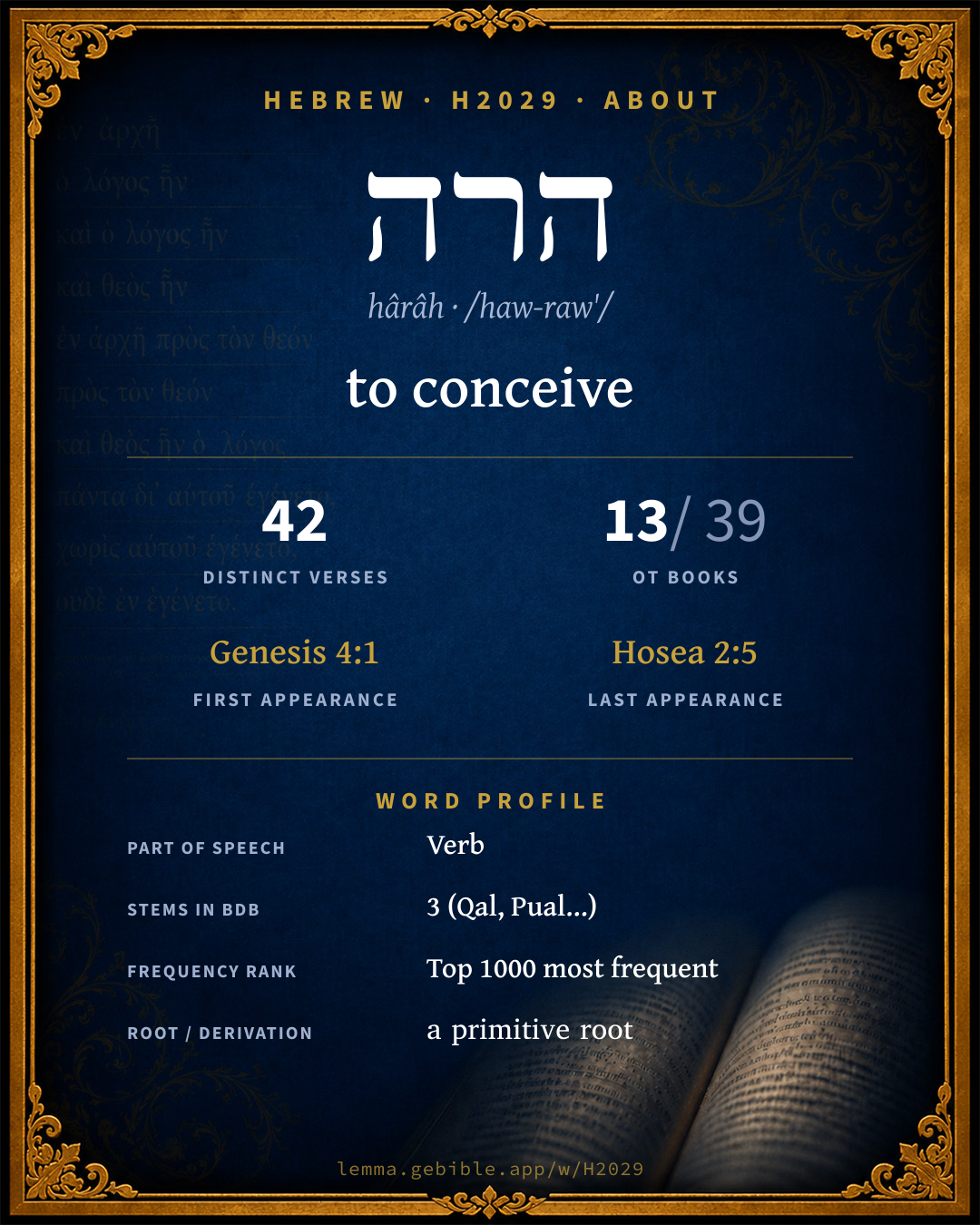
הָרָה
to conceive
also: become pregnant, bear, be with child, be conceived fuller range ↓
Full lexicon entry — Brown-Driver-Briggs (BDB)
From Brown-Driver-Briggs (BDB)
Where this word appears
See every Qal verb in the Hebrew Bible →
Grammar key — what these labels mean
Part of speech
- Verb
- An action or state-of-being word.
Stem
- Qal
- The basic, simple active stem — the plain form of the verb (“he wrote”). Here: ‘lit. conceive’
- Pual
- The passive counterpart of the Piel.
Form
- Sequential Imperfect
- An imperfect with prefixed waw — the standard past-narrative form (waw-consecutive imperfect).
- Infinitive Absolute
- An unbound verbal noun, often intensifying or standing in for a finite verb.
- Perfect
- A completed action or state — Hebrew marks aspect (completeness) more than strict tense (“he wrote”).
- Sequential Perfect
- A perfect with prefixed waw continuing a preceding imperfect or command (waw-consecutive perfect).
- Imperfect
- An incomplete, ongoing, or future action (“he will / would write”).
- Participle Active
- A verbal adjective expressing ongoing or characteristic action (“writing / one who writes”).
State
- Construct
- A noun bound to a following noun in a possessive / “of” relationship (the construct chain).
Person
- 3rd Person
- The one spoken about (“he / she / it / they”).
- 2nd Person
- The one addressed (“you”).
- 1st Person
- The speaker (“I / we”).
Gender
- Feminine
- Grammatically feminine.
- Masculine
- Grammatically masculine.
- Common
- Either gender — not distinguished for this form.
Number
- Singular
- One.
- Plural
- More than one (in Hebrew, generally three or more).
Grammatical forms 13 distinct
- Verb, Qal, Sequential Imperfect, 3rd Person, Feminine, Singular 28 times (65%)
- Verb, Qal, Infinitive Absolute 2 times (5%)
- Verb, Qal, Perfect, 3rd Person, Feminine, Singular 2 times (5%)
- Verb, Qal, Participle Active, Feminine, Singular, Construct 2 times (5%)
- Verb, Qal, Perfect, 2nd Person, Feminine, Singular 1 time (2%)
- Verb, Qal, Sequential Perfect, 3rd Person, Masculine, Singular 1 time (2%)
- Verb, Qal, Sequential Imperfect, 3rd Person, Feminine, Plural 1 time (2%)
- Verb, Pual, Perfect, 3rd Person, Masculine, Singular 1 time (2%)
+5 more forms (5 occurrences)
Parsed forms decoded from the imported morphology (morphhb / Westminster Leningrad Codex — WLC text public domain, morphhb tagging CC BY 4.0), counted across 43 parsed occurrences — not distinct verses.
Every verse where H2029 appears — 42 distinct verses across 13 books. Click any verse to open its interlinear word-by-word view. Verse text shown in the World English Bible for context — . Each verse’s Hebrew form is shown with its reference; the English is not keyword-highlighted, since the data carries no word-level English alignment. Use “Compare translations” on any verse to read it across multiple English versions. This concordance covers the Hebrew Bible; Septuagint (Greek Old Testament) occurrences are not indexed here.
Genesis 20 verses
- Genesis 4:1 וַ/תַּ֨הַר֙ conj + Qal wimpf 3fs The man knew Eve his wife. She conceived, and gave birth to Cain, and said, "I have gotten a man with Yahweh's help."
- Genesis 4:17 וַ/תַּ֖הַר conj + Qal wimpf 3fs Cain knew his wife. She conceived, and gave birth to Enoch. He built a city, and called the name of the city, after the name of his son, Enoch.
- Genesis 16:4 וַ/תַּ֑הַר הָרָ֔תָה conj + Qal wimpf 3fs Qal pf 3fs He went in to Hagar, and she conceived. When she saw that she had conceived, her mistress was despised in her eyes.
- Genesis 16:5 הָרָ֔תָה Qal pf 3fs Sarai said to Abram, "This wrong is your fault. I gave my handmaid into your bosom, and when she saw that she had conceived, I was despised in her eyes. Yahweh judge between me and you."
- Genesis 19:36 וַֽ/תַּהֲרֶ֛יןָ conj + Qal wimpf 3fp Thus both of Lot's daughters were with child by their father.
- Genesis 21:2 וַ/תַּהַר֩ conj + Qal wimpf 3fs Sarah conceived, and bore Abraham a son in his old age, at the set time of which God had spoken to him.
- Genesis 25:21 וַ/תַּ֖הַר conj + Qal wimpf 3fs Isaac entreated Yahweh for his wife, because she was barren. Yahweh was entreated by him, and Rebekah his wife conceived.
- Genesis 29:32 וַ/תַּ֤הַר conj + Qal wimpf 3fs Leah conceived, and bore a son, and she named him Reuben. For she said, "Because Yahweh has looked at my affliction. For now my husband will love me."
- Genesis 29:33 וַ/תַּ֣הַר conj + Qal wimpf 3fs She conceived again, and bare a son, and said, "Because Yahweh has heard that I am hated, he has therefore given me this son also." She named him Simeon.
- Genesis 29:34 וַ/תַּ֣הַר conj + Qal wimpf 3fs She conceived again, and bare a son. Said, "Now this time will my husband be joined to me, because I have borne him three sons." Therefore was his name called Levi.
- Genesis 29:35 וַ/תַּ֨הַר conj + Qal wimpf 3fs She conceived again, and bare a son. She said, "This time will I praise Yahweh." Therefore she named him Judah. Then she stopped bearing.
- Genesis 30:5 וַ/תַּ֣הַר conj + Qal wimpf 3fs Bilhah conceived, and bore Jacob a son.
- Genesis 30:7 וַ/תַּ֣הַר conj + Qal wimpf 3fs Bilhah, Rachel's handmaid, conceived again, and bore Jacob a second son.
- Genesis 30:17 וַ/תַּ֛הַר conj + Qal wimpf 3fs God listened to Leah, and she conceived, and bore Jacob a fifth son.
- Genesis 30:19 וַ/תַּ֤הַר conj + Qal wimpf 3fs Leah conceived again, and bore a sixth son to Jacob.
- Genesis 30:23 וַ/תַּ֖הַר conj + Qal wimpf 3fs She conceived, bore a son, and said, "God has taken away my reproach."
- Genesis 38:3 וַ/תַּ֖הַר conj + Qal wimpf 3fs She conceived, and bore a son; and he named him Er.
- Genesis 38:4 וַ/תַּ֥הַר conj + Qal wimpf 3fs She conceived again, and bore a son; and she named him Onan.
- Genesis 38:18 וַ/תַּ֥הַר conj + Qal wimpf 3fs He said, "What pledge will I give you?" She said, "Your signet and your cord, and your staff that is in your hand." He gave them to her, and came in to her, and she conceived by him.
- Genesis 49:26 הוֹרַ֔/י Qal ptcp.act mp cs + sfx pers 1cs The blessings of your father Have prevailed above the blessings of the ancient mountains, Above the bounty of the age-old hills. They will be on the head of Joseph, On the crown of the head of him who is separated from his brothers.
Exodus 1 verse
Numbers 1 verse
Judges 1 verse
1 Samuel 2 verses
- 1 Samuel 1:20 וַ/תַּ֥הַר conj + Qal wimpf 3fs It happened, when the time was come about, that Hannah conceived, and bore a son; and she named him Samuel, [saying], Because I have asked him of Yahweh.
- 1 Samuel 2:21 וַ/תַּ֛הַר conj + Qal wimpf 3fs Yahweh visited Hannah, and she conceived, and bore three sons and two daughters. The child Samuel grew before Yahweh.
2 Samuel 1 verse
2 Kings 1 verse
1 Chronicles 2 verses
- 1 Chronicles 4:17 וַ/תַּ֨הַר֙ conj + Qal wimpf 3fs The sons of Ezrah: Jether, and Mered, and Epher, and Jalon; and she bore Miriam, and Shammai, and Ishbah the father of Eshtemoa.
- 1 Chronicles 7:23 וַ/תַּ֖הַר conj + Qal wimpf 3fs He went in to his wife, and she conceived, and bore a son, and he named him Beriah, because it went evil with his house.
Job 2 verses
Psalms 1 verse
Song of Solomon 1 verse
Isaiah 5 verses
- Isaiah 8:3 וַ/תַּ֖הַר conj + Qal wimpf 3fs I went to the prophetess; and she conceived, and bore a son. Then said Yahweh to me, Call his name Maher Shalal Hash Baz.
- Isaiah 26:18 הָרִ֣ינוּ Qal pf 1cp We have been with child, we have been in pain, we have as it were brought forth wind; we have not worked any deliverance in the earth; neither have the inhabitants of the world fallen.
- Isaiah 33:11 תַּהֲר֥וּ Qal impf 2mp You shall conceive chaff, you shall bring forth stubble: your breath is a fire that shall devour you.
- Isaiah 59:4 הָר֥וֹ Qal inf.abs None sues in righteousness, and none pleads in truth: they trust in vanity, and speak lies; they conceive mischief, and bring forth iniquity.
- Isaiah 59:13 הֹר֧וֹ Poel inf.abs transgressing and denying Yahweh, and turning away from following our God, speaking oppression and revolt, conceiving and uttering from the heart words of falsehood.
Hosea 4 verses
- Hosea 1:3 וַ/תַּ֥הַר conj + Qal wimpf 3fs So he went and took Gomer the daughter of Diblaim; and she conceived, and bore him a son.
- Hosea 1:6 וַ/תַּ֤הַר conj + Qal wimpf 3fs She conceived again, and bore a daughter. Then he said to him, "Call her name Lo-Ruhamah; for I will no longer have mercy on the house of Israel, that I should in any way pardon them.
- Hosea 1:8 וַ/תַּ֖הַר conj + Qal wimpf 3fs Now when she had weaned Lo-Ruhamah, she conceived, and bore a son.
- Hosea 2:5 הֽוֹרָתָ֑/ם Qal ptcp.act fs cs + sfx pers 3mp For their mother has played the prostitute. She who conceived them has done shamefully; For she said, 'I will go after my lovers, Who give me my bread and my water, My wool and my flax, My oil and my drink.'
About this entry
At a glance — auto-summarized from this page’s data, not written by a person. Every figure links to its source below. This summary describes the numbers; it doesn’t interpret them.
הרה — transliterated hârâh — is a Hebrew verb carrying the sense “to conceive.” It first appears in Genesis 4:1. With 42 verses in 13 books, it is a moderately common word in the Hebrew Bible. Its uses concentrate in Genesis (48% of all occurrences). The verb spans 3 stems, from Qal to Pual. Each statement above links to its evidence; the full detail follows below.
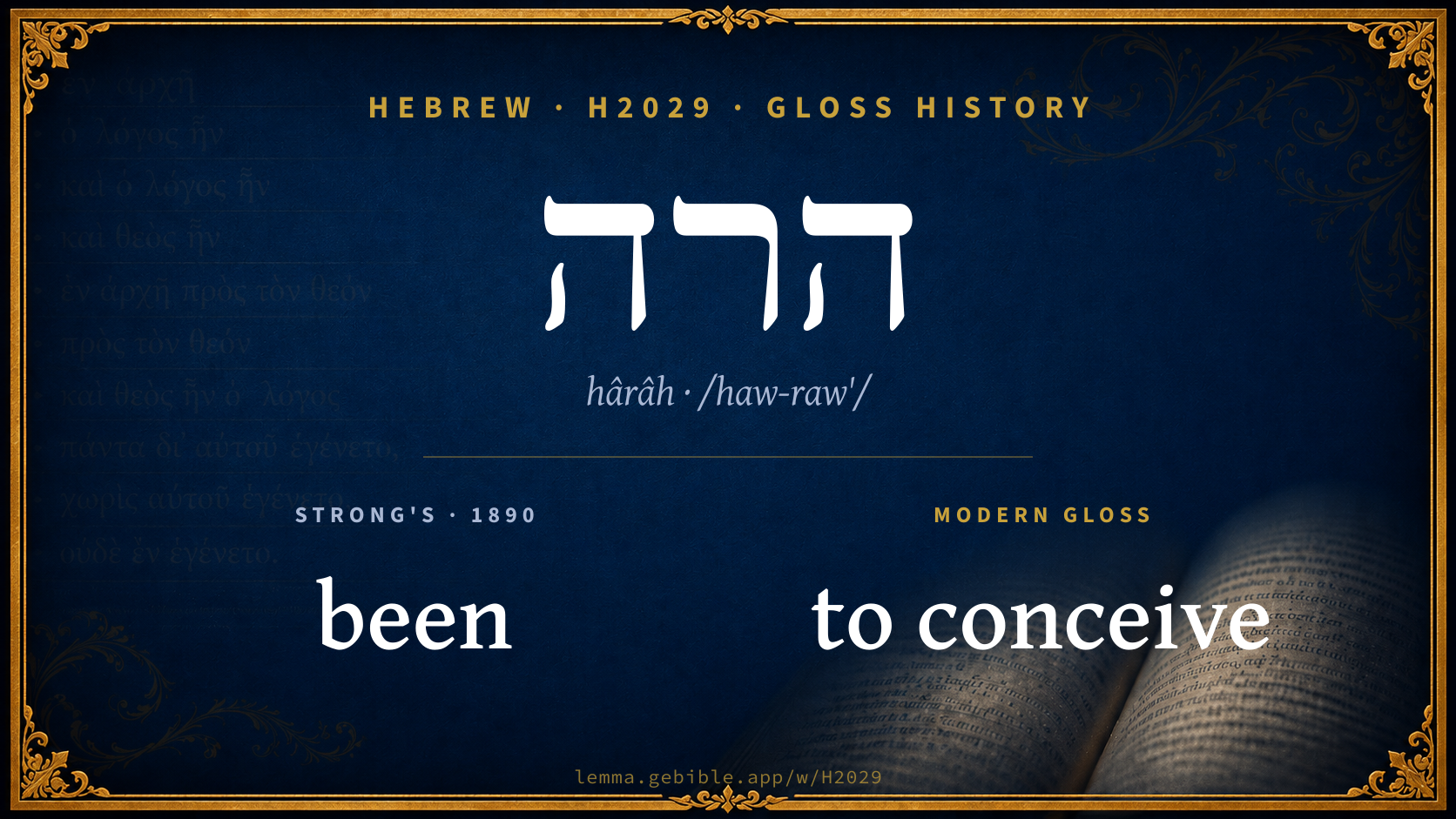
Gloss history
Strong's 1890 vs modern scholarship
About this word
Strong's H2029 catalogs a Hebrew word from the Hebrew Old Testament.
These counts are not copied from any lexicon or concordance. They are computed here, from the morphology-tagged Hebrew Old Testament. What Lemma adds →
- 42
- distinct verses
- The word appears in 42 distinct verses.
- 13 / 39
- OT books
- The word appears in 13 of 39 Old Testament books.
- #837
- by frequency
- Top 1000 most frequent Hebrew words (rank 837 of 8,640 Hebrew words by occurrence).
View all 42 occurrences in the concordance →
By section of the Old Testament
By traditional corpus
Conventional, traditional groupings — biblical authorship is debated, so this is a traditional corpus grouping, not an authorship claim. Each share is this word’s portion of its verses in that division of the Hebrew canon. Each figure is a share of the word’s 42 distinct verses.
- Torah (Pentateuch) 22 verses · 52%
- Prophets (Nevi'im) 14 verses · 33%
- Writings (Ketuvim) 6 verses · 14%
How translations render this word
Counts come from each version’s own published word-to-Strong’s tagging or interlinear alignment — an approximate guide to how each version renders this word, not a word-level alignment the data otherwise carries. Because each total is that version’s own tagged count, the per-version totals vary from one another and need not match the appearance or distinct-verse counts above. These counts may also differ from a printed concordance because Lemma counts each distinctly tagged rendering and does not collapse phrase taggings into a single head-word total. This is a fixed set of word-tagged versions (KJV, ASV, BSB, ULT) and does not change with the reading translation you choose elsewhere. Each version’s license is shown beside its name below (and on Sources).
BDB lists this Strong’s number as 3 distinct words (homographs). Each count above pools all of them and is not split by sense — see the Senses section below. A low-frequency rendering may belong to a different one of those words, not the primary meaning.
- King James Version†: She conceived 14×, Conceived 12×, She conceived again 2×
- American Standard Version†: She conceived 14×, Conceived 10×, She conceived again 2×
- Berean Standard Bible†: She conceived 13×, Conceived 12×, She was pregnant 2×
- unfoldingWord Literal Text†: She conceived 18×, Conceived 10×, And 4×
King James Version Public Domain
Renders H2029 across 43† tagged occurrences — most commonly:
Plus 11 renderings that appear only once — usually multi-word phrases or single function words the recovered tagging swept in, not distinct renderings.
American Standard Version Public Domain
Renders H2029 across 43† tagged occurrences — most commonly:
Plus 13 renderings that appear only once — usually multi-word phrases or single function words the recovered tagging swept in, not distinct renderings.
Berean Standard Bible Public Domain
Renders H2029 across 43† tagged occurrences — most commonly:
Plus 14 renderings that appear only once — usually multi-word phrases or single function words the recovered tagging swept in, not distinct renderings.
unfoldingWord Literal Text CC BY-SA 4.0
Renders H2029 across 54† tagged occurrences — most commonly:
Plus 12 renderings that appear only once — usually multi-word phrases or single function words the recovered tagging swept in, not distinct renderings.
Senses in the full BDB
Hebrew verbs can shift meaning by stem (binyan): Qal is the basic action, Niphal is often passive or reflexive, Piel often intensifies or makes it factitive, and Hiphil is typically causative. The senses below are grouped under the stem BDB assigns to each. This entry also uses Pual (the passive of Piel) and one or more reduplicated stems (the Pōlēl/Pilpēl type), which for hollow or geminate roots behave much like Piel — often intensive or iterative.
What do BDB’s symbols mean?
BDB uses these scholarly abbreviations:
| Symbol | Meaning |
|---|---|
| 𝔊 | the Septuagint (the ancient Greek translation, LXX) |
| 𝔙 | the Vulgate (the Latin translation) |
| 𝔖 | the Syriac version (the Peshitta) |
| 𝔗 | the Targum (the Aramaic translation) |
| ψ | the Psalms |
| √ | root (the underlying root or stem) |
| ‖ | parallel passage (a synonymous or contrasted parallel) |
| † | the dagger: every passage where the word occurs is cited |
The 5 senses and sub-senses the full Brown-Driver-Briggs lexicon distinguishes for this word, in lexicon order (not ranked by frequency), with BDB’s own verbatim wording and sub-sense lettering. Shown in Hebrew script with BDB’s own scholarly abbreviations. The condensed entry is in the Lexicon Entry tab. See also the Forms in the corpus table below.
הרה I assumed by Thes al. as ancient form for הַר mountain, to explain הוֹרַי Gn 49
הרה II conceive, become pregnant (Assyrian erû cf. DlPr 21 Muss. Arnolt Hbr Oct. 1890, 67 JägerBAS i. 473)
Qal
- Pf. 3 ms. וְהָרָה consec. ψ 7:15; 3 fs. הָרָ֑תָה Gn 16:4, 5; 2 fs. וְהָרִית consec. Ju 13:3; i s. הָרִיתִי Nu 11:12; 1 pl. הָרִינוּ Is 26:18; Impf. וַתַּ֫הַר Gn 4:1 + 26 times (וַתַּ֑הַר Gn 16:4); 3 fpl. וַתַּהֲרֶיןָ Gn 19:36; 2 mpl. תַּהֲרוּ Is 33:11; Inf. abs. הָרֹה Jb 15:35, הָרוֹ Is 59:4 cf. also v 13 sub Po. infr.; Pt. f. sf. הוֹרָתִי Ct 3:4; הוֹרָתָם Ho 2:7;— e.g. Psalms 7:15
- 1. lit. conceive, become pregnant Gn 16:4(×2), 5; 19:36; 25:21; 38:18 (all J), 2 S 11:5 (agency of man expressed by מִן Gn 19:36, לְ 38:18); usually in phr. וַתַּהַר וַתֵּלֶד Gn 4:1, 17; 21:2; 29:32, 33, 34, 35; 30:5, 7 (all J), v 17, 19, 23 (all E), 38:3, 4 (both J), Ex 2:2 (E), 1 S 1:20; 2:21 2 K 4:17 1 Ch 7:23 Is 8:3 Ho 1:3, 6, 8, prob. also 1 Ch 4:17 ותהר אֶת־מִרְיָם [ותלד] cf. Be; further Ju 13:3, and cf. Moses’ question הֶאָנֹכִי הָרִיתִי אֵת כָּל־הָעָם הַזֶּה אִם־אָנֹכִי יְלִדְתִּיהוּ Nu 11:12 have I conceived all this people, or have I brought it forth? Pt. f. ‖ אֵם Ho 2:7 Ct 3:4. e.g. Genesis 16:4
- 2. metaph. הָרִינוּ חַלְנוּ כְמוֹ יָלַדְנוּ רוּחַ Is 26:18 of anxious and disappointed waiting; תַּהֲרוּ חֲשַׁשׁ תֵּלְדוּ קַשׁ Is 33:11, of futile planning, cf. Che; elsewhere of evil, mischief וְהָרָה עָמָל וְיָלַד שָׁ֑קֶר ψ 7:15 (subj. wicked man), cf. Jb 15:35 Is 59:4, so also v 13, read הָרוֹ (Inf. abs.) cf. Di. e.g. Isaiah 26:18
Pual
- Pf. 3 ms. הֹרָה גָּ֑בֶר Jb 3:3 a man hath been conceived (Böii p. 103 BaNB 77 regard as Qal pass.). e.g. Job 3:3
Po
- Inf. abs., conceive, contrive, devise הֹרוֹ וְהֹגוֹ מִּלֵּב דִּבְרֵי שָׁ֑קֶר Is 59:13, but read rather הָרוֹ וְהָגוֹ Qal Inf. abs. v. supr. (Ba l.c. expl. MT as Qal Inf. pass.).—On הוֹרַי Gn 49:26 v. הוֹר and הַר 1 c. e.g. Isaiah 59:13
הרה III f. pregnant
Senses from the full Brown-Driver-Briggs lexicon (Brown, Driver, Briggs; Oxford 1906 — public domain), digitized via Sefaria, supplemented by the OpenScriptures HebrewLexicon (CC BY 4.0). Full attribution on Sources.
Word origin
I. assumed by Thes al. as ancient form for הַר mountain, to explain הוֹרַי Gn 49:26, read הוֹרֵי־עָד; but better הַרֲרֵי־עַד everlasting mountains, v. הַר sub הרר.
I. vb. conceive, become pregnant (Assyrian erû cf. DlPr 21 Muss. Arnolt Hbr Oct. 1890, 67 JägerBAS i. 473);—
II. adj.f. pregnant—;abs. ה׳ Gn 16:11 + 10 times; cstr. הֲרַת Je 20:17; pl. cstr. הָרוֹת Am 1:13; sf. הָרוֹתֶיהָ 2 K 15:16; הָרֹתֵיהֶם 2 K 8:12;—pregnant, as attrib., אִשָּׁה ה׳ Ex 21:22; as pred. Gn 38:24 (לִזְנוּנִים), v 25 (לְאִישׁ), 1 S 4:19 2 S 11:5 Is 7:14 (+ וְיֹלֶדֶת); in phr. הִנָּךְ הָרָה וְיֹלַדְתְּ Gn 16:11 (on resemblance to Is 7:14 cf. PetersHbr Apr. 1885, 243; Apr. 1886, 175), Ju 13:5, 7; = subst. pregnant women, women with child Am 1:13 2 K 8:12; 15:16 Je 31:8, and, in sim., Is 26:17; once of womb וְרַחְמָהּ הֲרַת עוֹלָם Je 20:17.
— Brown-Driver-Briggs (Oxford 1906, public domain), digitized via Sefaria, supplemented by the OpenScriptures HebrewLexicon (CC BY 4.0). See Sources.
Origin: a primitive root
Jastrow Dictionary
A second Hebrew/Aramaic lexicon for comparison, covering Aramaic and post-biblical (Talmudic, Targumic, Midrashic) usage that the biblical-Hebrew BDB does not. Matched by lemma rather than by Strong’s number, so a lemma may carry more than one Jastrow headword (shown separately below), and the entries cover usage well beyond the Bible.
הָרָה
- (b. h.) to conceive, be with child. Yalk. Ex. 168, end. Y. B. Kam. V, 5ᵃ top; Bab. B. Kam. 49ᵃ
- to be conceived; *(homilet.) conception, v. הוֹרָת. Gen. R. s. 64; Yalk. Job 894 that she would have said to him, ה׳ גבר is this a time for conception, man? (‘Rashi’).
A Dictionary of the Targumim, the Talmud Babli and Yerushalmi, and the Midrashic Literature (Marcus Jastrow; London, Luzac, 1903) — Public Domain. Digitized via Sefaria. Digitized via Sefaria. Full attribution on Sources.
Forms in the corpus
The 23 distinct written forms H2029 takes in the Hebrew Bible, most frequent first — each parse links to that stem’s occurrences in the concordance. Hebrew forms include their vowel points and cantillation, so a single lemma takes many written forms.
Same root — word family
Other BDB entries built from the same root as H2029, grouped by Strong’s listed origin. These share a root / origin per the lexicon — not necessarily a shared meaning. Each links to that word’s own entry.
Derived from this word
Compare all same-root words → They share a root, not necessarily a meaning.
Septuagint verse parallels
This word appears in 42 verses that also exist in the Greek Old Testament (Septuagint), out of the 42 Hebrew verses it occurs in. You can read those verses in Greek by switching the Old Testament edition to the Septuagint.
Read these verses in the Septuagint
- Genesis 4:1
- Exodus 2:2
- Numbers 11:12
- Judges 13:3
- 1 Samuel 1:20
- 2 Samuel 11:5
- 2 Kings 4:17
- 1 Chronicles 4:17
- Job 3:3
- Psalms 7:14
- Song of Solomon 3:4
- Isaiah 8:3
This is a verse-level parallel only — the same verses exist in both the Hebrew and Greek Old Testaments. No word-level Hebrew↔Greek correspondence is claimed: the data carries no such alignment, so no Greek word is shown as this Hebrew word’s translation. Coverage is not total — the Septuagint omits the deuterocanon and renumbers the Psalms, so some Hebrew verses have no direct Greek parallel.