
Isaiah 33:11

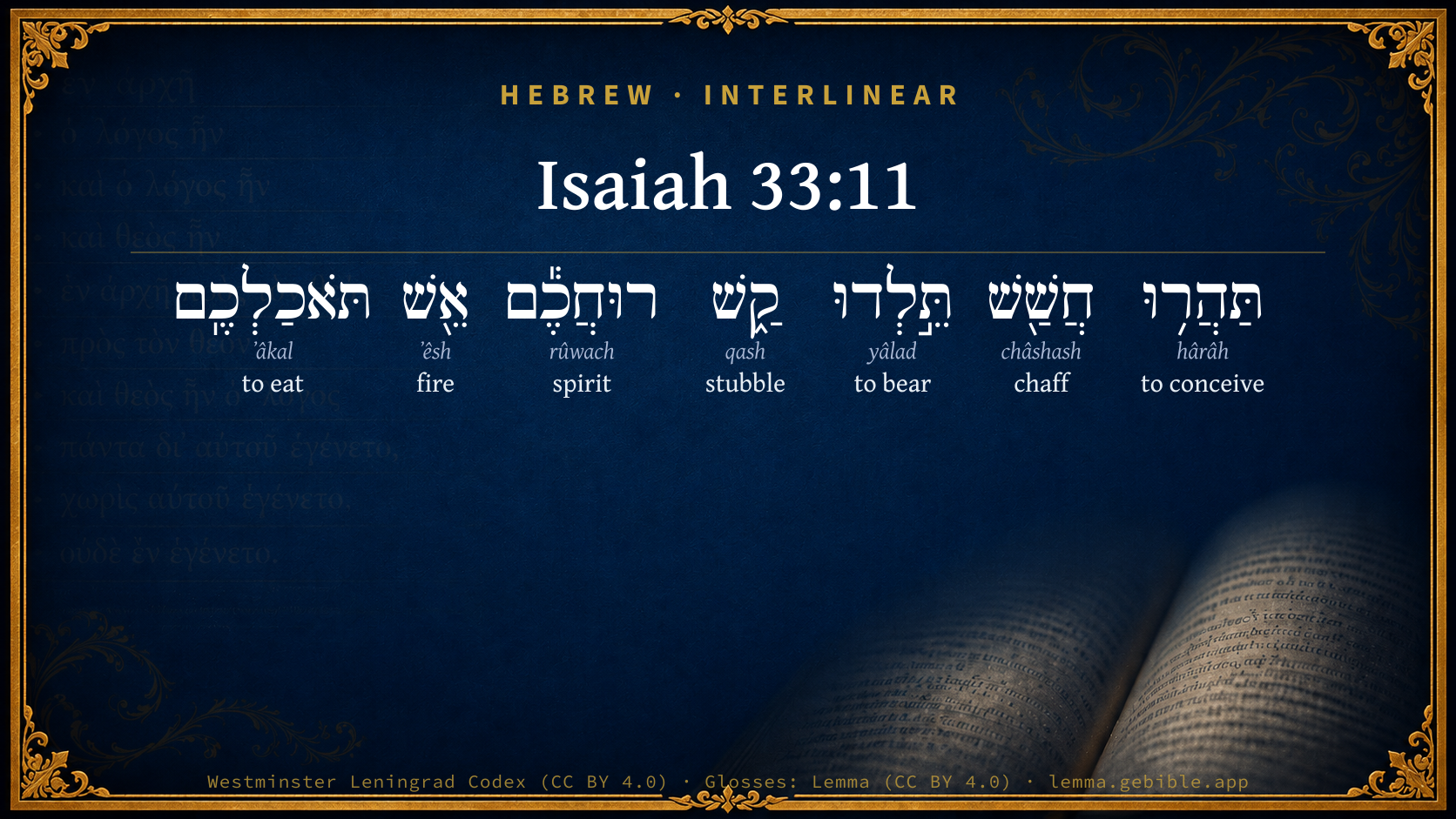
Hebrew (Westminster Leningrad Codex) Isaiah 33:11 appears in the Hebrew Old Testament. The text above is from the Westminster Leningrad Codex. Each word links to its Strong’s number, a concise gloss, and parsing drawn from the Open Scriptures Hebrew Bible morphology. Click any word for its full Brown-Driver-Briggs (BDB) entry.
Download image
Cite this verse

Isaiah 33:11 (World English Bible). Public Domain. Lemma interlinear Bible study tool, https://lemma.gebible.app/v/isaiah/33/11.

Show BibTeX & RIS
BibTeX
RIS
English Translation
You shall conceive chaff, you shall bring forth stubble: your breath is a fire that shall devour you.
World English Bible · Public Domain
Download a study sheet

One document with this verse’s original text, its word-by-word gloss line, the meaning frame, cross-references with their text, attributed commentary, and full source and license credits — printable, and it pastes into notes with its structure intact.

This verse Autodidact and up

Study sheet (.html) Plain text (.txt)

A passage Seminary Student

Up to 50 verses in one chapter. A passage sheet keeps up to 6 commentary sources and 12 cross-references per verse, in the order this page ranks them, and says so on the sheet whenever that leaves anything out. Ask for a single verse and you get the Autodidact verse sheet above.

Everything on this page stays free to read, with no account — the sheet is a download of what is already on screen, not access to it.

Want to remove ads? Support Godless Engineer
Compare translations 3

The same verse in 3 English versions, stacked beneath the original-language interlinear above. Click any original word for its lexicon entry.

Each is an independent rendering of the whole verse — the interlinear is not word-aligned to these translations.

Highlighted words mark where these versions differ — a whole-verse word diff, not a word-by-word alignment.

  • World English Bible Public Domain
    You shall conceive chaff, you shall bring forth stubble: your breath is a fire that shall devour you.
  • King James Version Public Domain
    Ye shall conceive chaff, ye shall bring forth stubble: your breath, as fire, shall devour you.
  • unfoldingWord Literal Text CC BY-SA 4.0
    You will conceive chaff, you will bear stubble; your breath a fire, it will devour you.

unfoldingWord Literal Text — © unfoldingWord, licensed CC BY-SA 4.0. Word-aligned USFM3 via Door43 (git.door43.org/unfoldingWord/en_ult).

Versions to compare (up to 4)

3 of 4 selected

Show all 18 translations

Every available English version of this verse, each an independent rendering of the whole verse.

  • World English Bible Public Domain
    You shall conceive chaff, you shall bring forth stubble: your breath is a fire that shall devour you.
  • Berean Standard Bible Public Domain
    You conceive chaff; you give birth to stubble. Your breath is a fire that will consume you.
  • Majority Standard Bible Public Domain
    You conceive chaff; you give birth to stubble. Your breath is a fire that will consume you.
  • King James Version Public Domain
    Ye shall conceive chaff, ye shall bring forth stubble: your breath, as fire, shall devour you.
  • American Standard Version (1901) Public Domain
    Ye shall conceive chaff, ye shall bring forth stubble: your breath is a fire that shall devour you.
  • Revised Version (1885) Public Domain
    Ye shall conceive chaff, ye shall bring forth stubble: your breath is a fire that shall devour you.
  • Geneva Bible (1599) Public Domain
    Ye shall conceiue chaffe, and bring forth stubble: the fire of your breath shall deuoure you.
  • Douay-Rheims (1899) Public Domain
    You shall conceive heat, you shall bring forth stubble: your breath as fire shall devour you.
  • Young's Literal Translation Public Domain
    Ye conceive chaff, ye bear stubble, Your spirit! -- fire devoureth you.
  • Literal Standard Version CC BY-SA 4.0
    You conceive chaff, you bear stubble; Your spirit—a fire [that] devours you.
  • Unlocked Literal Bible CC BY-SA 4.0
    You conceive chaff, and you give birth to stubble; your breath is a fire that will consume you.
  • unfoldingWord Literal Text CC BY-SA 4.0
    You will conceive chaff, you will bear stubble; your breath a fire, it will devour you.
  • Darby Bible Public Domain
    Ye shall conceive dry grass, ye shall bring forth stubble: your breath shall devour you [as] fire.
  • World Messianic Bible Public Domain
    You will conceive chaff. You will give birth to stubble. Your breath is a fire that will devour you.
  • Webster's Bible Public Domain
    Ye shall conceive chaff, ye shall bring forth stubble: your breath, as fire, shall devour you.
  • Free Bible Version CC BY-SA 4.0
    All you give birth to is only dry grass, all you deliver is just stubble. Your breath is a fire that will burn you up.
  • Bible in Basic English Public Domain
    Your designs will be without profit, and their effect will be nothing: you will be burned up by the fire of my breath.
  • JPS Tanakh (1917) Public Domain
    Ye conceive chaff, ye shall bring forth stubble; your breath is a fire that shall devour you.

Literal Standard Version (2020), Covenant Press — licensed CC BY-SA 4.0. Text via the HelloAO Bible API (eBible.org). Unlocked Literal Bible (unfoldingWord) — licensed CC BY-SA 4.0. Text via the HelloAO Bible API (eBible.org). unfoldingWord Literal Text — © unfoldingWord, licensed CC BY-SA 4.0. Word-aligned USFM3 via Door43 (git.door43.org/unfoldingWord/en_ult). Free Bible Version, Dr. Jonathan Gallagher — licensed CC BY-SA 4.0. Text via the HelloAO Bible API (eBible.org).

Word by word

More ways to search: Search by grammar → Find every occurrence → Compare this word →

Practice this passage: Drill this verse → Learn its vocabulary →

About this verse

These counts appear in no published source. They are computed here, from the morphology-tagged text and Lemma’s own curated glosses. What Lemma adds →

7
words
7
distinct lemmas
Prophets
section

Notable vocabulary

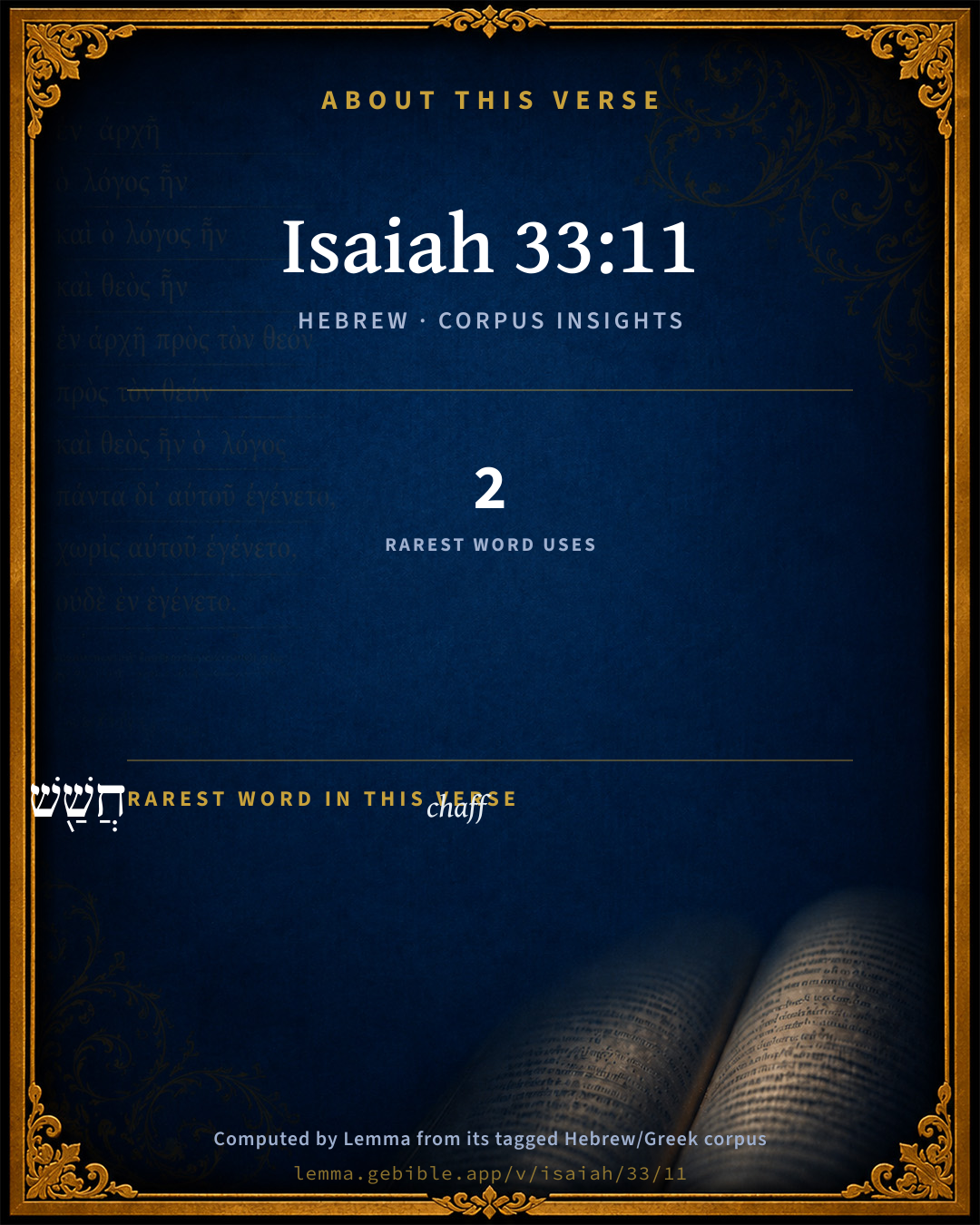
The rarest word here is חֲשַׁ֖שׁ chaff H2842 — appearing just 2 times in the whole Hebrew Bible.

Shared distinctive vocabulary

חֲשַׁ֖שׁ chaff H2842 occurs in 2 verses of the Hebrew Bible. Also found in:

Grammatical profile

  • 3 verbs
  • 4 nouns

Verb forms

  • תַּהֲר֥וּ Qal · Imperfect
  • תֵּ֣לְדוּ Qal · Imperfect
  • תֹּאכַלְכֶֽם Qal · Imperfect

Hebrew & Septuagint length

In English translation the verse runs 18 words from the Hebrew and 20 from the Septuagint (LXX English) — closely comparable.

A rough comparison of the two English renderings, which tokenize alike — not a word-level alignment.

Word counts can differ between the Hebrew and the Greek without any difference in meaning — e.g. the Hebrew direct-object marker אֵת has no separate Greek word, and Greek often adds the article ὁ.

Cross-references

18

Topical passages linked to Isaiah 33:11 in the Treasury of Scripture Knowledge — connected by theme and wording, ordered by reader-vote popularity; previews shown in the World English Bible.

  • Psalms 7:14 Behold, he travails with iniquity; Yes, he has conceived mischief, And brought forth falsehood.
  • Isaiah 59:4 None sues in righteousness, and none pleads in truth: they trust in vanity, and speak lies; they conceive mischief, and bring forth iniquity.
  • James 1:15 Then the lust, when it has conceived, bears sin; and the sin, when it is full grown, brings forth death.
  • Acts 5:4 While you kept it, didn't it remain your own? After it was sold, wasn't it in your power? How is it that you have conceived this thing in your heart? You haven't lied to men, but to God."
  • Job 15:35 They conceive mischief, and bring forth iniquity. Their heart prepares deceit."
  • Psalms 2:1 Why do the nations rage, And the peoples plot a vain thing?
  • Psalms 83:5–18 For they have conspired together with one mind. They form an alliance against you.
  • Isaiah 1:31 The strong will be like tinder, And his work like a spark. They will both burn together, And no one will quench them."
  • Isaiah 5:24 Therefore as the tongue of fire devours the stubble, And as the dry grass sinks down in the flame, So their root shall be as rottenness, And their blossom shall go up as dust; Because they have rejected the law of Yahweh of Hosts, And despised the word of the Holy One of Israel.
  • Isaiah 8:9–10 Make an uproar, O you peoples, and be broken in pieces! And give ear, all you of far countries: gird yourselves, and be broken in pieces! Gird yourselves, and be broken in pieces!
  • Isaiah 10:7–14 However he doesn't mean so, neither does his heart think so; but it is in his heart to destroy, and to cut off not a few nations.
  • Isaiah 17:13 The nations shall rush like the rushing of many waters: but he shall rebuke them, and they shall flee far off, and shall be chased as the chaff of the mountains before the wind, and like the whirling dust before the storm.
  • Isaiah 26:18 We have been with child, we have been in pain, we have as it were brought forth wind; we have not worked any deliverance in the earth; neither have the inhabitants of the world fallen.
  • Isaiah 29:5–8 But the multitude of your foes shall be like small dust, and the multitude of the awesome ones as chaff that passes away: yes, it shall be in an instant suddenly.
  • Isaiah 30:30–33 Yahweh will cause his glorious voice to be heard, and will show the lighting down of his arm, with the indignation of [his] anger, and the flame of a devouring fire, with a blast, and tempest, and hailstones.
  • Isaiah 31:8–9 The Assyrian shall fall by the sword, not of man; and the sword, not of men, shall devour him; and he shall flee from the sword, and his young men shall become subject to forced labor.
  • Isaiah 37:23–29 Whom have you defied and blasphemed? and against whom have you exalted your voice and lifted up your eyes on high? [even] against the Holy One of Israel.
  • Nahum 1:5–10 The mountains quake before him, and the hills melt away. The earth trembles at his presence, yes, the world, and all who dwell in it.

Cross-references courtesy of OpenBible.info (CC BY 4.0).

Hebrew and Greek witnesses Masoretic Hebrew ↔ Greek Septuagint

The same verse in the two great witnesses to the Old Testament, shown verse-for-verse.

These are two independent witnesses, not word-aligned to each other, and the Septuagint is shown in lemma (dictionary) form.

Hebrew Isaiah 33:11 Masoretic · Westminster Leningrad Codex

תַּהֲר֥וּ חֲשַׁ֖שׁ תֵּ֣לְדוּ קַ֑שׁ רוּחֲכֶ֕ם אֵ֖שׁ תֹּאכַלְכֶֽם

You shall conceive chaff, you shall bring forth stubble: your breath is a fire that shall devour you.

World English Bible · Public Domain

Greek LXX Isaiah 33:11 Septuagint · lemma form

νῦν ὁράω νῦν αἰσθάνομαι μάταιος εἰμί ὁ ἰσχύς ὁ πνεῦμα σύ πῦρ σύ καταἐσθίω

Now shall you⌃ see, now shall you⌃ perceive; the strength of your breath, shall be vain; fire shall devour you.

LXX2012 (modern English Septuagint) · Public Domain

Hebrew: Westminster Leningrad Codex (CC BY 4.0). Greek: Septuagint (public domain); English from LXX2012 (modern English Septuagint) (Public Domain). How the Septuagint differs from the Hebrew →

Targum (Aramaic paraphrase)

1

The Targum is the ancient Jewish Aramaic paraphrase of the Hebrew Scriptures — an interpretive translation, not the Hebrew text itself. Onkelos (literal) and Pseudo-Jonathan (expansive) render the Torah, and Jonathan the Prophets. Coverage is partial: where no permissively-licensed English translation exists for a verse, only the Aramaic is shown. This is verse-level text, not a word-by-word alignment to the Hebrew.

  1. Targum Jonathan Prophets (Joshua–Malachi)
    אִתְעַשְׁתּוּן לְכוֹן עַמְמַיָא עַשְׁתּוֹנִין דִרְשַׁע עֲבַדְתּוּן לְכוֹן עוֹבָדִין בִּישִׁין בְּדִיל עוֹבָדֵיכוֹן בִּישַׁיָא מֵימְרִי כְּעַלְעוֹלָא לְקַשָׁא יְשֵׁיצֵי יַתְכוֹן:

    Ye, O people! have purposed for yourselves purposes of iniquity; ye have worked for yourselves evil works, because your works are evil; my WORD shall consume you, as a whirlwind consumes chaff.

    Targum Jonathan — Aramaic: “Mikraot Gedolot” (public domain). English: “Sefaria Community Translation” (CC0 1.0 (public-domain dedication)); “London "Chaldee Paraphrase," 1871” (public domain). Text via Sefaria.

Commentary

Notes on Isaiah 33:11 from classic Christian and Jewish commentators (each source and its license shown beneath its notes). The classic Christian expositions comment on the surrounding passage and are grouped to its opening verse, so a note may address several verses; the Jewish commentaries on the Tanakh (Rashi and others) are per-verse, so they appear only where the commentator wrote on this verse.

Lemma curates 59 commentaries, every one of them public domain or Creative Commons licensed, each selected and text-cleaned for this edition rather than reprinted as found. About our sources →

Trapp's Complete Commentary

John Trapp

Isa 33:11 Ye shall conceive chaff, ye shall bring forth stubble: your breath, [as] fire, shall devour you.

Ver. 11. Ye shall conceive chaff, ye shall bring forth stubble.] Gravidi estis stramiue, parietis stipulum. So did Pharaoh, Antiochus, Julian, &c. So doth Antichrist and his champions, notwithstanding his bloody alarms to them, such as was that sounded out in the year 1582.

“ Utere iure tao, Caesar, sectamque Lutheri

Ease, rota, ponto, funibus, igne neca. ”

And that other of the King of France not many years since, exhorting him to kill up all the Protestants per Galliam stabulantes, the very words of the Pope’s bull, that had any stable room in France.

Your breath as fire shall devour you.] Shall blow up the fire that shall consume your chaff and stubble. Your iniquity shall be your ruin. {Eze 18:3-9} Turdus sibi malum cacat. Hic est gladius quem ipse fecisti: This is a sword of thine own making, said the soldier to Marius, when he ran him through with it.

John Trapp, A Commentary or Exposition upon All the Books of the Old and New Testament (1647–1656) — public domain. Text from a community e-Sword module.

Keil & Delitzsch

C. F. Keil & F. Delitzsch

After the prophet has heard this from Jehovah, he knows how it will fare with them. He therefore cries out to them in triumph (Isa 33:11), "Ye are pregnant with hay, ye bring forth stubble! Your snorting is the fire that will devour you." Their vain purpose to destroy Jerusalem comes to nothing; their burning wrath against Jerusalem becomes the fire of wrath, which consumes them (for chashash and qash, see at Isa 5:24).

Keil & Delitzsch — Biblical Commentary on the Old Testament (1861–1891) — public domain (CC PDM 1.0). Text via the HelloAO Bible API. (Old Testament only.)

Tyndale Open Study Notes

Tyndale Open Resources

33:11 In most passages, the Assyrians were turning other nations into worthless dry grass and stubble (see 17:13; 29:5; 40:24; 41:2). Here, ironically, they get a taste of their own medicine.

Tyndale Open Study Notes — © Tyndale Open Resources, licensed CC BY-SA 4.0. Text via the HelloAO Bible API.

Geneva Bible (1599)

Geneva Bible translators

This is spoken against the enemies, who thought all was their own: but he showeth that their enterprise shall be in vain, and that the fire which they had kindled for others, should consume them.

Geneva Bible (1599) marginal notes — public domain. Text via Bolls.life.

Jamieson, Fausset & Brown

Robert Jamieson, A. R. Fausset & David Brown

Ye--the enemy.

conceive chaff-- (Isa 26:18; Isa 59:4).

your breath--rather, your own spirit of anger and ambition [MAURER], (Isa 30:28).

Jamieson, Fausset & Brown — Commentary Critical and Explanatory on the Whole Bible (1871) — public domain (CC PDM 1.0). Text via the HelloAO Bible API.

Adam Clarke's Commentary

Verse 11. Your breath - "And my spirit"] "For רוחכם ruchechem, your spirit, read רוחי כמו ruchi kemo." Secker. Which reading is confirmed by the Chaldee, where מימרי meywri, "my word," answers to רוחי ruchi, "my spirit."

Adam Clarke's Commentary on the Bible (1810–1826) — public domain. Text from a community e-Sword/MySword module.

Ellicott's Commentary for English Readers

(11) Ye shall conceive chaff . . .—Primarily the words are addressed to the Assyrian invaders, but not without a side glance at all who had been weaving their own webs of policy instead of trusting in Jehovah. Scheme and result, conception and parturition, would be alike worthless.

Your breath, as fire . . .—“Breath,” the hot panting of rage; this, instead of working the destruction of Judah, should prove suicidal.

A Bible Commentary for English Readers, edited by Charles John Ellicott (1878–1897) — public domain. Text from a community e-Sword module.

The Cambridge Bible for Schools and Colleges

gen. ed. J. J. S. Perowne

11. Still the words of Jehovah, addressed to the enemy. The present tense would be better than the future. For the first figure see ch. Isa_59:4; Job_15:35; Psa_7:14.

your breath …] Better as R.V. your breath (i.e. “anger”) is a fire that devours you.

The Cambridge Bible for Schools and Colleges (gen. ed. J. J. S. Perowne; Cambridge University Press, 1878–1918) — public domain. Text from a community e-Sword module.

John Gill's Exposition

Ye shall conceive chaff, ye shall bring forth stubble,.... Signifying that all the counsels, designs, and schemes, of the antichristian party, to continue themselves in their present state, and save themselves from ruin, as well as utterly to destroy the interest of Christ, would be weak, vain, and fruitless; their conceptions and actions, their purposes and attempts, would be alike; would be abortive, like chaff and stubble, and only serve as such for their own destruction:

your breath as fire shall devour you; or, "your spirit" (a); your pride and haughtiness, in self praises, commendations, and glorying; your rage, wrath, and fury, against the saints; your blasphemy against God and Christ shall be the reason why the fire of God's wrath shall consume you. The Targum is,

"you have thought for yourselves, O ye people, thoughts of wickedness; ye have done for yourselves evil works; because of your evil works, my Word shall destroy you, as a whirlwind the stubble;''

Christ, the essential Word of God.

(a) "spiritus vester", V. L. Pagninus, Montanus, &c.

John Gill's Exposition of the Whole Bible (1746–1763) — public domain (CC PDM 1.0). Text via the HelloAO Bible API.

Albert Barnes' Notes on the Bible

Ye shall conceive chaff - An address of God to the Assyrians. The figure is one that denotes that their counsels would be in vain. Chaff and stubble are used in the Scriptures, in contrast with grain, to denote anything which is not solid, nutritious, or substantial; then anything which is frivolous, useless, vain. A similar image occurs in Isa 26:18 (see the note on that place; compare Isa 59:4).

Your breath as fire shall devour you - The word ‘breath’ here (רוח rûach, spirit) is evidently used in the sense of the Θυμός thumos, and denotes anger, as in Isa 30:28. It refers to the haughty and arrogant spirit of Sennacherib; the enraged and excited mind intent on victory and plunder. The sense is, that his mind, so intent on conquest - so proud, excited, and angry, would be the means of his own destruction. Lowth proposes to read ‘my spirit,’ but for this change there is no authority from manuscripts (see the notes at Isa 1:31).

Albert Barnes' Notes on the Bible (1834–1885) — public domain. Text from a community e-Sword/MySword module.

Haydock's Catholic Bible Commentary

You, Assyrians, are bringing destruction upon yourselves. (Calmet)

George Leo Haydock (1774–1849), Haydock's Catholic Family Bible and Commentary, 1859 edition — public domain. Excludes Psalms (Douay-Rheims chapter numbering differs from Protestant) and Deuterocanonical books (Catholic canon only).

Matthew Poole's English Annotations

Ye shall conceive chaff, ye shall bring forth stubble, instead of solid corn. Your great hopes and designs, O ye Assyrians! shall be utterly disappointed.

Your breath, as fire, shall devour you; your rage against my people shall bring ruin upon yourselves.

Matthew Poole's English Annotations on the Holy Bible (1683–1685) — public domain. Text from a community e-Sword/MySword module.

The Pulpit Commentary

Ye shall conceive chaff. The Assyrian plans against Jerusalem shall be mere "chaff" and stubble." They shall come to naught. Nay, the fury of the foe against Jerusalem shall be the fire to destroy them.

The Pulpit Commentary (1880–1919), ed. H.D.M. Spence-Jones & Joseph S. Exell — public domain. Text from a community e-Sword module.

John Wesley's Explanatory Notes

Stubble - Instead of solid corn. Your great hopes and designs, shall be utterly disappointed. Your breath - Your rage against my people shall bring ruin upon yourselves.

John Wesley, Explanatory Notes Upon the Whole Bible (1754–1765) — public domain. Text via the GEBible commentary corpus.

J. A. Alexander on Isaiah

Joseph Addison Alexander

“Ye shall conceive chaff ye shall bring forth stubble; your breath (as) fire shall devour you.” The first clause contains a common scriptural figure for failure and frustration. (See Isa 26:18). Chaff and stubble are named as worthless and perishable substances.

Joseph Addison Alexander, The Prophecies of Isaiah (1846–1847; New York: Scribner, 1870–1878) — public domain. Text from a community e-Sword module.

Rashi

Rabbi Shlomo Yitzchaki (Rashi)

chaff (חֲשַׁשׁ) a kind of chaff, something that is easily ignited.

your breath is fire From your body shall emanate breath of fire and will consume the chaff and the stubble.

Rashi on the Tanakh — English translations: “The Judaica Press complete Tanach with Rashi, translated by A. J. Rosenberg” (CC BY 4.0); “Pentateuch with Rashi's commentary by M. Rosenbaum and A.M. Silbermann, 1929-1934” (public domain); “The Metsudah Tanach series, Lakewood, N.J” (CC BY 4.0); and “The Book of Joshua, Metsudah Publications, 1997” (CC BY 4.0). Text via Sefaria.

Ibn Ezra

Rabbi Abraham ibn Ezra

Ye shall conceive. Assyria is addressed.

חשש Chaff. The word has the same meaning in Arabic.

רוחכם אש תאכלכם According to some: Your breath, as fire, shall devour you. It is more correctly considered as the continuation of the preceding figure of the chaff and stubble: Your wind, will not lift you up, but, like fire, utterly destroy you.

Ibn Ezra on the Tanakh — English translations: “Sefaria Community Translation” (CC0 1.0 (public-domain dedication)); “Yalkut, Sifsei Chachomim Chumash, Metsudah Publications, 2009” (CC BY 4.0); and “Commentary of Ibn Ezra on Isaiah - trans. by M. Friedlander, 1873” (public domain). Text via Sefaria.

Lesson kit

Teaching starters — assembled from the data on this page, not authored interpretation. Every prompt links to the verse data it draws on. Edit before teaching.

Isaiah, in the Prophets, opens this verse with 7 words (7 distinct Hebrew lemmas). Its most distinctive word is châshash (“chaff”). A historical commentator’s framing appears above. Read the whole chapter for the surrounding context.

Discussion questions

  1. What does “chaff” (châshash) contribute to the verse as a whole?
  2. How does Isaiah 5:24, which shares the word «chaff», read alongside this verse?
  3. The translations on this page render this verse differently — a whole-verse word diff, not a word-by-word alignment. What might account for the different wordings?
  4. «תַּהֲר֥וּ» is a Qal Imperfect verb. How does that grammatical form shape the action described?
  5. Compare how Trapp's Complete Commentary and Keil & Delitzsch read this verse. Where do they agree or differ?

Things to notice

Reading settings

Reading text

Shown beneath each verse's original-language words.

Old Testament
Old Testament edition

Read the OT as the Masoretic Hebrew (MT) or the Greek Septuagint (LXX).

English shown for the Greek Septuagint (in the Hebrew ↔ Greek comparison).

Comparing translations? Open the Compare panel on any verse page to stack up to four side by side.