Isaiah 8:3

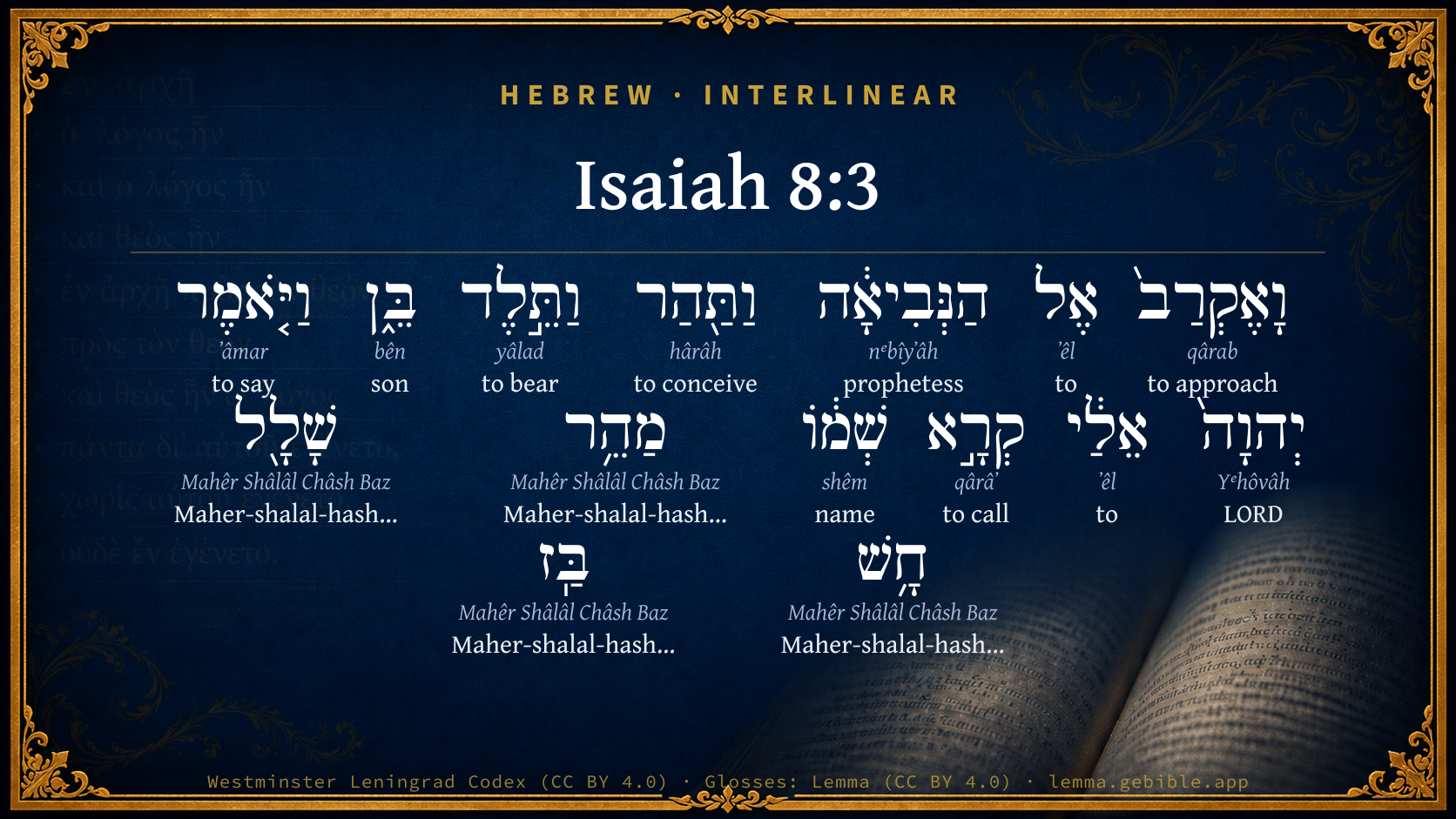
Hebrew (Westminster Leningrad Codex) Isaiah 8:3 appears in the Hebrew Old Testament. The text above is from the Westminster Leningrad Codex. Each word links to its Strong’s number, a concise gloss, and parsing drawn from the Open Scriptures Hebrew Bible morphology. Click any word for its full Brown-Driver-Briggs (BDB) entry.
Download image
Cite this verse

Isaiah 8:3 (World English Bible). Public Domain. Lemma interlinear Bible study tool, https://lemma.gebible.app/v/isaiah/8/3.

Show BibTeX & RIS
BibTeX
RIS
English Translation
I went to the prophetess; and she conceived, and bore a son. Then said Yahweh to me, Call his name Maher Shalal Hash Baz.
World English Bible · Public Domain
Download a study sheet

One document with this verse’s original text, its word-by-word gloss line, the meaning frame, cross-references with their text, attributed commentary, and full source and license credits — printable, and it pastes into notes with its structure intact.

This verse Autodidact and up

Study sheet (.html) Plain text (.txt)

A passage Seminary Student

Up to 50 verses in one chapter. A passage sheet keeps up to 6 commentary sources and 12 cross-references per verse, in the order this page ranks them, and says so on the sheet whenever that leaves anything out. Ask for a single verse and you get the Autodidact verse sheet above.

Everything on this page stays free to read, with no account — the sheet is a download of what is already on screen, not access to it.

Want to remove ads? Support Godless Engineer
Compare translations 3

The same verse in 3 English versions, stacked beneath the original-language interlinear above. Click any original word for its lexicon entry.

Each is an independent rendering of the whole verse — the interlinear is not word-aligned to these translations.

Highlighted words mark where these versions differ — a whole-verse word diff, not a word-by-word alignment.

  • World English Bible Public Domain
    I went to the prophetess; and she conceived, and bore a son. Then said Yahweh to me, Call his name Maher Shalal Hash Baz.
  • King James Version Public Domain
    And I went unto the prophetess; and she conceived, and bare a son. Then said the LORD to me, Call his name Mahershalalhashbaz.
  • unfoldingWord Literal Text CC BY-SA 4.0
    And I drew near to the prophetess, and she conceived and bore a son. And Yahweh said to me, “Call his name Maher-Shalal-Hash-Baz,

unfoldingWord Literal Text — © unfoldingWord, licensed CC BY-SA 4.0. Word-aligned USFM3 via Door43 (git.door43.org/unfoldingWord/en_ult).

Versions to compare (up to 4)

3 of 4 selected

Show all 18 translations

Every available English version of this verse, each an independent rendering of the whole verse.

  • World English Bible Public Domain
    I went to the prophetess; and she conceived, and bore a son. Then said Yahweh to me, Call his name Maher Shalal Hash Baz.
  • Berean Standard Bible Public Domain
    And I had relations with the prophetess, and she conceived and gave birth to a son. The LORD said to me, “Name him Maher-shalal-hash-baz.
  • Majority Standard Bible Public Domain
    And I had relations with the prophetess, and she conceived and gave birth to a son. The LORD said to me, “Name him Maher-shalal-hash-baz.
  • King James Version Public Domain
    And I went unto the prophetess; and she conceived, and bare a son. Then said the LORD to me, Call his name Mahershalalhashbaz.
  • American Standard Version (1901) Public Domain
    And I went unto the prophetess; and she conceived, and bare a son. Then said Jehovah unto me, Call his name Maher-shalal-hash-baz.
  • Revised Version (1885) Public Domain
    And I went unto the prophetess; and she conceived, and bare a son. Then said the LORD unto me, Call his name Maher-shalal-hash-baz.
  • Geneva Bible (1599) Public Domain
    After, I came vnto the Prophetesse, which conceiued, and bare a sonne. Then sayd the Lord to me, Call his name, Mahershalalhash-baz.
  • Douay-Rheims (1899) Public Domain
    And I went to the prophetess, and she conceived, and bore a son. And the Lord said to me: Call his name, Hasten to take away the spoils: Make haste to take away the prey.
  • Young's Literal Translation Public Domain
    And I draw near unto the prophetess, and she conceiveth, and beareth a son; and Jehovah saith unto me, `Call his name Maher-shalal-hash-baz,
  • Literal Standard Version CC BY-SA 4.0
    And I draw near to the prophetess, and she conceives, and bears a son; and YHWH says to me, “Call his name Maher-shalal-hash-baz,
  • Unlocked Literal Bible CC BY-SA 4.0
    I went to the prophetess, and she conceived and bore a son. Then Yahweh said to me, “Call his name Maher-Shalal-Hash-Baz.
  • unfoldingWord Literal Text CC BY-SA 4.0
    And I drew near to the prophetess, and she conceived and bore a son. And Yahweh said to me, “Call his name Maher-Shalal-Hash-Baz,
  • Darby Bible Public Domain
    And I came near to the prophetess, and she conceived and bore a son; and Jehovah said unto me, Call his name, Maher-shalal-hash-baz.
  • World Messianic Bible Public Domain
    I went to the prophetess, and she conceived, and bore a son. Then the LORD said to me, “Call his name ‘Maher Shalal Hash Baz.’
  • Webster's Bible Public Domain
    And I went to the prophetess; and she conceived, and bore a son. Then said the LORD to me, Call his name Maher-shalal-hash-baz.
  • Free Bible Version CC BY-SA 4.0
    Then I slept with my wife the prophetess, and she became pregnant and gave birth to a son. The Lord told me, “Call him Maher-shalal-hash-baz.
  • Bible in Basic English Public Domain
    And I went in to my wife, and she became with child, and gave birth to a son. Then the Lord said to me, Give him the name Maher-shalal-hash-baz,
  • JPS Tanakh (1917) Public Domain
    And I went unto the prophetess; and she conceived, and bore a son. Then said the LORD unto me: 'Call his name Maher-shalal-hashbaz.

Literal Standard Version (2020), Covenant Press — licensed CC BY-SA 4.0. Text via the HelloAO Bible API (eBible.org). Unlocked Literal Bible (unfoldingWord) — licensed CC BY-SA 4.0. Text via the HelloAO Bible API (eBible.org). unfoldingWord Literal Text — © unfoldingWord, licensed CC BY-SA 4.0. Word-aligned USFM3 via Door43 (git.door43.org/unfoldingWord/en_ult). Free Bible Version, Dr. Jonathan Gallagher — licensed CC BY-SA 4.0. Text via the HelloAO Bible API (eBible.org).

Word by word

More ways to search: Search by grammar → Find every occurrence → Compare this word →

Practice this passage: Drill this verse → Learn its vocabulary →

הַנְּבִיאָ֔ה
nᵉbîyʼâh
H5031
“the · prophetess”
Particle, Definite Article + Noun, Common, Feminine, Singular, Absolute
Part of Speech
Particle + Noun
Type
Common
Gender
Feminine
Number
Singular
State
Absolute
Full BDB Definition

Origin: from H5030

TWOT: 1277c

prophetess - ancient type endowed with gift of song (Miriam) - later type consulted for a word (Huldah) - false prophetess (Noadiah) - wife of Isaiah the prophet
  1. וָאֶקְרַב֙ qârab H7126 “and · to approach” Conjunction + Verb, Qal, Sequential Imperfect, 1st Person, Common, Singular
  2. אֶל ʼêl H413 “to” Preposition
  3. וַתַּ֖הַר hârâh H2029 “and · to conceive” Conjunction + Verb, Qal, Sequential Imperfect, 3rd Person, Feminine, Singular
  4. וַתֵּ֣לֶד yâlad H3205 “and · to bear” Conjunction + Verb, Qal, Sequential Imperfect, 3rd Person, Feminine, Singular
  5. בֵּ֑ן bên H1121 “son” Noun, Common, Masculine, Singular, Absolute
  6. וַיֹּ֤אמֶר ʼâmar H559 “and · to say” Conjunction + Verb, Qal, Sequential Imperfect, 3rd Person, Masculine, Singular
  7. יְהוָה֙ Yᵉhôvâh H3068 “LORD” Noun, Proper
  8. אֵלַ֔י ʼêl H413 “to · me” Preposition + Suffix, Personal, 1st Person, Common, Singular
  9. קְרָ֣א qârâʼ H7121 “call” Verb, Qal, Imperative, 2nd Person, Masculine, Singular
  10. שְׁמ֔וֹ shêm H8034 “name · his” Noun, Common, Masculine, Singular, Construct + Suffix, Personal, 3rd Person, Masculine, Singular
  11. מַהֵ֥ר Mahêr Shâlâl Châsh Baz H4122 “Maher-shalal-hash-baz” Noun, Proper
  12. שָׁלָ֖ל Mahêr Shâlâl Châsh Baz H4122 “Maher-shalal-hash-baz” Noun, Proper
  13. חָ֥שׁ Mahêr Shâlâl Châsh Baz H4122 “Maher-shalal-hash-baz” Noun, Proper
  14. בַּֽז Mahêr Shâlâl Châsh Baz H4122 “Maher-shalal-hash-baz” Noun, Proper

About this verse

These counts appear in no published source. They are computed here, from the morphology-tagged text and Lemma’s own curated glosses. What Lemma adds →

15
words
11
distinct lemmas
Prophets
section

Notable vocabulary

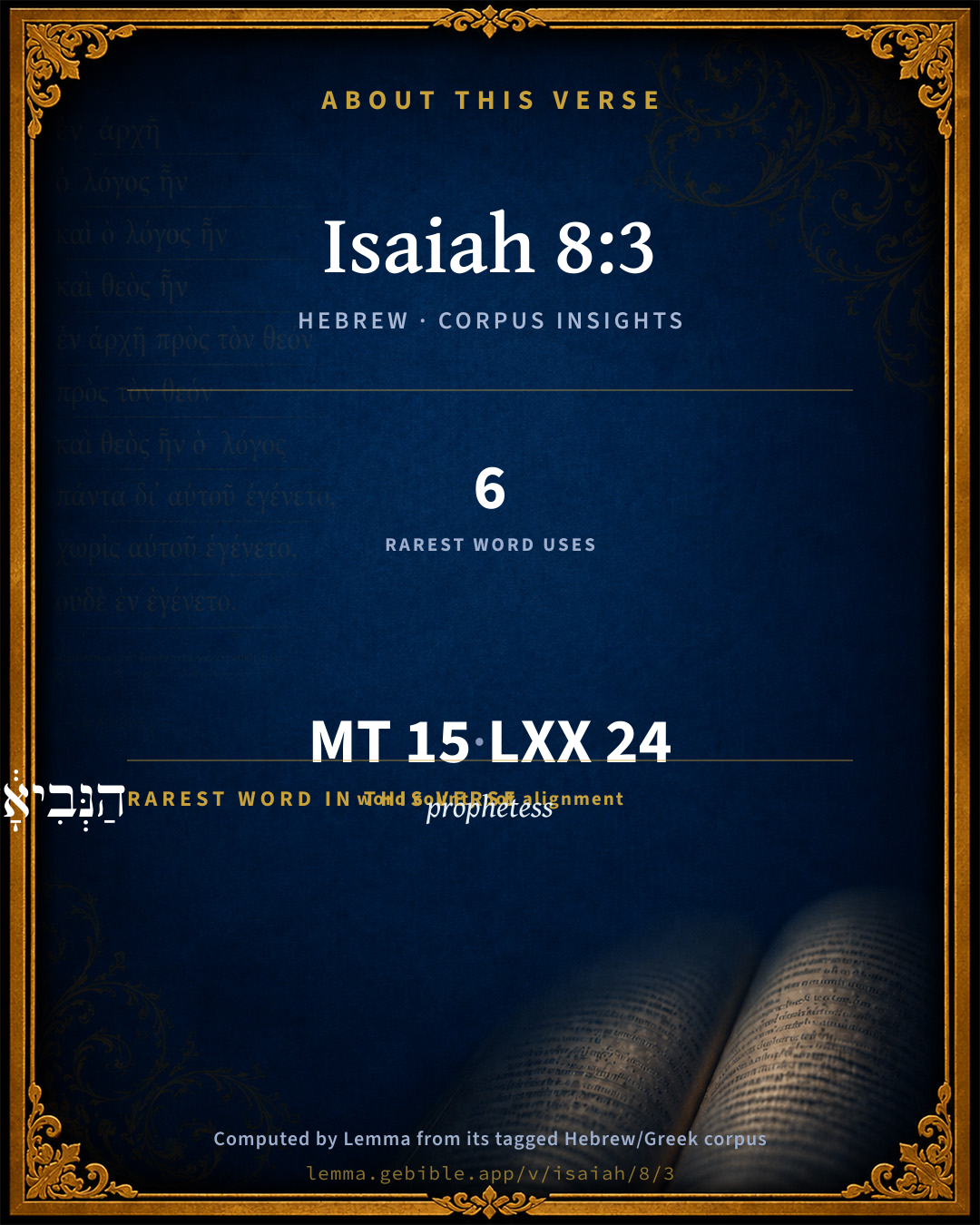
The rarest word here is הַנְּבִיאָ֔ה prophetess H5031 — appearing just 6 times in the whole Hebrew Bible.

Shared distinctive vocabulary

הַנְּבִיאָ֔ה prophetess H5031 occurs in 6 verses of the Hebrew Bible. Also found in:

Grammatical profile

  • 5 verbs
  • 8 nouns
  • 2 prepositions

Verb forms

  • וָאֶקְרַב֙ Qal · Sequential Imperfect
  • וַתַּ֖הַר Qal · Sequential Imperfect
  • וַתֵּ֣לֶד Qal · Sequential Imperfect
  • וַיֹּ֤אמֶר Qal · Sequential Imperfect
  • קְרָ֣א Qal · Imperative

Repetition

Words recur within this verse — often emphatic in Hebrew:

  • מַהֵ֥ר Maher-shalal-hash-baz H4122 ×4
  • אֶל to H413 ×2

Hebrew & Septuagint length

In English translation the verse runs 24 words from the Hebrew and 27 from the Septuagint (LXX English) — closely comparable.

A rough comparison of the two English renderings, which tokenize alike — not a word-level alignment.

Word counts can differ between the Hebrew and the Greek without any difference in meaning — e.g. the Hebrew direct-object marker אֵת has no separate Greek word, and Greek often adds the article ὁ.

In the original languages it is 15 Hebrew tokens and 24 Greek tokens — but the two are counted differently (Hebrew bundles its prefixes and suffixes into one token; the Greek is in lemma form), so that isn’t a like-for-like length.

Cross-references

4

Topical passages linked to Isaiah 8:3 in the Treasury of Scripture Knowledge — connected by theme and wording, ordered by reader-vote popularity; previews shown in the World English Bible.

  • Hosea 1:3–9 So he went and took Gomer the daughter of Diblaim; and she conceived, and bore him a son.
  • Judges 4:4 Now Deborah, a prophetess, the wife of Lappidoth, she judged Israel at that time.
  • 2 Kings 22:14 So Hilkiah the priest, and Ahikam, and Achbor, and Shaphan, and Asaiah, went to Huldah the prophetess, the wife of Shallum the son of Tikvah, the son of Harhas, keeper of the wardrobe (now she lived in Jerusalem in the second quarter); and they talked with her.
  • Isaiah 7:13–14 He said, "Listen now, house of David: Is it not enough for you to try the patience of men, that you will try the patience of my God also?

Cross-references courtesy of OpenBible.info (CC BY 4.0).

Hebrew and Greek witnesses Masoretic Hebrew ↔ Greek Septuagint

The same verse in the two great witnesses to the Old Testament, shown verse-for-verse.

These are two independent witnesses, not word-aligned to each other, and the Septuagint is shown in lemma (dictionary) form.

Hebrew Isaiah 8:3 Masoretic · Westminster Leningrad Codex

וָאֶקְרַב֙ אֶל הַנְּבִיאָ֔ה וַתַּ֖הַר וַתֵּ֣לֶד בֵּ֑ן וַיֹּ֤אמֶר יְהוָה֙ אֵלַ֔י קְרָ֣א שְׁמ֔וֹ מַהֵ֥ר שָׁלָ֖ל חָ֥שׁ בַּֽז

I went to the prophetess; and she conceived, and bore a son. Then said Yahweh to me, Call his name Maher Shalal Hash Baz.

World English Bible · Public Domain

Greek LXX Isaiah 8:3 Septuagint · lemma form

καί προςἔρχομαι πρός ὁ προφῆτις καί ἐν γαστήρ λαμβάνω καί τίκτω υἱός καί εἶπον κύριος ἐγώ καλέω ὁ ὄνομα αὐτός ταχέως σκυλεύω ὀξέως προνομεύω

And I went in to the prophetess; and she conceived, and bore a son. And the Lord said to me, Call his name, Spoil quickly, plunder speedily.

LXX2012 (modern English Septuagint) · Public Domain

Hebrew: Westminster Leningrad Codex (CC BY 4.0). Greek: Septuagint (public domain); English from LXX2012 (modern English Septuagint) (Public Domain). How the Septuagint differs from the Hebrew →

Targum (Aramaic paraphrase)

1

The Targum is the ancient Jewish Aramaic paraphrase of the Hebrew Scriptures — an interpretive translation, not the Hebrew text itself. Onkelos (literal) and Pseudo-Jonathan (expansive) render the Torah, and Jonathan the Prophets. Coverage is partial: where no permissively-licensed English translation exists for a verse, only the Aramaic is shown. This is verse-level text, not a word-by-word alignment to the Hebrew.

  1. Targum Jonathan Prophets (Joshua–Malachi)
    וַעֲלֵית לְוַת נְבִיאֲתָא וְעַדִיאַת וִילֵדַת בַּר וַאֲמַר יְיָ לִי קְרִי שְׁמֵיהּ מוֹחִי לְמִבַּז בִּזָא וּלְמֶעְדֵי עֲדָאָה:

    And I went to the prophetess; and she conceived, and bare a son. Then said the Lord unto me, Call his name 'Hasten to seize the prey, and to take away the spoil.'

    Targum Jonathan — Aramaic: “Mikraot Gedolot” (public domain). English: “Sefaria Community Translation” (CC0 1.0 (public-domain dedication)); “London "Chaldee Paraphrase," 1871” (public domain). Text via Sefaria.

Commentary

Notes on Isaiah 8:3 from classic Christian and Jewish commentators (each source and its license shown beneath its notes). The classic Christian expositions comment on the surrounding passage and are grouped to its opening verse, so a note may address several verses; the Jewish commentaries on the Tanakh (Rashi and others) are per-verse, so they appear only where the commentator wrote on this verse.

Lemma curates 59 commentaries, every one of them public domain or Creative Commons licensed, each selected and text-cleaned for this edition rather than reprinted as found. About our sources →

Trapp's Complete Commentary

John Trapp

Isa 8:3 And I went unto the prophetess; and she conceived, and bare a son. Then said the LORD to me, Call his name Mahershalalhashbaz.

Ver. 3. And I went unto the prophetess.] Prophets’ wives were anciently called prophetesses; like as bishops’ wives, saith A Lapide the Jesuit, were also called bishopesses, presbyters’ wives, presbyteresses, deacons’ wives, deaconesses. Jesuits have still their Jesuitesses, as majors their majoresses, &c.

Maher-shalal-hash-baz,] q.d., Make haste, come away to so rich a booty, to the rifling and ruinating of these two potent and opulent kingdoms. God hereby seemeth to speak of the Assyrian, as Cicero once did his friend, Si dormis, expergiscere: si stas, ingredere: si ingrederis, curre: si curtis, advola, &c. and at the calling of this child by his name, the prediction was remembered, and the thing ascertained.

John Trapp, A Commentary or Exposition upon All the Books of the Old and New Testament (1647–1656) — public domain. Text from a community e-Sword module.

Tyndale Open Study Notes

Tyndale Open Resources

8:3 my wife: Literally the prophetess. • Like the name Immanuel (7:14), Maher-shalal-hash-baz is symbolic. It is possible that this child was the partial fulfillment of the Immanuel prophecy as well (see study note on 7:14). The ultimate fulfillment of the Immanuel prophecy occurred with the birth of Jesus (Matt 1:22-23).

Tyndale Open Study Notes — © Tyndale Open Resources, licensed CC BY-SA 4.0. Text via the HelloAO Bible API.

Geneva Bible (1599)

Geneva Bible translators

Meaning, to his wife, and this was done in a vision.

Or, make speed to the spoil: haste to the prey.

Geneva Bible (1599) marginal notes — public domain. Text via Bolls.life.

Jamieson, Fausset & Brown

Robert Jamieson, A. R. Fausset & David Brown

prophetess--perhaps the same as the "virgin" (Isa 7:14), in the interim married as Isaiah's second wife: this is in the primary and temporary sense. Immanuel is even in this sense distinct from Maher-shalal-hash-baz. Thus nineteen months at least intervene from the prophecy (Isa 7:14), nine before the birth of Immanuel, and ten from that time to the birth of Maher-shalal-hash-baz: adding eleven or twelve months before the latter could cry, "Father" (Isa 8:4), we have about three years in all, agreeing with Isa 7:15-16.

Jamieson, Fausset & Brown — Commentary Critical and Explanatory on the Whole Bible (1871) — public domain (CC PDM 1.0). Text via the HelloAO Bible API.

Ellicott's Commentary for English Readers

(3) I . . . the prophetess . . .—The word may have been given by courtesy to a prophet’s wife as such. Elsewhere, however, as in the case of Deborah (Jdg_4:4) and Huldah (2Ch_34:22), it implies prophetic gifts. Possibly, therefore, we may think of the prophet and his wife as having been drawn together by united thoughts and counsels, in contrast with the celibate life of Jeremiah (Jer_16:2), the miseries of Hosea’s marriage (Hosea 1, 2), and the sudden bereavement of Ezekiel (Eze_24:16-18). We may, perhaps, trace, on this view, the wife’s hand in the toilet inventory of Isa_3:16-24.

A Bible Commentary for English Readers, edited by Charles John Ellicott (1878–1897) — public domain. Text from a community e-Sword module.

The Cambridge Bible for Schools and Colleges

gen. ed. J. J. S. Perowne

3. the prophetess] Isaiah’s wife is so called, not because she herself possessed the prophetic gift, but because the husband’s designation is transferred by courtesy to the wife;—as a German might have said “die Frau Prophetin.”

The Cambridge Bible for Schools and Colleges (gen. ed. J. J. S. Perowne; Cambridge University Press, 1878–1918) — public domain. Text from a community e-Sword module.

John Gill's Exposition

And I went unto the prophetess,.... His wife, so called; not because she prophesied, but because she was the wife of a prophet; and besides, the birth of her son later mentioned, and his name, had in them the nature of a prophecy. The phrase of going unto her is an euphemism, a modest way of expressing the conjugal debt:

and she conceived and bare a son; which Jarchi would have the same with Immanuel in Isa 7:14 but this is a later prophecy, and a distinct one from that; and not only the names of the children are different, but the mothers also; the one a virgin, the other the prophet's wife.

Then said the Lord to me, call his name Mahershalalhashbaz: of the signification of this name; see Gill on Isa 8:1. Kimchi thinks that his name did not consist of these four words, only of two of them; and that he was sometimes called "Mahershalal", and sometimes "Hashbaz": both signifying the same thing. Some think that all this was done only in a vision, and not in reality, to declare and confirm what follows; though by that it seems rather to be a real fact.

John Gill's Exposition of the Whole Bible (1746–1763) — public domain (CC PDM 1.0). Text via the HelloAO Bible API.

Albert Barnes' Notes on the Bible

Then said the Lord ... - The name thus given was to be emblematic of a particular event - that Assyria would soon take away the spoil of Damascus and Samaria. It is not remarkable that the name Immanuel should also be given to the same child, as signifying the presence and protection of God in defending the nation from the invaders; see the notes at Isa 7:14-15. Calvin thinks that all this passed in a vision before the prophet; but it has every mark of being a literal narrative of the birth of a son to Isaiah; and without this supposition, it is impossible to understand the account contained here.

Albert Barnes' Notes on the Bible (1834–1885) — public domain. Text from a community e-Sword/MySword module.

Haydock's Catholic Bible Commentary

Prophetess. The blessed Virgin [Mary], (St. Chrysostom, &c.) or to his wife. He gives his son a different name from Emmanuel, (chap. vii. 14.) that they might not be confounded. --- Hasten. Hebrew Mahershalalchashbaz, ver. 1. (Haydock)

George Leo Haydock (1774–1849), Haydock's Catholic Family Bible and Commentary, 1859 edition — public domain. Excludes Psalms (Douay-Rheims chapter numbering differs from Protestant) and Deuterocanonical books (Catholic canon only).

Matthew Poole's English Annotations

I went unto, Heb. I came near to her. A modest expression of the conjugal act.

The prophetess; so called, partly as she was the prophet’s wife, wives being frequently denominated from their husbands’ titles, as the wives of mayor, or doctor, &c, are commonly called mayoress, doctoress, &c.; and partly because she did concur with the prophet to the procreation of this prophetical child.

Matthew Poole's English Annotations on the Holy Bible (1683–1685) — public domain. Text from a community e-Sword/MySword module.

Whedon's Commentary on the Bible

Daniel D. Whedon

3. Then said the Lord — The prophetic inscription is fulfilled so far by the child’s birth; and Jehovah requires his symbolic name to be conferred, like a prophetic inscription, on the child.

Daniel D. Whedon (gen. ed.), Commentary on the Old and New Testaments (1874–1909) — public domain. Text from a community e-Sword module.

The Pulpit Commentary

The prophetess. It is not necessary to suppose that the wife of Isaiah must have uttered prophecies because she is called "the prophetess." Titles were given in the East to the wives, daughters, etc., of officials, which merely reflected the dignity of their husbands, fathers, etc. Even Miriam seems to be called a "prophetess" (Exo_15:20) from her close relationship to Moses, rather than from any supernatural power that she had. In the Mishna, a priest"s wife or daughter is called "priestess" (Cheyne). Call his name. There is no reason for doubting that the name was actually given. Other Israelites had such names as Jushab-hosed, (1Ch_3:20) Haah-ashtari, (1Ch_4:6) Romamti-ezer, (1Ch_25:4) Machnadebai, (Ezr_10:40) and the like. Assyrian names were even longer; e.g. As-shur-bel-nisi-su, Asshur-kinat-ili-kain, etc. In ordinary parlance, names of this type were commonly shortened, "Shalman-eser" becoming "Shalmau", (Hos_10:14) "Sennacherib Jareb", (Hos_10:6) and the like.

The Pulpit Commentary (1880–1919), ed. H.D.M. Spence-Jones & Joseph S. Exell — public domain. Text from a community e-Sword module.

John Wesley's Explanatory Notes

Prophetess - To his own wife, so called, because the wife of a prophet.

John Wesley, Explanatory Notes Upon the Whole Bible (1754–1765) — public domain. Text via the GEBible commentary corpus.

Keil & Delitzsch

C. F. Keil & F. Delitzsch

But something occurred in the meantime whereby the place of the lifeless table was taken by a more eloquent and living one. "And I drew near to the prophetess; and she conceived, and bare a son: and Jehovah said to me, Call his name In-speed-spoil-booty-hastens (Maher-shalal-hash-baz): for before the boy shall know how to cry, My father, and my mother, they will carry away the riches of Damascus, and the spoil of Samaria, before the king of Asshur." To his son Shear-yashub, in whose name the law of the history of Israel, as revealed to the prophet on the occasion of his call (Isa 6:1-13), viz., the restoration of only a remnant of the whole nation, had been formulated, there was now added a second son, to whom the inscription upon the table was given as a name (with a small abbreviation, and if the Lamed is the particle of dedication, a necessary one). He was therefore the symbol of the approaching chastisement of Syria and the kingdom of the ten tribes. Before the boy had learned to stammer out the name of father and mother, they would carry away (yissâ, not the third pers. fut. niphal, which is yinnâsē, but kal with a latent, indefinite subject hannōsē': Ges. 137, 3) the treasures of Damascus and the trophies (i.e., the spoil taken from the flying or murdered foe) of Samaria before the king of Asshur, who would therefore leave the territory of the two capitals as a conqueror. It is true that Tiglath-pileser only conquered Damascus, and not Samaria; but he took from Pekah, the king of Samaria, the land beyond the Jordan, and a portion of the land on this side. The trophies, which he took thence to Assyria, were no less the spoil of Samaria than if he had conquered Samaria itself (which Shalmanassar did twenty years afterwards). The birth of Mahershalal took place about three-quarters of a year later than the preparation of the table (as the verb vâ'ekrab is an aorist and not a pluperfect); and the time appointed, from the birth of the boy till the chastisement of the allied kingdoms, was about a year. Now, as the Syro-Ephraimitish war did not commence later than the first year of the reign of Ahaz, i.e., the year 743, and the chastisement by Tiglath-pileser occurred in the lifetime of the allies, whereas Pekah was assassinated in the year 739, the interval between the commencement of the war and the chastisement of the allies cannot have been more than three years; so that the preparation of the table must not be assigned to a much later period than the interview with Ahaz. The inscription upon the table, which was adopted as the name of the child, was not a purely consolatory prophecy, since the prophet had predicted, a short time before, that the same Asshur which devastated the two covenant lands would lay Judah waste as well. It was simply a practical proof of the omniscience and omnipotence of God, by which the history of the future was directed and controlled. The prophet had, in fact, the mournful vocation to harden. Hence the enigmatical character of his words and doings in relation to both kings and nation. Jehovah foreknew the consequences which would follow the appeal to Asshur for help, as regarded both Syria and Israel. This knowledge he committed to writing in the presence of witnesses. When this should be fulfilled, it would be all over with the rejoicing of the king and people at their self-secured deliverance.

But Isaiah was not merely within the broader circle of an incorrigible nation ripe for judgment. He did not stand alone; but was encircled by a small band of believing disciples, who wanted consolation, and were worthy of it. It was to them that the more promising obverse of the prophecy of Immanuel belonged. Mahershalal could not comfort them; for they knew that when Asshur had done with Damascus and Samaria, the troubles of Judah would not be over, but would only then be really about to commence. To be the shelter of the faithful in the terrible judicial era of the imperial power, which was then commencing, was the great purpose of the prediction of Immanuel; and to bring out and expand the consolatory character of that prophecy for the benefit of believers, was the design of the addresses which follow.

Keil & Delitzsch — Biblical Commentary on the Old Testament (1861–1891) — public domain (CC PDM 1.0). Text via the HelloAO Bible API. (Old Testament only.)

J. A. Alexander on Isaiah

Joseph Addison Alexander

The significant name, before inscribed upon the tablet, is now applied to the Prophet’s new-born son, that the child, as well as the inscription, might remind all who saw them of the prophecy. The execution of the previous command is here, as in many other cases, tacitly included in the record of the command itself. (Vide supra, Isa 7:4) “And I approached unto the Prophetess; and she conceived and bare a son, and Jehovah said to me, Call his name Maher-shalal-hash-baz.” This name, like Immanuel, may be understood as simply descriptive or symbolical, but its actual imposition is inferred by most interpreters from verse 18, where the Prophet speaks of himself and his children as signs and wonders in Israel, with reference, as they suppose, to the names Shear-jashub and Maher-shalal-hash-baz. The Prophetess is probably so called because she was a prophet’s wife, as queen usually means a royal consort, not a queen in her own right. A remarkable series of prophetic names, imposed upon three children, is recorded in the first chapter of Hosea.

Joseph Addison Alexander, The Prophecies of Isaiah (1846–1847; New York: Scribner, 1870–1878) — public domain. Text from a community e-Sword module.

unfoldingWord translationNotes

Door43 World Missions Community

I went to the prophetess

It can be stated explicitly that Isaiah is married to the prophetess. AT: "I slept with my wife, the prophetess" (See: Euphemism and Assumed Knowledge and Implicit Information)

the riches of Damascus and the plunder of Samaria will be carried away by the king of Assyria

This can be stated in active form. AT: "the king of Assyria will carry away all the treasures of Damascus and Samaria" (See: Active or Passive)

translationWords

prophet

name

Damascus

Samaria

king

Assyria

unfoldingWord translationNotes — © Distant Shores Media and the Door43 World Missions Community, licensed CC BY-SA 4.0. Source: git.door43.org/Door43/en_tn.

Rashi

Rabbi Shlomo Yitzchaki (Rashi)

and she bore a son He is the very son whom the prophetess called Immanuel, since the Holy One, blessed be He, would be at the aid of Hezekiah when he would reign. [It is impossible to say that it was another son, for we learned [in Seder Olam ch. 22] that in the fourth year of Ahaz, this prophecy was said, and in the fourth year of Ahaz, Pekah was assassinated, and it is impossible for two children to be born in one year, one after the other.] And Isaiah his father called him Maher-shalal-hash-baz, because of the calamity destined to befall Rezin and the son of Remaliah, who were coming to wrest the kingdom from the House of David and to curtail the kingdom of Hezekiah.

Rashi on the Tanakh — English translations: “The Judaica Press complete Tanach with Rashi, translated by A. J. Rosenberg” (CC BY 4.0); “Pentateuch with Rashi's commentary by M. Rosenbaum and A.M. Silbermann, 1929-1934” (public domain); “The Metsudah Tanach series, Lakewood, N.J” (CC BY 4.0); and “The Book of Joshua, Metsudah Publications, 1997” (CC BY 4.0). Text via Sefaria.

Ibn Ezra

Rabbi Abraham ibn Ezra

ואקרב. And I went unto. Euphemism; comp. Exod. 19:15.

The prophetess. The wife of the prophet; she is called prophetess on account of her husband being a prophet, or perhaps because she was herself a prophetess.

Ibn Ezra on the Tanakh — English translations: “Sefaria Community Translation” (CC0 1.0 (public-domain dedication)); “Yalkut, Sifsei Chachomim Chumash, Metsudah Publications, 2009” (CC BY 4.0); and “Commentary of Ibn Ezra on Isaiah - trans. by M. Friedlander, 1873” (public domain). Text via Sefaria.

Lesson kit

Teaching starters — assembled from the data on this page, not authored interpretation. Every prompt links to the verse data it draws on. Edit before teaching.

Isaiah, in the Prophets, opens this verse with 15 words (11 distinct Hebrew lemmas). Its most distinctive word is nᵉbîyʼâh (“prophetess”). A historical commentator’s framing appears above. Read the whole chapter for the surrounding context.

Discussion questions

  1. The word nᵉbîyʼâh carries the sense “prophetess.” How does it shape the verse?
  2. Exodus 15:20 shares the word «prophetess» with this verse. How do the two illuminate each other?
  3. “Maher-shalal-hash-baz” occurs 4× in this one verse. What is the effect of the repetition?
  4. These translations render this verse differently. What is at stake in choosing one wording over another?
  5. The verb «וָאֶקְרַב֙» is Qal Sequential Imperfect. How does its form color the action?
  6. Reading how Trapp's Complete Commentary and Tyndale Open Study Notes read this verse, where do the two commentators agree and where do they part?

Things to notice

Reading settings

Reading text

Shown beneath each verse's original-language words.

Old Testament
Old Testament edition

Read the OT as the Masoretic Hebrew (MT) or the Greek Septuagint (LXX).

English shown for the Greek Septuagint (in the Hebrew ↔ Greek comparison).

Comparing translations? Open the Compare panel on any verse page to stack up to four side by side.