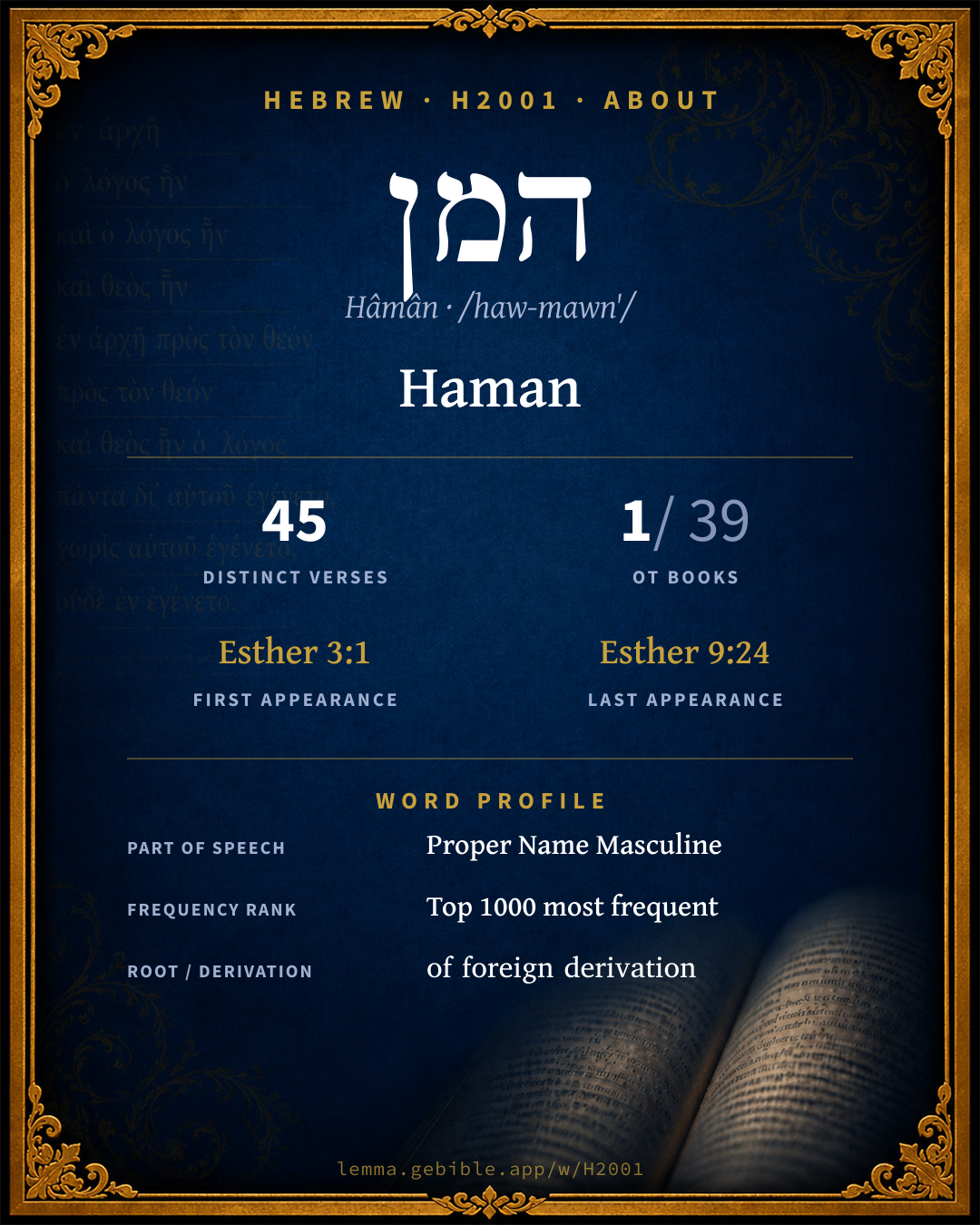
הָמָן
Haman
BDB lists 2 entries for ‘Haman’ fuller range ↓
Full lexicon entry — Brown-Driver-Briggs (BDB)
From Brown-Driver-Briggs (BDB)
Where this word appears
Grammar key — what these labels mean
Part of speech
- Noun
- A naming word — a person, place, thing, or idea.
Noun type
- Proper
- A name of a specific person, place, or people (e.g. Abraham, Zion, Israel).
Every verse where H2001 appears — 45 distinct verses across 1 book. Click any verse to open its interlinear word-by-word view. Verse text shown in the World English Bible for context — . Each verse’s Hebrew form is shown with its reference; the English is not keyword-highlighted, since the data carries no word-level English alignment. Use “Compare translations” on any verse to read it across multiple English versions. This concordance covers the Hebrew Bible; Septuagint (Greek Old Testament) occurrences are not indexed here.
Esther 45 verses
- Esther 3:1 הָמָ֧ן n Proper After these things did king Ahasuerus promote Haman the son of Hammedatha the Agagite, and advanced him, and set his seat above all the princes who were with him.
- Esther 3:2 לְ/הָמָ֔ן prep + n Proper All the king's servants, who were in the king's gate, bowed down, and did reverence to Haman; for the king had so commanded concerning him. But Mordecai didn't bow down, nor did him reverence.
- Esther 3:4 לְ/הָמָ֗ן prep + n Proper Now it came to pass, when they spoke daily to him, and he didn't listen to them, that they told Haman, to see whether Mordecai's matters would stand: for he had told those who he was a Jew.
- Esther 3:5 הָמָ֔ן הָמָ֖ן n Proper n Proper When Haman saw that Mordecai didn't bow down, nor did him reverence, then was Haman full of wrath.
- Esther 3:6 הָמָ֗ן n Proper But he scorned the thought of laying hands on Mordecai alone; for they had made known to him the people of Mordecai: therefore Haman sought to destroy all the Jews who were throughout the whole kingdom of Ahasuerus, even the people of Mordecai.
- Esther 3:7 הָמָ֗ן n Proper In the first month, which is the month Nisan, in the twelfth year of king Ahasuerus, they cast Pur, that is, the lot, before Haman from day to day, and from month to month, [to] the twelfth [month], which is the month Adar.
- Esther 3:8 הָמָן֙ n Proper Haman said to king Ahasuerus, There is a certain people scattered abroad and dispersed among the peoples in all the provinces of your kingdom; and their laws are diverse from [those of] every people; neither keep they the king's laws: therefore it is not for the king's profit to allow them.
- Esther 3:10 לְ/הָמָ֧ן prep + n Proper The king took his ring from his hand, and gave it to Haman the son of Hammedatha the Agagite, the Jews' enemy.
- Esther 3:11 לְ/הָמָ֔ן prep + n Proper The king said to Haman, The silver is given to you, the people also, to do with them as it seems good to you.
- Esther 3:12 הָמָ֡ן n Proper Then were the king's scribes called in the first month, on the thirteenth day of it; and there was written according to all that Haman commanded to the king's satraps, and to the governors who were over every province, and to the princes of every people, to every province according to the writing of it, and to every people after their language; in the name of king Ahasuerus was it written, and it was sealed with the king's ring.
- Esther 3:15 וְ/הָמָן֙ conj + n Proper The posts went forth in haste by the king's commandment, and the decree was given out in Shushan the palace. The king and Haman sat down to drink; but the city of Shushan was perplexed.
- Esther 4:7 הָמָן֙ n Proper Mordecai told him of all that had happened to him, and the exact sum of the money that Haman had promised to pay to the king's treasuries for the Jews, to destroy them.
- Esther 5:4 וְ/הָמָן֙ conj + n Proper Esther said, If it seem good to the king, let the king and Haman come this day to the banquet that I have prepared for him.
- Esther 5:5 הָמָ֔ן וְ/הָמָ֔ן n Proper conj + n Proper Then the king said, Cause Haman to make haste, that it may be done as Esther has said. So the king and Haman came to the banquet that Esther had prepared.
- Esther 5:8 וְ/הָמָ֗ן conj + n Proper if I have found favor in the sight of the king, and if it please the king to grant my petition, and to perform my request, let the king and Haman come to the banquet that I shall prepare for them, and I will do tomorrow as the king has said.
- Esther 5:9 הָמָן֙ הָמָ֨ן הָמָ֛ן n Proper n Proper n Proper Then went Haman forth that day joyful and glad of heart: but when Haman saw Mordecai in the king's gate, that he didn't stand up nor move for him, he was filled with wrath against Mordecai.
- Esther 5:10 הָמָ֔ן n Proper Nevertheless Haman refrained himself, and went home; and he sent and fetched his friends and Zeresh his wife.
- Esther 5:11 הָמָ֛ן n Proper Haman recounted to them the glory of his riches, and the multitude of his children, and all the things in which the king had promoted him, and how he had advanced him above the princes and servants of the king.
- Esther 5:12 הָמָן֒ n Proper Haman said moreover, Yes, Esther the queen did let no man come in with the king to the banquet that she had prepared but myself; and tomorrow also am I invited by her together with the king.
- Esther 5:14 הָמָ֖ן n Proper Then said Zeresh his wife and all his friends to him, Let a gallows be made fifty cubits high, and in the morning speak you to the king that Mordecai may be hanged thereon: then go you in merrily with the king to the banquet. The thing pleased Haman; and he caused the gallows to be made.
- Esther 6:4 וְ/הָמָ֣ן conj + n Proper The king said, "Who is in the court?" Now Haman was come into the outward court of the king's house, to speak to the king to hang Mordecai on the gallows that he had prepared for him.
- Esther 6:5 הָמָ֖ן n Proper The king's servants said to him, Behold, Haman stands in the court. The king said, Let him come in.
- Esther 6:6 הָמָן֒ הָמָן֙ n Proper n Proper So Haman came in. The king said to him, What shall be done to the man whom the king delights to honor? Now Haman said in his heart, To whom would the king delight to do honor more than to myself?
- Esther 6:7 הָמָ֖ן n Proper Haman said to the king, For the man whom the king delights to honor,
- Esther 6:10 לְ/הָמָ֗ן prep + n Proper Then the king said to Haman, Make haste, and take the clothing and the horse, as you have said, and do even so to Mordecai the Jew, who sits at the king's gate: let nothing fail of all that you have spoken.
- Esther 6:11 הָמָן֙ n Proper Then took Haman the clothing and the horse, and arrayed Mordecai, and caused him to ride through the street of the city, and proclaimed before him, Thus shall it be done to the man whom the king delights to honor.
- Esther 6:12 וְ/הָמָן֙ conj + n Proper Mordecai came again to the king's gate. But Haman hurried to his house, mourning and having his head covered.
- Esther 6:13 הָמָ֜ן n Proper Haman recounted to Zeresh his wife and all his friends everything that had happened to him. Then his wise men and Zeresh his wife said to him, If Mordecai, before whom you have begun to fall, be of the seed of the Jews, you shall not prevail against him, but shall surely fall before him.
- Esther 6:14 הָמָ֔ן n Proper While they were yet talking with him, came the king's chamberlains, and hurried to bring Haman to the banquet that Esther had prepared.
- Esther 7:1 וְ/הָמָ֔ן conj + n Proper So the king and Haman came to banquet with Esther the queen.
- Esther 7:6 הָמָ֥ן וְ/הָמָ֣ן n Proper conj + n Proper Esther said, An adversary and an enemy, even this wicked Haman. Then Haman was afraid before the king and the queen.
- Esther 7:7 וְ/הָמָ֣ן conj + n Proper The king arose in his wrath from the banquet of wine [and went] into the palace garden: and Haman stood up to make request for his life to Esther the queen; for he saw that there was evil determined against him by the king.
- Esther 7:8 וְ/הָמָן֙ הָמָ֖ן conj + n Proper n Proper Then the king returned out of the palace garden into the place of the banquet of wine; and Haman was fallen on the couch whereon Esther was. Then said the king, Will he even force the queen before me in the house? As the word went out of the king's mouth, they covered Haman's face.
- Esther 7:9 הָמָ֟ן הָמָ֔ן n Proper n Proper Then said Harbonah, one of the chamberlains who were before the king, Behold also, the gallows fifty cubits high, which Haman has made for Mordecai, who spoke good for the king, stands in the house of Haman. The king said, Hang him thereon.
- Esther 7:10 הָמָ֔ן n Proper So they hanged Haman on the gallows that he had prepared for Mordecai. Then was the king's wrath pacified.
- Esther 8:1 הָמָ֖ן n Proper On that day did the king Ahasuerus give the house of Haman the Jews' enemy to Esther the queen. Mordecai came before the king; for Esther had told what he was to her.
- Esther 8:2 מֵֽ/הָמָ֔ן הָמָֽן prep + n Proper n Proper The king took off his ring, which he had taken from Haman, and gave it to Mordecai. Esther set Mordecai over the house of Haman.
- Esther 8:3 הָמָ֣ן n Proper Esther spoke yet again before the king, and fell down at his feet, and begged him with tears to put away the mischief of Haman the Agagite, and his device that he had devised against the Jews.
- Esther 8:5 הָמָ֤ן n Proper She said, If it please the king, and if I have found favor in his sight, and the thing seem right before the king, and I be pleasing in his eyes, let it be written to reverse the letters devised by Haman, the son of Hammedatha the Agagite, which he wrote to destroy the Jews who are in all the king's provinces:
- Esther 8:7 הָמָ֜ן n Proper Then the king Ahasuerus said to Esther the queen and to Mordecai the Jew, See, I have given Esther the house of Haman, and him they have hanged on the gallows, because he laid his hand on the Jews.
- Esther 9:10 הָמָ֧ן n Proper the ten sons of Haman the son of Hammedatha, the Jew's enemy, killed they; but they didn't lay their hand on the spoil.
- Esther 9:12 הָמָ֔ן n Proper The king said to Esther the queen, The Jews have slain and destroyed five hundred men in Shushan the palace, and the ten sons of Haman; what then have they done in the rest of the king's provinces! Now what is your petition? and it shall be granted you: or what is your request further? and it shall be done.
- Esther 9:13 הָמָ֖ן n Proper Then said Esther, If it please the king, let it be granted to the Jews who are in Shushan to do tomorrow also according to this day's decree, and let Haman's ten sons be hanged on the gallows.
- Esther 9:14 הָמָ֖ן n Proper The king commanded it so to be done: and a decree was given out in Shushan; and they hanged Haman's ten sons.
- Esther 9:24 הָמָ֨ן n Proper because Haman the son of Hammedatha, the Agagite, the enemy of all the Jews, had plotted against the Jews to destroy them, and had cast Pur, that is the lot, to consume them, and to destroy them;
About this entry
At a glance — auto-summarized from this page’s data, not written by a person. Every figure links to its source below. This summary describes the numbers; it doesn’t interpret them.
The Hebrew name המן centers on the idea of “Haman.” The word gravitates to Esther (100%). It appears 45 verses across 1 book of the Hebrew Bible, among its moderately common vocabulary. Debuting at Esther 3:1, it then recurs through the corpus. Dig into 45-verse concordance and the renderings breakdown below.
Gloss history
Strong's 1890 vs modern scholarship
About this word
Strong's H2001 catalogs a Hebrew word from the Hebrew Old Testament.
These counts are not copied from any lexicon or concordance. They are computed here, from the morphology-tagged Hebrew Old Testament. What Lemma adds →
- 45
- distinct verses
- The word appears in 45 distinct verses.
- 1 / 39
- OT books
- The word appears in 1 of 39 Old Testament books.
- #696
- by frequency
- Top 1000 most frequent Hebrew words (rank 696 of 8,640 Hebrew words by occurrence).
View all 45 occurrences in the concordance →
Most concentrated in
- Esther 45 verses 100%
By section of the Old Testament
By traditional corpus
Conventional, traditional groupings — biblical authorship is debated, so this is a traditional corpus grouping, not an authorship claim. Each share is this word’s portion of its verses in that division of the Hebrew canon. Each figure is a share of the word’s 45 distinct verses.
- Writings (Ketuvim) 45 verses · 100%
How translations render this word
Counts come from each version’s own published word-to-Strong’s tagging or interlinear alignment — an approximate guide to how each version renders this word, not a word-level alignment the data otherwise carries. Because each total is that version’s own tagged count, the per-version totals vary from one another and need not match the appearance or distinct-verse counts above. These counts may also differ from a printed concordance because Lemma counts each distinctly tagged rendering and does not collapse phrase taggings into a single head-word total. This is a fixed set of word-tagged versions (KJV, ASV, BSB, ULT) and does not change with the reading translation you choose elsewhere. Each version’s license is shown beside its name below (and on Sources).
- King James Version: Haman 42×, Haman's 2×, Now haman 2×
- American Standard Version: Haman 42×, Him 2×, Now haman 2×
- Berean Standard Bible: Haman 40×, Haman’s 3×, Now haman 2×
- unfoldingWord Literal Text: Haman 53×, The 7×
King James Version Public Domain
Renders H2001 across 54 tagged occurrences — most commonly:
Plus 8 renderings that appear only once — usually multi-word phrases or single function words the recovered tagging swept in, not distinct renderings.
American Standard Version Public Domain
Renders H2001 across 54 tagged occurrences — most commonly:
Plus 8 renderings that appear only once — usually multi-word phrases or single function words the recovered tagging swept in, not distinct renderings.
Berean Standard Bible Public Domain
Renders H2001 across 51 tagged occurrences — most commonly:
Plus 6 renderings that appear only once — usually multi-word phrases or single function words the recovered tagging swept in, not distinct renderings. Not rendered by a distinct English word in 3 further occurrences.
unfoldingWord Literal Text CC BY-SA 4.0
Renders H2001 across 61 tagged occurrences — most commonly:
Plus 1 rendering that appears only once — usually multi-word phrases or single function words the recovered tagging swept in, not distinct renderings.
Senses in BDB
The 2 senses BDB distinguishes for this word, in lexicon order (not ranked by frequency or importance). The full entry — with sub-senses — is in the Lexicon Entry tab.
- Haman = "magnificent"
- chief minister of Ahasuerus…
Word origin
n.pr.m. Haman, favourite of Ahasuerus (etym. dub.; according to JenVOJ 1892, 58 ff. = Elamit. n.pr.div. Ḫumban, or Ḫumman)—Est 3:1 + 53 times in Esther.
— Brown-Driver-Briggs (Oxford 1906, public domain), digitized via Sefaria, supplemented by the OpenScriptures HebrewLexicon (CC BY 4.0). See Sources.
Origin: of foreign derivation
Jastrow Dictionary
A second Hebrew/Aramaic lexicon for comparison, covering Aramaic and post-biblical (Talmudic, Targumic, Midrashic) usage that the biblical-Hebrew BDB does not. Matched by lemma rather than by Strong’s number, so a lemma may carry more than one Jastrow headword (shown separately below), and the entries cover usage well beyond the Bible.
הָמָן
- (b. h.) Haman. Snh. 61ᵃ נעבד כה׳ worshipped as H. wanted to be. Ḥull. 139ᵇ ה׳ מן התורה מנין where is Haman alluded to in the Pentateuch?—Meg. 10ᵇ ה׳ הרשע; a. fr.
מִן
- (b. h.) from, of; more (or less) than. Ab. Zar. 18ᵃ מן השמים ירחמו from heaven they will have mercy (on me), i.e. I trust in God. Sabb. 21ᵇ המהדרין מן המהדרין v. הָדַר.—מן המובחר, v. בָּחַר; מן המומחה, v. מוּמְחֶה.—Tem. 28ᵃ מן הבהמה להוציא וכ׳ ‘of the cattle’ (Lev. I, 2) intimates the exclusion of &c.; a. v. fr.—Prefix מִ־, מָי־, מֵ־, מֵי־ q. v.—מִנַּיִן, מִנַּיִין, מִינַּיִין (= b. h. מֵאַיִן, v. אַיִן) whence?, whence is it proven?—Yoma 32ᵃ מ׳ לחמש וכ׳ whence is derived the regulation about five immersions &c.? Ib. ומ׳ שכל טבילה וכ׳ and whence is the rule derived that each immersion requires &c.? Ib. 44ᵃ אין לי אלא … מ׳ this would prove to me only in favor of …, whence do you derive that the same applies to …?; a. v. fr. e.g. Leviticus 1:2
מִן ²
- Targ. Gen. I, 2; a. v. fr.—With suffixes of pers. pron. מִנִּי, מִי׳ from me; מִנָּךְ, מִי׳ from thee; מִנֵּיה, מִי׳ from him, it &c. Ib. XXII, 12. Ib. III, 3; a. fr.—Y. Ber. II, 5ᵃ bot. מן הן דסלק to where he had come from. Sabb. 80ᵇ מן דיליה דא ליה this came to him from his own doing. Sot. 40ᵃ ומאי נפקא ליך מִינָּהּ and what difference does it make? מִנִּי ומִנֵּיה יתקלס וכ׳ through myself and him the Most High is exalted. B. Kam. 18ᵃ קאזיל מיניה מיניה it was lost through its (the chicken’s) action alone. Y. Peah VII, 20ᵇ מיניה וביה הוא (the sweetness) is entirely its own (no honey has been added). Snh. 39ᵇ, v. אִבָּא; a. fr.—לא כולא מיניה, לא כל כמיניה it is not at all in his power; v. כּוֹלָא.—מן ד־ from the time that, after; from the fact that; when; because. Lam. R. to II, 2 מן דאכלון after they had eaten; a. v. fr.; v. מִדְּ־.
מָן I
- portion, food. Num. R. s. 12 (play on א̇ר̇ג̇מ̇ן̇) the sun שיצרו הקב"ה לארוג מן וכ׳ whom the Lord has created to weave (ripen) food for creatures; ואין מן אלא פירות וכ׳ man means fruits and food (with ref. to וימן, Dan. I, 5).—Esp. מָּן(הַ) the manna of the desert. Ex. R. s. 25. Tanḥ. B’shall. 20; Mekh. ib., Vayassa, s. 2 אוכלי המן those eating manna (not troubling themselves about to-morrow). Yoma 75ᵃ; a. fr. e.g. Daniel 1:5
מַן I
- (a day’s) support. Succ. 39ᵇ בכדי מן for as much only as is needed for the day. Ib. דהאי מ׳ וכ׳ that man means support, v. preced.—Esp. מַנָּא the manna. Targ. Ex. XVI, 31. Targ. Y. ib. 27; a. e. (some ed. מָנָא).
מַן
- who?, what?, v. מַאן. Targ. Gen. XXIV, 23. Ib. XXXIII, 8 (ed. Berl. מָא; oth. ed. מאן); a. fr.—Emphatic. (מָנָא) מְנָא. Targ. Ps. XXXIX, 5. Targ. Prov. IV, 19; a. fr.
מָן III
- thing, vessel, garment; coulter, v. מָאן.
A Dictionary of the Targumim, the Talmud Babli and Yerushalmi, and the Midrashic Literature (Marcus Jastrow; London, Luzac, 1903) — Public Domain. Digitized via Sefaria. Digitized via Sefaria. Full attribution on Sources.
Forms in the corpus
The 23 distinct written forms H2001 takes in the Hebrew Bible, most frequent first — each parse links to that state’s occurrences in the concordance. Hebrew forms include their vowel points and cantillation, so a single lemma takes many written forms.
| Form | Parsing | Example | Uses |
|---|---|---|---|
| הָמָ֖ן | Noun, Proper | Esther 3:5 | 8 |
| הָמָ֔ן | Noun, Proper | Esther 3:5 | 7 |
| הָמָן֙ | Noun, Proper | Esther 3:8 | 5 |
| וְ/הָמָן֙ | Noun, Proper | Esther 3:15 | 4 |
| וְ/הָמָ֣ן | Noun, Proper | Esther 6:4 | 3 |
| הָמָ֗ן | Noun, Proper | Esther 3:6 | 2 |
| הָמָ֛ן | Noun, Proper | Esther 5:9 | 2 |
| הָמָ֜ן | Noun, Proper | Esther 6:13 | 2 |
| הָמָ֧ן | Noun, Proper | Esther 3:1 | 2 |
| הָמָ֨ן | Noun, Proper | Esther 5:9 | 2 |
| הָמָן֒ | Noun, Proper | Esther 5:12 | 2 |
| וְ/הָמָ֔ן | Noun, Proper | Esther 5:5 | 2 |
| לְ/הָמָ֔ן | Noun, Proper | Esther 3:2 | 2 |
| לְ/הָמָ֗ן | Noun, Proper | Esther 3:4 | 2 |
| הָמָ֟ן | Noun, Proper | Esther 7:9 | 1 |
| הָמָ֡ן | Noun, Proper | Esther 3:12 | 1 |
| הָמָ֣ן | Noun, Proper | Esther 8:3 | 1 |
| הָמָ֤ן | Noun, Proper | Esther 8:5 | 1 |
| הָמָ֥ן | Noun, Proper | Esther 7:6 | 1 |
| הָמָֽן | Noun, Proper | Esther 8:2 | 1 |
| וְ/הָמָ֗ן | Noun, Proper | Esther 5:8 | 1 |
| לְ/הָמָ֧ן | Noun, Proper | Esther 3:10 | 1 |
| מֵֽ/הָמָ֔ן | Noun, Proper | Esther 8:2 | 1 |
Bible dictionary
Public-domain dictionary articles matched to this entry by name (Haman). A biblical name can be shared by more than one person or place, so an article may treat several.
Easton's Bible Dictionary · M. G. Easton, 1897
(of Persian origin), magnificent, the name of the vizier (i.e., the prime minister) of the Persian king Ahasuerus (Esther 3:1, etc.). He is called an "Agagite," which seems to denote that he was descended from the royal family of the Amalekites, the bitterest enemies of the Jews, as Agag was one of the titles of the Amalekite kings. He or his parents were brought to Persia as captives taken in war. He was hanged on the gallows which he had erected for Mordecai the Jew (Esther 7:10). (See ESTHER.)
Smith's Bible Dictionary · William Smith, 1863
(magnificent), the chief minister or vizier of King Ahasuerus. (Esther 3:1) (B.C. 473.) After the failure of his attempt to cut off all the Jews in the Persian empire, he was hanged on the gallows which he had erected for Mordecai. The Targum and Josephus interpret the inscription of him--the Agagite--as signifying that he was of Amalekitish descent. The Jews hiss whenever his name is mentioned on the day of Purim.
Hitchcock's Bible Names Dictionary · Roswell D. Hitchcock, 1869
noise; tumult
Classic public-domain reference works; full attribution on Sources.
Septuagint verse parallels
This word appears in 44 verses that also exist in the Greek Old Testament (Septuagint), out of the 45 Hebrew verses it occurs in. You can read those verses in Greek by switching the Old Testament edition to the Septuagint.
Read these verses in the Septuagint
This is a verse-level parallel only — the same verses exist in both the Hebrew and Greek Old Testaments. No word-level Hebrew↔Greek correspondence is claimed: the data carries no such alignment, so no Greek word is shown as this Hebrew word’s translation. Coverage is not total — the Septuagint omits the deuterocanon and renumbers the Psalms, so some Hebrew verses have no direct Greek parallel.