
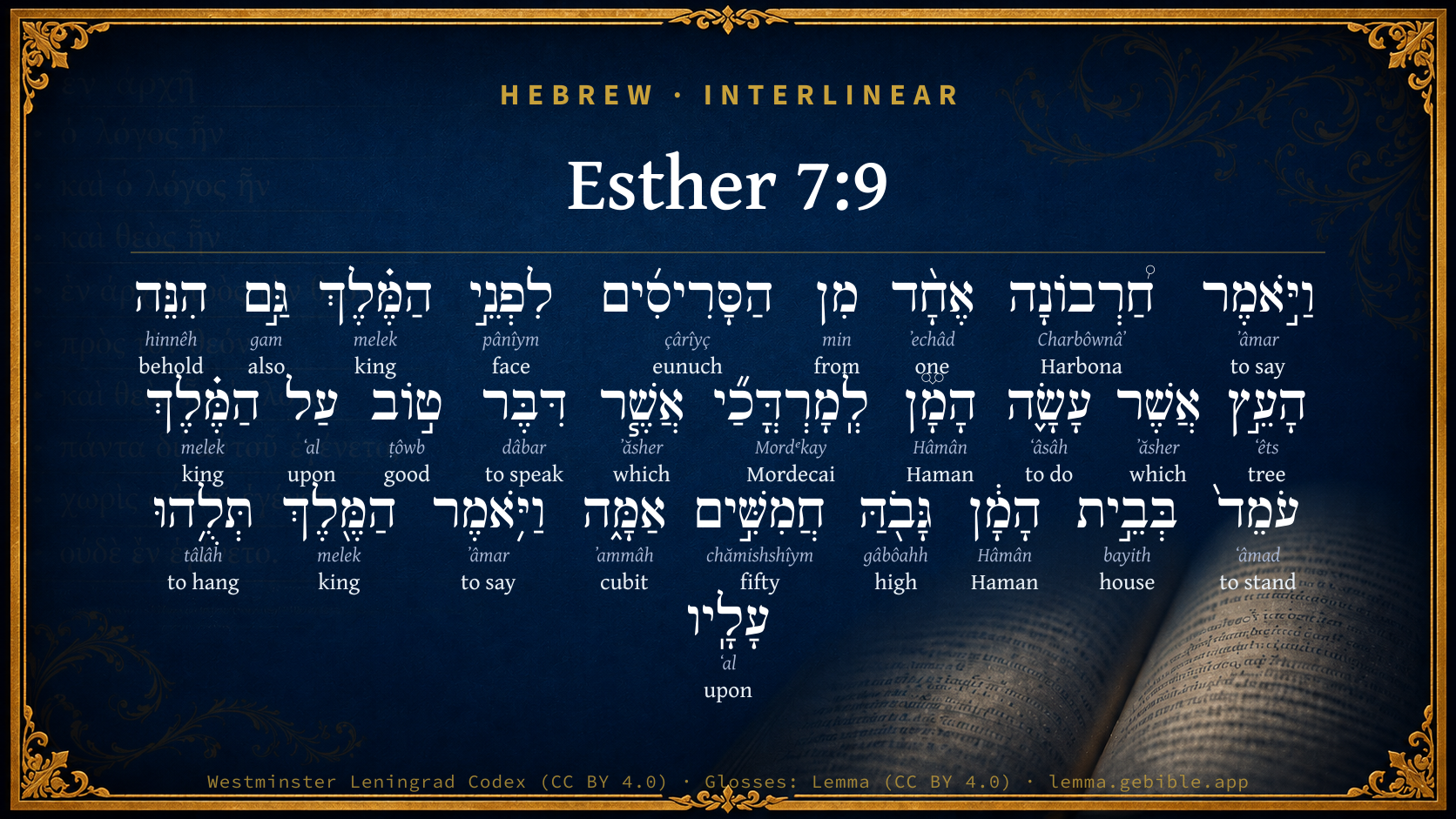
Esther 7:9

Hebrew (Westminster Leningrad Codex) Esther 7:9 appears in the Hebrew Old Testament. The text above is from the Westminster Leningrad Codex. Each word links to its Strong’s number, a concise gloss, and parsing drawn from the Open Scriptures Hebrew Bible morphology. Click any word for its full Brown-Driver-Briggs (BDB) entry.
Download image
Cite this verse

Esther 7:9 (World English Bible). Public Domain. Lemma interlinear Bible study tool, https://lemma.gebible.app/v/esther/7/9.

Show BibTeX & RIS
BibTeX
RIS
English Translation
Then said Harbonah, one of the chamberlains who were before the king, Behold also, the gallows fifty cubits high, which Haman has made for Mordecai, who spoke good for the king, stands in the house of Haman. The king said, Hang him thereon.
World English Bible · Public Domain
Download a study sheet

One document with this verse’s original text, its word-by-word gloss line, the meaning frame, cross-references with their text, attributed commentary, and full source and license credits — printable, and it pastes into notes with its structure intact.

This verse Autodidact and up

Study sheet (.html) Plain text (.txt)

A passage Seminary Student

Up to 50 verses in one chapter. A passage sheet keeps up to 6 commentary sources and 12 cross-references per verse, in the order this page ranks them, and says so on the sheet whenever that leaves anything out. Ask for a single verse and you get the Autodidact verse sheet above.

Everything on this page stays free to read, with no account — the sheet is a download of what is already on screen, not access to it.

Want to remove ads? Support Godless Engineer
Compare translations 3

The same verse in 3 English versions, stacked beneath the original-language interlinear above. Click any original word for its lexicon entry.

Each is an independent rendering of the whole verse — the interlinear is not word-aligned to these translations.

Highlighted words mark where these versions differ — a whole-verse word diff, not a word-by-word alignment.

  • World English Bible Public Domain
    Then said Harbonah, one of the chamberlains who were before the king, Behold also, the gallows fifty cubits high, which Haman has made for Mordecai, who spoke good for the king, stands in the house of Haman. The king said, Hang him thereon.
  • King James Version Public Domain
    And Harbonah, one of the chamberlains, said before the king, Behold also, the gallows fifty cubits high, which Haman had made for Mordecai, who spoken good for the king, standeth in the house of Haman. Then the king said, Hang him thereon.
  • unfoldingWord Literal Text CC BY-SA 4.0
    And Harbona, one from the eunuchs before the face of the king, said, “Also, behold, the pole that Haman made for Mordecai, who spoke good for the king, is standing at the house of Haman 50 cubits high.” And the king said, “Hang him on it.”

unfoldingWord Literal Text — © unfoldingWord, licensed CC BY-SA 4.0. Word-aligned USFM3 via Door43 (git.door43.org/unfoldingWord/en_ult).

Versions to compare (up to 4)

3 of 4 selected

Show all 18 translations

Every available English version of this verse, each an independent rendering of the whole verse.

  • World English Bible Public Domain
    Then said Harbonah, one of the chamberlains who were before the king, Behold also, the gallows fifty cubits high, which Haman has made for Mordecai, who spoke good for the king, stands in the house of Haman. The king said, Hang him thereon.
  • Berean Standard Bible Public Domain
    Then Harbonah, one of the eunuchs attending the king, said: “There is a gallows fifty cubits high at Haman’s house. He had it built for Mordecai, who gave the report that saved the king.” “Hang him on it!” declared the king.
  • Majority Standard Bible Public Domain
    Then Harbonah, one of the eunuchs attending the king, said: “There is a gallows fifty cubits high at Haman’s house. He had it built for Mordecai, who gave the report that saved the king.” “Hang him on it!” declared the king.
  • King James Version Public Domain
    And Harbonah, one of the chamberlains, said before the king, Behold also, the gallows fifty cubits high, which Haman had made for Mordecai, who spoken good for the king, standeth in the house of Haman. Then the king said, Hang him thereon.
  • American Standard Version (1901) Public Domain
    Then said Harbonah, one of the chamberlains that were before the king, Behold also, the gallows fifty cubits high, which Haman hath made for Mordecai, who spake good for the king, standeth in the house of Haman. And the king said, Hang him thereon.
  • Revised Version (1885) Public Domain
    Then said Harbonah, one of the chamberlains that were before the king, Behold also, the gallows fifty cubits high, which Haman hath made for Mordecai, who spake good for the king, standeth in the house of Haman. And the king said, Hang him thereon.
  • Geneva Bible (1599) Public Domain
    And Harbonah one of the eunuches, sayde in the presence of the King, Beholde, there standeth yet the tree in Hamans house fiftie cubites hie, which Haman had prepared for Mordecai, that spake good for the King. Then the King sayd, Hang him thereon.
  • Douay-Rheims (1899) Public Domain
    And Harbona, one of the eunuchs that stood waiting on the king, said: Behold the gibbet which he hath prepared for Mardochai, who spoke for the king, standeth in Aman's house, being fifty cubits high. And the king said to him: Hang him upon it.
  • Young's Literal Translation Public Domain
    And Harbonah, one of the eunuchs, saith before the king, `Also lo, the tree that Haman made for Mordecai, who spake good for the king, is standing in the house of Haman, in height fifty cubits;' and the king saith, `Hang him upon it.'
  • Literal Standard Version CC BY-SA 4.0
    And Harbonah, one of the eunuchs, says before the king, “Also behold, the tree that Haman made for Mordecai, who spoke good for the king, is standing in the house of Haman, in height fifty cubits”; and the king says, “Hang him on it.”
  • Unlocked Literal Bible CC BY-SA 4.0
    Then Harbona, one of the officials who served the king, said, “A gallows fifty cubits tall stands beside Haman's house. He set it up for Mordecai, the one who spoke up to protect the king.” The king said, “Hang him on it.”
  • unfoldingWord Literal Text CC BY-SA 4.0
    And Harbona, one from the eunuchs before the face of the king, said, “Also, behold, the pole that Haman made for Mordecai, who spoke good for the king, is standing at the house of Haman 50 cubits high.” And the king said, “Hang him on it.”
  • Darby Bible Public Domain
    And Harbonah, one of the chamberlains, said before the king, Behold, also, the gallows fifty cubits high, that Haman made for Mordecai, who spoke good for the king, stands in the house of Haman. And the king said, Hang him on it!
  • World Messianic Bible Public Domain
    Then Harbonah, one of the eunuchs who were with the king, said, “Behold, the gallows fifty cubits high, which Haman has made for Mordecai, who spoke good for the king, is standing at Haman’s house.” The king said, “Hang him on it!”
  • Webster's Bible Public Domain
    And Harbonah, one of the chamberlains, said before the king, Behold also, the gallows fifty cubits high, which Haman had made for Mordecai, who had spoken good for the king, standeth in the house of Haman. Then the king said, Hang him upon it.
  • Free Bible Version CC BY-SA 4.0
    Then Harbonah, one of the eunuchs attending the king, said: “Haman set up a pole beside his house for Mordecai, the one whose report saved the king's life. The pole is fifty cubits high.” “Impale him on it!” the king ordered.
  • Bible in Basic English Public Domain
    Then Harbonah, one of the unsexed servants waiting before the king, said, See, the pillar fifty cubits high, which Haman made for Mordecai, who said a good word for the king, is still in its place in Haman's house. Then the king said, Put him to death by hanging him on it.
  • JPS Tanakh (1917) Public Domain
    Then said Harbonah, one of the chamberlains that were before the king: 'Behold also, the gallows fifty cubits high, which Haman hath made for Mordecai, who spoke good for the king, standeth in the house of Haman.' And the king said: 'Hang him thereon.'

Literal Standard Version (2020), Covenant Press — licensed CC BY-SA 4.0. Text via the HelloAO Bible API (eBible.org). Unlocked Literal Bible (unfoldingWord) — licensed CC BY-SA 4.0. Text via the HelloAO Bible API (eBible.org). unfoldingWord Literal Text — © unfoldingWord, licensed CC BY-SA 4.0. Word-aligned USFM3 via Door43 (git.door43.org/unfoldingWord/en_ult). Free Bible Version, Dr. Jonathan Gallagher — licensed CC BY-SA 4.0. Text via the HelloAO Bible API (eBible.org).

Word by word

More ways to search: Search by grammar → Find every occurrence → Compare this word →

Practice this passage: Drill this verse → Learn its vocabulary →

חַ֠רְבוֹנָה
Charbôwnâʼ
H2726
“Harbona”
Noun, Proper
Part of Speech
Noun
Type
Proper
Full BDB Definition

Origin: of Persian origin

TWOT: None

Harbona or Harbonah = "ass-driver" - the 3rd of the seven chamberlains or eunuchs who served Ahasuerus
  1. וַיֹּ֣אמֶר ʼâmar H559 “and · to say” Conjunction + Verb, Qal, Sequential Imperfect, 3rd Person, Masculine, Singular
  2. אֶחָ֨ד ʼechâd H259 “one” Adjective, Cardinal number, Masculine, Singular, Absolute
  3. מִן min H4480 “from” Preposition
  4. הַסָּרִיסִ֜ים çârîyç H5631 “the · eunuchs” Particle, Definite Article + Noun, Common, Masculine, Plural, Absolute
  5. לִפְנֵ֣י pânîym H6440 “to/for · face(s) of” Preposition + Noun, Common, Both, Plural, Construct
  6. הַמֶּ֗לֶךְ melek H4428 “the · king” Particle, Definite Article + Noun, Common, Masculine, Singular, Absolute
  7. גַּ֣ם gam H1571 “also” Particle, Accusative
  8. הִנֵּה hinnêh H2009 “behold” Particle, Demonstrative
  9. הָעֵ֣ץ ʻêts H6086 “the · tree” Particle, Definite Article + Noun, Common, Masculine, Singular, Absolute
  10. אֲשֶׁר ʼăsher H834 “which” Particle, Relative
  11. עָשָׂ֪ה ʻâsâh H6213 “to do” Verb, Qal, Perfect, 3rd Person, Masculine, Singular
  12. הָמָ֟ן Hâmân H2001 “Haman” Noun, Proper
  13. לְֽמָרְדֳּכַ֞י Mordᵉkay H4782 “to/for · Mordecai” Preposition + Noun, Proper
  14. אֲשֶׁ֧ר ʼăsher H834 “which” Particle, Relative
  15. דִּבֶּר dâbar H1696 “to speak” Verb, Piel, Perfect, 3rd Person, Masculine, Singular
  16. ט֣וֹב ṭôwb H2896 “good” Adjective, Adjective, Masculine, Singular, Absolute
  17. עַל ʻal H5921 “upon” Preposition
  18. הַמֶּ֗לֶךְ melek H4428 “the · king” Particle, Definite Article + Noun, Common, Masculine, Singular, Absolute
  19. עֹמֵד֙ ʻâmad H5975 “standing” Verb, Qal, Participle Active, Masculine, Singular, Absolute
  20. בְּבֵ֣ית bayith H1004 “in/at · house of” Preposition + Noun, Common, Masculine, Singular, Construct
  21. הָמָ֔ן Hâmân H2001 “Haman” Noun, Proper
  22. גָּבֹ֖הַּ gâbôahh H1364 “high” Adjective, Adjective, Masculine, Singular, Absolute
  23. חֲמִשִּׁ֣ים chămishshîym H2572 “fifty” Adjective, Cardinal number, Both, Plural, Absolute
  24. אַמָּ֑ה ʼammâh H520 “cubit” Noun, Common, Feminine, Singular, Absolute
  25. וַיֹּ֥אמֶר ʼâmar H559 “and · to say” Conjunction + Verb, Qal, Sequential Imperfect, 3rd Person, Masculine, Singular
  26. הַמֶּ֖לֶךְ melek H4428 “the · king” Particle, Definite Article + Noun, Common, Masculine, Singular, Absolute
  27. תְּלֻ֥הוּ tâlâh H8518 “hang · him” Verb, Qal, Imperative, 2nd Person, Masculine, Plural + Suffix, Personal, 3rd Person, Masculine, Singular
  28. עָלָֽיו ʻal H5921 “upon · him” Preposition + Suffix, Personal, 3rd Person, Masculine, Singular

About this verse

These counts appear in no published source. They are computed here, from the morphology-tagged text and Lemma’s own curated glosses. What Lemma adds →

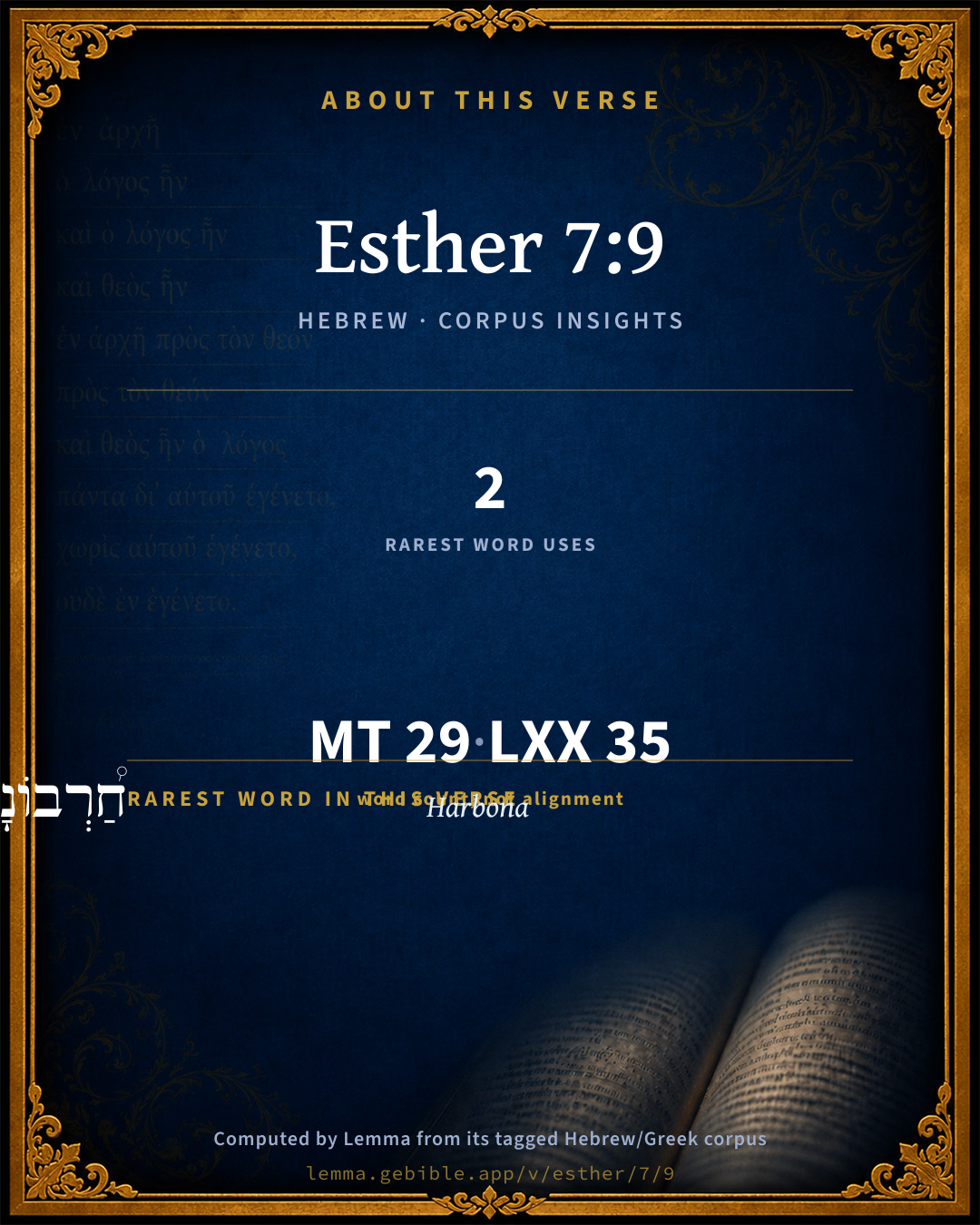
29
words
23
distinct lemmas
Historical
section

Notable vocabulary

The rarest word here is חַ֠רְבוֹנָה Harbona H2726 — appearing just 2 times in the whole Hebrew Bible.

Shared distinctive vocabulary

חַ֠רְבוֹנָה Harbona H2726 occurs in 2 verses of the Hebrew Bible. Also found in:

Grammatical profile

  • 6 verbs
  • 12 nouns
  • 4 adjectives
  • 3 prepositions
  • 4 particles

Verb forms

  • וַיֹּ֣אמֶר Qal · Sequential Imperfect
  • עָשָׂ֪ה Qal · Perfect
  • דִּבֶּר Piel · Perfect
  • עֹמֵד֙ Qal · Participle Active
  • וַיֹּ֥אמֶר Qal · Sequential Imperfect
  • תְּלֻ֥הוּ Qal · Imperative

Repetition

Words recur within this verse — often emphatic in Hebrew:

  • הַמֶּ֗לֶךְ king H4428 ×3
  • וַיֹּ֣אמֶר to say H559 ×2
  • הָמָ֟ן Haman H2001 ×2
  • עַל upon H5921 ×2
  • אֲשֶׁר which H834 ×2

Hebrew & Septuagint length

In English translation the verse runs 43 words from the Hebrew and 49 from the Septuagint (LXX English) — closely comparable.

A rough comparison of the two English renderings, which tokenize alike — not a word-level alignment.

Word counts can differ between the Hebrew and the Greek without any difference in meaning — e.g. the Hebrew direct-object marker אֵת has no separate Greek word, and Greek often adds the article ὁ.

In the original languages it is 29 Hebrew tokens and 35 Greek tokens — but the two are counted differently (Hebrew bundles its prefixes and suffixes into one token; the Greek is in lemma form), so that isn’t a like-for-like length.

Cross-references

18

Topical passages linked to Esther 7:9 in the Treasury of Scripture Knowledge — connected by theme and wording, ordered by reader-vote popularity; previews shown in the World English Bible.

  • Psalms 7:15–16 He has dug a hole, And has fallen into the pit which he made.
  • Proverbs 11:5–6 The righteousness of the blameless will direct his way, But the wicked shall fall by his own wickedness.
  • Esther 1:10 On the seventh day, when the heart of the king was merry with wine, he commanded Mehuman, Biztha, Harbona, Bigtha, and Abagtha, Zethar, and Carcass, the seven chamberlains who ministered in the presence of Ahasuerus the king,
  • Esther 5:14 Then said Zeresh his wife and all his friends to him, Let a gallows be made fifty cubits high, and in the morning speak you to the king that Mordecai may be hanged thereon: then go you in merrily with the king to the banquet. The thing pleased Haman; and he caused the gallows to be made.
  • Psalms 35:8 Let destruction come on him unawares. Let his net that he has hidden catch himself. Let him fall into that destruction.
  • Psalms 141:10 Let the wicked fall together into their own nets, While I pass by.
  • Daniel 6:24 The king commanded, and they brought those men who had accused Daniel, and they cast them into the den of lions, them, their children, and their wives; and the lions had the mastery of them, and broke all their bones in pieces, before they came to the bottom of the den.
  • 1 Samuel 17:51 Then David ran, and stood over the Philistine, and took his sword, and drew it out of the sheath of it, and killed him, and cut off his head therewith. When the Philistines saw that their champion was dead, they fled.
  • Esther 6:2 It was found written that Mordecai had told of Bigthana and Teresh, two of the king's chamberlains, of those who kept the threshold, who had sought to lay hands on the king Ahasuerus.
  • Esther 6:14 While they were yet talking with him, came the king's chamberlains, and hurried to bring Haman to the banquet that Esther had prepared.
  • Esther 9:25 but when [the matter] came before the king, he commanded by letters that his wicked device, which he had devised against the Jews, should return on his own head, and that he and his sons should be hanged on the gallows.
  • Job 27:20–23 Terrors overtake him like waters; A tempest steals him away in the night.
  • Psalms 9:15–16 The nations have sunk down in the pit that they made; In the net which they hid, their own foot is taken.
  • Psalms 37:35–36 I have seen the wicked in great power, Spreading himself like a green tree in its native soil.
  • Psalms 73:19 How they are suddenly destroyed! They are completely swept away with terrors.
  • Daniel 6:7 All the presidents of the kingdom, the deputies and the satraps, the counselors and the governors, have consulted together to establish a royal statute, and to make a strong interdict, that whoever shall ask a petition of any god or man for thirty days, save of you, O king, he shall be cast into the den of lions.
  • 2 Kings 9:32 He lifted up his face to the window, and said, Who is on my side? who? There looked out to him two or three eunuchs.
  • Esther 2:21–23 In those days, while Mordecai was sitting in the king's gate, two of the king's chamberlains, Bigthan and Teresh, of those who kept the threshold, were angry, and sought to lay hands on the king Ahasuerus.

Cross-references courtesy of OpenBible.info (CC BY 4.0).

Hebrew and Greek witnesses Masoretic Hebrew ↔ Greek Septuagint

The same verse in the two great witnesses to the Old Testament, shown verse-for-verse.

These are two independent witnesses, not word-aligned to each other, and the Septuagint is shown in lemma (dictionary) form.

Hebrew Esther 7:9 Masoretic · Westminster Leningrad Codex

וַיֹּ֣אמֶר חַ֠רְבוֹנָה אֶחָ֨ד מִן הַסָּרִיסִ֜ים לִפְנֵ֣י הַמֶּ֗לֶךְ גַּ֣ם הִנֵּה הָעֵ֣ץ אֲשֶׁר עָשָׂ֪ה הָמָ֟ן לְֽמָרְדֳּכַ֞י אֲשֶׁ֧ר דִּבֶּר ט֣וֹב עַל הַמֶּ֗לֶךְ עֹמֵד֙ בְּבֵ֣ית הָמָ֔ן גָּבֹ֖הַּ חֲמִשִּׁ֣ים אַמָּ֑ה וַיֹּ֥אמֶר הַמֶּ֖לֶךְ תְּלֻ֥הוּ עָלָֽיו

Then said Harbonah, one of the chamberlains who were before the king, Behold also, the gallows fifty cubits high, which Haman has made for Mordecai, who spoke good for the king, stands in the house of Haman. The king said, Hang him thereon.

World English Bible · Public Domain

Greek LXX Esther 7:9 Septuagint · lemma form

εἶπον δέ βουγαθαν εἷς ὁ εὐνοῦχος πρός ὁ βασιλεύς ἰδού καί ξύλον ἑτοιμάζω αμαν μαρδοχαῖος ὁ λαλέω περί ὁ βασιλεύς καί ὀρθόω ἐν ὁ αμαν ξύλον πῆχυς πεντήκοντα εἶπον δέ ὁ βασιλεύς σταυρόω ἐπί αὐτός

And Bugathan, one of the chamberlains, said to the king, Behold, Aman has also prepared a gallows for Mardochaeus, who spoke concerning the king, and a gallows of fifty cubits high has been set up in the premises of Aman. And the king said, Let him be hanged thereon.

LXX2012 (modern English Septuagint) · Public Domain

On this verse, Ellicott's Commentary for English Readers discusses the Septuagint’s reading. Read the note in Commentary ↓

Hebrew: Westminster Leningrad Codex (CC BY 4.0). Greek: Septuagint (public domain); English from LXX2012 (modern English Septuagint) (Public Domain). How the Septuagint differs from the Hebrew →

Commentary

Notes on Esther 7:9 from classic Christian and Jewish commentators (each source and its license shown beneath its notes). The classic Christian expositions comment on the surrounding passage and are grouped to its opening verse, so a note may address several verses; the Jewish commentaries on the Tanakh (Rashi and others) are per-verse, so they appear only where the commentator wrote on this verse.

Lemma curates 59 commentaries, every one of them public domain or Creative Commons licensed, each selected and text-cleaned for this edition rather than reprinted as found. About our sources →

Ellicott's Commentary for English Readers

(9) Harbonah.—See Est_1:10.

One of the chamberlains. . . .—Translate, one of the chamberlains [who stood, or served] before the king, said.

Hang him.—In the LXX., let him be crucified. The climax of the story is now reached in the pithy words, “They hanged Haman upon the gallows that he had prepared for Mordecai.” In his own house (Est_7:9), that is, probably, in some court or garden belonging to it, in the sight doubtless of his own children and his own servants, and the wife who had given him such cold comfort, did the unfortunate man meet his fate. Thus not only does God vouchsafe to deliver his people, but He brings on the enemy the very destruction he had devised for his adversary: “He hath fallen himself into the pit that he digged for other.” Our Saviour has rescued us from our enemy who was too mighty for us, and has trodden down our foe, to be destroyed for ever in His own good time. So may we Christians see in the dangers threatening the Jews throughout this book a picture of our own, and in Haman’s discomfiture a type of the victory of the Lamb over sin and Satan.

A Bible Commentary for English Readers, edited by Charles John Ellicott (1878–1897) — public domain. Text from a community e-Sword module.

Trapp's Complete Commentary

John Trapp

Est 7:9 And Harbonah, one of the chamberlains, said before the king, Behold also, the gallows fifty cubits high, which Haman had made for Mordecai, who had spoken good for the king, standeth in the house of Haman. Then the king said, Hang him thereon.

Ver. 9. And Harbonah, one of the king’s chamberlains, &c.] See Est 6:14. {See Trapp on "Est 6:14"}

Said before the king] Not a man opens his mouth to speak for Haman, but all against him. Had the cause been better, thus it would have been. Every cur is ready to fall upon the dog that he seeth worried; every man ready to pull a branch from the tree that is falling (δρυος πεσουσης πας ανηρ ξυλευεται). Cromwell had experience of this when once he fell into displeasure, by speaking against the king’s match with Lady Catherine Howard, in defence of Queen Anne, of Cleve, and discharge of his conscience, for the which he suffered death, Stephen Gardiner being the chief engineer. Had Haman’s cause been like his, albeit he had found as few friends to intercede for him as Cromwell, yet he might have died with as much comfort as he did. But he died more like to the Lord Hungerford, of Hatesby, who was beheaded together with the noble Cromwell, but neither so Christianly suffering, nor so quietly dying for his offence committed against nature, viz. buggery. (sodemy?) Cromwell exhorted him to repent, and promised him mercy from God; but his heart was hardened, and so was this wicked Haman’s. God, therefore, justly set off all hearts from him in his greatest necessity; and now, to add to his misery, brings another of his foul sins to light, that he might the more condignly be cut off.

Behold also the gallows, fifty cubits high] See Est 5:14. This the queen knew not of when she petitioned against Haman. But now they all hear of it, for Haman’s utter confusion.

Which he had prepared for Mordecai] At a time when the king had done him greatest honour, as preserver and near ally by marriage, as now it appeared. This must needs reflect upon the king, and be a reproach to him. Besides, the king looked upon him as one that went about either to throttle the queen (as some understand the words, Est 7:8), or to ravish her; and this was just upon him, say some interpreters, eo quo aliis virginibus et matronis vini intulisset, because it was common with him to ravish other maids and matrons, and hence the king’s suspicion and charge, whereof before.

Who had spoken good for the king] All is now for Mordecai, but not a word for Haman; the rising sun shall be sure to be adored. And the contrary, Sejanus’s friends showed themselves most passionate against him when once the emperor frowned upon him, saying, that if Caesar had clemency, he ought to reserve it for men, and not use it towards monsters. This is courtiers’ custom, ad quamlibet auram sese inclinare, to shift their sails to the sitting of every wind, to comply with the king which way soever he inclineth. It is better, therefore, to put trust in the Lord than to put confidence in man. It is better to trust in the Lord than to put confidence in princes, Psa 118:8-9. If Harbonah spake this out in hatred of Haman’s insolence, and in favour of Mordecai’s innocence and loyalty, he deserved commendation. However, God’s holy hand was in it for the good of his people and overthrow of their enemy; and little did this night-sprung-mushroom Haman (that sucked the earth’s fatness from far better plants than himself) take notice till now of the many hands ready to pluck him up by the roots, when the season should serve to clear the land of such weeds.

Standeth in the house of Haman] Or, by the house of Haman, that he might feed his eyes with that delightful sight, and cry out, as Hannibal did when he saw a ditch filled with man’s blood, O iucundum spectaculum, O pleasant spectacle. The story of that king of France is well known, who vowed to see a certain martyr executed; but before that could be done had his eye put out at a joust, whereof not long after also he died. And that of Sir Ralph Ellerker, governor of Calais in King Henry VIII’s time, who, at the death of Adam Damlip, martyr, called to the executioner, saying, Dispatch the knave, have done, I will not away before I see the traitor’s heart out. But shortly after, in a skirmish between the French and us at Bullen, this knight was not only slain among others, but stripped, dismembered, and his heart ripped out, and so left a terrible example, saith Mr Fox, of God’s justice to all bloody and merciless men. "Thou shouldest not have looked," &c., Oba 1:12. See the note there.

Then the king said, Hang him thereon] The kings of Persia had absolute and unquestionable power to do whatsoever they wished, Quicquid libuit, licuit. All their subjects, except their queens, were no better than their slaves: whom they would they slew, and whom they would they kept alive; whom they would they set up, and whom they would they put down, Dan 5:19. Haman is here, without order of law, more than the king’s command, adjudged to be hanged. The truth is, it was a clear case, and the malefactor was self condemned; hang him, therefore, saith the king; a short and just sentence, and soon executed.

John Trapp, A Commentary or Exposition upon All the Books of the Old and New Testament (1647–1656) — public domain. Text from a community e-Sword module.

Joseph Benson's Commentary

Est 7:9. And Harbonah said — The courtiers that adored Haman when he was rising, set themselves as much against him now he is falling, and are glad of an opportunity to sink him lower: so little sure can proud men be of the interest they think they have in others. Behold also the gallows, &c., standeth in the house of Haman — He had probably observed it, or been informed of it by some of his brethren, who were lately sent to Haman’s house: and this he said, either out of a dislike he had taken to Haman, for his great insolence and barbarous cruelty, or in compliance with the king and queen’s inclinations. Which Haman had made for Mordecai, who had spoken good for the king — And, therefore, deserved a better requital than this, even from Haman, if he had not basely preferred the satisfaction of his own revenge before the king’s life. Now Mordecai is the favourite, and Haman being in disgrace, every thing is taken notice of that was to his disadvantage, or that might incense the king more against him. Then the king said, Hang him thereon — He takes no time to deliberate, but instantly passes sentence, without so much as asking Haman what he had to say in his own defence, or to offer why this judgment should not be passed upon him, and execution awarded.

Joseph Benson's Commentary on the Old and New Testaments (1811–1818) — public domain. Text from a community e-Sword module.

Tyndale Open Study Notes

Tyndale Open Resources

7:9 He intended to use it to impale Mordecai: Harbona, one of the king’s seven eunuchs (1:10), was apparently no friend of Haman and was already aware of Haman’s plot. • impale Haman on it! This great reversal of fortunes demonstrates the guiding hand of God. Regarding impalement, see study note on 2:23.

Tyndale Open Study Notes — © Tyndale Open Resources, licensed CC BY-SA 4.0. Text via the HelloAO Bible API.

Geneva Bible (1599)

Geneva Bible translators

Which discovered the conspiracy against the king, Esther 2:21, 22.

Geneva Bible (1599) marginal notes — public domain. Text via Bolls.life.

Jamieson, Fausset & Brown

Robert Jamieson, A. R. Fausset & David Brown

Harbonah, one of the chamberlains, said before the king, Behold also, the gallows--This eunuch had probably been the messenger sent with the invitation to Haman, and on that occasion had seen the gallows. The information he now volunteered, as well it may be from abhorrence of Haman's cold-blooded conspiracy as from sympathy with his amiable mistress, involved with her people in imminent peril.

Jamieson, Fausset & Brown — Commentary Critical and Explanatory on the Whole Bible (1871) — public domain (CC PDM 1.0). Text via the HelloAO Bible API.

Adam Clarke's Commentary

Verse 9. Behold also, the gallows] As if he had said, Besides all he has determined to do to the Jews, he has erected a very high gallows, on which he had determined, this very day, to hang Mordecai, who has saved the king's life.

Hang him thereon.] Let him be instantly impaled on the same post. "Harm watch, harm catch," says the proverb. Perillus was the first person burnt alive in the brazen bull which he had made for the punishment of others; hence the poet said: -

____ Nec lex est justior ulla,

Quam necis artifices arte perire sua.

"Nor can there be a juster law than that the artificers of death should perish by their own invention."

Adam Clarke's Commentary on the Bible (1810–1826) — public domain. Text from a community e-Sword/MySword module.

John Gill's Exposition

And Harbonah, one of the chamberlains, said before the king,.... One of the seven chamberlains, see Est 1:10, his name, with Josephus (y), is Sabouchadas.

Behold also, the gallows fifty cubits high, which Haman had made for Mordecai, who had spoken good for the king, standeth in the house of Haman. This man, perhaps, had seen it there, when he went with others to fetch Haman to the banquet, Est 6:14. The sin of Haman is aggravated by preparing a gallows for a man before he was accused to the king, or condemned, or had a grant for his execution, and for a man that had well deserved of the king for discovering a conspiracy against him, and whom now the king had delighted to honour:

then the king said, hang him thereon; immediately, being ready prepared, the king's word was enough, being a sovereign and tyrannical prince.

(y) Antiqu. l. 11. c. 6. sect. 11.

John Gill's Exposition of the Whole Bible (1746–1763) — public domain (CC PDM 1.0). Text via the HelloAO Bible API.

Haydock's Catholic Bible Commentary

Harbona. Cr.[Greek?], "Bougathan." (Haydock) --- He had been to call Aman to the feast. (Jos.[Josephus?]) --- Little dependance is to be had on false friendship, when a man is disgraced. (Worthington) --- Upon it. His body was perhaps afterwards exposed in the street, chap. xvi. 18. It is not clear that he was nailed to the cross, though this custom prevailed in the country, 1 Esdras vi. 11. Alexander crucified many satraps. (Curtius ix.) --- The old Vulgate observes that the wife and ten children of Aman suffered with him, chap. ix. 6. (Calmet)

George Leo Haydock (1774–1849), Haydock's Catholic Family Bible and Commentary, 1859 edition — public domain. Excludes Psalms (Douay-Rheims chapter numbering differs from Protestant) and Deuterocanonical books (Catholic canon only).

Matthew Poole's English Annotations

Harbonah knew this either by his own observation, or by the information of some of his brethren, who were lately sent to Haman’s house, Est 6:14, where they might easily see it, or at least hear of it. And this he said, either out of a distaste which he had taken against Haman for his great insolency and barbarous cruelty; or in compliance with the king’s inclinations, and the queen’s desires.

Had spoken good for the king, even to the saving of the king’s life, Est 2:21-23, and therefore deserved a better requital than this even from Haman, if he had not basely preferred the satisfaction of his own revenge before the preservation of the king’s life.

Matthew Poole's English Annotations on the Holy Bible (1683–1685) — public domain. Text from a community e-Sword/MySword module.

Whedon's Commentary on the Bible

Daniel D. Whedon

9. Harbonah… said — This eunuch had been many years in Xerxes’ service. Comp. Est_1:10.

Behold also the gallows — “We are not told that the king said, Who is in the court? and they answered, Mordecai is in the outer court; and he said, Let him come in: nor that the king said, What shall be done to the man who has dishonoured the king and sought the life of the queen? and Mordecai said, Let him be hanged on a gallows fifty cubits high. Nothing of this kind happened. Haman resented the conduct of Mordecai in refusing him the honours of which he was so covetous. But Mordecai never touched a hair of his head. It was not he, but one of those who had been most lavish of their adulations, and had fawned most servilely upon him, who moved his death, and pointed to the mode of its execution.” — M’Crie. In all the range of literature we find no more signal display of righteous retribution than in the death of Haman.

Daniel D. Whedon (gen. ed.), Commentary on the Old and New Testaments (1874–1909) — public domain. Text from a community e-Sword module.

The Pulpit Commentary

Harbonah, one of the chamberlains, said before the king. Rather, "Harbonah, one of the chamberlains (eunuchs) that served before the king, said." The "eunuchs that served before the king" were those of the highest grade, as appears from Est_1:10. Harbonah was one of them. Who had spoken good for the king. Or, "who spake good." The reference is to his detection of the conspiracy. (Est_2:22) In the house of Haman. This had not been mentioned previously. It adds one touch of extra barbarity to Haman"s character, that he should have intended the execution to take place within the walls of his own house.

Vers. 9, 10.

The oppressed avenged.

This was indeed the hand as the heathen would have said, of Nemesis as we Christians say, of a righteous God and Ruler. Upon the treeerected for the impalement of Mordecai, the cruel, bloodthirsty conspirator Haman was sentenced himself to die. "The gods are just, and of our pleasant vices make whips to scourge us.

I OFTEN WE OBSERVE, FOR A WHILE, INNOCENCE SUFFERING AND THREATENED, AND SIN POWERFUL, INSOLENT, AND TRIUMPHANT. Never was a more striking instance of this than was furnished at the court of the Persian king. Yet since the world began similar spectacles have been beheld.

II A RIGHTEOUS AND ALMIGHTY RULER LOOKS DOWN FROM HIS THRONE AND OBSERVES SUCH SCENES. It is not we only who mark the inequalities and apparent wrongs of human life. An all-seeing Eye is ever upon the prosperous sinner and the afflicted saint. "All things are naked and opened unto the eyes of him with whom we have to do.

III THE TIME WILL COME WHEN THE OPPRESSOR SHALL BE BROUGHT LOW, AND THE LOWLY AND RIGHTEOUS SHALL BE EXALTED. Perhaps, as in the case before us, in this world; assuredly in the general judgment. "The Lord reigneth;" and though he may have reasons we cannot fully understand for permitting the temporary reign of injustice, the Judge of all the earth shall assuredly do right.

Righteous retribution.

him thereon." Short time elapsed between the discovery of Haman"s crime and his suffering for it. He had observant enemies around. Those who had been willing to fawn upon him while he was in power are ready to turn against him on his fall. They let the king know of the gallows he had prepared for Mordecai. "Hang him thereon," says the king, with respect to the builder.

I WE CANNOT FAIL TO BE STRUCK WITH THE SUITABILITY OF THE PUNISHMENT TO THE CRIME. Haman "hoisted with his own petard." Into the trap he digged for another he fell. See another fitting illustration of this in Adoni-bezek, who, having disabled seventy-two by the excisions of thumbs and great toes, was himself served in the same way, and confessed, "As I have done, so God hath requited me". (Jud_1:7)

II IN THE FUTURE THE SUITABILITY OF THE PUNISHMENT TO THE SIN OF THE LIFE WILL BE CLEARLY SEEN. It will be the outgrowth naturally of our sin, and not an arbitrary infliction on the part of God. Despisers of parents, oppressors of the weak, the intemperate and sensual, will find how fitting is the retribution to the sin, and will have to confess, as Haman must have done in his heart, that it is just. H.

The Pulpit Commentary (1880–1919), ed. H.D.M. Spence-Jones & Joseph S. Exell — public domain. Text from a community e-Sword module.

unfoldingWord translationNotes

Door43 World Missions Community

Harbona

This is the name of a man. (See: How to Translate Names)

A gallows fifty cubits tall

You may convert "fifty cubits" to a modern measure. See how you translated a similar phrase in Esther 5:14. AT: "A gallows twenty-three meters high" (See: Numbers and Biblical Distance)

Then the king's rage died down

The king's rage is a spoken of as if it were a large fire that became smaller. AT: "Then the king's rage lessened" or "Then the king was not so angry" (See: Metaphor)

translationWords

Mordecai

hang

unfoldingWord translationNotes — © Distant Shores Media and the Door43 World Missions Community, licensed CC BY-SA 4.0. Source: git.door43.org/Door43/en_tn.

Rashi

Rabbi Shlomo Yitzchaki (Rashi)

Also, behold the gallows He also committed another evil, that he prepared the gallows to hang the king’s friend, who saved the king from poison.

Rashi on the Tanakh — English translations: “The Judaica Press complete Tanach with Rashi, translated by A. J. Rosenberg” (CC BY 4.0); “Pentateuch with Rashi's commentary by M. Rosenbaum and A.M. Silbermann, 1929-1934” (public domain); “The Metsudah Tanach series, Lakewood, N.J” (CC BY 4.0); and “The Book of Joshua, Metsudah Publications, 1997” (CC BY 4.0). Text via Sefaria.

Lesson kit

Teaching starters — assembled from the data on this page, not authored interpretation. Every prompt links to the verse data it draws on. Edit before teaching.

Esther, in the Historical, opens this verse with 29 words (23 distinct Hebrew lemmas). Its most distinctive word is Charbôwnâʼ (“Harbona”). A historical commentator’s framing appears above. Read the whole chapter for the surrounding context.

Discussion questions

  1. The word Charbôwnâʼ carries the sense “Harbona.” How does it shape the verse?
  2. How does Esther 1:10, which shares the word «Harbona», read alongside this verse?
  3. What does the repetition of “king” (3× in this one verse) do in this verse?
  4. The translations on this page render this verse differently — a whole-verse word diff, not a word-by-word alignment. What might account for the different wordings?
  5. «וַיֹּ֣אמֶר» is a Qal Sequential Imperfect verb. How does that grammatical form shape the action described?
  6. Compare how Ellicott's Commentary for English Readers and Trapp's Complete Commentary read this verse. Where do they agree or differ?

Things to notice

Reading settings

Reading text

Shown beneath each verse's original-language words.

Old Testament
Old Testament edition

Read the OT as the Masoretic Hebrew (MT) or the Greek Septuagint (LXX).

English shown for the Greek Septuagint (in the Hebrew ↔ Greek comparison).

Comparing translations? Open the Compare panel on any verse page to stack up to four side by side.