
Zephaniah 2:5

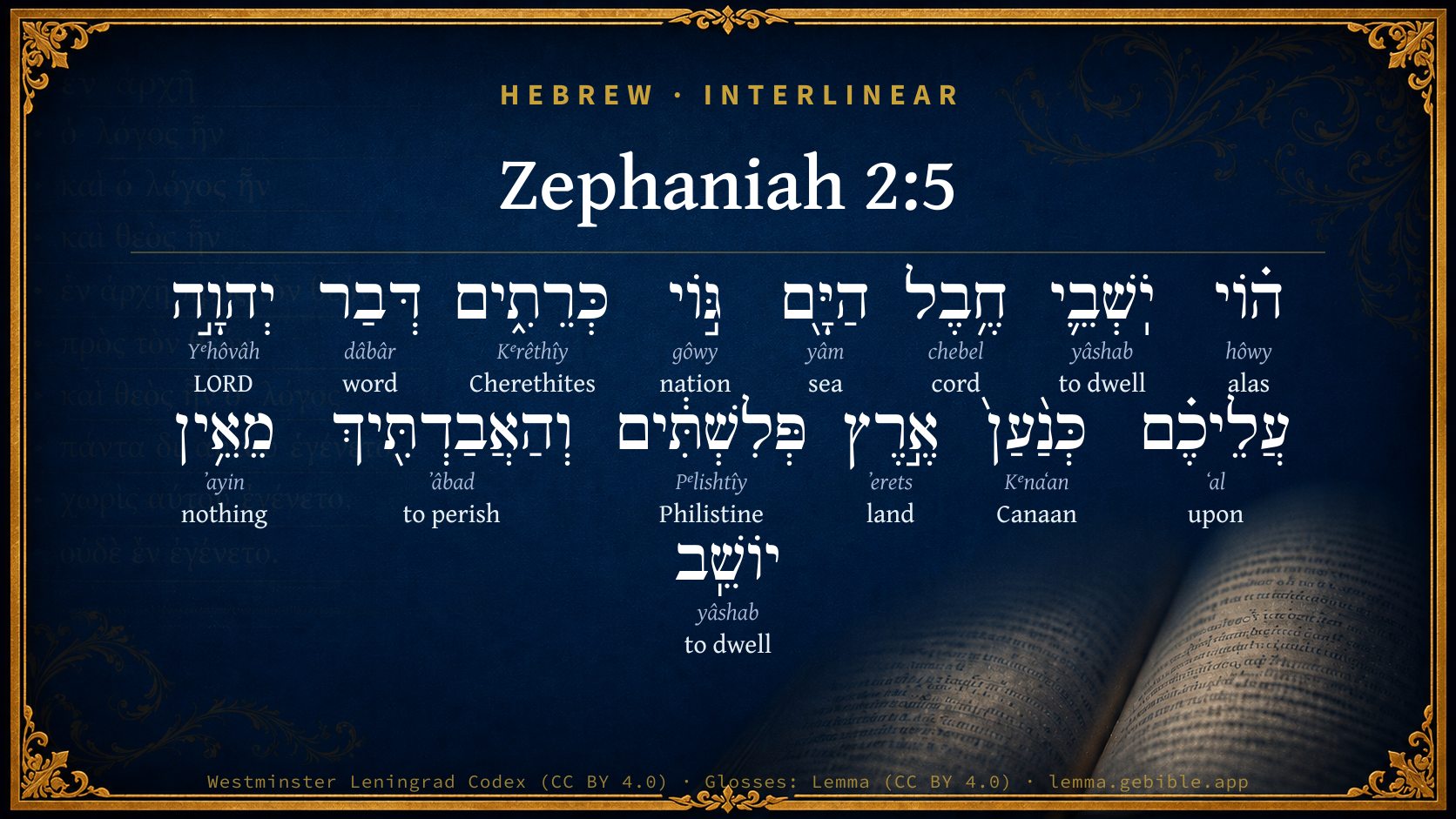
Hebrew (Westminster Leningrad Codex) Zephaniah 2:5 appears in the Hebrew Old Testament. The text above is from the Westminster Leningrad Codex. Each word links to its Strong’s number, a concise gloss, and parsing drawn from the Open Scriptures Hebrew Bible morphology. Click any word for its full Brown-Driver-Briggs (BDB) entry.
Download image
Cite this verse

Zephaniah 2:5 (World English Bible). Public Domain. Lemma interlinear Bible study tool, https://lemma.gebible.app/v/zephaniah/2/5.

Show BibTeX & RIS
BibTeX
RIS
English Translation
Woe to the inhabitants of the sea coast, the nation of the Cherethites! The word of Yahweh is against you, Canaan, the land of the Philistines. I will destroy you, that there will be no inhabitant.
World English Bible · Public Domain
Download a study sheet

One document with this verse’s original text, its word-by-word gloss line, the meaning frame, cross-references with their text, attributed commentary, and full source and license credits — printable, and it pastes into notes with its structure intact.

This verse Autodidact and up

Study sheet (.html) Plain text (.txt)

A passage Seminary Student

Up to 50 verses in one chapter. A passage sheet keeps up to 6 commentary sources and 12 cross-references per verse, in the order this page ranks them, and says so on the sheet whenever that leaves anything out. Ask for a single verse and you get the Autodidact verse sheet above.

Everything on this page stays free to read, with no account — the sheet is a download of what is already on screen, not access to it.

Want to remove ads? Support Godless Engineer
Compare translations 3

The same verse in 3 English versions, stacked beneath the original-language interlinear above. Click any original word for its lexicon entry.

Each is an independent rendering of the whole verse — the interlinear is not word-aligned to these translations.

Highlighted words mark where these versions differ — a whole-verse word diff, not a word-by-word alignment.

  • World English Bible Public Domain
    Woe to the inhabitants of the sea coast, the nation of the Cherethites! The word of Yahweh is against you, Canaan, the land of the Philistines. I will destroy you, that there will be no inhabitant.
  • King James Version Public Domain
    Woe unto the inhabitants of the sea coast, the nation of the Cherethites! the word of the LORD is against you; O Canaan, the land of the Philistines, I will even destroy thee, that there shall be no inhabitant.
  • unfoldingWord Literal Text CC BY-SA 4.0
    Woe the inhabitants of the region of the sea, the nation of the Kerethites! The word of Yahweh against you, Canaan, land of the Philistines: “And I will destroy you until there is no inhabitant.”

unfoldingWord Literal Text — © unfoldingWord, licensed CC BY-SA 4.0. Word-aligned USFM3 via Door43 (git.door43.org/unfoldingWord/en_ult).

Versions to compare (up to 4)

3 of 4 selected

Show all 18 translations

Every available English version of this verse, each an independent rendering of the whole verse.

  • World English Bible Public Domain
    Woe to the inhabitants of the sea coast, the nation of the Cherethites! The word of Yahweh is against you, Canaan, the land of the Philistines. I will destroy you, that there will be no inhabitant.
  • Berean Standard Bible Public Domain
    Woe to the dwellers of the seacoast, O nation of the Cherethites! The word of the LORD is against you, O Canaan, land of the Philistines: “I will destroy you, and no one will be left.”
  • Majority Standard Bible Public Domain
    Woe to the dwellers of the seacoast, O nation of the Cherethites! The word of the LORD is against you, O Canaan, land of the Philistines: “I will destroy you, and no one will be left.”
  • King James Version Public Domain
    Woe unto the inhabitants of the sea coast, the nation of the Cherethites! the word of the LORD is against you; O Canaan, the land of the Philistines, I will even destroy thee, that there shall be no inhabitant.
  • American Standard Version (1901) Public Domain
    Woe unto the inhabitants of the sea-coast, the nation of the Cherethites! The word of Jehovah is against you, O Canaan, the land of the Philistines; I will destroy thee, that there shall be no inhabitant.
  • Revised Version (1885) Public Domain
    Woe unto the inhabitants of the sea coast, the nation of the Cherethites! The word of the LORD is against you, O Canaan, the land of the Philistines; I will destroy thee, that there shall be no inhabitant.
  • Geneva Bible (1599) Public Domain
    Wo vnto the inhabitants of the sea coast. the nation of the Cherethims, the worde of the Lord is against you: O Canaan, the lande of the Philistims, I will euen destroye thee without an inhabitant.
  • Douay-Rheims (1899) Public Domain
    Woe to you that inhabit the sea coast, O nation of reprobates: the word of the Lord upon you, O Chanaan, the land of the Philistines, and I will destroy thee, so that there shall not be an inhabitant.
  • Young's Literal Translation Public Domain
    Ho! O inhabitants of the sea-coast, Nation of the Cherethites, A word of Jehovah `is' against you, Canaan, land of the Philistines, And I have destroyed thee without an inhabitant.
  • Literal Standard Version CC BY-SA 4.0
    Behold! O inhabitants of the seacoast, || Nation of the Cherethites, || A word of YHWH [is] against you, || Canaan, land of the Philistines, || “And I have destroyed you without an inhabitant.”
  • Unlocked Literal Bible CC BY-SA 4.0
    Woe to the inhabitants of the seacoast, the nation of the Kerethites! Yahweh has spoken against you, Canaan, land of the Philistines. I will destroy you until no inhabitant remains.
  • unfoldingWord Literal Text CC BY-SA 4.0
    Woe the inhabitants of the region of the sea, the nation of the Kerethites! The word of Yahweh against you, Canaan, land of the Philistines: “And I will destroy you until there is no inhabitant.”
  • Darby Bible Public Domain
    Woe unto the inhabitants of the sea-coast, the nation of the Cherethites! The word of Jehovah is against you, O Canaan, land of the Philistines: I will destroy thee, that there shall be no inhabitant;
  • World Messianic Bible Public Domain
    Woe to the inhabitants of the sea coast, the nation of the Cherethites! The LORD’s word is against you, Canaan, the land of the Philistines. I will destroy you until there is no inhabitant.
  • Webster's Bible Public Domain
    Woe to the inhabitants of the sea coasts, the nation of the Cherethites! the word of the LORD is against you; O Canaan, the land of the Philistines, I will even destroy thee, that there shall be no inhabitant.
  • Free Bible Version CC BY-SA 4.0
    What disaster is coming to you Philistines, you sea-people who live along the coast and in the land of Canaan! The Lord has passed judgment on you. I will destroy you—there will be no survivors.
  • Bible in Basic English Public Domain
    Sorrow to the people living by the sea, the nation of the Cherethites! The word of the Lord is against you, O Canaan, the land of the Philistines; I will send destruction on you till there is no one living in you.
  • JPS Tanakh (1917) Public Domain
    Woe unto the inhabitants of the sea-coast, the nation of the Cherethites! the word of the LORD is against you, O Canaan, the land of the Philistines; I will even destroy thee, that there shall be no inhabitant.

Literal Standard Version (2020), Covenant Press — licensed CC BY-SA 4.0. Text via the HelloAO Bible API (eBible.org). Unlocked Literal Bible (unfoldingWord) — licensed CC BY-SA 4.0. Text via the HelloAO Bible API (eBible.org). unfoldingWord Literal Text — © unfoldingWord, licensed CC BY-SA 4.0. Word-aligned USFM3 via Door43 (git.door43.org/unfoldingWord/en_ult). Free Bible Version, Dr. Jonathan Gallagher — licensed CC BY-SA 4.0. Text via the HelloAO Bible API (eBible.org).

Word by word

More ways to search: Search by grammar → Find every occurrence → Compare this word →

Practice this passage: Drill this verse → Learn its vocabulary →

כְּרֵתִ֑ים
Kᵉrêthîy
H3774
“Cherethites”
Noun, Gentilic, Masculine, Plural, Absolute
Part of Speech
Noun
Type
Gentilic
Gender
Masculine
Number
Plural
State
Absolute
Full BDB Definition

Origin: probably from H3772 in the sense of executioner

TWOT: None

Cherethites = "executioners" - a group of foreign mercenary soldiers serving as a bodyguard for king David; also executioners - either Cretans or proto-Philistines (in general)
  1. ה֗וֹי hôwy H1945 “alas” Particle, Interjection
  2. יֹֽשְׁבֵ֛י yâshab H3427 “dwelling” Verb, Qal, Participle Active, Masculine, Plural, Construct
  3. חֶ֥בֶל chebel H2256 “cord of” Noun, Common, Both, Singular, Construct
  4. הַיָּ֖ם yâm H3220 “the · sea” Particle, Definite Article + Noun, Common, Masculine, Singular, Absolute
  5. גּ֣וֹי gôwy H1471 “nation of” Noun, Common, Masculine, Singular, Construct
  6. דְּבַר dâbâr H1697 “word of” Noun, Common, Masculine, Singular, Construct
  7. יְהוָ֣ה Yᵉhôvâh H3068 “LORD” Noun, Proper
  8. עֲלֵיכֶ֗ם ʻal H5921 “upon · you” Preposition + Suffix, Personal, 2nd Person, Masculine, Plural
  9. כְּנַ֨עַן֙ Kᵉnaʻan H3667 “Canaan” Noun, Proper
  10. אֶ֣רֶץ ʼerets H776 “land of” Noun, Common, Both, Singular, Construct
  11. פְּלִשְׁתִּ֔ים Pᵉlishtîy H6430 “Philistines” Noun, Gentilic, Masculine, Plural, Absolute
  12. וְהַאֲבַדְתִּ֖יךְ ʼâbad H6 “and · to perish · her” Conjunction + Verb, Hiphil, Sequential Perfect, 1st Person, Common, Singular + Suffix, Personal, 3rd Person, Feminine, Singular
  13. מֵאֵ֥ין ʼayin H369 “from · nothing” Preposition + Particle, Negative
  14. יוֹשֵֽׁב yâshab H3427 “dwelling” Verb, Qal, Participle Active, Masculine, Singular, Absolute

About this verse

These counts appear in no published source. They are computed here, from the morphology-tagged text and Lemma’s own curated glosses. What Lemma adds →

15
words
14
distinct lemmas
Prophets
section

Notable vocabulary

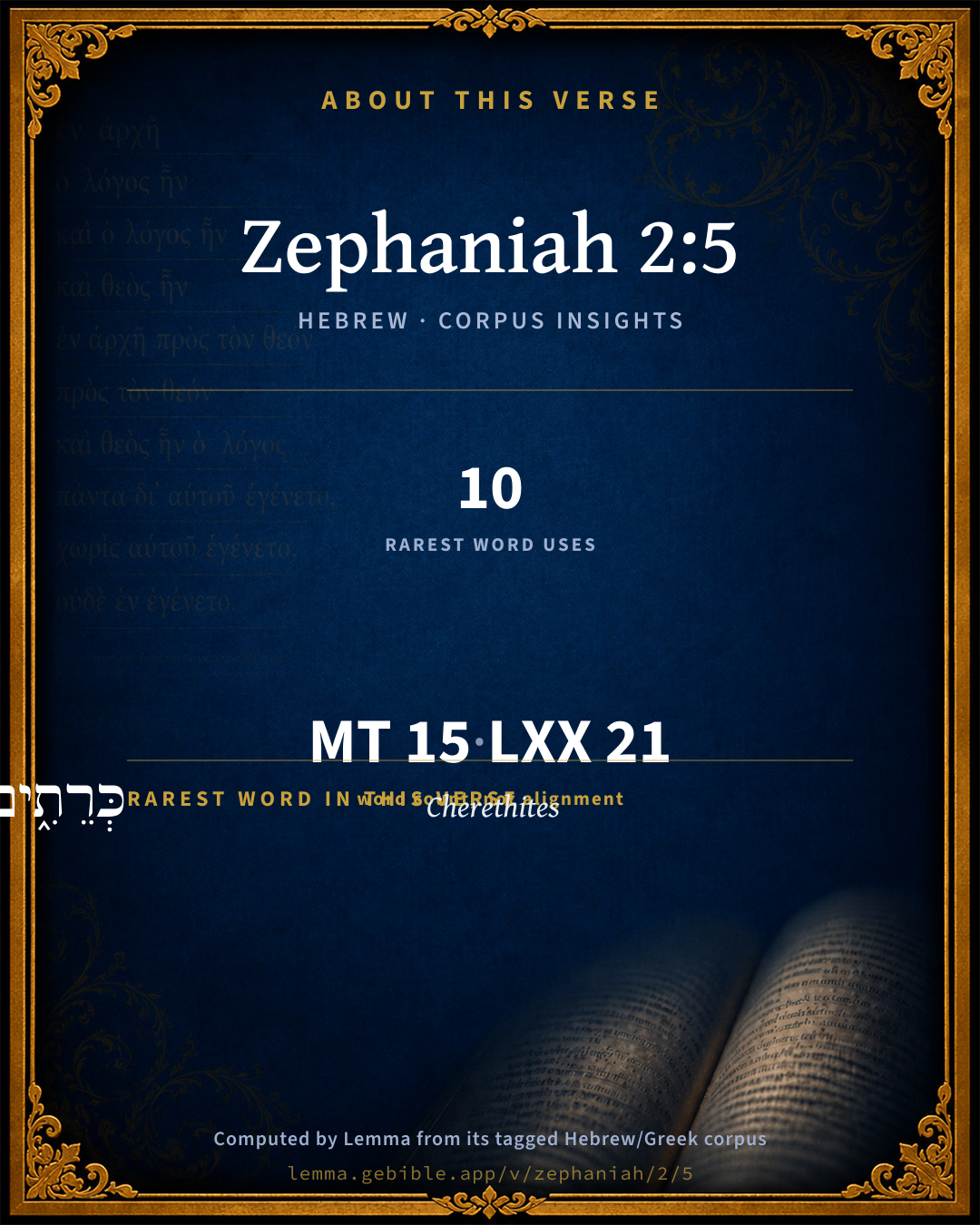
The rarest word here is כְּרֵתִ֑ים Cherethites H3774 — appearing just 10 times in the whole Hebrew Bible.

Shared distinctive vocabulary

כְּרֵתִ֑ים Cherethites H3774 occurs in 10 verses of the Hebrew Bible. Also found in:

Grammatical profile

  • 3 verbs
  • 9 nouns
  • 1 preposition
  • 2 particles

Verb forms

  • יֹֽשְׁבֵ֛י Qal · Participle Active
  • וְהַאֲבַדְתִּ֖יךְ Hiphil · Sequential Perfect
  • יוֹשֵֽׁב Qal · Participle Active

Repetition

A word recurs within this verse — often emphatic in Hebrew:

  • יֹֽשְׁבֵ֛י to dwell H3427 ×2

Hebrew & Septuagint length

In English translation the verse runs 36 words from the Hebrew and 38 from the Septuagint (LXX English) — closely comparable.

A rough comparison of the two English renderings, which tokenize alike — not a word-level alignment.

Word counts can differ between the Hebrew and the Greek without any difference in meaning — e.g. the Hebrew direct-object marker אֵת has no separate Greek word, and Greek often adds the article ὁ.

In the original languages it is 15 Hebrew tokens and 21 Greek tokens — but the two are counted differently (Hebrew bundles its prefixes and suffixes into one token; the Greek is in lemma form), so that isn’t a like-for-like length.

Cross-references

10

Topical passages linked to Zephaniah 2:5 in the Treasury of Scripture Knowledge — connected by theme and wording, ordered by reader-vote popularity; previews shown in the World English Bible.

  • Ezekiel 25:16 therefore thus says the Lord Yahweh, Behold, I will stretch out my hand on the Philistines, and I will cut off the Cherethites, and destroy the remnant of the sea coast.
  • Jeremiah 47:7 How can you be quiet, seeing Yahweh has given you a charge? Against Ashkelon, and against the sea-shore, there has he appointed it.
  • Joshua 13:3 from the Shihor, which is before Egypt, even to the border of Ekron northward, [which] is reckoned to the Canaanites; the five lords of the Philistines; the Gazites, and the Ashdodites, the Ashkelonites, the Gittites, and the Ekronites; also the Avvim,
  • Amos 3:1 Hear this word that Yahweh has spoken against you, children of Israel, against the whole family which I brought up out of the land of Egypt, saying:
  • Judges 3:3 [namely], the five lords of the Philistines, and all the Canaanites, and the Sidonians, and the Hivites who lived on Mount Lebanon, from Mount Baal Hermon to the entrance of Hamath.
  • Isaiah 14:30 The firstborn of the poor shall feed, and the needy shall lie down in safety; and I will kill your root with famine, and your remnant shall be killed.
  • Amos 5:1 Listen to this word which I take up for a lamentation over you, O house of Israel.
  • Zephaniah 3:6 I have cut off nations. Their battlements are desolate. I have made their streets waste, so that no one passes by. Their cities are destroyed, so that there is no man, so that there is no inhabitant.
  • Zechariah 1:6 But my words and my decrees, which I commanded my servants the prophets, didn't they overtake your fathers? "Then they repented and said, 'Just as Yahweh of Hosts determined to do to us, according to our ways, and according to our practices, so he has dealt with us.'"
  • Mark 12:12 They tried to seize him, but they feared the multitude; for they perceived that he spoke the parable against them. They left him, and went away.

Cross-references courtesy of OpenBible.info (CC BY 4.0).

Hebrew and Greek witnesses Masoretic Hebrew ↔ Greek Septuagint

The same verse in the two great witnesses to the Old Testament, shown verse-for-verse.

These are two independent witnesses, not word-aligned to each other, and the Septuagint is shown in lemma (dictionary) form.

Hebrew Zephaniah 2:5 Masoretic · Westminster Leningrad Codex

ה֗וֹי יֹֽשְׁבֵ֛י חֶ֥בֶל הַיָּ֖ם גּ֣וֹי כְּרֵתִ֑ים דְּבַר יְהוָ֣ה עֲלֵיכֶ֗ם כְּנַ֨עַן֙ אֶ֣רֶץ פְּלִשְׁתִּ֔ים וְהַאֲבַדְתִּ֖יךְ מֵאֵ֥ין יוֹשֵֽׁב

Woe to the inhabitants of the sea coast, the nation of the Cherethites! The word of Yahweh is against you, Canaan, the land of the Philistines. I will destroy you, that there will be no inhabitant.

World English Bible · Public Domain

Greek LXX Zephaniah 2:5 Septuagint · lemma form

οὐαί ὁ καταοἰκέω ὁ σχοίνισμα ὁ θάλασσα πάροικος κρῆτες λόγος κύριος ἐπί σύ χανααν γῆ ἀλλόφυλος καί ἀποὀλλύω σύ ἐκ κατοικία

Woe to them that dwell on the border of the sea, neighbors of the Cretans! the word of the Lord is against you, O Chanaan, land of the Philistines, and I will destroy you out of your dwelling-place.

LXX2012 (modern English Septuagint) · Public Domain

On this verse, John Gill's Exposition discusses the Septuagint’s reading. Read the note in Commentary ↓

Hebrew: Westminster Leningrad Codex (CC BY 4.0). Greek: Septuagint (public domain); English from LXX2012 (modern English Septuagint) (Public Domain). How the Septuagint differs from the Hebrew →

Targum (Aramaic paraphrase)

1

The Targum is the ancient Jewish Aramaic paraphrase of the Hebrew Scriptures — an interpretive translation, not the Hebrew text itself. Onkelos (literal) and Pseudo-Jonathan (expansive) render the Torah, and Jonathan the Prophets. Coverage is partial: where no permissively-licensed English translation exists for a verse, only the Aramaic is shown. This is verse-level text, not a word-by-word alignment to the Hebrew.

  1. Targum Jonathan Prophets (Joshua–Malachi)
    וַי דְיָתְבִין בִּסְפַר יַמָא עַמָא דְחַיָבִין לְאִשְׁתֵּיצָאָה גְזֵירַת פִּתְגָמָא דַייָ עֲלֵיכוֹן דְיָתְבִין בִּכְנָעַן אַרְעָא דִפְלִשְׁתָּאֵי וְאַבְּדִינָךְ מִבְּלִי יָתֵיב:

    (no public-domain English translation for this verse)

    Targum Jonathan — Aramaic: “Mikraot Gedolot” (public domain). English: “Sefaria Community Translation” (CC0 1.0 (public-domain dedication)); “London "Chaldee Paraphrase," 1871” (public domain). Text via Sefaria.

Commentary

Notes on Zephaniah 2:5 from classic Christian and Jewish commentators (each source and its license shown beneath its notes). The classic Christian expositions comment on the surrounding passage and are grouped to its opening verse, so a note may address several verses; the Jewish commentaries on the Tanakh (Rashi and others) are per-verse, so they appear only where the commentator wrote on this verse.

Lemma curates 59 commentaries, every one of them public domain or Creative Commons licensed, each selected and text-cleaned for this edition rather than reprinted as found. About our sources →

Trapp's Complete Commentary

John Trapp

Zep 2:5 Woe unto the inhabitants of the sea coast, the nation of the Cherethites! the word of the LORD [is] against you; O Canaan, the land of the Philistines, I will even destroy thee, that there shall be no inhabitant.

Ver. 5. Woe to the inhabitants of the sea coast] These were the Philistines; they lay between the Jews and the sea; God having so disposed of it, that his people might not have much commerce with foreign nations, nor learn their manners. Into havens and maritime towns there is usually a conflux of vices, like as there is of waters into the sea: witness Tyre and Sidon, Corinth, Carthage, Capernaum, &c. Hence that proverb, maritimi mores; naval customs, and that censure of such people, littorales duri, horridi, immanes, latrociniis dediti, omnium denique pessimi, Those that dwell by the seaside are usually ill-conditioned, ferce, cruel, thievish, and the worst of men. These Philistines were no better, and are therefore here put under a woe, and threatened with utter destruction.

The nation of the Cherethites] i.e. Destroyer; so the Philistines had styled themselves, as glorying to have conquered and cut off many people. The old Latin translation rendereth it Gens perditorum, The nation of destroyers; so doth Aquila, Theodotion, and Symmachus. Now it comes to their turn to be destroyed, according to Isa 33:1. That these Cherethites were a sort of Philistines, see 1Sa 30:14; 1Sa 30:16 Eze 25:16 That they were valiant men appears by that legion of them that guarded David, 2Sa 8:4, and were highly esteemed by him, because they stuck to him in his affliction at Gath, and also when Absalom was up in arms, 2Sa 15:18.

The word of the Lord is against you] And not only against Israel. This was spoken, as for the terror of those Philistines, who thought themselves out of the reach of God’s rod, and slighted his word, so for the comfort of the people of God, who thought much that themselves should be so severely dealt with, and the uncircumcised Philistines escape scot free.

O Canaan, the land of the Philistines] Indeed, of the Israelites, Jos 13:3, but held by force by the Philistines, who were of the stock of the Canaanites, but not subdued; and had detained part of the land from the right owners for eight hundred years and upwards; and now they come to be reckoned with. Subito tollitur qui diu toleratur. Suddenly be destroyed who where tolerated for a long time.

I will even destroy thee, that there shall be no inhabitant] No settled inhabitant, that shall fix there, as the word signifieth. Thus Poena venit gravior, quo mage sera venit, the longer God stays the heavier he strikes.

John Trapp, A Commentary or Exposition upon All the Books of the Old and New Testament (1647–1656) — public domain. Text from a community e-Sword module.

Tyndale Open Study Notes

Tyndale Open Resources

2:5 Old Testament scholars believe the Philistines came from the island of Crete (cp. Ezek 25:16).

Tyndale Open Study Notes — © Tyndale Open Resources, licensed CC BY-SA 4.0. Text via the HelloAO Bible API.

Geneva Bible (1599)

Geneva Bible translators

That is, Galilee: by these nations he meaneth the people that dwelt near to the Jews, and instead of friendship were their enemies: therefore he calleth them Canaanites whom the Lord appointed to be slain.

Geneva Bible (1599) marginal notes — public domain. Text via Bolls.life.

Jamieson, Fausset & Brown

Robert Jamieson, A. R. Fausset & David Brown

inhabitants of the seacoast--the Philistines dwelling on the strip of seacoast southwest of Canaan. Literally, the "cord" or "line" of sea (compare Jer 47:7; Eze 25:16).

the Cherethites--the Cretans, a name applied to the Philistines as sprung from Crete (Deu 2:23; Jer 47:4; Amo 9:7). Philistine means "an emigrant."

Canaan . . . land of the Philistines--They occupied the southwest of Canaan (Jos 13:2-3); a name which hints that they are doomed to the same destruction as the early occupants of the land.

Jamieson, Fausset & Brown — Commentary Critical and Explanatory on the Whole Bible (1871) — public domain (CC PDM 1.0). Text via the HelloAO Bible API.

Adam Clarke's Commentary

Verse 5. The sea-coasts, the nation of the Cherethites] The sea-coasts mean all the country lying on the Mediterranean coast from Egypt to Joppa and Gaza. The Cherethites - the Cretans who were probably a colony of the Phoenicians. See on 1Sa 30:14, and Am 9:7.

Adam Clarke's Commentary on the Bible (1810–1826) — public domain. Text from a community e-Sword/MySword module.

Ellicott's Commentary for English Readers

(5) The Cherethites.—Perhaps Cretans. See on 1Sa_30:14; Eze_25:16, where the same term is applied to the Philistines.

Canaan originally means “low-lying ground.” It here indicates the low maritime plain inhabited by the Philistines.

A Bible Commentary for English Readers, edited by Charles John Ellicott (1878–1897) — public domain. Text from a community e-Sword module.

The Cambridge Bible for Schools and Colleges

gen. ed. J. J. S. Perowne

5. the sea coast] Or, the region by the sea. The reference is to the strip of territory belonging to the Philistines; Eze_25:16. The Cherethites are the Philistines, or at least those along the coast (1Sa_30:14). The word is supposed to have some relation to Crete, from which it is believed the Philistines migrated into Palestine. In Amo_9:7, Deu_2:23, Jer_47:4 the Philistines are said to have come from Caphtor, which may be Crete. In 2Sa_8:18 the Cherethites and Pelethites (Philistines?) appear as mercenaries among David’s household troops. According to Jos_13:3-4 the territory of the Philistines was reckoned to the Canaanites.

The Cambridge Bible for Schools and Colleges (gen. ed. J. J. S. Perowne; Cambridge University Press, 1878–1918) — public domain. Text from a community e-Sword module.

John Gill's Exposition

Woe unto the inhabitants of the sea coasts, the nation of the Cherethites Which is a name of the Philistines in general, as Kimchi and Ben Melech; or these were a particular tribe belonging to them, that inhabited the southern part of their country; see ( 1 Samuel 30:14 1 Samuel 30:16 ) those on the sea coast, the coast of the Mediterranean sea, and so lay between that and Judea: out of this nation, in the times of David and Solomon, were some choice soldiers selected, called the Cherethites and Pelethites, who were their bodyguards, as Josephus F1 calls them; a royal band, which never departed from the king's person; see ( 2 Samuel 15:18 ) ( 2 Samuel 20:7 2 Samuel 20:23 ) . The Septuagint version calls them "strangers of the Cretians"; and are thought by some to be a colony of the Cretians; a people that came originally from the island of Crete, and settled here; but, on the contrary, rather Crete was a colony of the Philistines, and had its name from them; for by the Arabians F2, the country of Palestine, or the Philistines, is called Keritha; and by the Syrians Creth; and, by the Hebrews the inhabitants thereof are called Cherethites, as here, and in ( Ezekiel 25:16 ) and so the south of the Cherethites, in ( 1 Samuel 30:14 ) , is, in ( Ezekiel 25:16 ) , called the land of the Philistines. In all the above places, where they are spoken of as the attendants of Solomon and David, they are in the Targum called "archers"; and it is a clear case the Philistines were famous for archery, whereby they had sometimes the advantage of their enemies; see ( 1 Samuel 31:3 ) and bows and arrows were the arms the Cretians made use of, and were famous for, as Bochart F3 from various writers has shown; the use of which they learned very probably from the Philistines, from whom they sprung; though Solinus F4 says they were the first that used arrows; and, according to Diodorus Siculus, Saturn introduced the art of using bows and arrows into the island of Crete; though others ascribe it to Apollo F5; and it is said that Hercules learnt this art from Rhadamanthus of Crete; which last instance seems to favour the notion of those, that these Cherethites were Cretians, or sprung from them; to which the Septuagint version inclines; and Calmet F6 is of opinion that Caphtor, from whence the Philistines are said to come, ( Amos 9:7 ) and who are called the remnant of the country of Caphtor, ( Jeremiah 47:4 ) is the island of Crete; and that the Philistines came from thence into Palestine; and that the Cherethites are the ancient Cretians; the language, manners, arms, religion and gods, of the Cretians and Philistines, being much the same; though so they might be, as being a colony of the Philistines; (See Gill on Amos 9:7) though a learned man {1}, who gives into the opinion that these were royal guards, yet thinks they were not strangers and idolaters, but proselytes to the Jewish religion at least; and rather Israelites, choice selected men, men of strength and valour, of military courage and skill, picked out of the nation, to guard the king's person; and who were called Cherethites and Pelethites, from the kind of shields and targets they wore, called "cetra" and "pelta": and it is a notion several of the Jewish writers {2} have, that they were two families in Israel; but it seems plain and evident that a foreign nation is here meant, which lay on the sea coast, and belonged to the Philistines. Another learned man F7 thinks they are the Midianites, the same with the Cretians that Luke joins with the Arabians, ( Acts 2:11 ) as the Midianites are with the Arabians and Amalekites by Josephus F8; however, a woe is denounced against them, and they are threatened with desolation. The Vulgate Latin version is, "a nation of destroyed ones": and the Targum, ``a people who have sinned, that they might be destroyed:'' the word of the Lord is against you; inhabitants of the sea coast, the Cherethites; the word of the Lord conceived in his own mind, his purpose to destroy them, which cannot be frustrated. So the Targum, ``the decree of the word of the Lord is against you;'' and the word pronounced by his lips, the word of prophecy concerning them, by the mouth of former prophets, as Isaiah, ( Isaiah 14:29 Isaiah 14:31 ) and by the mouth of the present prophet: O Canaan, the land of the Philistines; Palestine was a part of Canaan; the five lordships of the Philistines before mentioned belonged originally to the Canaanite, ( Joshua 13:3 ) and these belonged to the land of Israel, though possessed by them, out of which now they should be turned, and the country wasted, as follows: I will even destroy thee, that there shall be no inhabitant; so great should be the desolation; all should be removed from it, either by death or by captivity; at least there should be no settled inhabitant. FOOTNOTES: F1 Antiqu. l. 7. c. 5. sect. 4. and c. 11. sect. 8. Vid. Opitii Exercitat. de Crethi & Plethi. F2 Giggeius apud Bochart. Canaan, l. 1. c. 15. col. 422. F3 Ibid. col. 423. F4 Polyhistor. c. 16. F5 Diodor. Sicul. Bibliothec. l. 5. p. 334, 341. F6 Dictionary, in the word "Caphtor". {1} Fortunati Scacchi Elaeochrism, Myrothec. l. 3. c. 18, 19. {2} Kimchi & Ben Gersom in 2 Sam. viii. 18. and xv. 18. F7 Texelii Phoenix. l. 3. c. 21. sect. 4. p. 389, 390. F8 Antiqu. l. 5. c. 6. sect. 1.

John Gill's Exposition of the Whole Bible (1746–1763) — public domain (CC PDM 1.0). Text via the HelloAO Bible API.

Albert Barnes' Notes on the Bible

The “woe” having been pronounced on the five cities apart, now falls upon the whole nation of the Cherethites or Philistines. The Cherethites are only named as equivalent to the Philistines, probably as originally a distinct immigration of the same people . The name is used by the Egyptian slave of the Amalekite 1Sa 30:14 for those whom the author of the first book of Samuel calls Philistines 1Sa 30:16. Ezekiel uses the name parallel with that of “Philistines,” with reference to the destruction which God would bring upon them .

The word of the Lord - Comes not to them, but “upon” them, overwhelming them. To them He speaketh not in good, but in evil; not in grace, but in anger; not in mercy, but in vengeance. Philistia was the first enemy of the Church. It showed its enmity to Abraham and Isaac and would fain that they should not sojourn among them Gen 21:34; Gen 26:14-15, Gen 26:28. They were the hindrance that Israel should not go straight to the promised land Exo 13:17. When Israel passed the Red Sea Exo 15:14, “sorrow” took hold of them.” They were close to salvation in body, but far in mind. They are called “Canaan,” as being a chief nation of it Gen 15:21, and in that name lay the original source of their destruction. They inherited the sins of Canaan and with them his curse, preferring the restless beating of the barren, bitter sea on which they dwelt, “the waves of this troublesome world,” to being a part of the true Canaan. They would absorb the Church into the world, and master it, subduing it to the pagan Canaan, not subdue themselves to it, and become part of the heavenly Canaan.

Albert Barnes' Notes on the Bible (1834–1885) — public domain. Text from a community e-Sword/MySword module.

Haydock's Catholic Bible Commentary

Coast. Literally, "line," (Haydock) with which land was measured. (Calmet) --- Reprobates. Hebrew cerethim, (Haydock) or Cerethi, of whom David’s guards were formed. (Calmet) --- Septuagint, "people sprung the Cretans," whence some (Theodoret) of the Philistines came, perhaps rather than from Cyprus, as was conjectured, Genesis x. 14. --- Chanaan. So the Philistines are styled contemptuously. They adored the same idols, Wisdom xii. 23.

George Leo Haydock (1774–1849), Haydock's Catholic Family Bible and Commentary, 1859 edition — public domain. Excludes Psalms (Douay-Rheims chapter numbering differs from Protestant) and Deuterocanonical books (Catholic canon only).

Matthew Poole's English Annotations

Woe unto the inhabitants! now all the Philistines are threatened, whereas before he named only those four cities.

Of the sea-coasts; the coasts of the great or western sea, now the Mediterranean, on which the Philistines of old did dwell.

The Cherethites, or destroyers, men that were stout, but fierce, and perhaps terrible to neighbours and foreigners that had the hard hap to be forced on their coasts by violence of sea. They were great soldiers, and lived Switzerlike, guards to David, it may be to other kings also.

The word of the Lord; his purpose, his threats too by his prophet.

Canaan; that part that the Philistines did by three keep from the Jews.

I will even destroy thee: though the Chaldeans be the men that shall destroy, yet the Lord will do it also; they his servants, he chief, in doing it.

There shall be no inhabitant; no more cities, nor citizens to dwell therein.

Matthew Poole's English Annotations on the Holy Bible (1683–1685) — public domain. Text from a community e-Sword/MySword module.

The Pulpit Commentary

Woe. The denunciation extends to all Philistia. The inhabitants of the sea coast. Both the. Greek and Latin Versions retain the notion of the Hebrew word chebel: "Ye who inhabit the measured allotment of the sea." "Philistia," says Sir C. Warren, "consists of an undulating plain from fifty to a hundred feet above the level of the sea, reaching thirty-two miles from Ekron to Gaza, with a breadth of from nine to sixteen miles. To the east of this the hills commence, not the hill country, but a series of low spurs and undulating ground, culminating in hogs" backs, running nearly north and south, and rising in places to twelve hundred feet above the ocean" ("Survey Memoirs: Jerusalem," p. 436). The nation of the Cherethites. So in Eze_25:16. Zephaniah calls the Philistines by this name for the sake of a play on the word, Cherethites meaning "Cutters off," and they were devoted to being "cut off" (karath). Part of David"s bodyguard was composed of the same people. (1Sa_30:14) The name seems to have belonged to a portion of the Philistines who inhabited the southern part of the district. "One of the principal villages of Philistia is now called Keretiya, so that the term may apply to the inhabitants of this town an ancient Cherith not mentioned in the Bible" (Courier"s "Handbook to the Bible," p. 237). They have been supposed to have emigrated from Crete, but there are no reliable grounds for this theory, though the LXX in the present passage has, Paroikoi Krhtwn , "sojourners of the Cretans;" and the Syriac gives a similar rendering. St. Jerome renders, "gens perditorum," "nation of destroyers." The word of the Lord is against you. The sentence is pronounced in the words following. O Canaan. O Philistia, which shall be as Canaan, and in like manner exterminated. Canaan means "Lowland," a name which originally was applied to the Phoenician and Philistine tracts on the seacoast. I will even destroy thee. The like threat is uttered by Jeremiah (Jer_47:4, Jer_47:5) and Ezekiel. (Eze_25:15-17)

The Pulpit Commentary (1880–1919), ed. H.D.M. Spence-Jones & Joseph S. Exell — public domain. Text from a community e-Sword module.

John Wesley's Explanatory Notes

The inhabitants - All the Philistines. Cherethites - Or destroyers, men that were stout, fierce, and terrible to their neighbours. O Canaan - That part that the Philistines kept by force from the Jews.

John Wesley, Explanatory Notes Upon the Whole Bible (1754–1765) — public domain. Text via the GEBible commentary corpus.

Rashi

Rabbi Shlomo Yitzchaki (Rashi)

the seacoast the border of the sea. The expression חֶבֶל is a measure of land that they measured with a rope, i.e., those close to the sea.

the nation of Cherethites the people liable to destruction. Who are the inhabitants of the seacoast of Canaan, the land of the Philistines? The Philistines, who dwell on the coast of the western sea, in the west of Eretz lsrael, within its boundaries. Although Jonathan explains this phrase homiletically as [the nation of] destruction, the nation of the Cherethites is a province of the Philistines; its name is Cherethi. So Scripture states (I Sam. 30:14) regarding Ziklag: “We made a raid upon the south of the Cherethites, etc.” Jonathan translates: on the south of Cherethi. Below (ibid. 30:16) it is written: “Because of all the great spoil which they had taken from the land of the Philistines and from the land of Judah.”

Rashi on the Tanakh — English translations: “The Judaica Press complete Tanach with Rashi, translated by A. J. Rosenberg” (CC BY 4.0); “Pentateuch with Rashi's commentary by M. Rosenbaum and A.M. Silbermann, 1929-1934” (public domain); “The Metsudah Tanach series, Lakewood, N.J” (CC BY 4.0); and “The Book of Joshua, Metsudah Publications, 1997” (CC BY 4.0). Text via Sefaria.

Lesson kit

Teaching starters — assembled from the data on this page, not authored interpretation. Every prompt links to the verse data it draws on. Edit before teaching.

Zephaniah, in the Prophets, opens this verse with 15 words (14 distinct Hebrew lemmas). Its most distinctive word is Kᵉrêthîy (“Cherethites”). A historical commentator’s framing appears above. Read the whole chapter for the surrounding context.

Discussion questions

  1. The word Kᵉrêthîy carries the sense “Cherethites.” How does it shape the verse?
  2. How does 1 Samuel 30:14, which shares the word «Cherethites», read alongside this verse?
  3. What does the repetition of “to dwell” (2× in this one verse) do in this verse?
  4. These translations render this verse differently; the difference is in the English rendering, not the original. What questions does that raise?
  5. «יֹֽשְׁבֵ֛י» is a Qal Participle Active verb. How does that grammatical form shape the action described?
  6. Compare how Trapp's Complete Commentary and Tyndale Open Study Notes read this verse. Where do they agree or differ?

Things to notice

Reading settings

Reading text

Shown beneath each verse's original-language words.

Old Testament
Old Testament edition

Read the OT as the Masoretic Hebrew (MT) or the Greek Septuagint (LXX).

English shown for the Greek Septuagint (in the Hebrew ↔ Greek comparison).

Comparing translations? Open the Compare panel on any verse page to stack up to four side by side.