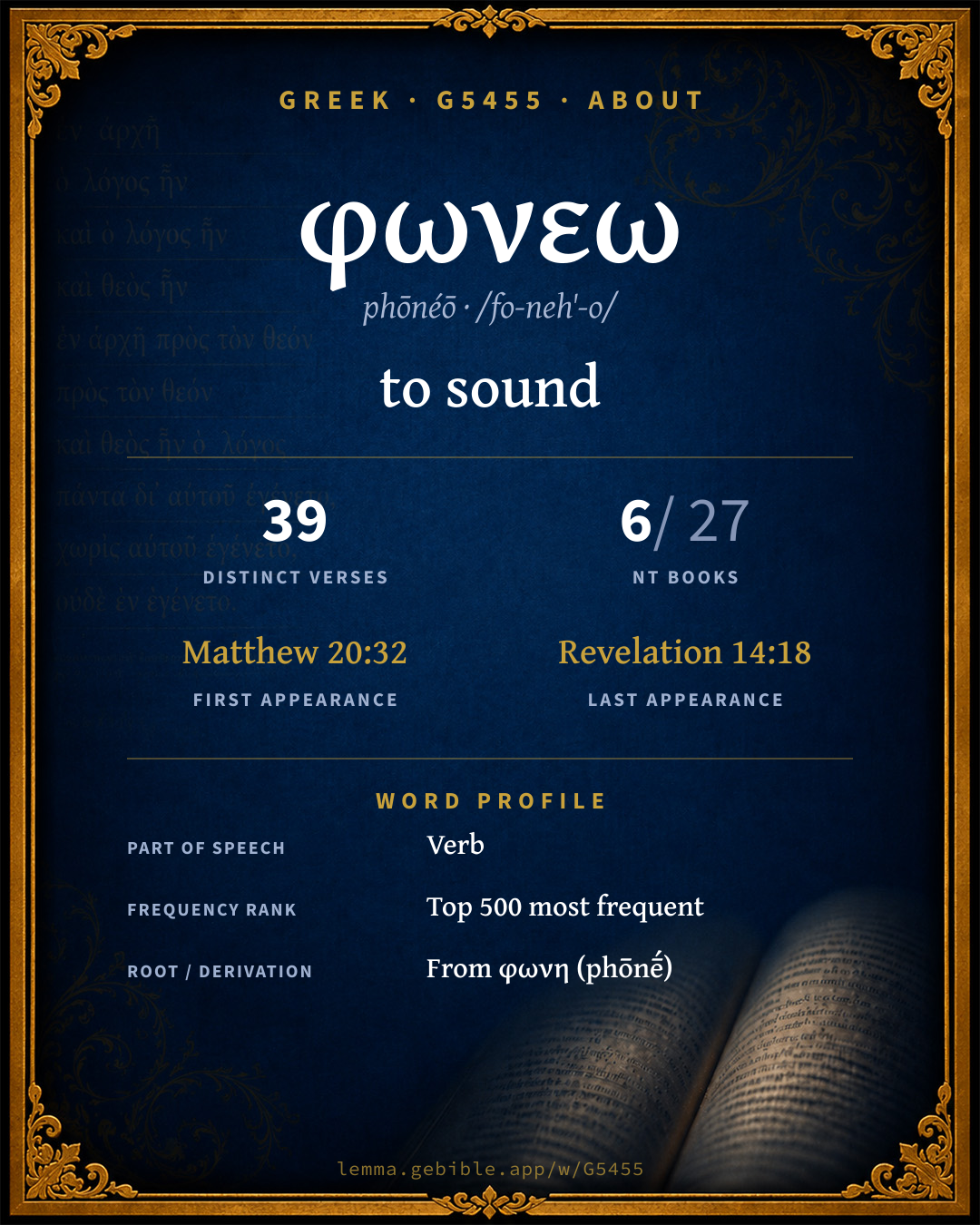
φωνέω
to sound
also: emit a sound, to speak fuller range ↓
Full lexicon entry — Thayer's Greek Lexicon
From Thayer's Greek Lexicon
Where this word appears
See every Aorist-tense verb in the Greek New Testament →
Grammar key — what these labels mean
Part of speech
- Verb
- An action or state-of-being word.
Tense
- Aorist
- Action viewed as a simple whole, without regard to duration — often past (perfective aspect).
- Present
- Ongoing or general action in present time (imperfective aspect).
- Future
- Action expected in future time.
- Imperfect
- Continuous or repeated action in past time (“was writing”).
Voice
- Active
- The subject performs the action.
- Passive
- The subject receives the action.
Mood
- Indicative
- States a fact or asks a factual question (the mood of reality).
- Infinitive
- A verbal noun (“to write”), unmarked for person or number.
- Participle
- A verbal adjective (“writing,” “having written”).
- Imperative
- Expresses a command or request.
- Subjunctive
- Expresses probability, purpose, or possibility (the mood of contingency).
Case
- Nominative
- The case of the subject (and the predicate nominative).
Person
- 3rd person
- The one spoken about (“he / she / it / they”).
- 2nd person
- The one addressed (“you”).
Gender
- Masculine
- Grammatically masculine.
- Neuter
- Grammatically neuter.
Number
- Singular
- One.
- Plural
- More than one.
Grammatical forms 16 distinct
- Verb, Aorist, Active, Indicative, 3rd person, Singular 13 times (30%)
- Verb, Aorist, Active, Infinitive 6 times (14%)
- Verb, Present, Active, Indicative, 3rd person, Singular 6 times (14%)
- Verb, Aorist, Active, Participle, Nominative, Singular, Masculine 5 times (12%)
- Verb, Aorist, Active, Indicative, 3rd person, Plural 2 times (5%)
- Verb, Aorist, Active, Imperative, 2nd person, Plural 1 time (2%)
- Verb, Aorist, Active, Imperative, 2nd person, Singular 1 time (2%)
- Verb, Aorist, Active, Participle, Nominative, Plural, Masculine 1 time (2%)
+8 more forms (8 occurrences)
Parsed forms decoded from the imported morphology (Robinson–Tischendorf, public domain), counted across 43 parsed occurrences — not distinct verses.
Every verse where G5455 appears — 39 distinct verses across 6 books. Click any verse to open its interlinear word-by-word view. Verse text shown in the World English Bible for context — . Each verse’s Greek form is shown with its reference; the English is not keyword-highlighted, since the data carries no word-level English alignment. Use “Compare translations” on any verse to read it across multiple English versions. This concordance covers the Greek New Testament; Septuagint (Greek Old Testament) occurrences of this word are not indexed here.
Matthew 5 verses
- Matthew 20:32 ἐφώνησεν aor act ind 3sg Jesus stood still, and called them, and asked, "What do you want me to do for you?"
- Matthew 26:34 φωνῆσαι aor act inf Jesus said to him, "Most assuredly I tell you that tonight, before the rooster crows, you will deny me three times."
- Matthew 26:74 ἐφώνησεν aor act ind 3sg Then he began to curse and to swear, "I don't know the man!" Immediately the rooster crowed.
- Matthew 26:75 φωνῆσαι aor act inf Peter remembered the word which Jesus had said to him, "Before the rooster crows, you will deny me three times." He went out and wept bitterly.
- Matthew 27:47 φωνεῖ pres act ind 3sg Some of them who stood there, when they heard it, said, "This man is calling Elijah."
Mark 7 verses
- Mark 1:26 φωνῆσαν aor act ptcp nom sg neut The unclean spirit, convulsing him and crying with a loud voice, came out of him.
- Mark 9:35 ἐφώνησεν aor act ind 3sg He sat down, and called the twelve; and he said to them, "If any man wants to be first, he shall be last of all, and servant of all."
- Mark 10:49 φωνήσατε φωνοῦσιν φωνεῖ aor act impv 2pl pres act ind 3pl pres act ind 3sg Jesus stood still, and said, "Call him." They called the blind man, saying to him, "Cheer up! Get up. He is calling you!"
- Mark 14:30 φωνῆσαι aor act inf Jesus said to him, "Most assuredly I tell you, that you today, even this night, before the rooster crows twice, you will deny me three times."
- Mark 14:68 ἐφώνησεν aor act ind 3sg But he denied it, saying, "I neither know, nor understand what you are saying." He went out on the porch, and the rooster crowed.
- Mark 14:72 ἐφώνησεν φωνῆσαι aor act ind 3sg aor act inf The rooster crowed the second time. Peter remembered the word, how that Jesus said to him, "Before the rooster crows twice, you will deny me three times." When he thought about that, he wept.
- Mark 15:35 φωνεῖ pres act ind 3sg Some of those who stood by, when they heard it, said, "Behold, he is calling Elijah."
Luke 10 verses
- Luke 8:8 ἐφώνει impf act ind 3sg Other fell into the good ground, and grew, and brought forth fruit one hundred times." As he said these things, he called out, "He who has ears to hear, let him hear!"
- Luke 8:54 ἐφώνησεν aor act ind 3sg But he put them all outside, and taking her by the hand, he called, saying, "Child, arise!"
- Luke 14:12 φώνει pres act impv 2sg He also said to the one who had invited him, "When you make a dinner or a supper, don't call your friends, nor your brothers, nor your kinsmen, nor rich neighbors, or perhaps they might also return the favor, and pay you back.
- Luke 16:2 φωνήσας aor act ptcp nom sg masc He called him, and said to him, 'What is this that I hear about you? Give an accounting of your management, for you can no longer be manager.'
- Luke 16:24 φωνήσας aor act ptcp nom sg masc He cried and said, 'Father Abraham, have mercy on me, and send Lazarus, that he may dip the tip of his finger in water, and cool my tongue! For I am in anguish in this flame.'
- Luke 19:15 φωνηθῆναι aor pass inf "It happened when he had come back again, having received the kingdom, that he commanded these servants, to whom he had given the money, to be called to him, that he might know what they had gained by conducting business.
- Luke 22:34 φωνήσει fut act ind 3sg He said, "I tell you, Peter, the rooster will by no means crow today until you deny that you know me three times."
- Luke 22:60 ἐφώνησεν aor act ind 3sg But Peter said, "Man, I don't know what you are talking about!" Immediately, while he was still speaking, a rooster crowed.
- Luke 22:61 φωνῆσαι aor act inf The Lord turned, and looked at Peter. Then Peter remembered the Lord's word, how he said to him, "Before the rooster crows you will deny me three times."
- Luke 23:46 φωνήσας aor act ptcp nom sg masc Jesus, crying with a loud voice, said, "Father, into your hands I commit my spirit!" Having said this, he breathed his last.
John 12 verses
- John 1:49 φωνῆσαι aor act inf Nathanael answered him, "Rabbi, you are the Son of God! You are King of Israel!"
- John 2:9 φωνεῖ pres act ind 3sg When the ruler of the feast tasted the water now become wine, and didn't know where it came from (but the servants who had drawn the water knew), the ruler of the feast called the bridegroom,
- John 4:16 φώνησον aor act impv 2sg Jesus said to her, "Go, call your husband, and come here."
- John 9:18 ἐφώνησαν aor act ind 3pl The Jews therefore did not believe concerning him, that he had been blind, and had received his sight, until they called the parents of him who had received his sight,
- John 9:24 Ἐφώνησαν aor act ind 3pl So they called the man who was blind a second time, and said to him, "Give glory to God. We know that this man is a sinner."
- John 10:3 φωνεῖ pres act ind 3sg The gatekeeper opens the gate for him, and the sheep listen to his voice. He calls his own sheep by name, and leads them out.
- John 11:28 ἐφώνησεν φωνεῖ aor act ind 3sg pres act ind 3sg When she had said this, she went away, and called Mary, her sister, secretly, saying, "The Teacher is here, and is calling you."
- John 12:17 ἐφώνησεν aor act ind 3sg The multitude therefore that was with him when he called Lazarus out of the tomb, and raised him from the dead, was testifying about it.
- John 13:13 φωνεῖτέ pres act ind 2pl You call me, 'Teacher' and 'Lord.' You say so correctly, for so I am.
- John 13:38 φωνήσῃ aor act subj 3sg Jesus answered him, "Will you lay down your life for me? Most assuredly I tell you, the rooster won't crow until you have denied me three times.
- John 18:27 ἐφώνησεν aor act ind 3sg Peter therefore denied it again, and immediately the rooster crowed.
- John 18:33 ἐφώνησεν aor act ind 3sg Pilate therefore entered again into the Praetorium, called Jesus, and said to him, "Are you the King of the Jews?"
Acts 4 verses
- Acts 9:41 φωνήσας aor act ptcp nom sg masc He gave her his hand, and raised her up. Calling the saints and widows, he presented her alive.
- Acts 10:7 φωνήσας aor act ptcp nom sg masc When the angel who spoke to him had departed, Cornelius called two of his household servants and a devout soldier of those who waited on him continually.
- Acts 10:18 φωνήσαντες aor act ptcp nom pl masc and called and asked whether Simon, who was surnamed Peter, was lodging there.
- Acts 16:28 ἐφώνησεν aor act ind 3sg But Paul cried with a loud voice, saying, "Don't harm yourself, for we are all here!"
Revelation 1 verse
About this entry
At a glance — auto-summarized from this page’s data, not written by a person. Every figure links to its source below. This summary describes the numbers; it doesn’t interpret them.
The Greek verb φωνεω centers on the idea of “to sound.” Older and newer Bibles part ways — “called” in the King James Version, “crows” (unfoldingWord Literal Text) in modern versions. See the renderings breakdown. It turns up in 39 verses across 6 books, a moderately common footprint. The word gravitates to John (31%), then Luke and Mark. Thayer's distinguishes 5 senses; alongside “to sound” it spans “emit a sound” and “to speak”. Dig into 39-verse concordance and the renderings breakdown below.
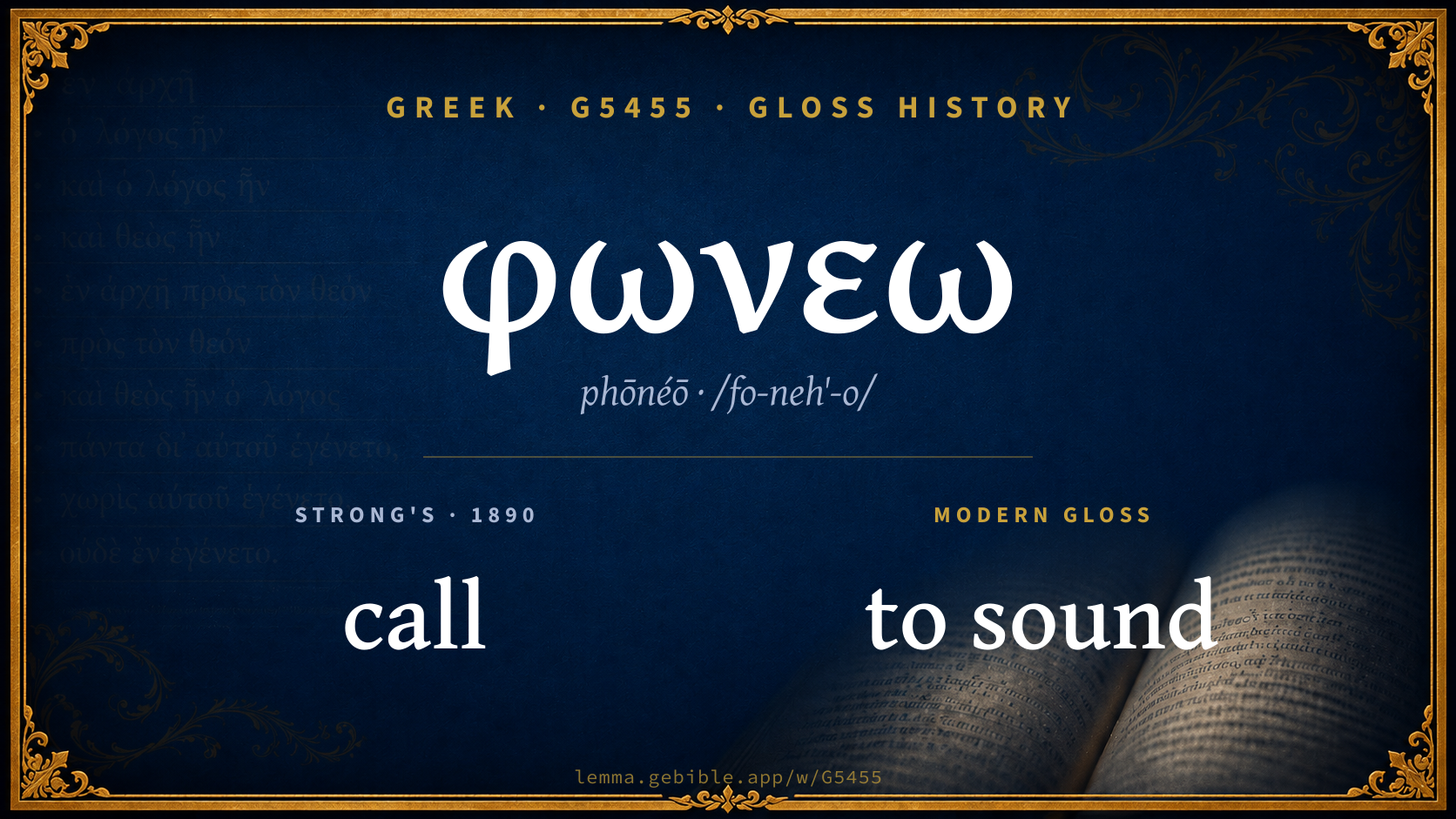
Gloss history
Strong's 1890 vs modern scholarship
About this word
Strong's G5455 catalogs a Greek word from the Greek New Testament.
These counts are not copied from any lexicon or concordance. They are computed here, from the morphology-tagged Greek New Testament. What Lemma adds →
- 39
- distinct verses
- The word appears in 39 distinct verses.
- 6 / 27
- NT books
- The word appears in 6 of 27 New Testament books.
- #347
- by frequency
- Top 500 most frequent Greek words (rank 347 of 5,347 Greek words by occurrence).
View all 39 occurrences in the concordance →
By section of the New Testament
By traditional corpus
Conventional, traditional groupings — biblical authorship is debated, so this is a traditional corpus grouping, not an authorship claim. Some books belong to more than one corpus (Luke is in both the Gospels and the Lukan corpus, and so on), so these shares overlap and need not total 100%. Each figure is a share of the word’s 39 distinct verses.
- Gospels 34 verses · 87%
- Lukan (Luke–Acts) 14 verses · 36%
- Johannine 13 verses · 33%
- Revelation 1 verse · 3%
How translations render this word
Counts come from each version’s own published word-to-Strong’s tagging or interlinear alignment — an approximate guide to how each version renders this word, not a word-level alignment the data otherwise carries. Because each total is that version’s own tagged count, the per-version totals vary from one another and need not match the appearance or distinct-verse counts above. These counts may also differ from a printed concordance because Lemma counts each distinctly tagged rendering and does not collapse phrase taggings into a single head-word total. This is a fixed set of word-tagged versions (KJV, ASV, BSB, ULT) and does not change with the reading translation you choose elsewhere. Each version’s license is shown beside its name below (and on Sources).
- King James Version: Called 8×, Crow 7×, Crew 5×
- American Standard Version: Called 7×, Crow 7×, Crew 5×
- Berean Standard Bible: Called 6×, Crows 6×, Crowed 5×
- unfoldingWord Literal Text: Crows 5×, Crowed 4×, Call 3×
King James Version Public Domain
Renders G5455 across 44 tagged occurrences — most commonly:
Plus 8 renderings that appear only once — usually multi-word phrases or single function words the recovered tagging swept in, not distinct renderings.
American Standard Version Public Domain
Renders G5455 across 44 tagged occurrences — most commonly:
Plus 8 renderings that appear only once — usually multi-word phrases or single function words the recovered tagging swept in, not distinct renderings.
Berean Standard Bible Public Domain
Renders G5455 across 41 tagged occurrences — most commonly:
Plus 12 renderings that appear only once — usually multi-word phrases or single function words the recovered tagging swept in, not distinct renderings. Not rendered by a distinct English word in 1 further occurrence.
unfoldingWord Literal Text CC BY-SA 4.0
Renders G5455 across 46 tagged occurrences — most commonly:
Plus 17 renderings that appear only once — usually multi-word phrases or single function words the recovered tagging swept in, not distinct renderings.
Senses in Thayer's
The 5 senses Thayer's distinguishes for this word, in lexicon order (not ranked by frequency or importance). The full entry — with sub-senses — is in the Lexicon Entry tab.
- to sound, emit a sound, to speak
- to call, to call one's self, either by one's own voice or though another
- to call out of (i.e. bid one to quit a place and come to one
- to invite
- to address, accost, call by a name
Word origin
Derived from φωνη (phōnḗ) (G5456) — voice.
From G5456 ; to emit a sound (animal human or instrumental); by implication to address in words or by name also in imitation : - call (for) crow cry.
— Strong’s Exhaustive Concordance (1890), public domain.
Forms in the corpus
The 17 distinct written forms G5455 takes in the Greek New Testament, most frequent first — each parse links to that tense’s occurrences in the concordance.
Septuagint usage
The same Greek word φωνεω appears 13 times in the Greek Old Testament (Septuagint), across 12 verses in 7 books.
- 13
- LXX occurrences
- Tagged occurrences of this Greek word in the Septuagint.
- 12
- verses
- Distinct Septuagint verses containing this word.
- 7 / 39
- OT books
- The word appears in 7 of the 39 Old Testament books.
Sample Septuagint occurrences
- 1 Chronicles 15:16 φωνέω
- Psalms 113:15 φωνέω
- Isaiah 8:19 φωνέω
- Jeremiah 17:11 φωνέω
- Daniel 4:7 φωνέω
- Amos 3:6 φωνέω
- Zephaniah 2:14 φωνέω
Septuagint occurrences (same lexeme)
Every verse where the same Strong’s number (G5455) appears in the Greek Septuagint. Verse text shown in the World English Bible for context; the Greek form is the matched word — the English is not keyword-highlighted.
- 1 Chronicles 15:16 φωνέω David spoke to the chief of the Levites to appoint their brothers the singers, with instruments of music, psalteries and harps and cymbals, sounding aloud and lifting up the voice with joy.
- Psalms 113:15 φωνέω
- Psalms 134:17 φωνέω
- Isaiah 8:19 φωνέω When they shall tell you, "Consult with those who have familiar spirits and with the wizards, who chirp and who mutter:" shouldn't a people consult with their God? on behalf of the living [should they consult] with the dead?
- Isaiah 19:3 φωνέω The spirit of Egypt shall fail in the midst of it; and I will destroy the counsel of it: and they shall seek to the idols, and to the charmers, and to those who have familiar spirits, and to the wizards.
- Isaiah 29:4 φωνέω You shall be brought down, and shall speak out of the ground, and your speech shall be low out of the dust; and your voice shall be as of one who has a familiar spirit, out of the ground, and your speech shall whisper out of the dust.
- Isaiah 38:14 φωνέω Like a swallow [or] a crane, so did I chatter; I did moan as a dove; my eyes fail [with looking] upward: Lord, I am oppressed, be my collateral.
- Jeremiah 17:11 φωνέω As the partridge that sits on [eggs] which she has not laid, so is he who gets riches, and not by right; in the midst of his days they shall leave him, and at his end he shall be a fool.
- Daniel 4:7 φωνέω Then came in the magicians, the enchanters, the Chaldeans, and the soothsayers; and I told the dream before them; but they did not make known to me the interpretation of it.
- Daniel 5:7 φωνέω The king cried aloud to bring in the enchanters, the Chaldeans, and the soothsayers. The king spoke and said to the wise men of Babylon, Whoever shall read this writing, and show me the interpretation of it, shall be clothed with purple, and have a chain of gold about his neck, and shall be the third ruler in the kingdom.
- Amos 3:6 φωνέω Does the trumpet alarm sound in a city, Without the people being afraid? Does evil happen to a city, And Yahweh hasn't done it?
- Zephaniah 2:14 φωνέω Herds will lie down in the midst of her, all the animals of the nations. Both the pelican and the porcupine will lodge in its capitals. Their calls will echo through the windows. Desolation will be in the thresholds, for he has laid bare the cedar beams.
These are occurrences of the same Greek lexeme (G5455) in the Septuagint — not a translation of any one Hebrew word. The store carries no word-level Hebrew↔Greek alignment, so no Hebrew original is asserted here. Counts come from the recovered LXX Strong's tagging — high-frequency vocabulary is well covered, while rare or late forms may be untagged — so they reflect tagged occurrences and may slightly undercount.