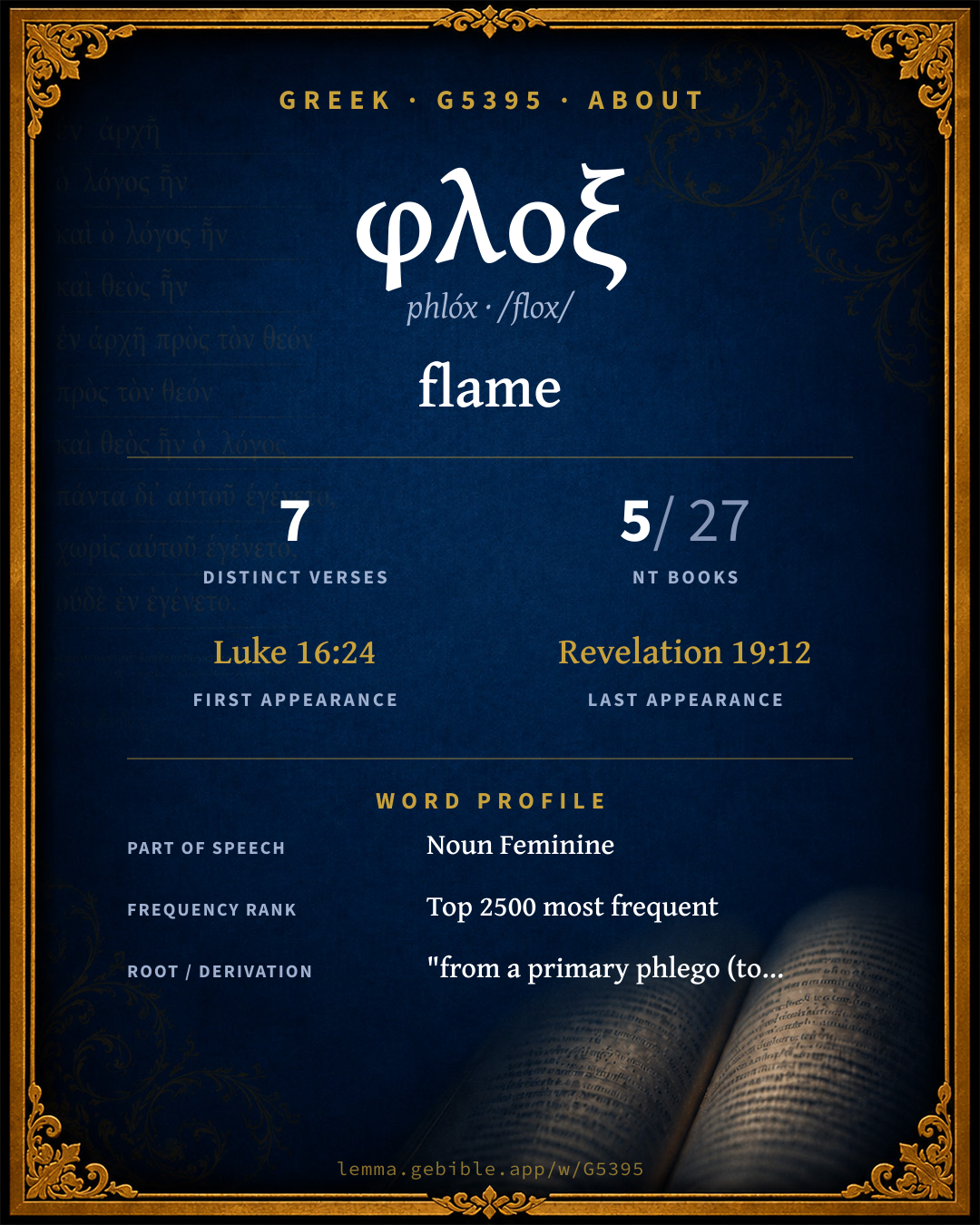
φλόξ
flame
Full lexicon entry — Thayer's Greek Lexicon
From Thayer's Greek Lexicon
Where this word appears
See every Nominative-case word in the Greek New Testament →
Grammar key — what these labels mean
Part of speech
- Noun
- A naming word — a person, place, thing, or idea.
Case
- Nominative
- The case of the subject (and the predicate nominative).
- Dative
- The case of the indirect object, means, or location — “to / for / with / in.”
- Accusative
- The case of the direct object and of extent.
- Genitive
- The case of source, possession, or “of” — answers “whose / from what.”
Gender
- Feminine
- Grammatically feminine.
Number
- Singular
- One.
Grammatical forms
- Noun, Nominative, Singular, Feminine 3 times (43%)
- Noun, Dative, Singular, Feminine 2 times (29%)
- Noun, Accusative, Singular, Feminine 1 time (14%)
- Noun, Genitive, Singular, Feminine 1 time (14%)
Parsed forms decoded from the imported morphology (Robinson–Tischendorf, public domain), counted across 7 parsed occurrences — not distinct verses.
Every verse where G5395 appears — 7 distinct verses across 5 books. Click any verse to open its interlinear word-by-word view. Verse text shown in the World English Bible for context — . Each verse’s Greek form is shown with its reference; the English is not keyword-highlighted, since the data carries no word-level English alignment. Use “Compare translations” on any verse to read it across multiple English versions. This concordance covers the Greek New Testament; Septuagint (Greek Old Testament) occurrences of this word are not indexed here.
Luke 1 verse
Acts 1 verse
2 Thessalonians 1 verse
Hebrews 1 verse
Revelation 3 verses
- Revelation 1:14 φλὸξ n nom sg fem His head and his hair were white as white wool, like snow. His eyes were like a flame of fire.
- Revelation 2:18 φλὸξ n nom sg fem "To the angel of the assembly in Thyatira write: "The Son of God, who has his eyes like a flame of fire, and his feet are like burnished brass, says these things:
- Revelation 19:12 φλὸξ n nom sg fem His eyes are a flame of fire, and on his head are many crowns. He has names written and a name written which no one knows but he himself.
About this entry
At a glance — auto-summarized from this page’s data, not written by a person. Every figure links to its source below. This summary describes the numbers; it doesn’t interpret them.
The Greek noun φλοξ centers on the idea of “flame.” Its earliest occurrence is Luke 16:24. Spanning 7 verses in 5 books, it ranks among the uncommon words of the Greek New Testament. Revelation dominates its distribution — 3 of 7 verses. Related forms include φλογιζω, φρυγανον and Φλεγων. Dig into 7-verse concordance and the renderings breakdown below.
Gloss history
Strong's 1890 vs modern scholarship
About this word
Strong's G5395 catalogs a Greek word from the Greek New Testament.
These counts are not copied from any lexicon or concordance. They are computed here, from the morphology-tagged Greek New Testament. What Lemma adds →
- 7
- distinct verses
- The word appears in 7 distinct verses.
- 5 / 27
- NT books
- The word appears in 5 of 27 New Testament books.
- #1,358
- by frequency
- Top 2500 most frequent Greek words (rank 1,358 of 5,347 Greek words by occurrence).
View all 7 occurrences in the concordance →
Most concentrated in
- Revelation 3 verses 43%
- Luke 1 verse 14%
- Acts 1 verse 14%
By section of the New Testament
By traditional corpus
Conventional, traditional groupings — biblical authorship is debated, so this is a traditional corpus grouping, not an authorship claim. Some books belong to more than one corpus (Luke is in both the Gospels and the Lukan corpus, and so on), so these shares overlap and need not total 100%. Each figure is a share of the word’s 7 distinct verses.
- Johannine 3 verses · 43%
- Revelation 3 verses · 43%
- Lukan (Luke–Acts) 2 verses · 29%
- Gospels 1 verse · 14%
- Pauline corpus 1 verse · 14%
- Hebrews 1 verse · 14%
How translations render this word
Counts come from each version’s own published word-to-Strong’s tagging or interlinear alignment — an approximate guide to how each version renders this word, not a word-level alignment the data otherwise carries. Because each total is that version’s own tagged count, the per-version totals vary from one another and need not match the appearance or distinct-verse counts above. These counts may also differ from a printed concordance because Lemma counts each distinctly tagged rendering and does not collapse phrase taggings into a single head-word total. This is a fixed set of word-tagged versions (KJV, ASV, BSB, ULT) and does not change with the reading translation you choose elsewhere. Each version’s license is shown beside its name below (and on Sources).
- King James Version: Flame 6×
- American Standard Version: Flame 6×
- Berean Standard Bible: Blazing 4×, Flames 2×
- unfoldingWord Literal Text: Flame 4×
King James Version Public Domain
Renders G5395 across 7 tagged occurrences — most commonly:
Plus 1 rendering that appears only once — usually multi-word phrases or single function words the recovered tagging swept in, not distinct renderings.
American Standard Version Public Domain
Renders G5395 across 7 tagged occurrences — most commonly:
Plus 1 rendering that appears only once — usually multi-word phrases or single function words the recovered tagging swept in, not distinct renderings.
Berean Standard Bible Public Domain
Renders G5395 across 7 tagged occurrences — most commonly:
Plus 1 rendering that appears only once — usually multi-word phrases or single function words the recovered tagging swept in, not distinct renderings.
unfoldingWord Literal Text CC BY-SA 4.0
Renders G5395 across 7 tagged occurrences — most commonly:
Plus 3 renderings that appear only once — usually multi-word phrases or single function words the recovered tagging swept in, not distinct renderings.
Senses in Thayer's
The 1 sense Thayer's distinguishes for this word, in lexicon order (not ranked by frequency or importance). The full entry — with sub-senses — is in the Lexicon Entry tab.
- a flame
Word origin
Origin: "from a primary phlego (to "flash" or "flame")"
From a primary φλέγω phlegō (to flash or flame); a blaze : - flame (-ing).
— Strong’s Exhaustive Concordance (1890), public domain.
Forms in the corpus
The 4 distinct written forms G5395 takes in the Greek New Testament, most frequent first — each parse links to that case’s occurrences in the concordance.
| Form | Parsing | Example | Uses |
|---|---|---|---|
| φλὸξ phlòx | Noun, Nominative, Singular, Feminine | Revelation 1:14 | 3 |
| φλογὶ phlogì | Noun, Dative, Singular, Feminine | Luke 16:24 | 2 |
| φλογός phlogós | Noun, Genitive, Singular, Feminine | 2 Thessalonians 1:8 | 1 |
| φλόγα phlóga | Noun, Accusative, Singular, Feminine | Hebrews 1:7 | 1 |
Same root — word family
Other Thayer's entries built from the same root as G5395, grouped by Strong’s listed origin. These share a root / origin per the lexicon — not necessarily a shared meaning. Each links to that word’s own entry.
Derived from this word
Proper names from this root
People and places named from this root — a name, not an additional meaning of the word.
Compare all same-root words → 1 of the same-root words is a proper name (a person or place). They share a root, not necessarily a meaning.
Septuagint usage
The same Greek word φλοξ appears 37 times in the Greek Old Testament (Septuagint), across 34 verses in 15 books.
- 37
- LXX occurrences
- Tagged occurrences of this Greek word in the Septuagint.
- 34
- verses
- Distinct Septuagint verses containing this word.
- 15 / 39
- OT books
- The word appears in 15 of the 39 Old Testament books.
Sample Septuagint occurrences
- Genesis 15:17 φλόξ
- Exodus 3:2 φλόξ
- Numbers 21:28 φλόξ
- Judges 3:22 φλόξ
- Job 18:5 φλόξ
- Psalms 28:7 φλόξ
- Proverbs 24:22 φλόξ
- Song of Solomon 8:6 φλόξ
- Isaiah 5:24 φλόξ
- Lamentations 2:3 φλόξ
- Ezekiel 21:3 φλόξ
- Daniel 3:23 φλόξ
Septuagint occurrences (same lexeme)
Every verse where the same Strong’s number (G5395) appears in the Greek Septuagint. Verse text shown in the World English Bible for context; the Greek form is the matched word — the English is not keyword-highlighted.
- Genesis 15:17 φλόξ It came to pass that, when the sun went down, and it was dark, behold, a smoking furnace, and a flaming torch passed between these pieces.
- Genesis 19:28 φλόξ He looked toward Sodom and Gomorrah, and toward all the land of the plain, and looked, and saw that the smoke of the land went up as the smoke of a furnace.
- Exodus 3:2 φλόξ The angel of Yahweh appeared to him in a flame of fire out of the midst of a bush. He looked, and behold, the bush burned with fire, and the bush was not consumed.
- Numbers 21:28 φλόξ For a fire is gone out of Heshbon, A flame from the city of Sihon: It has devoured Ar of Moab, The lords of the high places of the Arnon.
- Judges 3:22 φλόξ and the haft also went in after the blade; and the fat closed on the blade, for he didn't draw the sword out of his body; and it came out behind.
- Judges 13:20 φλόξ For it happened, when the flame went up toward the sky from off the altar, that the angel of Yahweh ascended in the flame of the altar: and Manoah and his wife looked on; and they fell on their faces to the ground.
- Job 18:5 φλόξ "Yes, the light of the wicked shall be put out, The spark of his fire shall not shine.
- Job 41:13 φλόξ Who can strip off his outer garment? Who shall come within his jaws?
- Psalms 28:7 φλόξ Yahweh is my strength and my shield. My heart has trusted in him, and I am helped. Therefore my heart greatly rejoices. With my song I will thank him.
- Psalms 82:15 φλόξ
- Psalms 105:18 φλόξ They bruised his feet with shackles. His neck was locked in irons,
- Proverbs 24:22 φλόξ For their calamity will rise suddenly; The destruction from them both--who knows?
- Song of Solomon 8:6 φλόξ Set me as a seal on your heart, As a seal on your arm; For love is strong as death. Jealousy is as cruel as Sheol; Its flashes are flashes of fire, A very flame of Yahweh.
- Isaiah 5:24 φλόξ Therefore as the tongue of fire devours the stubble, And as the dry grass sinks down in the flame, So their root shall be as rottenness, And their blossom shall go up as dust; Because they have rejected the law of Yahweh of Hosts, And despised the word of the Holy One of Israel.
- Isaiah 10:18 φλόξ He will consume the glory of his forest, and of his fruitful field, both soul and body: and it shall be as when a standard-bearer faints.
- Isaiah 13:8 φλόξ and they shall be dismayed; pangs and sorrows shall take hold [of them]; they shall be in pain as a woman in travail: they shall look in amazement one at another; their faces [shall be] faces of flame.
- Isaiah 29:6 φλόξ She shall be visited of Yahweh of Hosts with thunder, and with earthquake, and great noise, with whirlwind and tempest, and the flame of a devouring fire.
- Isaiah 30:30 φλόξ Yahweh will cause his glorious voice to be heard, and will show the lighting down of his arm, with the indignation of [his] anger, and the flame of a devouring fire, with a blast, and tempest, and hailstones.
- Isaiah 43:2 φλόξ When you pass through the waters, I will be with you; and through the rivers, they shall not overflow you: when you walk through the fire, you shall not be burned, neither shall the flame kindle on you.
- Isaiah 47:14 φλόξ Behold, they shall be as stubble; the fire shall burn them; they shall not deliver themselves from the power of the flame: it shall not be a coal to warm at, nor a fire to sit before.
- Isaiah 50:11 φλόξ Behold, all you who kindle a fire, who gird yourselves about with firebrands; walk you in the flame of your fire, and among the brands that you have kindled. This shall you have of my hand; you shall lie down in sorrow.
- Isaiah 66:15 φλόξ For, behold, Yahweh will come with fire, and his chariots shall be like the whirlwind; to render his anger with fierceness, and his rebuke with flames of fire.
- Lamentations 2:3 φλόξ He has cut off in fierce anger all the horn of Israel; He has drawn back his right hand from before the enemy: He has burned up Jacob like a flaming fire, which devours round about.
- Ezekiel 21:3 φλόξ and tell the land of Israel, Thus says Yahweh: Behold, I am against you, and will draw forth my sword out of its sheath, and will cut off from you the righteous and the wicked.
- Daniel 3:23 φλόξ These three men, Shadrach, Meshach, and Abednego, fell down bound into the midst of the burning fiery furnace.
- Daniel 3:47 φλόξ
- Daniel 3:49 φλόξ
- Daniel 3:88 φλόξ
- Daniel 7:9 φλόξ I saw until thrones were placed, and one who was ancient of days sat: his clothing was white as snow, and the hair of his head like pure wool; his throne was fiery flames, [and] the wheels of it burning fire.
- Hosea 7:4 φλόξ They are all adulterers. They are burning like an oven that the baker stops stirring, From the kneading of the dough, until it is leavened.
- Joel 1:19 φλόξ Yahweh, I cry to you, For the fire has devoured the pastures of the wilderness, And the flame has burned all the trees of the field.
- Joel 2:3 φλόξ A fire devours before them, And behind them, a flame burns. The land is as the garden of Eden before them, And behind them, a desolate wilderness. Yes, and no one has escaped them.
- Joel 2:5 φλόξ Like the noise of chariots on the tops of the mountains do they leap, Like the noise of a flame of fire that devours the stubble, As a strong people set in battle array.
- Obadiah 1:18 φλόξ The house of Jacob will be a fire, the house of Joseph a flame, and the house of Esau for stubble. They will burn among them, and devour them. There will not be any remaining to the house of Esau." Indeed, Yahweh has spoken.
These are occurrences of the same Greek lexeme (G5395) in the Septuagint — not a translation of any one Hebrew word. The store carries no word-level Hebrew↔Greek alignment, so no Hebrew original is asserted here. Counts come from the recovered LXX Strong's tagging — high-frequency vocabulary is well covered, while rare or late forms may be untagged — so they reflect tagged occurrences and may slightly undercount.