
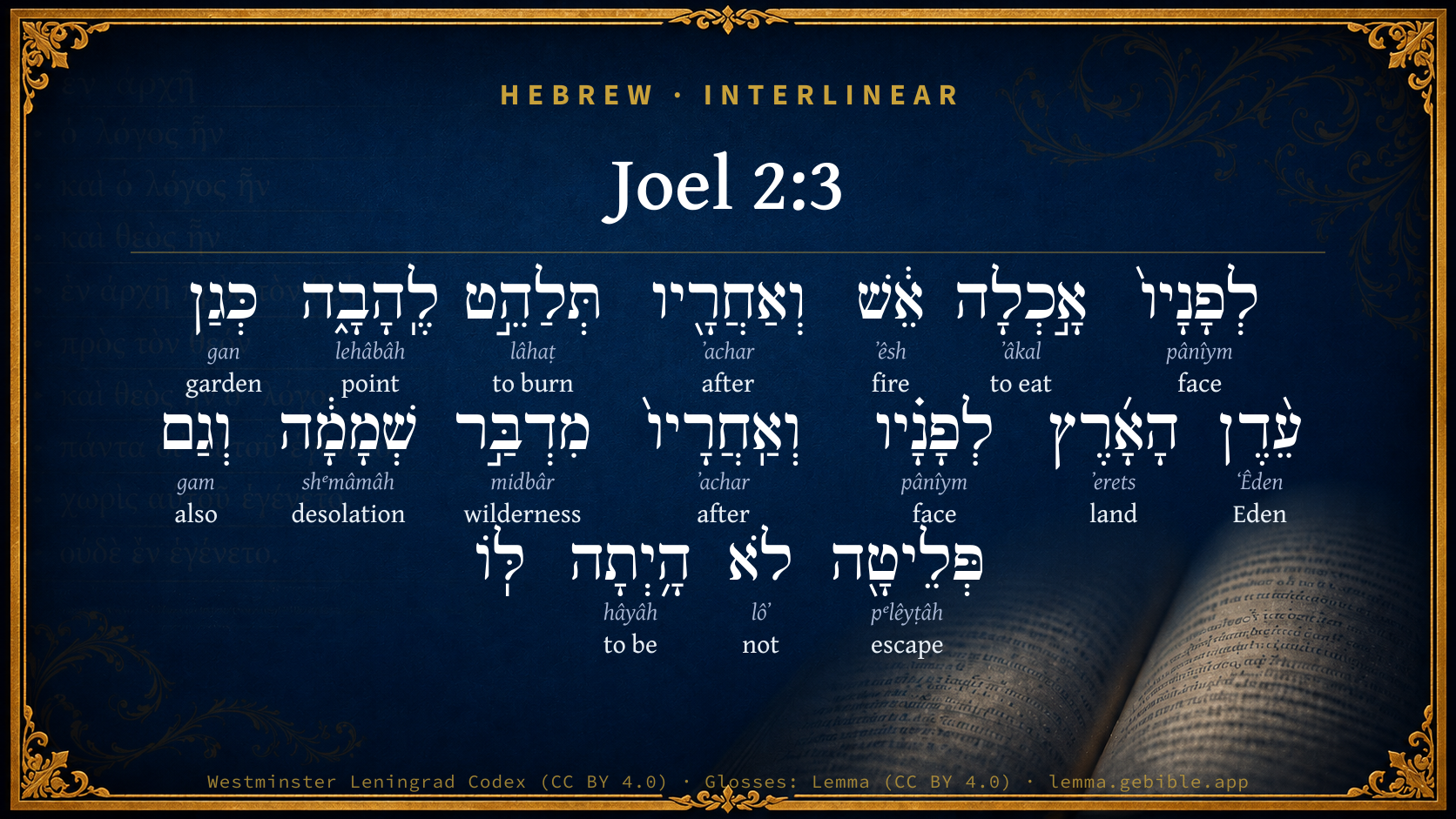
Joel 2:3

Hebrew (Westminster Leningrad Codex) Joel 2:3 appears in the Hebrew Old Testament. The text above is from the Westminster Leningrad Codex. Each word links to its Strong’s number, a concise gloss, and parsing drawn from the Open Scriptures Hebrew Bible morphology. Click any word for its full Brown-Driver-Briggs (BDB) entry.
Download image
Cite this verse

Joel 2:3 (World English Bible). Public Domain. Lemma interlinear Bible study tool, https://lemma.gebible.app/v/joel/2/3.

Show BibTeX & RIS
BibTeX
RIS
English Translation
A fire devours before them, And behind them, a flame burns. The land is as the garden of Eden before them, And behind them, a desolate wilderness. Yes, and no one has escaped them.
World English Bible · Public Domain
Download a study sheet

One document with this verse’s original text, its word-by-word gloss line, the meaning frame, cross-references with their text, attributed commentary, and full source and license credits — printable, and it pastes into notes with its structure intact.

This verse Autodidact and up

Study sheet (.html) Plain text (.txt)

A passage Seminary Student

Up to 50 verses in one chapter. A passage sheet keeps up to 6 commentary sources and 12 cross-references per verse, in the order this page ranks them, and says so on the sheet whenever that leaves anything out. Ask for a single verse and you get the Autodidact verse sheet above.

Everything on this page stays free to read, with no account — the sheet is a download of what is already on screen, not access to it.

Want to remove ads? Support Godless Engineer
Compare translations 3

The same verse in 3 English versions, stacked beneath the original-language interlinear above. Click any original word for its lexicon entry.

Each is an independent rendering of the whole verse — the interlinear is not word-aligned to these translations.

Highlighted words mark where these versions differ — a whole-verse word diff, not a word-by-word alignment.

  • World English Bible Public Domain
    A fire devours before them, And behind them, a flame burns. The land is as the garden of Eden before them, And behind them, a desolate wilderness. Yes, and no one has escaped them.
  • King James Version Public Domain
    A fire devoureth before them; and behind them a flame burneth: the land is as the garden of Eden before them, and behind them a desolate wilderness; yea, and nothing shall escape them.
  • unfoldingWord Literal Text CC BY-SA 4.0
    A fire is devouring to its face, and behind it a flame is burning. To its face the land is like the garden of Eden, but behind it a wilderness of desolation, and indeed, is no escape from it.

unfoldingWord Literal Text — © unfoldingWord, licensed CC BY-SA 4.0. Word-aligned USFM3 via Door43 (git.door43.org/unfoldingWord/en_ult).

Versions to compare (up to 4)

3 of 4 selected

Show all 18 translations

Every available English version of this verse, each an independent rendering of the whole verse.

  • World English Bible Public Domain
    A fire devours before them, And behind them, a flame burns. The land is as the garden of Eden before them, And behind them, a desolate wilderness. Yes, and no one has escaped them.
  • Berean Standard Bible Public Domain
    Before them a fire devours, and behind them a flame scorches. The land before them is like the Garden of Eden, but behind them, it is like a desert wasteland—surely nothing will escape them.
  • Majority Standard Bible Public Domain
    Before them a fire devours, and behind them a flame scorches. The land before them is like the Garden of Eden, but behind them, it is like a desert wasteland—surely nothing will escape them.
  • King James Version Public Domain
    A fire devoureth before them; and behind them a flame burneth: the land is as the garden of Eden before them, and behind them a desolate wilderness; yea, and nothing shall escape them.
  • American Standard Version (1901) Public Domain
    A fire devoureth before them; and behind them a flame burneth: the land is as the garden of Eden before them, and behind them a desolate wilderness; yea, and none hath escaped them.
  • Revised Version (1885) Public Domain
    A fire devoureth before them; and behind them a flame burneth: the land is as the garden of Eden before them, and behind them a desolate wilderness; yea, and none hath escaped them.
  • Geneva Bible (1599) Public Domain
    A fire deuoureth before him, and behinde him a flame burneth vp: the land is as the garden of Eden before him, and behinde him a desolate wildernesse, so that nothing shall escape him.
  • Douay-Rheims (1899) Public Domain
    Before the face thereof a devouring fire, and behind it a burning flame: the land is like a garden of pleasure before it, and behind it a desolate wilderness, neither is there any one that can escape it.
  • Young's Literal Translation Public Domain
    Before it consumed hath fire, And after it burn doth a flame, As the garden of Eden `is' the land before it, And after it a wilderness -- a desolation! And also an escape there hath not been to it,
  • Literal Standard Version CC BY-SA 4.0
    Before it fire has consumed, || And after it a flame burns, || As the Garden of Eden [is] the land before it, || And after it a wilderness—a desolation! And also there has not been to it an escape,
  • Unlocked Literal Bible CC BY-SA 4.0
    A fire is consuming everything in front of it, and behind it a flame is burning. The land is like the garden of Eden in front of it, but behind it there is a ruined wilderness. Indeed, nothing will escape from it.
  • unfoldingWord Literal Text CC BY-SA 4.0
    A fire is devouring to its face, and behind it a flame is burning. To its face the land is like the garden of Eden, but behind it a wilderness of desolation, and indeed, is no escape from it.
  • Darby Bible Public Domain
    A fire devoureth before them, and behind them a flame burneth; the land is as a garden of Eden before them, and behind them a desolate wilderness: yea, and nothing escapeth them.
  • World Messianic Bible Public Domain
    A fire devours before them, and behind them, a flame burns. The land is as the garden of Eden before them, and behind them, a desolate wilderness. Yes, and no one has escaped them.
  • Webster's Bible Public Domain
    A fire devoureth before them; and behind them a flame burneth: the land is as the garden of Eden before them, and behind them a desolate wilderness; and nothing shall escape them.
  • Free Bible Version CC BY-SA 4.0
    Fire blazes in front of them, behind them flames are burning. In front of them the land looks like the Garden of Eden, behind them is a desert of total desolation: not a single survivor remains.
  • Bible in Basic English Public Domain
    Before them fire sends destruction, and after them flame is burning: the land is like the garden of Eden before them, and after them an unpeopled waste; truly, nothing has been kept safe from them.
  • JPS Tanakh (1917) Public Domain
    A fire devoureth before them, and behind them a flame blazeth; the land is as the garden of Eden before them, and behind them a desolate wilderness; yea, and nothing escapeth them.

Literal Standard Version (2020), Covenant Press — licensed CC BY-SA 4.0. Text via the HelloAO Bible API (eBible.org). Unlocked Literal Bible (unfoldingWord) — licensed CC BY-SA 4.0. Text via the HelloAO Bible API (eBible.org). unfoldingWord Literal Text — © unfoldingWord, licensed CC BY-SA 4.0. Word-aligned USFM3 via Door43 (git.door43.org/unfoldingWord/en_ult). Free Bible Version, Dr. Jonathan Gallagher — licensed CC BY-SA 4.0. Text via the HelloAO Bible API (eBible.org).

Word by word

More ways to search: Search by grammar → Find every occurrence → Compare this word →

Practice this passage: Drill this verse → Learn its vocabulary →

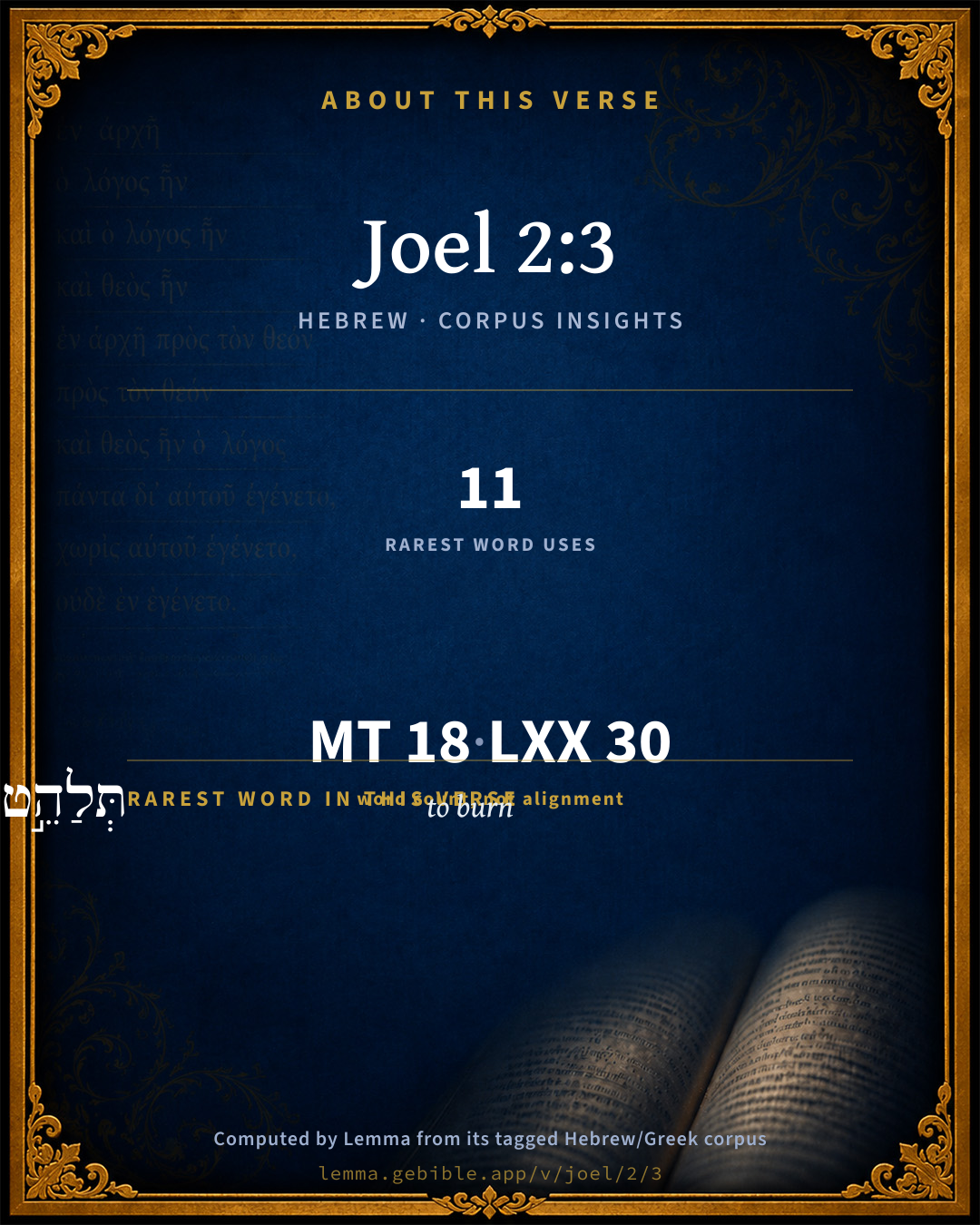
תְּלַהֵ֣ט
lâhaṭ
H3857
“to burn”
Verb, Piel, Imperfect, 3rd Person, Feminine, Singular
Part of Speech
Verb
Stem
Piel
Form
Imperfect
Person
3rd Person
Gender
Feminine
Number
Singular
Full BDB Definition

Origin: a primitive root

TWOT: 1081

to burn, blaze, scorch, kindle, blaze up, flame - (Qal) blazing (participle) - (Piel) to scorch, burn, blaze
  1. לְפָנָיו֙ pânîym H6440 “to/for · face(s) · his” Preposition + Noun, Common, Both, Plural, Construct + Suffix, Personal, 3rd Person, Masculine, Singular
  2. אָ֣כְלָה ʼâkal H398 “to eat” Verb, Qal, Perfect, 3rd Person, Feminine, Singular
  3. אֵ֔שׁ ʼêsh H784 “fire” Noun, Common, Both, Singular, Absolute
  4. וְאַחֲרָ֖יו ʼachar H310 “and · after · him” Conjunction + Preposition + Suffix, Personal, 3rd Person, Masculine, Singular
  5. לֶֽהָבָ֑ה lehâbâh H3852 “point” Noun, Common, Feminine, Singular, Absolute
  6. כְּגַן gan H1588 “like/as · garden of” Preposition + Noun, Common, Both, Singular, Construct
  7. עֵ֨דֶן ʻÊden H5731 “Eden” Noun, Proper
  8. הָאָ֜רֶץ ʼerets H776 “the · land” Particle, Definite Article + Noun, Common, Both, Singular, Absolute
  9. לְפָנָ֗יו pânîym H6440 “to/for · face(s) · his” Preposition + Noun, Common, Both, Plural, Construct + Suffix, Personal, 3rd Person, Masculine, Singular
  10. וְאַֽחֲרָיו֙ ʼachar H310 “and · after · him” Conjunction + Preposition + Suffix, Personal, 3rd Person, Masculine, Singular
  11. מִדְבַּ֣ר midbâr H4057 “wilderness of” Noun, Common, Masculine, Singular, Construct
  12. שְׁמָמָ֔ה shᵉmâmâh H8077 “desolation” Noun, Common, Feminine, Singular, Absolute
  13. וְגַם gam H1571 “and · also” Conjunction + Particle, Accusative
  14. פְּלֵיטָ֖ה pᵉlêyṭâh H6413 “escape” Noun, Common, Feminine, Singular, Absolute
  15. לֹא lôʼ H3808 “not” Particle, Negative
  16. הָ֥יְתָה hâyâh H1961 “to be” Verb, Qal, Perfect, 3rd Person, Feminine, Singular

About this verse

These counts appear in no published source. They are computed here, from the morphology-tagged text and Lemma’s own curated glosses. What Lemma adds →

18
words
15
distinct lemmas
Prophets
section

Notable vocabulary

The rarest word here is תְּלַהֵ֣ט to burn H3857 — appearing just 11 times in the whole Hebrew Bible.

Shared distinctive vocabulary

תְּלַהֵ֣ט to burn H3857 occurs in 11 verses of the Hebrew Bible. Also found in:

Grammatical profile

  • 3 verbs
  • 10 nouns
  • 3 prepositions
  • 2 particles

Verb forms

  • אָ֣כְלָה Qal · Perfect
  • תְּלַהֵ֣ט Piel · Imperfect
  • הָ֥יְתָה Qal · Perfect

Repetition

Words recur within this verse — often emphatic in Hebrew:

  • לְפָנָיו֙ face H6440 ×2
  • וְאַחֲרָ֖יו after H310 ×2

Hebrew & Septuagint length

In English translation the verse runs 34 words from the Hebrew and 36 from the Septuagint (LXX English) — closely comparable.

A rough comparison of the two English renderings, which tokenize alike — not a word-level alignment.

Word counts can differ between the Hebrew and the Greek without any difference in meaning — e.g. the Hebrew direct-object marker אֵת has no separate Greek word, and Greek often adds the article ὁ.

In the original languages it is 18 Hebrew tokens and 30 Greek tokens — but the two are counted differently (Hebrew bundles its prefixes and suffixes into one token; the Greek is in lemma form), so that isn’t a like-for-like length.

Cross-references

13

Topical passages linked to Joel 2:3 in the Treasury of Scripture Knowledge — connected by theme and wording, ordered by reader-vote popularity; previews shown in the World English Bible.

  • Isaiah 51:3 For Yahweh has comforted Zion; he has comforted all her waste places, and has made her wilderness like Eden, and her desert like the garden of Yahweh; joy and gladness shall be found therein, thanksgiving, and the voice of melody.
  • Genesis 2:8 Yahweh God planted a garden eastward, in Eden, and there he put the man whom he had formed.
  • Joel 1:19–20 Yahweh, I cry to you, For the fire has devoured the pastures of the wilderness, And the flame has burned all the trees of the field.
  • Zechariah 7:14 "but I will scatter them with a whirlwind among all the nations which they have not known. Thus the land was desolate after them, so that no man passed through nor returned: for they made the pleasant land desolate."
  • Psalms 50:3 Our God comes, and does not keep silent. A fire devours before him. It is very tempestuous around him.
  • Amos 7:4 Thus the Lord Yahweh showed me and, behold, the Lord Yahweh called for judgment by fire; and it dried up the great deep, and would have devoured the land.
  • Genesis 13:10 Lot lifted up his eyes, and saw all the plain of the Jordan, that it was well watered every where, before Yahweh destroyed Sodom and Gomorrah, like the garden of Yahweh, like the land of Egypt, as you go to Zoar.
  • Exodus 10:5 and they shall cover the surface of the earth, so that one won't be able to see the earth. They shall eat the residue of that which has escaped, which remains to you from the hail, and shall eat every tree which grows for you out of the field.
  • Exodus 10:15 For they covered the surface of the whole earth, so that the land was darkened, and they ate every herb of the land, and all the fruit of the trees which the hail had left. There remained nothing green, either tree or herb of the field, through all the land of Egypt.
  • Psalms 105:34–35 He spoke, and the locusts came, And the grasshoppers, without number,
  • Jeremiah 5:17 They shall eat up your harvest, and your bread, [which] your sons and your daughters should eat; they shall eat up your flocks and your herds; they shall eat up your vines and your fig trees; they shall beat down your fortified cities, in which you trust, with the sword.
  • Ezekiel 31:8–9 The cedars in the garden of God could not hide it; the fir trees were not like its boughs, and the plane trees were not as its branches; nor was any tree in the garden of God like it in its beauty.
  • Joel 1:4–7 What the swarming locust has left, the great locust has eaten. What the great locust has left, the grasshopper has eaten. What the grasshopper has left, the caterpillar has eaten.

Cross-references courtesy of OpenBible.info (CC BY 4.0).

Hebrew and Greek witnesses Masoretic Hebrew ↔ Greek Septuagint

The same verse in the two great witnesses to the Old Testament, shown verse-for-verse.

These are two independent witnesses, not word-aligned to each other, and the Septuagint is shown in lemma (dictionary) form.

Hebrew Joel 2:3 Masoretic · Westminster Leningrad Codex

לְפָנָיו֙ אָ֣כְלָה אֵ֔שׁ וְאַחֲרָ֖יו תְּלַהֵ֣ט לֶֽהָבָ֑ה כְּגַן עֵ֨דֶן הָאָ֜רֶץ לְפָנָ֗יו וְאַֽחֲרָיו֙ מִדְבַּ֣ר שְׁמָמָ֔ה וְגַם פְּלֵיטָ֖ה לֹא הָ֥יְתָה לּֽוֹ

A fire devours before them, And behind them, a flame burns. The land is as the garden of Eden before them, And behind them, a desolate wilderness. Yes, and no one has escaped them.

World English Bible · Public Domain

Greek LXX Joel 2:3 Septuagint · lemma form

ὁ ἔμπροσθεν αὐτός πῦρ ἀναἁλίσκω καί ὁ ὀπίσω αὐτός ἀναἅπτω φλόξ ὡς παράδεισος τρυφή ὁ γῆ πρό πρόσωπον αὐτός καί ὁ ὄπισθεν αὐτός πεδίον ἀφανισμός καί ἀνασώζω οὐ εἰμί αὐτός

Before them is a consuming fire, and behind them is a flame kindled: the land before them is as a paradise of delight, and behind them a desolate plain: and there shall none of them escape.

LXX2012 (modern English Septuagint) · Public Domain

On this verse, The Cambridge Bible for Schools and Colleges discusses the Septuagint’s reading. Read the note in Commentary ↓

Hebrew: Westminster Leningrad Codex (CC BY 4.0). Greek: Septuagint (public domain); English from LXX2012 (modern English Septuagint) (Public Domain). How the Septuagint differs from the Hebrew →

Targum (Aramaic paraphrase)

1

The Targum is the ancient Jewish Aramaic paraphrase of the Hebrew Scriptures — an interpretive translation, not the Hebrew text itself. Onkelos (literal) and Pseudo-Jonathan (expansive) render the Torah, and Jonathan the Prophets. Coverage is partial: where no permissively-licensed English translation exists for a verse, only the Aramaic is shown. This is verse-level text, not a word-by-word alignment to the Hebrew.

  1. Targum Jonathan Prophets (Joshua–Malachi)
    קֳדָמוֹהִי אֶכְלָא אֶשְׁתָּא וּבַתְרוֹהִי מְשֵׁיצִיָא שַׁלְהוֹבִיתָא כְּגַנָא דְעֵדֶן אַרְעָא קָדָמוֹהִי וּבַתְרוֹהִי מִדְבָּר צָדוּ וְאַף שֵׁיזְבָא לֵית לֵיהּ לְרַשִׁיעַיָא:

    (no public-domain English translation for this verse)

    Targum Jonathan — Aramaic: “Mikraot Gedolot” (public domain). English: “Sefaria Community Translation” (CC0 1.0 (public-domain dedication)); “London "Chaldee Paraphrase," 1871” (public domain). Text via Sefaria.

Commentary

Notes on Joel 2:3 from classic Christian and Jewish commentators (each source and its license shown beneath its notes). The classic Christian expositions comment on the surrounding passage and are grouped to its opening verse, so a note may address several verses; the Jewish commentaries on the Tanakh (Rashi and others) are per-verse, so they appear only where the commentator wrote on this verse.

Lemma curates 59 commentaries, every one of them public domain or Creative Commons licensed, each selected and text-cleaned for this edition rather than reprinted as found. About our sources →

Trapp's Complete Commentary

John Trapp

Joe 2:3 A fire devoureth before them; and behind them a flame burneth: the land [is] as the garden of Eden before them, and behind them a desolate wilderness; yea, and nothing shall escape them.

Ver. 3. A fire devoureth before them, and behind them a flame burneth] Such waste these vermin shall make, like as it is said of the Great Turk, that wherever he sets his foot there never grows grass again; he doth so eat up the countries where he comes with his huge armies. And the late Lord Brook, in his discourse of episcopacy, notes, that that unhappy proverb among us was not for nought, The bishop’s foot hath trodden here. In Biscay, a province of Spain, they admit no bishops to come among them; and when Ferdinand, the Catholic king, came in progress hither, accompanied among others by the Bishop of Pampelune, the people arose in arms, drove back the bishop, and gathering all the dust on the which they thought he had trodden, flung it into the sea. What fires they kindled here in Queen Mary’s days, devouring six or seven hundred, at least, of God’s faithful witnesses in five years’ time; and what work they made in our remembrance throughout the three kingdoms, to the embroiling of all and their own utter ruin, I need not relate. That renowned author cited before had told them time enough, but that they were destined to destruction, that if they forbear to touch the supreme authority of the land, which they affected, it was but as once Mercury spared Jupiter’s thunderbolts, which he dared not steal, lest they should roar too loud, or, at least, burn his fingers.

The land is as the garden of Eden] i.e. of all kind of pleasures and delights. See Gen 2:8; Gen 13:10. Eden inde ηδονη. Strabo speaks spitefully of the land of Canaan, as if it were a dry, stony, and barren country, not worth the seeking after, Rabshakeh shows more ingenuity than this, Strabus et pravus Strabo (as one therefore calleth him), 2Ki 18:32. Tacitus commends it for a fertile soil, so doth Pliny; but above all, the holy Scripture setteth it forth to be Sumen totius orbis, the bread basket of the whole world, a land flowing with milk and honey, &c., Exo 3:17 Deu 32:13.

And behind them a desolate wilderness] Not such a wilderness as yielded pastures, and habitations for shepherds, Joe 1:19-20, but utterly desolate, and therefore unhabitable, as under the torrid zone. No place can be so pleasant but sin can lay it waste. "A fruitful land turneth the Lord into barrenness for the wickedness of them that dwell therein," Psa 107:34. There is no footstep left to this day of that gallant garden, planted by God himself; or if any, cecidit rosa, est spina; the place remains in the upper part of Chaldea, but not the pleasantness of the place. The like we may say of Sodom, of Jerusalem, of Greece, of Asia the less, of Germany, Ireland, &c. England hath hitherto subsisted merely by a miracle of God’s mercy, and by a prop of his extraordinary patience. The Lord continue it to the glory of his name and the good of his poor people. Fiat, fiat.

John Trapp, A Commentary or Exposition upon All the Books of the Old and New Testament (1647–1656) — public domain. Text from a community e-Sword module.

Joseph Benson's Commentary

Joe 2:3. A fire devoureth before them, &c. — They consume like a general conflagration. “They destroy the ground,” says Sir Hans Sloane, (Natural History of Jamaica, 1:29,) “not only for the time, but burn trees for two years after.” “Wheresoever they feed, says Ludolphus, (History of Ethiopia, lib. 1. c. 13,) “their leavings seem, as it were, parched with fire.” Pliny bears the same testimony, 11:29, Multa contactu adurentes, “Burning things up by the touch.” The land is as the garden of Eden before them, &c. — The land of Judea, so famous for its fertility and pleasantness, shall be turned into a desolate wilderness by the ravages they will make. The garden of Eden is a proverbial expression for a place of pleasure and fruitfulness, in which sense we commonly use the word paradise. And nothing shall escape them — Namely, which the ground produces. “After devouring the herbage,” says Adanson, as above, “with the fruits and the leaves of the trees, they attacked even the buds and very bark. They did not so much as spare the reeds with which the huts were thatched.” Thus also Ludolphus: “Sometimes they enter the very bark of trees, and then the spring itself cannot repair the damage.” “Omnia morsu erodentes, et fores quoque tectorum,” says Pliny, 11:20. “Consuming all things, even the doors of the houses.” In the Philosophical Transactions, No. 112, A.D. 1686, we have an account of the locusts in Languedoc, being about an inch in length, of a gray colour. “The earth,” it is observed, “in some places, was covered four inches thick with them, in the morning, before the heat of the sun was considerable; but as soon as it began to grow hot they took wing, and fell upon the corn, eating up both leaf and ear; and that with such expedition, by reason of their number, that in three hours they would devour a whole field, after which they again took wing, and their swarms were so thick, that they covered the sun like a cloud, and were whole hours in passing. After having eaten up the corn, they fell upon the vines, the pulse, the willows, and even the hemp, notwithstanding its great bitterness; after this these insects died, and stunk very much.”

Joseph Benson's Commentary on the Old and New Testaments (1811–1818) — public domain. Text from a community e-Sword module.

Tyndale Open Study Notes

Tyndale Open Resources

2:3 The destruction wrought by the invading army would be like a raging wildfire. Before the attack, the land looked like the Garden of Eden, but afterwards, it would be nothing but desolation (a reversal of Isa 51:3 and Ezek 36:35).

Tyndale Open Study Notes — © Tyndale Open Resources, licensed CC BY-SA 4.0. Text via the HelloAO Bible API.

Geneva Bible (1599)

Geneva Bible translators

The enemy destroyed our plentiful country, wheresoever he cometh.

Geneva Bible (1599) marginal notes — public domain. Text via Bolls.life.

Jamieson, Fausset & Brown

Robert Jamieson, A. R. Fausset & David Brown

before . . . behind--that is, on every side (Ch1 19:10).

fire . . . flame--destruction . . . desolation (Isa 10:17).

as . . . Eden . . . wilderness--conversely (Isa 51:3; Eze 36:35).

Jamieson, Fausset & Brown — Commentary Critical and Explanatory on the Whole Bible (1871) — public domain (CC PDM 1.0). Text via the HelloAO Bible API.

Adam Clarke's Commentary

Verse 3. A fire devoureth before them] They consume like a general conflagration. "They destroy the ground, not only for the time, but burn trees for two years after." Sir Hans Sloane, Nat. Hist. of Jamaica, vol. i., p. 29.

Behind them a flame burneth] "Wherever they feed," says Ludolf, in his History of Ethiopia, "their leavings seem as if parched with fire."

Nothing shall escape them.] "After devouring the herbage," says Adanson, "with the fruits and leaves of trees, they attacked even the buds and the very bark; they did not so much as spare the reeds with which the huts were thatched."

Adam Clarke's Commentary on the Bible (1810–1826) — public domain. Text from a community e-Sword/MySword module.

John Calvin's Commentaries

Before them, he says, the fire will devour, and after them the flame will burn. He means that the vengeance of God would be such as would consume the whole people: for God has in various ways begun to chastise the people, but, as we have seen, without any advantage. The Prophet then says here that the last stroke remained, and that the Lord would wholly destroy men so refractory, and whom he could not hitherto restore to a sound mind by moderate punishments. For he had in a measure spared them, though he had treated them sharply and severely, and given them time to repent. Hence, when the Prophet saw that they were wholly irreclaimable, he says, that it now only remained that the Lord should at once utterly consume them.

He adds, As the garden of Eden the land is before them, and after them it is the land of solitude; and so (and also) there will be no escape from them. Here the Prophet warns the Jews, that though they inhabited a most pleasant country and one especially fruitful, there was no reason for them to flatter themselves, for God could convert the fairest lands into a waste. He therefore compares Judea to the garden of Eden or to Paradise. But such also was the state of Sodom, as Moses shows. What did it avail the Sodomites that they dwelt as in Paradise, that they inhabited a rich and fertile land, and thought themselves to be nourished as in the bosom of God? So also now the Prophet says, “Though the land is like Paradise, yet when the enemy shall march through it, a universal waste shall follow, a scattering shall everywhere follow, there shall be no cultivation, no pleasantness, no appearance of inhabited land, for the enemy will destroy every thing ” His purpose was to prevent the Jews, by confiding in God’s blessing, which they had hitherto experienced, from heedlessly disregarding in future his vengeance; for his wrath would in a moment consume and devour whatever fruitfulness the land had hitherto possessed. This is the meaning. He therefore concludes that there would be no escape from these enemies, the Assyrians, because they would come armed with a command to reduce to nothing the whole land.

John Calvin's Commentaries (1540-1563) — public domain. Text from the Calvin Translation Society English edition (1840s-50s) via the Christian Classics Ethereal Library (ccel.org). Calvin's coverage is partial (roughly two-thirds of the Bible); uncommented books and verses are honest gaps, never fabricated. The 19th-century editor's footnotes and remarks are omitted so the notes are faithfully Calvin's own voice.

Ellicott's Commentary for English Readers

(3) Before them . . . behind them.—As with the locusts, so with the invading hosts of enemies: the country is found a paradise, and left a desert.

A Bible Commentary for English Readers, edited by Charles John Ellicott (1878–1897) — public domain. Text from a community e-Sword module.

The Cambridge Bible for Schools and Colleges

gen. ed. J. J. S. Perowne

3. A fire devoureth before them, &c.] A hyperbolical description of the destructive march of a swarm of locusts: the country which they have passed over is left as bare as if it had been wasted by fire; and the prophet accordingly imagines poetically a fire as preceding and following them on their course. Many travellers have used the same comparison: one says, for instance, “Wherever they come, the ground seems burned, as it were with fire.” Another, “They covered a square mile so completely, that it appeared, at a little distance, to have been burned and strewed over with brown ashes.” And a third, “Wherever they settled, it looked as if fire had devoured and burnt up everything.” Palestine was invaded by locusts in 1865; from June 13 to 15 they poured into Nazareth: “the trees,” an eye-witness wrote, “are as barren as in England in winter, but it looks as if the country had been burnt by fire” (Eccles. Gazette, 1865, p. 55).

as the garden of Eden] like a park (LXX. here, as in Gen., παράδεισος), richly watered, and well stocked with majestic trees (Gen_2:8-10): the comparison, as Eze_36:35 (of the restored land of Israel) “this land that was desolate is become like the garden of Eden”: similarly the garden of Jehovah, Gen_13:10, Isa_51:3 (in the parallel clause, Eden); cp. also the trees of Eden, Eze_31:9; Eze_31:16; Eze_31:18.

and behind them a desolate wilderness] The destruction wrought by locusts is such as to be hardly imaginable by those who have not witnessed it: see the next note; and cf. Exo_10:15.

shall escape them] escapeth them. Present tenses, in English, represent the scene, as pictured by Joel, most vividly; and are best throughout to Joe_2:11 (cf. R.V.). The fact noted by the prophet is literally true, as almost every observer testifies. “On whatever spot they fall, the whole vegetable produce disappears. Nothing escapes them, from the leaves on the forest to the herbs on the plain” (Clarke, Travels, I. 428 f.). “They had [for a space of 80–90 miles in length] devoured every green herb, and every herb of grass.” “Not a shrub nor blade of grass was visible” (Barrow, S. Africa, pp. 242, 257).

The Cambridge Bible for Schools and Colleges (gen. ed. J. J. S. Perowne; Cambridge University Press, 1878–1918) — public domain. Text from a community e-Sword module.

John Gill's Exposition

A fire devoureth before them, and behind them aflame burneth,.... This is not to be understood of the heat of the sun, or of the great drought that went before and continued after the locusts; but of them themselves, which were like a consuming fire; wherever they came, they devoured all green grass, herbs, and leaves of trees, as fire does stubble; they sucked out the juice and moisture of everything they came at, and what they left behind shrivelled up and withered away, as if it had been scorched with a flame of fire: and so the Assyrians and Chaldeans, they were an emblem of, destroyed all they met with, by fire and sword; cut up the corn and herbage for forage; and what they could not dispense with they set fire to, and left it burning. Sanctius thinks this refers to fire, which the Chaldeans worshipped as God, and carried before their armies as a sacred and military sign; but this seems not likely:

the land is as the garden of Eden before them; abounding with fields and vineyards, set with fruitful trees, planted with all manner of pleasant plants, and all kind of corn growing upon it, and even resembling a paradise:

and behind them a desolate wilderness; all green grass eaten up, the corn of the field devoured, the vines and olives destroyed, the leaves and fruit of them quite gone, and the trees themselves barked; so that there was just the same difference between this country before the calamities described came upon it, and what it was after, as between the garden of Eden, or a paradise, and the most desolate wilderness; such ravages were made by the locusts, and by those they resembled:

yea, and nothing shall escape them; no herb: plant, or tree, could escape the locusts; nor any city, town, or village, nor scarce any particular person, could escape the Chaldean army; but was either killed with the sword, or carried captive, or brought into subjection. The Targum interprets it of no deliverance to the ungodly.

John Gill's Exposition of the Whole Bible (1746–1763) — public domain (CC PDM 1.0). Text via the HelloAO Bible API.

Albert Barnes' Notes on the Bible

A fire devoureth before them ... - Travelers, of different nations and characters, and in different lands, some unacquainted with the Bible words, have agreed to describe under this image the ravages of locusts. : “They scorch many things with their touch.” : “Whatever of herb or leaf they gnaw, is, as it were, scorched by fire.” : “Wherever they come, the ground seems burned, as it were with fire.” : “Wherever they pass, they burn and spoil everything, and that irremediably.” : “I have myself observed that the places where they had browsed were as scorched, as if the fire had passed there.” : “They covered a square mile so completely, that it appeared, at a little distance, to have been burned and strewn over with brown ashes. Not a shrub, nor a blade of grass was visible.” : “A few months afterward, a much larger army alighted and gave the whole country the appearance of having been burned.” “Wherever they settled, it looks as if fire had devoured and burnt up everything.” : “It is better to have to do with the Tartars, than with these little destructive animals; you would think that fire follows their track,” are the descriptions of their ravages in Italy, Aethiopia, the Levant, India, South Africa. The locust, itself the image of God’s judgments, is described as an enemy, invading, as they say, “with fire and sword,” “breathing fire,” wasting all, as he advances, and leaving behind him the blackness of ashes, and burning villages. : “Whatsoever he seizeth on, he shall consume as a devouring flame and shall leave nothing whole behind him.”

The land is as the garden of Eden before them - In outward beauty the land was like that Paradise of God, where He placed our first parents; as were Sodom and Gomorrah, before God overthrew them Gen 13:10. It was like a garden enclosed and protected from all inroad of evil. They sinned, and like our first parents forfeited its bliss. “A fruitful land God maketh barren, for the wickedness of them that dwell therein” Psa 107:34. Ezekiel fortells the removal of the punishment, in connection with the Gospel promise of “a new heart and a new spirit. They shall say, This land that was desolate is become like the garden of Eden” Eze 36:26, Eze 36:35.

And behind them a desolate wilderness - The desolation caused by the locust is even more inconceivable to us, than their numbers. We have seen fields blighted; we have known of crops, of most moment to man’s support, devoured; and in one year we heard of terrific famine, as its result. We do not readily set before our eyes a whole tract, embracing in extent several of our counties, in which not the one or other crop was smitten, but every green thing was gone. Yet such was the scourge of locusts, the image of other and worse scourges in the treasure-house of God’s displeasure. A Syrian writer relates , “1004 a.d., a large swarm of locusts appeared in the land of Mosul and Bagdad, and it was very grievous in Shiraz. It left no herb nor even leaf on the trees, and even gnawed the pieces of linen which the fullers were bleaching; of each piece the fuller gave a scrap to its owner: and time was a famine, and a cor (about two quarters) of wheat was sold in Bagdad for 120 gold dinars (about 54 British pounds):” and again , “when it (the locust of 784 a.d.,) had consumed the whole tract of Edessa and Sarug, it passed to the west and for three years after this heavy chastisement there was a famine in the land.” : “We traveled five days through lands wholly despoiled; and for the canes of maize, as large as the largest canes used to prop vines, it cannot be said how they were broken and trampled, as if donkeys had trampled them; and all this from the locusts. The wheat, barley, tafos , were as if they had never been sown; the trees without a single leaf; the tender wood all eaten; there was no memory of herb of any sort. If we had not been advised to take mules laden with harley and provisions for ourselves, we should have perished of hunger, we and our mules. This land was all covered with locusts without wings, and they said that they were the seed of those who had all gone, who had destroyed the land.” : “Everywhere, where their legions march, verdure disappears from the country, like a curtain which is folded up; trees and plants stripped of leaves, and reduced to their branches and stalks, substitute, in the twinkling of an eye, the dreary spectacle of winter for the rich scenes of spring.” “Happily this plague is not very often repeated, for there is none which brings so surely famine and the diseases which follow it.” : “Desolation and famine mark their progress; all the expectations of the farmer vanish; his fields, which the rising sun beheld covered with luxuriance, are before evening a desert; the produce of his garden and orchard are alike destroyed, for where these destructive swarms alight, not a leaf is left upon the trees, a blade of grass in the pastures, nor an ear of corn in the field.” : “In 1654 a great multitude of locusts came from the northwest to the Islands Tayyovvan and Formosa, which consumed all that grew in the fields, so that above eight thousand men perished by famine.” : “They come sometimes in such prodigious swarms, that they darken the sky as they pass by and devour all in those parts where they settle, so that the inhabitants are often obliged to change their habitations for want of sustenance, as it has happened frequently in China and the Isle of Tajowak.” : “The lands, ravaged throughout the west, produced no harvest. The year 1780 was still more wretched. A dry winter produced a new race of locusts which ravaged what had escaped the inclemency of the season. The farmer reaped not what he had sown, and was reduced to have neither nourishment, seed, nor cattle. The people experienced all the horrors of famine. You might see them wandering over the country to devour the roots; and, seeking in the bowels of the earth for means to lengthen their days, perhaps they rather abridged them. A countless number died of misery and bad nourishment. I have seen countrymen on the roads and in the streets dead of starvation, whom others were laying across asses, to go bury them. fathers sold their children. A husband, in concert with his wife, went to marry her in some other province as if she were his sister, and went to redeem her, when better off. I have seen women and children run after the camels, seek in their dung for some grain of indigested barley and devour it with avidity.”

Yea, and nothing shall escape them - Or (which the words also include) “none shall escape him,” literally, “and also there shall be no escaping as to him or from him.” The word , being used elsewhere of the persons who escape, suggests, in itself, that we should not linger by the type of the locusts only, but think of enemies more terrible, who destroy not harvests only, but people, bodies or souls also. Yet the picture of devastation is complete. No creature of God so destroys the whole face of nature, as does the locust. A traveler in the Crimea uses unconsciously the words of the prophet; ; “On whatever spot they fall, the whole vegetable produce disappears. Nothing escapes them, from the leaves of the forest to the herbs on the plain. Fields, vineyards, gardens, pastures, everything is laid waste; and sometimes the only appearance left is a disgusting superficies caused by their putrefying bodies, the stench of which is sufficient to breed a pestilence.” Another in South Africa says , “When they make their appearance, not a single field of grain remains unconsumed by them. This year the whole of the Sneuwberg will not, I suppose, produce a single bushel.” : “They had (for a space 80 or 90 miles in length) devoured every green herb and every blade of grass; and had it not been for the reeds on which our cattle entirely subsisted while we skirted the banks of the river, the journey must have been discontinued, at least in the line that had been proposed.” : “Not a shrub nor blade of grass was visible.” The rapidity with which they complete the destruction is also observed. : “In two hours, they destroyed all the herbs around Rama.”

All this which is a strong, but true, image of the locusts is a shadow of God’s other judgments. It is often said of God, “A fire goeth before Him and burneth up His enemies on every side” Psa 97:3. “The Lord will come with fire; by fire will the Lord plead with all flesh” Isa 66:15-16. This is said of the Judgment Day, as in Paul, “The Lord Jesus shall be revealed from heaven with His mighty angels, in flaming fire taking vengeance on them that know not God, and that obey not the Gospel of our Lord Jesus Christ” 2Th 1:7-8. That awful lurid stream of fire shall burn up “the earth and all the works that are therein” 2Pe 3:10. All this whole circuit of the globe shall be enveloped in one burning deluge of fire; all gold and jewels, gardens, fields, pictures, books, “the cloud-capt towers and gorgeous palaces, shall dissolve, and leave not a rack behind.” The good shall be removed beyond its reach, for they shall be caught up to meet the Lord in the air 1Th 4:17.

But all which is in the earth and those who are of the earth shall be swept away by it. It shall go before the army of the Lord, the Angels whom “the Son of man shall send forth, to gather out of His kingdom all things that shall offend and them that do iniquity. It shall burn after them” Mat 13:41. For it shall burn on during the Day of Judgment until it have consumed all for which it is sent. “The land will be a garden of Eden before it.” For they will, our Lord says, be eating, drinking, buying, selling, planting, building, marrying and giving in marriage Luk 17:27-28, Luk 17:30; the world will be “glorifying itself and living deliciously,” full of riches and delights, when it “shall be utterly burned with fire,” and “in one hour so great riches shall come to nought” Rev 18:7-8, Rev 18:17. “And after it a desolate wilderness,” for there shall be none left. “And none shall escape.” For our Lord says, “they shall gather all things that offend; the angels shall come forth and sever the wicked from among the just, and shall cast them into the furnace of fire” Mat 13:41, Mat 13:49-50.

Albert Barnes' Notes on the Bible (1834–1885) — public domain. Text from a community e-Sword/MySword module.

Haydock's Catholic Bible Commentary

Flame. They destroy all by their bite, chap. i. 12. (Calmet) (Theodoret) --- Pleasure. Hebrew, "Eden." So luxuriant was Palestine.

George Leo Haydock (1774–1849), Haydock's Catholic Family Bible and Commentary, 1859 edition — public domain. Excludes Psalms (Douay-Rheims chapter numbering differs from Protestant) and Deuterocanonical books (Catholic canon only).

Matthew Poole's English Annotations

A fire, either the heat of the sun more vehement than usual, or the locusts, or Chaldeans and Babylonians resembled by locusts, as fire, shall devour, utterly consume and eat up,

before them; that people, Joe 2:2.

Behind them a flame burneth; what is left behind them is as burnt with a flame; all that the locusts leave behind them is as that which the flame hath scorched, dried, and turned into charcoal; or, all the Chaldeans and Babylonians leave behind them is (as customary with the barbarous invaders) set on fire, and what they cannot bat or carry away they destroy with fire.

The land is as the garden of Eden before them; it is every where most fruitful and pleasant, a land where they have not yet come. This is expressed in that proverbial speech,

as the garden of Eden: see Isa 51:3; Eze 36:35.

And behind them a desolate wilderness; but wherever these locusts, or the armies they signify, come, all is turned into a most desolate wilderness. Nothing shall escape; nothing that was for beauty and pleasure, nor any thing for necessity and support of life.

Matthew Poole's English Annotations on the Holy Bible (1683–1685) — public domain. Text from a community e-Sword/MySword module.

The Pulpit Commentary

A fire devoureth before them; and behind them a flame burneth.

(1) The fire was the extreme drought preceding them; and the flame refers to the devastation of the locusts, for the places laid waste by them presented the appearance of being burnt with fire, the locusts consuming not only the grain and grass, but the very roots.

(2) Or it may refer to the locusts themselves; their destructive power being as though fire spread along before them. and flame swept the ground behind them.

(3) Or the fire may have been literally such, the people, in self-de fence, kindling it to stop, or turn aside, or drive away the advance of the locust-army.

(4) Keil explains this burning heat, heightened into devouring flames of fire, as accompaniments of the Divine Being "as he comes to judgment at the head of his army," like the balls of fire which attended his manifestation in Egypt, and the thunder and lightning amid which he descended at Sinai.

The land is as the garden of Eden before them, and behind them a desolate wilderness. This reference by the first of the prophets to the first book of the Bible is noteworthy. The country before them, with its fertile fields and valuable vineyards, its fruit trees, and pleasant plants, and various cereals resembled a paradise. As they proceeded the corn was consumed, fruit trees and forest trees alike stripped of leaves and left barked and bare, the grass and verdure withered; so that after them nothing was to be seen but a desolate wilderness. Yea, and nothing shall escape them.

(1) That is, either nothing shall escape the locusts; or

(2) Keil contends that the meaning is that "even that which escaped did not remain to it," and refers lo to the land.

The Pulpit Commentary (1880–1919), ed. H.D.M. Spence-Jones & Joseph S. Exell — public domain. Text from a community e-Sword module.

John Wesley's Explanatory Notes

A fire - The Chaldeans, as a fire shall utterly consume all things. Behind them - What is left behind is as burnt with a flame. As Eden - Fruitful and pleasant.

John Wesley, Explanatory Notes Upon the Whole Bible (1754–1765) — public domain. Text via the GEBible commentary corpus.

unfoldingWord translationNotes

Door43 World Missions Community

General Information:

Joel's description of the coming army continues.

A fire is consuming everything in front of it

A fire destroys everything as it moves, and the "army" (Joel 2:2), whether of humans or of locusts, destroys everything as it moves. (See: Metaphor)

behind it a flame is burning

After a wall of flame goes through dry land and burns the dryest and smallest fuel, there will still be flames as the larger and less dry fuel burns, (See: Metaphor)

land is like the garden of Eden

The garden of Eden was a beautiful place, and the land was beautiful. (See: Simile)

translationWords

Eden

ruin

desert

unfoldingWord translationNotes — © Distant Shores Media and the Door43 World Missions Community, licensed CC BY-SA 4.0. Source: git.door43.org/Door43/en_tn.

Rashi

Rabbi Shlomo Yitzchaki (Rashi)

Fire consumes before it—They destroy everything as though a fire consumes before them and a flame blazes after them.

like the Garden of Eden—was the land before it came, and, after it goes, it leaves the land like a desert wasteland.

Rashi on the Tanakh — English translations: “The Judaica Press complete Tanach with Rashi, translated by A. J. Rosenberg” (CC BY 4.0); “Pentateuch with Rashi's commentary by M. Rosenbaum and A.M. Silbermann, 1929-1934” (public domain); “The Metsudah Tanach series, Lakewood, N.J” (CC BY 4.0); and “The Book of Joshua, Metsudah Publications, 1997” (CC BY 4.0). Text via Sefaria.

Lesson kit

Teaching starters — assembled from the data on this page, not authored interpretation. Every prompt links to the verse data it draws on. Edit before teaching.

Joel, in the Prophets, opens this verse with 18 words (15 distinct Hebrew lemmas). Its most distinctive word is lâhaṭ (“to burn”). A historical commentator’s framing appears above. Read the whole chapter for the surrounding context.

Discussion questions

  1. The word lâhaṭ carries the sense “to burn.” How does it shape the verse?
  2. How does Deuteronomy 32:22, which shares the word «to burn», read alongside this verse?
  3. What does the repetition of “face” (2× in this one verse) do in this verse?
  4. The translations on this page render this verse differently — a whole-verse word diff, not a word-by-word alignment. What might account for the different wordings?
  5. «אָ֣כְלָה» is a Qal Perfect verb. How does that grammatical form shape the action described?
  6. Compare how Trapp's Complete Commentary and Joseph Benson's Commentary read this verse. Where do they agree or differ?

Things to notice

Reading settings

Reading text

Shown beneath each verse's original-language words.

Old Testament
Old Testament edition

Read the OT as the Masoretic Hebrew (MT) or the Greek Septuagint (LXX).

English shown for the Greek Septuagint (in the Hebrew ↔ Greek comparison).

Comparing translations? Open the Compare panel on any verse page to stack up to four side by side.