Joel 1:19

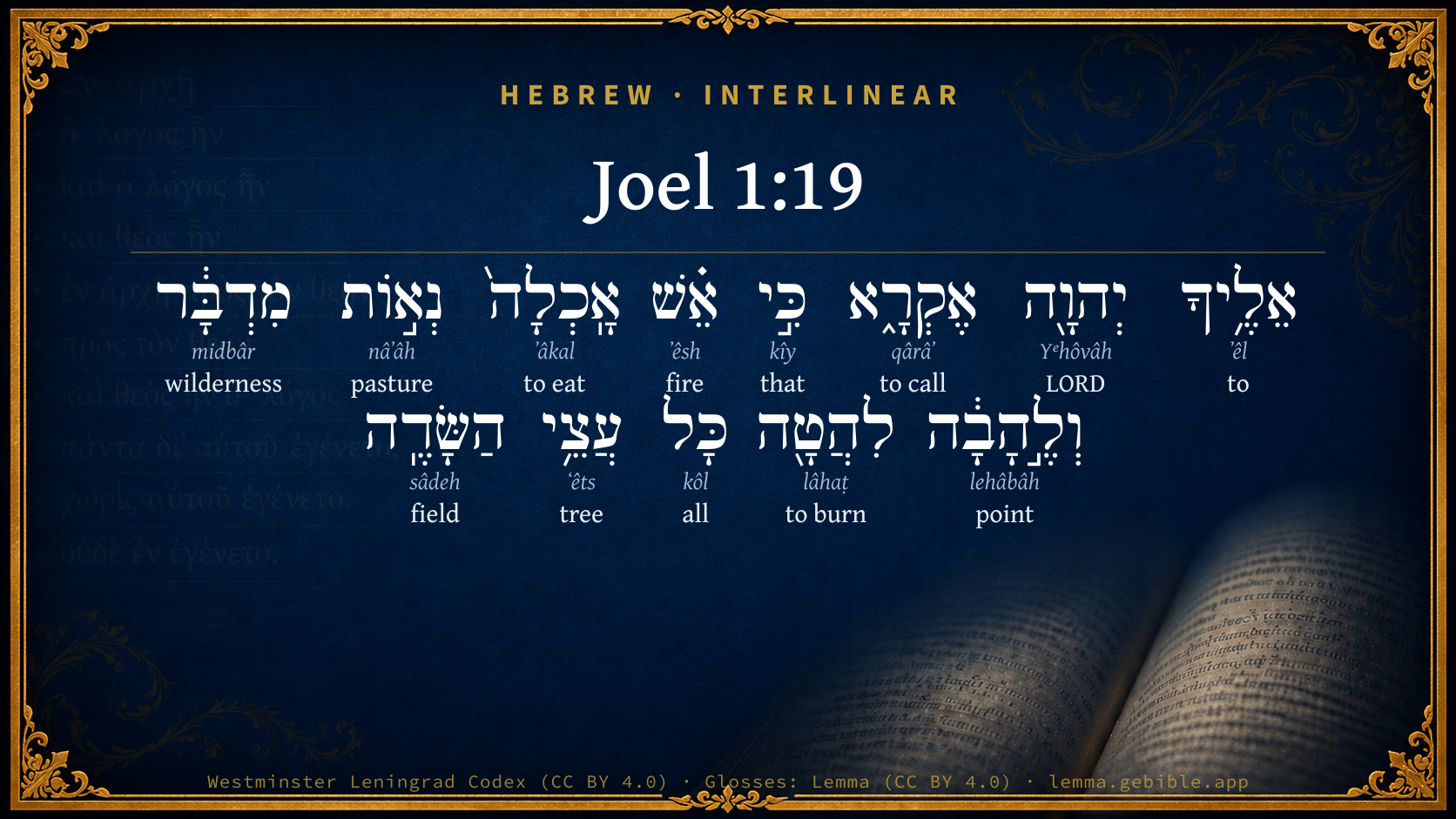
Hebrew (Westminster Leningrad Codex) Joel 1:19 appears in the Hebrew Old Testament. The text above is from the Westminster Leningrad Codex. Each word links to its Strong’s number, a concise gloss, and parsing drawn from the Open Scriptures Hebrew Bible morphology. Click any word for its full Brown-Driver-Briggs (BDB) entry.
Download image
Cite this verse

Joel 1:19 (World English Bible). Public Domain. Lemma interlinear Bible study tool, https://lemma.gebible.app/v/joel/1/19.

Show BibTeX & RIS
BibTeX
RIS
English Translation
Yahweh, I cry to you, For the fire has devoured the pastures of the wilderness, And the flame has burned all the trees of the field.
World English Bible · Public Domain
Download a study sheet

One document with this verse’s original text, its word-by-word gloss line, the meaning frame, cross-references with their text, attributed commentary, and full source and license credits — printable, and it pastes into notes with its structure intact.

This verse Autodidact and up

Study sheet (.html) Plain text (.txt)

A passage Seminary Student

Up to 50 verses in one chapter. A passage sheet keeps up to 6 commentary sources and 12 cross-references per verse, in the order this page ranks them, and says so on the sheet whenever that leaves anything out. Ask for a single verse and you get the Autodidact verse sheet above.

Everything on this page stays free to read, with no account — the sheet is a download of what is already on screen, not access to it.

Want to remove ads? Support Godless Engineer
Compare translations 3

The same verse in 3 English versions, stacked beneath the original-language interlinear above. Click any original word for its lexicon entry.

Each is an independent rendering of the whole verse — the interlinear is not word-aligned to these translations.

Highlighted words mark where these versions differ — a whole-verse word diff, not a word-by-word alignment.

  • World English Bible Public Domain
    Yahweh, I cry to you, For the fire has devoured the pastures of the wilderness, And the flame has burned all the trees of the field.
  • King James Version Public Domain
    O LORD, to thee will I cry: for the fire hath devoured the pastures of the wilderness, and the flame hath burned all the trees of the field.
  • unfoldingWord Literal Text CC BY-SA 4.0
    To you, Yahweh, I cry, for fire has devoured the pastures of the wilderness, and the flame has burned all of the trees of the field.

unfoldingWord Literal Text — © unfoldingWord, licensed CC BY-SA 4.0. Word-aligned USFM3 via Door43 (git.door43.org/unfoldingWord/en_ult).

Versions to compare (up to 4)

3 of 4 selected

Show all 18 translations

Every available English version of this verse, each an independent rendering of the whole verse.

  • World English Bible Public Domain
    Yahweh, I cry to you, For the fire has devoured the pastures of the wilderness, And the flame has burned all the trees of the field.
  • Berean Standard Bible Public Domain
    To You, O LORD, I call, for fire has consumed the open pastures and flames have scorched all the trees of the field.
  • Majority Standard Bible Public Domain
    To You, O LORD, I call, for fire has consumed the open pastures and flames have scorched all the trees of the field.
  • King James Version Public Domain
    O LORD, to thee will I cry: for the fire hath devoured the pastures of the wilderness, and the flame hath burned all the trees of the field.
  • American Standard Version (1901) Public Domain
    O Jehovah, to thee do I cry; for the fire hath devoured the pastures of the wilderness, and the flame hath burned all the trees of the field.
  • Revised Version (1885) Public Domain
    O LORD, to thee do I cry: for the fire hath devoured the pastures of the wilderness, and the flame hath burned all the trees of the field.
  • Geneva Bible (1599) Public Domain
    O Lord, to thee will I crie: for the fire hath deuoured the pastures of the wildernesse, and the flame hath burnt vp all the trees of the fielde.
  • Douay-Rheims (1899) Public Domain
    To thee, 0 Lord, will I cry: because fire hath devoured the beautiful places of the wilderness, and the flame hath burnt all the trees of the country.
  • Young's Literal Translation Public Domain
    Unto Thee, O Jehovah, I do call, For fire hath consumed comely places of a wilderness, And a flame hath set on fire all trees of the field.
  • Literal Standard Version CC BY-SA 4.0
    To You, O YHWH, I call, || For fire has consumed lovely places of a wilderness, || And a flame has set on fire all trees of the field.
  • Unlocked Literal Bible CC BY-SA 4.0
    Yahweh, I cry to you. For fire has devoured the pastures of the wilderness, and flames have burned all the trees of the fields.
  • unfoldingWord Literal Text CC BY-SA 4.0
    To you, Yahweh, I cry, for fire has devoured the pastures of the wilderness, and the flame has burned all of the trees of the field.
  • Darby Bible Public Domain
    To thee, Jehovah, do I cry; for the fire hath devoured the pastures of the wilderness, and the flame hath burned up all the trees of the field.
  • World Messianic Bible Public Domain
    LORD, I cry to you, for the fire has devoured the pastures of the wilderness, and the flame has burned all the trees of the field.
  • Webster's Bible Public Domain
    O LORD, to thee will I cry: for the fire hath devoured the pastures of the wilderness, and the flame hath burned all the trees of the field.
  • Free Bible Version CC BY-SA 4.0
    To you, Lord, I cry out! For fire has destroyed the pastures in the wilderness; flames have burned up all the orchards.
  • Bible in Basic English Public Domain
    O Lord, my cry goes up to you: for fire has put an end to the grass-lands of the waste, and all the trees of the field are burned with its flame.
  • JPS Tanakh (1917) Public Domain
    Unto Thee, O LORD, do I cry; for the fire hath devoured the pastures of the wilderness, and the flame hath set ablaze all the trees of the field.

Literal Standard Version (2020), Covenant Press — licensed CC BY-SA 4.0. Text via the HelloAO Bible API (eBible.org). Unlocked Literal Bible (unfoldingWord) — licensed CC BY-SA 4.0. Text via the HelloAO Bible API (eBible.org). unfoldingWord Literal Text — © unfoldingWord, licensed CC BY-SA 4.0. Word-aligned USFM3 via Door43 (git.door43.org/unfoldingWord/en_ult). Free Bible Version, Dr. Jonathan Gallagher — licensed CC BY-SA 4.0. Text via the HelloAO Bible API (eBible.org).

Word by word

More ways to search: Search by grammar → Find every occurrence → Compare this word →

Practice this passage: Drill this verse → Learn its vocabulary →

לִהֲטָ֖ה
lâhaṭ
H3857
“to burn”
Verb, Piel, Perfect, 3rd Person, Feminine, Singular
Part of Speech
Verb
Stem
Piel
Form
Perfect
Person
3rd Person
Gender
Feminine
Number
Singular
Full BDB Definition

Origin: a primitive root

TWOT: 1081

to burn, blaze, scorch, kindle, blaze up, flame - (Qal) blazing (participle) - (Piel) to scorch, burn, blaze
  1. אֵלֶ֥יךָ ʼêl H413 “to · you” Preposition + Suffix, Personal, 2nd Person, Masculine, Singular
  2. יְהוָ֖ה Yᵉhôvâh H3068 “LORD” Noun, Proper
  3. אֶקְרָ֑א qârâʼ H7121 “to call” Verb, Qal, Imperfect, 1st Person, Common, Singular
  4. כִּ֣י kîy H3588 “that” Conjunction
  5. אֵ֗שׁ ʼêsh H784 “fire” Noun, Common, Both, Singular, Absolute
  6. אָֽכְלָה֙ ʼâkal H398 “to eat” Verb, Qal, Perfect, 3rd Person, Feminine, Singular
  7. נְא֣וֹת nâʼâh H4999 “pastures of” Noun, Common, Feminine, Plural, Construct
  8. מִדְבָּ֔ר midbâr H4057 “wilderness” Noun, Common, Masculine, Singular, Absolute
  9. וְלֶ֣הָבָ֔ה lehâbâh H3852 “and · point” Conjunction + Noun, Common, Feminine, Singular, Absolute
  10. כָּל kôl H3605 “all of” Noun, Common, Masculine, Singular, Construct
  11. עֲצֵ֥י ʻêts H6086 “trees of” Noun, Common, Masculine, Plural, Construct
  12. הַשָּׂדֶֽה sâdeh H7704 “the · field” Particle, Definite Article + Noun, Common, Masculine, Singular, Absolute

About this verse

These counts appear in no published source. They are computed here, from the morphology-tagged text and Lemma’s own curated glosses. What Lemma adds →

13
words
13
distinct lemmas
Prophets
section

Notable vocabulary

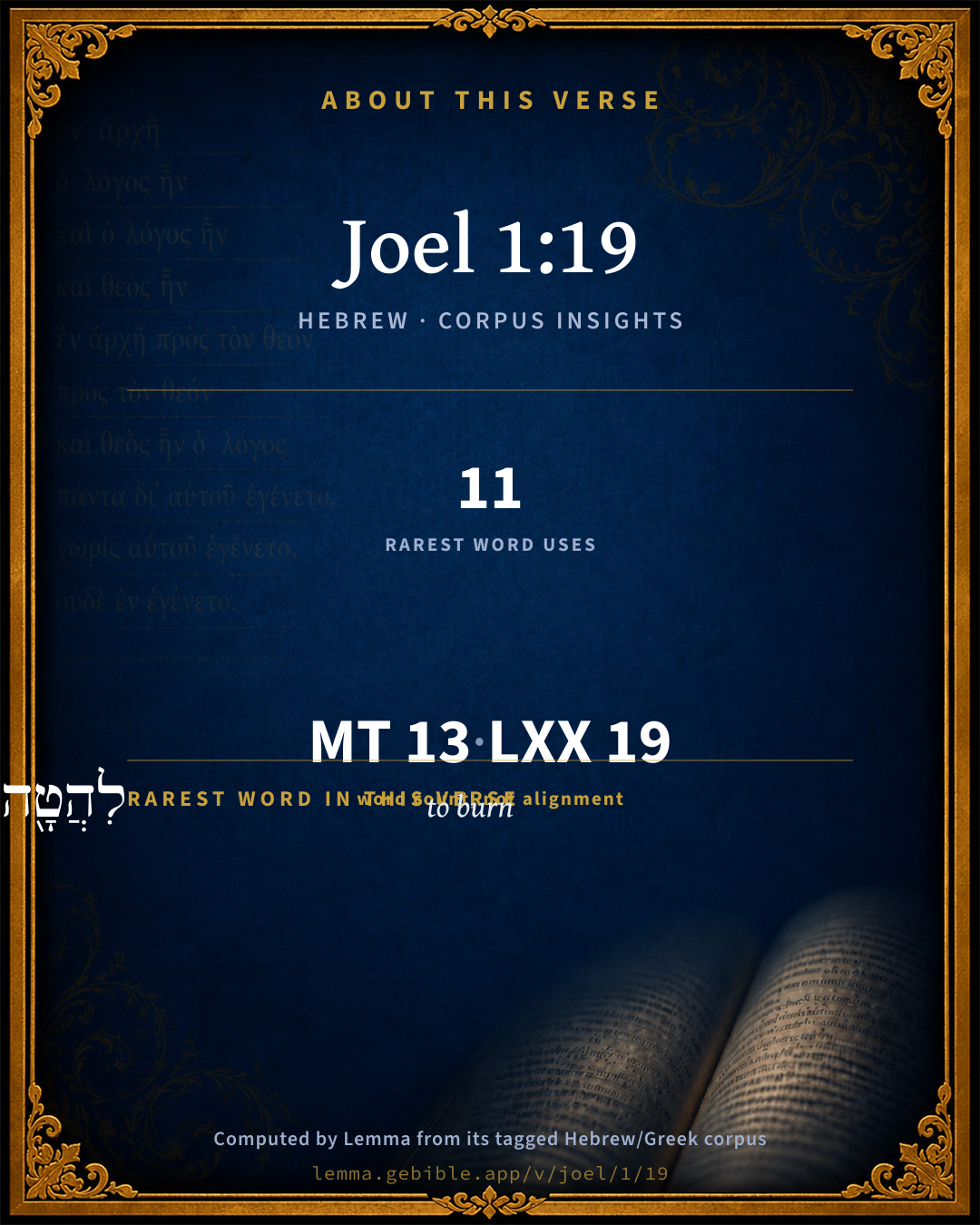
The rarest word here is לִהֲטָ֖ה to burn H3857 — appearing just 11 times in the whole Hebrew Bible.

Shared distinctive vocabulary

לִהֲטָ֖ה to burn H3857 occurs in 11 verses of the Hebrew Bible. Also found in:

Grammatical profile

  • 3 verbs
  • 8 nouns
  • 1 preposition
  • 1 conjunction

Verb forms

  • אֶקְרָ֑א Qal · Imperfect
  • אָֽכְלָה֙ Qal · Perfect
  • לִהֲטָ֖ה Piel · Perfect

Hebrew & Septuagint length

In English translation the verse runs 26 words from the Hebrew and 29 from the Septuagint (LXX English) — closely comparable.

A rough comparison of the two English renderings, which tokenize alike — not a word-level alignment.

Word counts can differ between the Hebrew and the Greek without any difference in meaning — e.g. the Hebrew direct-object marker אֵת has no separate Greek word, and Greek often adds the article ὁ.

In the original languages it is 13 Hebrew tokens and 19 Greek tokens — but the two are counted differently (Hebrew bundles its prefixes and suffixes into one token; the Greek is in lemma form), so that isn’t a like-for-like length.

Cross-references

10

Topical passages linked to Joel 1:19 in the Treasury of Scripture Knowledge — connected by theme and wording, ordered by reader-vote popularity; previews shown in the World English Bible.

  • Psalms 50:15 Call on me in the day of trouble. I will deliver you, and you will honor me."
  • Jeremiah 9:10 For the mountains will I take up a weeping and wailing, and for the pastures of the wilderness a lamentation, because they are burned up, so that none passes through; neither can men hear the voice of the cattle; both the birds of the sky and the animals are fled, they are gone.
  • Amos 7:4 Thus the Lord Yahweh showed me and, behold, the Lord Yahweh called for judgment by fire; and it dried up the great deep, and would have devoured the land.
  • Micah 7:7 But as for me, I will look to Yahweh. I will wait for the God of my salvation. My God will hear me.
  • Psalms 91:15 He will call on me, and I will answer him. I will be with him in trouble. I will deliver him, and honor him.
  • Joel 2:3 A fire devours before them, And behind them, a flame burns. The land is as the garden of Eden before them, And behind them, a desolate wilderness. Yes, and no one has escaped them.
  • Habakkuk 3:17–18 For though the fig tree doesn't flourish, Nor fruit be in the vines; The labor of the olive fails, The fields yield no food; The flocks are cut off from the fold, And there is no herd in the stalls:
  • Luke 18:7 Won't God avenge his chosen ones, who are crying out to him day and night, and yet he exercises patience with them?
  • Luke 18:1 He also spoke a parable to them that they must always pray, and not give up,
  • Philippians 4:6–7 In nothing be anxious, but in everything, by prayer and petition with thanksgiving, let your requests be made known to God.

Cross-references courtesy of OpenBible.info (CC BY 4.0).

Hebrew and Greek witnesses Masoretic Hebrew ↔ Greek Septuagint

The same verse in the two great witnesses to the Old Testament, shown verse-for-verse.

These are two independent witnesses, not word-aligned to each other, and the Septuagint is shown in lemma (dictionary) form.

Hebrew Joel 1:19 Masoretic · Westminster Leningrad Codex

אֵלֶ֥יךָ יְהוָ֖ה אֶקְרָ֑א כִּ֣י אֵ֗שׁ אָֽכְלָה֙ נְא֣וֹת מִדְבָּ֔ר וְלֶ֣הָבָ֔ה לִהֲטָ֖ה כָּל עֲצֵ֥י הַשָּׂדֶֽה

Yahweh, I cry to you, For the fire has devoured the pastures of the wilderness, And the flame has burned all the trees of the field.

World English Bible · Public Domain

Greek LXX Joel 1:19 Septuagint · lemma form

πρός σύ κύριος βοάω ὅτι πῦρ ἀναἁλίσκω ὁ ὡραῖος ὁ ἔρημος καί φλόξ ἀναἅπτω πᾶς ὁ ξύλον ὁ ἀγρός

To you, O Lord, will I cry: for fire has devoured the fair places of the wilderness, and a flame has burnt up all the trees of the field.

LXX2012 (modern English Septuagint) · Public Domain

Hebrew: Westminster Leningrad Codex (CC BY 4.0). Greek: Septuagint (public domain); English from LXX2012 (modern English Septuagint) (Public Domain). How the Septuagint differs from the Hebrew →

Targum (Aramaic paraphrase)

1

The Targum is the ancient Jewish Aramaic paraphrase of the Hebrew Scriptures — an interpretive translation, not the Hebrew text itself. Onkelos (literal) and Pseudo-Jonathan (expansive) render the Torah, and Jonathan the Prophets. Coverage is partial: where no permissively-licensed English translation exists for a verse, only the Aramaic is shown. This is verse-level text, not a word-by-word alignment to the Hebrew.

  1. Targum Jonathan Prophets (Joshua–Malachi)
    קֳדָמָךְ יְיָ אֲנָא מְצַלֵי אֲרֵי קִדוּם תַּקִיף כְּאֵשָׁא אָסַף דַרְוַת מַדְבְּרָא וְשַׁלְהוֹבִיתָא שֵׁיצָאַת כָּל אִילָנֵי חַקְלָא:

    (no public-domain English translation for this verse)

    Targum Jonathan — Aramaic: “Mikraot Gedolot” (public domain). English: “Sefaria Community Translation” (CC0 1.0 (public-domain dedication)); “London "Chaldee Paraphrase," 1871” (public domain). Text via Sefaria.

Commentary

Notes on Joel 1:19 from classic Christian and Jewish commentators (each source and its license shown beneath its notes). The classic Christian expositions comment on the surrounding passage and are grouped to its opening verse, so a note may address several verses; the Jewish commentaries on the Tanakh (Rashi and others) are per-verse, so they appear only where the commentator wrote on this verse.

Lemma curates 59 commentaries, every one of them public domain or Creative Commons licensed, each selected and text-cleaned for this edition rather than reprinted as found. About our sources →

Trapp's Complete Commentary

John Trapp

Joe 1:19 O LORD, to thee will I cry: for the fire hath devoured the pastures of the wilderness, and the flame hath burned all the trees of the field.

Ver. 19. O Lord, to thee will I cry] I will, though others will not. I have called upon others to cry mightily unto thee, and to meet thee by repentance; but they, tanquam monstra marina, as so many sea monsters, pass by my words with a deaf ear, they refuse to return. "Thy hand is lifted up" in threatening, and will fall down in punishing, but "they will not see," Isa 26:11, they will not search, they will not have their eyes (like the windows in Solomon’s temple) broad inward, 1Ki 6:4; the eyes of their minds are as ill set (for this matter) as the eyes of their bodies, they see not what is within. But whatever they do, "my soul shall weep in secret for their pride, and mine eyes shall weep sore," &c., Jer 13:17, for their insensibleness of their misery.

For the fire hath devoured the pastures] That is, the immoderate scorching heat of the season. See Psa 83:14 Jer 17:6. Or the blasting wind, as Lyra expounds it; or the locusts, as Drusius, or God (who is a consuming fire), by any, or all these instruments of his wrath, as Tarnovius.

And the flame hath burnt all the trees of the field] This was dreadful, but yet nothing to that conflagratio mundi, spoken of by St Peter, 2Pe 3:12, "when the heavens being on fire, shall be dissolved, and the elements melt with fervent heat" on the heads of the wicked; who shall give a terrible account, with the world all on a light fire about their ears.

John Trapp, A Commentary or Exposition upon All the Books of the Old and New Testament (1647–1656) — public domain. Text from a community e-Sword module.

The Biblical Illustrator

Joseph S. Exell

Joe_1:19

O Lord, to Thee will I cry.

Adding prayers to complaints

Turn thy complaint into prayer, or else it is but a murmuring against God. It is by prayer we make our sorrowful hearts known to God. The reasons of this doctrine are--

1. Because God forgetteth not the complaints of the poor; i.e., of those that pray unto Him. Otherwise He remembereth no more the poor mans envy than the rich mans quarrel. Therefore let this stir us up to make our complaint in prayer.

2. When men do only complain of this or that want without prayer they tempt God; therefore if we will obtain anything at the Lords hand for our good, let us ask by prayer.

3. Let us learn to ask of God without murmuring or grudging at our own estate, or the Lords hand; for the Lord will complain as fast on us as we complained to Him.

4. Another use is this,--that if complainers without praying be odious in the Lords sight, although the cause be indifferent, then much more are those that never pray but for unlawful and filthy things, that they may bestow them on their lusts, as the apostle saith. (Edw. Topsell.)

Prayer to God against terrible judgments

The prophet now turns from the people of Judah, with whom he could prevail but little, and cries to God as he stands in the midst, of the universal plague. It is often a relief for Christian workers to leave the society of hardened men for communion with Jehovah. Prayer is sometimes their only refuge and strength.

I. That this prayer was wisely directed to the only Giver of the true remedy. O Lord, to Thee will I cry.

1. It was wisely directed. He sought unto God in this time of peril. He did not pray unto any idols, but unto the true God, the Maker of the heaven and the earth. Jehovah had sent the calamity, and He only could remove it. Sorrow should send us to God.

2. It was earnestly presented. The prophet cried unto the Lord with all the energy of his being. His was no languid petition. Sorrow should make men earnest in devotion.

3. It was widely representative. The prophet did not merely pray on his own behalf; he remembered the universal woe around him, and caught up the pain-cry of nature and of the brute, and expressed it in his own prayer. He prayed as the groaning herds could not. A good man is the priest of the universe, especially in the hour of calamity.

II. That this prayer was prompted by a sad appre hension of the calamity it sought to remove. For the fire hath devoured the pastures of the wilderness, and the flame hath burned all the trees of the field. The prophet recognised the severity of the calamity which had come upon the nation. And it is essential to prayer that we should have a clear apprehension of the sorrow to be relieved, of the sin to be removed, and of the want to be supplied; prayer should always include a good knowledge of the conditions and circumstances under which it is presented and which it hopes to ameliorate.

III. That in this prayer was united the inarticulate pleadings of suffering brutes. The beasts of the field cry also unto Thee: for the rivers of waters are dried up, etc. We are not to suppose that the cry of the brutes was one with the cry of the prophet; one was the outcome of pious intelligence, the other was the outcome of blind instinct (Psa_147:9; Job_30:41). Lessons--

1. That a sorrowful soul should pray to God for aid.

2. That the soul must feel its need before it can expect relief.

3. That man should consider the pain of the inferior creatures, and never render himself liable to their rebuke. (J. S. Exell, M. A.)

The influence of national calamities on the minds of the good

It is a question whether the fire and flame are to be taken literally as burning the grass, or whether they are used figuratively. Probably the reference is to the burning heat in drought which consumes the meadows, scorches the trees, and dries up the water-brooks. The effect of national calamity on Joel was to excite him to prayer, to compel him to lay the case before the Lord. Having called the attention of all classes of the community to the terrible judgments, he turns his soul in a devout supplication to Almighty God.

I. This was right. Prayer is right.

1. God requires it.

2. Christ engaged in it. He is our example.

II. This was wise. Who else could remove the calamity and restore the ruin? None. When all earthly resources fail, where else can we go but to Him who originates all that is good, and controls all that is evil? True prayer is always wise, because--

1. It seeks the highest good.

2. By the best means.

III. This was natural. The beasts of the field also cry unto Thee. What better, says an old author, are they than beasts, who never cry to God but for corn and wine, and complain of nothing but the wants of sense? Conclusion. It is well when our trials lead us in prayer to God. The greatest calamities are termed the greatest blessings when they act thus. Hail the tempests, if they drive our bark into the quiet haven of prayer! (Homilist.)

.

The Biblical Illustrator, edited by Joseph S. Exell (c. 1880s–1900s) — public domain. Text from a community e-Sword module.

Joseph Benson's Commentary

Joe 1:19-20. O Lord, to thee will I cry — The prophet carries on the beautiful hypotyposis, (or description of the calamity, painted in such strong and bright colours as rendered it, as it were, present before the eyes of the people,) by representing himself as a sharer in the calamity. And by crying to God himself, he endeavours to stir up the people to cry to him. For the fire hath devoured the pastures of the wilderness — The fiery drought hath burned up all the pasture-grounds. The wilderness is sometimes opposed to the hills and mountains, and then it signifies the plains and places for pasture. Or, if the expression be here understood of deserts, it must be observed, that there were spots in them where flocks and herds might feed. The beasts of the field also cry unto thee — Even the cattle and wild beasts utter their complaints, and express their want of food by the mournful noise which they make, as it were beseeching thee to have pity on them and relieve their wants. Even they have a voice to cry, as well as an eye to look to God. The rivers of water are dried up — The drought drying up the springs, the rivers have failed, and have little or no water in them. Thus, throughout the chapter, the prophet foretels a drought, as well as a plague of locusts; and these two calamities often go together, a great increase of locusts, according to Pliny and Bochart, being occasioned by heat.

Joseph Benson's Commentary on the Old and New Testaments (1811–1818) — public domain. Text from a community e-Sword module.

The Preacher's Complete Homiletical Commentary

Joseph S. Exell (gen. ed.)

CRITICAL NOTES.]

Joe_1:19.] Beasts cry to God, but man hears not; the prophet is touched and cries for the impenitent. To thee] beasts even lift their heads in dumb appeal, and to thee I cry, for thou art the only hope (Isa_15:5; Jer_23:9), amid the insensibility of man, the distress of nations, and the judgments of providence.

HOMILETICS

STUPIDITY IN NATIONAL CALAMITIES REPROVED BY BRUTES AND GOOD MEN.—Joe_1:19-20

The fact that irrational creatures suffer with man should make him cautious in his conduct. If the people neglect the warnings of the prophet, they should heed the cries of the brute creation. Both the animal and vegetable world are included in man’s destiny for good or for evil. Should we be silent when beasts implore help?

I. Some men are insensible to sin in great national calamities. The drought had consumed the pastures of the field, burned the trees of the forest, and dried up the waterbrooks, but Israel did not see the hand of God in this. Man is a creature of emotion, and is bound to acquaint himself with all the phenomena calculated to move him; to estimate them according to their design, and to carry out the emotions which they produce into final acts. Every object is adapted to produce a certain state of mind. The hand of God in history, the judgments of God in nations, should be read and observed by us. If we discern not the presence of God, if through selfishness and hardness of heart we despise the chastisements of God, we aggravate our sin and unbelief. God has placed us in certain relations to himself and his works as sentient and intelligent beings. We have capacities higher than brutes, can see and hear God in his dispensations, and live habitually under a sense of duty. But the complaint is often made, “Israel doth not know, my people doth not consider.” “For God speaketh once, yea, twice, yet man perceiveth it not.”

II. This insensibility to sin in great national calamities is censurable. Men ought to feel in distress. If they do not they violate their own nature and disregard the voice of God.

1. Brutes reprove insensible men. “The beasts of the field cry also unto thee.” They depend upon God, and he gives them their meat in due season (Psa_145:15). When young lions lack and suffer hunger, they “seek their meat from God” (Psa_104:21). They enjoy the gifts of nature with sensitive pleasure and apparent gratitude. But men are heedless of their groans, stupid in their folly, and turn not to God in their trouble. “The stork in the heaven knoweth her appointed times; and the turtle, and the crane, and the swallow observe the time of their coming; but my people know not the judgment of God.”

2. God’s people reprove insensible men. The prophet stirs them up by his own example. If no one else will call upon God, “O Lord, to thee will I cry.” When others are unmoved God’s people are touched with national calamities. They set others an example, and seek to provoke them to repentance and return to God.

1. An example of penitence. The heart of the prophet was deeply moved for innocent creatures and for ungodly men. We hear his sighs, see his tears, and dwell upon his words. He comes before us, an embodiment of the spiritual and personal duty he teaches. He is the prophet of repentance, and sees in the judgments of God motives to repentance. National sins brought national affliction, and should cause national humiliation.

2. An example of patriotism. God’s people are as keenly alive to the interests and dangers of the nations as others. The Hebrew prophets were patriots and statesmen, to whom nothing that affected the national welfare was alien or indifferent. “May Heaven save my country,” cried a British legislator. So good men see God in everything; point out the real causes of suffering; the operation of moral under physical law; and lament the state of the country and the condition of the people. “For the mountains will I take up a weeping and wailing, and for the habitations of the wilderness a lamentation, because they are burned up, so that none can pass through them; neither can men hear the voice of the cattle.”

3. An example of prayer. The prophet turned to God, our only hope in distress. In public calamity men write pamphlets, make speeches, and enact laws to meet and overcome it. But the man of God goes to the root of evil, and points out its only cure. He holds the principles of Divine life in his soul, believes that individual circumstances and national events are controlled by God’s will, and sees in present visitations the future results to the wicked and the righteous. God was working out his mysterious purposes, and he prays that the visitations of anger may be turned into corrective discipline. As Abraham prayed for the cities of the plain and Moses for the tribes of Israel, so Joel betakes himself to Jehovah. “O Lord, to thee I will cry: for the fire hath devoured the pastures of the wilderness.”

Lord, what a change within us one short hour

Spent in thy presence will prevail to make,

What heavy burdens from our bosoms take;

What parched grounds refresht as with a shower?

We kneel, and all around us seems to lower;

We rise, and all—the distant and the near—

Stands forth in sunny outline, brave and clear—[Trench].

HOMILETIC HINTS AND OUTLINES

There is an order in these distresses. First he points out the insensate things wasted; then those afflicted, which have sense only; then those endowed with reason; so that to the order of calamity there may be consorted an order of pity, sparing first the creature, then the things sentient, then things rational [Pusey].

Beasts cry. I. The dependence of all creatures upon God. II. The compassion of God to all creatures—

1. In removing their sufferings.

2. In supplying their wants. An argument against cruelty to animals and a motive to prayer. If God hears the cries of dumb animals will he not hear our prayers?

The double purpose of Divine judgments upon a nation—

1. Restoration of land.

2. Improvement of men.

1. A suffering world in sympathy with suffering man. What a mystery man’s sin, desolating the land, blighting the trees, and adding to the groans of the brute creation! The whole creation, animate and inanimate, touched by the fall of man! What evidences of sin! What motives to repentance!

2. A beneficent world in sympathy with restored man. A cheering thought that true penitence and restoration to God will give pasture to flocks, beauty to flowers, and freshness to the landscape. “New heavens and a new earth, wherein dwelleth righteousness.”

ILLUSTRATIONS TO CHAPTER 1

Joe_1:19-20. Animal sensibility forms a perpetual appeal to human sensibility, and is an important means of its improvement. The progressiveness of creation is made subservient to the moral education and advancement of the human race. A single alteration throws the whole into disorder. What a picture, then, for man to be ungrateful, insensible, and rebellious in the sufferings of nature for his conduct!

The Preacher's Complete Homiletical Commentary (gen. ed. Joseph S. Exell; Funk & Wagnalls, c. 1892) — public domain (pre-1929). A full-Bible homiletical/sermon-outline anthology covering 65 of 66 books (2 John is absent from the source module). Text from a community e-Sword module.

Tyndale Open Study Notes

Tyndale Open Resources

1:19 Lord, help us! (literally to you, Lord, I cry): Joel responded to the plague with an earnest prayer. The people’s only recourse was to turn to the sovereign Lord of heaven and earth and appeal to his goodness; he alone could reverse their desperate situation.

Tyndale Open Study Notes — © Tyndale Open Resources, licensed CC BY-SA 4.0. Text via the HelloAO Bible API.

Jamieson, Fausset & Brown

Robert Jamieson, A. R. Fausset & David Brown

to thee will I cry--Joel here interposes, As this people is insensible to shame or fear and will not hear, I will leave them and address myself directly to Thee (compare Isa 15:5; Jer 23:9).

fire--that is, the parching heat.

pastures--"grassy places"; from a Hebrew root "to be pleasant." Such places would be selected for "habitations" (Margin). But the English Version rendering is better than Margin.

Jamieson, Fausset & Brown — Commentary Critical and Explanatory on the Whole Bible (1871) — public domain (CC PDM 1.0). Text via the HelloAO Bible API.

Adam Clarke's Commentary

Verse 19. O Lord, to thee will I cry] Let this calamity come as it may, we have sinned, and should humble ourselves before God; and it is such a calamity as God alone can remove, therefore unto him must we cry.

The fire hath devoured the pastures] This may either refer to a drought, or to the effects of the locusts; as the ground, after they have passed over it, everywhere appears as if a sheet of flame had not only scorched, but consumed every thing.

Adam Clarke's Commentary on the Bible (1810–1826) — public domain. Text from a community e-Sword/MySword module.

John Calvin's Commentaries

When the Prophet saw that he succeeded less than he expected, leaving the people, he speaks of what he would do himself, I will cry to thee, Jehovah. He had before bidden others to cry, and why does he not now press the same thing? Because he saw that the Jews were so deaf and listless as to make no account of all his exhortations: he therefore says, “I will cry to thee, Jehovah; for they are touched neither by shame nor by fear. Since they throw aside every regard for their own safety, since they account as nothing my exhortations I will leave them, and will cry to thee;” which means this, — “I see, Lord, that all these calamities proceed from thy hand; I will not howl as profane men do, but I will ascribe them to thee; for I perceive thee to be acting as a judge in all the evils which we suffer.” Having then before declared that the Jews were more tardy than brute animals and having reproached them for feeling less acutely than oxen and sheep, the Prophet now says, that though they all remained obstinate, he would yet do what a pious man and a worshipper of God ought to do, I will cry to thee — Why? Because the fire has consumed the pastures, or the dwellings, of the wilderness.

He here again gives an awful record of God’s judgments. Though the heat may burn up whole regions, yet we know that pasture-lands do not soon wither, especially on mountains; and of such cold pastures he speaks here. We know that however great may be the fertility of mountains, yet coolness prevails there, and that, in the greatest drought, the mountainous regions are ever green. But the Prophet tells us here of an unusual thing, that the dwellings of the wilderness were burnt up. Some render נאות naut pastures; others, dwellings: but as to the meaning, we may read either; for the Prophet refers here to cold and humid regions, which never want moisture in the greatest heats. Some render the word, the beautiful or fair spots of the wilderness, but improperly. He doubtless means pastures, or dwellings, or folds. The fire then has consumed the dwellings, or pastures of the wilderness. This was not usual; it did not happen according to the ordinary course of nature: it then follows that it was a miracle. This is the reason why the Prophet says, that it was now time to cry to God; for it did not appear to be fortuitous, that the heat had burnt up regions which were moist and well watered. The flame, he says hath burnt up all the trees of the field.

John Calvin's Commentaries (1540-1563) — public domain. Text from the Calvin Translation Society English edition (1840s-50s) via the Christian Classics Ethereal Library (ccel.org). Calvin's coverage is partial (roughly two-thirds of the Bible); uncommented books and verses are honest gaps, never fabricated. The 19th-century editor's footnotes and remarks are omitted so the notes are faithfully Calvin's own voice.

Ellicott's Commentary for English Readers

(19) The fire hath devoured.—This may be explained as produced by the scorching heat bringing about spontaneous combustion, or by the efforts of the people to exterminate the locusts by burning the trees, or by the mark, as of fire, left upon all vegetation after the locusts had finished their work of devastation.

A Bible Commentary for English Readers, edited by Charles John Ellicott (1878–1897) — public domain. Text from a community e-Sword module.

The Cambridge Bible for Schools and Colleges

gen. ed. J. J. S. Perowne

19. Unto thee, O Jehovah, do I cry] the prophet, speaking (as Joe_1:6-7; Joe_1:13) in the nation’s name, turns for help to Jehovah, who “saveth men and cattle” (Psa_36:6).

fire] either fig. of the intense heat of the sun, or (comp. on Amo_7:4) of the conflagrations kindled among the parched herbage during a drought. The words might, however, be simply a poetical description of the ravages of the locusts themselves (cf. Joe_2:3 a).

the pastures of the wilderness] Joe_1:20, Joe_2:22; Jer_9:10; Jer_23:10; Psa_65:12. “Wilderness” does not mean the desert: midbâr (properly, a place for driving cattle) denotes land which is unenclosed, and uncultivated, especially a broad prairie or steppe, but not land which is destitute of pasturage.

The Cambridge Bible for Schools and Colleges (gen. ed. J. J. S. Perowne; Cambridge University Press, 1878–1918) — public domain. Text from a community e-Sword module.

John Gill's Exposition

O Lord, to thee will I cry,.... Or pray, as the Targum; with great vehemency and earnestness, commiserating the case of man and beast: these are the words of the prophet, resolving to use his interest at the through of grace in this time of distress, whatever others did:

for the fire hath devoured the pastures of the wilderness; or, "of the plain" (c) though in the wildernesses of Judea, there were pastures for cattle: Kimchi interprets them of the shepherds' tents or cotes, as the word (d) is sometimes used; which were will not to be pitched where there were pastures for their flocks: and so the Targum renders it, "the habitations of the wilderness"; these, whether pastures or habitations, or both, were destroyed by fire, the pastures by the locusts, as Kimchi; which, as Pliny (e) says, by touching burn the trees, herbs, and fruits of the earth; see Joe 2:3; or by the Assyrians or Chaldeans, who by fire and sword consumed all in their way; or by a dry burning blasting wind, as Lyra; and so the Targum interprets it of a strong east wind like fire: it seems rather to design extreme heat and excessive drought, which burn up all the produce of the earth:

and the flame hath burnt all the trees of the field; which may be understood of flashes of lightning, which are common in times of great heat and drought; see Psa 83:14.

(c) "non tantum desertum significat sed et campum sativum", Oecolampadius. "A place of pasture for cattle", Ben Melech. (d) "caulas", Piscator. So Ben Melech. (e) Nat. Hist. l. 11. c. 29.

John Gill's Exposition of the Whole Bible (1746–1763) — public domain (CC PDM 1.0). Text via the HelloAO Bible API.

Albert Barnes' Notes on the Bible

O Lord, to Thee will I cry - This is the only hope left, and contains all hopes. From the Lord was the infliction; in Him is the healing. The prophet appeals to God by His own Name, the faithful Fulfiller of His promises, Him who Is, and who had promised to hear all who call upon Him. Let others call to their idols, if they would, or remain stupid and forgetful, the prophet would cry unto God, and that earnestly.

For the fire hath devoured the pastures - The gnawing of locusts leaves things, as though scorched by fire (see the note at Joe 2:3); the sun and the east wind scorch up all green things, as though it had been the actual contact of fire. Spontaneous combustion frequently follows. The Chaldees wasted all before them with fire and sword. All these and the like calamities are included under “the fire,” whose desolating is without remedy. What has been scorched by fire never recovers . “The famine,” it is said of Mosul, “was generally caused by fire spreading in dry weather over pastures, grass lands, and grain lands, many miles in extent. It burnt night and day often for a week and sometimes embraced the whole horizon.”

Albert Barnes' Notes on the Bible (1834–1885) — public domain. Text from a community e-Sword/MySword module.

Haydock's Catholic Bible Commentary

Places. Hebrew, "dwellings," or shepherds’ huts. --- Wilderness, denoting all pasture land unploughed.

George Leo Haydock (1774–1849), Haydock's Catholic Family Bible and Commentary, 1859 edition — public domain. Excludes Psalms (Douay-Rheims chapter numbering differs from Protestant) and Deuterocanonical books (Catholic canon only).

Matthew Poole's English Annotations

O Lord, Maker and Preserver of these poor famished cattle,

to thee will I cry: either it is the prophet’s prayer he maketh, or a form prescribed for the priests.

The fire; the immoderate heats, or else the scorching and blasting flashes of fire in the air, which in those hot countries are more frequent and more precious than in colder climates.

Hath devoured the pastures; the fruitful and pleasant places where shepherds pitched their tents, and were used to feed their sheep, all are parched and dried as if burned with fire.

Of the wilderness; either because the shepherds chose to pitch their tents far from cities and towns; or else because in those vast wildernesses there were some fruitful pastures scattered up and down, some lower places of springs and water-courses.

The flame, the flashes of fire from the clouds, or in the air, without thunder, or else lightnings with thunder,

hath burnt all the trees, that they neither afford their fruit, their shade, or their green boughs for browse for the relief of man or beast. This extreme desolation should affect them all; it doth shame the sinfully Senseless among them; and it is a good argument to use with God, whose creatures they are as well as man.

Matthew Poole's English Annotations on the Holy Bible (1683–1685) — public domain. Text from a community e-Sword/MySword module.

The Pulpit Commentary

Vers. 19, 20. O Lord, to thee will I cry. In consideration of man and beast creatures rational and irrational being subject to so much hardship and suffering the prophet appeals in intense earnestness of spirit to God, and all the more so because of the encouragement of his own Word, as it is written, "Lord, thou preservest man and beast." For the fire hath devoured the pastures of the wilderness, and the flame hath burned all the trees of the field. The fire and flame here referred to denote the fiery heat of the drought which burnt up the meadows and scorched the trees. Some seem to understand the terms literally, as applied to setting on fire the heath, or even the trees, in order to check the progress of the locusts or turn them aside by smoke and flame. This, however, is refuted by the following verse, which mentions the rivers of water being dried up: The beasts of the field cry also unto thee: for the rivers of waters are dried up, and the fire hath devoured the pastures of the wilderness. In like manner we read in Jer_14:4-6, "Because the ground is chapt, for there was no rain in the earth, the ploughmen were ashamed, they covered their heads. Yea, the hind also calved in the field, and forsook it, because there was no grass. And the wild asses did stand in the high places, they snuffed up the wind like dragons; their eyes did fail, because there was no grass." The various animals suffering from hunger and thirst express their distress in loud and lamentable, though inarticulate, cries. The Hebrew words which respectively denote the cries of the different animals are, according to Rashi, the following: gr expresses the cry of deer; (also gav), to roar like lions; hn, to low as oxen; ljx, to neigh like horses; pwxpyx (rather pxipxi, fulfil), to twitter or chirp as birds. Further, the subject is plural, but the verb is singular, for the purpose of individualizing.

Vers. 19, 20. Trouble leads to prayer.

When Scripture depicts human misery and destitution, it does not leave the matter, as though there were nothing further to say. Always a way of escape is pointed out; always a gleam of light is let in upon the darkness; always a remedy is offered for the disease whose symptoms are described.

I THE CRY TO WHICH TROUBLE LEADS IS A CRY OF CONFESSION. God has not afflicted the greatest sufferer beyond his deserts. The distressed soul gives utterance to the acknowledgment, Against thee, thee only, have I sinned.

II THE CRY WHICH TROUBLE PROMPTS IS A CRY OF HELPLESSNESS. The soul may have called upon others, and in vain. There is no answer, no deliverance, when help is sought from man. Perhaps the soul addresses itself last to the Helper who should have been sought first, before all

III THE CRY WHICH TROUBLE PROMPTS IS A CRY OF FAITH. God has said, "Call upon me in the day of trouble, and I will deliver thee." The promise is remembered, acted upon, and pleaded. Believing the Divine assurance, the afflicted lifts up his eyes unto the hills whence cometh help.

IV THE CRY WHICH TROUBLE PROMPTS IS A CRY WHICH IS HEARD AND ANSWERED. God delights to hear the suppliant"s entreaty, the sinner"s confession, the earnest petition of interceding friends.

Such cries come up into the ear of God. The sacrifice is accepted; the sin is forgiven; the grace is accorded; the chastisement is removed; the blessing is bestowed. T.

Vers. 19, 20. The influence of national calamities on the minds of the good.

"O Lord, to thee will I cry," etc. In the verses extending from the sixth to the eighteenth, the prophet described with great vividness and force the attributes of these "locusts" and the terrible devastations they would effect, and he called upon various members of the community to attend to the calamity. The old men and the young people, the drunkards and the farmers, the priests and the laity, all are summoned to reflection, penitence, and reform. Here he cries out to the Lord himself on account of the calamity, which he describes with remarkable force. "The fire hath devoured the pastures of the wilderness, and the flame hath burned all the trees of the field." It is a question whether the fire and flame are to be taken literally as burning the grass, which often happens in extreme heat, or whether they are used figuratively. The reference, I think, is to the burning heat in drought which consumes the meadows, scorches the trees, and dries up the water-brooks. Our subject is the influence of national calamities on the minds of the good. The effect on Joel was to excite him to prayer, to compel him to lay the case before the Lord. Having called the attention of all classes of the community to the terrible judgements, he turns his soul in a devout supplication to Almighty God.

I THIS WAS RIGHT. "In everything by prayer and supplication we should make known our wants to God." Prayer is right:

1. God requires it. "For all these things will I be inquired of;" "Ask, and ye shall receive," etc.

2. Christ engaged in it. He prayed, prayed often, prayed earnestly, prayed "without ceasing." He is our Example.

II THIS WAS WISE. Who else could remove the calamity and restore the ruin? None. All men were utterly helpless. When all earthly resources fail, where else can we go but to him who originates all that is good, and controls all that is evil? True prayer is always wise, because

(1) it seeks the highest good;

(2) by the best means.

III THIS WAS NATURAL. "The beasts of the field cry also unto thee." "The young lions roar after their prey, and seek their meat from God." "What better," says an old author, "are they than beasts, who never cry to God but for corn and wine, and complain of nothing but the wants of sense?

CONCLUSION. It is well when our trials lead us in prayer to God. The greatest calamities are termed the greatest blessings when they act thus. Hail the tempests, if they drive our bark into the quiet haven of prayer. "There"s a power which man can wield, When mortal aid is vain, That eye, that arm, that love, to reach, That listening ear to gain: That power is prayer, which sears on high, And feeds on bliss beyond the sky. D.T.

The Pulpit Commentary (1880–1919), ed. H.D.M. Spence-Jones & Joseph S. Exell — public domain. Text from a community e-Sword module.

John Wesley's Explanatory Notes

The fire - The immoderate heats. The wilderness - The world, only means places not ploughed, and less inhabited than others.

John Wesley, Explanatory Notes Upon the Whole Bible (1754–1765) — public domain. Text via the GEBible commentary corpus.

Rashi

Rabbi Shlomo Yitzchaki (Rashi)

the dwellings of the wilderness Heb. נְאוֹת, an expression of a dwelling (נָוֶה).

Rashi on the Tanakh — English translations: “The Judaica Press complete Tanach with Rashi, translated by A. J. Rosenberg” (CC BY 4.0); “Pentateuch with Rashi's commentary by M. Rosenbaum and A.M. Silbermann, 1929-1934” (public domain); “The Metsudah Tanach series, Lakewood, N.J” (CC BY 4.0); and “The Book of Joshua, Metsudah Publications, 1997” (CC BY 4.0). Text via Sefaria.

Lesson kit

Teaching starters — assembled from the data on this page, not authored interpretation. Every prompt links to the verse data it draws on. Edit before teaching.

Joel, in the Prophets, opens this verse with 13 words (13 distinct Hebrew lemmas). Its most distinctive word is lâhaṭ (“to burn”). A historical commentator’s framing appears above. Read the whole chapter for the surrounding context.

Discussion questions

  1. How does “to burn” (lâhaṭ) shape what this verse is saying?
  2. How does Deuteronomy 32:22, which shares the word «to burn», read alongside this verse?
  3. These translations render this verse differently. What is at stake in choosing one wording over another?
  4. «אֶקְרָ֑א» is a Qal Imperfect verb. How does that grammatical form shape the action described?
  5. Compare how Trapp's Complete Commentary and The Biblical Illustrator read this verse. Where do they agree or differ?

Things to notice

Reading settings

Reading text

Shown beneath each verse's original-language words.

Old Testament
Old Testament edition

Read the OT as the Masoretic Hebrew (MT) or the Greek Septuagint (LXX).

English shown for the Greek Septuagint (in the Hebrew ↔ Greek comparison).

Comparing translations? Open the Compare panel on any verse page to stack up to four side by side.