Revelation 1:14

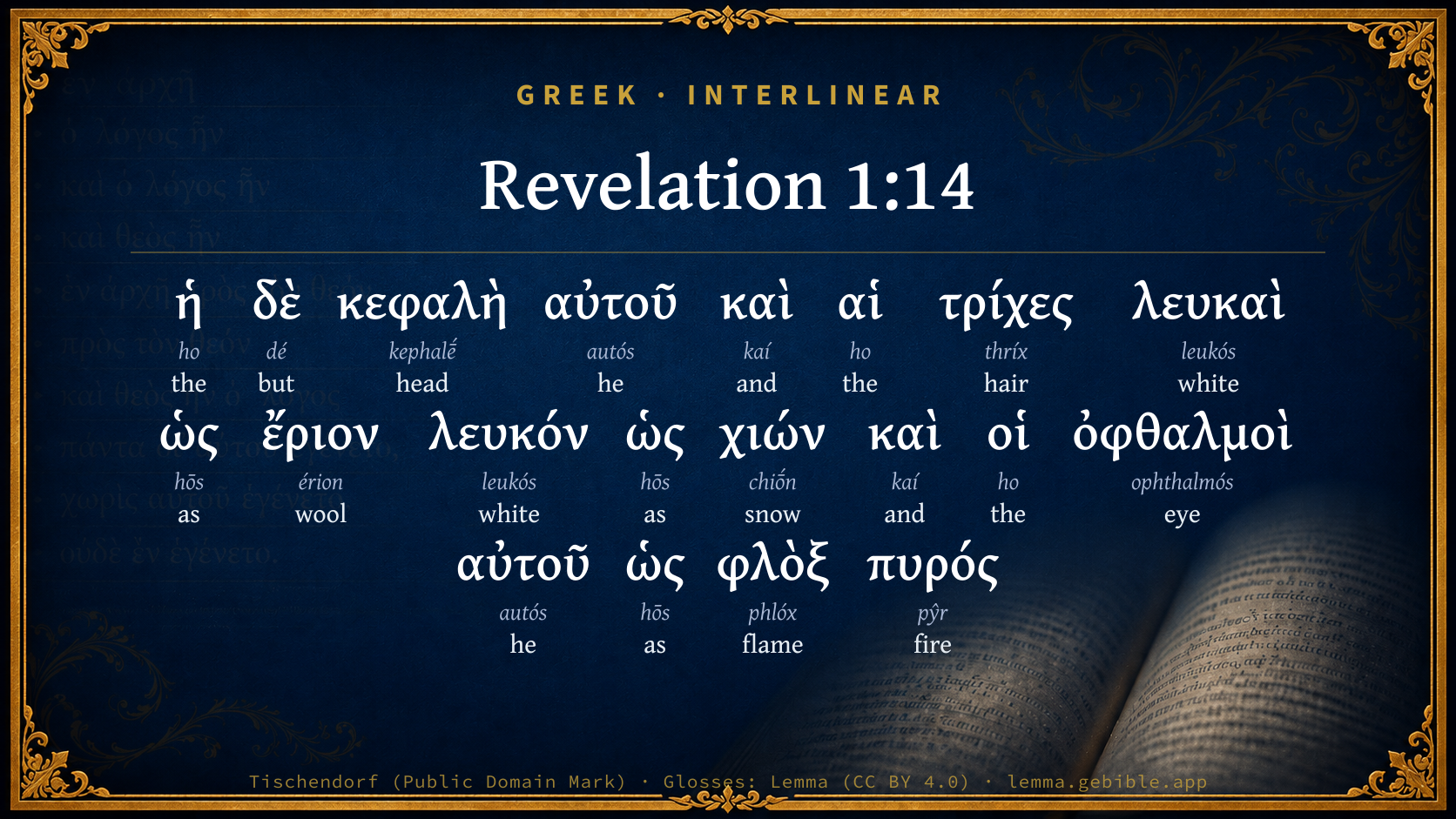
Greek (Tischendorf 8th ed.) Revelation 1:14 appears in the Greek New Testament. The text above is from the Tischendorf 8th edition. Each word links to its Strong’s number and a concise gloss. Click any word for its full Thayer’s Greek Lexicon entry.
Download image
Cite this verse

Revelation 1:14 (World English Bible). Public Domain. Lemma interlinear Bible study tool, https://lemma.gebible.app/v/revelation/1/14.

Show BibTeX & RIS
BibTeX
RIS
English Translation
His head and his hair were white as white wool, like snow. His eyes were like a flame of fire.
World English Bible · Public Domain
Download a study sheet

One document with this verse’s original text, its word-by-word gloss line, the meaning frame, cross-references with their text, attributed commentary, and full source and license credits — printable, and it pastes into notes with its structure intact.

This verse Autodidact and up

Study sheet (.html) Plain text (.txt)

A passage Seminary Student

Up to 50 verses in one chapter. A passage sheet keeps up to 6 commentary sources and 12 cross-references per verse, in the order this page ranks them, and says so on the sheet whenever that leaves anything out. Ask for a single verse and you get the Autodidact verse sheet above.

Everything on this page stays free to read, with no account — the sheet is a download of what is already on screen, not access to it.

Want to remove ads? Support Godless Engineer
Compare translations 3

The same verse in 3 English versions, stacked beneath the original-language interlinear above. Click any original word for its lexicon entry.

Each is an independent rendering of the whole verse — the interlinear is not word-aligned to these translations.

Highlighted words mark where these versions differ — a whole-verse word diff, not a word-by-word alignment.

  • World English Bible Public Domain
    His head and his hair were white as white wool, like snow. His eyes were like a flame of fire.
  • King James Version Public Domain
    His head and his hairs were white like wool, as white as snow; and his eyes were as a flame of fire;
  • unfoldingWord Literal Text CC BY-SA 4.0
    Now his head and hair white as wool—white as snow—and his eyes like a flame of fire,

unfoldingWord Literal Text — © unfoldingWord, licensed CC BY-SA 4.0. Word-aligned USFM3 via Door43 (git.door43.org/unfoldingWord/en_ult).

Versions to compare (up to 4)

3 of 4 selected

Show all 19 translations

Every available English version of this verse, each an independent rendering of the whole verse.

  • World English Bible Public Domain
    His head and his hair were white as white wool, like snow. His eyes were like a flame of fire.
  • Berean Standard Bible Public Domain
    The hair of His head was white like wool, as white as snow, and His eyes were like a blazing fire.
  • Majority Standard Bible Public Domain
    The hair of His head was white like wool, as white as snow, and His eyes were like a blazing fire.
  • King James Version Public Domain
    His head and his hairs were white like wool, as white as snow; and his eyes were as a flame of fire;
  • American Standard Version (1901) Public Domain
    And his head and his hair were white as white wool, `white' as snow; and his eyes were as a flame of fire;
  • Revised Version (1885) Public Domain
    And his head and his hair were white as white wool, white as snow; and his eyes were as a flame of fire;
  • Geneva Bible (1599) Public Domain
    His head, and heares were white as white wooll, and as snowe, and his eyes were as a flame of fire,
  • Douay-Rheims (1899) Public Domain
    And his head and his hairs were white, as white wool, and as snow, and his eyes were as a flame of fire,
  • Young's Literal Translation Public Domain
    and his head and hairs white, as if white wool -- as snow, and his eyes as a flame of fire;
  • Literal Standard Version CC BY-SA 4.0
    and His head and hairs [were] white, as if white wool—as snow, and His eyes as a flame of fire;
  • Unlocked Literal Bible CC BY-SA 4.0
    His head and hair were as white as wool—as white as snow—and his eyes were like a flame of fire.
  • unfoldingWord Literal Text CC BY-SA 4.0
    Now his head and hair white as wool—white as snow—and his eyes like a flame of fire,
  • Darby Bible Public Domain
    his head and hair white like white wool, as snow; and his eyes as a flame of fire;
  • World Messianic Bible Public Domain
    His head and his hair were white as white wool, like snow. His eyes were like a flame of fire.
  • Webster's Bible Public Domain
    His head and his hairs were white like wool, as white as snow; and his eyes were as a flame of fire;
  • Free Bible Version CC BY-SA 4.0
    His hair looked like white wool, and his eyes like flaming fire.
  • Bible in Basic English Public Domain
    And his head and his hair were white like wool, as white as snow; and his eyes were as a flame of fire;
  • Text-Critical English NT CC BY 4.0
    His head and his hair were white like wool, as white as snow. His eyes were like a flame of fire,
  • Tyndale New Testament (1534) Public Domain
    His heed and his heares were whyte as whyte woll and as snowe: and his eyes were as a flame of fyre:

Literal Standard Version (2020), Covenant Press — licensed CC BY-SA 4.0. Text via the HelloAO Bible API (eBible.org). Unlocked Literal Bible (unfoldingWord) — licensed CC BY-SA 4.0. Text via the HelloAO Bible API (eBible.org). unfoldingWord Literal Text — © unfoldingWord, licensed CC BY-SA 4.0. Word-aligned USFM3 via Door43 (git.door43.org/unfoldingWord/en_ult). Free Bible Version, Dr. Jonathan Gallagher — licensed CC BY-SA 4.0. Text via the HelloAO Bible API (eBible.org).

Word by word

More ways to search: Search by grammar → Find every occurrence → Compare this word →

Practice this passage: Drill this verse → Learn its vocabulary →

ἔριον
érion
G2053
“wool”
Noun, Nominative, Singular, Neuter
Part of Speech
Noun
Case
Nominative
Number
Singular
Gender
Neuter
Full Thayer's Definition

Origin: of obscure affinity

TDNT: None

a. wool
  1. ἡ ho G3588 “the” Article, Nominative, Singular, Feminine
  2. δὲ dé G1161 “but” Conjunction
  3. κεφαλὴ kephalḗ G2776 “head” Noun, Nominative, Singular, Feminine
  4. αὐτοῦ autós G846 “he” Personal pronoun, Genitive, Singular, Masculine
  5. καὶ kaí G2532 “and” Conjunction
  6. αἱ ho G3588 “the” Article, Nominative, Plural, Feminine
  7. τρίχες thríx G2359 “hair” Noun, Nominative, Plural, Feminine
  8. λευκαὶ leukós G3022 “white” Adjective, Nominative, Plural, Feminine
  9. ὡς hōs G5613 “as” Adverb
  10. λευκόν leukós G3022 “white” Adjective, Nominative, Singular, Neuter
  11. ὡς hōs G5613 “as” Adverb
  12. χιών chiṓn G5510 “snow” Noun, Nominative, Singular, Feminine
  13. καὶ kaí G2532 “and” Conjunction
  14. οἱ ho G3588 “the” Article, Nominative, Plural, Masculine
  15. ὀφθαλμοὶ ophthalmós G3788 “eye” Noun, Nominative, Plural, Masculine
  16. αὐτοῦ autós G846 “he” Personal pronoun, Genitive, Singular, Masculine
  17. ὡς hōs G5613 “as” Adverb
  18. φλὸξ phlóx G5395 “flame” Noun, Nominative, Singular, Feminine
  19. πυρός pŷr G4442 “fire” Noun, Genitive, Singular, Neuter

About this verse

These counts appear in no published source. They are computed here, from the morphology-tagged text and Lemma’s own curated glosses. What Lemma adds →

20
words
13
distinct lemmas
Revelation
section

Notable vocabulary

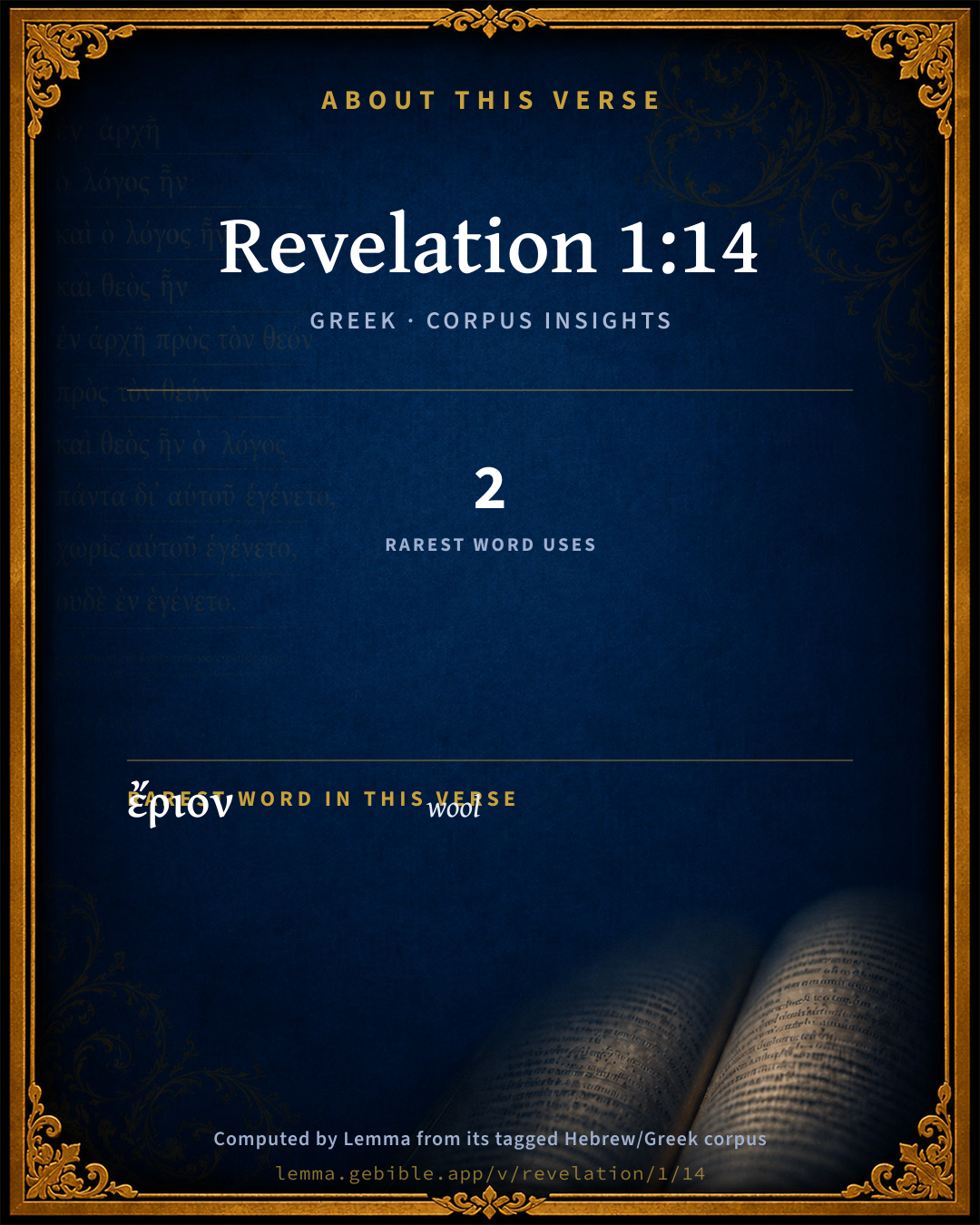
The rarest word here is ἔριον wool G2053 — appearing just 2 times in the whole Greek New Testament.

Shared distinctive vocabulary

ἔριον wool G2053 occurs in 2 verses of the Greek New Testament. Also found in:

Repetition

Words recur within this verse:

Cross-references

5

Topical passages linked to Revelation 1:14 in the Treasury of Scripture Knowledge — connected by theme and wording, ordered by reader-vote popularity; previews shown in the World English Bible.

  • Daniel 10:6 his body also was like the beryl, and his face as the appearance of lightning, and his eyes as flaming torches, and his arms and his feet like burnished brass, and the voice of his words like the voice of a multitude.
  • Daniel 7:9 I saw until thrones were placed, and one who was ancient of days sat: his clothing was white as snow, and the hair of his head like pure wool; his throne was fiery flames, [and] the wheels of it burning fire.
  • Revelation 2:18 "To the angel of the assembly in Thyatira write: "The Son of God, who has his eyes like a flame of fire, and his feet are like burnished brass, says these things:
  • Revelation 19:12 His eyes are a flame of fire, and on his head are many crowns. He has names written and a name written which no one knows but he himself.
  • Matthew 28:3 His appearance was like lightning, and his clothing white as snow.

Cross-references courtesy of OpenBible.info (CC BY 4.0).

Commentary

Notes on Revelation 1:14 from classic Christian and Jewish commentators (each source and its license shown beneath its notes). The classic Christian expositions comment on the surrounding passage and are grouped to its opening verse, so a note may address several verses; the Jewish commentaries on the Tanakh (Rashi and others) are per-verse, so they appear only where the commentator wrote on this verse.

Lemma curates 59 commentaries, every one of them public domain or Creative Commons licensed, each selected and text-cleaned for this edition rather than reprinted as found. About our sources →

Tyndale Open Study Notes

Tyndale Open Resources

1:14 White hair represents wisdom and maturity; this vision reflects Daniel’s vision of the Ancient One (Dan 7:9). • His eyes . . . like flames of fire pierce through pretense; the One who knows everything will judge everyone (see Dan 10:6; Heb 4:13).

Tyndale Open Study Notes — © Tyndale Open Resources, licensed CC BY-SA 4.0. Text via the HelloAO Bible API.

Bengel's Gnomon

Johann Albrecht Bengel

Rev 1:14. Ἡ κεφαλὴ καὶ αἱ τρίχες) ἕν διὰ δυοῖν: that is, the hair of His head. Thus John saw it.

Bengel's Gnomon of the New Testament — English translation (T&T Clark, Edinburgh, 1860) — public domain. Text from a community e-Sword module.

Meyer's Critical & Exegetical Commentary

Heinrich August Wilhelm Meyer

Rev_1:14. To the general conception ἡ δὲ κεφαλὴ αὐτοῦ, the part which properly pertains to the description is attached by the more accurately determining καὶ.[763] Thus there is a dependence on the ἡ δὲ κεφαλὴ αὐτοῦ, corresponding to which are the special particulars, each of which is designated with the addition of αὐτοῦ; viz., οἱ ὀφθ. αὐτοῦ, οἱ ποδ. αὐτοῦ, and ἡ φων. αὐτοῦ, while the καὶ αἱ τριχ. is without the αὐτοῦ.[764] The order of thought is not, therefore, as De Wette proposes, first concerning the whole of the head, to which also face and beard belong, and then especially to the hair of the head.

The whiteness of the hair signifies neither the freedom from sin of Christs earthly life,[765] nor in general the holiness peculiar to him;[766] nor does it designate merely the heavenly light-nature.[767] Christ rather appears here to the Christian prophet in the same divine brilliancy in which Daniel[768] beheld not the Son of man, but the Ancient of days, whose eternity is designated by the whiteness of his hair. This interpretation[769] is justified not only by the type in Daniel, but also by the fact that Christ represents himself as the Eternal One, like the Father, Rev_1:4; Rev_1:8, in his words, corresponding to his manifestation, Rev_1:17-18; cf. Rev_2:8. The eyes, as a flame of fire,[770] are, as all the other features, not without significant reference to the revelation itself.[771] By Rev_2:18, Rev_19:12,[772] the idea is presented not of omniscience in general,[773] also not of punitive justice,[774] or of holiness consuming all that is impure[775] without regard to omniscience, but of omniscience combined with holy wrath directed against all that is unholy.

[763] Cf., also, Bengel, Hengstenb., Ebrard.

[764] In Dan_7:9, according to the LXX., there stands, on the other hand, καὶ ἡ θρὶξ τῆς κεφαλῆς αὐτοῦ.

[765] Areth., Coccej., Vieg.

[766] Hengstenb., who, however, understands at the same time, the majesty of glory.

[767] De Wette.

[768] Rev_7:9.

[769] Cf., also, C. a Lap., Calov., Vitr., Storr., Diss. in Apoc., quaed. loc.; Commentatt. ed. Velthusen, etc., iv. 439; Stern, etc.

[770] Rev_19:12; Dan_10:6; cf. Virg., Aen., v. 647 sqq.: Divini signa decoris ardentesque notate oculosqui voltus vocisque sonus (Note the marks of divine beauty and the glowing eyes; what is the countenance, and sound of the voice). Hom., Il., xix. 365 sqq.: τὼ δὲ οἱ ὄσσε λαμπέσθην ὡσεί τε πυρὸς σέλας (The eyes shone like the brightness of fire).

[771] On the other hand, De Wette: An exaggeration of the spirited, fiery glance of human eyes, to the penetrating, consuming gaze of such eyes as belong to celestial beings, as the Greeks also ascribe to their gods, and as the Son of God has it in an unparalleled way.

[772] Cf. Psa_18:9; Psa_97:3; Deu_4:24; Deu_9:3; Heb_12:29.

[773] Vitr., Calov., Beng., Stern.

[774] Hengstenb.; cf. Ribera, C. a Lap.

[775] Ebrard.

Meyer — Critical and Exegetical Commentary on the New Testament — English translation by Peter Christie, edited by Frederick Crombie (T&T Clark, 1880) — public domain. Text from a community e-Sword module.

Expositor's Greek Testament

ed. W. Robertson Nicoll

Rev 1:14 . ὡς χ .; another conventional simile for celestial beings. ἡ κ . κ . αἱ τ ., a pleonastic expression; either = “his head, i.e. his hair,” or “his forehead and his hair”; scarcely a hendiadys for “the hair of the head” (Bengel). Jewish tradition rationalised the white hairs into a proof of God’s activity as a wise old teacher (Chag. 14, cf. Pro 20:27 f.), and the Daniel-vision might suggest the fine paradox between the divine energy and this apparent sign of weakness. But such traits are probably poetical, not allegorical, in John’s vision; they body forth his conception of Jesus as divine. In Egyptian theology a similar trait belongs to Ani after beatification. The whole conception of the messiah in the Apocalypse resembles that outlined in Enoch (Similitudes, xxxvii. lxxi.), where he also possesses pre-existence as Son of man (xlviii) sits on his throne of glory (xlvii. 3) for judgment, rules all men (lxii. 6), and slays the wicked with the word of his mouth (xlii. 2); but this particular transference to the messiah (Rev 1:14 ; Rev 1:17-18 , Rev 2:8 , Rev 22:12-13 ), of what is in Daniel predicated of God as the world-judge, seems to form a specifically N.T. idea, unmediated even in Enoch (xlvi. 1), although the association of priestly and judicial attributes with those of royalty was easy for an Oriental (it is predicated of the messiah by Jonathan ben Usiel on Zec 4:12-13 ). ὡς φλὸξ πυρός , like Slav. En. i. 5, from Dan 10:6 ; cf. Suet. August . 79, “oculos habuit claros et nitidos, quibus etiam existimari uoluit inesse quiddam diuini uigoris; gaudebat-que si quis sibi acrius contuenti quasi ad fulgorem solis uultum submitteret”. Divine beauty was generally manifested (Verg. Aen. ver. 647 f.) in glowing eyes (insight and indignation), the countenance and the voice; here also (Rev 1:15 ) in feet to crush all opposition. The messiah is not crowned, however ( cf. later, Rev 19:12 ). χ . = some hard (as yet unidentified) metal which gleamed after smelting. The most probable meaning of this obscure hybrid term is that suggested by Suidas: χαλκοίβανον · εἶδος ἠλέκτρου τιμιώτερου χρυσοῦ , ἔστι δὲ τὸ ἤλεκτρον ἀλλότυπον χρυσίον μεμιγμένον ὑέλῳ καὶ λιθείᾳ ( ἤλ . actually occuring in LXX, Eze 1:27 ). The reference then is to amber or to some composition like brass or (copper) bronze; only, it contains gold ( cf. vulg. = aurichalcum, a valuable and gleaming metal). Abbott (201) sees a corruption of some phrase like χαλκὸν ἐν κλιβάνῳ , while others suggest χαλκός and לבן ( i.e. , glowing white brass). Haussleiter would upon inadequate grounds omit ὡς ἐκ . κ . πεπ . (219 24).

The Expositor's Greek Testament, edited by W. Robertson Nicoll (1897–1910) — public domain. Text from a community e-Sword module.

Jamieson, Fausset & Brown

Robert Jamieson, A. R. Fausset & David Brown

--Greek, "But," or "And."

like wool--Greek, "like white wool." The color is the point of comparison; signifying purity and glory. (So in Isa 1:18). Not age, for hoary hairs are the sign of decay.

eyes . . . as . . . flame--all-searching and penetrating like fire: at the same time, also, implying consuming indignation against sin, especially at His coming "in flaming fire, taking vengeance" on all the ungodly, which is confirmed as the meaning here, by Rev 19:11-12.

Jamieson, Fausset & Brown — Commentary Critical and Explanatory on the Whole Bible (1871) — public domain (CC PDM 1.0). Text via the HelloAO Bible API.

Adam Clarke's Commentary

Verse 14. His head and his hairs were white like wool] This was not only an emblem of his antiquity, but it was the evidence of his glory; for the whiteness or splendour of his head and hair doubtless proceeded from the rays of light and glory which encircled his head, and darted from it in all directions. The splendour around the head was termed by the Romans nimbus, and by us a glory; and was represented round the heads of gods, deified persons, and saints. It is used in the same way through almost all the nations of the earth.

His eyes were as a flame of fire] To denote his omniscience, and the all-penetrating nature of the Divine knowledge.

Adam Clarke's Commentary on the Bible (1810–1826) — public domain. Text from a community e-Sword/MySword module.

Ellicott's Commentary for English Readers

(14) His head and his hairs were white like wool, as white as snow.—The whiteness here is thought by some to be the token of the transfiguration in light of the glorified person of the Redeemer. “It is the glorious white which is the colour and livery of heaven.” This doubtless is true; but it appears to me a mistake to say that there is no hint here of age. It is argued that the white hair of age is a token of decay, and that no such token would have place here; but surely this is straining a point, and making a mere emblem an argument. Age and youth alike have their glories; the glory of young men is their strength; the hoary head, too, the token of experience, dignity, authority, is the glory of age. Physically, white hair may be a sign of decay; typically it never is, else the effort to produce the appearance of it in the persons of monarchs and judges would never have been made. The white head is never in public sentiment other than the venerable sign of ripe knowledge, mature judgment, and solid wisdom; and as such it well betokens that full wisdom and authority which is wielded by the Ancient of Days, who, though always the same in the fresh dew of youth, is yet from everlasting, the captain of salvation, perfect through suffering, radiant in the glorious youthhood of heaven, venerable in that eternal wisdom and glory which He had with the Father before the world. (Comp. Dan_7:9.) “He was one,” Saadias Gaon beautifully says, “with the appearance of an old man, and like an old man full of mercies. His white hair, His white garments, indicated the pure, kind intentions He had to purify His people from their sins.”

His eyes were as a flame of fire.—Comp. Rev_19:12; Dan_10:6. The eyes of the Lord, which are in every place, beholding the evil and the good, are here described as like unto fire, to express not merely indignation (He had looked once on the Jewish rulers in indignation) against evil, but determination to consume it; for our God is a consuming fire, purging away sin from those who forsake sin, and consuming in their sin those who refuse to be separated from it. (See Rev_20:9; Dan_7:9-10; Jud_1:7.)

A Bible Commentary for English Readers, edited by Charles John Ellicott (1878–1897) — public domain. Text from a community e-Sword module.

The Cambridge Bible for Schools and Colleges

gen. ed. J. J. S. Perowne

14. like wool, as white as snow] Either these words are to be taken together, ‘like wool white as snow’ or we must punctuate “were white like white wool, like snow.” Though the Person seen is the Son of Man of Dan_7:13, the description is more nearly that of the Ancient of Days, ibid. 9. We need not wonder that Their union was made more plain to the later Prophet.

The Cambridge Bible for Schools and Colleges (gen. ed. J. J. S. Perowne; Cambridge University Press, 1878–1918) — public domain. Text from a community e-Sword module.

John Gill's Exposition

His head and his hairs were white like wool, as white as snow,.... In allusion to the white head and hairs of old men, said to be hoary, or like the hoar frost, and compared to an almond tree in bloom, Ecc 12:5; and here to wool and snow for whiteness; see Eze 27:18; and according to the Jews (p), , "white wool", is the wool of a lamb just born, about which a cloth is bound, that it may not be defiled; now these metaphors are expressive of the antiquity of Christ, who is the everlasting Father, and whose goings forth were of old, even from everlasting; and of his senile gravity and prudence, for with the Ancient is wisdom; he is the wisdom of God, in whom all the treasures of wisdom and knowledge are hid; and also of his glory and majesty, being the brightness of his Father's glory; and likewise of his true and proper deity, since this description is the same with that of the Ancient of days in Dan 7:9; for by his head is not here meant either God the Father, who is sometimes called the head of Christ, Co1 11:3, nor his divine nature, which is the chief and principal in him, nor his headship over the church; nor do his hairs intend his elect, which grow upon him, and are nourished by him, and are so called for their number, weakness, and purity:

and his eyes were as a flame of fire: see Dan 10:6; which may design the omniscience of Christ, which reaches to all persons, and things, and is very searching and penetrating, and discovers and brings to light things the most dark and obscure; and also Christ's eyes of love upon his own people, which have both heat and light; Christ's love never waxes cold, and, being shed abroad in the hearts of his people, warms theirs; and in the light of his gracious countenance do they see light; and his love, like flames of fire, melts their souls into a true and genuine repentance for sin: or else, rather his eyes of wrath and vengeance, as set upon his enemies, are here meant: which will be fierce and furious, bring swift and sudden destruction on them, before which there is no standing, and from which there is no fleeing. It is said of Augustus Caesar, that he had fiery eyes (q),

(p) T. Bab. Sabbat, fol. 54. 1. Maimon. & Bartenora in Misn. Sabbat, c. 5. sect. 2. (q) Servius in Virgil. Aeneid. l. 8. p. 13. 55.

John Gill's Exposition of the Whole Bible (1746–1763) — public domain (CC PDM 1.0). Text via the HelloAO Bible API.

Trapp's Complete Commentary

John Trapp

14 His head and his hairs were white like wool, as white as snow; and his eyes were as a flame of fire;

Ver. 14. White like wool] Noting his antiquity, or rather his eternity and unspeakable purity. Thales, one of the heathen sages, called God πρεσβυτατον των οντων, the most ancient of beings. (Diog. Laert.)

As a flame of fire] Sharp and terrible, such as pierce into the inward parts, Heb 4:13. {See Trapp on "Heb 4:13"} The school of nature teacheth, that the fiery eye needeth not outward light; that seeth extra mittendo, by sending out a ray, &c.

John Trapp, A Commentary or Exposition upon All the Books of the Old and New Testament (1647–1656) — public domain. Text from a community e-Sword module.

Albert Barnes' Notes on the Bible

His head and his hairs were white like wool, as white as snow - Exceedingly or perfectly white - the first suggestion to the mind of the apostle being that of wool, and then the thought occurring of its extreme whiteness resembling snow - the purest white of which the mind conceives. The comparison with wool and snow to denote anything especially white is not uncommon. See Isa 1:18. Prof. Stuart supposes that this means, not that his hairs were literally white, as if with age, which he says would be incongruous to one just risen from the dead, clothed with immortal youth and vigor, but that it means radiant, bright, resplendent - similar to what occurred on the transfiguration of the Saviour, Mat 17:2. But to this it may be replied:

That this would not accord well with that with which his hair is compared - snow and wool, particularly the latter. The usual meaning of the word is more obvious here, and not at all inappropriate.

The representation was suited to signify majesty and authority; and this would be best accomplished by the image of one who was venerable in years. Thus, in the vision that appeared to Daniel Dan 7:9, it is said of him who is there called the “Ancient of Days,” that “his garment was white as snow, and the hair of his head like the pure wool.” It is not improbable that John had that representation in his eye, and that therefore he would be impressed with the conviction that this was a manifestation of a divine person. We are not necessarily to suppose that this is the form in which the Saviour always appears now in heaven, anymore than we are to suppose that God appears always in the form in which he was manifested to Isaiah Isa 6:1, to Daniel Dan 7:9, or to Moses and Aaron, Nadab and Abihu in the mount, Exo 24:10-11. The representation is, that this form was assumed for the purpose of impressing the mind of the apostle with a sense of his majesty and glory.

And his eyes were as a flame of fire - Bright, sharp, penetrating; as if everything was light before them, or they would penetrate into the thoughts of people. Such a representation is not uncommon. We speak of a lightning glance, a fiery look, etc. In Dan 10:6, it is said of the man who appeared to the prophet on the banks of the river Hiddekel, that his eyes were “as lamps of fire.” Numerous instances of this comparison from the Greek and Latin Classics may be seen in Wetstein, in loco.

Albert Barnes' Notes on the Bible (1834–1885) — public domain. Text from a community e-Sword/MySword module.

Matthew Poole's English Annotations

His head and his hairs were white like wool, as white as snow: whiteness signifies purity; whiteness of hair signifies old age ordinarily, which commonly is attended with more prudence, as having most experience: hence this appearance of Christ may denote both his purity and wisdom, and that he is the Ancient of days; see Dan 7:9,13,22; though there the term of Ancient of days belongs to God the Father, yet it also agreeth to Christ, who is equal with the Father, as to his Divine nature.

And his eyes were as a flame of fire; such an appearance is applied to God, Eze 1:27; Dan 10:6; and to Christ, Rev 19:12, to denote either Christ’s knowledge, wisdom, and omniscience; or his grace in purifying souls, as fire doth metals; or his wrath and anger against his enemies.

Matthew Poole's English Annotations on the Holy Bible (1683–1685) — public domain. Text from a community e-Sword/MySword module.

Whedon's Commentary on the Bible

Daniel D. Whedon

14. As (Rev_1:16) his face was like the sun, so this sun bore a “corona” of hairs of dazzling whiteness.

White like wool—But that is not quite white enough, and so as snow. The whiteness is not indicative of age, but, like the whiteness of the priest’s robe, of purity, and of that celestial lustre characterizing the whole figure. See note, Rev_1:16.

Eyes… fire—Fire, we are told, denotes wrath, and so these eyes denote flaming wrath—for which there is no demand. How often does love find fire in the eyes of its object, and admiration find fire in the eye of genius. These are celestial eyes, beaming, burning, blazing with divine brilliancy; clairvoyant to look with omniscience into and through all visible things. In reality, however, the intensity and power of the eyes are simply in keeping with the supernatural splendour of the whole figure, stature, hair, and voice.

Daniel D. Whedon (gen. ed.), Commentary on the Old and New Testaments (1874–1909) — public domain. Text from a community e-Sword module.

The Pulpit Commentary

His head. From the garments of the great High Priest, St. John passes on to himself. What he had seen as a momentary foretaste of glory at the Transfiguration, he sees now as the abiding condition of the Christ. In Dan_7:9 "the Ancient of days" has "the hair of his head like pure wool." This snowy whiteness is partly the brightness of heavenly glory, partly the majesty of the hoary head. The Christ appears to St. John as a son of man, but also as a "Divine Person invested with the attributes of eternity." As a flame of fire. "The Lord thy God is a consuming fire". (Deu_4:24) "I the Lord search the heart, I try the reins". (Jer_17:10) The flame purifies the conscience and kindles the affections.

The Pulpit Commentary (1880–1919), ed. H.D.M. Spence-Jones & Joseph S. Exell — public domain. Text from a community e-Sword module.

John Wesley's Explanatory Notes

His head and his hair - That is, the hair of his head, not his whole head. Were white as white wool - Like the Ancient of Days, represented in Daniel's vision, Dan. vii, 9. Wool is commonly supposed to be an emblem of eternity. As snow - Betokening his spotless purity. And his eyes as a flame of fire - Piercing through all things; a token of his omniscience.

John Wesley, Explanatory Notes Upon the Whole Bible (1754–1765) — public domain. Text via the GEBible commentary corpus.

Godbey's Commentary on the New Testament

William B. Godbey

14. “His head and His hands were white as wool, white as snow.” This clause describes His antiquity, setting forth the fact that He is uncreated, and has existed from all eternity. “His eyes are as a flame of fire.” This certifies His omniscience. The eye is the great receptacle of knowledge, and symbolizes all the senses.

William B. Godbey, Commentary on the New Testament (1896–1900) — public domain. Text from a community e-Sword module.

The People's New Testament

B. W. Johnson

14. His head and his hair were white. White is the color of purity and of triumph. The idea here is not age but heavenly glory. His eyes were as a flame of fire. Bright, piercing, all seeing, flashing light, and also a consuming fire of the wicked.

B. W. Johnson's The People's New Testament with Notes (1889–1891) — public domain. Electronic text from the Christian Classics Ethereal Library (CCEL) ThML edition.

unfoldingWord translationNotes

Door43 World Missions Community

His head and hair were as white as wool—as white as snow

Wool and snow are examples of things that are very white. The repetition of "as white as" emphasizes that they were very white. (See: Simile and Doublet)

wool

This is the hair of a sheep or goat. It was known to be very white.

his eyes were like a flame of fire

His eyes are described as being full of light like a flame of fire. AT: "his eyes were glowing like a flame of fire" (See: Simile)

His feet were like polished bronze

Bronze is polished to make it shine and reflect light. AT: "His feet were very shiny like polished bronze" (See: Simile)

like polished bronze, like bronze that had been refined in a furnace

The bronze would be refined first and then polished. AT: "like bronze that has been purified in a hot furnace and polished" (See: Order of Events)

furnace

a strong container for holding a very hot fire. People would put metal in it, and the hot fire would burn away any impurities that were in the metal.

the sound of many rushing waters

This is very loud, like the sound of a large, fast flowing river, of a large waterfall, or of loud waves in the sea.

a sword ... was coming out of his mouth

The sword blade was sticking out of his mouth. The sword itself was not in motion.

a sword with two sharp edges

This refers to a double-edged sword, which is sharpened on both sides to cut both directions.

translationWords

head

snow

like

fire

bronze

voice

water

right hand

sword

face

unfoldingWord translationNotes — © Distant Shores Media and the Door43 World Missions Community, licensed CC BY-SA 4.0. Source: git.door43.org/Door43/en_tn.

Cambridge Greek Testament for Schools and Colleges

14. ὡς ἔριον λευκόν, ὡς χιών. Cf. Dan 7:9 LXX. ὡσεὶ ἔριον λευκὸν καθαρὸν (Theodotion has ὡσεὶ ἔριον καθαρὸν); otherwise we might translate and punctuate “like wool, as white as snow.” Though the Person seen is the Son of Man of Dan 7:13, the description is more nearly that of the Ancient of Days, ibid. 9. We need not wonder that Their union was made more plain to the later Prophet.

Cambridge Greek Testament for Schools and Colleges (Cambridge University Press, 1896; 21 vols, various authors incl. Carr, Maclear, Plummer, Farrar, Lumby, Moule, M. R. James, Simcox) — public domain. Text from a community e-Sword module.

Alford’s Greek Testament

Henry Alford

14.] and his head and his hairs (were) white like white wool, as snow (by the κεφαλή is perhaps indicated the forehead; not the face, which is afterwards described. It is only in colour, not in material, that His hair is compared to white wool; and the ὡς χιών is afterwards added to impress this still more. The whiteness signifies purity and glory, not as (Expos. ad Galat., c. 40, vol. iii. p. 2134: “quia et Dominus non nisi ob antiquitatem veritatis in Apocalypsi albo capite apparuit”), Vitr., Stern, al., eternity, either here or in Dan 7:9), and his eyes as a flame of fire (so Dan 10:6: representing perhaps, as Vitr., “perspicaciam divinæ et puræ mentis, omnia arcana pervadentis.” This may be, notwithstanding that Gabriel has eyes like lamps of fire in Daniel. Though omniscience could not be ascribed to him, the figure might be relatively consistent. But it is perhaps better to consider these physical details rather as in themselves characteristic, than as emblematic of attributes lying “beneath” them. The “fiery eye,” among the sons of men, is indicative of energy and power of command: so also in the Son of man Himself):

Henry Alford, The Greek Testament (1849–1861) — public domain. Text from a community e-Sword module.

Lesson kit

Teaching starters — assembled from the data on this page, not authored interpretation. Every prompt links to the verse data it draws on. Edit before teaching.

Revelation, in the Revelation, opens this verse with 20 words (13 distinct Greek lemmas). Its most distinctive word is érion (“wool”). A historical commentator’s framing appears above. Read the whole chapter for the surrounding context.

Discussion questions

  1. What does “wool” (érion) contribute to the verse as a whole?
  2. How does Hebrews 9:19, which shares the word «wool», read alongside this verse?
  3. What does the repetition of “white” (2× in this one verse) do in this verse?
  4. These translations render this verse differently; the difference is in the English rendering, not the original. What questions does that raise?
  5. Compare how Tyndale Open Study Notes and Bengel's Gnomon read this verse. Where do they agree or differ?

Things to notice

  • These translations choose different wording for 7 words in this verse.
  • “white” occurs 2× in this single verse.
  • 13 distinct Greek lemmas span 20 words in this verse.

Reading settings

Reading text

Shown beneath each verse's original-language words.

Old Testament
Old Testament edition

Read the OT as the Masoretic Hebrew (MT) or the Greek Septuagint (LXX).

English shown for the Greek Septuagint (in the Hebrew ↔ Greek comparison).

Comparing translations? Open the Compare panel on any verse page to stack up to four side by side.