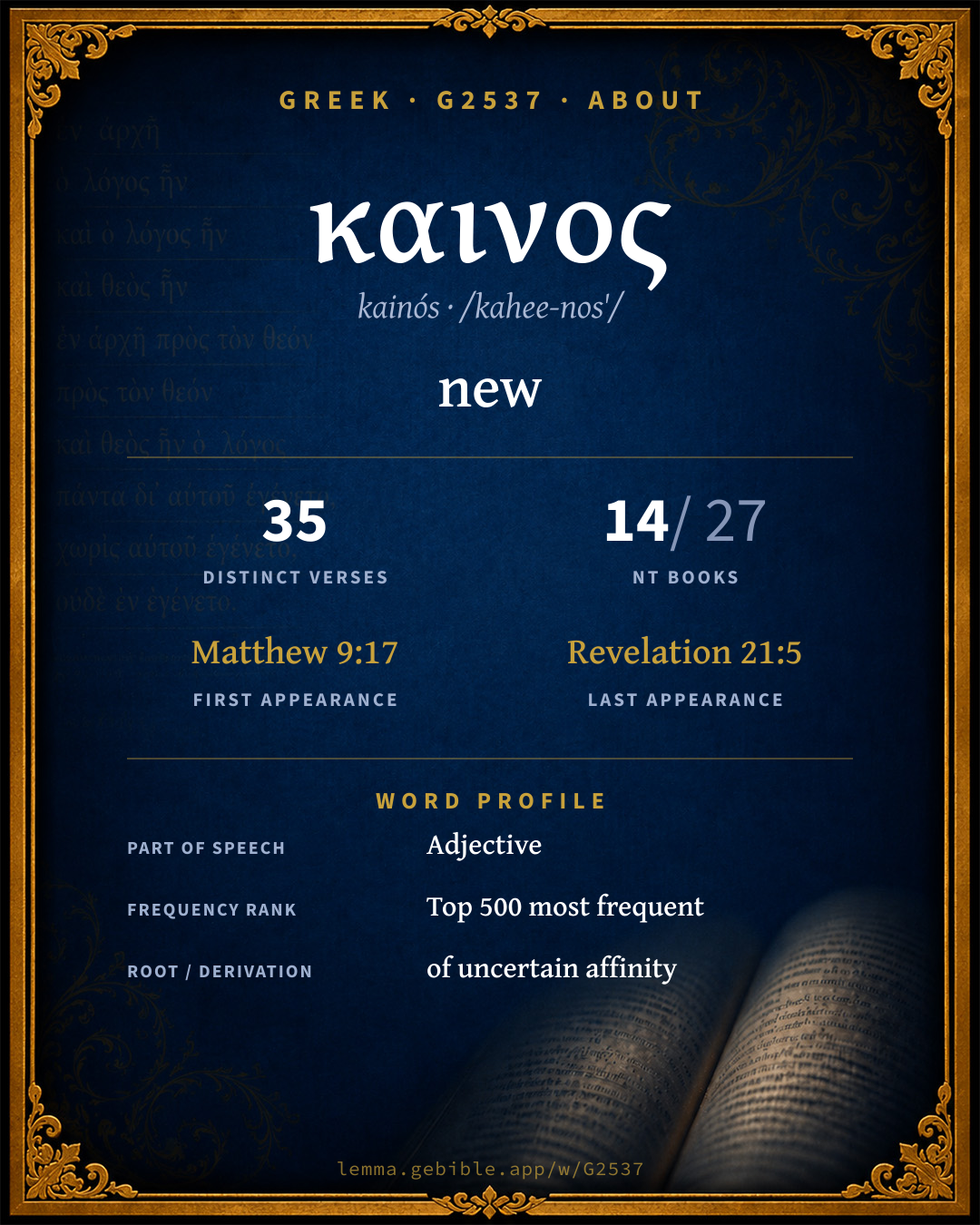
καινός
new
Full lexicon entry — Thayer's Greek Lexicon
From Thayer's Greek Lexicon
Where this word appears
See every Accusative-case word in the Greek New Testament →
Grammar key — what these labels mean
Part of speech
- Adjective
- A word that describes or qualifies a noun.
Case
- Accusative
- The case of the direct object and of extent.
- Nominative
- The case of the subject (and the predicate nominative).
- Genitive
- The case of source, possession, or “of” — answers “whose / from what.”
- Dative
- The case of the indirect object, means, or location — “to / for / with / in.”
Gender
- Feminine
- Grammatically feminine.
- Neuter
- Grammatically neuter.
- Masculine
- Grammatically masculine.
Number
- Singular
- One.
- Plural
- More than one.
Degree
- Comparative
- Expresses a greater degree (“greater,” “more”).
Every verse where G2537 appears in the Book of Matthew — 4 distinct verses. Click any verse to open its interlinear word-by-word view. Verse text shown in the World English Bible for context — . Each verse’s Greek form is shown with its reference; the English is not keyword-highlighted, since the data carries no word-level English alignment. Use “Compare translations” on any verse to read it across multiple English versions. This concordance covers the Greek New Testament; Septuagint (Greek Old Testament) occurrences of this word are not indexed here.
Matthew
- Matthew 9:17 καινούς adj acc pl masc Neither do people put new wine into old wineskins, or else the skins would burst, and the wine be spilled, and the skins ruined. No, they put new wine into fresh wineskins, and both are preserved."
- Matthew 13:52 καινὰ adj acc pl neut He said to them, "Therefore, every scribe who has been made a disciple in the Kingdom of Heaven is like a man who is a householder, who brings out of his treasure new and old things."
- Matthew 26:29 καινὸν adj acc sg neut But I tell you that I will not drink of this fruit of the vine from now on, until that day when I drink it anew with you in my Father's Kingdom."
- Matthew 27:60 καινῷ adj dat sg neut and laid it in his own new tomb, which he had hewn out in the rock, and he rolled a great stone to the door of the tomb, and departed.
About this entry
At a glance — auto-summarized from this page’s data, not written by a person. Every figure links to its source below. This summary describes the numbers; it doesn’t interpret them.
The Greek adjective καινος centers on the idea of “new.” First canonically at Matthew 9:17, it enters the text early. It turns up in 35 verses across 14 books, a moderately common footprint. It clusters with καινοτης under a shared root. For the data behind this summary, explore the sense tree and the renderings breakdown below.
Gloss history
Strong's 1890 vs modern scholarship

About this word
Strong's G2537 catalogs a Greek word from the Greek New Testament.
These counts are not copied from any lexicon or concordance. They are computed here, from the morphology-tagged Greek New Testament. What Lemma adds →
- 35
- distinct verses
- The word appears in 35 distinct verses.
- 14 / 27
- NT books
- The word appears in 14 of 27 New Testament books.
- #364
- by frequency
- Top 500 most frequent Greek words (rank 364 of 5,347 Greek words by occurrence).
View all 35 occurrences in the concordance →
Most concentrated in
- Revelation 7 verses 20%
- Matthew 4 verses 11%
- Mark 4 verses 11%
By section of the New Testament
By traditional corpus
Conventional, traditional groupings — biblical authorship is debated, so this is a traditional corpus grouping, not an authorship claim. Some books belong to more than one corpus (Luke is in both the Gospels and the Lukan corpus, and so on), so these shares overlap and need not total 100%. Each figure is a share of the word’s 35 distinct verses.
- Gospels 13 verses · 37%
- Johannine 12 verses · 34%
- Revelation 7 verses · 20%
- Pauline corpus 6 verses · 17%
- Lukan (Luke–Acts) 5 verses · 14%
- General (Catholic) Epistles 4 verses · 11%
- Hebrews 3 verses · 9%
How translations render this word
Counts come from each version’s own published word-to-Strong’s tagging or interlinear alignment — an approximate guide to how each version renders this word, not a word-level alignment the data otherwise carries. Because each total is that version’s own tagged count, the per-version totals vary from one another and need not match the appearance or distinct-verse counts above. These counts may also differ from a printed concordance because Lemma counts each distinctly tagged rendering and does not collapse phrase taggings into a single head-word total. This is a fixed set of word-tagged versions (KJV, ASV, BSB, ULT) and does not change with the reading translation you choose elsewhere. Each version’s license is shown beside its name below (and on Sources).
- King James Version: New 39×
- American Standard Version: New 34×, Fresh 3×, The 2×
- Berean Standard Bible: New 39×, Anew 2×
- unfoldingWord Literal Text: New 40×
King James Version Public Domain
Renders G2537 across 44 tagged occurrences — most commonly:
Plus 5 renderings that appear only once — usually multi-word phrases or single function words the recovered tagging swept in, not distinct renderings.
American Standard Version Public Domain
Renders G2537 across 44 tagged occurrences — most commonly:
Plus 5 renderings that appear only once — usually multi-word phrases or single function words the recovered tagging swept in, not distinct renderings.
Berean Standard Bible Public Domain
Renders G2537 across 41 tagged occurrences — most commonly:
Not rendered by a distinct English word in 1 further occurrence.
unfoldingWord Literal Text CC BY-SA 4.0
Renders G2537 across 42 tagged occurrences — most commonly:
Plus 2 renderings that appear only once — usually multi-word phrases or single function words the recovered tagging swept in, not distinct renderings.
Senses in Thayer's
The 1 sense Thayer's distinguishes for this word, in lexicon order (not ranked by frequency or importance). The full entry — with sub-senses — is in the Lexicon Entry tab.
- new
Word origin
Origin: of uncertain affinity
Of uncertain affinity; new (especially in freshness ; while G3501 is properly so with respect to age ): - new.
— Strong’s Exhaustive Concordance (1890), public domain.
Forms in the corpus
The 14 distinct written forms G2537 takes in the Greek New Testament, most frequent first — each parse links to that case’s occurrences in the concordance.
Same root — word family
Other Thayer's entries built from the same root as G2537, grouped by Strong’s listed origin. These share a root / origin per the lexicon — not necessarily a shared meaning. Each links to that word’s own entry.
Derived from this word
Compare all same-root words → They share a root, not necessarily a meaning.
Septuagint usage
The same Greek word καινος appears 40 times in the Greek Old Testament (Septuagint), across 36 verses in 15 books.
- 40
- LXX occurrences
- Tagged occurrences of this Greek word in the Septuagint.
- 36
- verses
- Distinct Septuagint verses containing this word.
- 15 / 39
- OT books
- The word appears in 15 of the 39 Old Testament books.
Sample Septuagint occurrences
- Deuteronomy 20:5 καινός
- Joshua 9:13 καινός
- Judges 5:8 καινός
- 1 Samuel 6:7 καινός
- 2 Samuel 6:3 καινός
- 1 Kings 11:29 καινός
- 2 Kings 2:20 καινός
- 1 Chronicles 13:7 καινός
- 2 Chronicles 20:5 καινός
- Job 29:20 καινός
- Psalms 143:9 καινός
- Ecclesiastes 1:10 καινός
Septuagint occurrences (same lexeme)
Every verse where the same Strong’s number (G2537) appears in the Greek Septuagint. Verse text shown in the World English Bible for context; the Greek form is the matched word — the English is not keyword-highlighted.
- Deuteronomy 20:5 καινός The officers shall speak to the people, saying, What man is there who has built a new house, and has not dedicated it? let him go and return to his house, lest he die in the battle, and another man dedicate it.
- Deuteronomy 22:8 καινός When you build a new house, then you shall make a battlement for your roof, that you don't bring blood on your house, if any man fall from there.
- Deuteronomy 32:17 καινός They sacrificed to demons, [which were] no God, To gods that they didn't know, To new [gods] that came up of late, Which your fathers didn't dread.
- Joshua 9:13 καινός and these wine-skins, which we filled, were new; and, behold, they are torn: and these our garments and our shoes are become old by reason of the very long journey.
- Judges 5:8 καινός They chose new gods; Then was war in the gates: Was there a shield or spear seen Among forty thousand in Israel?
- Judges 15:13 καινός They spoke to him, saying, No; but we will bind you fast, and deliver you into their hand: but surely we will not kill you. They bound him with two new ropes, and brought him up from the rock.
- Judges 16:11 καινός He said to her, If they only bind me with new ropes with which no work has been done, then shall I become weak, and be as another man.
- Judges 16:12 καινός So Delilah took new ropes, and bound him therewith, and said to him, The Philistines are on you, Samson. The liers-in-wait were abiding in the inner chamber. He broke them off his arms like a thread.
- 1 Samuel 6:7 καινός Now therefore take and prepare yourselves a new cart, and two milk cattle, on which there has come no yoke; and tie the cattle to the cart, and bring their calves home from them;
- 2 Samuel 6:3 καινός They set the ark of God on a new cart, and brought it out of the house of Abinadab that was in the hill: and Uzzah and Ahio, the sons of Abinadab, drove the new cart.
- 1 Kings 11:29 καινός It happened at that time, when Jeroboam went out of Jerusalem, that the prophet Ahijah the Shilonite found him in the way; now [Ahijah] had clad himself with a new garment; and they two were alone in the field.
- 1 Kings 11:30 καινός Ahijah laid hold of the new garment that was on him, and tore it in twelve pieces.
- 1 Kings 12:24 καινός Thus says Yahweh, You shall not go up, nor fight against your brothers the children of Israel: return every man to his house; for this thing is of me. So they listened to the word of Yahweh, and returned and went their way, according to the word of Yahweh.
- 2 Kings 2:20 καινός He said, Bring me a new jar, and put salt therein. They brought it to him.
- 1 Chronicles 13:7 καινός They carried the ark of God on a new cart, [and brought it] out of the house of Abinadab: and Uzza and Ahio drove the cart.
- 2 Chronicles 20:5 καινός Jehoshaphat stood in the assembly of Judah and Jerusalem, in the house of Yahweh, before the new court;
- Job 29:20 καινός My glory is fresh in me, My bow is renewed in my hand.'
- Psalms 143:9 καινός Deliver me, Yahweh, from my enemies. I flee to you to hide me.
- Ecclesiastes 1:10 καινός Is there a thing of which it may be said, "Behold, this is new?" It has been long ago, in the ages which were before us.
- Isaiah 8:1 καινός Yahweh said to me, "Take a large tablet, and write on it with a man's pen, 'For Maher Shalal Hash Baz;'
- Isaiah 41:15 καινός Behold, I have made you [to be] a new sharp threshing instrument having teeth; you shall thresh the mountains, and beat them small, and shall make the hills as chaff.
- Isaiah 42:9 καινός Behold, the former things have happened, and new things do I declare. Before they spring forth I tell you of them.
- Isaiah 42:10 καινός Sing to Yahweh a new song, and his praise from the end of the earth; you who go down to the sea, and all that is therein, the isles, and the inhabitants of it.
- Isaiah 43:19 καινός Behold, I will do a new thing; now shall it spring forth; shall you not know it? I will even make a way in the wilderness, and rivers in the desert.
- Isaiah 48:6 καινός You have heard it; see all this; and you, will you not declare it? I have shown you new things from this time, even hidden things, which you have not known.
- Isaiah 62:2 καινός The nations shall see your righteousness, and all kings your glory, and you shall be called by a new name, which the mouth of Yahweh shall name.
- Isaiah 65:15 καινός You shall leave your name for a curse to my chosen; and the Lord Yahweh will kill you; and he will call his servants by another name:
- Isaiah 65:17 καινός For, behold, I create new heavens and a new earth; and the former things shall not be remembered, nor come into mind.
- Isaiah 66:22 καινός For as the new heavens and the new earth, which I will make, shall remain before me, says Yahweh, so shall your seed and your name remain.
- Jeremiah 33:10 καινός Thus says Yahweh: Yet again there shall be heard in this place, about which you say, It is waste, without man and without animal, even in the cities of Judah, and in the streets of Jerusalem, that are desolate, without man and without inhabitant and without animal,
- Jeremiah 38:22 καινός behold, all the women who are left in the king of Judah's house shall be brought forth to the king of Babylon's princes, and those women shall say, Your familiar friends have set you on, and have prevailed over you: [now that] your feet are sunk in the mire, they are turned away back.
- Jeremiah 38:31 καινός
- Jeremiah 43:10 καινός and tell them, Thus says Yahweh of Hosts, the God of Israel: Behold, I will send and take Nebuchadrezzar the king of Babylon, my servant, and will set his throne on these stones that I have hidden; and he shall spread his royal pavilion over them.
- Ezekiel 11:19 καινός I will give them one heart, and I will put a new spirit within you; and I will take the stony heart out of their flesh, and will give them a heart of flesh;
- Ezekiel 18:31 καινός Cast away from you all your transgressions, in which you have transgressed; and make you a new heart and a new spirit: for why will you die, house of Israel?
- Ezekiel 36:26 καινός A new heart also will I give you, and a new spirit will I put within you; and I will take away the stony heart out of your flesh, and I will give you a heart of flesh.
These are occurrences of the same Greek lexeme (G2537) in the Septuagint — not a translation of any one Hebrew word. The store carries no word-level Hebrew↔Greek alignment, so no Hebrew original is asserted here. Counts come from the recovered LXX Strong's tagging — high-frequency vocabulary is well covered, while rare or late forms may be untagged — so they reflect tagged occurrences and may slightly undercount.