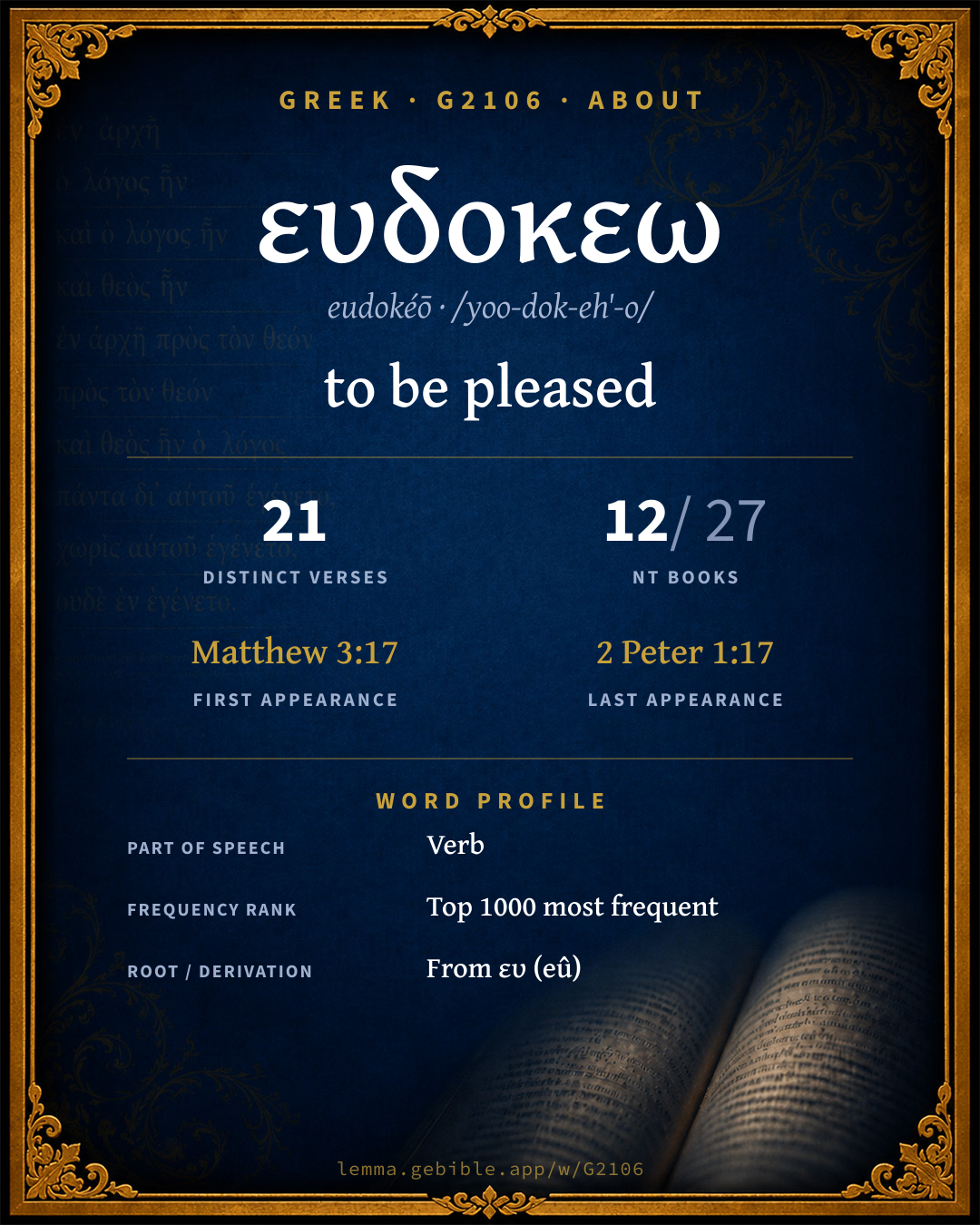
εὐδοκέω
to be pleased
‘to be pleased’ is one of 2 main senses fuller range ↓
Full lexicon entry — Thayer's Greek Lexicon
From Thayer's Greek Lexicon
Where this word appears
See every Aorist-tense verb in the Greek New Testament →
Grammar key — what these labels mean
Part of speech
- Verb
- An action or state-of-being word.
Tense
- Aorist
- Action viewed as a simple whole, without regard to duration — often past (perfective aspect).
- Present
- Ongoing or general action in present time (imperfective aspect).
Voice
- Active
- The subject performs the action.
Mood
- Indicative
- States a fact or asks a factual question (the mood of reality).
- Participle
- A verbal adjective (“writing,” “having written”).
Case
- Nominative
- The case of the subject (and the predicate nominative).
Person
- 3rd person
- The one spoken about (“he / she / it / they”).
- 1st person
- The speaker (“I / we”).
- 2nd person
- The one addressed (“you”).
Gender
- Masculine
- Grammatically masculine.
Number
- Singular
- One.
- Plural
- More than one.
1 verse where G2106 appears in the Present tense in the Book of Hebrews. Filtered view — show all forms. Click any verse to open its interlinear word-by-word view. Verse text shown in the World English Bible for context — . Each verse’s Greek form is shown with its reference; the English is not keyword-highlighted, since the data carries no word-level English alignment. Use “Compare translations” on any verse to read it across multiple English versions. This concordance covers the Greek New Testament; Septuagint (Greek Old Testament) occurrences of this word are not indexed here.
Hebrews
About this entry
At a glance — auto-summarized from this page’s data, not written by a person. Every figure links to its source below. This summary describes the numbers; it doesn’t interpret them.
At its core, ευδοκεω (eudokéō) means “to be pleased.” Scripture first uses it in Matthew 3:17. Spanning 21 verses in 12 books, it ranks among the uncommon words of the Greek New Testament. Catalogued under 2 senses, its meaning is not single-sense. From the same root come ευ, ευαγγελιζω and ευαρεστος. Each statement above links to its evidence; the full detail follows below.
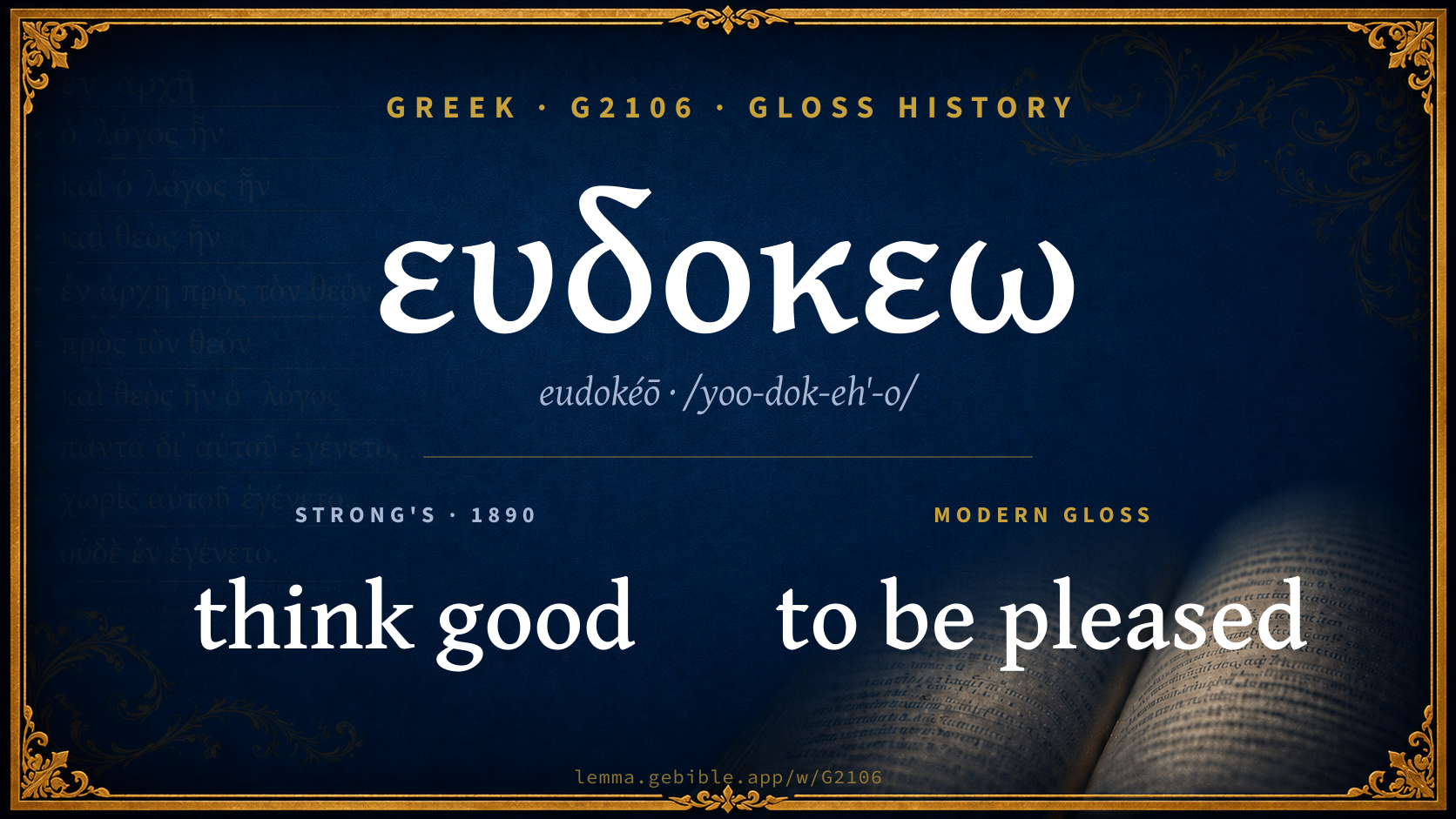
Gloss history
Strong's 1890 vs modern scholarship
About this word
Strong's G2106 catalogs a Greek word from the Greek New Testament.
These counts are not copied from any lexicon or concordance. They are computed here, from the morphology-tagged Greek New Testament. What Lemma adds →
- 21
- distinct verses
- The word appears in 21 distinct verses.
- 12 / 27
- NT books
- The word appears in 12 of 27 New Testament books.
- #607
- by frequency
- Top 1000 most frequent Greek words (rank 607 of 5,347 Greek words by occurrence).
View all 21 occurrences in the concordance →
By section of the New Testament
By traditional corpus
Conventional, traditional groupings — biblical authorship is debated, so this is a traditional corpus grouping, not an authorship claim. Some books belong to more than one corpus (Luke is in both the Gospels and the Lukan corpus, and so on), so these shares overlap and need not total 100%. Each figure is a share of the word’s 21 distinct verses.
- Pauline corpus 11 verses · 52%
- Gospels 6 verses · 29%
- Hebrews 3 verses · 14%
- Lukan (Luke–Acts) 2 verses · 10%
- General (Catholic) Epistles 1 verse · 5%
How translations render this word
Counts come from each version’s own published word-to-Strong’s tagging or interlinear alignment — an approximate guide to how each version renders this word, not a word-level alignment the data otherwise carries. Because each total is that version’s own tagged count, the per-version totals vary from one another and need not match the appearance or distinct-verse counts above. These counts may also differ from a printed concordance because Lemma counts each distinctly tagged rendering and does not collapse phrase taggings into a single head-word total. This is a fixed set of word-tagged versions (KJV, ASV, BSB, ULT) and does not change with the reading translation you choose elsewhere. Each version’s license is shown beside its name below (and on Sources).
- King James Version: I am well pleased 4×, Pleased 3×, Hath pleased them 2×
- American Standard Version: I am well pleased 4×, 's good pleasure 2×, Pleasure 2×
- Berean Standard Bible: I am well pleased 4×, Was pleased 3×
- unfoldingWord Literal Text: I am well pleased 4×, Was pleased 3×, Well pleased 2×
King James Version Public Domain
Renders G2106 across 25 tagged occurrences — most commonly:
Plus 14 renderings that appear only once — usually multi-word phrases or single function words the recovered tagging swept in, not distinct renderings.
American Standard Version Public Domain
Renders G2106 across 25 tagged occurrences — most commonly:
Plus 15 renderings that appear only once — usually multi-word phrases or single function words the recovered tagging swept in, not distinct renderings.
Berean Standard Bible Public Domain
Renders G2106 across 21 tagged occurrences — most commonly:
Plus 14 renderings that appear only once — usually multi-word phrases or single function words the recovered tagging swept in, not distinct renderings.
unfoldingWord Literal Text CC BY-SA 4.0
Renders G2106 across 25 tagged occurrences — most commonly:
Plus 16 renderings that appear only once — usually multi-word phrases or single function words the recovered tagging swept in, not distinct renderings.
Senses in Thayer's
The 2 senses Thayer's distinguishes for this word, in lexicon order (not ranked by frequency or importance). The full entry — with sub-senses — is in the Lexicon Entry tab.
- it seems good to one, is one's good pleasure
- to be well pleased with, take pleasure in, to be favourably inclined towards one
Word origin
Derived from ευ (eû) (G2095) — to prosper.
Forms in the corpus
The 10 distinct written forms G2106 takes in the Greek New Testament, most frequent first — each parse links to that tense’s occurrences in the concordance.
| Form | Parsing | Example | Uses |
|---|---|---|---|
| εὐδόκησα eudókēsa | Verb, Aorist, Active, Indicative, 1st person, Singular | Matthew 3:17 | 5 |
| εὐδόκησεν eudókēsen | Verb, Aorist, Active, Indicative, 3rd person, Singular | Luke 12:32 | 5 |
| εὐδοκοῦμεν eudokoûmen | Verb, Present, Active, Indicative, 1st person, Plural | 2 Corinthians 5:8 | 2 |
| ηὐδόκησαν ēudókēsan | Verb, Aorist, Active, Indicative, 3rd person, Plural | Romans 15:26 | 2 |
| ηὐδόκησας ēudókēsas | Verb, Aorist, Active, Indicative, 2nd person, Singular | Hebrews 10:6 | 2 |
| εὐδοκήσαμεν eudokḗsamen | Verb, Aorist, Active, Indicative, 1st person, Plural | 1 Thessalonians 3:1 | 1 |
| εὐδοκήσαντες eudokḗsantes | Verb, Aorist, Active, Participle, Nominative, Plural, Masculine | 2 Thessalonians 2:12 | 1 |
| εὐδοκεῖ eudokeî | Verb, Present, Active, Indicative, 3rd person, Singular | Hebrews 10:38 | 1 |
| εὐδοκῶ eudokō̂ | Verb, Present, Active, Indicative, 1st person, Singular | 2 Corinthians 12:10 | 1 |
| ηὐδόκησεν ēudókēsen | Verb, Aorist, Active, Indicative, 3rd person, Singular | Matthew 12:18 | 1 |
Same root — word family
Other Thayer's entries built from the same root as G2106, grouped by Strong’s listed origin. These share a root / origin per the lexicon — not necessarily a shared meaning. Each links to that word’s own entry.
Derives from
Shares the same root
- ευαγγελιζω euangelízō G2097 to evangelize
- ευαρεστος euárestos G2101 pleasing
- ευγενης eugenḗs G2104 noble
- ευδια eudía G2105 fair weather
- ευδοκια eudokía G2107 pleasure
- ευεργετης euergétēs G2110 benefactor
- ευθετος eúthetos G2111 well situated
- ευθυμος eúthymos G2115 courageous
- ευθυς euthýs G2117 straight
- ευκαιρος eúkairos G2121 opportune
- ευκοπωτερος eukopṓteros G2123 easy
- ευλαβης eulabḗs G2126 devout
- ευλογεω eulogéō G2127 to praise
- ευμεταδοτος eumetádotos G2130 generous
- ευνοεω eunoéō G2132 to wish well
- ευοδοω euodóō G2137 to prosper
- ευπειθης eupeithḗs G2138 obedient
- ευπεριστατος euperístatos G2139 besetting
- ευποιΐα eupoiḯa G2140 doing good
- ευπρεπεια euprépeia G2143 beauty
- ευπροσδεκτος euprósdektos G2144 acceptable
- ευπροσεδρος euprósedros G2145 devoted
- ευπροσωπεω euprosōpéō G2146 to please
- ευσεβης eusebḗs G2152 pious
+13 more words share this root (not shown).
Proper names from this root
People and places named from this root — a name, not an additional meaning of the word.
Compare all same-root words → Showing 4 of 42 — not the complete family. 3 of the same-root words are proper names (people or places). They share a root, not necessarily a meaning.
Septuagint usage
The same Greek word ευδοκεω appears 37 times in the Greek Old Testament (Septuagint), across 36 verses in 13 books.
- 37
- LXX occurrences
- Tagged occurrences of this Greek word in the Septuagint.
- 36
- verses
- Distinct Septuagint verses containing this word.
- 13 / 39
- OT books
- The word appears in 13 of the 39 Old Testament books.
Sample Septuagint occurrences
- Genesis 24:26 εὐδοκέω
- Leviticus 26:34 εὐδοκέω
- Judges 11:17 εὐδοκέω
- 2 Samuel 22:20 εὐδοκέω
- 1 Chronicles 29:3 εὐδοκέω
- 2 Chronicles 10:7 εὐδοκέω
- Job 14:6 εὐδοκέω
- Psalms 39:14 εὐδοκέω
- Ecclesiastes 9:7 εὐδοκέω
- Jeremiah 2:19 εὐδοκέω
- Habakkuk 2:4 εὐδοκέω
- Haggai 1:8 εὐδοκέω
Septuagint occurrences (same lexeme)
Every verse where the same Strong’s number (G2106) appears in the Greek Septuagint. Verse text shown in the World English Bible for context; the Greek form is the matched word — the English is not keyword-highlighted.
- Genesis 24:26 εὐδοκέω The man bowed his head, and worshiped Yahweh.
- Genesis 24:48 εὐδοκέω I bowed my head, and worshiped Yahweh, and blessed Yahweh, the God of my master Abraham, who had led me in the right way to take my master's brother's daughter for his son.
- Genesis 33:10 εὐδοκέω Jacob said, "Please, no, if I have now found favor in your sight, then receive my present at my hand, because I have seen your face, as one sees the face of God, and you were pleased with me.
- Leviticus 26:34 εὐδοκέω Then the land will enjoy its sabbaths as long as it lies desolate and you are in your enemies' land. Even then the land will rest and enjoy its sabbaths.
- Leviticus 26:41 εὐδοκέω I also walked contrary to them, and brought them into the land of their enemies: if then their uncircumcised heart is humbled, and they then accept the punishment of their iniquity;
- Judges 11:17 εὐδοκέω then Israel sent messengers to the king of Edom, saying, Please let me pass through your land; but the king of Edom didn't listen. In the same way, he sent to the king of Moab; but he would not: and Israel abode in Kadesh.
- Judges 15:18 εὐδοκέω He was very thirsty, and called on Yahweh, and said, You have given this great deliverance by the hand of your servant; and now shall I die for thirst, and fall into the hand of the uncircumcised.
- Judges 19:10 εὐδοκέω But the man wouldn't stay that night, but he rose up and departed, and came over against Jebus (the same is Jerusalem): and there were with him a couple of donkeys saddled; his concubine also was with him.
- Judges 19:25 εὐδοκέω But the men wouldn't listen to him: so the man laid hold on his concubine, and brought her forth to them; and they knew her, and abused her all the night until the morning: and when the day began to spring, they let her go.
- Judges 20:13 εὐδοκέω Now therefore deliver up the men, the base fellows, who are in Gibeah, that we may put them to death, and put away evil from Israel. But Benjamin would not listen to the voice of their brothers the children of Israel.
- 2 Samuel 22:20 εὐδοκέω He brought me forth also into a large place; He delivered me, because he delighted in me.
- 1 Chronicles 29:3 εὐδοκέω In addition, because I have set my affection on the house of my God, seeing that I have a treasure of my own of gold and silver, I give it to the house of my God, over and above all that I have prepared for the holy house,
- 1 Chronicles 29:23 εὐδοκέω Then Solomon sat on the throne of Yahweh as king instead of David his father, and prospered; and all Israel obeyed him.
- 2 Chronicles 10:7 εὐδοκέω They spoke to him, saying, If you are kind to this people, and please them, and speak good words to them, then they will be your servants forever.
- Job 14:6 εὐδοκέω Look away from him, that he may rest, Until he shall accomplish, as a hireling, his day.
- Psalms 39:14 εὐδοκέω
- Psalms 43:4 εὐδοκέω Then I will go to the altar of God, To God, my exceeding joy. I will praise you on the harp, God, my God.
- Psalms 48:14 εὐδοκέω For this God is our God forever and ever. He will be our guide even to death.
- Psalms 50:18 εὐδοκέω When you saw a thief, you consented with him, And have participated with adulterers.
- Psalms 50:21 εὐδοκέω You have done these things, and I kept silent. You thought that the "I AM" was just like you. I will rebuke you, and accuse you in front of your eyes.
- Psalms 67:17 εὐδοκέω
- Psalms 76:8 εὐδοκέω You pronounced judgment from heaven. The earth feared, and was silent,
- Psalms 84:2 εὐδοκέω My soul longs, and even faints for the courts of Yahweh. My heart and my flesh cry out for the living God.
- Psalms 101:15 εὐδοκέω
- Psalms 118:108 εὐδοκέω
- Psalms 146:10 εὐδοκέω Yahweh will reign forever; Your God, O Zion, to all generations. Praise Yah!
- Psalms 146:11 εὐδοκέω
- Psalms 149:4 εὐδοκέω For Yahweh takes pleasure in his people. He crowns the humble with salvation.
- Psalms 151:5 εὐδοκέω
- Ecclesiastes 9:7 εὐδοκέω Go your way--eat your bread with joy, and drink your wine with a merry heart; for God has already accepted your works.
- Jeremiah 2:19 εὐδοκέω Your own wickedness shall correct you, and your backsliding shall reprove you: know therefore and see that it is an evil thing and a bitter, that you have forsaken Yahweh your God, and that my fear is not in you, says the Lord, Yahweh of Hosts.
- Jeremiah 14:10 εὐδοκέω Thus says Yahweh to this people, Even so have they loved to wander; they have not refrained their feet: therefore Yahweh does not accept them; now will he remember their iniquity, and visit their sins.
- Jeremiah 14:12 εὐδοκέω When they fast, I will not hear their cry; and when they offer burnt offering and meal-offering, I will not accept them; but I will consume them by the sword, and by the famine, and by the pestilence.
- Habakkuk 2:4 εὐδοκέω Behold, his soul is puffed up. It is not upright in him, but the righteous will live by his faith.
- Haggai 1:8 εὐδοκέω Go up to the mountain, bring wood, and build the house. I will take pleasure in it, and I will be glorified," says Yahweh.
- Malachi 2:17 εὐδοκέω You have wearied Yahweh with your words. Yet you say, 'How have we wearied him?' In that you say, 'Everyone who does evil is good in the sight of Yahweh, and he delights in them;' or 'Where is the God of justice?'
These are occurrences of the same Greek lexeme (G2106) in the Septuagint — not a translation of any one Hebrew word. The store carries no word-level Hebrew↔Greek alignment, so no Hebrew original is asserted here. Counts come from the recovered LXX Strong's tagging — high-frequency vocabulary is well covered, while rare or late forms may be untagged — so they reflect tagged occurrences and may slightly undercount.