
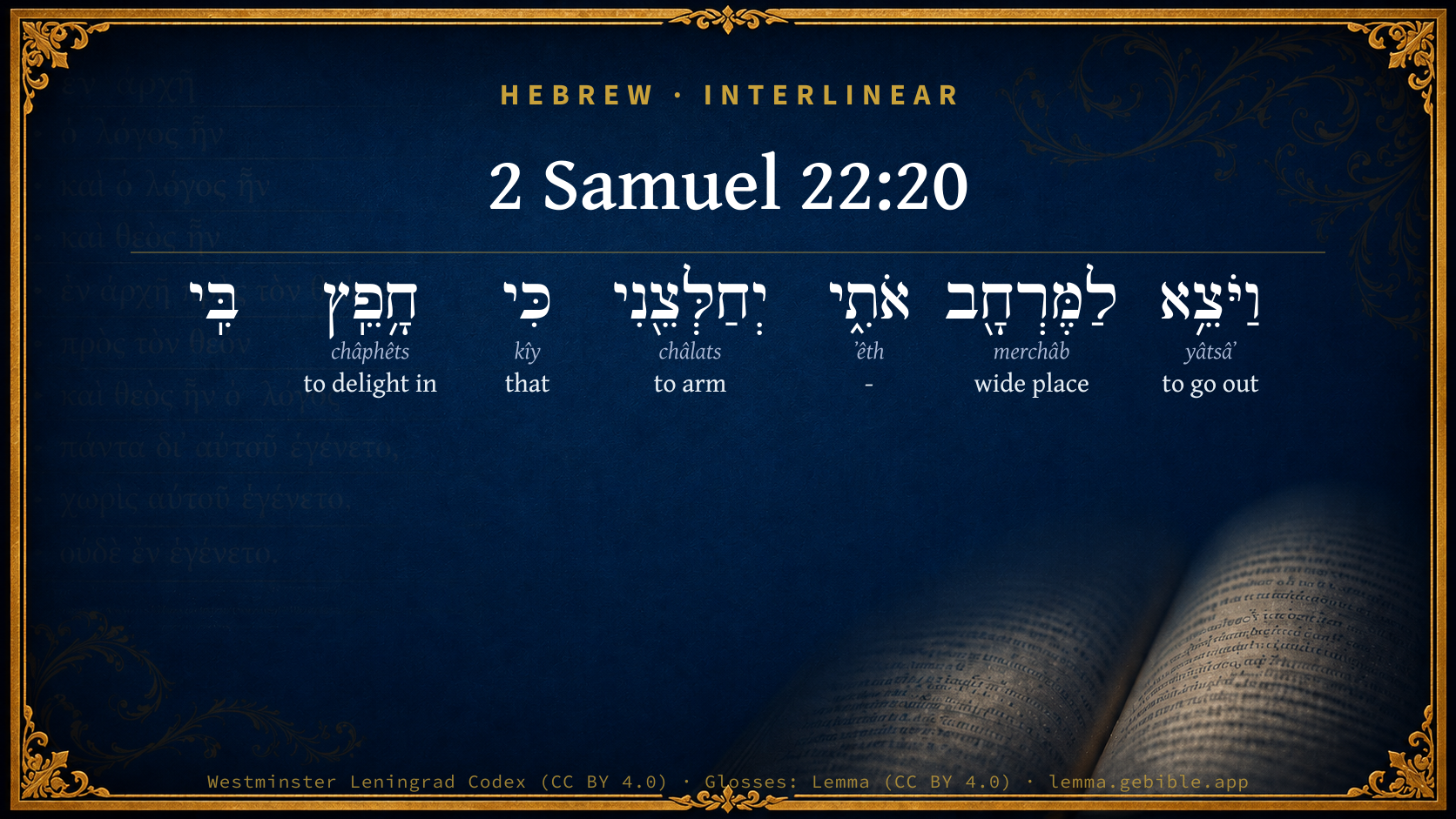
2 Samuel 22:20

Hebrew (Westminster Leningrad Codex) 2 Samuel 22:20 appears in the Hebrew Old Testament. The text above is from the Westminster Leningrad Codex. Each word links to its Strong’s number, a concise gloss, and parsing drawn from the Open Scriptures Hebrew Bible morphology. Click any word for its full Brown-Driver-Briggs (BDB) entry.
Download image
Cite this verse

2 Samuel 22:20 (World English Bible). Public Domain. Lemma interlinear Bible study tool, https://lemma.gebible.app/v/2-samuel/22/20.

Show BibTeX & RIS
BibTeX
RIS
English Translation
He brought me forth also into a large place; He delivered me, because he delighted in me.
World English Bible · Public Domain
Highlights
  • 1 first appearance in the Hebrew Bible
Full analysis ↓
Download a study sheet

One document with this verse’s original text, its word-by-word gloss line, the meaning frame, cross-references with their text, attributed commentary, and full source and license credits — printable, and it pastes into notes with its structure intact.

This verse Autodidact and up

Study sheet (.html) Plain text (.txt)

A passage Seminary Student

Up to 50 verses in one chapter. A passage sheet keeps up to 6 commentary sources and 12 cross-references per verse, in the order this page ranks them, and says so on the sheet whenever that leaves anything out. Ask for a single verse and you get the Autodidact verse sheet above.

Everything on this page stays free to read, with no account — the sheet is a download of what is already on screen, not access to it.

Want to remove ads? Support Godless Engineer
Compare translations 3

The same verse in 3 English versions, stacked beneath the original-language interlinear above. Click any original word for its lexicon entry.

Each is an independent rendering of the whole verse — the interlinear is not word-aligned to these translations.

Highlighted words mark where these versions differ — a whole-verse word diff, not a word-by-word alignment.

  • World English Bible Public Domain
    He brought me forth also into a large place; He delivered me, because he delighted in me.
  • King James Version Public Domain
    He brought me forth also into a large place: he delivered me, because he delighted in me.
  • unfoldingWord Literal Text CC BY-SA 4.0
    And he brought me out to an open space. He delivered me because he delighted in me.

unfoldingWord Literal Text — © unfoldingWord, licensed CC BY-SA 4.0. Word-aligned USFM3 via Door43 (git.door43.org/unfoldingWord/en_ult).

Versions to compare (up to 4)

3 of 4 selected

Show all 18 translations

Every available English version of this verse, each an independent rendering of the whole verse.

  • World English Bible Public Domain
    He brought me forth also into a large place; He delivered me, because he delighted in me.
  • Berean Standard Bible Public Domain
    He brought me out into the open; He rescued me because He delighted in me.
  • Majority Standard Bible Public Domain
    He brought me out into the open; He rescued me because He delighted in me.
  • King James Version Public Domain
    He brought me forth also into a large place: he delivered me, because he delighted in me.
  • American Standard Version (1901) Public Domain
    He brought me forth also into a large place; He delivered me, because he delighted in me.
  • Revised Version (1885) Public Domain
    He brought me forth also into a large place: he delivered me, because he delighted in me.
  • Geneva Bible (1599) Public Domain
    And brought me foorth into a large place: he deliuered me, because he fauoured me.
  • Douay-Rheims (1899) Public Domain
    And he brought me forth into a large place, he delivered me, because I pleased him.
  • Young's Literal Translation Public Domain
    And He bringeth me out to a large place, He draweth me out for He delighted in me.
  • Literal Standard Version CC BY-SA 4.0
    And He brings me out to a large place, || He draws me out for He delighted in me.
  • Unlocked Literal Bible CC BY-SA 4.0
    He also brought me out to a wide open place. He saved me because he was pleased with me.
  • unfoldingWord Literal Text CC BY-SA 4.0
    And he brought me out to an open space. He delivered me because he delighted in me.
  • Darby Bible Public Domain
    And he brought me forth into a large place; He delivered me, because he delighted in me.
  • World Messianic Bible Public Domain
    He also brought me out into a large place. He delivered me, because he delighted in me.
  • Webster's Bible Public Domain
    He brought me forth also into a large place: he delivered me, because he delighted in me.
  • Free Bible Version CC BY-SA 4.0
    He set me free, he rescued me because he's happy with me.
  • Bible in Basic English Public Domain
    He took me out into a wide place; he was my saviour because he had delight in me.
  • JPS Tanakh (1917) Public Domain
    He brought me forth also into a large place; He delivered me, because He delighted in me.

Literal Standard Version (2020), Covenant Press — licensed CC BY-SA 4.0. Text via the HelloAO Bible API (eBible.org). Unlocked Literal Bible (unfoldingWord) — licensed CC BY-SA 4.0. Text via the HelloAO Bible API (eBible.org). unfoldingWord Literal Text — © unfoldingWord, licensed CC BY-SA 4.0. Word-aligned USFM3 via Door43 (git.door43.org/unfoldingWord/en_ult). Free Bible Version, Dr. Jonathan Gallagher — licensed CC BY-SA 4.0. Text via the HelloAO Bible API (eBible.org).

Word by word

More ways to search: Search by grammar → Find every occurrence → Compare this word →

Practice this passage: Drill this verse → Learn its vocabulary →

About this verse

These counts appear in no published source. They are computed here, from the morphology-tagged text and Lemma’s own curated glosses. What Lemma adds →

7
words
6
distinct lemmas
Historical
section

Notable vocabulary

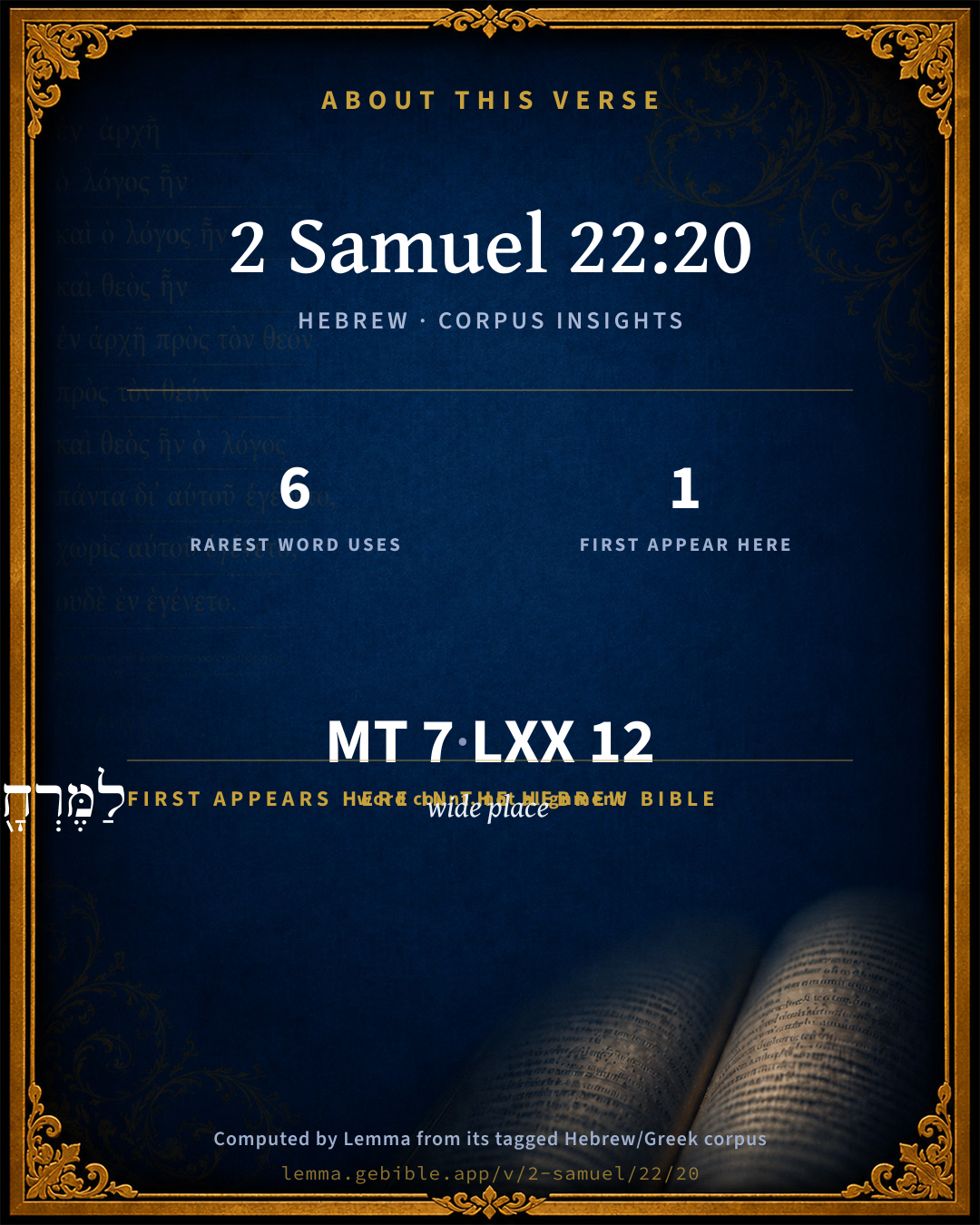
The rarest word here is לַמֶּרְחָ֖ב wide place H4800 — appearing just 6 times in the whole Hebrew Bible.

First appearance in Scripture

This word makes its first canonical appearance in the Hebrew Bible here:

  • לַמֶּרְחָ֖ב wide place H4800

Shared distinctive vocabulary

לַמֶּרְחָ֖ב wide place H4800 occurs in 6 verses of the Hebrew Bible. Also found in:

Grammatical profile

  • 3 verbs
  • 1 noun
  • 1 preposition
  • 1 conjunction
  • 1 particle

Verb forms

  • וַיֹּצֵ֥א Hiphil · Sequential Imperfect
  • יְחַלְּצֵ֖נִי Piel · Imperfect
  • חָ֥פֵֽץ Qal · Perfect

Hebrew & Septuagint length

In English translation the verse runs 17 words from the Hebrew and 16 from the Septuagint (LXX English) — closely comparable.

A rough comparison of the two English renderings, which tokenize alike — not a word-level alignment.

Word counts can differ between the Hebrew and the Greek without any difference in meaning — e.g. the Hebrew direct-object marker אֵת has no separate Greek word, and Greek often adds the article ὁ.

In the original languages it is 7 Hebrew tokens and 12 Greek tokens — but the two are counted differently (Hebrew bundles its prefixes and suffixes into one token; the Greek is in lemma form), so that isn’t a like-for-like length.

Cross-references

14

Topical passages linked to 2 Samuel 22:20 in the Treasury of Scripture Knowledge — connected by theme and wording, ordered by reader-vote popularity; previews shown in the World English Bible.

  • Psalms 31:8 You have not shut me up into the hand of the enemy. You have set my feet in a large place.
  • 2 Samuel 15:26 but if he say thus, I have no delight in you; behold, here am I, let him do to me as seems good to him.
  • Psalms 118:5 Out of my distress, I called on Yah. Yah answered me with freedom.
  • Psalms 22:8 "He trusts in Yahweh; Let him deliver him; Let him rescue him, since he delights in him."
  • Psalms 149:4 For Yahweh takes pleasure in his people. He crowns the humble with salvation.
  • Psalms 147:11 Yahweh takes pleasure in those who fear him, In those who hope in his loving kindness.
  • Acts 2:32–36 This Jesus God raised up, to which we all are witnesses.
  • Genesis 26:22 He left that place, and dug another well. They didn't argue over that one. He called it Rehoboth. He said, "For now Yahweh has made room for us, and we will be fruitful in the land."
  • 1 Chronicles 4:10 Jabez called on the God of Israel, saying, Oh that you would bless me indeed, and enlarge my border, and that your hand might be with me, and that you would keep me from evil, that it not be to my sorrow! God granted him that which he requested.
  • Isaiah 42:1 Behold, my servant, whom I uphold; my chosen, in whom my soul delights: I have put my Spirit on him; he will bring forth justice to the Gentiles.
  • Hosea 4:16 For Israel has behaved extremely stubbornly, like a stubborn heifer. Then how will Yahweh feed them like a lamb in a meadow.
  • Matthew 3:17 Behold, a voice out of the heavens said, "This is my beloved Son, with whom I am well pleased."
  • Matthew 17:5 While he was still speaking, behold, a bright cloud overshadowed them. Behold, a voice came out of the cloud, saying, "This is my beloved Son, in whom I am well pleased. Listen to him."
  • Matthew 27:43 He trusts in God. Let God deliver him now, if he wants him; for he said, 'I am the Son of God.'"

Cross-references courtesy of OpenBible.info (CC BY 4.0).

Hebrew and Greek witnesses Masoretic Hebrew ↔ Greek Septuagint

The same verse in the two great witnesses to the Old Testament, shown verse-for-verse.

These are two independent witnesses, not word-aligned to each other, and the Septuagint is shown in lemma (dictionary) form.

Hebrew 2 Samuel 22:20 Masoretic · Westminster Leningrad Codex

וַיֹּצֵ֥א לַמֶּרְחָ֖ב אֹתִ֑י יְחַלְּצֵ֖נִי כִּי חָ֥פֵֽץ בִּֽי

He brought me forth also into a large place; He delivered me, because he delighted in me.

World English Bible · Public Domain

Greek LXX 2 Samuel 22:20 Septuagint · lemma form

καί ἐκἄγω ἐγώ εἰς πλατυσμός καί ἐκαἱρέω ἐγώ ὅτι εὐδοκέω ἐν ἐγώ

And he brought me into a wide place, and rescued me, because he delighted in me.

LXX2012 (modern English Septuagint) · Public Domain

Hebrew: Westminster Leningrad Codex (CC BY 4.0). Greek: Septuagint (public domain); English from LXX2012 (modern English Septuagint) (Public Domain). How the Septuagint differs from the Hebrew →

Targum (Aramaic paraphrase)

1

The Targum is the ancient Jewish Aramaic paraphrase of the Hebrew Scriptures — an interpretive translation, not the Hebrew text itself. Onkelos (literal) and Pseudo-Jonathan (expansive) render the Torah, and Jonathan the Prophets. Coverage is partial: where no permissively-licensed English translation exists for a verse, only the Aramaic is shown. This is verse-level text, not a word-by-word alignment to the Hebrew.

  1. Targum Jonathan Prophets (Joshua–Malachi)
    וְאַפֵּיק לִרְוָחָא יָתִי שֵׁיזְבַנִי אֲרֵי אִתְרְעִי בִי:

    (no public-domain English translation for this verse)

    Targum Jonathan — Aramaic: “Mikraot Gedolot” (public domain). English: “Sefaria Community Translation” (CC0 1.0 (public-domain dedication)); “London "Chaldee Paraphrase," 1871” (public domain). Text via Sefaria.

Commentary

Notes on 2 Samuel 22:20 from classic Christian and Jewish commentators (each source and its license shown beneath its notes). The classic Christian expositions comment on the surrounding passage and are grouped to its opening verse, so a note may address several verses; the Jewish commentaries on the Tanakh (Rashi and others) are per-verse, so they appear only where the commentator wrote on this verse.

Lemma curates 59 commentaries, every one of them public domain or Creative Commons licensed, each selected and text-cleaned for this edition rather than reprinted as found. About our sources →

The Preacher's Complete Homiletical Commentary

Joseph S. Exell (gen. ed.)

CRITICAL AND EXPOSITORY NOTES

2Sa_22:20. “Large place.” Lit. the broad, a condition of freedom and safety in contrast with the straits and dangers of the past.

2Sa_22:21. The Lord rewarded, or, requited. Alexander in Psalms 18 translates the verbs of this clause into the future tense: “They have reference,” he says, “to the condition of the Psalmist under his afflictions, and the hopes which he was even then enabled to cherish.” “Cleanness of hands.” Dr. Jamieson sees here a special reference to David’s refusal to injure Saul, or to free himself by any unrighteous act.

2Sa_22:22. “Ways of the Lord.” “The rules of human conduct given in His law.” (Erdmann.) “Wickedly departed,” etc. Literally, “wicked from God.” “The combination of the verb and preposition shows clearly that the essential idea in the writer’s mind was that of apostasy or total abjuration of God’s service.” (Alexander.)

2Sa_22:23. “Judgments.” Rights. (Keil.) Judicial decisions. (Alexander.) The verbs here are in the present tense.

2Sa_22:24. “Mine iniquity.” “That to which I am naturally prone, An undoubted confession of corruption.” (Alexander.) “An indirect testimony to indwelling sinfulness.” (Erdmann.)

2Sa_22:25. “Therefore,” etc. “This verse shows clearly that the futures in 2Sa_22:21 must be strictly understood.” (Alexander.)

2Sa_22:26. “Merciful,” or gracious.

2Sa_22:27. “Pure,” or genuine. (Keil.) “Unsavoury.” Better, perverse, or crooked. “The resemblance of the last clause of this verse to Lev_26:23-24, makes it highly probable that the whole form of this singular dictum was suggested by that passage, the rather as this Psalm abounds in allusions to the Pentateuch and imitations of it.” (Alexander.)

2Sa_22:28. “Thou.” This word is emphatic. “However men may despise thy afflicted people, I know that thou wilt save them.” (Alexander)

MAIN HOMILETICS OF THE PARAGRAPH.—2Sa_22:20-28

DAVID’S SONG.—PART II

I. Men are to be judged by the spirit of their lives, and not by isolated actions. It is evident that we must read David’s words here concerning himself in the light of others found elsewhere, and then we shall understand that he does not claim to have been faultless even in his outward life, or to have merited the distinguishing marks of divine favour that he had received. (See Suggestive Comments.) He can only be recording his consciousuess of a generally faithful discharge of his public duties and of a life which had, upon the whole, been governed by pure and holy motives. If a man holds a fort against an enemy for many years, and is upon one occasion overpowered and taken prisoner, even if it be by his own negligence, he cannot be classed with him who treacherously parleys with the foe and betrays his trust for selfish ends. He must be regarded as blameworthy, but if he make every possible effort to retrieve his failure he cannot be treated as a deserter. David’s reputation was sadly tarnished by his being surprised through being found morally asleep by the tempter when he ought to have been awake and standing upon his watch-tower. But though he was at that time captured by the devil at his will, and remained for some time tied and bound in the camp of the enemy, the 51st Psalm reveals his efforts to escape, and his desire, so far as it was possible, to regain his old position and again serve God in serving his people. God’s subsequent treatment of David reveals that He did not judge him by this fall, or even by repeated false steps, but by the general spirit and intent of his whole life, and the heart and conscience of every upright man testify to the justice of the divine verdict. It has been remarked that the disobedience of Saul in the matter of the sacrifice (1 Samuel 13) bears no comparison in itself to the crimes of David in relation to Uriah, yet it seems to have been visited by a far heavier penalty. We can only explain the different treatment of the two offenders upon the principle just considered. (See also on this subject, page 360.)

II. The character of man influences the conduct of God. David here teaches this truth by connecting his own faithfulness and integrity with the gracious dealings of God towards him, making, in fact, the one dependent on the other. Valuable possessions of any kind give a man worth and importance in the eyes of others. Even material wealth increases a man’s worth in the estimation of his fellow men—because such an addition to his existence enables him to do what poorer men cannot do, he is treated with more consideration, and his life is regarded as more precious. The gifts and possessions of the intellect more justly give value to him to whom they belong—great knowledge and mental ability can be so beneficial to the community at large that he who has them is held in high estimation, and men who can appreciate such a person delight to honour him. But much more does moral excellence make a man precious in the sight of other good men. They look upon character as the real and personal and eternal possession, and value human creatures only in proportion as they are holy and true. This they do, not only because of the sympathy which must exist between all who are united in desire and aim, but because of the beneficial influence of such a character—because of the blessed use of such a life in the world and in the universe. It would be strange indeed if we found this rule reversed as we ascended in the moral scale—if the infinitely good God did not set a high price upon human character, and deal with men accordingly. True is it that he can discern flaws and imperfections in the best of human creatures, but His moral perfection does not prevent Him from looking with approval upon those who love and seek after righteousness, however morally weak they may be. He not only loves them for all that is God-like within them, but for the efforts they make to uphold and advance His kingdom in the world. Such being the regard in which they are held by God, it must be that His dealings with them are in accordance with His gracious approval of them, and there must, therefore, be a special and intimate connection between human character and Divine conduct.

III. Upon the character and conduct of men depends their view of the character and conduct of God. Many commentators do not think this idea is expressed in 2Sa_22:26-27, but that they only express the truth just dwelt upon, viz., “that God’s objective, real conduct towards men, according to His retributive justice, corresponds exactly to man’s ethical conduct towards God” (Erdmann). But David may also here refer to the undoubted fact that every man’s conception of God depends upon his own condition of heart and conscience. Men see each other through the same medium. The face that looks into the mirror is the same that is seen reflected; there are laws which forbid that distorted or unlovely features should give back a beautiful and pleasing reflection. And there are also laws which make all other men appear morally unattractive and even disagreeable to a wicked or even an unloving man. He who lives for self thinks everybody whom he meets is a selfish being, and the proud and angry man is always complaining of the pride and bad temper of those around him. There is some objective foundation for these conceptions, inasmuch as evil passions in ourselves call forth and foster the same in others and the reverse; and there is a sense in which even the unchanging and righteous God, as we have already seen, must really manifest a side of His perfect character to the unholy and rebellious which differs from that which is seen by those who love Him and desire to serve Him. But apart from the actual fact, all the ways of the Almighty seem hard and often unjust to those who will not fall in with His methods of blessing them, and the more they rebel under the yoke the heavier it must really become. The old statute is still in force:—“If ye will not be reformed by me in these things, but will walk contrary unto me, then will I walk contrary unto you” (Lev_26:23-24), but every man who is unreconciled to God regards even His most merciful dispensations and laws from a false standpoint, and often transfers his own unrighteousness to the spotless character of his Maker.

OUTLINES AND SUGGESTIVE COMMENTS

2Sa_22:21. Albeit the dispensations of Divine grace are to the fullest degree sovereign and irrespective of human merit, yet in the dealings of Providence there is often discernible a rule of justice by which the injured are avenged and the righteous ultimately triumph. David’s early troubles arose from the wicked malice of envious Saul, who, no doubt, prosecuted his persecutions under cover of charges brought against the character of the man after God’s own heart. These charges David declares to have been utterly false, and asserts that he possessed a grace-given righteousness which the Lord had graciously rewarded in defiance of all his calumniators. Before God, the man after God’s own heart was a humble sinner; but before his slanderers he could, with unblushing face, speak of the cleanness of his hands and the righteousness of his life. He knows little of the sanctifying power of Divine grace who is not, at the bar of human equity, able to plead innocence. There is no self-righteousness in an honest man knowing that he is honest, nor even in his believing that God rewarded him in Providence because of his honesty, for such is often a most evident matter of fact. It is not at all an opposition to the doctrine of salvation by grace, and no sort of evidence of a Pharisaic spirit, when a gracious man, having been slandered, stoutly maintains his own integrity and vigorously defends his character. A godly man has a clear conscience, and knows himself to be upright. Is he to deny his own consciousness, and to despise the work of the Holy Ghost, by hypocritically making himself out to be worse than he is? A godly man prizes his integrity very highly, or else he would not be a godly man at all; is he to be called proud because he would not readily lose the jewel of a reputable character? A godly man can see that in the long run uprightness and truth are sure to bring their own reward; may he not, when he sees that reward bestowed in his own case, praise the Lord for it? Yea, rather must he not show forth the faithfulness and goodness of his God? Read the cluster of expressions in this and the following verses as the song of a good conscience, after having safely outridden a storm of obloquy, persecution, and abuse, and there will be no fear of our upbraiding the writer as one who set too high a price upon his own moral character.—Spurgeon.

2Sa_22:22. That is, with a purpose and resolution to continue in the way of sinning, and that is the property of sincerity. A man indeed may be overtaken and surprised in a temptation, but it is not with a resolution to forsake God and to cleave unto the sin, or rest in it. He will not sleep in it, spare it, or favour it; that is, to do wickedly against God, to have a double heart and a double eye; to look upon two objects, partly at God and partly at sin; so to keep God as to keep some sin also, as it is with all false-hearted men in the world. They look not upon God alone, let them pretend to religion never so much, but upon something else together with God; as Herod regarded John, but regarded his Herodias more; and the young man in the gospel, comes to Christ, yet he looks after his estate; and Judas followed Christ, yet looks after the bag; this is to depart wickedly from God.—W. Strong.

2Sa_22:24. Keep himself! Who made man his own keeper? ’Tis the Lord that is his keeper; He is the keeper of Israel and the preserver of men. If a man cannot keep himself from sorrow, how can he keep himself from sin? God indeed in our first conversion works upon us as He works upon the earth, or Adam’s body in paradise, before He breathed a soul into it, or made a living creature; such a power as Christ put forth on Lazarus in his grave, for we are dead in trespasses and sins; but yet, being living, he must walk and act of himself, the Lord will have us to co-operate together with Him, for we are built upon Christ, not as dead, but as “living stones.” (1Pe_2:5).—W. Strong.

There is “I have” and “I have not,” both of which must be blended in a truly sanctified life; constraining and restraining grace must each take its share.—Spurgeon.

Mark “from mine iniquity.” The godless man, though he do much, will be sure to fail here, and the godly man will strike home here wherever he be favourable. A horse that is not sound, but foundered, will favour one foot, if not more; the lapwing, some observe, will cry and make a great noise, but it is when she is farthest from her nest; the hypocrite may keep a great stir about many sins, but there is one sin which he meddleth not with. There is, says a learned divine, no greater argument of unsound repentance than indulgent thoughts and reserved delight and complacency in a master-sin. As some grounds are most proper soils to breed and nourish some particular weeds, so are some men’s hearts for some particular sins, and the devil holds them as fast by this sin as by ten thousand.… The creature may do much by the command of God, but there is old stir and pulling before this sin be separated from him. If this be once done thoroughly the man is converted truly.—Swinnock.

2Sa_22:25. God first gives us holiness and then rewards us for it. We are His workmanship—vessels made unto honour, and when made the honour is not withheld from the vessel; though, in fact, it all belongs to the Potter upon whose wheel it was fashioned. The prize is awarded to the flower at the show, but the gardener reared it; the child wins the prize from the school master, but the real honour of his schooling lies with the master, although, instead of receiving, he gives the reward.—Spurgeon.

2Sa_22:26. Note that even the merciful need mercy. No amount of generosity to the poor or forgiveness to enemies can set us beyond the need of mercy.—Spurgeon.

2Sa_22:22-25. What David here extols is not the ground upon which he personally, as a sinner, obtained the favour of God, but the ground on which he, as the public champion of a great cause, enjoyed God’s countenance, while he was honestly and faithfully maintaining that cause. There could be no self-praise in the lieutenant of a ship saying to his captain, “I adhered to your instructions in every point, and my success was complete.” There would have been no self-righteousness in such a man as Luther saying, “I constantly maintained the principles of the Bible—God crowned my labours with success;” for the honour in such cases is not claimed by the person acting, it is given to his superior, by whose instructions he has acted.… No other spirit than this can with consistency be claimed for David.—Blaikie.

The current of his moral being flowed on in the channel of everlasting right. His sins were only wavelets on the stream, which the winds of temptation occasionally dashed over the embankments.—Dr. David Thomas.

As you may see a proportion between sins and punishments which are the rewards of them, so that you can say, such a sin brought forth this affliction, it is so like its father; so you might see the like proportions between your prayers and your walking with God and God’s answers to you and His dealings with you. So did David. According to the cleanness, etc. His speech denotes some similitude or likeness, as, for example, the more by ends or carnal desires you had in praying, and the more you mingled of these with your holy desires, and the more want of zeal, fervency, etc., were found in your prayers, the more you shall, it may be, find of bitterness mingled with the mercy, when it is granted, and so much imperfection, and want of comfort in it. So says David in this psalm, “With the pure thou wilt show thyself pure.” Pure prayers have pure blessing, and è contra, “With the froward thou wilt show Thyself froward.” And, again, as you in prayer sometimes slackened and grew cold, so you might see the business in like manner to cool and cast backward, as, when Moses hands were down Amalek prevailed, and when they were lifted up Israel had the better. A man finds in praying that his suit sometimes sticks, and goes not on as he expected; but, on the contrary, when he was stirred up to pray, then still he found things to go well. By this a man may clearly see that it was the prayer which God did hear and regarded. Thus, likewise, when a man sees hills and dales in a business, fair hopes often, and then all dashed again, and the thing in the end brought to pass, let him look back upon his prayers. Didst thou not in like manner just thus deal with God? When thou hadst prayed earnestly, and thought thou hadst even carried it, then dash all again by interposing some sin, and thus again and again. Herein God would have you observe a proportion, and it may help you to discern how and when they are obtained by prayer, because God deals thus with you therein in such a proportion to your prayers.—T. Goodwin.

2Sa_22:26-27. If men will deal plainly with God, He will deal plainly with them. He that is upright in performing his duty shall find God upright in performing His promises. It is God’s way to carry to men as they carry to Him. If thou hast a design to please Him, He will have a design to please thee; if thou wilt echo to Him when He calls, He will echo to thee when thou callest.—R. Steele.

Even as the sun which, unto eyes being sound and without disease, is very pleasant and wholesome, but unto the same eyes, when they are feeble, sore, and weak, is very troublesome and hurtful, yet the sun is ever all one and the self-same that it was before; so God, who hath ever shown Himself benign and bountiful to those who are kind and tender-hearted towards His saints, is merciful to those who show mercy. But unto the same men, when they fall into wickedness and show themselves full of beastly cruelty, the Lord showeth Himself to be very wrathful and angry, and yet is one and the same immutable God from everlasting to everlasting.—Cawdray.

But doth the Lord take colour from everyone He meets, or change His temper as the company changes? That’s the weakness of sinful man. He cannot do so with whom is no variableness nor shadow of changing. God is pure and upright with the unclean and hypocritical, as well as with the pure and upright, and His actions show Him to be so. God shows Himself froward with the froward, when He deals with them as He has said He will deal with the froward—deny them and reject them. God shows Himself pure with the pure when He deals with them as He has said He will—hear them and accept them. Though there be nothing in purity and sincerity which deserveth mercy, yet we cannot expect mercy without them. Our comforts are not grounded upon our graces, but they are the fruits or consequences of our graces.—Caryl.

The Preacher's Complete Homiletical Commentary (gen. ed. Joseph S. Exell; Funk & Wagnalls, c. 1892) — public domain (pre-1929). A full-Bible homiletical/sermon-outline anthology covering 65 of 66 books (2 John is absent from the source module). Text from a community e-Sword module.

The Cambridge Bible for Schools and Colleges

gen. ed. J. J. S. Perowne

20. into a large place] The opposite of the straits of peril. Cp. 2Sa_22:37; Psa_31:8.

because he delighted in me] This was the ground of God’s deliverance, and it now becomes the leading thought of the Psalm. Cp. ch. 2Sa_15:26; Psa_22:8; and also Mat_3:17, where the Greek word for “I am well pleased” is the same as that used in the Sept. (εὐδοκεῖν). The reference becomes doubly significant if it is borne in mind that the theocratic king was called God’s son (ch. 2Sa_7:14; Psa_2:7). See Introd. p. 43.

The Cambridge Bible for Schools and Colleges (gen. ed. J. J. S. Perowne; Cambridge University Press, 1878–1918) — public domain. Text from a community e-Sword module.

John Gill's Exposition

Thou hast enlarged my steps under me; so that my feet did not slip. See Gill on Psa 18:36.

.

2 Samuel 22:38

sa2 22:38

sa2 22:38

sa2 22:38I have pursued mine enemies, and destroyed them; and turned not again until I had consumed them. See Gill on Psa 18:37.

John Gill's Exposition of the Whole Bible (1746–1763) — public domain (CC PDM 1.0). Text via the HelloAO Bible API.

The Pulpit Commentary

Vers. 20-30.

God"s righteousness in saving the righteous.

The facts are:

1. David states that, in delivering him from his enemies, God recognizedhis uprightness and purity.

2. He affirms that, as a matter of fact, he had in his conduct endeavoured to live according to the will of God.

3. He declares the general truth that, in thus rescuing him the upright, andshowing disfavour to the perverse persecutor, there was exemplified the principle of the usual Divine procedure.

4. He ascribes the successes of the past, not to himself, however upright,but to God, his Light in darkness and his Strength for deeds of daring. There is, in David"s references to his own righteousness and purity, an appearance of what is now called, self-righteousness. He seems to violate the primary canons of Christian propriety and to establish a doctrine of merit. But this interpretation of his words is an utter misconception of his meaning, and proceeds from an ignorance of the historical circumstances he had in mind when penning the words. It is a wrong done to personal experiences of the Old Testament to approach their interpretation with certain prepossessions based on New Testament teaching with reference to our personal unworthiness before God on account of our essential sinfulness. David was not speaking of his state absolutely before God; he was not thinking of the question as to whether he or any one else was a sinner. His sole thought was of the distinct charges brought against him by such men as Doeg the Edomite, and believed by the foolish king Saul; and he was conscious that his being hunted by Saul was a grievous wrong, a treatment he did not deserve. He was the righteous man, for he loved Saul, showed him kindness, and. paid him honour; Saul and Doeg and others in the conspiracy were the unrighteous men, uttering falsehoods, using cruelty, and cherishing malice. God came as Judge between them, and by interposition showed his delight in what his servant had been and done in this particular matter, and his displeasure with Saul for his wicked conduct. He vindicates the gracious interposition of God on the ground that it is a righteous and glorious thing on the part of God to rescue those who suffer unrighteously, and to declare, by his rescue of them, his delight in them as compared with the men who cause their sufferings. (cf. 1Sa_21:7 1Sa_22:9-13, 18-23 24:7-15 26:10-20) The vindication and illustration of God"s righteousness in saving his people may be considered as follows.

I THERE ARE SPECIAL INSTANCES IN WHICH IT MAY BE SAID THAT GOD SAVES THE RIGHTEOUS. In ordinary speech we say that God saves sinners. That is true in the sense that all men saved, whether temporally or spiritually, are, in their relation to him, sinful, or transgressors of the Law. But in relation to others and in relation to specific obligations which he may impose on them, they may be relatively righteous, and his saving them may be because they are so. Thus:

1. Those who are righteous in life, as compared with others, are saved from calamity and suffering. Noah was a righteous man, and therefore was spared, while the Flood carried away the wicked. Lot was a righteous man in comparison with the Sodomites, and therefore was delivered by Divine pressure put upon him from the destruction which befell the rest. Some of the better Churches in Asia were not doomed to the woe that was to come on others, because God "knew their works". (Rev 2:, Rev_2:3) The more holy and devoted to Christ we are, and the more minutely our lives are regulated by the laws of God as written in his Word and works, and in our own mental and physical nature, the more shall we be saved from woes that come upon others who violate laws physical, moral, and spiritual.

1. Those who suffer as being unrighteous, when all the time they are not so. This was the case of David, who was persecuted most bitterly by Saul on the ground that he hated his king and sought his life, when all the time he loved his king and guarded his life. It was as a righteous man in this particular that God saved him from distress. The same was true of Joseph in prison; of the Apostles Peter and Paul; yea, of our Saviour himself. And often still does God save his people from the reproach and sorrow brought

2. on them by being represented as being other than they really are (Mat_5:11, Mat_5:12; 1Pe_4:14-17)

3. Those who conform to the gospel law of salvation. Before God all are sinners, and condemned by their own consciences as also by the broken Law. But Christ has made full atonement for sin, and now therefore God, in his sovereign grace, has laid down a new law for us to keep, based upon his acceptance of Christ"s perfect work, namely, that we exercise faith in Christ as our atoning Saviour. We are not to try and keep the Decalogue as a condition of being accepted; we cannot attain to the righteousness of the moral Law. We are not to plead the value of repentance and a future life better than the past; all that is indefinite, uncertain. But we are simply to have faith in Christ as set forth in the gospel, that is all that God requires for our acceptance; that is the newly created law, the sum of all obligations in reference to obtaining justification before God. In other words, we are to attain to the "righteousness of faith," the righteousness which consists in fulfilling the obligation created by gospel grace, and then there is no condemnation: we walk then as freed sons in the glorious liberty of the children of God.

II IN ALL THESE INSTANCES IT IS CONSONANT WITH GOD"S NATURE TO SAVE THE RIGHTEOUS. God"s treatment of Noah and Lot, and of all who keep his truth in the midst of prevailing degeneracy, marks his distinction of character on the basis of goodness. It is the Divine nature to love the good and hate the evil tendencies of men. When the persecuted are delivered, there is a vindication of character and a repressing of wrong which cannot but accord with God"s natural love of justice. When he graciously accepts us on the condition that we have fulfilled all that he requires under the gospel order, and in our justification recognizes the "righteousness of faith", (Rom_3:25-28 Rom_4:5, Rom_4:6, Rom_4:11, Rom_4:13) he, accepting that kind of righteousness, that fulfilment of all obligation, maintains the honour of the violated Law under which we had lived, and glorifies the sacrificial work of his beloved Son. There is therefore nothing arbitrary in the "law of faith.

III THESE SPECIAL INSTANCES OF SALVATION ARE IN ACCORD WITH THE GENERAL PRINCIPLE OF GOD"S GOVERNMENT. David was quite warranted in saying that when God, in the matter of the deliverance from the persecutions of Saul, recompensed him according to his righteousness (ver. 25), he was simply acting in harmony with his general kindness to the merciful and upright, and his stern and repressive ways of providence toward the perverse (vers. 26, 27). The actual laws revealed in the Decalogue, in the civil institutions of Moses, in the precepts of the New Testament, in the constitution of the physical and mental worlds, all go for the good and against the wicked, whatever be the form or degree of the goodness or wickedness. It may be that, for reasons not yet made clear, the wicked triumph for a while and the righteous cry out in agony, "O Lord, how long!" but God"s government is vast, intricate, and stretching far into the future, and there are forces at work by which at last the righteous shall be exalted and the wicked abased. (Psa_5:4-6, Psa_5:11, 12 37:6, 7, 23-40)

IV THOSE WHO ARE SAVED BY GOD ON THE GROUND OF RIGHTEOUSNESS LAY NO CLAIM TO MERIT. The object of David in this passage is not to proclaim his own deeds and claim a right to God"s favour, but rather to set forth the righteousness and goodness of God in saving those who conform to his will. He had kept the ways, the statutes, and the judgments of God (vers. 23, 24) in respect to his behaviour toward Saul, he could honestly say that; and he considers it a matter of praise and glory to God that he manifested his love of what is just in coming to the rescue of such a one. To have allowed Saul to triumph would have been a reflection on Divine justice. In all this, therefore, there is no reference to merit in the sight of God, any more than Noah felt that he merited God"s favour. It was in neither ease a question of the desert of the entire life, but of the state of the life in relation to other men. So in our personal salvation through faith, there is no claim of merit. It is all of grace. The "law of faith" is the creation of grace, and the heart to conform to it is of grace. The light in which we see spiritual things, and in which we rejoice, is not our own. The Lord is our Lamp, and he lightens our darkness (ver. 29). If we are able to break through troops of spiritual foes, and leap over walls (ver. 30) that hem us in, it is not because of our strength; it is only by our God, who of his free mercy supplies all our need.

The Pulpit Commentary (1880–1919), ed. H.D.M. Spence-Jones & Joseph S. Exell — public domain. Text from a community e-Sword module.

Lesson kit

Teaching starters — assembled from the data on this page, not authored interpretation. Every prompt links to the verse data it draws on. Edit before teaching.

2 Samuel, in the Historical, opens this verse with 7 words (6 distinct Hebrew lemmas). Its most distinctive word is merchâb (“wide place”). A historical commentator’s framing appears above. Read the whole chapter for the surrounding context.

Discussion questions

  1. The word merchâb carries the sense “wide place.” How does it shape the verse?
  2. This is the first place “wide place” appears in Scripture (first appears here). What does its debut here establish?
  3. How does Psalms 18:19, which shares the word «wide place», read alongside this verse?
  4. These translations render this verse differently; the difference is in the English rendering, not the original. What questions does that raise?
  5. «וַיֹּצֵ֥א» is a Hiphil Sequential Imperfect verb. How does that grammatical form shape the action described?
  6. Compare how The Preacher's Complete Homiletical Commentary and The Cambridge Bible for Schools and Colleges read this verse. Where do they agree or differ?

Things to notice

Reading settings

Reading text

Shown beneath each verse's original-language words.

Old Testament
Old Testament edition

Read the OT as the Masoretic Hebrew (MT) or the Greek Septuagint (LXX).

English shown for the Greek Septuagint (in the Hebrew ↔ Greek comparison).

Comparing translations? Open the Compare panel on any verse page to stack up to four side by side.