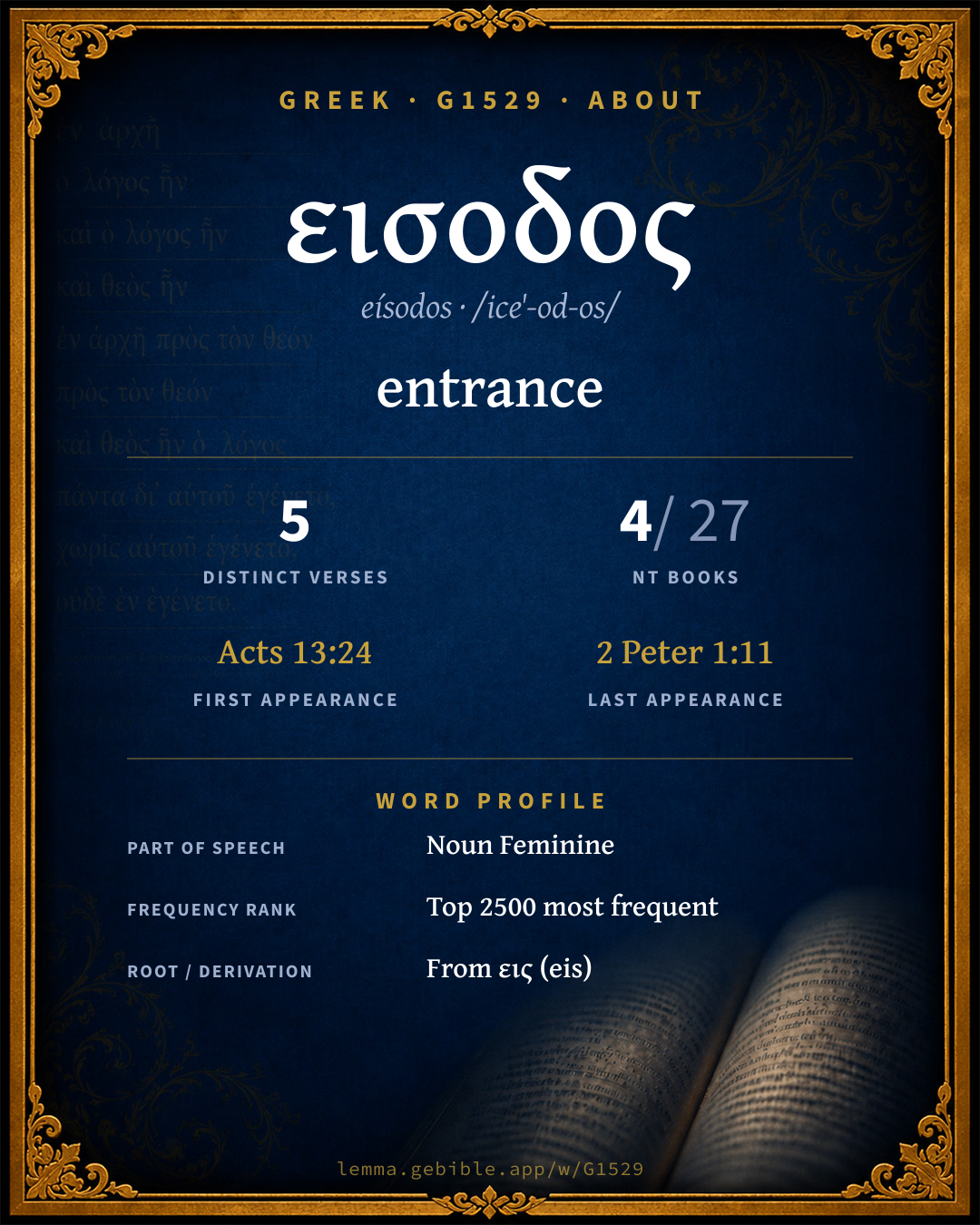
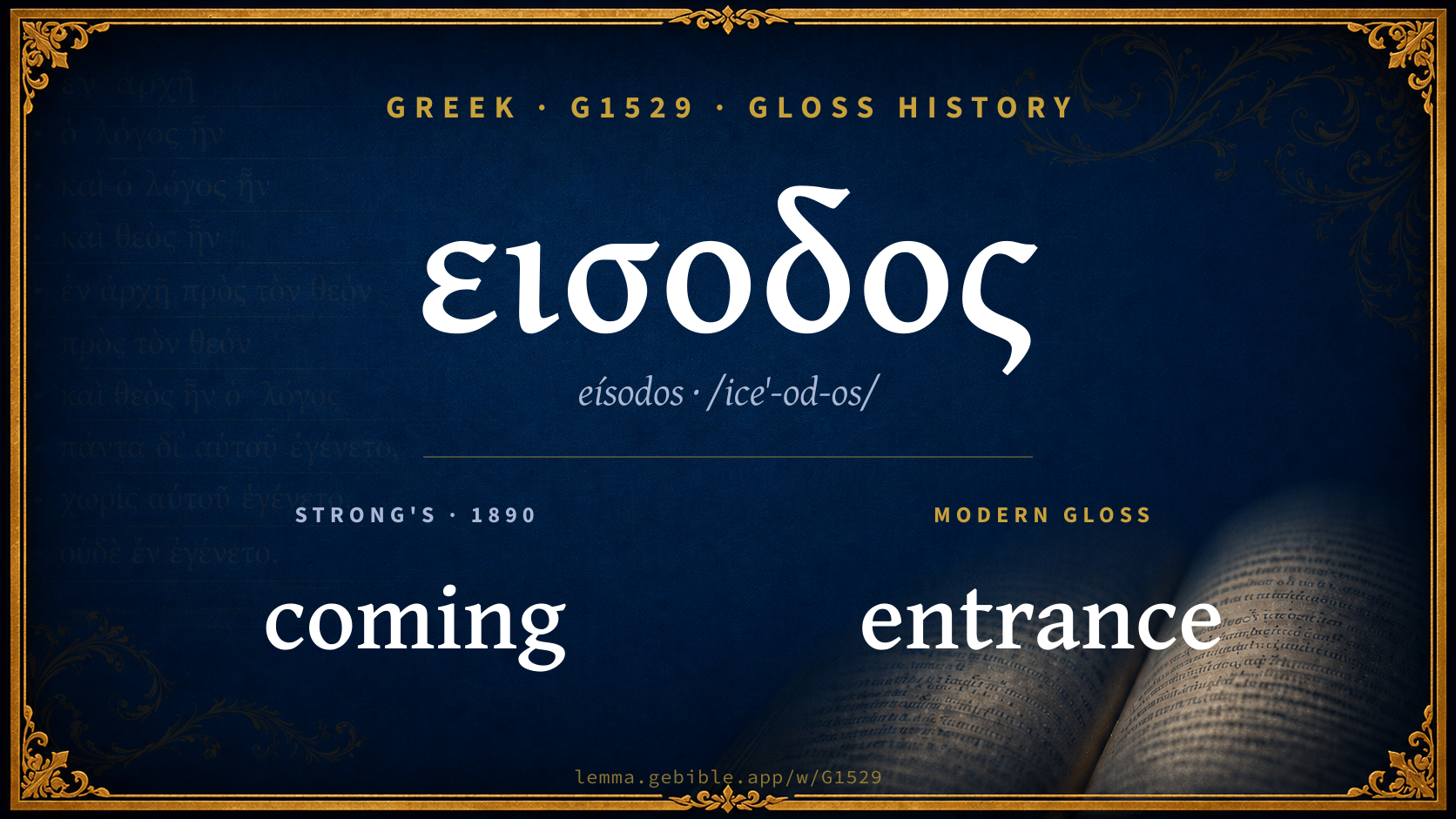
εἴσοδος
entrance
‘entrance’ is one of 2 main senses fuller range ↓
Full lexicon entry — Thayer's Greek Lexicon
From Thayer's Greek Lexicon
Where this word appears
Grammar key — what these labels mean
Part of speech
- Noun
- A naming word — a person, place, thing, or idea.
Case
- Accusative
- The case of the direct object and of extent.
- Genitive
- The case of source, possession, or “of” — answers “whose / from what.”
- Nominative
- The case of the subject (and the predicate nominative).
Gender
- Feminine
- Grammatically feminine.
Number
- Singular
- One.
Every verse where G1529 appears in the Book of Acts — 1 distinct verse. Click any verse to open its interlinear word-by-word view. Verse text shown in the World English Bible for context — . Each verse’s Greek form is shown with its reference; the English is not keyword-highlighted, since the data carries no word-level English alignment. Use “Compare translations” on any verse to read it across multiple English versions. This concordance covers the Greek New Testament; Septuagint (Greek Old Testament) occurrences of this word are not indexed here.
Acts
About this entry
At a glance — auto-summarized from this page’s data, not written by a person. Every figure links to its source below. This summary describes the numbers; it doesn’t interpret them.
εισοδος — transliterated eísodos — is a Greek noun carrying the sense “entrance.” A scarce word — 5 verses in all of the Greek New Testament. More than a third of its appearances fall in 1 Thessalonians. Its earliest occurrence is Acts 13:24. Thayer's distinguishes 2 senses for it. Each statement above links to its evidence; the full detail follows below.
Gloss history
Strong's 1890 vs modern scholarship
About this word
Strong's G1529 catalogs a Greek word from the Greek New Testament.
These counts are not copied from any lexicon or concordance. They are computed here, from the morphology-tagged Greek New Testament. What Lemma adds →
- 5
- distinct verses
- The word appears in 5 distinct verses.
- 4 / 27
- NT books
- The word appears in 4 of 27 New Testament books.
- #1,648
- by frequency
- Top 2500 most frequent Greek words (rank 1,648 of 5,347 Greek words by occurrence).
View all 5 occurrences in the concordance →
Most concentrated in
- 1 Thessalonians 2 verses 40%
- Acts 1 verse 20%
- Hebrews 1 verse 20%
By section of the New Testament
By traditional corpus
Conventional, traditional groupings — biblical authorship is debated, so this is a traditional corpus grouping, not an authorship claim. Some books belong to more than one corpus (Luke is in both the Gospels and the Lukan corpus, and so on), so these shares overlap and need not total 100%. Each figure is a share of the word’s 5 distinct verses.
- Pauline corpus 2 verses · 40%
- Lukan (Luke–Acts) 1 verse · 20%
- Hebrews 1 verse · 20%
- General (Catholic) Epistles 1 verse · 20%
How translations render this word
Counts come from each version’s own published word-to-Strong’s tagging or interlinear alignment — an approximate guide to how each version renders this word, not a word-level alignment the data otherwise carries. Because each total is that version’s own tagged count, the per-version totals vary from one another and need not match the appearance or distinct-verse counts above. These counts may also differ from a printed concordance because Lemma counts each distinctly tagged rendering and does not collapse phrase taggings into a single head-word total. This is a fixed set of word-tagged versions (KJV, ASV, BSB, ULT) and does not change with the reading translation you choose elsewhere. Each version’s license is shown beside its name below (and on Sources).
- King James Version: Enter 1×, Entering in 1×, Entrance 1×
- American Standard Version: Entering in 2×
- Berean Standard Bible: Arrival 1×, Enter 1×, Reception 1×
- unfoldingWord Literal Text: Entrance 4×
King James Version Public Domain
Renders G1529 across 4 tagged occurrences — most commonly:
Not rendered by a distinct English word in 1 further occurrence.
American Standard Version Public Domain
Renders G1529 across 5 tagged occurrences — most commonly:
Plus 3 renderings that appear only once — usually multi-word phrases or single function words the recovered tagging swept in, not distinct renderings.
Berean Standard Bible Public Domain
Renders G1529 across 5 tagged occurrences — most commonly:
unfoldingWord Literal Text CC BY-SA 4.0
Renders G1529 across 6 tagged occurrences — most commonly:
Plus 2 renderings that appear only once — usually multi-word phrases or single function words the recovered tagging swept in, not distinct renderings.
Senses in Thayer's
The 2 senses Thayer's distinguishes for this word, in lexicon order (not ranked by frequency or importance). The full entry — with sub-senses — is in the Lexicon Entry tab.
- the place or way leading into a place (as a gate)
- the act of entering
Word origin
Derived from εις (eis) (G1519) — into.
Forms in the corpus
The 3 distinct written forms G1529 takes in the Greek New Testament, most frequent first — each parse links to that case’s occurrences in the concordance.
| Form | Parsing | Example | Uses |
|---|---|---|---|
| εἴσοδον eísodon | Noun, Accusative, Singular, Feminine | 1 Thessalonians 1:9 | 3 |
| εἰσόδου eisódou | Noun, Genitive, Singular, Feminine | Acts 13:24 | 1 |
| εἴσοδος eísodos | Noun, Nominative, Singular, Feminine | 2 Peter 1:11 | 1 |
Same root — word family
Other Thayer's entries built from the same root as G1529, grouped by Strong’s listed origin. These share a root / origin per the lexicon — not necessarily a shared meaning. Each links to that word’s own entry.
Derives from
Shares the same root
- εισαγω eiságō G1521 to bring in
- εισακουω eisakoúō G1522 to obey
- εισδεχομαι eisdéchomai G1523 to receive
- εισειμι eíseimi G1524 to go in
- εισερχομαι eisérchomai G1525 to enter
- εισκαλεω eiskaléō G1528 to invite
- εισπηδαω eispēdáō G1530 to rush in
- εισπορευομαι eisporeúomai G1531 to enter
- ειστρεχω eistréchō G1532 to run in
- εισφερω eisphérō G1533 to bring in
- εν en G1722 in
- εσοπτρον ésoptron G2072 mirror
- εσω ésō G2080 within
- σκυβαλον skýbalon G4657 refuse
Compare all same-root words → Showing 4 of 16 — not the complete family. They share a root, not necessarily a meaning.
Septuagint usage
The same Greek word εισοδος appears 40 times in the Greek Old Testament (Septuagint), across 39 verses in 15 books.
- 40
- LXX occurrences
- Tagged occurrences of this Greek word in the Septuagint.
- 39
- verses
- Distinct Septuagint verses containing this word.
- 15 / 39
- OT books
- The word appears in 15 of the 39 Old Testament books.
Sample Septuagint occurrences
- Genesis 30:27 εἴσοδος
- Joshua 13:5 εἴσοδος
- Judges 1:14 εἴσοδος
- 1 Samuel 16:4 εἴσοδος
- 2 Samuel 3:25 εἴσοδος
- 1 Kings 2:13 εἴσοδος
- 2 Kings 11:16 εἴσοδος
- 1 Chronicles 9:19 εἴσοδος
- 2 Chronicles 7:8 εἴσοδος
- Psalms 73:5 εἴσοδος
- Proverbs 8:3 εἴσοδος
- Isaiah 37:28 εἴσοδος
Septuagint occurrences (same lexeme)
Every verse where the same Strong’s number (G1529) appears in the Greek Septuagint. Verse text shown in the World English Bible for context; the Greek form is the matched word — the English is not keyword-highlighted.
- Genesis 30:27 εἴσοδος Laban said to him, "If now I have found favor in your eyes, stay here, for I have divined that Yahweh has blessed me for your sake."
- Joshua 13:5 εἴσοδος and the land of the Gebalites, and all Lebanon, toward the sunrise, from Baal Gad under Mount Hermon to the entrance of Hamath;
- Judges 1:14 εἴσοδος It happened, when she came [to him], that she moved him to ask of her father a field: and she alighted from off her donkey; and Caleb said to her, What would you?
- Judges 1:24 εἴσοδος The watchers saw a man come forth out of the city, and they said to him, Show us, we pray you, the entrance into the city, and we will deal kindly with you.
- Judges 1:25 εἴσοδος He shown them the entrance into the city; and they struck the city with the edge of the sword; but they let the man go and all his family.
- 1 Samuel 16:4 εἴσοδος Samuel did that which Yahweh spoke, and came to Bethlehem. The elders of the city came to meet him trembling, and said, Come you peaceably?
- 1 Samuel 17:32 εἴσοδος David said to Saul, Let no man's heart fail because of him; your servant will go and fight with this Philistine.
- 1 Samuel 29:6 εἴσοδος Then Achish called David, and said to him, As Yahweh lives, you have been upright, and your going out and your coming in with me in the host is good in my sight; for I have not found evil in you since the day of your coming to me to this day: nevertheless the lords don't favor you.
- 2 Samuel 3:25 εἴσοδος You know Abner the son of Ner, that he came to deceive you, and to know your going out and your coming in, and to know all that you do.
- 1 Kings 2:13 εἴσοδος Then Adonijah the son of Haggith came to Bathsheba the mother of Solomon. She said, Come you peaceably? He said, Peaceably.
- 1 Kings 3:7 εἴσοδος Now, Yahweh my God, you have made your servant king instead of David my father: and I am but a little child; I don't know how to go out or come in.
- 1 Kings 8:65 εἴσοδος So Solomon held the feast at that time, and all Israel with him, a great assembly, from the entrance of Hamath to the brook of Egypt, before Yahweh our God, seven days and seven days, even fourteen days.
- 2 Kings 11:16 εἴσοδος So they made way for her; and she went by the way of the horses' entry to the king's house: and there was she slain.
- 2 Kings 14:25 εἴσοδος He restored the border of Israel from the entrance of Hamath to the sea of the Arabah, according to the word of Yahweh, the God of Israel, which he spoke by his servant Jonah the son of Amittai, the prophet, who was of Gath Hepher.
- 2 Kings 16:18 εἴσοδος The covered way for the Sabbath that they had built in the house, and the king's entry outside, turned he to the house of Yahweh, because of the king of Assyria.
- 2 Kings 19:27 εἴσοδος But I know your sitting down, and your going out, and your coming in, and your raging against me.
- 2 Kings 23:11 εἴσοδος He took away the horses that the kings of Judah had given to the sun, at the entrance of the house of Yahweh, by the chamber of Nathan-melech the chamberlain, which was in the precincts; and he burned the chariots of the sun with fire.
- 1 Chronicles 9:19 εἴσοδος Shallum the son of Kore, the son of Ebiasaph, the son of Korah, and his brothers, of his father's house, the Korahites, were over the work of the service, keepers of the thresholds of the tent: and their fathers had been over the camp of Yahweh, keepers of the entry.
- 1 Chronicles 13:5 εἴσοδος So David assembled all Israel together, from the Shihor [the brook] of Egypt even to the entrance of Hamath, to bring the ark of God from Kiriath Jearim.
- 2 Chronicles 7:8 εἴσοδος So Solomon held the feast at that time seven days, and all Israel with him, a very great assembly, from the entrance of Hamath to the brook of Egypt.
- 2 Chronicles 16:1 εἴσοδος In the six and thirtieth year of the reign of Asa, Baasha king of Israel went up against Judah, and built Ramah, that he might not allow anyone to go out or come in to Asa king of Judah.
- 2 Chronicles 23:4 εἴσοδος This is the thing that you shall do: a third part of you, who come in on the Sabbath, of the priests and of the Levites, shall be porters of the thresholds;
- 2 Chronicles 23:13 εἴσοδος and she looked, and, behold, the king stood by his pillar at the entrance, and the captains and the trumpets by the king; and all the people of the land rejoiced, and blew trumpets; the singers also [played] on instruments of music, and led the singing of praise. Then Athaliah tore her clothes, and said, Treason! treason!
- 2 Chronicles 26:8 εἴσοδος The Ammonites gave tribute to Uzziah: and his name spread abroad even to the entrance of Egypt; for he grew exceeding strong.
- Psalms 73:5 εἴσοδος They are free from burdens of men, Neither are they plagued like other men.
- Psalms 120:8 εἴσοδος
- Proverbs 8:3 εἴσοδος Beside the gates, at the entry of the city, At the entry doors, she cries aloud:
- Proverbs 8:34 εἴσοδος Blessed is the man who hears me, Watching daily at my gates, Waiting at my door posts.
- Isaiah 37:28 εἴσοδος But I know your sitting down, and your going out, and your coming in, and your raging against me.
- Isaiah 66:11 εἴσοδος that you may suck and be satisfied with the breasts of her consolations; that you may milk out, and be delighted with the abundance of her glory.
- Jeremiah 8:7 εἴσοδος Yes, the stork in the sky knows her appointed times; and the turtle-dove and the swallow and the crane observe the time of their coming; but my people don't know Yahweh's law.
- Ezekiel 27:3 εἴσοδος and tell Tyre, you who dwell at the entry of the sea, who are the merchant of the peoples to many isles, thus says the Lord Yahweh: You, Tyre, have said, I am perfect in beauty.
- Ezekiel 42:9 εἴσοδος From under these chambers was the entry on the east side, as one goes into them from the outer court.
- Ezekiel 44:5 εἴσοδος Yahweh said to me, Son of man, mark well, and see with your eyes, and hear with your ears all that I tell you concerning all the ordinances of the house of Yahweh, and all the laws of it; and mark well the entrance of the house, with every exit of the sanctuary.
- Ezekiel 46:19 εἴσοδος Then he brought me through the entry, which was at the side of the gate, into the holy chambers for the priests, which looked toward the north: and, behold, there was a place on the hinder part westward.
- Ezekiel 47:15 εἴσοδος This shall be the border of the land: On the north side, from the great sea, by the way of Hethlon, to the entrance of Zedad;
- Ezekiel 47:20 εἴσοδος The west side shall be the great sea, from the [south] border as far as over against the entrance of Hamath. This is the west side.
- Ezekiel 48:1 εἴσοδος Now these are the names of the tribes: From the north end, beside the way of Hethlon to the entrance of Hamath, Hazar Enan at the border of Damascus, northward beside Hamath, (and they shall have their sides east [and] west), Dan, one [portion].
- Malachi 3:2 εἴσοδος "But who can endure the day of his coming? And who will stand when he appears? For he is like a refiner's fire, and like launderer's soap;
These are occurrences of the same Greek lexeme (G1529) in the Septuagint — not a translation of any one Hebrew word. The store carries no word-level Hebrew↔Greek alignment, so no Hebrew original is asserted here. Counts come from the recovered LXX Strong's tagging — high-frequency vocabulary is well covered, while rare or late forms may be untagged — so they reflect tagged occurrences and may slightly undercount.