Jeremiah 30:23

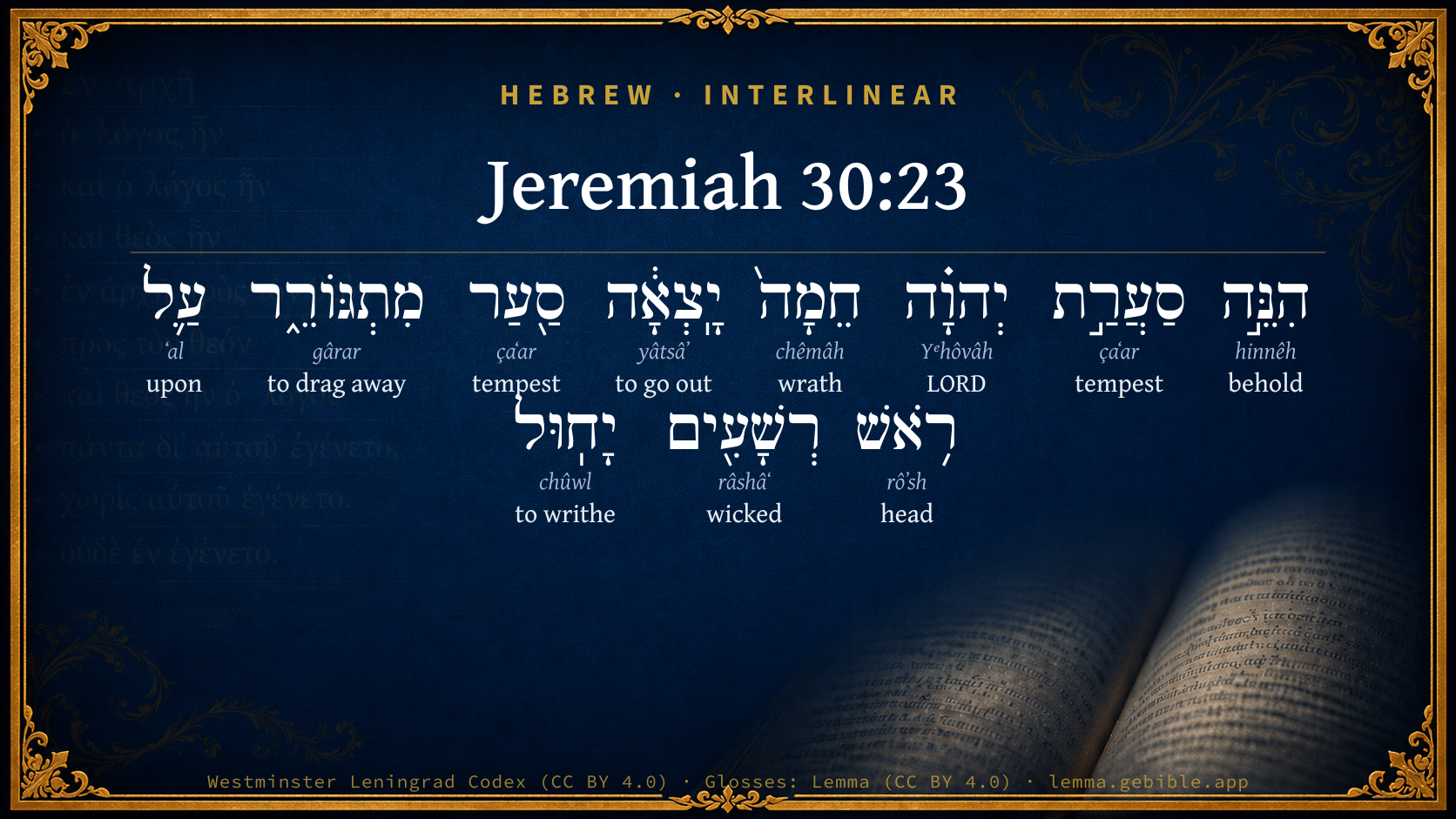
Hebrew (Westminster Leningrad Codex) Jeremiah 30:23 appears in the Hebrew Old Testament. The text above is from the Westminster Leningrad Codex. Each word links to its Strong’s number, a concise gloss, and parsing drawn from the Open Scriptures Hebrew Bible morphology. Click any word for its full Brown-Driver-Briggs (BDB) entry.
Download image
Cite this verse

Jeremiah 30:23 (World English Bible). Public Domain. Lemma interlinear Bible study tool, https://lemma.gebible.app/v/jeremiah/30/23.

Show BibTeX & RIS
BibTeX
RIS
English Translation
Behold, the tempest of Yahweh, [even his] wrath, is gone forth, a sweeping tempest: it shall burst on the head of the wicked.
World English Bible · Public Domain
Download a study sheet

One document with this verse’s original text, its word-by-word gloss line, the meaning frame, cross-references with their text, attributed commentary, and full source and license credits — printable, and it pastes into notes with its structure intact.

This verse Autodidact and up

Study sheet (.html) Plain text (.txt)

A passage Seminary Student

Up to 50 verses in one chapter. A passage sheet keeps up to 6 commentary sources and 12 cross-references per verse, in the order this page ranks them, and says so on the sheet whenever that leaves anything out. Ask for a single verse and you get the Autodidact verse sheet above.

Everything on this page stays free to read, with no account — the sheet is a download of what is already on screen, not access to it.

Want to remove ads? Support Godless Engineer
Compare translations 3

The same verse in 3 English versions, stacked beneath the original-language interlinear above. Click any original word for its lexicon entry.

Each is an independent rendering of the whole verse — the interlinear is not word-aligned to these translations.

Highlighted words mark where these versions differ — a whole-verse word diff, not a word-by-word alignment.

  • World English Bible Public Domain
    Behold, the tempest of Yahweh, [even his] wrath, is gone forth, a sweeping tempest: it shall burst on the head of the wicked.
  • King James Version Public Domain
    Behold, the whirlwind of the LORD goeth forth with fury, a continuing whirlwind: it shall fall with pain upon the head of the wicked.
  • unfoldingWord Literal Text CC BY-SA 4.0
    See, the tempest of Yahweh, his fury, has gone out. It is a continual tempest. It will whirl on the heads of the wicked people.

unfoldingWord Literal Text — © unfoldingWord, licensed CC BY-SA 4.0. Word-aligned USFM3 via Door43 (git.door43.org/unfoldingWord/en_ult).

Versions to compare (up to 4)

3 of 4 selected

Show all 18 translations

Every available English version of this verse, each an independent rendering of the whole verse.

  • World English Bible Public Domain
    Behold, the tempest of Yahweh, [even his] wrath, is gone forth, a sweeping tempest: it shall burst on the head of the wicked.
  • Berean Standard Bible Public Domain
    Behold, the storm of the LORD has gone out with fury, a whirlwind swirling down upon the heads of the wicked.
  • Majority Standard Bible Public Domain
    Behold, the storm of the LORD has gone out with fury, a whirlwind swirling down upon the heads of the wicked.
  • King James Version Public Domain
    Behold, the whirlwind of the LORD goeth forth with fury, a continuing whirlwind: it shall fall with pain upon the head of the wicked.
  • American Standard Version (1901) Public Domain
    Behold, the tempest of Jehovah, `even his' wrath, is gone forth, a sweeping tempest: it shall burst upon the head of the wicked.
  • Revised Version (1885) Public Domain
    Behold, the tempest of the LORD, even his fury, is gone forth, a sweeping tempest: it shall burst upon the head of the wicked.
  • Geneva Bible (1599) Public Domain
    Beholde, the tempest of the Lord goeth foorth with wrath: the whirlewinde that hangeth ouer, shall light vpon the head of the wicked.
  • Douay-Rheims (1899) Public Domain
    Behold the whirlwind of the Lord, his fury going forth, a violent storm, it shall rest upon the head of the wicked.
  • Young's Literal Translation Public Domain
    Lo, a whirlwind of Jehovah -- Fury hath gone forth -- a cutting whirlwind, On the head of the wicked it stayeth.
  • Literal Standard Version CC BY-SA 4.0
    Behold, a whirlwind of YHWH—Fury has gone forth—a cutting whirlwind, || It stays on the head of the wicked.
  • Unlocked Literal Bible CC BY-SA 4.0
    See, the tempest of Yahweh, his fury, has gone out. It is a continual tempest. It will whirl on the heads of the wicked people.
  • unfoldingWord Literal Text CC BY-SA 4.0
    See, the tempest of Yahweh, his fury, has gone out. It is a continual tempest. It will whirl on the heads of the wicked people.
  • Darby Bible Public Domain
    Behold, a tempest of Jehovah, fury is gone forth, a sweeping storm: it shall whirl down upon the head of the wicked.
  • World Messianic Bible Public Domain
    Behold, the LORD’s storm, his wrath, has gone out, a sweeping storm; it will burst on the head of the wicked.
  • Webster's Bible Public Domain
    Behold, the whirlwind of the LORD goeth forth with fury, a continuing whirlwind: it shall fall with pain upon the head of the wicked.
  • Free Bible Version CC BY-SA 4.0
    Watch out! The Lord has sent out a furious storm, a tornado swirling around the heads of the wicked.
  • Bible in Basic English Public Domain
    See, the storm-wind of the Lord, even the heat of his wrath, has gone out, a rolling storm, bursting on the heads of the evil-doers.
  • JPS Tanakh (1917) Public Domain
    Behold, a storm of the LORD is gone forth in fury, a sweeping storm; it shall whirl upon the head of the wicked.

Literal Standard Version (2020), Covenant Press — licensed CC BY-SA 4.0. Text via the HelloAO Bible API (eBible.org). Unlocked Literal Bible (unfoldingWord) — licensed CC BY-SA 4.0. Text via the HelloAO Bible API (eBible.org). unfoldingWord Literal Text — © unfoldingWord, licensed CC BY-SA 4.0. Word-aligned USFM3 via Door43 (git.door43.org/unfoldingWord/en_ult). Free Bible Version, Dr. Jonathan Gallagher — licensed CC BY-SA 4.0. Text via the HelloAO Bible API (eBible.org).

Word by word

More ways to search: Search by grammar → Find every occurrence → Compare this word →

Practice this passage: Drill this verse → Learn its vocabulary →

מִתְגּוֹרֵ֑ר
gârar
H1641
“dragging away”
Verb, Hithpolel, Participle Active, Masculine, Singular, Absolute
Part of Speech
Verb
Stem
Hithpolel
Form
Participle Active
Gender
Masculine
Number
Singular
State
Absolute
Full BDB Definition

Origin: a primitive root

TWOT: 386

to drag, drag away - (Qal) to drag away - (Niphal) to chew the cud - (Poal) sawn (participle) - (Hithpoel) roaring (participle)
  1. הִנֵּ֣ה hinnêh H2009 “behold” Particle, Demonstrative
  2. סַעֲרַ֣ת çaʻar H5591 “tempest of” Noun, Common, Feminine, Singular, Construct
  3. יְהוָ֗ה Yᵉhôvâh H3068 “LORD” Noun, Proper
  4. חֵמָה֙ chêmâh H2534 “wrath” Noun, Common, Feminine, Singular, Absolute
  5. יָֽצְאָ֔ה yâtsâʼ H3318 “to go out” Verb, Qal, Perfect, 3rd Person, Feminine, Singular
  6. סַ֖עַר çaʻar H5591 “tempest” Noun, Common, Masculine, Singular, Absolute
  7. עַ֛ל ʻal H5921 “upon” Preposition
  8. רֹ֥אשׁ rôʼsh H7218 “head of” Noun, Common, Masculine, Singular, Construct
  9. רְשָׁעִ֖ים râshâʻ H7563 “wicked” Adjective, Adjective, Masculine, Plural, Absolute
  10. יָחֽוּל chûwl H2342 “to writhe” Verb, Qal, Imperfect, 3rd Person, Masculine, Singular

About this verse

These counts appear in no published source. They are computed here, from the morphology-tagged text and Lemma’s own curated glosses. What Lemma adds →

11
words
10
distinct lemmas
Prophets
section

Notable vocabulary

The rarest word here is מִתְגּוֹרֵ֑ר to drag away H1641 — appearing just 5 times in the whole Hebrew Bible.

Shared distinctive vocabulary

מִתְגּוֹרֵ֑ר to drag away H1641 occurs in 5 verses of the Hebrew Bible. Also found in:

Grammatical profile

  • 3 verbs
  • 5 nouns
  • 1 adjective
  • 1 preposition
  • 1 particle

Verb forms

  • יָֽצְאָ֔ה Qal · Perfect
  • מִתְגּוֹרֵ֑ר Hithpolel · Participle Active
  • יָחֽוּל Qal · Imperfect

Repetition

A word recurs within this verse — often emphatic in Hebrew:

  • סַעֲרַ֣ת tempest H5591 ×2

Cross-references

5

Topical passages linked to Jeremiah 30:23 in the Treasury of Scripture Knowledge — connected by theme and wording, ordered by reader-vote popularity; previews shown in the World English Bible.

  • Jeremiah 23:19–20 Behold, the tempest of Yahweh, [even his] wrath, is gone forth, yes, a whirling tempest: it shall burst on the head of the wicked.
  • Jeremiah 25:32 Thus says Yahweh of hosts, Behold, evil shall go forth from nation to nation, and a great tempest shall be raised up from the uttermost parts of the earth.
  • Zechariah 9:14 Yahweh will be seen over them; And his arrow will go flash like lightning; And the Lord Yahweh will blow the trumpet, And will go with whirlwinds of the south.
  • Psalms 58:9 Before your pots can feel the heat of the thorns, He will sweep away the green and the burning alike.
  • Proverbs 1:27 When calamity overtakes you like a storm, When your disaster comes on like a whirlwind; When distress and anguish come on you.

Cross-references courtesy of OpenBible.info (CC BY 4.0).

Hebrew and Greek witnesses Masoretic Hebrew ↔ Greek Septuagint

The same verse in the two great witnesses to the Old Testament, shown verse-for-verse.

These are two independent witnesses, not word-aligned to each other, and the Septuagint is shown in lemma (dictionary) form.

Hebrew Jeremiah 30:23 Masoretic · Westminster Leningrad Codex

הִנֵּ֣ה סַעֲרַ֣ת יְהוָ֗ה חֵמָה֙ יָֽצְאָ֔ה סַ֖עַר מִתְגּוֹרֵ֑ר עַ֛ל רֹ֥אשׁ רְשָׁעִ֖ים יָחֽוּל

Behold, the tempest of Yahweh, [even his] wrath, is gone forth, a sweeping tempest: it shall burst on the head of the wicked.

World English Bible · Public Domain

Greek LXX Structure differs

In the Septuagint, Jeremiah is about an eighth shorter than the Hebrew and arranges its material differently — the Oracles Against the Nations (Hebrew chapters 46–51) appear in the middle of the Greek book, after 25:13. Because the chapter and verse boundaries do not line up, a verse-for-verse comparison with the Hebrew is not shown.

A verse-for-verse comparison isn’t shown here because the chapters and verses don’t line up. Switch to the LXX edition with the MT / LXX toggle above to read the Greek directly.

Hebrew: Westminster Leningrad Codex (CC BY 4.0). Greek: Septuagint (public domain); English from a public-domain English Septuagint. How the Septuagint differs from the Hebrew →

Targum (Aramaic paraphrase)

1

The Targum is the ancient Jewish Aramaic paraphrase of the Hebrew Scriptures — an interpretive translation, not the Hebrew text itself. Onkelos (literal) and Pseudo-Jonathan (expansive) render the Torah, and Jonathan the Prophets. Coverage is partial: where no permissively-licensed English translation exists for a verse, only the Aramaic is shown. This is verse-level text, not a word-by-word alignment to the Hebrew.

  1. Targum Jonathan Prophets (Joshua–Malachi)
    הָא מְזוֹפִיתָא מִן קֳדָם יְיָ בִּרְגַז נַפְקָא וְעִלְעוּל מִתְכְּנַשׁ עַל רֵישׁ רַשִׁיעִין יֵחוּל:

    (no public-domain English translation for this verse)

    Targum Jonathan — Aramaic: “Mikraot Gedolot” (public domain). English: “Sefaria Community Translation” (CC0 1.0 (public-domain dedication)); “London "Chaldee Paraphrase," 1871” (public domain). Text via Sefaria.

Commentary

Notes on Jeremiah 30:23 from classic Christian and Jewish commentators (each source and its license shown beneath its notes). The classic Christian expositions comment on the surrounding passage and are grouped to its opening verse, so a note may address several verses; the Jewish commentaries on the Tanakh (Rashi and others) are per-verse, so they appear only where the commentator wrote on this verse.

Lemma curates 59 commentaries, every one of them public domain or Creative Commons licensed, each selected and text-cleaned for this edition rather than reprinted as found. About our sources →

Trapp's Complete Commentary

John Trapp

Jer 30:23 Behold, the whirlwind of the LORD goeth forth with fury, a continuing whirlwind: it shall fall with pain upon the head of the wicked.

Ver. 23. Behold the whirlwind of the Lord goeth forth with fury.] Sensim sese conglomerans ac demittens in eorum capite; the vengeance of God followeth them close at heels, till at length they be wherried away by that terrible tempest at death. {Job 27:20}

John Trapp, A Commentary or Exposition upon All the Books of the Old and New Testament (1647–1656) — public domain. Text from a community e-Sword module.

Joseph Benson's Commentary

Jer 30:23-24. Behold, the whirlwind of the Lord goeth forth with fury — Rather, with anger, the word fury being manifestly improper when applied to God. These two verses occur with some slight variations, Jer 23:19-20, where see the notes. In the latter days ye shall consider it — The latter days here may signify the time to come; but they commonly imply the times of the gospel, that being the last dispensation, and what should continue till the end of the world. Thus understood, the words import, “When all these evils are come upon you, which God has threatened for your disobedience, and particularly for your heinous crime of rejecting the Messiah, and you have found the denunciations verified in the several captivities you have undergone, then you will understand the import of this and several other prophecies, and the event will perfectly instruct you in their meaning.” — Lowth.

Joseph Benson's Commentary on the Old and New Testaments (1811–1818) — public domain. Text from a community e-Sword module.

Keil & Delitzsch

C. F. Keil & F. Delitzsch

The wicked shall be destroyed by the fire of God's anger. - Jer 30:23. "Behold, a whirlwind of Jahveh - wrath goeth forth - a sweeping whirlwind; it shall hurl down on the head of the wicked. Jer 30:24. The heat of Jahveh's anger shall not return till He hath done and till He hath established the purpose of His heart; in the end of the days ye shall consider it."

These two verses have been already met with in Jer 23:19 and Jer 23:20, with a few variations. Instead of מיחולל we have here מתגּורר, and אף־יהוה is here strengthened by prefixing חרון; on the other hand, בּינה, which is added in the preceding passage to intensify התבּוננוּ, is here omitted. The first of these changes is more of a formal than a real kind; for by the substitution of מתגּורר for מיחולל, the play in the latter word on יחוּל is merely disturbed, not "destroyed," since ר and ל are kindred sounds. התגּורר has been variously rendered. The meaning of "abiding," which is founded on Kg1 17:20, is here unsuitable. Equally inappropriate is the meaning of "crowding together," or assembling in troops, which we find in Hos 7:14. It is more correct to derive it from גּרר, either in the sense of sweeping away or that of blustering, which are meanings derived from the fundamental one of producing harsh sounds in the throat, and transferred to the rushing sound made by the storm as it carries everything along with it. The second and third changes affect the sense. For, by the addition of חרון to אף, the idea of a judgment in wrath is intensified; and by dropping בּינה, less is made of the acuteness of perception. Both of these variations correspond to differences in the context of both passages. In Jer 23, where the words are applied to the false prophets, it was important to place emphasis on the statement that these men would, by experience, come to a full knowledge of the reality of that judgment they denied; in this chapter, on the other hand, the idea of judgment in wrath must be expressly set aside. There is thus no good ground for considering these verses a later interpolation into the text, as Movers, Hitzig, and Ngelsbach think. Hitzig rejects these verses as spurious on the false ground that the judgment threatened in this chapter refers merely to the fall of the kingdom of Babylon, which Jeremiah could not have been able to know beforehand; Ngelsbach rejects them on the ground of other erroneous assumptions.

(Note: First, he holds the groundless opinion that this prophecy originated in the time of Josiah, and therefore could not have borrowed verses from the address given in Jer 23, which belongs to the time of Jehoiakim; secondly, with as little ground he affirms that these verses do not correspond with the character of the chapter, and seem like a jarring discord in the midst of the announcement of deliverance it contains; finally, he asks whence could come "the wicked" mentioned, in the times described by the prophet - as if he thought that when the captivity of the people was turned, all godless ones would suddenly disappear. - The doubts as to the genuineness of Jer 30:22 are based by Ngelsbach merely on the fact that the same idea is repeated in Jer 31:1.)

The only doubtful point regarding these verses is, whether they are to be connected, as Hengstenberg thinks, with what precedes, or with what follows, as Ewald supposes. In the former case, to the promise for the true Israel would be added a threat against those who only seemed to be Israel, - like the declaration in Isaiah, "There is no peace to the wicked:" this addition would thus be made, lest those for whom the promise was not intended should unwarrantably apply it to themselves. But, however well-founded the thought is, that every increasing manifestation of grace is invariably accompanied by an increased manifestation of righteousness, and though all the prophets clearly testify that the godless members of the covenant people have no share in the promised salvation, but instead are liable to judgment; yet there has not been such preparation made for the introduction of this thought as that we might be able at once to join these two verses to what precedes. The exclamation "Behold!" with which the words are introduced, rather form a sign that a new addition is to be made to the prophecy. We therefore view the threat in this verse as a resumption of the threat of judgment made in Jer 30:5., to which is attached, in Jer 31:1, the further development of the announcement of deliverance; but we refer the threat made in the verse not merely to the heathen as such, but to all "wicked ones," in such a way that it at the same time applies to the godless members of the covenant people, and signifies their exclusion from salvation.

Keil & Delitzsch — Biblical Commentary on the Old Testament (1861–1891) — public domain (CC PDM 1.0). Text via the HelloAO Bible API. (Old Testament only.)

Tyndale Open Study Notes

Tyndale Open Resources

30:23 The reestablished nation was still held accountable for rebellion. The Lord reserved the authority to express his stormy anger against the wicked.

Tyndale Open Study Notes — © Tyndale Open Resources, licensed CC BY-SA 4.0. Text via the HelloAO Bible API.

Geneva Bible (1599)

Geneva Bible translators

Lest the wicked hypocrites should flatter themselves with these promises, the Prophets showeth what shall be their portion.

Geneva Bible (1599) marginal notes — public domain. Text via Bolls.life.

Jamieson, Fausset & Brown

Robert Jamieson, A. R. Fausset & David Brown

(Jer 23:19). Vengeance upon God's foes always accompanies manifestations of His grace to His people.

continuing--literally, "sojourning," abiding constantly; appropriately here in the case of Babylon, which was to be permanently destroyed, substituted for "whirling itself about" ("grievous" in English Version) (see on Jer 23:19-20), where the temporary downfall of Judea is spoken of.

As in that chapter the restoration of Judah, so in this the restoration of Israel's ten tribes is foretold.

Next: Jeremiah Chapter 31

Jamieson, Fausset & Brown — Commentary Critical and Explanatory on the Whole Bible (1871) — public domain (CC PDM 1.0). Text via the HelloAO Bible API.

Adam Clarke's Commentary

Verse 23. The whirlwind of the Lord] A grievous tempest of desolation,-

Shall fall with pain upon the head of the wicked.] On Nebuchadnezzar and the Chaldeans.

Adam Clarke's Commentary on the Bible (1810–1826) — public domain. Text from a community e-Sword/MySword module.

John Calvin's Commentaries

The Prophet seems to speak abruptly; for nothing could be more delightful than the promise that God gives, that he would be a Father to the people; but he immediately adds, that there would arise an involving whirlwind, which would abide on the head of the wicked. These things, at the first view, seem not to harmonize. But the latter sentence may be applied to the heathens, or to any of the enemies of the Church; for whenever God appears as the Savior of his people, his vengeance goes forth, and is poured on the wicked. Hence such declarations as the following often occur,

“The day of my vengeance is nigh, and the year of my visitation.” (Isaiah 63:4)

Isaiah joins both, the favor of God and his vengeance: and this is often done by the other Prophets, in order that we may see that God’s mercy cannot be clearly and distinctly perceived towards the faithful, except when his judgment on the other hand be made conspicuous as to the wicked. So this passage may be explained. But we may well thus connect the words of the Prophet, — that he kindly endeavored to allure the people by offering them God’s favor; but that having seen that it would be despised, as we stated yesterday, by the greater part of them, he now seasonably threatens them, that if they refused the favor offered them, such ingratitude could not be borne by God. And this is a mode of teaching common in Scripture. For God on his part thus manifests his kindness so as to stimulate men; but as he sees them not only slothful and tardy, but also wicked and ungrateful, he declares that they shall not be unpunished if they despise his favor. The former truth then well agrees with what the Prophet now says, — that the wrath of God would arise like a tempestuous storm.

He afterwards adds, a whirling or involving tempest, properly, a tempest gathering itself. The verb is גור gur, in a reduplicate form and in Hithpael. A similar sentence is found in Jeremiah 23:19; but there the Prophet used another word as required by the subject. Some render it “falling,” for גור, gur, means to fall; and this meaning is suitable, “a falling storm,” that is, impetuously descending, so as to abide on the head of the wicked. But the former sense has been more generally taken, and I am disposed to embrace it; for it tends to shake men with terror, when the storm is said to be like a whirlwind, for it turns and twists around, so that it cannot be avoided. The meaning then is, that God’s vengeance would be fatal to all the wicked. But we may take the wicked, רשעים reshoim, for the despisers of God, though boasting of his name, as well as for aliens: but I am inclined to include both, even domestic and foreign enemies of God; as though the Prophet had said, that no remedy remained, except they fled to the mercy of God. It afterwards follows, —

John Calvin's Commentaries (1540-1563) — public domain. Text from the Calvin Translation Society English edition (1840s-50s) via the Christian Classics Ethereal Library (ccel.org). Calvin's coverage is partial (roughly two-thirds of the Bible); uncommented books and verses are honest gaps, never fabricated. The 19th-century editor's footnotes and remarks are omitted so the notes are faithfully Calvin's own voice.

Ellicott's Commentary for English Readers

(23, 24) Behold, the whirlwind of the Lord . . .—The “wicked” who are thus threatened are the enemies and oppressors of the penitent and rescued people. In the “latter days,” the far-off future (Gen_49:1; Num_24:14; Isa_2:2), it should be seen that He was their avenger. (See Notes on Jer_23:19-20.) A right division of chapters would probably connect this with the great promise of Jer_31:1.

A Bible Commentary for English Readers, edited by Charles John Ellicott (1878–1897) — public domain. Text from a community e-Sword module.

The Cambridge Bible for Schools and Colleges

gen. ed. J. J. S. Perowne

23. This and the following v. are nearly identical with Jer_23:19-20 (see notes there), where judgement is pronounced upon the false prophets. Co. (not so Du.) doubts their genuineness here as well as there, both for metrical reasons, and because the thought they contain is one which has not met us hitherto, viz. a purifying judgement to be executed on recreant Jews (the general reference of “the wicked” in the Hebrew) before the final deliverance.

a sweeping (mg. gathering) tempest] The sense of the Hebrew word is uncertain. Probably sweeping or rushing is the meaning intended.

23, 24. See introd. summary to this section.

The Cambridge Bible for Schools and Colleges (gen. ed. J. J. S. Perowne; Cambridge University Press, 1878–1918) — public domain. Text from a community e-Sword module.

John Gill's Exposition

Behold, the whirlwind of the Lord goeth forth with fury,.... That is, the wrath of God, which like a whirlwind comes suddenly, with great force and strength, and carries all before it; there is no withstanding it; such is the wrath of God against the enemies of his church and people:

a continuing whirlwind; whirlwinds, as they come suddenly, are generally soon over; but this will continue very boisterous and terrible, until it has done all the execution designed by it:

it shall fall with pain upon the head of the wicked; according to some, the wicked Jews, that do not repent and turn to the Lord; but rather the wicked of the nations, as Jarchi; not the Gentiles in general, as distinguished from the Jews, which is his sense, but the antichristian states; for the ruin of antichrist, and the conversion of the Jews, will be much about the same time; and the vials of God's wrath, which will be poured upon them, and fall upon their heads, will give them much pain, both in body and mind; see Rev 16:10; and which wrath and ruin are expressed by a tempest of thunder, lightning, and hail, and by an earthquake, Jer 30:18.

John Gill's Exposition of the Whole Bible (1746–1763) — public domain (CC PDM 1.0). Text via the HelloAO Bible API.

Albert Barnes' Notes on the Bible

Compare the marginal reference. These verses would more appropriately be attached to the next chapter, for which they form a suitable introduction.

Albert Barnes' Notes on the Bible (1834–1885) — public domain. Text from a community e-Sword/MySword module.

Haydock's Catholic Bible Commentary

Wicked, at Jerusalem, or rather the Chaldeans; and the Jews, who crucified their Messias. (St. Jerome, &c.) (Calmet)

George Leo Haydock (1774–1849), Haydock's Catholic Family Bible and Commentary, 1859 edition — public domain. Excludes Psalms (Douay-Rheims chapter numbering differs from Protestant) and Deuterocanonical books (Catholic canon only).

Matthew Poole's English Annotations

The whirlwind of the Lord goeth forth with fury; the vengeance of God compared to a whirlwind, for the suddenness of it, and because it should encompass them to their ruin, a terrible whirlwind.

A continuing whirlwind; or, a continuing whirling; not a sudden blast of wind, that shall presently go over, but a vengeance that shall abide. The miserable effects of which, in destroying, shall be either upon the heathen, or upon the wicked Jews that shall continue in their disobedience and stubbornness.

Matthew Poole's English Annotations on the Holy Bible (1683–1685) — public domain. Text from a community e-Sword/MySword module.

The Pulpit Commentary

Vers. 23, 24. These verses occur in a form evidently more original in Jer_23:19, Jer_23:20. In all probability they were first inserted from memory in the margin, and then incorporated into the text at a time subsequent (how long subsequent we cannot say) to Jeremiah.

The Pulpit Commentary (1880–1919), ed. H.D.M. Spence-Jones & Joseph S. Exell — public domain. Text from a community e-Sword module.

John Wesley's Explanatory Notes

A continuing - Not a sudden blast, that shall presently go over, but a vengeance that shall abide.

John Wesley, Explanatory Notes Upon the Whole Bible (1754–1765) — public domain. Text via the GEBible commentary corpus.

unfoldingWord translationNotes

Door43 World Missions Community

See, the tempest of Yahweh, his fury, has gone out

This speaks of God's anger and punishment as if it were a storm. This emphasizes his power and ability to destroy wicked people. (See: Metaphor)

his heart's intentions

The abstract noun "intentions" can be translated using the verb "intends." The heart is a synecdoche for the whole person. AT: "what he intends to do" (See: Abstract Nouns and Synecdoche)

translationWords

head

evil

wrath

heart

unfoldingWord translationNotes — © Distant Shores Media and the Door43 World Missions Community, licensed CC BY-SA 4.0. Source: git.door43.org/Door43/en_tn.

Rashi

Rabbi Shlomo Yitzchaki (Rashi)

settling storm camping and dwelling an expression of “the land of the sojournings of (מְגוּרֵי)” (Gen. 37:1), and a similar case is “and a whirling (מִתְחוֹלֵל) storm” (supra 23:19) stated in the other verse is the same as this for both of them are expressions of camping.

on the head[s] of the wicked On the heads of the heathens.

Rashi on the Tanakh — English translations: “The Judaica Press complete Tanach with Rashi, translated by A. J. Rosenberg” (CC BY 4.0); “Pentateuch with Rashi's commentary by M. Rosenbaum and A.M. Silbermann, 1929-1934” (public domain); “The Metsudah Tanach series, Lakewood, N.J” (CC BY 4.0); and “The Book of Joshua, Metsudah Publications, 1997” (CC BY 4.0). Text via Sefaria.

Lesson kit

Teaching starters — assembled from the data on this page, not authored interpretation. Every prompt links to the verse data it draws on. Edit before teaching.

Jeremiah, in the Prophets, opens this verse with 11 words (10 distinct Hebrew lemmas). Its most distinctive word is gârar (“to drag away”). A historical commentator’s framing appears above. Read the whole chapter for the surrounding context.

Discussion questions

  1. How does “to drag away” (gârar) shape what this verse is saying?
  2. How does Leviticus 11:7, which shares the word «to drag away», read alongside this verse?
  3. What does the repetition of “tempest” (2× in this one verse) do in this verse?
  4. These translations render this verse differently; the difference is in the English rendering, not the original. What questions does that raise?
  5. «יָֽצְאָ֔ה» is a Qal Perfect verb. How does that grammatical form shape the action described?
  6. Compare how Trapp's Complete Commentary and Joseph Benson's Commentary read this verse. Where do they agree or differ?

Things to notice

Reading settings

Reading text

Shown beneath each verse's original-language words.

Old Testament
Old Testament edition

Read the OT as the Masoretic Hebrew (MT) or the Greek Septuagint (LXX).

English shown for the Greek Septuagint (in the Hebrew ↔ Greek comparison).

Comparing translations? Open the Compare panel on any verse page to stack up to four side by side.