
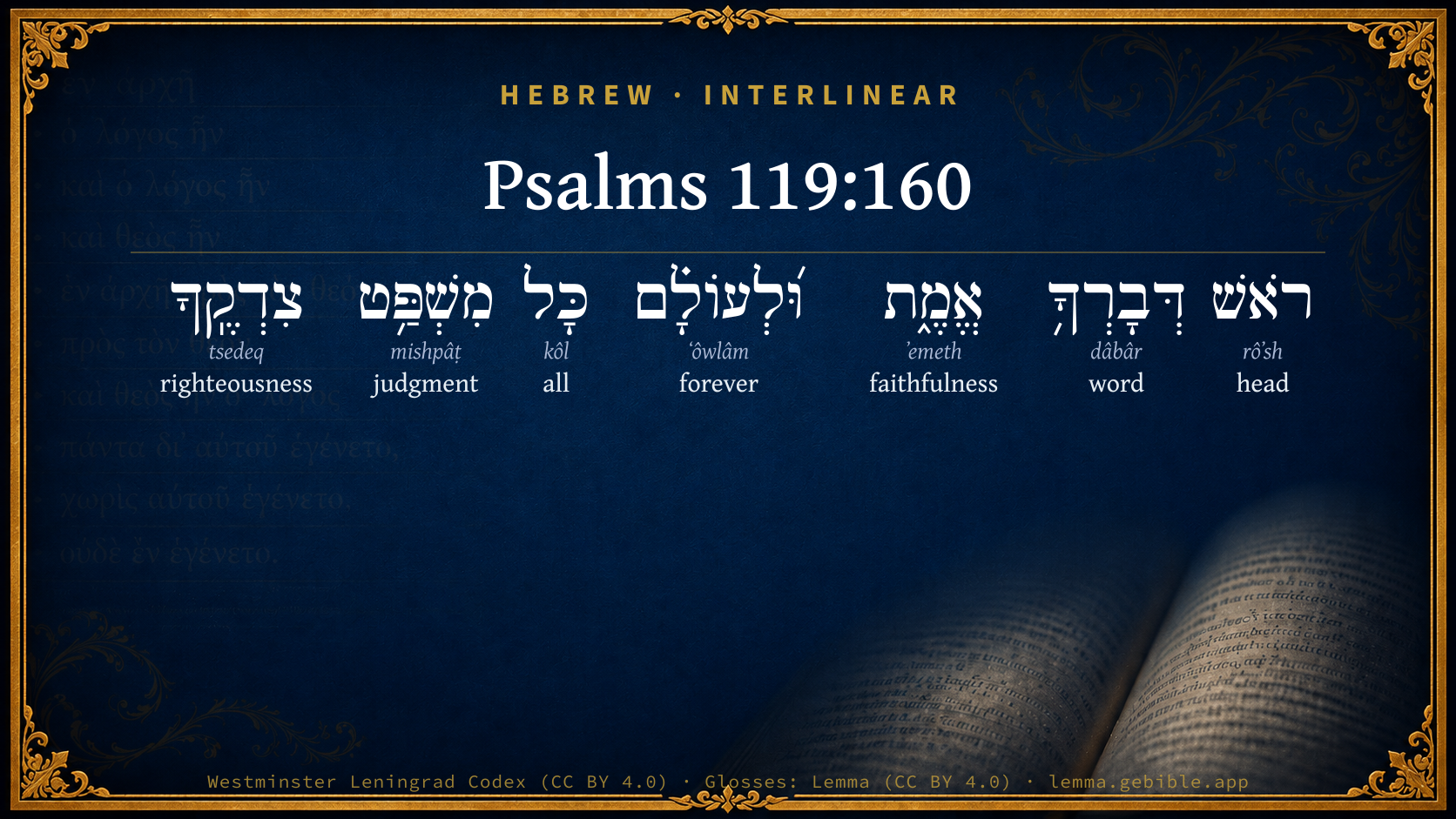
Psalms 119:160

Hebrew (Westminster Leningrad Codex) Psalms 119:160 appears in the Hebrew Old Testament. The text above is from the Westminster Leningrad Codex. Each word links to its Strong’s number, a concise gloss, and parsing drawn from the Open Scriptures Hebrew Bible morphology. Click any word for its full Brown-Driver-Briggs (BDB) entry.
Download image
Cite this verse

Psalms 119:160 (World English Bible). Public Domain. Lemma interlinear Bible study tool, https://lemma.gebible.app/v/psalms/119/160.

Show BibTeX & RIS
BibTeX
RIS
English Translation
All of your words are truth. Every one of your righteous ordinances endures forever.
World English Bible · Public Domain
Download a study sheet

One document with this verse’s original text, its word-by-word gloss line, the meaning frame, cross-references with their text, attributed commentary, and full source and license credits — printable, and it pastes into notes with its structure intact.

This verse Autodidact and up

Study sheet (.html) Plain text (.txt)

A passage Seminary Student

Up to 50 verses in one chapter. A passage sheet keeps up to 6 commentary sources and 12 cross-references per verse, in the order this page ranks them, and says so on the sheet whenever that leaves anything out. Ask for a single verse and you get the Autodidact verse sheet above.

Everything on this page stays free to read, with no account — the sheet is a download of what is already on screen, not access to it.

Want to remove ads? Support Godless Engineer
Compare translations 3

The same verse in 3 English versions, stacked beneath the original-language interlinear above. Click any original word for its lexicon entry.

Each is an independent rendering of the whole verse — the interlinear is not word-aligned to these translations.

Highlighted words mark where these versions differ — a whole-verse word diff, not a word-by-word alignment.

  • World English Bible Public Domain
    All of your words are truth. Every one of your righteous ordinances endures forever.
  • King James Version Public Domain
    Thy word is true from the beginning: and every one of thy righteous judgments endureth for ever.
  • unfoldingWord Literal Text CC BY-SA 4.0
    The head of your word truth, and every judgment of your righteousness forever. SHIN

unfoldingWord Literal Text — © unfoldingWord, licensed CC BY-SA 4.0. Word-aligned USFM3 via Door43 (git.door43.org/unfoldingWord/en_ult).

Versions to compare (up to 4)

3 of 4 selected

Show all 17 translations

Every available English version of this verse, each an independent rendering of the whole verse.

  • World English Bible Public Domain
    All of your words are truth. Every one of your righteous ordinances endures forever.
  • Berean Standard Bible Public Domain
    The entirety of Your word is truth, and all Your righteous judgments endure forever.
  • Majority Standard Bible Public Domain
    The entirety of Your word is truth, and all Your righteous judgments endure forever.
  • King James Version Public Domain
    Thy word is true from the beginning: and every one of thy righteous judgments endureth for ever.
  • American Standard Version (1901) Public Domain
    The sum of thy word is truth; And every one of thy righteous ordinances `endureth' for ever.
  • Revised Version (1885) Public Domain
    The sum of thy word is truth; and every one of thy righteous judgments endureth for ever.
  • Geneva Bible (1599) Public Domain
    The beginning of thy worde is trueth, and all the iudgements of thy righteousnesse endure for euer.
  • Young's Literal Translation Public Domain
    The sum of Thy word `is' truth, And to the age `is' every judgment of Thy righteousness!
  • Literal Standard Version CC BY-SA 4.0
    The sum of Your word [is] truth, || And every judgment of Your righteousness [is] for all time!
  • Unlocked Literal Bible CC BY-SA 4.0
    The essence of your word is truth; every one of your righteous decrees lasts forever.
  • unfoldingWord Literal Text CC BY-SA 4.0
    The head of your word truth, and every judgment of your righteousness forever. SHIN
  • Darby Bible Public Domain
    The sum of thy word is truth, and every righteous judgment of thine is for ever.
  • World Messianic Bible Public Domain
    All of your words are truth. Every one of your righteous ordinances endures forever. SIN AND SHIN
  • Webster's Bible Public Domain
    Thy word is true from the beginning: and every one of thy righteous judgments endureth for ever.
  • Free Bible Version CC BY-SA 4.0
    Your word can be summed up in one word: truth! All of your just laws will last forever. Shin
  • Bible in Basic English Public Domain
    Your word is true from the first; and your upright decision is unchanging for ever.
  • JPS Tanakh (1917) Public Domain
    The beginning of Thy word is truth; and all Thy righteous ordinance endureth for ever.

Literal Standard Version (2020), Covenant Press — licensed CC BY-SA 4.0. Text via the HelloAO Bible API (eBible.org). Unlocked Literal Bible (unfoldingWord) — licensed CC BY-SA 4.0. Text via the HelloAO Bible API (eBible.org). unfoldingWord Literal Text — © unfoldingWord, licensed CC BY-SA 4.0. Word-aligned USFM3 via Door43 (git.door43.org/unfoldingWord/en_ult). Free Bible Version, Dr. Jonathan Gallagher — licensed CC BY-SA 4.0. Text via the HelloAO Bible API (eBible.org).

Word by word

More ways to search: Search by grammar → Find every occurrence → Compare this word →

Practice this passage: Drill this verse → Learn its vocabulary →

צִדְקֶֽךָ
tsedeq
H6664
“righteousness · your”
Noun, Common, Masculine, Singular, Construct + Suffix, Personal, 2nd Person, Masculine, Singular
Part of Speech
Noun
Type
Common
Gender
Masculine
Number
Singular
State
Construct
Full BDB Definition

Origin: from H6663

TWOT: 1879a

justice, rightness, righteousness - what is right or just or normal, rightness, justness (of weights and measures) - righteousness (in government) - of judges, rulers, kings - of law - of Davidic king, Messiah - of Jerusalem as seat of just government - of God's attribute - righteousness, justice (in case or cause) - rightness (in speech) - righteousness (as ethically right) - righteousness (as vindicated), justification (in controversy), deliverance, victory, prosperity - of God as covenant-keeping in redemption - in name of Messianic king - of people enjoying salvation - of Cyrus
  1. רֹאשׁ rôʼsh H7218 “head of” Noun, Common, Masculine, Singular, Construct
  2. דְּבָרְךָ֥ dâbâr H1697 “word · your” Noun, Common, Masculine, Singular, Construct + Suffix, Personal, 2nd Person, Masculine, Singular
  3. אֱמֶ֑ת ʼemeth H571 “faithfulness” Noun, Common, Feminine, Singular, Absolute
  4. וּ֝לְעוֹלָ֗ם ʻôwlâm H5769 “and · to/for · forever” Conjunction + Preposition + Noun, Common, Masculine, Singular, Absolute
  5. כָּל kôl H3605 “all of” Noun, Common, Masculine, Singular, Construct
  6. מִשְׁפַּ֥ט mishpâṭ H4941 “judgment of” Noun, Common, Masculine, Singular, Construct

About this verse

These counts appear in no published source. They are computed here, from the morphology-tagged text and Lemma’s own curated glosses. What Lemma adds →

7
words
7
distinct lemmas
Wisdom
section

Grammatical profile

  • 7 nouns

Hebrew & Septuagint length

In English translation the verse runs 14 words from the Hebrew and 17 from the Septuagint (LXX English) — closely comparable.

A rough comparison of the two English renderings, which tokenize alike — not a word-level alignment.

Word counts can differ between the Hebrew and the Greek without any difference in meaning — e.g. the Hebrew direct-object marker אֵת has no separate Greek word, and Greek often adds the article ὁ.

Cross-references

10

Topical passages linked to Psalms 119:160 in the Treasury of Scripture Knowledge — connected by theme and wording, ordered by reader-vote popularity; previews shown in the World English Bible.

  • Proverbs 30:5 "Every word of God is flawless. He is a shield to those who take refuge in him.
  • 2 Timothy 3:16 Every writing inspired by God is profitable for teaching, for reproof, for correction, and for instruction which is in righteousness,
  • Psalms 119:144 Your testimonies are righteous forever. Give me understanding, that I may live.
  • Matthew 5:18 For most assuredly, I tell you, until heaven and earth pass away, not even one smallest letter or one tiny pen stroke shall in any way pass away from the law, until all things are accomplished.
  • Psalms 119:142 Your righteousness is an everlasting righteousness. Your law is truth.
  • Psalms 119:152 Of old I have known from your testimonies, That you have founded them forever.
  • Ecclesiastes 3:14 I know that whatever God does, it shall be forever. Nothing can be added to it, nor anything taken from it; and God has done it, that men should fear before him.
  • Psalms 119:75 Yahweh, I know that your judgments are righteous, That in faithfulness you have afflicted me.
  • Psalms 119:86 All of your commandments are faithful. They persecute me wrongfully. Help me!
  • Psalms 119:138 You have commanded your statutes in righteousness. They are fully trustworthy.

Cross-references courtesy of OpenBible.info (CC BY 4.0).

Hebrew and Greek witnesses Masoretic Hebrew ↔ Greek Septuagint

The same verse in the two great witnesses to the Old Testament, shown verse-for-verse.

You’re reading Greek Psalm 118 (Hebrew Psalm 119). The Septuagint counts the superscription, so verse numbers can differ from the Hebrew — chapter-level alignment, not verse-by-verse. Numbering follows Rahlfs.

These are two independent witnesses, not word-aligned to each other, and the Septuagint is shown in lemma (dictionary) form.

Hebrew Psalms 119:160 Masoretic · Westminster Leningrad Codex

רֹאשׁ דְּבָרְךָ֥ אֱמֶ֑ת וּ֝לְעוֹלָ֗ם כָּל מִשְׁפַּ֥ט צִדְקֶֽךָ

All of your words are truth. Every one of your righteous ordinances endures forever.

World English Bible · Public Domain

Greek LXX Greek Psalm 118:160 Septuagint · lemma form

ἀρχή ὁ λόγος σύ ἀλήθεια καί εἰς ὁ αἰών πᾶς ὁ κρίμα ὁ δικαιοσύνη σύ

The beginning of your words is truth; and all the judgments of your righteousness endure for ever.

LXX2012 (modern English Septuagint) · Public Domain

On this verse, The Cambridge Bible for Schools and Colleges discusses the Septuagint’s reading. Read the note in Commentary ↓

Hebrew: Westminster Leningrad Codex (CC BY 4.0). Greek: Septuagint (public domain); English from LXX2012 (modern English Septuagint) (Public Domain). How the Septuagint differs from the Hebrew →

Commentary

Notes on Psalms 119:160 from classic Christian and Jewish commentators (each source and its license shown beneath its notes). The classic Christian expositions comment on the surrounding passage and are grouped to its opening verse, so a note may address several verses; the Jewish commentaries on the Tanakh (Rashi and others) are per-verse, so they appear only where the commentator wrote on this verse.

Lemma curates 59 commentaries, every one of them public domain or Creative Commons licensed, each selected and text-cleaned for this edition rather than reprinted as found. About our sources →

Trapp's Complete Commentary

John Trapp

Psa 119:160 Thy word [is] true [from] the beginning: and every one of thy righteous judgments [endureth] for ever.

Ver. 160. Thy word is true from the beginning] Heb. The beginning of thy word is true; Primarium illud est in verbo tuo quod est firmissimum, this is a special praise of thy word, that it is very sure. These words are faithful and true, Rev 22:6, from the one end of the Bible to the other. Some render it thus, Thy most excellent word is truth. This most excellent word Kimchi interpreteth to be particularly that in the head or preface to the decalogue, Hear, O Israel, Jehovah thy God, Jehovah is one. Theodoret will have it to be that promise made to Abraham that in his seed all nations of the earth should be blessed. Some read it, every chapter of thy word is truth.

John Trapp, A Commentary or Exposition upon All the Books of the Old and New Testament (1647–1656) — public domain. Text from a community e-Sword module.

The Biblical Illustrator

Joseph S. Exell

Psa_119:160

Thy word is true from the beginning.

The Bible--Gods Word

Civilization, intelligence, morality, and general prosperity unmistakably mark the pathway of the Bible. These are the results that follow its introduction, or they are the signs that mark its coming. Or if these evidences of civilization precede the Book, they precede it as the rays of the morning sun precede the sun itself.

I. The word of God would be exposed to objection, and also liable to rejection by reason of the natural state of the human heart. All truth is truth, but the truth of the Bible differs from other truth in an important particular. The truth of the Bible is addressed specially, not to the intellect, but to the ethical or the moral character, and hence it involves moral accountability, and is, therefore, imperative in a sense in which truth ordinarily is not imperative. The Book is the true reformer. It begins with the heart, and it requires changes there, and the evidences of which are also to be apparent in the life. Hence the disinclination of the unregenerate man to consult the Bible either for counsel or instruction. Hence also the ignorance of what the Book really contains.

II. The pride of the human reason also interferes with the study and the reception of the Word of God. This remark applies more especially to those who profess to be the more learned among their fellow-men. In some departments of knowledge they are entitled to the advanced position which they profess to have attained. But their knowledge is ascribed to discovery. New truths in science are said to be discovered, and their discovery is ascribed to the superior knowledge or wisdom of the discoverer. But the Bible is a revelation, and not in any sense merely a discovery of the human reason; and as such it also claims acceptance by the human reason, and that without any distinction of persons. But this again is not agreeable to the speculative turn and the ambitious spirit of the human mind, which has been accustomed to discover truth rather than to receive it in the ordinary manner. He who saw with clear and open eye the mystery of the human soul, accounted for His rejection on the one hand, and for the feeble influence of the Gospel on the other, by saying that men loved darkness rather than light, because their deeds were evil. The same truth applies to the acceptance and to the rejection of the Bible. Not the want of sufficient evidence, but a moral cause, and often also a bad life is the strongest objection to the Bible. But the folly of the objection to the Bible, by reason of the purity of the heart and the uprightness of the life which it requires, is manifest in the fact that as any believe in a righteous God, to that extent also must there be a revelation possessing the characteristics of the God who makes it. The Book must bear the impress of its Divine Author.

III. But why should the Bible be rejected in view of its character and its influence on the earth? It is the most remarkable Book in the worlds literature. It is the basis for the religion of the civilized nations of the globe. It is everywhere the conserving companion of civil and religious freedom. It is the rock upon which governments must rest; it is the reflection of the Divinity, and the hope of humanity. It has been called the Star of Eternity, and rightly so, since only by its light the bark of man can cross the Sea of Life and reach the shores of immortality securely. It has been most truthfully said, that whilst the Bible comprises in bulk not more than the three-hundredth part of the Greek and the Roman literature extant, yet it has attracted and concentrated more thought upon itself, and has produced more books than all the Greek and Roman literature combined. This attraction and concentration of thought has also been on the part of those nations that occupy the very forefront of civilization, science, and learning. Said Thomas Carlyle, There never was any other book like the Bible, and there never will be such another. And when one said to Carlyle, There is nothing remarkable in the Book of Proverbs, Carlyles reply was, Make a few. Yes, make a few only. Ordinarily the philosopher writes books for those who are devoted to philosophy. The scientist writes books adapted to the student of science. The statesman writes books for the sage and the statesman. But in the Bible we have fishermen writing books for the philosopher. Men in the shepherds tent writing books for the statesman. Tax-gatherers writing books for teachers, judges, and legislators. Herdsmen writing poetry and prophecy. Physicians writing history and theology. No, there never was any other book like the Bible, and there never will be such another.

IV. the Word of the Lord endureth for ever. And so the Bible has come to stay. As long as there is a living soul upon the earth, so long also will that Book remain in the earth. It is the Word of God; and the Word of God and the human soul, which is also God-given, are in need of each other, and whilst the one remains here so also will the other. (J. B. Helwig, D. D.)

True from the first

Take this declaration in many ways. Take it as a reference of a documentary kind. Gods Word will be before us as a book or scroll, the scribe will refer to page one, line one, and he will go with us through every line and paragraph, and show us that the Word is true in root, and core, and origin, that the first syllable is a syllable of eternal, tranquil veracity. That would be the poorest way of all to take. A mere scribe never can be great. Yet even the scribe has his argument and his illustration, and we cannot do without the assistance of the scribe: we pass through the portal into the temple, we pass through the letter into the spirit; let us make a right use of the vestibule. Blind are they and foolish to themselves who tarry in the portico, thinking it the kings banqueting chamber. Look at the text from another and totally different point of view, namely, as covering all the instincts, desires, and aspirations of mans original moral constitution. In this sense it is true from the beginning; that is to say, the moment we begin to be, it begins to talk to us. The Bible is the dawn book; it whitens the east of our development, and goes with us through all the changing cloud and all the accumulating degrees until we wester towards our setting. If the Bible is not true in this sense, it cannot be true in any other. It is a moral revelation. If it can only join us at certain points in life, then it is an accidental book. The psalmist, with all the riches of his experience, with all his minute, personal, and kingly knowledge of life, says, Thy Word is true from the beginning. That is to say, it is not a guess, not a happy answer to a bewildering enigma. It comes to us with the authority of being right--true. The square was right before the building was put up, or before the square itself as an article in timber was ever made. The plumb-line cannot lie; the geometry of the universe is the text-book of all material, substantial, and permanent progress. The plumb-line does not by trial and use become true; it has not to be fastened down to something; let it alone, and it will swing itself into harmony with the process of the suns. Thus we come upon the greatest argument for inspiration, namely, the sufficiency of the Bible to meet us in all the need, and pain, and service of life. First thing in the morning, last thing at night, in the market-place, in affliction, in intellectual bewilderment, in moral self-disgust, everywhere, the Bible will join us, interpret us to ourselves, and interpret God to humanity. This, and not some cunning or skilful display of words, is the great and unanswerable argument for the inspiration of the Bible. What have we to do, then, with this Book of God? Test it. Lean upon it; draw out of it all that is in it, so far as your hunger and thirst require; put it to the proof, and if it fail you after honest trial, say so. But be sure of your interpretation. No Scripture is of any private interpretation. We must not use the Bible for purposes of sorcery or witchcraft, or prostitute it to any debased uses. We can only read the Bible aright in the spirit of the Bible itself, and we can only test the Bible aright when we test it honestly, broadly, continually. What is the testimony of people who have so tested it? Thy Word is true from the beginning. (J. Parker, D. D.)

The sum of Thy Word is truth

(R.V.):--That is to say, the total of it; in other words, it amounts to truth; in varied phrase it brings together all the elements that are necessary to constitute the sum-total of moral and spiritual truth; or, in still varied words, without it we should have parts of truth, little glimmerings and aspects of truth; but having Thy Word, we have Truth. Who translated that Word so? He who offered the intercessory prayer with Gethsemane in front of Him, with the shadow of Golgotha already falling upon His beautiful, but marred, face. Said he, Thy Word is truth; sanctify them by Thy Word; make them holy; complete them; set them apart to consecration by Thy Word. Thy Word is truth. Thus the voices join. What wonder if He who thus spake should, a few days afterwards, have begun at Moses and the Psalms, and expounded to wondering, saddened hearts all the things concerning Himself! The psalmist had said: The sum of Thy Word is truth; and He, greater Psalmist, with the blood-sweat soon to ooze from His bent brow and face, had said in prayer to God, Thy Word is truth. Thus age speaks to age, as star unto star speaks light. (J. Parker, D. D.)

The Biblical Illustrator, edited by Joseph S. Exell (c. 1880s–1900s) — public domain. Text from a community e-Sword module.

J. A. Alexander on Psalms

Joseph Addison Alexander

160. (Psa 119:160) The head of thy word (is) truth, and to eternity (is) every judgment of thy righteousness. Head is by some explained as meaning the sum total, by others as synonymous with the cognate form in Psa 111:10. Every judgment of thy righteousness, every one of thy righteous judgments. Three verses of the twentieth stanza begin with some form of the verb to see.

Joseph Addison Alexander, The Psalms Translated and Explained (1850) — public domain. Text from a community e-Sword module.

Geneva Bible (1599)

Geneva Bible translators

Since thou first promised it, even to the end all thy sayings are true.

Geneva Bible (1599) marginal notes — public domain. Text via Bolls.life.

Matthew Henry's Commentary

David here comforts himself with the faithfulness of God's word, for the encouragement of himself and others to rely upon it. 1. It has always been found faithful hitherto, and never failed any that ventured upon it; It is true from the beginning. Ever since God began to reveal himself to the children of men all he said was true and to be trusted. The church, from its beginning, was built upon this rock. It has not gained its validity by lapse of time, as many governments, whose best plea is prescription and long usage, Quod initio non valet, tractu temporis convalescit - That which, at first, wanted validity, in the progress of time acquired it. But the beginning of God's word was true (so some read it); his government was laid on a sure foundation. And all, in every age, that have received God's word in faith and love, have found every saying in it faithful and well worthy of all acceptation. 2. It will be found faithful to the end, because righteous: "Every one of thy judgments remains for ever unalterable and of perpetual obligation, adjusting men's everlasting doom."

Matthew Henry's Commentary on the Whole Bible (1708–1710) — public domain (CC PDM 1.0). Text via the HelloAO Bible API.

Adam Clarke's Commentary

Verse 160. Thy word is true from the beginning] ראש rosh, the head or beginning of thy word, is true. Does he refer to the first word in the Book of Genesis, בראשית bereshith, "in the beginning?" The learned reader knows that ראש rash, or raash, is the root in that word. Every word thou hast spoken from the first in Bereshith (Genesis) to the end of the law and prophets, and all thou wilt yet speak, as flowing from the fountain of truth, must be true; and all shall have in due time, their fulfillment. And all these, thy words endure for ever. They are true, and ever will be true.

ANALYSIS OF LETTER RESH. - Twentieth Division

I. 1. The psalmist begins with a petition: "Consider my affliction."

2. Begs that God would help him: "Deliver me."

3. The reason for both: "I do not forget thy law."

4. He begs God to be his Advocate: 1. "Plead my cause." At the bar of men a just cause often miscarries for want of an able advocate, and is borne down by an unjust judge. Be thou my Advocate, and I shall not fail. 2. "Quicken me:" Revive my hopes, give new life to my soul.

II. He believes he shall be heard, because -

1. "Salvation is far from the wicked:" But he does not forget God's law.

2. "They seek not God's statutes:" But he meditates in God's law day and night.

III. If he ever miscarries, or comes short, he flees to God for mercy.

1. On God's mercies he bestows two epithets: 1. They are great or many, and they endure for ever. 2. They are tender; they are misericordiae, q.d., miseria cordis, feelings which occasion pain and distress to the heart. רחמים rachamim, such as affect and flow from the tender yearnings of the bowels. The word signifies what a mother feels for the infant that lay in her womb, and hangs on her breast.

2. He prays to be quickened. Let me not die, but live.

IV. He complains of his adversaries: -

1. They are many: Many devils, many men; many visible, more invisible.

2. Yet he continued steadfast: "I do not decline," c.

3. They were "transgressors:" Not simple sinners, but workers of iniquity.

4. He was greatly distressed on their account: "I beheld them, and was grieved."

V. He brings this as a proof of his attachment to God.

1. "Consider how I love:" No man dare say to God, "Look upon me," but he who is persuaded that when God looks upon him he will like him. This was a sure proof of the psalmist's sincerity.

2. He loves not merely the blessings he receives from God, but he loves God's law and none will love this, who does not delight in obedience. And how few are there of this character, even in the Church of God!

3. And because he loves he prays to be quickened. The soul only which is spiritually alive, can obey.

VI. He concludes with a commendation of God's word.

1. "Thy word is true," in its principle and in all its details, from Adam to Moses; from Moses to Christ, from Christ to the present time; and from the present time to the end of the world.

2. For it "endures for ever:" All other things wear out or decay; lose their testimony, and become obsolete. But God will ever bear testimony to his own word, and continue to support its veracity by fulfilling it to all successive generations.

Adam Clarke's Commentary on the Bible (1810–1826) — public domain. Text from a community e-Sword/MySword module.

John Calvin's Commentaries

160. The beginning of thy word is truth. The design of the Prophet it is not difficult to perceive; but the words admit of being understood in two ways. Some interpret the noun beginning as denoting that the truth of God shines forth conspicuously in his word, immediately when we enter for the first time upon the study of it, so that this entrance may justly be called the beginning of the word. This sentence contains the profitable doctrine, that if we are finished with eyes of understanding, we will no sooner cast our eyes upon heavenly doctrine than the truth of it will meet our view. Others, however, give a different explanation, and perhaps with no less propriety, eliciting this sense, That the word of God has been from the beginning certain and infallible truth, and will continue so even to the end. These two clauses hang very well together — that God has been true to his word from the beginning, and that he will continue to be so everlastingly and immutably. The interpretation which refers the word judgment to the works of God and not to his doctrine, I would not altogether condemn, yet it is not in harmony with the context. Let us then retain this sense, That from the time when God began to speak he has always been faithful to his promises, and has never disappointed the hope of his people; and that the course of this faithfulness has been so uniform, that from the beginning even to the end his word is true and faithful.

John Calvin's Commentaries (1540-1563) — public domain. Text from the Calvin Translation Society English edition (1840s-50s) via the Christian Classics Ethereal Library (ccel.org). Calvin's coverage is partial (roughly two-thirds of the Bible); uncommented books and verses are honest gaps, never fabricated. The 19th-century editor's footnotes and remarks are omitted so the notes are faithfully Calvin's own voice.

Ellicott's Commentary for English Readers

(160) Beginning.—Heb., head; but here, as in Psa_139:17, it might be rendered sum. (Comp. Pro_1:7.) The translation “from the beginning,” of the Authorised Version must at all events be abandoned.

A Bible Commentary for English Readers, edited by Charles John Ellicott (1878–1897) — public domain. Text from a community e-Sword module.

The Cambridge Bible for Schools and Colleges

gen. ed. J. J. S. Perowne

160. The sum of thy word is truth, or perhaps, as LXX, Jer., of thy words. If he reckons up all God’s words of command or promise, their sum total is truth. Cp. Joh_14:6.

The Cambridge Bible for Schools and Colleges (gen. ed. J. J. S. Perowne; Cambridge University Press, 1878–1918) — public domain. Text from a community e-Sword module.

John Gill's Exposition

Great peace have they which love thy law,.... The Targum adds,

"in this world.''

Great prosperity, especially prosperity of soul, inward peace, peace of conscience, peace in Christ, and from him, flowing from his blood, righteousness, and sacrifice, and a view of interest therein; which is usually enjoyed in a way of believing, and frequently had in the ways, worship, and ordinances of God. Such as love the law of God, his word, precepts, and doctrines, have a large share of it; a peace so great, that it passes the understanding of unregenerate men, and cannot be fully expressed by the saints themselves; there is none to the wicked, it is peculiar to them that love the Lord, and what belong to him: the Arabic and Ethiopic versions render it, "which love thy name";

and nothing shall offend them; the Targum is,

"in the world to come.''

Nothing shall disturb their minds, and break their peace; nothing from without, though sin, temptations, and desertions do; not outward afflictions, the reproaches and persecutions of wicked men, nor the reproof of good men; nor what God does to them in a providential way: though in the world they have tribulation, in Christ they have peace, which the world can neither give nor take away. "There is no stumbling block unto them" (l), as it may be rendered; nothing that shall cause them to be offended and depart out of the good ways of God, which is the case of carnal formal professors, Mat 13:21; such stumble not at the word, as others do, at any of the doctrines of it; and the true light shining in them, and the word without being a light unto them, there is no occasion of stumbling in them; they see their way, and what lies in it, and so avoid that at which they might stumble, Jo1 2:10. Moreover, such do not easily either give or take offence; they are possessed of that charity or love, which is not suspicious or easily provoked; and they endeavour to give no offence to any, but live without it, in the midst of a perverse generation, Co1 13:5, Phi 2:15.

(l) "non est ipsis offendiculum", Cocceius, Gejerus, Michaelis.

John Gill's Exposition of the Whole Bible (1746–1763) — public domain (CC PDM 1.0). Text via the HelloAO Bible API.

Albert Barnes' Notes on the Bible

Thy word is true from the beginning - literally, “The head of thy word is truth.” Probably the meaning is, that the “principles” of God’s word were truth, or were based on truth. The main thing - that on which all relied - was truth, absolute truth. It was not “made” truth by the mere will of God, but it was “founded on” essential truth. Compare Psa 119:142, note; Psa 119:144, note. Margin, “The beginning of thy word is true.” Its origin is truth; its foundation is truth; its essential nature is truth. See Psa 19:9.

And every one of thy righteous judgments endureth for ever - Since any one of thy laws is as certainly founded in truth as any other, it must be that all alike are eternal and unchanging. It must be so with all the essential principles of morality. Mere regulations in regard to rites and ceremonies may be altered, as local and municipal laws among men may be; but essential principles of justice cannot be. A civil corporation - the government of a city or borough - may change its regulations about streets, and culverts, and taxes; but they can never enact laws authorizing murder or theft; nor can they alter the essential nature of honesty and dishonesty; of truth and falsehood.

Albert Barnes' Notes on the Bible (1834–1885) — public domain. Text from a community e-Sword/MySword module.

Matthew Poole's English Annotations

From the beginning; either from the beginning of the world, or ever since thou hast revealed thy mind by thy word to the sons of men; all thy words have been found to be true and certain, and so they will be to the end of the world, as is implied in the next clause. Or, as it is in the margin, the beginning (or, as others render it, the sum, as this very word is used, Exo 30:12; Num 26:2; 31:26, to wit, the whole of it, there is not the least part of it which is not so) of thy word is true.

Matthew Poole's English Annotations on the Holy Bible (1683–1685) — public domain. Text from a community e-Sword/MySword module.

The Treasury of David

Charles H. Spurgeon

Ver. 160. The sweet singer finishes up this section in the same way as the last by dwelling upon the sureness of the truth of God. It will be well for the reader to note the likeness between Ps 119:144, 152, and the present one.

Thy word is true. Whatever the transgressors may say, God is true, and his word is true. The ungodly are false, but God's word is true. They charge us with being false, but our solace is that God's true word will clear us.

From the beginning. God's word has been true from the first moment in which it was spoken, true throughout the whole of history, true to us from the instant in which we believed it, and true to us before we were true to it. Some read it, "Thy word is true from the head; "true as a whole, true from top to bottom. Experience had taught David this lesson, and experience is teaching us the same. The Scriptures are as true in Genesis as in Revelation, and the five books of: Moses are as inspired as the four Gospels.

And every one of thy righteous judgments endureth for ever. That which thou hast decided remains irreversible in every case. Against the decisions of the Lord no writ of error can be demanded, neither will there ever be a repealing of any of the acts of his sovereignty. There is not one single mistake either in the word of God or in the providential dealings of God. Neither in the book of revelation nor of providence will there be any need to put a single note of errata. The Lord has nothing to regret or to retract, nothing to amend or to reverse. All God's judgments, decrees, commands, and purposes are righteous, and as righteous things are lasting things, every one of them will outlive the stars. "Till heaven and earth pass, one jot or one tittle shall in no wise pass from the law, till all be fulfilled." God's justice endureth for ever. This is a cheering thought, but there is a much sweeter one, which of old was the song of the priests in the temple; let it be ours, "His mercy endureth for ever."

Ver. 160. Thy word is true from the beginning. Literally, "The beginning of thy word is truth, "in antithesis to the "enduring for ever, "in the future, in the next clause. Cocceius and Hengstenberg take it, "The sum of thy word is true, "as in Nu 26:2 31:26. But the antithesis noticed above in the English version is thus lost; and the old versions support the English version. Also, if it were "the sum, " the plural ought to follow, viz., "of thy words, "not "word." A. R. Fausset.

Ver. 160. Thy word is true from the beginning, etc. As if he should say, I believe that thou wilt thus quicken me, because the very beginning of thy word is most just and true; and when thou didst first enter into covenant with me, I did find that thou didst not deceive me, not beguile me. And when by thy Spirit thou madest me believe thy covenant, thou meanest truth; and I know that as thou didst promise, thou wilt perform, for thou art no more liberal in promising than faithful and just in performing, and thy judgment will be as righteous as thy promise is true. I know that as soon as thou speakest, truth proceedeth from thee; and even so I know thou wilt defend and preserve me, that thy judgments may shine as righteous in thee. Richard Greenham.

Ver. 160. Thy word is true from the beginning, etc. God's commandment and promise is exceeding broad, reaching to all times. Was a word of command "the guide of thy youth"? I assure thee it will be as good a staff of thine age. A good promise is a good nurse, both to the young babe and to the decrepit old man. Your apothecaries' best cordials in time will lose their spirits, and sometimes the stronger they are, the sooner. But hath a promise cheered thee, say, twenty, thirty, forty years ago? Taste it but now afresh, and thou shalt find it as fresh, and as full of refreshment as ever. If it hath been thy greatest joy in thy joyful youth, I tell thee, it hath as much joy in it for thy sad old age. That may be said of God's word, which the prophet saith of God himself (Isa 46:4): "And even to your old age I am he; and even to hoar hairs will I carry you." Doth not the Psalmist say as much here, "Thy word is true from the beginning"? It's well, it begins well. But will it last as well? Yes: he adds, "and every one of thy righteous judgments endureth for ever." Answerable to which is that other expression (verse 152), "Concerning thy testimonies, I have known of old that thou hast founded them for ever." "For ever, "and "founded for ever." O sweet expression! O grounded comfort! Brethren, get acquainted with God's word and promise as soon as you can, and maintain that acquaintance everlastingly; and your knowledge of it shall not either go before, or go beyond its truth. Know it as soon and as long as you will or can, and you shall never find it tripping or failing; but you may after long experience of God say of it, "I have known of old that thou hast founded it for ever." Anthony Tuckhey, 1599 1670.

Ver. 160.

1. Early: "true from the beginning."

2. Late: "endureth for ever." Or, Truth and immutability the believer's Jachin and Boaz.

Psalms 119:161*

Charles H. Spurgeon's The Treasury of David (1869–1885) — public domain. Psalms only. Text from a community e-Sword/MySword module.

The Pulpit Commentary

Thy Word is true from the beginning; rather, the sum of thy Word is truth. (So Hengstenberg, Kay, Cheyne, and the Revised Version.) "After examining the Divine Word, and estimating the value of its several parts, the psalmist found that the final sum was truth pure, absolute truth" (Kay). And every one of thy righteous judgments endureth forever. An emphatic repetition of the statement made in ver. 144.

The Pulpit Commentary (1880–1919), ed. H.D.M. Spence-Jones & Joseph S. Exell — public domain. Text from a community e-Sword module.

John Wesley's Explanatory Notes

The beginning - From the beginning of the world.

John Wesley, Explanatory Notes Upon the Whole Bible (1754–1765) — public domain. Text via the GEBible commentary corpus.

Rashi

Rabbi Shlomo Yitzchaki (Rashi)

The beginning of Your word is true And the end of Your word is not true? Rather, the end of Your word proves that the beginning of Your word is true. For, when the nations heard, “I am the Lord your God,” and “You shall not have [another god],” and “You shall not take, etc.,” they said, “Everything is for His benefit and for His glory.” As soon as they heard, “Honor, etc.; You shall not murder; You shall not commit adultery,” they admitted [that they had erred] about the beginning of Your word, that it is true.

Rashi on the Tanakh — English translations: “The Judaica Press complete Tanach with Rashi, translated by A. J. Rosenberg” (CC BY 4.0); “Pentateuch with Rashi's commentary by M. Rosenbaum and A.M. Silbermann, 1929-1934” (public domain); “The Metsudah Tanach series, Lakewood, N.J” (CC BY 4.0); and “The Book of Joshua, Metsudah Publications, 1997” (CC BY 4.0). Text via Sefaria.

Lesson kit

Teaching starters — assembled from the data on this page, not authored interpretation. Every prompt links to the verse data it draws on. Edit before teaching.

Psalms, in the Wisdom, opens this verse with 7 words (7 distinct Hebrew lemmas). Its most distinctive word is tsedeq (“righteousness”). A historical commentator’s framing appears above. Read the whole chapter for the surrounding context.

Discussion questions

  1. What does “righteousness” (tsedeq) contribute to the verse as a whole?
  2. Proverbs 30:5 shares this passage’s theme. How do the two illuminate each other?
  3. These translations render this verse differently; the difference is in the English rendering, not the original. What questions does that raise?
  4. Reading how Trapp's Complete Commentary and The Biblical Illustrator read this verse, where do the two commentators agree and where do they part?

Things to notice

Reading settings

Reading text

Shown beneath each verse's original-language words.

Old Testament
Old Testament edition

Read the OT as the Masoretic Hebrew (MT) or the Greek Septuagint (LXX).

English shown for the Greek Septuagint (in the Hebrew ↔ Greek comparison).

Comparing translations? Open the Compare panel on any verse page to stack up to four side by side.