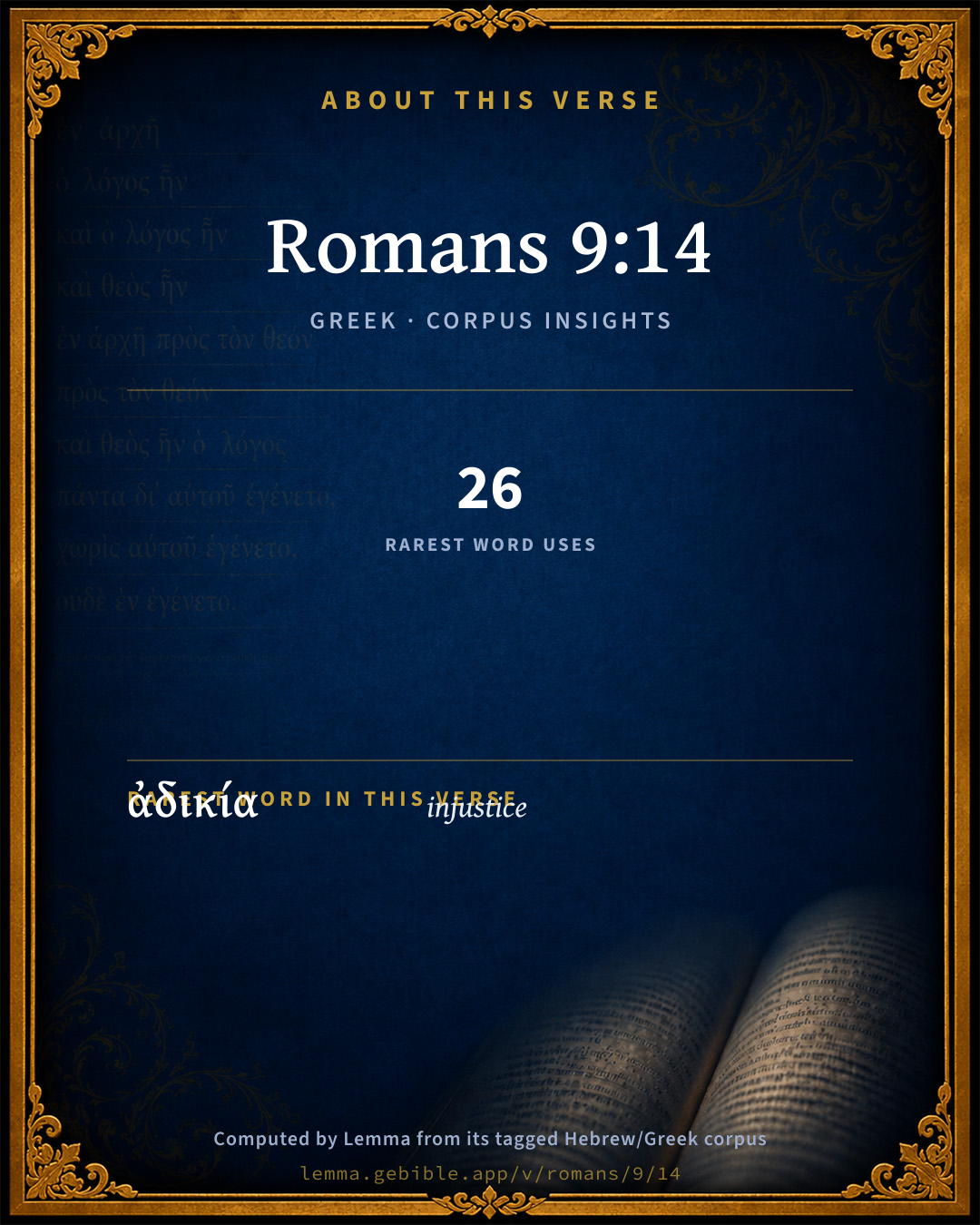
Romans 9:14

Greek (Tischendorf 8th ed.) Romans 9:14 appears in the Greek New Testament. The text above is from the Tischendorf 8th edition. Each word links to its Strong’s number and a concise gloss. Click any word for its full Thayer’s Greek Lexicon entry.
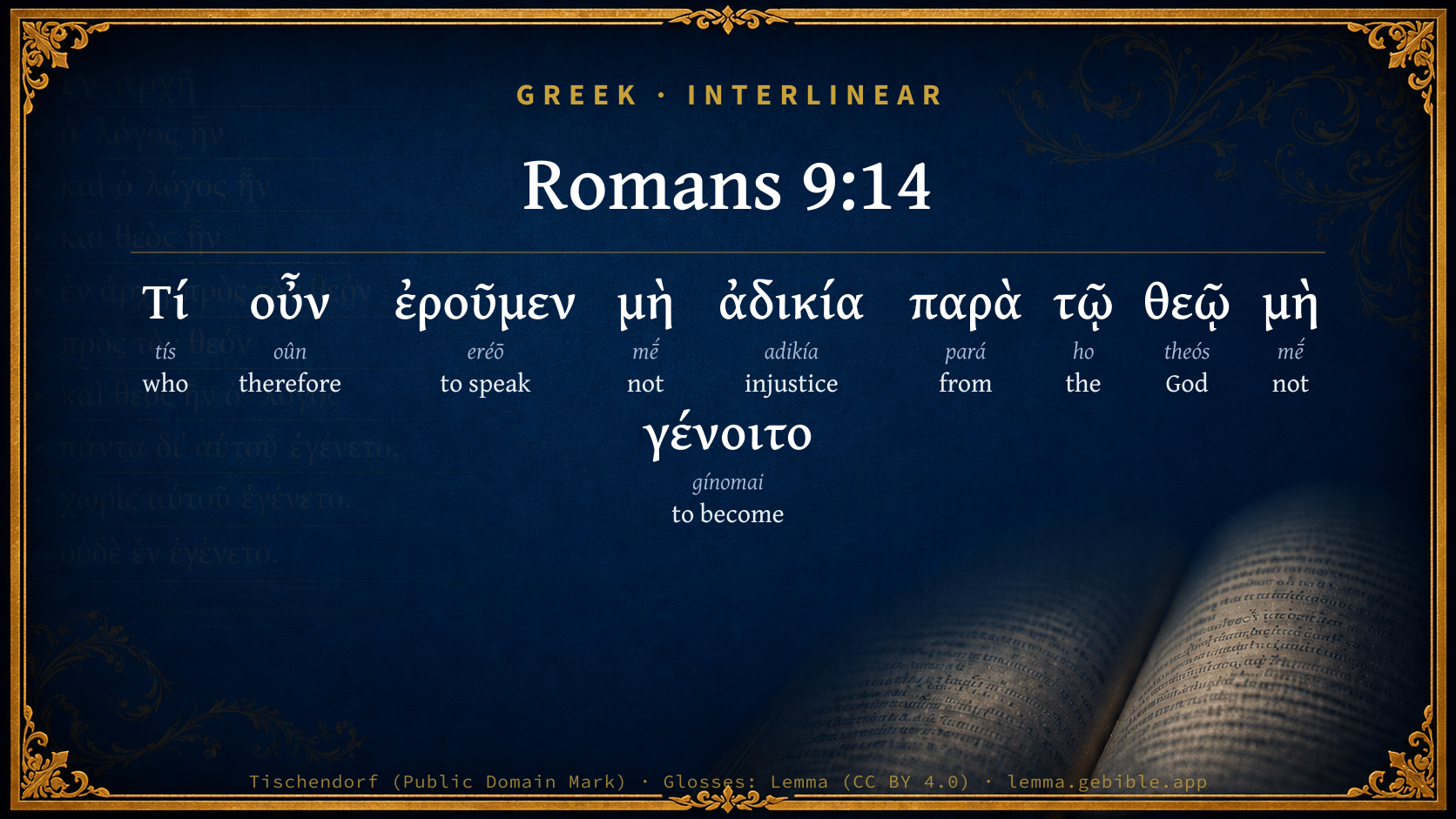
Download image
Cite this verse

Romans 9:14 (World English Bible). Public Domain. Lemma interlinear Bible study tool, https://lemma.gebible.app/v/romans/9/14.

Show BibTeX & RIS
BibTeX
RIS
English Translation
What shall we say then? Is there unrighteousness with God? May it never be!
World English Bible · Public Domain
Download a study sheet

One document with this verse’s original text, its word-by-word gloss line, the meaning frame, cross-references with their text, attributed commentary, and full source and license credits — printable, and it pastes into notes with its structure intact.

This verse Autodidact and up

Study sheet (.html) Plain text (.txt)

A passage Seminary Student

Up to 50 verses in one chapter. A passage sheet keeps up to 6 commentary sources and 12 cross-references per verse, in the order this page ranks them, and says so on the sheet whenever that leaves anything out. Ask for a single verse and you get the Autodidact verse sheet above.

Everything on this page stays free to read, with no account — the sheet is a download of what is already on screen, not access to it.

Want to remove ads? Support Godless Engineer
Compare translations 3

The same verse in 3 English versions, stacked beneath the original-language interlinear above. Click any original word for its lexicon entry.

Each is an independent rendering of the whole verse — the interlinear is not word-aligned to these translations.

Highlighted words mark where these versions differ — a whole-verse word diff, not a word-by-word alignment.

  • World English Bible Public Domain
    What shall we say then? Is there unrighteousness with God? May it never be!
  • King James Version Public Domain
    What shall we say then? Is there unrighteousness with God? God forbid.
  • unfoldingWord Literal Text CC BY-SA 4.0
    What then will we say? no unrighteousness with God? May it never be!

unfoldingWord Literal Text — © unfoldingWord, licensed CC BY-SA 4.0. Word-aligned USFM3 via Door43 (git.door43.org/unfoldingWord/en_ult).

Versions to compare (up to 4)

3 of 4 selected

Show all 19 translations

Every available English version of this verse, each an independent rendering of the whole verse.

  • World English Bible Public Domain
    What shall we say then? Is there unrighteousness with God? May it never be!
  • Berean Standard Bible Public Domain
    What then shall we say? Is God unjust? Certainly not!
  • Majority Standard Bible Public Domain
    What then shall we say? Is God unjust? Certainly not!
  • King James Version Public Domain
    What shall we say then? Is there unrighteousness with God? God forbid.
  • American Standard Version (1901) Public Domain
    What shall we say then? Is there unrighteousness with God? God forbid.
  • Revised Version (1885) Public Domain
    What shall we say then? Is there unrighteousness with God? God forbid.
  • Geneva Bible (1599) Public Domain
    What shall wee say then? Is there vnrighteousnes with God? God forbid.
  • Douay-Rheims (1899) Public Domain
    What shall we say then? Is there injustice with God? God forbid.
  • Young's Literal Translation Public Domain
    What, then, shall we say? unrighteousness `is' with God? let it not be!
  • Literal Standard Version CC BY-SA 4.0
    What, then, will we say? Unrighteousness [is] with God? Let it not be!
  • Unlocked Literal Bible CC BY-SA 4.0
    What then will we say? Is there unrighteousness with God? May it never be.
  • unfoldingWord Literal Text CC BY-SA 4.0
    What then will we say? no unrighteousness with God? May it never be!
  • Darby Bible Public Domain
    What shall we say then? [Is there] unrighteousness with God? Far be the thought.
  • World Messianic Bible Public Domain
    What shall we say then? Is there unrighteousness with God? May it never be!
  • Webster's Bible Public Domain
    What shall we say then? Is there unrighteousness with God? By no means.
  • Free Bible Version CC BY-SA 4.0
    So what should we conclude? That God was unjust? Certainly not!
  • Bible in Basic English Public Domain
    What may we say then? is God not upright? let it not be said.
  • Text-Critical English NT CC BY 4.0
    What then shall we say? Is there injustice with God? Certainly not!
  • Tyndale New Testament (1534) Public Domain
    What shall we saye then? is there eny vnrightewesses with God? God forbyd.

Literal Standard Version (2020), Covenant Press — licensed CC BY-SA 4.0. Text via the HelloAO Bible API (eBible.org). Unlocked Literal Bible (unfoldingWord) — licensed CC BY-SA 4.0. Text via the HelloAO Bible API (eBible.org). unfoldingWord Literal Text — © unfoldingWord, licensed CC BY-SA 4.0. Word-aligned USFM3 via Door43 (git.door43.org/unfoldingWord/en_ult). Free Bible Version, Dr. Jonathan Gallagher — licensed CC BY-SA 4.0. Text via the HelloAO Bible API (eBible.org).

Word by word

More ways to search: Search by grammar → Find every occurrence → Compare this word →

Practice this passage: Drill this verse → Learn its vocabulary →

About this verse

These counts appear in no published source. They are computed here, from the morphology-tagged text and Lemma’s own curated glosses. What Lemma adds →

10
words
9
distinct lemmas
Pauline Epistles
section

Shared distinctive vocabulary

ἀδικία injustice G93 occurs in 25 verses of the Greek New Testament. Also found in:

Repetition

A word recurs within this verse:

Cross-references

15

Topical passages linked to Romans 9:14 in the Treasury of Scripture Knowledge — connected by theme and wording, ordered by reader-vote popularity; previews shown in the World English Bible.

  • 2 Chronicles 19:7 Now therefore let the fear of Yahweh be on you; take heed and do it: for there is no iniquity with Yahweh our God, nor respect of persons, nor taking of bribes.
  • Psalms 145:17 Yahweh is righteous in all his ways, And gracious in all his works.
  • Deuteronomy 32:4 The Rock, his work is perfect; For all his ways are justice: A God of faithfulness and without iniquity, Just and right is he.
  • Job 34:10–12 "Therefore listen to me, you men of understanding: Far be it from God, that he should do wickedness, From the Almighty, that he should commit iniquity.
  • Psalms 92:15 To show that Yahweh is upright. He is my rock, And there is no unrighteousness in him.
  • Revelation 16:7 I heard the altar saying, "Yes, Lord God, the Almighty, true and righteous are your judgments."
  • Job 8:3 Does God pervert justice? Or does the Almighty pervert righteousness?
  • Genesis 18:25 Be it far from you to do things like that, to kill the righteous with the wicked, that so the righteous should be as the wicked. May that be far from you. Shouldn't the Judge of all the earth do right?"
  • Job 34:18–19 Who says to a king, 'Vile!' Or to nobles, 'Wicked!'
  • Job 35:2 "Do you think this to be your right, Or do you say, 'My righteousness is more than God's,'
  • Jeremiah 12:1 Righteous are you, Yahweh, when I contend with you; yet would I reason the cause with you: why does the way of the wicked prosper? why are all they at ease who deal very treacherously?
  • Romans 2:5 But according to your hardness and unrepentant heart you are treasuring up for yourself wrath in the day of wrath, revelation, and of the righteous judgment of God;
  • Romans 3:1 Then what advantage does the Jew have? Or what is the profit of circumcision?
  • Romans 3:5–6 But if our unrighteousness commends the righteousness of God, what will we say? Is God unrighteous who inflicts wrath? I speak like men do.
  • Revelation 15:3–4 They sang the song of Moses, the servant of God, and the song of the Lamb, saying, "Great and marvelous are your works, Lord God, the Almighty; Righteous and true are your ways, you King of the nations.

Cross-references courtesy of OpenBible.info (CC BY 4.0).

Commentary

Notes on Romans 9:14 from classic Christian and Jewish commentators (each source and its license shown beneath its notes). The classic Christian expositions comment on the surrounding passage and are grouped to its opening verse, so a note may address several verses; the Jewish commentaries on the Tanakh (Rashi and others) are per-verse, so they appear only where the commentator wrote on this verse.

Lemma curates 59 commentaries, every one of them public domain or Creative Commons licensed, each selected and text-cleaned for this edition rather than reprinted as found. About our sources →

Matthew Henry's Commentary

The apostle, having asserted the true meaning of the promise, comes here to maintain and prove the absolute sovereignty of God, in disposing of the children of men, with reference to their eternal state. And herein God is to be considered, not as a rector and governor, distributing rewards and punishments according to his revealed laws and covenants, but as an owner and benefactor, giving to the children of men such grace and favour as he has determined in and by his secret and eternal will and counsel: both the favour of visible church-membership and privileges, which is given to some people and denied to others, and the favour of effectual grace, which is given to some particular persons and denied to others.

Now this part of his discourse is in answer to two objections.

I. It might be objected, Is there unrighteousness with God? If God, in dealing with the children of men, do thus, in an arbitrary manner, choose some and refuse others, may it not be suspected that there is unrighteousness with him? This the apostle startles at the thought of: God forbid! Far be it from us to think such a thing; shall not the judge of all the earth do right? Gen 18:25; Rom 3:5, Rom 3:6. He denies the consequences, and proves the denial.

1. In respect of those to whom he shows mercy, Rom 9:15, Rom 9:16. He quotes that scripture to show God's sovereignty in dispensing his favours (Exo 33:19): I will be gracious to whom I will be gracious. All God's reasons of mercy are taken from within himself. All the children of men being plunged alike into a state of sin and misery, equally under guilt and wrath, God, in a way of sovereignty, picks out some from this fallen apostatized race, to be vessels of grace and glory. He dispenses his gifts to whom he will, without giving us any reason: according to his own good pleasure he pitches upon some to be monuments of mercy and grace, preventing grace, effectual grace, while he passes by others. The expression is very emphatic, and the repetition makes it more so: I will have mercy on whom I will have mercy. It imports a perfect absoluteness in God's will; he will do what he will, and giveth not account of any of his matters, nor is it fit he should. As these great words, I am that I am (Exo 3:14) do abundantly express the absolute independency of his being, so these words, I will have mercy on whom I will have mercy, do as fully express the absolute prerogative and sovereignty of his will. To vindicate the righteousness of God, in showing mercy to whom he will, the apostle appeals to that which God himself had spoken, wherein he claims this sovereign power and liberty. God is a competent judge, even in his own case. Whatsoever God does, or is resolved to do, is both by the one and the other proved to be just. Eleēsō on han heleō - I will have mercy on whom I will have mercy. When I begin, I will make an end. Therefore God's mercy endures for ever, because the reason of it is fetched from within himself; therefore his gifts and callings are without repentance. Hence he infers (Rom 9:16), It is not of him that willeth. Whatever good comes from God to man, the glory of it is not to be ascribed to the most generous desire, nor to the most industrious endeavour, of man, but only and purely to the free grace and mercy of God. In Jacob's case it was not of him that willeth, nor of him that runneth; it was not the earnest will and desire of Rebecca that Jacob might have the blessing; it was not Jacob's haste to get it (for he was compelled to run for it) that procured him the blessing, but only the mercy and grace of God. Wherein the holy happy people of God differ from other people, it is God and his grace that make them differ. Applying this general rule to the particular case that Paul has before him, the reason why the unworthy, undeserving, ill-deserving Gentiles are called, and grafted into the church, while the greatest part of the Jews are left to perish in unbelief, is not because those Gentiles were better deserving or better disposed for such a favour, but because of God's free grace that made that difference. The Gentiles did neither will it, nor run for it, for they sat in darkness, Mat 4:16. In darkness, therefore not willing what they knew not; sitting in darkness, a contented posture, therefore not running to meet it, but anticipated with these invaluable blessings of goodness. Such is the method of God's grace towards all that partake of it, for he is found of those that sought him not (Isa 65:1); in this preventing, effectual, distinguishing grace, he acts as a benefactor, whose grace is his own. Our eye therefore must not be evil because his is good; but, of all the grace that we or others have, he must have the glory: Not unto us, Psa 115:1.

2. In respect of those who perish, Rom 9:17. God's sovereignty, manifested in the ruin of sinners, is here discovered in the instance of Pharaoh; it is quoted from Exo 9:16. Observe,

(1.) What God did with Pharaoh. He raised him up, brought him into the world, made him famous, gave him the kingdom and power, - set him up as a beacon upon a hill, as the mark of all his plagues (compare Exo 9:14) - hardened his heart, as he had said he would (Exo 4:21): I will harden his heart, that is, withdraw softening grace, leave him to himself, let Satan loose against him, and lay hardening providences before him. Or, by raising him up may be meant the intermission of the plagues which gave Pharaoh respite, and the reprieve of Pharaoh in those plagues. In the Hebrew, I have made thee stand, continued thee yet in the land of the living. Thus doth God raise up sinners, make them for himself, even for the day of evil (Pro 16:4), raise them up in outward prosperity, external privileges (Mat 11:23), sparing mercies.

(2.) What he designed in it: That I might show my power in thee. God would, by all this, serve the honour of his name, and manifest his power in baffling the pride and insolence of that great and daring tyrant, who bade defiance to Heaven itself, and trampled upon all that was just and sacred. If Pharaoh had not been so high and might, so bold and hardy, the power of God had not been so illustrious in the ruining of him; but the taking off of the spirit of such a prince, who hectored at that rate, did indeed proclaim God glorious in holiness, fearful in praises, doing wonders, Exo 15:11. This is Pharaoh, and all his multitude.

(3.) His conclusion concerning both these we have, Rom 9:18. He hath mercy on whom he will have mercy, and whom he will he hardeneth. The various dealings of God, by which he makes some to differ from others, must be resolved into his absolute sovereignty. He is debtor to no man, his grace is his own, and he may give it or withhold it as it pleaseth him; we have none of us deserved it, nay, we have all justly forfeited it a thousand times, so that herein the work of our salvation is admirably well ordered that those who are saved must thank God only, and those who perish must thank themselves only, Hos 13:9. We are bound, as God hath bound us, to do our utmost for the salvation of all we have to do with; but God is bound no further than he has been pleased to bind himself by his own covenant and promise, which is his revealed will; and that is that he will receive, and not cast out, those that come to Christ; but the drawing of souls in order to that coming is a preventing distinguishing favour to whom he will. Had he mercy on the Gentiles? It was because he would have mercy on them. Were the Jews hardened? It was because it was his own pleasure to deny them softening grace, and to give them up to their chosen affected unbelief. Even so, Father, because it seemed good unto thee. That scripture excellently explains this, Luk 10:21, and, as this, shows the sovereign will of God in giving or withholding both the means of grace and the effectual blessing upon those means.

II. It might be objected, Why doth he yet find fault? For who hath resisted his will? Rom 9:19. Had the apostle been arguing only for God's sovereignty in appointing and ordering the terms and conditions of acceptance and salvation, there had not been the least colour for this objection; for he might well find fault if people refused to come up to the terms on which such a salvation is offered; the salvation being so great, the terms could not be hard. But there might be colour for the objection against his arguing for the sovereignty of God in giving and withholding differencing and preventing grace; and the objection is commonly and readily advanced against the doctrine of distinguishing grace. If God, while he gives effectual grace to some, denies it to others, why doth he find fault with those to whom he denies it? If he hath rejected the Jews, and hid from their eyes the things that belong to their peace, why doth he find fault with them for their blindness? If it be his pleasure to discard them as not a people, and not obtaining mercy, their knocking off themselves was no resistance of his will. This objection he answers at large,

1. By reproving the objector (Rom 9:20): Nay but, O man. This is not an objection fit to be made by the creature against his Creator, by man against God. The truth, as it is in Jesus, is that which abases man as nothing, less than nothing, and advances God as sovereign Lord of all. Observe how contemptibly he speaks of man, when he comes to argue with God his Maker: "Who art thou, thou that art so foolish, so feeble, so short-sighted, so incompetent a judge of the divine counsels? Art thou able to fathom such a depth, dispute such a case, to trace that way of God which is in the sea, his path in the great waters?" That repliest against God. It becomes us to submit to him, not to reply against him; to lie down under his hand, not to fly in his face, nor to charge him with folly. Ho antapokrinomenos - That answerest again. God is our master, and we are his servants; and it does not become servants to answer again, Tit 2:9.

2. By resolving all into the divine sovereignty. We are the thing formed, and he is the former; and it does not become us to challenge or arraign his wisdom in ordering and disposing of us into this or that shape of figure. The rude and unformed mass of matter hath no right to this or that form, but is shaped at the pleasure of him that formeth it. God's sovereignty over us is fitly illustrated by the power that the potter hath over the clay; compare Jer 18:6, where, by a like comparison, God asserts his dominion over the nation of the Jews, when he was about to magnify his justice in their destruction by Nebuchadnezzar.

(1.) He gives us the comparison, Rom 9:21. The potter, out of the same lump, may make either a fashionable vessel, and a vessel fit for creditable and honourable uses, or a contemptible vessel, and a vessel in which is no pleasure; and herein he acts arbitrarily, as he might have chosen whether he would make any vessel of it at all, or whether he would leave it in the hole of the pit, out of which it was dug.

(2.) The application of the comparison, Rom 9:22-24. Two sorts of vessels God forms out of the great lump of fallen mankind: - [1.] Vessels of wrath - vessels filled with wrath, as a vessel of wine is a vessel filled with wine; full of the fury of the Lord, Isa 51:20. In these God is willing to show his wrath, that is, his punishing justice, and his enmity to sin. This must be shown to all the world, God will make it appear that he hates sin. He will likewise make his power known, to dumaton autou. It is a power of strength and energy, an inflicting power, which works and effects the destruction of those that perish; it is a destruction that proceeds from the glory of his power, Th2 1:9. The eternal damnation of sinners will be an abundant demonstration of the power of God; for he will act in it himself immediately, his wrath preying as it were upon guilty consciences, and his arm stretched out totally to destroy their well-being, and yet at the same instant wonderfully to preserve the being of the creature. In order to this, God endured them with much long-suffering - exercised a great deal of patience towards them, let them alone to fill up the measure of sin, to grow till they were ripe for ruin, and so they became fitted for destruction, fitted by their own sin and self-hardening. The reigning corruptions and wickedness of the soul are its preparedness and disposedness for hell: a soul is hereby made combustible matter, fit for the flames of hell. When Christ said to the Jews (Mat 23:32), Fill you up then the measure of your father, that upon you may come all the righteous blood (Mat 23:35), he did, as it were, endure them with much long-suffering, that they might, by their own obstinacy and wilfulness in sin, fit themselves for destruction. [2.] Vessels of mercy - filled with mercy. The happiness bestowed upon the saved remnant is the fruit, not of their merit, but of God's mercy. The spring of all the joy and glory of heaven is that mercy of God which endures for ever. Vessels of honour must to eternity own themselves vessels of mercy. Observe, First, What he designs in them: To make known the riches of his glory, that is, of his goodness; for God's goodness is his greatest glory, especially when it is communicated with the greatest sovereignty. I beseech thee show me thy glory, says Moses, Exo 33:18. I will make all my goodness to pass before thee, says God (Exo 33:19), and that given out freely: I will be gracious to whom I will be gracious. God makes known his glory, this goodness of his, in the preservation and supply of all the creatures: the earth is full of his goodness, and the year crowned with it; but when he would demonstrate the riches of his goodness, unsearchable riches, he does it in the salvation of the saints, that will be to eternity glorious monuments of divine grace. Secondly, What he does for them he does before prepare them to glory. Sanctification is the preparation of the soul for glory, making it meet to partake of the inheritance of the saints in light. This is God's work. We can destroy ourselves fast enough, but we cannot save ourselves. Sinners fit themselves for hell, but it is God that prepares saints for heaven; and all those that God designs for heaven hereafter he prepares and fits for heaven now: he works them to the self-same thing, Co2 5:5. And would you know who these vessels of mercy are? Those whom he hath called (Rom 9:24); for whom he did predestinate those he also called with an effectual call: and these not of the Jews only, but of the Gentiles; for, the partition-wall being taken down, the world was laid in common, and not (as it had been) God's favour appropriated to the Jews, and they put a degree nearer his acceptance than the rest of the world. They now stood upon the same level with the Gentiles; and the question is not now whether of the seed of Abraham or no, that is neither here nor there, but whether or no called according to his purpose.

Matthew Henry's Commentary on the Whole Bible (1708–1710) — public domain (CC PDM 1.0). Text via the HelloAO Bible API.

The Cambridge Bible for Schools and Colleges

gen. ed. J. J. S. Perowne

14–33. Electing Sovereignty: Vindication, Restatement and application

(A) Is God unrighteous?

14. What shall we say then?] Same words as Rom_3:5, Rom_4:1, Rom_6:1, Rom_7:7, Rom_8:31, Rom_9:30. St Paul often introduces thus an objection which is to be solved. The objection here is twofold; (1) “Is God righteous so to act?” (Rom_9:14,) and (2) “Is man responsible if He so acts?” (Rom_9:19.)

Is there unrighteousness with God?] On the Gr. rendered “with” see note on Rom_1:11. The words here, as the words there, may refer to a court of justice: “Is there injustice at His bar?”

God forbid] See on Rom_3:4.—On the principle of the reply here, see long Note on Rom_9:11.

The Cambridge Bible for Schools and Colleges (gen. ed. J. J. S. Perowne; Cambridge University Press, 1878–1918) — public domain. Text from a community e-Sword module.

Joseph Benson's Commentary

Rom 9:14-16. What shall we say then? — To this. The apostle now introduces and refutes an objection. Is there unrighteousness, or injustice, with God? — In the distribution of his providential blessings, in this or any other instance that can be produced? Was it unjust in God to choose Jacob and his posterity to be the members of his visible church on earth, and to inherit the promises in their literal meaning, rather than Esau and his posterity? Or to accept believers who imitate the faith of Jacob, and them only? God forbid — In no wise: this is well consistent with justice. For he saith to Moses, &c. — For he has a right to fix the terms on which he will show mercy; according to his declaration to Moses, petitioning for all the people, after they had been guilty of idolatry in worshipping the golden calf; I will have mercy on whom I will have mercy — According to the terms I myself have fixed; and I will have compassion on whom I will have compassion — Namely, on those only who submit to my terms; who accept of it in the way that I have appointed. So then — The inference to be drawn is; It — The blessing; therefore is not of him that willeth, nor of him that runneth — It is not the effect either of the will or the works of man, but of the grace and power of God. The will of man is here opposed to the grace of God, and man’s running, to the divine operation. And this general declaration respects not only Isaac and Jacob, and the Israelites in the time of Moses, but likewise all the spiritual children of Abraham, even to the end of the world.

Joseph Benson's Commentary on the Old and New Testaments (1811–1818) — public domain. Text from a community e-Sword module.

Whedon's Commentary on the Bible

Daniel D. Whedon

3. Nor is God’s Rectitude impeached by Israel’s Downfall; for God’s Will (as he told Moses) will, in spite of Jewish dictation, extend mercy to faith, and (as He told Pharaoh) will execute wrath on persistent unbelief, Rom_9:14-18.

14. Unrighteousness with God—Unrighteousness in what respect?

Plainly in disregarding the law of lineage and substituting the law of faith as the basis of acceptance, thus endangering unbelieving Israel’s salvation.

The last previous paragraph defends the divine veracity; this the divine righteousness. Neither paragraph, be it noted, discusses the “Divine Sovereignty.”

God forbid—(See note on Rom_3:4.) As the insolent Jew truly enslaves the Divine Will to the law of lineage—making the pedigree the god of God—so the apostle most austerely and indignantly declares the independence of God’s will over all such Jewish dictation in selecting the basis (faith) of acceptance.

Daniel D. Whedon (gen. ed.), Commentary on the Old and New Testaments (1874–1909) — public domain. Text from a community e-Sword module.

Tyndale Open Study Notes

Tyndale Open Resources

9:14-16 God’s choice is not unfair because he owes nothing to his sinful creatures (see study note on 4:4-5).

Tyndale Open Study Notes — © Tyndale Open Resources, licensed CC BY-SA 4.0. Text via the HelloAO Bible API.

Bengel's Gnomon

Johann Albrecht Bengel

Rom 9:14. Τί οὖν, what then?) Can we then on this ground be accused of charging God with unrighteousness and iniquity by this assertion? By no means; for what we assert is the irrefragable assertion of God; see the following verse.—Μὴ γένοιτο, God forbid) The Jews thought, that they could by no means be rejected by God; that the Gentiles could by no means be received. As therefore an honest man acts even with greater severity [ἀποτομίᾳ] towards those who are harshly and spitefully importunate, than he really feels (that he may defend his own rights, and those of his patron, and may not at an unseasonable time betray and cast away his character for liberality) so Paul defends the power and justice of God against the Israelites, who trusted to their mere name and their own merits; and on this subject, he sometimes uses those appropriate phrases, to which he seems to have been accustomed in former times in the school of the Pharisees. This is his language: No man can prescribe anything to the Lord God, nor demand and somewhat insolently extort anything from Him as a debt, nor can he interdict Him in anything [which He pleases to do] or require a reason, why He shows Himself kind also to others [as well as to himself]. Therefore Paul somewhat abruptly checks by a rather severe answer the peevish and spiteful objectors. Luk 19:22-23, is a similar case. For no man is allowed to deal with God as if by virtue of a bond of agreement, [as if he were His creditor], but even if there were such a bond, God even deals more strictly with man [i.e. with a man of such a hireling spirit]; let the parable, Mat 20:13-15, which is quite parallel, be compared: I do thee no wrong, etc. There is therefore one meaning of Paul’s language, by which he gives an answer to those who contend for good works: another, of a milder description, in behalf of believers, lies hid under the veil of the words. In the Sacred Scriptures too, especially when we have come from the thesis [the proposition] to the hypothesis [that on which the proposition rests], the manners, τὰ ἤθη, as well as the reasonings, οἱ λόγοι, ought to be considered; and yet there can be no commentary so plain, which he, who contends for justification by good works, may more easily understand than the text of Paul.

Bengel's Gnomon of the New Testament — English translation (T&T Clark, Edinburgh, 1860) — public domain. Text from a community e-Sword module.

Meyer's Critical & Exegetical Commentary

Heinrich August Wilhelm Meyer

Rom_9:14. A possible inference, unfavourable to the character of God, from Rom_9:11-13, is suggested by Paul himself, and repelled.

μὴ ἀδικ. παρὰ τῷ Θεῷ;] But is there not unrighteousness with God? Comp. the question in Rom_3:5. παρὰ, with qualities, corresponds to the Latin in. See Matthiae, § 588. 6. Comp. Rom_2:11.

Rom_9:14-18. Second part of the Theodicée: God does not deal unrighteously, in that His πρόθεσις according to election is to have its subsistence, not ἐξ ἔργων, but ἐκ τοῦ καλοῦντος; for He Himself maintains in the Scripture His own freedom to have mercy upon or to harden whom He will.

This reason has probative force, in so far as it is justly presupposed in it, that the axiom which God expresses respecting Himself is absolutely worthy of Him. Hence we are not, with Beyschlag, to refer the alleged injustice to the fact that God now prefers the Gentiles to the Jews, which is simply imported into the preceding text, and along with which, no less gratuitously, the following receives the sense: the Jews have indeed become what they are out of pure grace; this grace may therefore once again be directed towards others, and be withdrawn from, them (Beyschlag).

Meyer — Critical and Exegetical Commentary on the New Testament — English translation by Peter Christie, edited by Frederick Crombie (T&T Clark, 1880) — public domain. Text from a community e-Sword module.

Expositor's Greek Testament

ed. W. Robertson Nicoll

Rom 9:14-21 . In the second part of his theodicy Paul meets the objection that this sovereign freedom of God is essentially unjust.

Rom 9:14 . τί οὖν ἐροῦμεν ; cf. Rom 6:1 , Rom 7:7 , Rom 8:31 . It is Paul who speaks, anticipating, as he cannot help doing, the objection which is sure to rise, not only in Jewish minds, though it is with them he is directly concerned, but in the mind of every human being who reads his words. Yet he states the objection as one in itself incredible, μὴ ἀδικία παρὰ τῷ θεῷ ; surely we cannot say that there is unrighteousness with God? This is the force of the μὴ , and Paul can answer at once μὴ γένοιτο : away with the thought! God says Himself that He shows mercy with that sovereign freedom which Paul has ascribed to Him; and the principle of action which God announces as His own cannot be unjust.

The Expositor's Greek Testament, edited by W. Robertson Nicoll (1897–1910) — public domain. Text from a community e-Sword module.

Godet's Commentaries

Frédéric Louis Godet

Vv. 14-16. “What shall we say then? Is there not unrighteousness with God? Let it not be! For He saith to Moses, I will have mercy on whom I have mercy, and I will have compassion on whom I have compassion. So then it is not of him that willeth, nor of him that runneth, but of God that showeth mercy.”

Several commentators, and Mangold among the last, have taken Rom 9:15-18 not as the answer to the objection raised in Rom 9:14, but as the continuation and justification of the objection itself. But nothing is needed to refute this opinion beyond the exclamation: μὴ γένοιτο, let it not be, which cannot be a simple parenthesis; besides, the form of the question with the negation μή, in Rom 9:14, already assumes a negative answer, the development of which is necessarily expected in what follows.

The answer is taken solely from Scripture, which is an authority for Paul’s opponent in the discussion as well as for himself. This opponent is a Jew, who thinks that the sovereign liberty which the apostle ascribes to God, and by which he seeks to justify the rejection of Israel, wrongs the divine character. It must, indeed, be borne in mind that the Jewish conscience, being developed under the law, was accustomed to consider God’s dealings with man as entirely dependent on human merit or demerit. Man’s doings regulated those of God.

Vv. 15. Scripture itself, that foundation of all Israel’s theocratic claims, demonstrates divine liberty as it is taught by Paul. This liberty therefore cannot involve any injustice. And first, a quotation proving the absence, in the case of man, of all right to God’s favors. It is taken from Exo 33:19, where God, when condescending to grant the bold request of Moses that he might behold His glory with his bodily eyes, gives him to understand that nothing in him, notwithstanding all he has been able to do up till now in God’s service, merited such a favor. If God grants it to him, it is not because he is that Moses who asks it, or because there is any right in the matter; it is pure grace on God’s part. The passage is cited according to the LXX. The only difference between it and the Hebrew is, that here in each proposition the first verb is in the past (present), the second in the future; while in the Greek the first is in the future, the second in the present. It matters little for the sense. The two verbs in the present (or past) express the internal feeling, the source, and the verbs in the future the external manifestations, the successive effects. But the emphasis is neither on the first nor on the second verbs; it is on the pronoun ὃν ἄν, him, whosoever he may be. It is the idea of God’s free choice which reappears. The condescension of God to Moses is certainly not an arbitrary act; God knows why He grants it. But neither is it a right on the part of Moses, as if he would have been entitled to complain in case of refusal. The difference of meaning between the two verbs ἐλεεῖν and οἰκτείρειν is nearly the same as that between the two substantives λύπη and ὀδύνη, Rom 9:2. The first expresses the compassion of the heart, the second the manifestations of that feeling (cries or groans).

Vv. 16 enunciates the general principle to be derived from this divine utterance in the particular case of Moses. When God gives, it is not because a human will (he that willeth) or a human work (he that runneth) lays Him under obligation, and forces Him to give, in order not to be unjust by refusing. It is in Himself the initiative and the efficacy are (Him that calleth), whence the gift flows. He gives not as a thing due, but as a fruit of His love; which does not imply that therein He acts arbitrarily. Such a supposition is excluded, precisely because the giver in question is God, who is wisdom itself, and who thinks nothing good except what is good. The principle here laid down included God’s right to call the Gentiles to salvation when He should be pleased to grant them this favor. The words: “of him that willeth, of him that runneth,” have often been strangely understood. There have been found in them allusions to the wish of Isaac to make Esau the heir of the promise, and to Esau’s running to bring the venison necessary for the feast of benediction. But Isaac and Esau are no longer in question, and we must remain by the example of Moses. It was neither the wish expressed in his prayer, nor the faithful care which he had taken of Israel in the wilderness, which could merit the favor he asked; and as no man will ever surpass him in respect either of pious willing or holy working, it follows that the rule applied to him is universal. So it will always be. Israel, in particular, should understand thereby that it is neither their fixed theocratic necessities, nor the multitude of their ceremonial or moral works, which can convert salvation into a debt contracted toward them by God, and take away from Him the right of rejecting them if He comes to think it good to do so for reasons which He alone appreciates.

But if the words of God to Moses prove that God does not owe His favors to any one whomsoever, must it also be held that He is free to reject whom He will? Yes. Scripture ascribes to Him even this right. Such is the truth following from another saying of God, in reference to the adversary of Moses, Pharaoh.

Frédéric Louis Godet — Commentaries on Luke, John, Romans, and 1 Corinthians — English translation (T&T Clark, Edinburgh, 1870s–1890s) — public domain. Text from a community e-Sword module.

Hodge's Commentary on Romans, Ephesians & First Corinthians

Charles Hodge

Rom_9:14

What shall we say then, is there unrighteousness with God? God forbid. The apostle, according to his usual manner, proposes the objection to his own doctrine in the form of a question, denies its validity, and immediately subjoins his reason; see Rom_3:5; Gal_3:21. The obvious objection here presented is, that it is unjust in God, thus, according to his own purpose, so choose one and reject another. This Paul denies, and supports his denial by an appeal, in the first place, to Scripture, and the second, to experience. It will be remarked that these arguments of the apostle are founded on two assumptions. The first is, that the Scriptures are the word of God; and the second, that what God actually does cannot be unrighteous. Consequently any objection which can be shown to militate against either an express declaration of Scripture, or an obvious fact in providence, is fairly answered. And if, as is almost always the case, when it militates against the one, it can be shown to militate against the other, the answer is doubly ratified.

Charles Hodge — Commentary on Romans (1835), First Corinthians (1857), and Ephesians (1856) — public domain. Text from a community e-Sword module.

Geneva Bible (1599)

Geneva Bible translators

Man’s will knoweth no other causes of love or hatred, but those that are in the persons, and thereupon this objection riseth.

The first objection: If God doth love or hate upon no consideration of worthiness or unworthiness, then [is] he unjust, because he may love them which are unworthy, and hate them that are worthy. The Apostle detesteth this blasphemy, and afterward answereth it severally, point by point.

Geneva Bible (1599) marginal notes — public domain. Text via Bolls.life.

Jamieson, Fausset & Brown

Robert Jamieson, A. R. Fausset & David Brown

What shall we say then? Is there unrighteousness with God? God forbid--This is the first of two objections to the foregoing doctrine, that God chooses one and rejects another, not on account of their works, but purely in the exercise of His own good pleasure: "This doctrine is inconsistent with the justice of God." The answer to this objection extends to Rom 9:19, where we have the second objection.

Jamieson, Fausset & Brown — Commentary Critical and Explanatory on the Whole Bible (1871) — public domain (CC PDM 1.0). Text via the HelloAO Bible API.

Adam Clarke's Commentary

Verse 14. What shall we say then?] To what conclusion shall we come on the facts before us? Shall we suggest that God's bestowing peculiar privileges in this unequal manner, on those who otherwise are in equal circumstances, is inconsistent with justice and equity? By no means. Whatever God does is right, and he may dispense his blessings to whom and or what terms he pleases.

Adam Clarke's Commentary on the Bible (1810–1826) — public domain. Text from a community e-Sword/MySword module.

John Calvin's Commentaries

14. What then shall we say? etc. The flesh cannot hear of this wisdom of God without being instantly disturbed by numberless questions, and without attempting in a manner to call God to an account. We hence find that the Apostle, whenever he treats of some high mystery, obviates the many absurdities by which he knew the minds of men would be otherwise possessed; for when men hear anything of what Scripture teaches respecting predestination, they are especially entangled with very many impediments.

The predestination of God is indeed in reality a labyrinth, from which the mind of man can by no means extricate itself: but so unreasonable is the curiosity of man, that the more perilous the examination of a subject is, the more boldly he proceeds; so that when predestination is discussed, as he cannot restrain himself within due limits, he immediately, through his rashness, plunges himself, as it were, into the depth of the sea. What remedy then is there for the godly? Must they avoid every thought of predestination? By no means: for as the Holy Spirit has taught us nothing but what it behoves us to know, the knowledge of this would no doubt be useful, provided it be confined to the word of God. Let this then be our sacred rule, to seek to know nothing concerning it, except what Scripture teaches us: when the Lord closes his holy mouth, let us also stop the way, that we may not go farther. But as we are men, to whom foolish questions naturally occur, let us hear from Paul how they are to be met.

Is there unrighteousness with God? Monstrous surely is the madness of the human mind, that it is more disposed to charge God with unrighteousness than to blame itself for blindness. Paul indeed had no wish to go out of his way to find out things by which he might confound his readers; but he took up as it were from what was common the wicked suggestion, which immediately enters the minds of many, when they hear that God determines respecting every individual according to his own will. It is indeed, as the flesh imagines, a kind of injustice, that God should pass by one and show regard to another.

In order to remove this difficulty, Paul divides his subject into two parts; in the, former of which he speaks of the elect, and in the latter of the reprobate; and in the one he would have us to contemplate the mercy of God, and in the other to acknowledge his righteous judgment. His first reply is, that the thought that there is injustice with God deserves to be abhorred, and then he shows that with regard to the two parties, there can be none.

But before we proceed further, we may observe that this very objection clearly proves, that inasmuch as God elects some and passes by others, the cause is not to be found in anything else but in his own purpose; for if the difference had been based on works, Paul would have to no purpose mentioned this question respecting the unrighteousness of God, no suspicion could have been entertained concerning it if God dealt with every one according to his merit. It may also, in the second place, be noticed, that though he saw that this doctrine could not be touched without exciting instant clamours and dreadful blasphemies, he yet freely and openly brought it forward; nay, he does not conceal how much occasion for murmuring and clamour is given to us, when we hear that before men are born their lot is assigned to each by the secret will of God; and yet, notwithstanding all this, he proceeds, and without any subterfuges, declares what he had learned from the Holy Spirit. It hence follows, that their fancies are by no means to be endured, who aim to appear wiser than the Holy Spirit, in removing and pacifying offences. That they may not criminate God, they ought honestly to confess that the salvation or the perdition of men depends on his free election. Were they to restrain their minds from unholy curiosity, and to bridle their tongues from immoderate liberty, their modesty and sobriety would be deserving of approbation; but to put a restraint on the Holy Spirit and on Paul, what audacity it is! Let then such magnanimity ever prevail in the Church of God, as that godly teachers may not be ashamed to make an honest profession of the true doctrine, however hated it may be, and also to refute whatever calumnies the ungodly may bring forward.

John Calvin's Commentaries (1540-1563) — public domain. Text from the Calvin Translation Society English edition (1840s-50s) via the Christian Classics Ethereal Library (ccel.org). Calvin's coverage is partial (roughly two-thirds of the Bible); uncommented books and verses are honest gaps, never fabricated. The 19th-century editor's footnotes and remarks are omitted so the notes are faithfully Calvin's own voice.

Ellicott's Commentary for English Readers

(14) Is there unrighteousness?—Again, as in Rom_3:5, the Apostle anticipates a possible objection. Does not this apparently arbitrary choice of one and rejection of another imply injustice in Him who exercises it? The thought is not to be entertained.

(14-18) These verses contain the second part of the vindication. This power of choosing one and refusing another has always been reserved to Himself by God; as is seen by the examples of Moses and Pharaoh.

A Bible Commentary for English Readers, edited by Charles John Ellicott (1878–1897) — public domain. Text from a community e-Sword module.

John Gill's Exposition

For he saith to Moses,.... That is, God said to Moses. The apostle goes on to answer to the above objections, by producing some testimonies out of the writings of Moses, in favour of both branches of predestination; showing, that the doctrine he had advanced, was no other than what God himself had delivered to Moses, whose name and writings were in great esteem with the Jews, whereby the apostle might hope to give full satisfaction in this point. The first passage he cites, is in Exo 33:19.

And will be gracious to whom I will be gracious, and will show mercy on whom I will show mercy. This is produced, in favour of special, particular, and personal election, and to clear it from any charge of unrighteousness; and by it, it appears, that God bestows his grace and mercy in time, on such persons he has willed and determined from all eternity to bestow it; this, is clear from hence, for since all this is dependent on his will, it must be as this was his will from eternity, seeing no new will can possibly arise in God, God wills nothing in time, but what he willed before time; that this grace and mercy are shown only to some persons, and that the only reason of this is his sovereign will and pleasure, and not the works and merits of men; wherefore since this grace and mercy rise out of his own free good will and pleasure, and are by no means the creature's due, it most clearly follows, that God in determining to bestow his grace and mercy, and in the actual doing of it, whilst he determines to deny it, and does deny it to others, cannot possibly be chargeable with any unrighteousness.

John Gill's Exposition of the Whole Bible (1746–1763) — public domain (CC PDM 1.0). Text via the HelloAO Bible API.

Trapp's Complete Commentary

John Trapp

14 What shall we say then? Is there unrighteousness with God? God forbid.

Ver. 14. ls there] Carnal reason dares reprehend what it does not comprehend. (Para.)

John Trapp, A Commentary or Exposition upon All the Books of the Old and New Testament (1647–1656) — public domain. Text from a community e-Sword module.

Albert Barnes' Notes on the Bible

What shall we say then? - What conclusion shall we draw from these acknowledged facts, and from these positive declarations of Scripture.

Is there unrighteousness with God? - Does God do injustice or wrong? This charge has often been brought against the doctrine here advanced. But this charge the apostle strongly repels. He meets it by further showing that it is the doctrine explicitly taught in the Old Testament Rom 9:15, Rom 9:17, and that it is founded on the principles of equity, and on just views of the sovereignty of God; Rom 9:19-23.

God forbid - Note, Rom 3:4.

Albert Barnes' Notes on the Bible (1834–1885) — public domain. Text from a community e-Sword/MySword module.

Haydock's Catholic Bible Commentary

What shall we say, then? Is there injustice with God, when he bestows special favours and benefits on some, and not on others? He answers, by no means. And he justifies almighty God’s conduct, ver. 22. In the mean time, it is certain that there is no injustice in not giving what another has no right to: and besides all men having sinned, deserved punishment. If, then, he shews mercy to some, it is an effect of his goodness and liberality only which they do not deserve. If he leaves others in their sins, they are only punished according to their deserts. His mercy shines upon his elect; and his divine justice is displayed against the wicked and the reprobate, but only according to what they have deserved. (Witham)

George Leo Haydock (1774–1849), Haydock's Catholic Family Bible and Commentary, 1859 edition — public domain. Excludes Psalms (Douay-Rheims chapter numbering differs from Protestant) and Deuterocanonical books (Catholic canon only).

Matthew Poole's English Annotations

Another anticipation of an objection. Some might object and say: If God elect some, and reject others, their case being the same, or their persons being in themselves equal and alike, then he is unjust and partial. To this he answers,

1. More generally, with his repeated note of detestation: God forbid; the Syriac translator reads it, God forgive; noting thereby the heinousness of such a thought and then he answers this cavil more particularly; showing:

1. That God is not unjust in electing some, Rom 9:15,16. And,

2. That he is not unjust in rejecting others, Rom 9:17.

Matthew Poole's English Annotations on the Holy Bible (1683–1685) — public domain. Text from a community e-Sword/MySword module.

The Pulpit Commentary

Vers. 14-24. (b) In the next section injustice on the part of God, in thus electing the objects of his mercy according to the good pleasure of his will, is repudiated. As in Rom_6:1 and Rom_7:7, a false inference from what has been said is introduced by ti oun eroumen , and indignantly rejected by mh genoito , followed by reasons against the inference.

Vers. 14-16. What shall we say then? Unrighteousness with God? ("Is there" supplied in the Authorized Version somewhat weakens the force of the expression.) God forbid! For to Moses he saith, I will have mercy on whom I will have mercy, and I will have compassion on whom I will have compassion. So then it is not of him that willeth, nor of him that runneth, but of God that showeth mercy. The argument (thus introduced by gar) requires two understood premises that God cannot possibly be unrighteous, and that what he himself said to Moses must be true. These premises assumed, the apostle reasons thus: "What I have said of God"s way of dealing with men does not imply unrighteousness in him; for it agrees with what he said of himself to Moses." The quotation is from Exo_33:19. Moses had besought the LORD to show him his glory, as a token that he and the people had found grace in his sight (vers. 16, 18). The LORD, in answer to his prayer, makes "all his goodness pass before him," in token that such grace had been found; but declares, in the words quoted, that all such grace accorded was not due to any claim on the part of man, but to his own good pleasure.

In the verses that follow (17, 18) it is further shown, by the same kind of argument, that, as God declares himself to accept whom he will, so he also declares himself to reject whom he will; and hence, as his power is absolute, so is his justice unimpeachable, in himself determining the objects of his reprobation no less than the objects of his mercy. This appears from what he is recorded (Exo_9:16) to have said through Moses to Pharaoh.

Vers. 14-18. Moses and Pharaoh.

But was not this free election of God an unrighteous thing? Nay, verily. For, if they would think of it, the very antithesis of character which stood out so boldly at the threshold of their natural history, and in its results had made them what they were, was a conspicuous example, even according to God"s own showing, of this electing liberty. Moses, the man after God"s own heart, was chosen by God freely for the salvation of Israel from Egypt, and the consequent salvation of the world; and Pharaoh, the great antagonist of Moses, was chosen as freely by God for the working out of his purposes.

I MOSES. Next to the Christ, perhaps none has played so conspicuous a part in the history of the world"s salvation as Moses. Prepared from his birth for the great work of his life: trace his history with this in view. Called forth at last to step into the arena; and, when the antagonism was past, set forth by God as the great legislator for his race. And here, for his inauguration into the great work, the vision of God"s goodness. (Exo_33:19) But, while God would thus equip him and make him strong, had he a claim upon God"s call and fashioning and favour? No; it was all of God"s free choice. Another might have been chosen another called, equipped, and blessed. God had his reasons, doubtless, but these are in the background here. The question is one of freedom. Can God select whom he will for his saving purposes, or is he tied by any supposed claims on the part of individuals or of peoples? There is only one answer that God is perfectly free in this matter: "I will have mercy on whom I will have mercy," etc. Surely, if God showed this freedom in the case of Moses, he might show it equally in the case of the "remnant," and of the Gentiles.

II PHARAOH. God"s great purposes were to be wrought out the more effectually by antithesis; even as all his purposes are wrought out by the antithesis of good and evil. Moses was the great deliverer; Pharaoh was the great resister." And as Moses set forth judgment and mercy from God, Pharaoh set himself against God, and hardened his heart yet more and more. And at last his own conspicuous overthrow must publish abroad to all nations and all time that with a mighty hand God had set his people free. And could Pharaoh rightly complain that God made him play this conspicuous part, against his own will, in the salvation-purposes of God for the world? No, in truth. As an individual, he had perfect liberty of choice, and God undoubtedly willed his salvation; his sinful resistance of God was not ordained by God. But God, foreseeing the sin, determined to make even the wrath of man to praise him; and though Pharaoh"s cooperation with Moses would have achieved the object well, yet his resistance of Moses, as God"s messenger, was so overruled as to redound to the effectuation of God"s will. God certainly had the liberty to make his self-hardening tributary to the fulfilling of his own designs. And if he had the right to reprobate Pharaoh from a voluntary co-operation, and yet control his resistance to the same end, might he not equally reprobate unbelieving Israel from a voluntary co-operation now, and for this truth now comes into the foreground in their case make even their reprobation to subserve his designs?

Let us remember that God will use us, whether we will or not, for the work of his kingdom. But let us seek to be used as willing instruments, and, as we have no claim to be used in this way or that, seeing that God"s purposes are sovereign, let us pray, "What wilt thou have me to do?" T.F.L.

The Pulpit Commentary (1880–1919), ed. H.D.M. Spence-Jones & Joseph S. Exell — public domain. Text from a community e-Sword module.

John Wesley's Explanatory Notes

Is there injustice with God - Is it unjust in God to give Jacob the blessing rather than Esau? or to accept believers, and them only. God forbid - In no wise. This is well consistent with justice; for he has a right to fix the terms on which he will show mercy, according to his declaration to Moses, petitioning for all the people, after they had committed idolatry with the golden calf. I will have mercy on whom I will have mercy - According to the terms I myself have fixed. And I will have compassion on whom I will have compassion - Namely, on those only who submit to my terms, who accept of it in the way that I have appointed.

John Wesley, Explanatory Notes Upon the Whole Bible (1754–1765) — public domain. Text via the GEBible commentary corpus.

Kretzmann's Popular Commentary

Paul E. Kretzmann

The Divine Sovereignty and Its Result.

A serious objection answered:

v. 14. What shall we say, then? Is there unrighteousness with God? God forbid!

v. 15. for He saith to Moses, I will have mercy on whom I will have mercy, and I will have compassion on whom I will have compassion.

v. 16. So, then, it is not of him that willeth, nor of him that runneth, but of God that showeth mercy.

v. 17. For the Scripture saith unto Pharaoh, Even for this same purpose have I raised thee up, that I might show My power in thee, and that My name might be declared throughout all the earth.

v. 18. Therefore hath he mercy on whom he will have mercy, and whom He will He hardeneth.

What inference shall we draw from the argument as presented in the first part of the chapter? The apostle makes ready to meet an objection which he anticipates, not only on the part of the Jews, but on the part of every person that might read these words, namely, that the sovereign freedom of God is essentially unjust. He shows that God does not act unjustly in His sovereign choice, since he claims for Himself in Scriptures the liberty both to favor and to harden as He will. With horror, therefore, the apostle rejects the insinuation: Surely we cannot sap that there is unrighteousness with God? By no means! The principles which the sovereign God chooses for His own actions cannot be unjust, even if our weak human understanding should feel inclined to draw that conclusion. And the apostle quotes a passage from the solemn interview of God with Moses, Exo 33:18-19, to prove His contention. God there said to Moses: Mercy I will show to whomsoever I will show mercy, and compassion I will have upon whomsoever I will have compassion. The mercy and compassion of God have their foundation in God only, in His mercy and compassion; they depend solely upon His own sovereign will; He is responsible to no one outside of Himself; He must render an account to no one but Himself; He is under no obligation to any man. It is important to note that these words were spoken in the case of Moses, for in His case, if in that of any person in the world, the Lord might have been induced to make an exception. But since the same rule was applied in his case as in that of all other men, Paul concludes: So, then, it is not a matter of him that wills nor of him that runs, but of God that manifests mercy. In no way is the merciful application of God’s compassion dependent upon the efforts and endeavors of men, but solely upon God. And what God thus declares to be right and good by that token is right and good. The apostle rests his case upon two assumptions, namely, that the Scripture from which he quotes is the Word of God, and that no act of God can be actually unrighteous. And so he has answered every objection.

But still Paul is not satisfied. He wants to demonstrate also from the case of one that has experienced God’s wrath and displeasure that there is no unrighteousness and injustice in God. For the Scripture says to Pharaoh, Exo 9:16: To this end have I had thee arise, come forward, appear in history, that I might show in thee My power, and that My name might be proclaimed in all the earth. That was the reason why the Pharaoh of Scriptures appeared on the stage of history, that he might he an example of the revelation of God’s power, the power which is able to effect the destruction of obstinate sinners. And this design of God having been accomplished, Exo 9:15-17, the account of the punishment of Pharaoh and the deliverance of the children of Israel was spread far and wide among the heathen nations and served to establish the judgment and justice, the glory of God. And so Moses concludes, taking Pharaoh as a type of the hardened sinners: So, then, God has mercy upon whom He will, but whom He will He hardens. The example of Pharaoh shows the terrible effect of self-hardening. God has thoughts of grace and mercy toward all men, He seriously wants the salvation of all men. He offers His gifts of mercy to all without exception, 1Ti 2:4; Rom 11:32; Eze 33:11. God had extended His call also to Pharaoh; He sent His messengers to him, He pleaded with him, He chastised him to lead him to the way of repentance and righteousness. But the proud king refused to heed each and every offer; he deliberately turned from the attempts of God to direct his feet to the way of peace. And therefore God finally delivered him to his evil mind and intention; He withdrew His hand, His saving grace, from him. That was the judgment by which the heart of Pharaoh was hardened.

Paul E. Kretzmann, Popular Commentary of the Bible (1921–1924) — public domain. Text from a community e-Sword module.

Burkitt's Expository Notes on the New Testament

William Burkitt

The apostle having by the two foregoing instances asserted his doctrine, concerning the purpose and decree of God to justify those that should believe in his Son, be they Gentiles or Jews: and consequently made it good, that no word or promise of God falls to the ground by the rejection of the unbelieving Jews; proceeds in this verse to demonstrate the righteousness of God in the execution of this his purpose.

Is there then, says he, unrighteousness or injustice with God? God forbid. As if the apostle had said, "Is there any cause to say, That God, who preferred the posterity of Isaac before that of Ishmael, and the seed of Jacob before the numerous offspring of Esau; is there any just reason to say, that God is no unjust in calling the Gentiles, and upon their faith owning them for his people, the spiritual seed of Abraham, and rejecting the Jews because of their unbelief? God forbid that we should accuse him of unrighteous dealing upon this account."

Learn hence, That God is just, infallibly and inflexibly just and righteous, in all his dealings with, and dispensations towards the children of men: Is there unrighteousness with God? That is, there is none, there can be none.

Learn, 2. That all such tenets or doctrines which reflect any manner of unrighteousness upon God, or charge him with hard dealing, ought to be disclaimed with the utmost abhorrency and detestation: Is there unrighteousness with God? God forbid.

Observe next, How the apostle proves that there is no unrighteousness in this dispensation of God, in rejecting the Jews and calling the Gentiles, because he had said to Moses, he would show mercy, where, when, and to whom, or to what people, he pleased. If therefore, upon the infidelity of the Jews, he will call the idolatrous Gentiles, and receive them to be his people, who can accuse him of any injustice upon that account? Shall not Almighty God dispense his favours where and upon whom he pleases? May he not confer his kindness upon some, which he owes to none?

Learn hence, That God is absolutely and ultimately resolved to follow the counsel of his own will, in and about the justification of sinners; and whatsoever he doth, or resolves to do, his will being the rule of righteousness, is for that reason exactly just and undeniably righteous.

William Burkitt's Expository Notes on the New Testament (1700–1703) — public domain. Text from a community e-Sword module.

Godbey's Commentary on the New Testament

William B. Godbey

14. “Then what shall we say? Is there Unrighteousness with God? It could not be so.

William B. Godbey, Commentary on the New Testament (1896–1900) — public domain. Text from a community e-Sword module.

McGarvey & Pendleton's Commentaries

J. W. McGarvey

What shall, we say then? [The apostle makes frequent use of the semi-dialogue. Five times already in this Epistle he has asked this question ( Rom_3:5 ; Rom_4:1 ; Rom_6:1 ; Rom_7:7 ; Rom_8:31 ). He begins with this question which calls out an objection in the form of a question, to which he replies with an indignant denial, which he backs up by a full and detailed answer, or explanation. The question called out is] Is there unrighteousness with God? [The indignant denial is as usual] God forbid . [Poole calls this "Paul's repeated note of detestation." He uses it fourteen times. It expresses indignant, pious horror. Literally it is, "Let it not be;" but as this form of expression was too tame for our English ancestry who have ever held God's name in that light reverence which makes free use of it for emphasis, we find it translated "God forbid" by Wyclif, Coverdale, Tyndale, Cranmer, the Genevan, etc. But the use of God's name, being needless, is inexcusable. The import, then, of verse 14 runs thus: If God chooses arbitrarily, is he not unjust? and does he not thereby do violence to his moral character, his holiness? The apostle's answer is unique; for it is merely a quotation from Scripture. His argument, therefore, rests upon a double assumption; first, that God is truly represented in the Scripture, and, second, the Scripture everywhere represents him as just, holy and perfect. Paul's objector, in this case, would be a Jew, and any Jew would accept both these assumptions as axiomatic. If, therefore, Paul's Scripture quotation shows that God's power of choice is absolutely free, then the apostle by it has likewise shown that God's arbitrary choices are nevertheless just and holy, and objection to them as unjust is not well founded. The arbitrary choice of a sinful heart is sinful, but the arbitrary choice of the Sinless is likewise sinless, just and holy partaking of his nature who chooses.]

J. W. McGarvey (with Philip Y. Pendleton), Commentaries on the New Testament (The Fourfold Gospel, 1914; Acts; and the epistles) — public domain. Text from a community e-Sword/MySword module.

The People's New Testament

B. W. Johnson

14–18. Is there unrighteousness with God? Does not this liberty of God, in his election of races, do violence to his justice? Is it not unjust that God should choose one nation and reject another? The answer to this is now given. Paul shows that the Scriptures recognize this liberty, and these Scriptures, reverenced by the Jewish objector to whom he is writing, would not assign injustice to God. The argument is wholly scriptural.

B. W. Johnson's The People's New Testament with Notes (1889–1891) — public domain. Electronic text from the Christian Classics Ethereal Library (CCEL) ThML edition.

unfoldingWord translationNotes

Door43 World Missions Community

What then will we say?

Paul is using the question to get the attention of his readers. (See: Rhetorical Question)

May it never be

"That is not possible!" or "Certainly not!" This expression strongly denies that this could happen. You may have a similar expression in your language that you could use here.

For he says to Moses

Paul speaks about God's talking with Moses as if it is being done in the present time. AT: "For God said to Moses" (See: Metaphor)

it is not because of him who wills, nor because of him who runs

"it is not because of what people want or because they try hard"

nor because of him who runs

Paul speaks of a person who does good things in order to gain God's favor as if that person were running a race. (See: Metaphor)

translationWords

righteous

Moses

mercy

compassion

unfoldingWord translationNotes — © Distant Shores Media and the Door43 World Missions Community, licensed CC BY-SA 4.0. Source: git.door43.org/Door43/en_tn.

Cambridge Greek Testament for Schools and Colleges

14–33. This choice of GOD is not unjust, because it flows from His Mercy, not from man’s disposition or efforts. (17) Pharaoh himself was raised up to give an instance of GOD’S power and to make wide proclamation of His Name: GOD’S will works whether in mercy or in hardening. (19) If you ask what room is there for moral blame, seeing that GOD’S will is irresistible? I reply, that man has no right to protest against GOD the conditions of his nature: any more than the vessel can quarrel with the maker for the uses to which it is destined. (22) It was GOD’S will to make plain the conditions which should incur His wrath and to bring home to man’s knowledge His power; in doing so He bore long with those who served only to exhibit wrath and were formed by character only for destruction, His patience serving to reveal the great stores of revelation of Himself opened out to such as served to exhibit His mercy, formed and prepared for such revelation, men called now in our persons not only from Jews but also from Gentiles. (25) This action of GOD’S will is witnessed by the prophets both as regards the call of Gentiles (27) and as regards the call of only a remnant of Israel, representing the true Israel. (30) What then is the conclusion? That the righteousness (which is the purpose of GOD for man) is found among Gentiles, who for so long made no effort to attain it, while Israel missed even the law of righteousness at which they aimed. (32) And the reason is, that they neglected the one condition of attainment, namely faith: stumbling on the very rock of which the prophet spoke.

S. Paul is here defending his position, that the true people of GOD, the true Israel, now consists of a remnant of Israel and an incoming of Gentiles, both accepted on the ground of faith, against the objection that this involves an incredible rejection of the main stock of Israel: he shows how such an event was definitely contemplated by the prophets (25–33), and justifies it by the consideration of GOD’S use of man for the execution of His purpose. Man is made for such use; and according to his character he serves that use, either negatively by showing the awful consequences of GOD’S wrath upon sin (cf. Rom 1:17 f.), and an instance of His power, or positively by showing the operation of GOD’S loving mercy and self-revelation. The responsibility of man is maintained because he is a living instrument, who has the choice of faith or rebellion. He has no right to quarrel with the necessity which imposes this choice or the consequences which follow it; they are the conditions of his being a man at all. The clue to the meaning is to be found in the fact that the dominant thought is not that of man’s personal destiny and final salvation or the contrary, but the thought of GOD’S call to service, and the relation of man to GOD in the execution of that service. The call of man to take part in this work of GOD is a crowning instance of GOD’S mercy to man. The work has to be done; but it may be done either with man’s cooperation or against his will. The story of man is in the first case a revelation of GOD’S mercy, in selecting men for certain uses, in the second a revelation of GOD’S wrath, in visiting the failure to execute His purpose. The clue to the nature of man’s responsibility is given in Rom 9:32. See Add. Note, p. 222.

14. τί οὖν ἐροῦμεν; introduces a difficulty, as in Rom 6:1.

μὴ …; Can there be unrighteousness in GOD? is this choice of persons mere προσωπολημψία? (Rom 2:11)? Cf. Rom 3:5, where the problem here worked out is just stated.

παρὰ τῷ θεῷ. Cf. Hort, S. Jas 1:17 = in GOD; παρὰ being used instead of ἐν from an instinct of reverence; cf. Mar 10:27; Rom 2:11.

μὴ γένοιτο. Cf. Rom 3:4, Rom 6:1.

Cambridge Greek Testament for Schools and Colleges (Cambridge University Press, 1896; 21 vols, various authors incl. Carr, Maclear, Plummer, Farrar, Lumby, Moule, M. R. James, Simcox) — public domain. Text from a community e-Sword module.

Alford’s Greek Testament

Henry Alford

14-29.] This election was made by the indubitable right of God, Who is not therefore unjust.

14.] What then shall we say (anticipation of a difficulty or objection, see reff.,—but not put into the mouth of an objector)? Is there unrighteousness (injustice) with (in) God (viz. in that He chooses as He will, without any reference to previous desert)? Let it not be:

Henry Alford, The Greek Testament (1849–1861) — public domain. Text from a community e-Sword module.

International Critical Commentary

14-29. St. Paul now states for the purpose of refutation a possible objection. He has just shown that God chooses men independently of their works according to His own free determination, and the deduction is implied that He is free to choose or reject members of the chosen race. The objection which may be raised is, ‘if what you say is true, God is unjust,’ and the argument would probably be continued, ‘we know God is not unjust, therefore the principles laid down are not true.’ In answer, St. Paul shows that they cannot be unjust or inconsistent with God’s action, for they are exactly those which God has declared to be His in those very Scriptures on which the Jews with whom St. Paul is arguing would especially rely.

14. τί οὖν ἐροῦμεν; see on 3:5, a very similar passage: εἰ δὲ ἡ ἀδικία ἡμῶν Θεοῦ δικαιοσύνην συνίστησι, τί ἐροῦμεν; μὴ ἄδικος ὁ Θεὸς ὁ ἐπιφέρων τὴν ὀργήν; ̣ ̣ ̣ μὴ γένοιτο. The expression is used as always to introduce an objection which is stated only to be refuted.μή: implying that a negative answer may be expected, as in the instance just quoted.παρὰ τῷ Θεῷ. Cf. 2:11 οὐ γάρ ἐστι προσωποληψία παρὰ τῷ Θεῷ: Eph 6:9; 8:30, of Wisdom dwelling with God, ἤμην παρʼ αὐτῳ ἁρμόζουσα.

μὴ γένοιτο. Cf. 3:4. The expression is generally used as here to express St. Paul’s horror at an objection ‘which he has stated for the purpose of refutation and which is blasphemous in itself or one that his opponent would think to be such.’

International Critical Commentary — older volumes (1896–1929), various authors — public domain. Text from a community e-Sword module.

Lesson kit

Teaching starters — assembled from the data on this page, not authored interpretation. Every prompt links to the verse data it draws on. Edit before teaching.

Romans, in the Pauline Epistles, opens this verse with 10 words (9 distinct Greek lemmas). Its most distinctive word is adikía (“injustice”). A historical commentator’s framing appears above. Read the whole chapter for the surrounding context.

Discussion questions

  1. How does “injustice” (adikía) shape what this verse is saying?
  2. Luke 13:27 shares the word «injustice» with this verse. How do the two illuminate each other?
  3. “not” occurs 2× in this one verse. What is the effect of the repetition?
  4. These translations render this verse differently. What is at stake in choosing one wording over another?
  5. Reading how Matthew Henry's Commentary and The Cambridge Bible for Schools and Colleges read this verse, where do the two commentators agree and where do they part?

Things to notice

  • These translations choose different wording for 6 words in this verse.
  • “not” occurs 2× in this single verse.
  • 9 distinct Greek lemmas span 10 words in this verse.

Reading settings

Reading text

Shown beneath each verse's original-language words.

Old Testament
Old Testament edition

Read the OT as the Masoretic Hebrew (MT) or the Greek Septuagint (LXX).

English shown for the Greek Septuagint (in the Hebrew ↔ Greek comparison).

Comparing translations? Open the Compare panel on any verse page to stack up to four side by side.