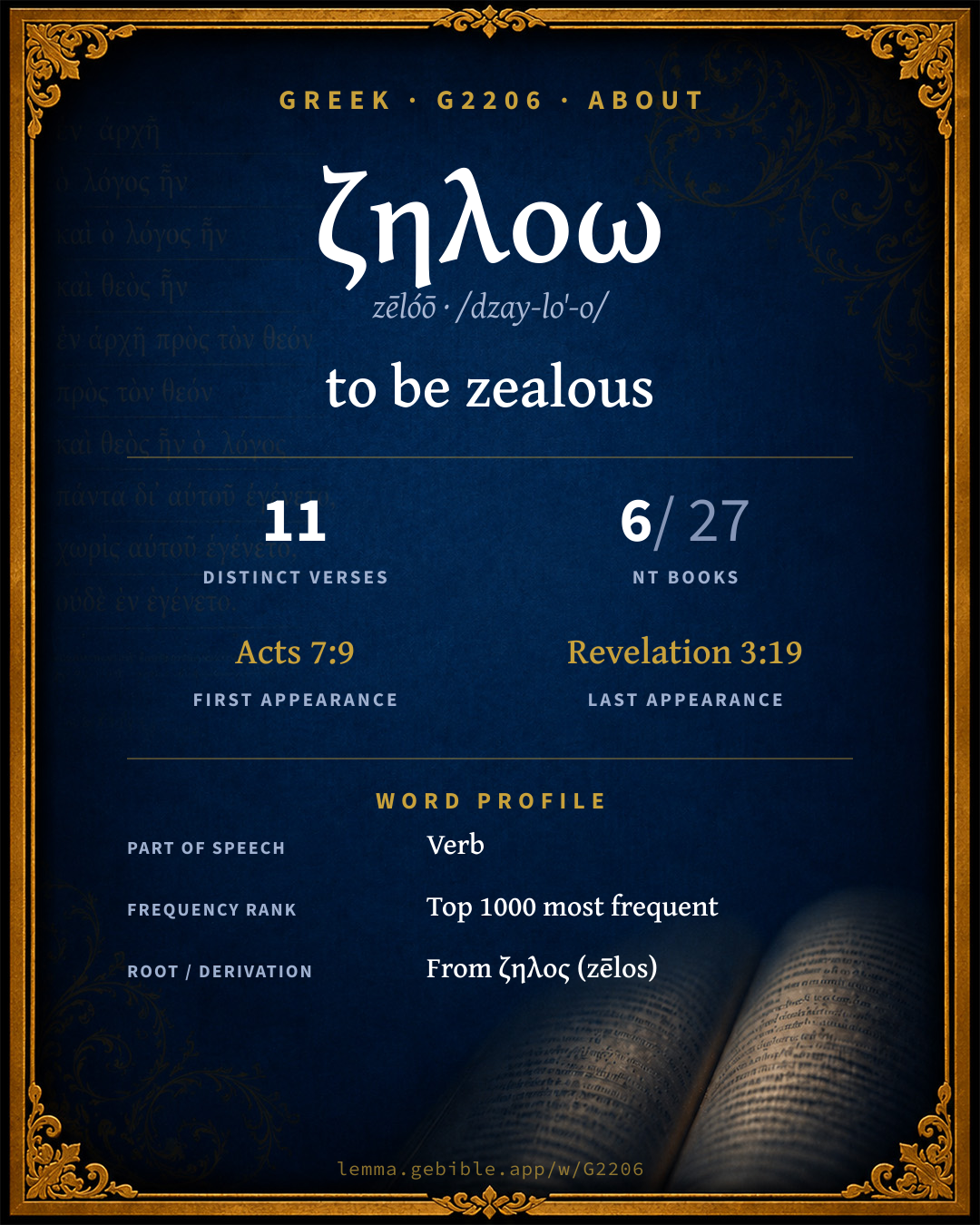
ζηλόω
to be zealous
‘to be zealous’ is one of 3 main senses fuller range ↓
Full lexicon entry — Thayer's Greek Lexicon
From Thayer's Greek Lexicon
Where this word appears
See every Present-tense verb in the Greek New Testament →
Grammar key — what these labels mean
Part of speech
- Verb
- An action or state-of-being word.
Tense
- Present
- Ongoing or general action in present time (imperfective aspect).
- Aorist
- Action viewed as a simple whole, without regard to duration — often past (perfective aspect).
Voice
- Active
- The subject performs the action.
- Passive
- The subject receives the action.
Mood
- Imperative
- Expresses a command or request.
- Participle
- A verbal adjective (“writing,” “having written”).
- Indicative
- States a fact or asks a factual question (the mood of reality).
- Subjunctive
- Expresses probability, purpose, or possibility (the mood of contingency).
- Infinitive
- A verbal noun (“to write”), unmarked for person or number.
Case
- Nominative
- The case of the subject (and the predicate nominative).
Person
- 2nd person
- The one addressed (“you”).
- 1st person
- The speaker (“I / we”).
- 3rd person
- The one spoken about (“he / she / it / they”).
Gender
- Masculine
- Grammatically masculine.
Number
- Plural
- More than one.
- Singular
- One.
Grammatical forms 9 distinct
- Verb, Present, Active, Imperative, 2nd person, Plural 3 times (25%)
- Verb, Aorist, Active, Participle, Nominative, Plural, Masculine 2 times (17%)
- Verb, Present, Active, Indicative, 1st person, Singular 1 time (8%)
- Verb, Present, Active, Indicative, 2nd person, Plural 1 time (8%)
- Verb, Present, Active, Indicative, 3rd person, Plural 1 time (8%)
- Verb, Present, Active, Indicative, 3rd person, Singular 1 time (8%)
- Verb, Present, Active, Imperative, 2nd person, Singular 1 time (8%)
- Verb, Present, Active, Subjunctive, 2nd person, Plural 1 time (8%)
+1 more form (1 occurrence)
Parsed forms decoded from the imported morphology (Robinson–Tischendorf, public domain), counted across 12 parsed occurrences — not distinct verses.
Every verse where G2206 appears — 11 distinct verses across 6 books. Click any verse to open its interlinear word-by-word view. Verse text shown in the World English Bible for context — . Each verse’s Greek form is shown with its reference; the English is not keyword-highlighted, since the data carries no word-level English alignment. Use “Compare translations” on any verse to read it across multiple English versions. This concordance covers the Greek New Testament; Septuagint (Greek Old Testament) occurrences of this word are not indexed here.
Acts 2 verses
- Acts 7:9 ζηλώσαντες aor act ptcp nom pl masc "The patriarchs, moved with jealousy against Joseph, sold him into Egypt. God was with him,
- Acts 17:5 ζηλώσαντες aor act ptcp nom pl masc But the unpersuaded Jews took along some wicked men from the marketplace, and gathering a crowd, set the city in an uproar. Assaulting the house of Jason, they sought to bring them out to the people.
1 Corinthians 4 verses
- 1 Corinthians 12:31 ζηλοῦτε pres act impv 2pl But earnestly desire the best gifts. Moreover, I show a most excellent way to you.
- 1 Corinthians 13:4 ζηλοῖ pres act ind 3sg Love is patient and is kind; love doesn't envy. Love doesn't brag, is not proud,
- 1 Corinthians 14:1 ζηλοῦτε pres act impv 2pl Follow after love, and earnestly desire spiritual gifts, but especially that you may prophesy.
- 1 Corinthians 14:39 ζηλοῦτε pres act impv 2pl Therefore, brothers, desire earnestly to prophesy, and don't forbid speaking with other languages.
2 Corinthians 1 verse
Galatians 2 verses
James 1 verse
Revelation 1 verse
About this entry
At a glance — auto-summarized from this page’s data, not written by a person. Every figure links to its source below. This summary describes the numbers; it doesn’t interpret them.
“to be zealous” is the headline sense of the Greek verb ζηλοω (zēlóō). First canonically at Acts 7:9, it enters the text early. The Greek New Testament uses it across 11 verses — uncommon. More than a third of its appearances fall in 1 Corinthians. Catalogued under 3 senses, its meaning is not single-sense. Each statement above links to its evidence; the full detail follows below.
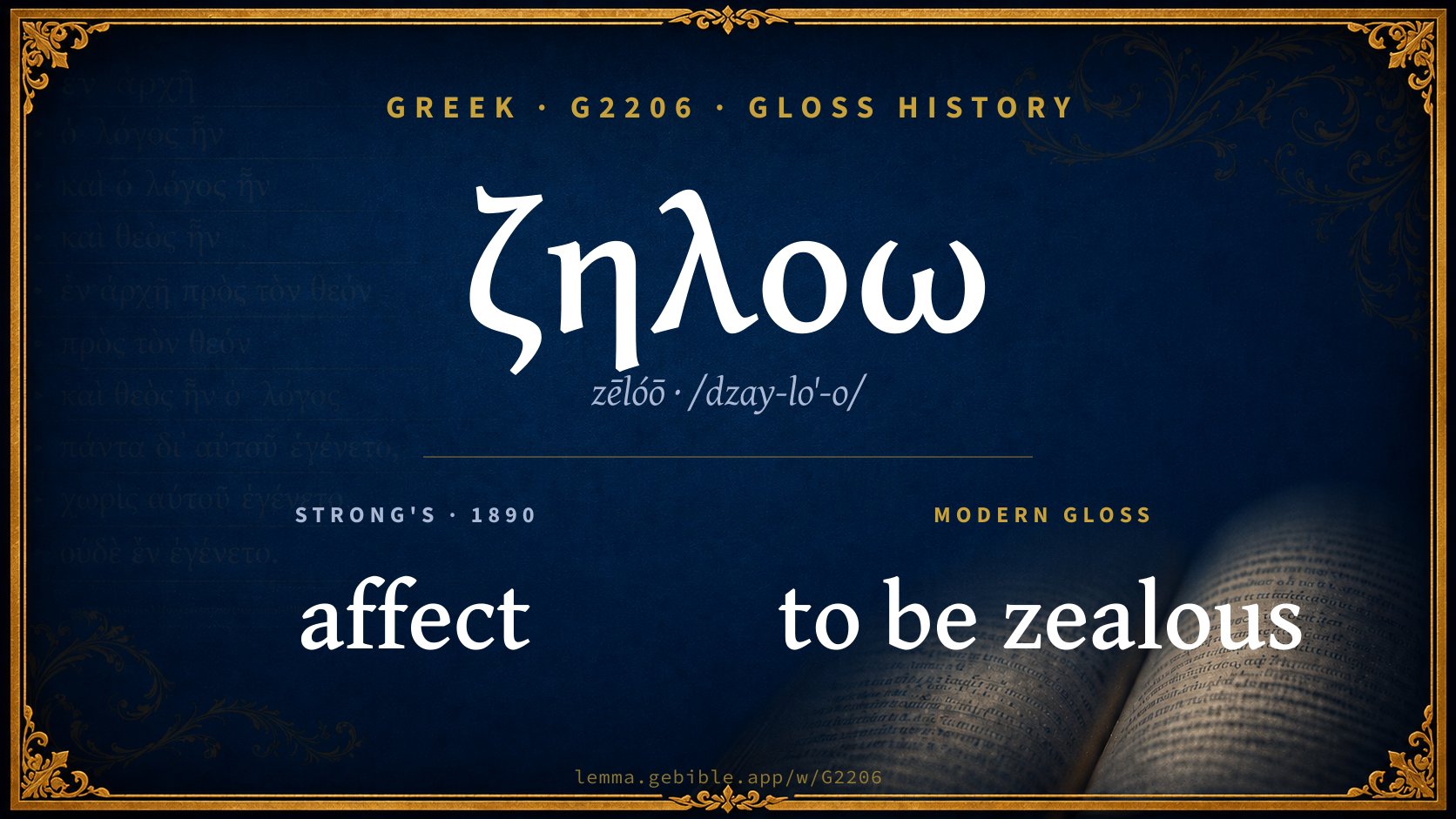
Gloss history
Strong's 1890 vs modern scholarship
About this word
Strong's G2206 catalogs a Greek word from the Greek New Testament.
These counts are not copied from any lexicon or concordance. They are computed here, from the morphology-tagged Greek New Testament. What Lemma adds →
- 11
- distinct verses
- The word appears in 11 distinct verses.
- 6 / 27
- NT books
- The word appears in 6 of 27 New Testament books.
- #904
- by frequency
- Top 1000 most frequent Greek words (rank 904 of 5,347 Greek words by occurrence).
View all 11 occurrences in the concordance →
Most concentrated in
- 1 Corinthians 4 verses 36%
- Acts 2 verses 18%
- Galatians 2 verses 18%
By section of the New Testament
By traditional corpus
Conventional, traditional groupings — biblical authorship is debated, so this is a traditional corpus grouping, not an authorship claim. Some books belong to more than one corpus (Luke is in both the Gospels and the Lukan corpus, and so on), so these shares overlap and need not total 100%. Each figure is a share of the word’s 11 distinct verses.
- Pauline corpus 7 verses · 64%
- Lukan (Luke–Acts) 2 verses · 18%
- Johannine 1 verse · 9%
- General (Catholic) Epistles 1 verse · 9%
- Revelation 1 verse · 9%
How translations render this word
Counts come from each version’s own published word-to-Strong’s tagging or interlinear alignment — an approximate guide to how each version renders this word, not a word-level alignment the data otherwise carries. Because each total is that version’s own tagged count, the per-version totals vary from one another and need not match the appearance or distinct-verse counts above. These counts may also differ from a printed concordance because Lemma counts each distinctly tagged rendering and does not collapse phrase taggings into a single head-word total. This is a fixed set of word-tagged versions (KJV, ASV, BSB, ULT) and does not change with the reading translation you choose elsewhere. Each version’s license is shown beside its name below (and on Sources).
- King James Version: Moved with envy 2×
- American Standard Version: Desire earnestly 2×
- Berean Standard Bible: Eagerly desire 2×
- unfoldingWord Literal Text: Be zealous 2×, Earnestly desire 2×, Envy 2×
King James Version Public Domain
Renders G2206 across 12 tagged occurrences — most commonly:
Plus 10 renderings that appear only once — usually multi-word phrases or single function words the recovered tagging swept in, not distinct renderings.
American Standard Version Public Domain
Renders G2206 across 12 tagged occurrences — most commonly:
Plus 10 renderings that appear only once — usually multi-word phrases or single function words the recovered tagging swept in, not distinct renderings.
Berean Standard Bible Public Domain
Renders G2206 across 12 tagged occurrences — most commonly:
Plus 10 renderings that appear only once — usually multi-word phrases or single function words the recovered tagging swept in, not distinct renderings.
unfoldingWord Literal Text CC BY-SA 4.0
Renders G2206 across 13 tagged occurrences — most commonly:
Plus 7 renderings that appear only once — usually multi-word phrases or single function words the recovered tagging swept in, not distinct renderings.
Senses in Thayer's
The 3 senses Thayer's distinguishes for this word, in lexicon order (not ranked by frequency or importance). The full entry — with sub-senses — is in the Lexicon Entry tab.
- to be heated or to boil with envy, hatred, anger
- to desire earnestly, pursue
- to envy
Word origin
Derived from ζηλος (zēlos) (G2205) — zeal.
From G2205 ; to have warmth of feeling for or against : - affect covet (earnestly) (have) desire (move with) envy be jealous over (be) zealous (-ly affect).
— Strong’s Exhaustive Concordance (1890), public domain.
Forms in the corpus
The 7 distinct written forms G2206 takes in the Greek New Testament, most frequent first — each parse links to that tense’s occurrences in the concordance.
| Form | Parsing | Example | Uses |
|---|---|---|---|
| ζηλοῦτε zēloûte | Verb, Present, Active, Imperative, 2nd person, Plural | 1 Corinthians 12:31 | 5 |
| ζηλώσαντες zēlṓsantes | Verb, Aorist, Active, Participle, Nominative, Plural, Masculine | Acts 7:9 | 2 |
| ζήλευε zḗleue | Verb, Present, Active, Imperative, 2nd person, Singular | Revelation 3:19 | 1 |
| ζηλοῖ zēloî | Verb, Present, Active, Indicative, 3rd person, Singular | 1 Corinthians 13:4 | 1 |
| ζηλοῦσθαι zēloûsthai | Verb, Present, Passive, Infinitive | Galatians 4:18 | 1 |
| ζηλοῦσιν zēloûsin | Verb, Present, Active, Indicative, 3rd person, Plural | Galatians 4:17 | 1 |
| ζηλῶ zēlō̂ | Verb, Present, Active, Indicative, 1st person, Singular | 2 Corinthians 11:2 | 1 |
Same root — word family
Other Thayer's entries built from the same root as G2206, grouped by Strong’s listed origin. These share a root / origin per the lexicon — not necessarily a shared meaning. Each links to that word’s own entry.
Derives from
Derived from this word
Compare all same-root words → They share a root, not necessarily a meaning.
Septuagint usage
The same Greek word ζηλοω appears 31 times in the Greek Old Testament (Septuagint), across 28 verses in 13 books.
- 31
- LXX occurrences
- Tagged occurrences of this Greek word in the Septuagint.
- 28
- verses
- Distinct Septuagint verses containing this word.
- 13 / 39
- OT books
- The word appears in 13 of the 39 Old Testament books.
Sample Septuagint occurrences
- Genesis 26:14 ζηλόω
- Numbers 5:14 ζηλόω
- Deuteronomy 32:19 ζηλόω
- Joshua 24:19 ζηλόω
- 2 Samuel 21:2 ζηλόω
- 1 Kings 19:10 ζηλόω
- 2 Kings 10:16 ζηλόω
- Psalms 72:3 ζηλόω
- Proverbs 3:31 ζηλόω
- Isaiah 11:11 ζηλόω
- Ezekiel 31:9 ζηλόω
- Joel 2:18 ζηλόω
Septuagint occurrences (same lexeme)
Every verse where the same Strong’s number (G2206) appears in the Greek Septuagint. Verse text shown in the World English Bible for context; the Greek form is the matched word — the English is not keyword-highlighted.
- Genesis 26:14 ζηλόω He had possessions of flocks, possessions of herds, and a great household. The Philistines envied him.
- Genesis 30:1 ζηλόω When Rachel saw that she bore Jacob no children, Rachel envied her sister. She said to Jacob, "Give me children, or else I will die."
- Genesis 37:11 ζηλόω His brothers envied him; but his father kept this saying in mind.
- Numbers 5:14 ζηλόω and the spirit of jealousy comes on him, and he is jealous of his wife, and she is defiled: or if the spirit of jealousy comes on him, and he is jealous of his wife, and she isn't defiled:
- Numbers 5:30 ζηλόω or when the spirit of jealousy comes on a man, and he is jealous of his wife; then he shall set the woman before Yahweh, and the priest shall execute on her all this law.
- Numbers 11:29 ζηλόω Moses said to him, Are you jealous for my sake? would that all Yahweh's people were prophets, that Yahweh would put his Spirit on them!
- Numbers 25:11 ζηλόω Phinehas, the son of Eleazar, the son of Aaron the priest, has turned my wrath away from the children of Israel, in that he was jealous with my jealousy among them, so that I didn't consume the children of Israel in my jealousy.
- Numbers 25:13 ζηλόω and it shall be to him, and to his seed after him, the covenant of an everlasting priesthood; because he was jealous for his God, and made atonement for the children of Israel.
- Deuteronomy 32:19 ζηλόω Yahweh saw [it], and abhorred [them], Because of the provocation of his sons and his daughters.
- Joshua 24:19 ζηλόω Joshua said to the people, You can't serve Yahweh; for he is a holy God; he is a jealous God; he will not forgive your disobedience nor your sins.
- 2 Samuel 21:2 ζηλόω The king called the Gibeonites, and said to them (now the Gibeonites were not of the children of Israel, but of the remnant of the Amorites; and the children of Israel had sworn to them: and Saul sought to kill them in his zeal for the children of Israel and Judah);
- 1 Kings 19:10 ζηλόω He said, I have been very jealous for Yahweh, the God of hosts; for the children of Israel have forsaken your covenant, thrown down your altars, and slain your prophets with the sword: and I, even I only, am left; and they seek my life, to take it away.
- 1 Kings 19:14 ζηλόω He said, I have been very jealous for Yahweh, the God of hosts; for the children of Israel have forsaken your covenant, thrown down your altars, and slain your prophets with the sword; and I, even I only, am left; and they seek my life, to take it away.
- 2 Kings 10:16 ζηλόω He said, Come with me, and see my zeal for Yahweh. So they made him ride in his chariot.
- Psalms 72:3 ζηλόω The mountains shall bring prosperity to the people. The hills bring the fruit of righteousness.
- Proverbs 3:31 ζηλόω Don't envy the man of violence. Choose none of his ways.
- Proverbs 4:14 ζηλόω Don't enter into the path of the wicked. Don't walk in the way of evil men.
- Proverbs 6:6 ζηλόω Go to the ant, you sluggard. Consider her ways, and be wise;
- Proverbs 23:17 ζηλόω Don't let your heart envy sinners; But rather fear Yahweh all the day long.
- Proverbs 24:1 ζηλόω Don't be envious of evil men; Neither desire to be with them:
- Proverbs 24:19 ζηλόω Don't fret yourself because of evildoers; Neither be envious of the wicked:
- Isaiah 11:11 ζηλόω It shall happen in that day, that the Lord will set his hand again the second time to recover the remnant of his people, who shall remain, from Assyria, and from Egypt, and from Pathros, and from Cush, and from Elam, and from Shinar, and from Hamath, and from the islands of the sea.
- Isaiah 11:13 ζηλόω The envy also of Ephraim shall depart, and those who vex Judah shall be cut off: Ephraim shall not envy Judah, and Judah shall not vex Ephraim.
- Ezekiel 31:9 ζηλόω I made it beautiful by the multitude of its branches, so that all the trees of Eden, that were in the garden of God, envied it.
- Ezekiel 39:25 ζηλόω Therefore thus says the Lord Yahweh: Now will I bring back the captivity of Jacob, and have mercy on the whole house of Israel; and I will be jealous for my holy name.
- Joel 2:18 ζηλόω Then Yahweh was jealous for his land, And had pity on his people.
- Zechariah 1:14 ζηλόω So the angel who talked with me said to me, "Proclaim, saying, 'Thus says Yahweh of Hosts: "I am jealous for Jerusalem and for Zion with a great jealousy.
- Zechariah 8:2 ζηλόω Thus says Yahweh of Hosts: "I am jealous for Zion with great jealousy, and I am jealous for her with great wrath."
These are occurrences of the same Greek lexeme (G2206) in the Septuagint — not a translation of any one Hebrew word. The store carries no word-level Hebrew↔Greek alignment, so no Hebrew original is asserted here. Counts come from the recovered LXX Strong's tagging — high-frequency vocabulary is well covered, while rare or late forms may be untagged — so they reflect tagged occurrences and may slightly undercount.