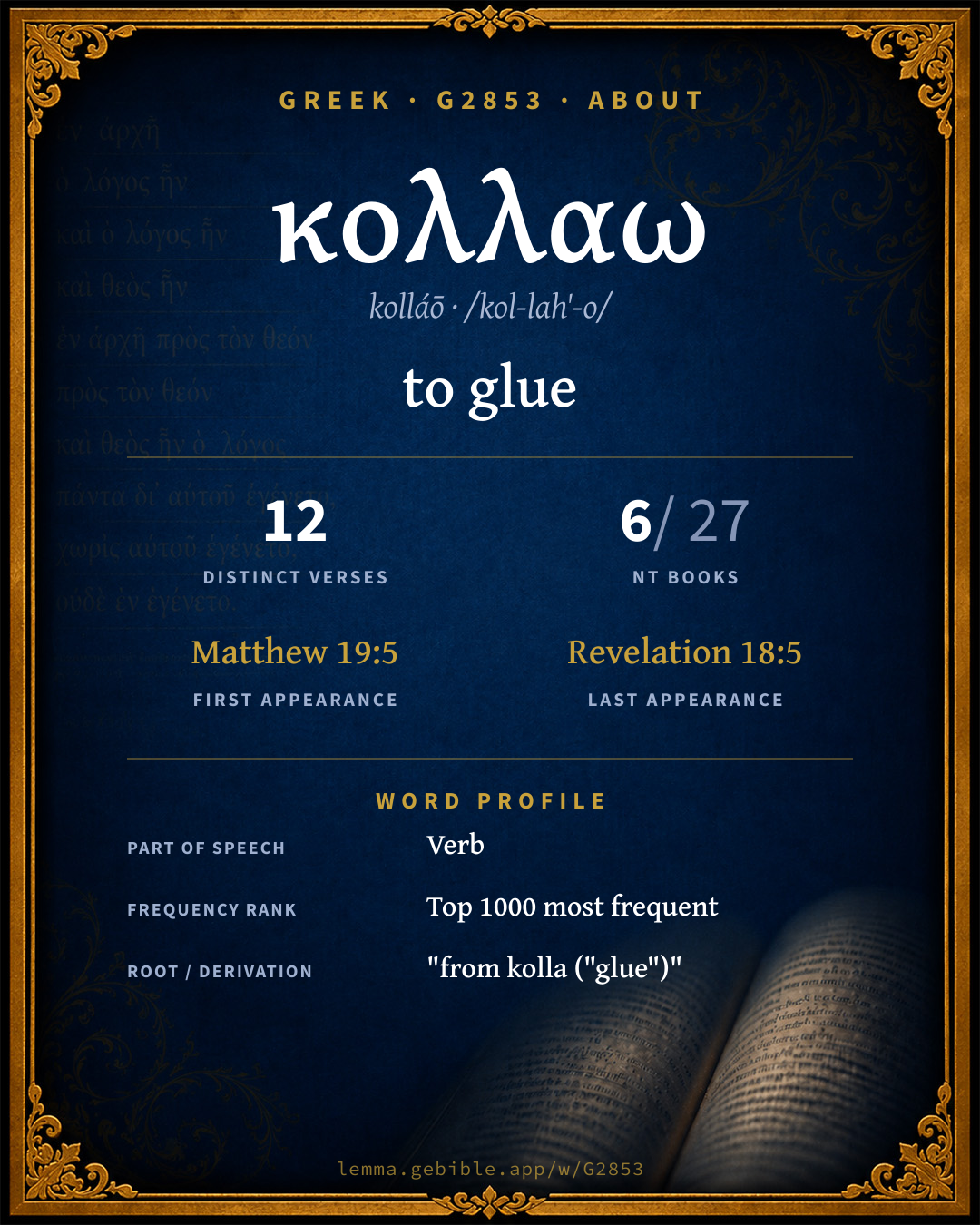
κολλάω
to glue
also: to glue together, cement, fasten together fuller range ↓
Full lexicon entry — Thayer's Greek Lexicon
From Thayer's Greek Lexicon
Where this word appears
See every Present-tense verb in the Greek New Testament →
Grammar key — what these labels mean
Part of speech
- Verb
- An action or state-of-being word.
Tense
- Present
- Ongoing or general action in present time (imperfective aspect).
- Aorist
- Action viewed as a simple whole, without regard to duration — often past (perfective aspect).
- Future
- Action expected in future time.
Voice
- Passive
- The subject receives the action.
Mood
- Infinitive
- A verbal noun (“to write”), unmarked for person or number.
- Participle
- A verbal adjective (“writing,” “having written”).
- Indicative
- States a fact or asks a factual question (the mood of reality).
- Imperative
- Expresses a command or request.
Case
- Nominative
- The case of the subject (and the predicate nominative).
- Accusative
- The case of the direct object and of extent.
Person
- 3rd person
- The one spoken about (“he / she / it / they”).
- 2nd person
- The one addressed (“you”).
Gender
- Masculine
- Grammatically masculine.
Number
- Singular
- One.
- Plural
- More than one.
Grammatical forms 9 distinct
- Verb, Present, Passive, Infinitive 3 times (25%)
- Verb, Present, Passive, Participle, Nominative, Singular, Masculine 2 times (17%)
- Verb, Aorist, Passive, Indicative, 3rd person, Plural 1 time (8%)
- Verb, Aorist, Passive, Indicative, 3rd person, Singular 1 time (8%)
- Verb, Aorist, Passive, Imperative, 2nd person, Singular 1 time (8%)
- Verb, Aorist, Passive, Participle, Accusative, Singular, Masculine 1 time (8%)
- Verb, Aorist, Passive, Participle, Nominative, Plural, Masculine 1 time (8%)
- Verb, Future, Passive, Indicative, 3rd person, Singular 1 time (8%)
+1 more form (1 occurrence)
Parsed forms decoded from the imported morphology (Robinson–Tischendorf, public domain), counted across 12 parsed occurrences — not distinct verses.
Every verse where G2853 appears — 12 distinct verses across 6 books. Click any verse to open its interlinear word-by-word view. Verse text shown in the World English Bible for context — . Each verse’s Greek form is shown with its reference; the English is not keyword-highlighted, since the data carries no word-level English alignment. Use “Compare translations” on any verse to read it across multiple English versions. This concordance covers the Greek New Testament; Septuagint (Greek Old Testament) occurrences of this word are not indexed here.
Matthew 1 verse
Luke 2 verses
- Luke 10:11 κολληθέντα aor pass ptcp acc sg masc 'Even the dust from your city that clings to us, we wipe off against you. Nevertheless know this, that the Kingdom of God has come near to you.'
- Luke 15:15 ἐκολλήθη aor pass ind 3sg He went and joined himself to one of the citizens of that country, and he sent him into his fields to feed pigs.
Acts 5 verses
- Acts 5:13 κολλᾶσθαι pres pass inf None of the rest dared to join them, however the people honored them.
- Acts 8:29 κολλήθητι aor pass impv 2sg The Spirit said to Philip, "Go near, and join yourself to this chariot."
- Acts 9:26 κολλᾶσθαι pres pass inf When Saul had come to Jerusalem, he tried to join himself to the disciples; but they were all afraid of him, not believing that he was a disciple.
- Acts 10:28 κολλᾶσθαι pres pass inf He said to them, "You yourselves know how it is an unlawful thing for a man who is a Jew to join himself or come to one of another nation, but God has shown me that I shouldn't call any man unholy or unclean.
- Acts 17:34 κολληθέντες aor pass ptcp nom pl masc But certain men joined with him, and believed, among whom also was Dionysius the Areopagite, and a woman named Damaris, and others with them.
Romans 1 verse
1 Corinthians 2 verses
Revelation 1 verse
About this entry
At a glance — auto-summarized from this page’s data, not written by a person. Every figure links to its source below. This summary describes the numbers; it doesn’t interpret them.
The Greek verb κολλαω centers on the idea of “to glue.” Its earliest occurrence is Matthew 19:5. Spanning 12 verses in 6 books, it ranks among the uncommon words of the Greek New Testament. Acts dominates its distribution — 5 of 12 verses. Lexicons map it across 3 senses — beyond “to glue” it also covers “to glue together”, “cement”, and “fasten together”. For the data behind this summary, explore the sense tree and the renderings breakdown below.
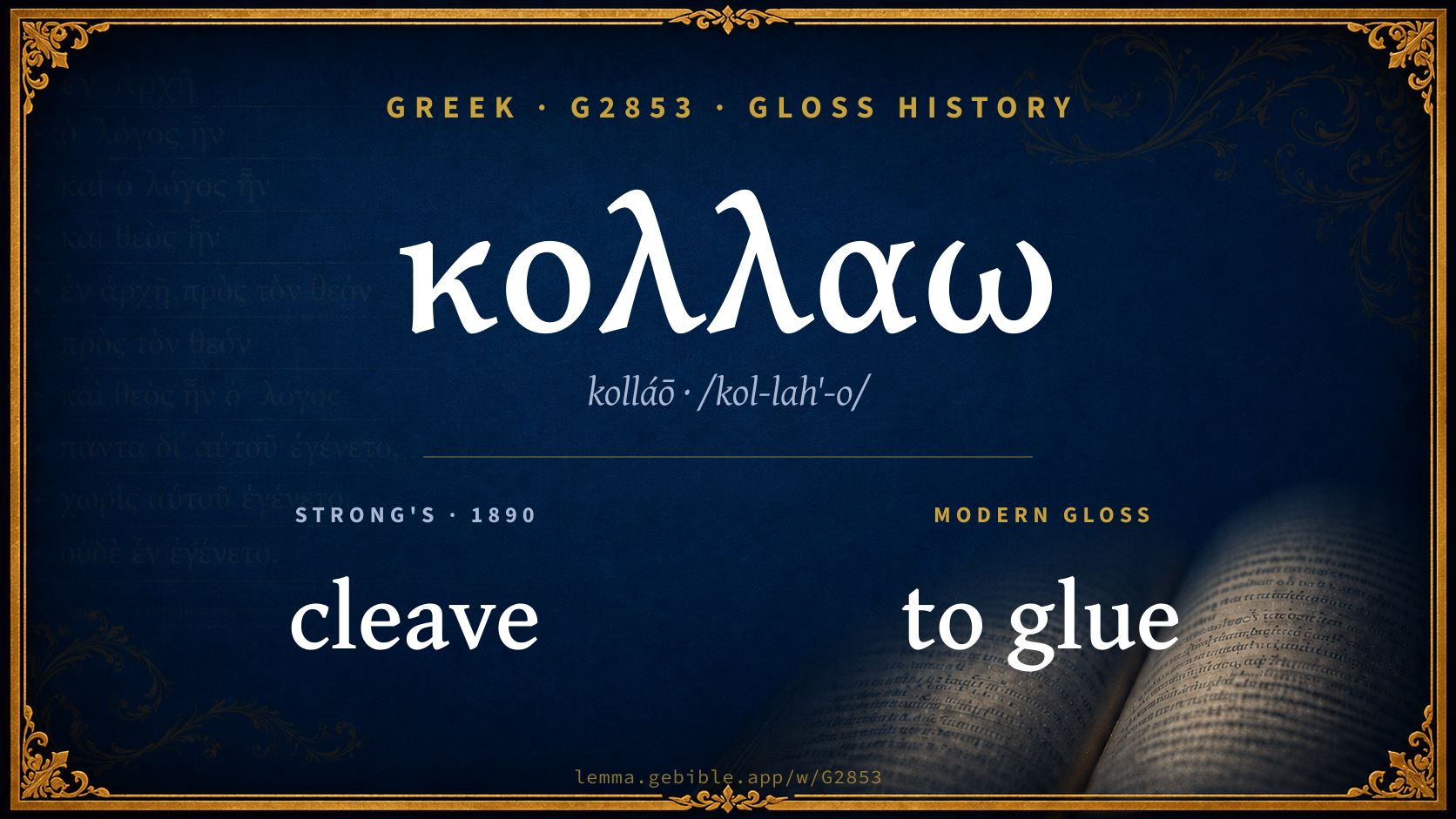
Gloss history
Strong's 1890 vs modern scholarship
About this word
Strong's G2853 catalogs a Greek word from the Greek New Testament.
These counts are not copied from any lexicon or concordance. They are computed here, from the morphology-tagged Greek New Testament. What Lemma adds →
- 12
- distinct verses
- The word appears in 12 distinct verses.
- 6 / 27
- NT books
- The word appears in 6 of 27 New Testament books.
- #904
- by frequency
- Top 1000 most frequent Greek words (rank 904 of 5,347 Greek words by occurrence).
View all 12 occurrences in the concordance →
Most concentrated in
- Acts 5 verses 42%
- Luke 2 verses 17%
- 1 Corinthians 2 verses 17%
By section of the New Testament
By traditional corpus
Conventional, traditional groupings — biblical authorship is debated, so this is a traditional corpus grouping, not an authorship claim. Some books belong to more than one corpus (Luke is in both the Gospels and the Lukan corpus, and so on), so these shares overlap and need not total 100%. Each figure is a share of the word’s 12 distinct verses.
- Lukan (Luke–Acts) 7 verses · 58%
- Gospels 3 verses · 25%
- Pauline corpus 3 verses · 25%
- Johannine 1 verse · 8%
- Revelation 1 verse · 8%
How translations render this word
Counts come from each version’s own published word-to-Strong’s tagging or interlinear alignment — an approximate guide to how each version renders this word, not a word-level alignment the data otherwise carries. Because each total is that version’s own tagged count, the per-version totals vary from one another and need not match the appearance or distinct-verse counts above. These counts may also differ from a printed concordance because Lemma counts each distinctly tagged rendering and does not collapse phrase taggings into a single head-word total. This is a fixed set of word-tagged versions (KJV, ASV, BSB, ULT) and does not change with the reading translation you choose elsewhere. Each version’s license is shown beside its name below (and on Sources).
- King James Version: Join himself 2×
- American Standard Version: Is joined 2×, Join himself 2×
- Berean Standard Bible: Join 2×, Unites himself 2×
- unfoldingWord Literal Text: Being joined 3×, Join 3×
King James Version Public Domain
Renders G2853 across 10 tagged occurrences — most commonly:
Plus 8 renderings that appear only once — usually multi-word phrases or single function words the recovered tagging swept in, not distinct renderings. Not rendered by a distinct English word in 1 further occurrence.
American Standard Version Public Domain
Renders G2853 across 9 tagged occurrences — most commonly:
Plus 5 renderings that appear only once — usually multi-word phrases or single function words the recovered tagging swept in, not distinct renderings.
Berean Standard Bible Public Domain
Renders G2853 across 12 tagged occurrences — most commonly:
Plus 8 renderings that appear only once — usually multi-word phrases or single function words the recovered tagging swept in, not distinct renderings.
unfoldingWord Literal Text CC BY-SA 4.0
Renders G2853 across 12 tagged occurrences — most commonly:
Plus 6 renderings that appear only once — usually multi-word phrases or single function words the recovered tagging swept in, not distinct renderings.
Senses in Thayer's
The 3 senses Thayer's distinguishes for this word, in lexicon order (not ranked by frequency or importance). The full entry — with sub-senses — is in the Lexicon Entry tab.
- to glue, to glue together, cement, fasten together
- to join or fasten firmly together
- to join one's self to, cleave to
Word origin
Origin: "from kolla ("glue")"
From κόλλα kolla (glue); to glue that is (passively or reflexively) to stick (figuratively): - cleave join (self) keep company.
— Strong’s Exhaustive Concordance (1890), public domain.
Forms in the corpus
The 9 distinct written forms G2853 takes in the Greek New Testament, most frequent first — each parse links to that tense’s occurrences in the concordance.
| Form | Parsing | Example | Uses |
|---|---|---|---|
| κολλᾶσθαι kollâsthai | Verb, Present, Passive, Infinitive | Acts 5:13 | 3 |
| κολλώμενος kollṓmenos | Verb, Present, Passive, Participle, Nominative, Singular, Masculine | 1 Corinthians 6:16 | 2 |
| κολλήθητι kollḗthēti | Verb, Aorist, Passive, Imperative, 2nd person, Singular | Acts 8:29 | 1 |
| κολληθέντα kollēthénta | Verb, Aorist, Passive, Participle, Accusative, Singular, Masculine | Luke 10:11 | 1 |
| κολληθέντες kollēthéntes | Verb, Aorist, Passive, Participle, Nominative, Plural, Masculine | Acts 17:34 | 1 |
| κολληθήσεται kollēthḗsetai | Verb, Future, Passive, Indicative, 3rd person, Singular | Matthew 19:5 | 1 |
| κολλώμενοι kollṓmenoi | Verb, Present, Passive, Participle, Nominative, Plural, Masculine | Romans 12:9 | 1 |
| ἐκολλήθη ekollḗthē | Verb, Aorist, Passive, Indicative, 3rd person, Singular | Luke 15:15 | 1 |
| ἐκολλήθησαν ekollḗthēsan | Verb, Aorist, Passive, Indicative, 3rd person, Plural | Revelation 18:5 | 1 |
Same root — word family
Other Thayer's entries built from the same root as G2853, grouped by Strong’s listed origin. These share a root / origin per the lexicon — not necessarily a shared meaning. Each links to that word’s own entry.
Derived from this word
Compare all same-root words → They share a root, not necessarily a meaning.
Septuagint usage
The same Greek word κολλαω appears 28 times in the Greek Old Testament (Septuagint), across 27 verses in 9 books.
- 28
- LXX occurrences
- Tagged occurrences of this Greek word in the Septuagint.
- 27
- verses
- Distinct Septuagint verses containing this word.
- 9 / 39
- OT books
- The word appears in 9 of the 39 Old Testament books.
Sample Septuagint occurrences
- Deuteronomy 6:13 κολλάω
- Ruth 2:8 κολλάω
- 2 Samuel 20:2 κολλάω
- 1 Kings 11:2 κολλάω
- 2 Kings 1:18 κολλάω
- Job 29:10 κολλάω
- Psalms 21:16 κολλάω
- Jeremiah 13:11 κολλάω
- Lamentations 2:2 κολλάω
Septuagint occurrences (same lexeme)
Every verse where the same Strong’s number (G2853) appears in the Greek Septuagint. Verse text shown in the World English Bible for context; the Greek form is the matched word — the English is not keyword-highlighted.
- Deuteronomy 6:13 κολλάω You shall fear Yahweh your God; and him shall you serve, and shall swear by his name.
- Deuteronomy 10:20 κολλάω You shall fear Yahweh your God; him shall you serve; and to him shall you cleave, and by his name shall you swear.
- Deuteronomy 28:60 κολλάω He will bring on you again all the diseases of Egypt, which you were afraid of; and they shall cleave to you.
- Deuteronomy 29:19 κολλάω and it happen, when he hears the words of this curse, that he bless himself in his heart, saying, I shall have peace, though I walk in the stubbornness of my heart, to destroy the moist with the dry.
- Ruth 2:8 κολλάω Then said Boaz to Ruth, Don't you hear, my daughter? Don't go to glean in another field, neither pass from hence, but abide here fast by my maidens.
- 2 Samuel 20:2 κολλάω So all the men of Israel went up from following David, and followed Sheba the son of Bichri; but the men of Judah joined with their king, from the Jordan even to Jerusalem.
- 1 Kings 11:2 κολλάω of the nations concerning which Yahweh said to the children of Israel, You shall not go among them, neither shall they come among you; for surely they will turn away your heart after their gods: Solomon joined to these in love.
- 2 Kings 1:18 κολλάω Now the rest of the acts of Ahaziah which he did, aren't they written in the book of the chronicles of the kings of Israel?
- 2 Kings 3:3 κολλάω Nevertheless he cleaved to the sins of Jeroboam the son of Nebat, with which he made Israel to sin; he didn't depart from it.
- 2 Kings 5:27 κολλάω The leprosy therefore of Naaman shall cleave to you, and to your seed forever. He went out from his presence a leper [as white] as snow.
- 2 Kings 18:6 κολλάω For he joined with Yahweh; he didn't depart from following him, but kept his commandments, which Yahweh commanded Moses.
- Job 29:10 κολλάω The voice of the nobles was hushed, And their tongue stuck to the roof of their mouth.
- Job 38:38 κολλάω When the dust runs into a mass, And the clods of earth stick together?
- Job 41:8 κολλάω Lay your hand on him. Remember the battle, and do so no more.
- Job 41:15 κολλάω Strong scales are his pride, Shut up together with a close seal.
- Psalms 21:16 κολλάω
- Psalms 24:21 κολλάω
- Psalms 43:26 κολλάω
- Psalms 62:9 κολλάω Surely men of low degree are just a breath, And men of high degree are a lie. In the balances they will go up. They are together lighter than a breath.
- Psalms 100:4 κολλάω Enter into his gates with thanksgiving, Into his courts with praise. Give thanks to him, and bless his name.
- Psalms 101:6 κολλάω My eyes will be on the faithful of the land, That they may dwell with me. He who walks in a perfect way, He will serve me.
- Psalms 118:25 κολλάω Save us now, we beg you, Yahweh; Yahweh, we beg you, now send prosperity.
- Psalms 118:31 κολλάω
- Psalms 136:6 κολλάω To him who spread out the earth above the waters; For his loving kindness endures forever:
- Jeremiah 13:11 κολλάω For as the belt cleaves to the loins of a man, so have I caused to cleave to me the whole house of Israel and the whole house of Judah, says Yahweh; that they may be to me for a people, and for a name, and for a praise, and for a glory: but they would not hear.
- Lamentations 2:2 κολλάω The Lord has swallowed up all the habitations of Jacob, and has not pitied: He has thrown down in his wrath the strongholds of the daughter of Judah; He has brought them down to the ground; he has profaned the kingdom and the princes of it.
- Lamentations 4:4 κολλάω The tongue of the sucking child cleaves to the roof of his mouth for thirst: The young children ask bread, and no man breaks it to them.
These are occurrences of the same Greek lexeme (G2853) in the Septuagint — not a translation of any one Hebrew word. The store carries no word-level Hebrew↔Greek alignment, so no Hebrew original is asserted here. Counts come from the recovered LXX Strong's tagging — high-frequency vocabulary is well covered, while rare or late forms may be untagged — so they reflect tagged occurrences and may slightly undercount.