
2 Corinthians 11:27

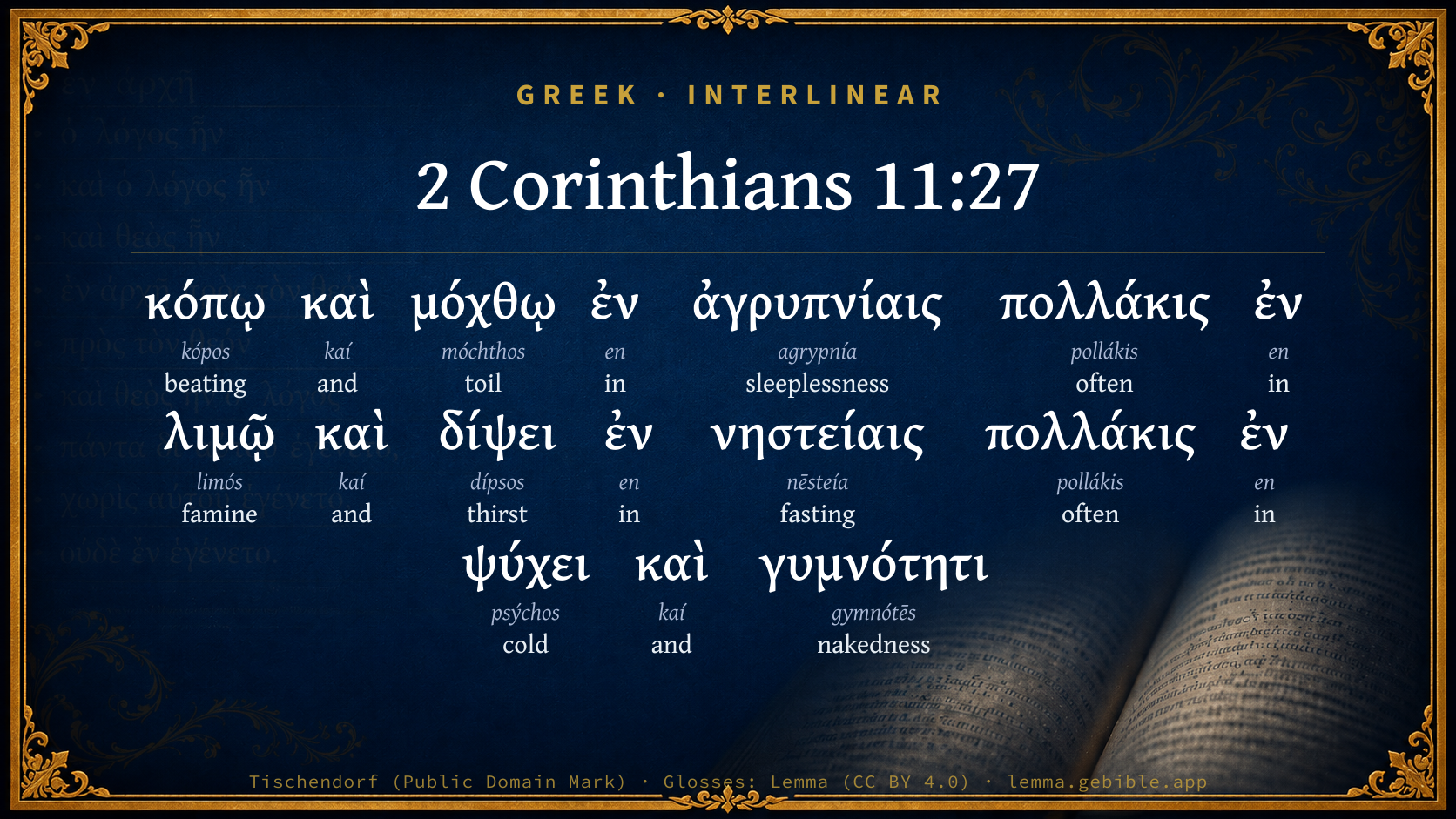
Greek (Tischendorf 8th ed.) 2 Corinthians 11:27 appears in the Greek New Testament. The text above is from the Tischendorf 8th edition. Each word links to its Strong’s number and a concise gloss. Click any word for its full Thayer’s Greek Lexicon entry.
Download image
Cite this verse

2 Corinthians 11:27 (World English Bible). Public Domain. Lemma interlinear Bible study tool, https://lemma.gebible.app/v/2-corinthians/11/27.

Show BibTeX & RIS
BibTeX
RIS
English Translation
in labor and travail, in watchings often, in hunger and thirst, in fastings often, and in cold and nakedness.
World English Bible · Public Domain
Highlights
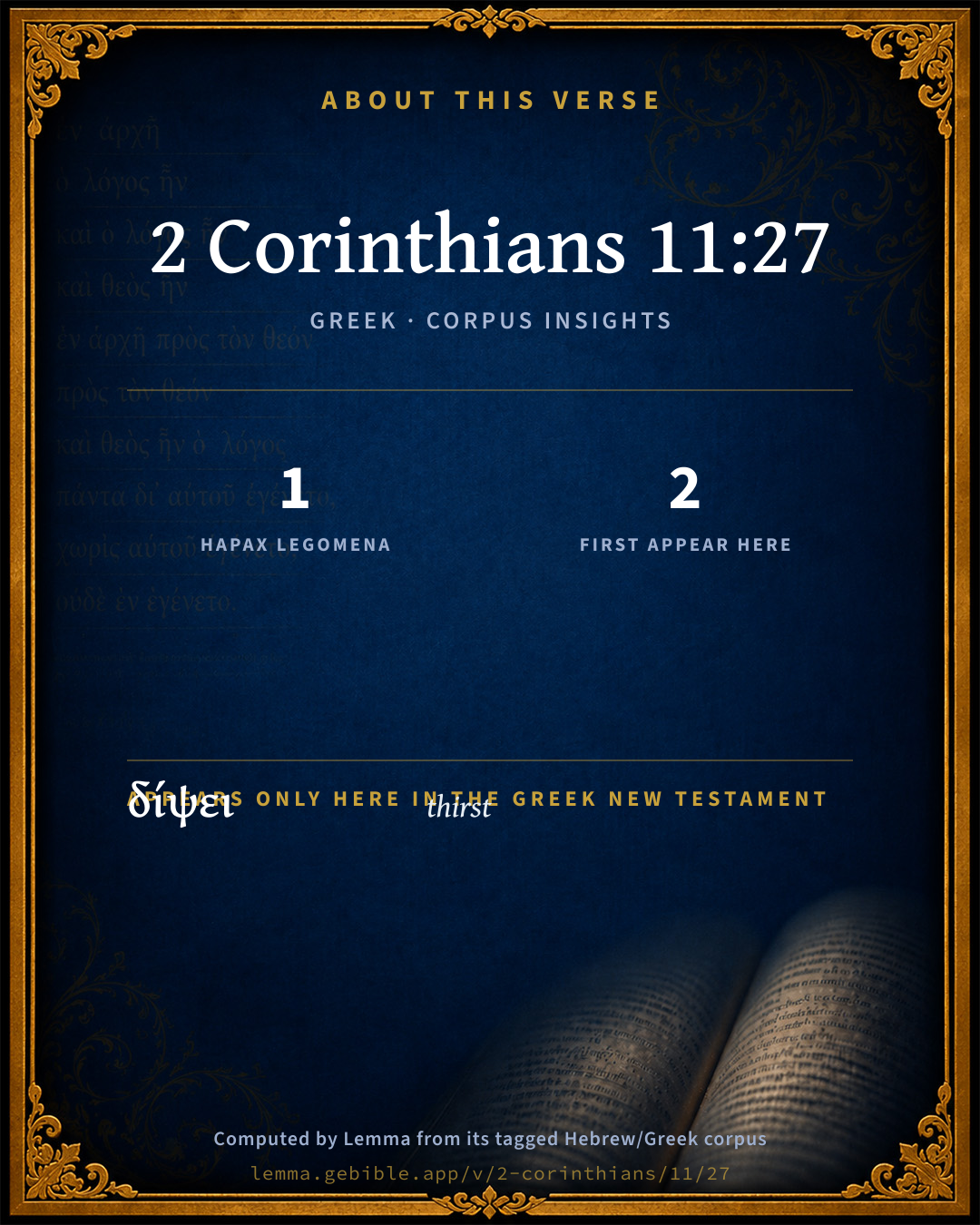
  • 1 hapax legomenon — only here in the Greek New Testament
  • 2 first appearances in the Greek New Testament
Full analysis ↓
Download a study sheet

One document with this verse’s original text, its word-by-word gloss line, the meaning frame, cross-references with their text, attributed commentary, and full source and license credits — printable, and it pastes into notes with its structure intact.

This verse Autodidact and up

Study sheet (.html) Plain text (.txt)

A passage Seminary Student

Up to 50 verses in one chapter. A passage sheet keeps up to 6 commentary sources and 12 cross-references per verse, in the order this page ranks them, and says so on the sheet whenever that leaves anything out. Ask for a single verse and you get the Autodidact verse sheet above.

Everything on this page stays free to read, with no account — the sheet is a download of what is already on screen, not access to it.

Want to remove ads? Support Godless Engineer
Compare translations 3

The same verse in 3 English versions, stacked beneath the original-language interlinear above. Click any original word for its lexicon entry.

Each is an independent rendering of the whole verse — the interlinear is not word-aligned to these translations.

Highlighted words mark where these versions differ — a whole-verse word diff, not a word-by-word alignment.

  • World English Bible Public Domain
    in labor and travail, in watchings often, in hunger and thirst, in fastings often, and in cold and nakedness.
  • King James Version Public Domain
    In weariness and painfulness, in watchings often, in hunger and thirst, in fastings often, in cold and nakedness.
  • unfoldingWord Literal Text CC BY-SA 4.0
    in hard work and hardship, often in sleeplessness, in hunger and thirst, often in fasting, in cold and nakedness;

unfoldingWord Literal Text — © unfoldingWord, licensed CC BY-SA 4.0. Word-aligned USFM3 via Door43 (git.door43.org/unfoldingWord/en_ult).

Versions to compare (up to 4)

3 of 4 selected

Show all 19 translations

Every available English version of this verse, each an independent rendering of the whole verse.

  • World English Bible Public Domain
    in labor and travail, in watchings often, in hunger and thirst, in fastings often, and in cold and nakedness.
  • Berean Standard Bible Public Domain
    in labor and toil and often without sleep, in hunger and thirst and often without food, in cold and exposure.
  • Majority Standard Bible Public Domain
    in labor and toil and often without sleep, in hunger and thirst and often without food, in cold and exposure.
  • King James Version Public Domain
    In weariness and painfulness, in watchings often, in hunger and thirst, in fastings often, in cold and nakedness.
  • American Standard Version (1901) Public Domain
    `in' labor and travail, in watchings often, in hunger and thirst, in fastings often, in cold and nakedness.
  • Revised Version (1885) Public Domain
    in labour and travail, in watchings often, in hunger and thirst, in fastings often, in cold and nakedness.
  • Geneva Bible (1599) Public Domain
    In wearinesse and painefulnesse, in watching often, in hunger and thirst, in fastings often, in colde and in nakednesse.
  • Douay-Rheims (1899) Public Domain
    In labour and painfulness, in much watchings, in hunger and thirst, in fastings often, in cold and nakedness.
  • Young's Literal Translation Public Domain
    in laboriousness and painfulness, in watchings many times, in hunger and thirst, in fastings many times, in cold and nakedness;
  • Literal Standard Version CC BY-SA 4.0
    in laboriousness and painfulness, many times in watchings, in hunger and thirst, many times in fastings, in cold and nakedness;
  • Unlocked Literal Bible CC BY-SA 4.0
    I have been at hard work and in hardship, in many sleepless nights, in hunger and thirst, often in fasting, in cold and nakedness.
  • unfoldingWord Literal Text CC BY-SA 4.0
    in hard work and hardship, often in sleeplessness, in hunger and thirst, often in fasting, in cold and nakedness;
  • Darby Bible Public Domain
    in labour and toil, in watchings often, in hunger and thirst, in fastings often, in cold and nakedness.
  • World Messianic Bible Public Domain
    in labor and travail, in watchings often, in hunger and thirst, in fastings often, and in cold and nakedness.
  • Webster's Bible Public Domain
    In weariness and painfulness, in watchings often, in hunger and thirst, in fastings often, in cold and nakedness.
  • Free Bible Version CC BY-SA 4.0
    I have faced hard labor and struggles, many sleepless nights, hunger and thirst, often going without food, cold, without enough clothing to keep warm.
  • Bible in Basic English Public Domain
    In hard work and weariness, in frequent watchings, going without food and drink, cold and in need of clothing.
  • Text-Critical English NT CC BY 4.0
    I have endured labor and hardship, many sleepless nights, and hunger and thirst. I have often gone without food and have been cold due to a lack of sufficient clothing.
  • Tyndale New Testament (1534) Public Domain
    in laboure and travayle in watchynge often in honger in thirst in fastynges often in colde and in nakednes.

Literal Standard Version (2020), Covenant Press — licensed CC BY-SA 4.0. Text via the HelloAO Bible API (eBible.org). Unlocked Literal Bible (unfoldingWord) — licensed CC BY-SA 4.0. Text via the HelloAO Bible API (eBible.org). unfoldingWord Literal Text — © unfoldingWord, licensed CC BY-SA 4.0. Word-aligned USFM3 via Door43 (git.door43.org/unfoldingWord/en_ult). Free Bible Version, Dr. Jonathan Gallagher — licensed CC BY-SA 4.0. Text via the HelloAO Bible API (eBible.org).

Word by word

More ways to search: Search by grammar → Find every occurrence → Compare this word →

Practice this passage: Drill this verse → Learn its vocabulary →

About this verse

These counts appear in no published source. They are computed here, from the morphology-tagged text and Lemma’s own curated glosses. What Lemma adds →

17
words
11
distinct lemmas
Pauline Epistles
section

Notable vocabulary

1 hapax legomenon — a word that appears only here in the entire Greek New Testament:

  • δίψει thirst G1373

First appearance in Scripture

These words make their first canonical appearance in the Greek New Testament here:

Shared distinctive vocabulary

ἀγρυπνίαις sleeplessness G70 occurs in 2 verses of the Greek New Testament. Also found in:
Repetition

Words recur within this verse:

  • πολλάκις often G4178 ×2
  • ἐν in G1722 ×4
  • καὶ and G2532 ×3

Cross-references

16

Topical passages linked to 2 Corinthians 11:27 in the Treasury of Scripture Knowledge — connected by theme and wording, ordered by reader-vote popularity; previews shown in the World English Bible.

  • 2 Corinthians 6:5 in beatings, in imprisonments, in riots, in labors, in watchings, in fastings;
  • Philippians 4:12 I know how to be humbled, and I know also how to abound. In everything and in all things I have learned the secret both to be filled and to be hungry, both to abound and to be in need.
  • 1 Thessalonians 2:9 For you remember, brothers, our labor and travail; for working night and day, that we might not burden any of you, we preached to you the Gospel of God.
  • 2 Thessalonians 3:8 neither did we eat bread from anyone's hand without paying for it, but in labor and travail worked night and day, that we might not burden any of you;
  • 1 Corinthians 4:11–12 Even to this present hour we hunger, thirst, are naked, are beaten, and have no certain dwelling place.
  • Jeremiah 38:9 My lord the king, these men have done evil in all that they have done to Jeremiah the prophet, whom they have cast into the dungeon; and he is likely to die in the place where he is, because of the famine; for there is no more bread in the city.
  • Acts 13:2–3 As they served the Lord and fasted, the Holy Spirit said, "Separate Barnabas and Saul for me, for the work to which I have called them."
  • Acts 14:23 When they had appointed elders for them in every assembly, and had prayed with fasting, they commended them to the Lord, on whom they had believed.
  • Acts 20:34–35 You yourselves know that these hands ministered to my necessities, and to those who were with me.
  • Romans 8:35–36 Who shall separate us from the love of Christ? Could oppression, or anguish, or persecution, or famine, or nakedness, or peril, or sword?
  • 1 Corinthians 7:5 Don't deprive one another, unless it is by consent for a season, that you may give yourselves to fasting and prayer, and may be together again, that Satan doesn't tempt you because of your lack of self-control.
  • 2 Corinthians 11:23 Are they servants of Christ? (I speak as one beside himself) I am more so; in labors more abundantly, in prisons more abundantly, in stripes above measure, in deaths often.
  • Hebrews 11:37 They were stoned. They were sawn apart. They were tempted. They were slain with the sword. They went around in sheep skins and in goat skins; being destitute, afflicted, ill-treated
  • James 2:15–16 And if a brother or sister is naked and in lack of daily food,
  • Acts 20:5–11 But these had gone ahead, and were waiting for us at Troas.
  • Acts 20:31 Therefore watch, remembering that for a period of three years I didn't cease to admonish everyone night and day with tears.

Cross-references courtesy of OpenBible.info (CC BY 4.0).

Commentary

Notes on 2 Corinthians 11:27 from classic Christian and Jewish commentators (each source and its license shown beneath its notes). The classic Christian expositions comment on the surrounding passage and are grouped to its opening verse, so a note may address several verses; the Jewish commentaries on the Tanakh (Rashi and others) are per-verse, so they appear only where the commentator wrote on this verse.

Lemma curates 59 commentaries, every one of them public domain or Creative Commons licensed, each selected and text-cleaned for this edition rather than reprinted as found. About our sources →

The Biblical Illustrator

Joseph S. Exell

2Co_11:27-29

In weariness.

The weariness of life

Weariness means to wear away the nervous sensibilities. Paul felt this. It is not lassitude which comes from indifference, but the exhaustion felt by the earnest and faithful soul. Let us thank God for restorative power. In nature how blessed this is! So with grace!

I. Weariness comes with temporary disappointment and defeat. God has promised to perfect that which concerneth us, but the way of perfection is just the way which wearies us. We are disappointed at the slow progress. And we are human. Think of Rebekah!--I am weary of my life because of the daughters of Heth. The motherly anxiety was at work. As we get older we feel limitations of power. Disappointment is a cloud, and we wait till the heavens are clear and the all-revealing light comes again! But we are defeated too! But first defeat has made many a true general, has quickened many an inventor, like Watt, Stephenson, and Brunel. Weariness comes to student, explorer, missionary, and philanthropist saddened with ingratitude. But this is not the weariness of sin, that not only exhausts, but destroys.

II. Weariness comes with self-discovery. The volcano tells what is in the earth. The lightning reveals the latent electricity in the air. Passions and lusts reveal terrible possibilities in good men. David said, I am weary with my groaning, and again, I am weary of my crying. Conflict with sin in all its forms is weary work.

1. The roots are so hidden. Like some garden weeds have roots that never seem uprooted, long white threads that interlace the earth and strangle other plants.

2. The battle is so varied. Like Stanleys passage of the Falls, enemies on both banks and on the island, mid-stream.

3. The avengements are so real. There is no escaping the voice! Thou art the man. And the soul cannot pretend not to hear. But think of this same Paul. Who shall deliver me from the body of this death? The answer is--Christ. More than conquerors!

III. Weariness comes with unbelief. The Greeks had an underlying sadness in their outwardly beautiful life. It is faith which gives life and zest. Thomas Carlyle says, All epochs, wherein unbelief, under whatever form soever, maintains its sorry victory, should they ever for a moment glitter with a sham splendour, vanish from the eyes of posterity; because no one chooses to burden himself with study of the unfruitful. Men must be weary who have lost faith.

1. Round of same duties without a goal.

2. Growth a mockery merging into weakness.

3. Health into pain. Vision into dimness. Thought into blank!

IV. Weariness comes from solitude. The regiment is thinning in which you started. You have seen many arms of the soldiers dip below the downs into the valley. You are beginning in a human sense to feel solitary. The Master was weary in solitude: What, could ye not watch with Me one hour? So was Paul: At Athens alone. But the Christian is never alone. I will not leave you comfortless. I will come to you. (W. M. Statham.)

Beside … the care of all the Churches.--

Anxiety of the Churches

The word care is anxiety--the same word by which Christ (Luk_8:4-15) designates one of the three influences by which the good seed is stifled. St. Paul speaks here of it in the list of sufferings for Christs sake. That anxiety which our Lord reproved (Mat_6:25, etc.; Luk_10:41) has a namesake among the graces. St. Paul, who says (Php_4:6), Be anxious about nothing, mentions this without apology as his daily experience. Just in proportion to the meanness of the one is the dignity of the other. The anxieties which choke the Word are commonly as selfish as they are earthly; those of which Paul was here capable are elevating, and, so far from choking the Word, grow out of it. Notice, respecting this care of all the Churches--

I. Its unselfishness. These people were nothing to him. They were neither kinsfolk, neighbours, nor countrymen. They were converts, but his idea of his responsibility towards them was not to do his duty and then leave it. He was solicitous, even to pain, about their continuous welfare.

II. Its strictness.

1. As regards his government of the Churches, with what eagerness both of authority and argument does he throw himself into questions even of dress! (1Co_11:3-16; cf. 1Ti_2:13-14). In our ritual controversies we are certain that he would have laid down, as it is now thought tyranny to do, the law of obedience (1Co_14:36).

2. His anxiety, as his Epistles show, was a doctrinal anxiety. He was fighting for Christ, and therefore was peremptory in his enforcement of doctrine.

III. Individual (2Co_11:29). True he made the world his province, but he took a personal interest in his converts. See how he deals with the incestuous person. He never suffered the supposed interests of Churches to eclipse the value of souls. I knew an archbishop who failed not, whatever his distance or occupation, to write at certain intervals to a common northern townsman whom he had reclaimed from intemperance for his establishment in grace. (Dean Vaughan.)

Who is weak, and I am not weak? Who is offended, and I burn not?--

Sympathy and indignation

I. There are two faults which alternate in human character--weakness and harshness.

1. We sometimes find a person who is extremely amiable, one invaluable in hours of distress, to whom we fly in sorrow. And yet in this character, so attractive at first sight, there may be a fatal defect. There may be a want of strength--a sympathy not only with the erring, which is right, but with the error, which is wrong.

2. On the other hand, we sometimes see a person of the greatest elevation and purity of character; we hear his judgment upon right and wrong; we fancy our own moral tone to be braced by his principles and example. And yet here too there may be something fatally wanting. He may be harsh, and have the effect of driving in upon itself, but not of correcting, that which is sinful in another. We feel, perhaps, that it would be impossible for us to confess a fault to such a person; therefore in his company we are tempted to deceive him if not ourselves, and that which is evil sinks the deeper in for being thus driven from the surface.

II. Turn now, and see a character which, by Gods grace, combined both these virtues and avoided both these faults.

1. By nature it was a strong character. Those whom he regarded as in error St. Paul once persecuted to the death. But, as soon as the love of Christ touched his heart, without losing one particle of strength, he learned to add to it tenderness. Knowing how much he had been forgiven, he knew how to forgive.

2. Now therefore his language is, Who is weak, and I am not weak? Who is inexperienced or unstable in the life of God, living powerless in a perilous world, and I do not share his fears and sympathise with him to the full from the depth of my own experience? On the other hand, Who is offended, and I burn not? I am weak with the weak, but I am not weak towards their tempter. Read the passage in the first Epistle, in which he consigns to a terrible punishment the guilty person, and then read the passage in the second Epistle, in which, after a due interval of exclusion, he bids them to receive back and comfort the penitent offender.

III. The lesson for ourselves.

1. Amongst you some are weak, vigorous in body, it may be, quick in mind, and yet weak. Some of you feel it, and accuse yourselves of it: I am so weak, so unstable, so irresolute, so soon shaken from my purpose. Now, then, St. Paul tells us here how we ought to deal with such weakness. He became weak along with it. This was the right way, he meant, to deal with weakness, to descend, as it were, to its level, and, in the very act of doing so, to help to raise it to his own. Do I recommend laxity of treatment? Far from it. Sympathy is not indulgence, for sympathy can rebuke severely, and severely punish. But there are two ways of doing everything; it is one thing to rebuke with sorrow, and another to rebuke or punish in coldness or in apathy.

2. Who is offended, and I burn not? It is the tendency of long carelessness, whether in an individual or in a community, to blunt the edge of the sense of sin. It is said of advancing age that its tendency is to make men more indulgent and less sanguine. Certainly we do find a great want in ourselves too often of righteous indignation. A strange companion, some of you may be saying, to that spirit of sympathy which has just been spoken of! St. Paul, however, did not think so. Now indignation is a dangerous quality to foster towards one of ourselves. But nevertheless it has its uses in the Christian scheme, and the loss of it causes a terrible injury to the health of a community, if not of an individual man. No tongue ever uttered words of such consuming indignation as those which Christ addressed to the Scribes and Pharisees. Would to God there were more who could be angry and sin not in the sight and hearing of some kinds of evil! It is the loss of this feeling which fills the courts of justice with records of unmanly aggressions upon the confiding and the feeble. (Dean Vaughan.)

Sympathy

Many-sidedness, which is an invariable characteristic of all really great men, was indisputably a feature in St. Paul. No doubt it has risks and disadvantages. There is the chance of shallowness. It is often, and with supreme unfairness, identified with insincerity. Capriciousness, too, is imputed to these large and sensitive natures, because we cannot always find them in the same mood. Perhaps that one feature of nature which has done more than any other to conciliate the affection of the Church is sympathy. Sympathy is feeling with others, and it is quite a distinct thing from feeling for them. The latter is more of a quick and evanescent sentiment, good as far as it goes, but not often going far. Sympathy is a habit, or temper of mind, which means prayer and effort and sacrifice. Let us first select certain types of circumstance which sympathy springs to meet.

1. First, let us not forget our apostles precept, Rejoice with them that do rejoice, and not be so ignorant as to suppose that men do not value sympathy with happiness, though they may need it more in sorrow. All conditions of life, as well as all classes of men, claim and appreciate sympathy. Our Lords presence at the marriage feast at Cana, as well as at the feast at Bethany after the raising of His friend Lazarus, is an instance in point. Disappointment and wounded self-love may occasionally have something to do with our lack of sympathy in a friends happiness, but thoughtlessness and a certain lazy selfishness have more.

2. There are difficulties in religion, where honest and even reverent souls demand sympathy and do not always get it. Nothing so tends to discourage, or harden, or anger men into actual unbelief as a cold, harsh, dogmatic treatment of their difficulties. Sympathy here, indeed, must be prudent and frank.

3. It is hardly necessary to add how needful and blessed in hours of personal sorrow is the felt sympathy of a friend. People who dont know are apt, by way of excusing themselves for negligence, to allege that sympathy at such times has no real value. Little they know about it. Here, again, we must premise that true sympathy has nothing morbid or softening about it. It braces, while it sighs; it points to Christ, instead of leaning on man. If it means tact and skill, it also means courage and power. In conclusion, let us say other things about sympathy. No doubt there are some people in whom it is a born instinct; so to speak, it is neither hard for them nor easy. It is a matter of course, for it is a part of themselves. Yet, even in them, it needs educating and disciplining by experience. Then let us be careful how, with the best meaning possible, we express sympathy with troubles and losses of which we have no sort of personal knowledge, thereby, it may be, making our kindly intended consolations clumsy, ludricrous, or even painful. Let us leave it to those who do know what they are doing, and so avoid the danger of making a second wound in our attempt to heal the first. Once more, no quality of the soul, when it is genuine and ripe and wise, is so gratefully accepted, so tenderly cherished, so lavishly repaid, as this grace of sympathy, and it does not need money, talent, cleverness--only the presence of love. The love of God and the love of man react upon each other. (Bp. Thorold.)

The Biblical Illustrator, edited by Joseph S. Exell (c. 1880s–1900s) — public domain. Text from a community e-Sword module.

Bengel's Gnomon

Johann Albrecht Bengel

2Co 11:27. Ἐν, in) Five clauses; the second agrees with the first, the fourth with the third, in pleasant harmony.—ἐν λιμῷ, in hunger) Deu 28:48, ἐν λιμῷ καὶ ἐν δίψει, καὶ ἐν γυμνότητι, καὶ ἐν ἐκλείψει πάντων.

Bengel's Gnomon of the New Testament — English translation (T&T Clark, Edinburgh, 1860) — public domain. Text from a community e-Sword module.

Expositor's Greek Testament

ed. W. Robertson Nicoll

2Co 11:27 . κόπῳ καὶ μόχ . κ . τ . λ .: in labour and travail, in watchings often (see on 2Co 6:5 ), in hunger and thirst ( cf. 1Co 4:11 , Phi 4:12 ), in fastings often, i.e., plainly, in involuntary deprivation of all food (the idea of voluntary devotional fastings is quite foreign to the context here, and to bring it in spoils the rhetorical force of the passage; see on 2Co 6:5 ), in cold and nakedness ( cf. 1Co 4:11 ).

The Expositor's Greek Testament, edited by W. Robertson Nicoll (1897–1910) — public domain. Text from a community e-Sword module.

Geneva Bible (1599)

Geneva Bible translators

Painfulness is a troublesome sickness, as when a man who is weary and would rest, he is constrained to fall to new labor.

Geneva Bible (1599) marginal notes — public domain. Text via Bolls.life.

Jamieson, Fausset & Brown

Robert Jamieson, A. R. Fausset & David Brown

fastings--voluntary, in order to kindle devotions (Act 13:2-3; Act 14:23; Co1 9:27); for they are distinguished from "hunger and thirst," which were involuntary [GROTIUS]. However, see on Co2 6:5. The context refers solely to hardships, not to self-imposed devotional mortification. "Hunger and thirst" are not synonymous with "foodlessness" (as the Greek of "fasting" means), but are its consequences.

cold . . . nakedness--"cold" resulting from "nakedness," or insufficient clothing, as the Greek often means: as "hunger and thirst" result from "foodlessness." (Compare Act 28:2; Rom 8:35). "When we remember that he who endured all this was a man constantly suffering from infirm health (Co2 4:7-12; Co2 12:7-10; Gal 4:13-14), such heroic self-devotion seems almost superhuman" [CONYBEARE and HOWSON].

Jamieson, Fausset & Brown — Commentary Critical and Explanatory on the Whole Bible (1871) — public domain (CC PDM 1.0). Text via the HelloAO Bible API.

Adam Clarke's Commentary

Verse 27. In weariness and painfulness] Tribulations of this kind were his constant companions. Lord Lyttleton and others have made useful reflections on this verse: "How hard was it for a man of a genteel and liberal education, as St. Paul was, to bear such rigours, and to wander about like a vagabond, hungry and almost naked, yet coming into the presence of persons of high life, and speaking in large and various assemblies on matters of the utmost importance!" Had not St. Paul been deeply convinced of the truth and absolute certainty of the Christian religion, he could not have continued to expose himself to such hardships.

Adam Clarke's Commentary on the Bible (1810–1826) — public domain. Text from a community e-Sword/MySword module.

John Calvin's Commentaries

By fastings I understand those that are voluntary, as he has spoken previously of hunger and want. Such were the tokens by which he showed himself, and on good grounds, to be an eminent servant of Christ. For how may we better distinguish Christ’s servants than by proofs so numerous, so various, and so important? On the other hand, while those effeminate boasters had done nothing for Christ, and had suffered nothing for him, they, nevertheless, impudently vaunted.

It is asked, however, whether any one can be a servant of Christ, that has not been tried with so many evils, perils, and vexations? I answer, that all these things are not indispensably requisite on the part of all; but where these things are seen, there is, undoubtedly, a greater and more illustrious testimony afforded. That man, therefore, who will be signalized by so many marks of distinction, will not despise those that are less illustrious, and less thoroughly tried, nor will he on that account be elated with pride; but still, whenever there is occasion for it, he will be prepared, after Paul’s example, to exult with a holy triumph, in opposition to pretenders and worthless persons, provided he has an eye to Christ, not to himself — for nothing but pride or ambition could corrupt and tarnish all these praises. For the main thing is — that we serve Christ with a pure conscience. All other things are, as it were, additional.

John Calvin's Commentaries (1540-1563) — public domain. Text from the Calvin Translation Society English edition (1840s-50s) via the Christian Classics Ethereal Library (ccel.org). Calvin's coverage is partial (roughly two-thirds of the Bible); uncommented books and verses are honest gaps, never fabricated. The 19th-century editor's footnotes and remarks are omitted so the notes are faithfully Calvin's own voice.

Ellicott's Commentary for English Readers

(27) In weariness and painfullness . . .—The same combination meets us in 2Th_3:8, where the English version has “labour and travail,” as Tyndale and Cranmer have in this passage. “Weariness and painfulness” appear first in the Geneva version; toil and trouble is, perhaps, the best English equivalent. From the use of the phrase in 2Th_3:8, it probably refers chiefly to St. Paul’s daily labour as a tent-maker. The “watchings” indicate the sleepless nights spent in anxiety, or pain, or prayer. “Hunger and thirst” are named as privations incident to his journeys or his labours. “Fastings,” as distinguished from these, can hardly mean anything but times of self-chosen abstinence, of which we have at least two instances in Act_13:2-3, and which would be natural in St. Paul both as a Pharisee (see Notes on Mat_6:16, and Luk_18:12) and as a disciple of Christ (see Note on Mat_9:15). “Cold and nakedness” seem to speak not only of lonely journeys, thinly clad and thinly shod, on the high passes from Syria into Asia Minor, but also of lodgings without fire, and of threadbare garments. The whole passage reminds us of the narrative given by an old chronicler of the first appearance of the disciples of Francis of Assisi in England, walking with naked and bleeding feet through ice and snow, clothed only with their one friar’s cloak, shivering and frost-bitten (Eccleston, De Adventu Minorum). He obviously contrasts this picture of his sufferings with what the Corinthians knew of the life of his rivals, who, if they were like their brethren of Judæa, walked in long robes, and loved the uppermost places at feasts (Mat_23:6). It had become a Jewish proverb that “the disciples of the wise had a right to a goodly house, a fair wife, and a soft couch” (Ursini. Antiqq. Hebr. c. 5, in Ugolini’s Thesaurus, vol. xxi.).

A Bible Commentary for English Readers, edited by Charles John Ellicott (1878–1897) — public domain. Text from a community e-Sword module.

The Cambridge Bible for Schools and Colleges

gen. ed. J. J. S. Perowne

27. in weariness and painfulness] In laboure and travayle (Tyndale), more literally. So Cranmer also. Our translators followed the Geneva version. Cf. 2Th_3:8, where the words in the Greek are the same as here.

in watchings] Literally, in sleeplessnesses, i.e. in repeated nights of sleeplessness, whether from anxiety or other causes.

in hunger and thirst] Cf. 1Co_4:11; Php_4:12.

in fastings often] “Voluntary ones, as he has before spoken of hunger and want.” Calvin. Cf. ch. 2Co_6:5.

in cold and nakedness] Dr Plumptre reminds us of the sharp contrast between this view of the greatness of a teacher and that current among the Jews, who had a proverb that “a goodly house, a fair wife, and a soft couch” were the prerogatives of the “disciples of the wise.” He refers to Mat_23:6. See also Mat_8:20.

The Cambridge Bible for Schools and Colleges (gen. ed. J. J. S. Perowne; Cambridge University Press, 1878–1918) — public domain. Text from a community e-Sword module.

John Gill's Exposition

Besides those things that are without,.... Or are omitted, which he had passed by, and had not mentioned in the account and enumeration of things he had given; for otherwise the things he had taken notice of and instanced in, were things external; but besides them and many other things which would be too tedious to relate,

that which cometh upon me daily, is not to be forgotten; meaning the prodigious deal of business which was every day upon his hands, through the continual coming of brethren to him, either for advice, or comfort, or instruction; and through the multiplicity of letters from divers parts, which he was obliged to give answers to; and the several duties of the day, as prayer, meditation, reading, praising, preaching, &c. and to sum up the whole, and which is explanative of the phrase,

the care of all the churches; not of ten, or twenty, or some only; but of all of them, he being the apostle of the Gentiles, and was concerned in planting, and raising them, and preaching the Gospel to most of them; and who continually stood in need of his watch and care over them, to provide ministers for some, to prevent schisms and heat divisions in others; to preserve others from errors and heresies, and warn them of the dangers to which they were exposed by false teachers; and to animate, strengthen, and support others under violent persecutions, lest their faith should fail, and they be tempted to desert the Gospel, and drop their profession of religion.

John Gill's Exposition of the Whole Bible (1746–1763) — public domain (CC PDM 1.0). Text via the HelloAO Bible API.

Trapp's Complete Commentary

John Trapp

27 In weariness and painfulness, in watchings often, in hunger and thirst, in fastings often, in cold and nakedness.

Ver. 27. In weariness and painfulness] Here is dainty rhetoric. Cicero calleth Aristotle’s Politics, Aureum flamen orationis, a golden flood of eloquence in respect of the purity of the style and the excellency of the matter. May it not be more truly said of this great apostle’s writings?

John Trapp, A Commentary or Exposition upon All the Books of the Old and New Testament (1647–1656) — public domain. Text from a community e-Sword module.

Albert Barnes' Notes on the Bible

In weariness - Resulting from traveling, exposure, labor, and want. The word κόπος kopos (from κόπτω koptō, “to beat, to cut”) means, properly, “wailing and grief,” accompanied with beating the breast. Hence, the word means “toil, labor, wearisome effort.”

And painfulness - This word (μόχθος mochthos) is a stronger term than the former. It implies painful effort; labor producing sorrow, and in the New Testament is uniformly connected with the word rendered “weariness” (1 Thess, 2Co 2:9; 2Th 3:8), rendered in both those places “travail.”

In watchings often - In loss of sleep, arising from abundant toils and from danger; see the note on 2Co 6:5.

In hunger and thirst - From traveling among strangers, and being dependent on them and on his own personal labors; see the note, 1Co 4:11.

In fastings often - Either voluntary or involuntary; see the note on 2Co 6:5.

In cold and nakedness - see the note, 1Co 4:11.

Albert Barnes' Notes on the Bible (1834–1885) — public domain. Text from a community e-Sword/MySword module.

Matthew Poole's English Annotations

The apostle reckons up several afflictive evils, ordinarily incident to such as travel in foreign countries. Of this nature were the

weariness and painfulness, the hunger and thirst, the cold and nakedness, here mentioned. He also mentioneth the watchings and fastings, as voluntary acts of discipline, which he used for the end mentioned, 1Co 9:27, for the keeping under his body, and bringing it into subjection, and that he might the better attend and discharge the work of the ministry.

Matthew Poole's English Annotations on the Holy Bible (1683–1685) — public domain. Text from a community e-Sword/MySword module.

Whedon's Commentary on the Bible

Daniel D. Whedon

27. An enumeration of bodily privations.

Painfulness—The aches resulting from overwork.

Watchings—Sleeplessnesses.

Fastings—Not voluntary fastings, but inability to procure food.

Daniel D. Whedon (gen. ed.), Commentary on the Old and New Testaments (1874–1909) — public domain. Text from a community e-Sword module.

The Pulpit Commentary

In weariness and painfulness; literally, in toil and travail (1Th_2:9; 2Th_3:8) In watchings; literally, in spells of sleeplessness. (Act_20:34) In hunger and thirst (ver. 8; 1Co_4:11; Php_4:12) In fastings often. It is not clear whether this refers to voluntary fastings (2Co_6:5; Act_27:9) or to general destitution short of the actual pangs of hunger. In cold and nakedness. St. Paul"s ideal, like that of his Master Christ, was the very antithesis of that adopted by the wealthy, honoured, and full-fed Shammais and Hillels of Jewish rabbinism, who delighted in banquets, fine garments, pompous titles, domestic comforts, and stationary ease.

The Pulpit Commentary (1880–1919), ed. H.D.M. Spence-Jones & Joseph S. Exell — public domain. Text from a community e-Sword module.

John Wesley's Explanatory Notes

In cold and nakedness - Having no place where to lay my head; no convenient raiment to cover me; yet appearing before noble-men, governors, kings; and not being ashamed.

John Wesley, Explanatory Notes Upon the Whole Bible (1754–1765) — public domain. Text via the GEBible commentary corpus.

McGarvey & Pendleton's Commentaries

J. W. McGarvey

in labor and travail, in watchings often, in hunger and thirst, in fastings often, in cold and nakedness . [The apostle here tells how he labored until labor became a pain; how he sacrificed his sleep that he might teach, preach and pray ( Act_20:31 ; 1Th_3:10 ); how his journeyings often took him where he suffered for water and was faint with hunger; how he often fasted for the good of the cause ( Act_13:2 ; Act_13:3 ; Act_14:23 ; 1Co_9:27 ); and how he was cold and insufficiently clad. The apostle makes no mention of the frequency of his hunger and thirst, etc., for the recurrency of these trials was beyond his control. He employs the word "often" when speaking of the watchings and fastings which were directly under his control, and which he might have avoided had he chosen to do so. Surely this catalogue of privations must have made the apostle's character stand in strong contrast to the self-indulgent spirit of his adversaries. From physical trials Paul now turns to those which were mental.]

J. W. McGarvey (with Philip Y. Pendleton), Commentaries on the New Testament (The Fourfold Gospel, 1914; Acts; and the epistles) — public domain. Text from a community e-Sword/MySword module.

The People's New Testament

B. W. Johnson

27. In weariness and painfulness. Often weary and in pain. The verse shows the self-denial made necessary in preaching the gospel. Often in want, hungry, naked and cold. Why should all these have been endured? Nothing but overwhelming conviction and love could have led him to this sacrifice himself.

B. W. Johnson's The People's New Testament with Notes (1889–1891) — public domain. Electronic text from the Christian Classics Ethereal Library (CCEL) ThML edition.

unfoldingWord translationNotes

Door43 World Missions Community

nakedness

Here Paul exaggerates to show his need of clothing. AT: "without enough clothing to keep me warm" (See: Hyperbole and Generalization)

there is the daily pressure on me of my anxiety

Paul knows that God will hold him responsible for how well the churches obey God and speaks of that knowledge as if it were a heavy object pushing him down. AT: "I know that God will hold me accountable for the spiritual growth of all the churches, and so I always feel like a heavy object is pushing me down" (See: Metaphor)

Who is weak, and I am not weak?

This rhetorical question can be translated as a statement. AT: "Whenever anyone is weak, I feel that weakness also." (See: Rhetorical Question)

Who is weak, and I am not weak?

The word "weak" is probably a metaphor for a spiritual condition, but no one is sure what Paul is speaking of, so it is best to use the same word here. AT: "I am weak whenever anyone else is weak." (See: Metaphor)

Who has been caused to stumble, and I do not burn?

Paul uses this question to express his anger when a fellow believer is caused to sin. Here his anger is spoken of as a burning inside him. This rhetorical question can be translated as a statement. AT: "Whenever anyone causes a brother to sin, I am angry." (See: Rhetorical Question and Metaphor)

has been caused to stumble

Paul speaks of sin as if it were tripping over something and then falling. AT: "has been led to sin" or "has thought that God would permit him to sin because of something that someone else did" (See: Metaphor)

I do not burn

Paul speaks of being angry about sin as if he had a fire inside his body. AT: "I am not angry about it" (See: Metaphor)

translationWords

hard

works

church

stumble

unfoldingWord translationNotes — © Distant Shores Media and the Door43 World Missions Community, licensed CC BY-SA 4.0. Source: git.door43.org/Door43/en_tn.

Cambridge Greek Testament for Schools and Colleges

27. κόπῳ (אBDFG, d g) rather than ἐν κόπῳ (KLMP, Vulg.).

27. Having mentioned thirteen cases in which he might have lost his life, and eight kinds of dangers which one who travelled as he did must incur, he goes on to mention miscellaneous trials and afflictions. In sense this verse comes immediately after ὁδοιπορίαις πολλάκις, all that lies between being a mere expansion of ὁδοιπορίαις: as by these he is ὕπερ as a minister of Christ, so also by what follows.

κόπῳ καὶ μόχθῳ. By labour and travail, as in 1Th 2:9; 2Th 3:8, where the same two words occur of his working with his own hands to maintain himself. Here the Vulgate has labor and aerumna, there labor and fatigatio. ‘In labore,’ id est, sive manuum sive praedicationum. Et quia potest esse labor absque aerumna, id est, sine indigentia et penuria, ut ostenderet exitiosum laborem, adjunxit ‘aerumna’ (Atto Vercell.). The A.V. both here and throughout 2Co 11:26 should put ‘in’ in italics, as the R.V. does; but it is perhaps better to change the preposition: see critical note. In what follows to is resumed from 2Co 11:23.

ἐν ἀγρυπνίαις πολλάκις. These cover both voluntary and involuntary sleeplessness. But seeing that involuntary sleeplessness may be included in κόπῳ καὶ μόχθῳ, here we may understand voluntary ‘watchings’ (A.V., R.V.) for thought and prayer. Comp. 2Co 6:5. In the LXX. the word is frequent in Ecclus (prol. 24, 34[31]:1, 2, 20, 38:26, 27, 28, 30, 42:9); elsewhere only 2Ma 2:26.

ἐν λιμῷ καὶ δίψει, ἐν νηστείαις πολλάκις. Here again we seem to have still more clearly, first what is involuntary, and then what is voluntary. ‘Jejunia’ voluntaria interpretor, cum de fame et penuria ante locutus est (Calvin). While ἐν λιμῷ καὶ δίψει would signify inability to get food (Deu 28:48), to ἐν νηστείαις would refer to voluntary abstention, either for self-discipline (1Co 9:27), or because he often would not allow meals to interfere with work. In the rhythm of the clauses, ἐν νηστείαις balances ἐν ἀγρυπνίαις, and therefore if ἐν νηστείαις refers to what is voluntary, this affords some presumption that the other does so also.

ἐν ψύχει καὶ γυμνότητι. These would occur when he was thrown into prison, or stripped by robbers, or drenched by floods or storms.

All this enumeration of sufferings as evidence that he was a true minister of Christ would seem indeed ‘madness’ to the Judaizers. It was Jewish doctrine that temporal blessings, especially wealth and comfort, were signs that God was pleased with His servants. Comp. Rom 8:35, which is a parallel to the whole passage.

Cambridge Greek Testament for Schools and Colleges (Cambridge University Press, 1896; 21 vols, various authors incl. Carr, Maclear, Plummer, Farrar, Lumby, Moule, M. R. James, Simcox) — public domain. Text from a community e-Sword module.

Alford’s Greek Testament

Henry Alford

27.] by labour and weariness, by watchings (see on ch. 6:5) frequently (the ἐν is here resumed, perhaps arbitrarily, perhaps also because κόπος and μόχθος are more directly instrumental,—ἀγρυπν., &c., more conditionally), by hunger and thirst, by fastings frequently (voluntary fastings, ‘ad purificandam mentem et edomandam carnem,’ as Estius, see also ch. 6:5 note. De W. here too (see also Stanley) holds to ‘involuntary fastings;’ but he is clearly wrong, for νηστ. is distinguished from λιμ. κ. δίψ.), in cold and nakedness (insufficient clothing:—or, literally, when thrust into prison after his scourgings,—or after his shipwrecks).

Henry Alford, The Greek Testament (1849–1861) — public domain. Text from a community e-Sword module.

International Critical Commentary

27. Having explained in vv. 24, 25 what he meant by being ἐν θανάτοις πολλάκις, and in v. 26 what ὁδοιπορίαις πολλάκις involved, he now adds a series of varied sufferings which continue the cumulative argument that his claim to be a minister of Christ is overwhelmingly stronger than that of his opponents. The verse consists of two evenly balanced lines, followed by a much shorter line, which is all the more effective through its being ended so abruptly. It leaves the hearer expectant.

27. κόπῳ καὶ μόχθῳ. ‘By labour and travail,’ or ‘By toil and moil,’ for it is possible that St Paul combines the two words here, as in 1Th 2:9 and 2Th 3:8, because of the similarity in sound. We have the same combination in Hermas, Sim. 5, 6:2, οὐδεὶς γὰρ δύναται σκαφεῦσαι ἄτερ κόπου ἤ μόχθου. Of the two words, μόχθος is active, indicating struggle and toil, while κόπος is passive, indicating the lassitude which results from prolonged exertion. Lightfoot on 1Th 2:9. The words are therefore not in logical order. In 1 and 2 Thess., Vulg. is more logical than exact with labor et fatigatio: here it has labor et aerumna. In all three places the Apostle refers to his working with his hands to maintain himself.

ἐν ἀγρυπνίαις πολλάκις. This probably refers chiefly to voluntary ‘watchings’ (AV, RV) rather than involuntary insomnia. His manual labour, his prayers and his preaching (Act 20:9-11, Act 20:31) often kept him from sleep. Cf. 6:5. The word is freq. in Ecclus, elsewhere very rare in Bibl. Grk. In the prologue to Ecclus. and 2 Macc. 2:26 it is used of sitting up at night writing a book. In Ecclus. 38:26-30 it is used repeatedly of labourers and artisans working at night. On the other hand, in 36:1 [31], 2, 20 and 42:9 it is used of sleeplessness caused by anxiety or discomfort.

ἐν λιμῷ καὶ δίψει. The hunger and thirst caused by inability to obtain food and drink (Deu 28:48; Isa 49:10). This is involuntary fasting.

ἐν νηστείαις πολλάκις. Some commentators explain this also of involuntary fasting. But this makes it a mere repetition of ἐν λιμῷ καὶ δίψει. Ἐν ἀγρυπνίαις πολλάκις is not a repetition of κόπῳ καὶ μόχθῳ. Calvin decides for jejunia voluntaria, because the hunger caused by want has already been mentioned; and as ἀγρυπνίαις probably refers to going without sleep in order to work, so νηστείαις probably refers to going without meals for the same reason. Fastings as a means of self-discipline (1Co 9:27) are less probable, for these would hardly be included in a list of hardships. But seeing that the Apostle is accumulating evidence that he is a true minister of Christ, it is not impossible that the work of bringing his body into subjection is included; quin νηστείαις enim, quum λιμῷ καὶ δίψει adjungantur, jejunia voluntarie ac sine necessitate servata intelligenda sint, nemo prudens dubitat (Cornely).* Cf. Rom 8:35-37.

ἐν ψύχει καὶ γυμνότητι. When he was thrown into prison, or drenched by rain, or stripped by brigands.

All this argument is in strong contrast to the comfortable doctrine of the Jews, and doubtless of the Judaizers at Corinth, that to be in easy circumstances and general prosperity was a sign of Divine favour. Chrysostom points out that St Paul says nothing about results, as to the number of converts that he had made: he counts up only what he has suffered in his missionary work. And this he does not merely out of modesty, but because his labours, even if fruitless, proved the reality of his mission.

א3 K L M P, f Vulg. support ἐν before κόπῳ καὶ μόχθῳ: but we may safely omit ἐν with א* B D E F G, d e g Goth. It would be more likely to be inserted as probable than dropped as unnecessary. Note the divergence of f from F.

International Critical Commentary — older volumes (1896–1929), various authors — public domain. Text from a community e-Sword module.

Vincent's Word Studies in the New Testament

Marvin R. Vincent

Watchings. See on ch. 2Co 6:5.

Marvin R. Vincent, Word Studies in the New Testament (1887–1900) — public domain. Text from a community e-Sword/MySword module.

Lesson kit

Teaching starters — assembled from the data on this page, not authored interpretation. Every prompt links to the verse data it draws on. Edit before teaching.

2 Corinthians, in the Pauline Epistles, opens this verse with 17 words (11 distinct Greek lemmas). Its most distinctive word is dípsos (“thirst”). A historical commentator’s framing appears above. Read the whole chapter for the surrounding context.

Discussion questions

  1. How does “thirst” (dípsos) shape what this verse is saying?
  2. 1 word here appears nowhere else in the Greek New Testament. Why might the author reach for such rare wording?
  3. 2 words make their first appearance in Scripture here. What does this debut establish?
  4. How does 2 Corinthians 6:5, which shares the word «sleeplessness», read alongside this verse?
  5. What does the repetition of “often” (2× in this one verse) do in this verse?
  6. These translations render this verse differently. What is at stake in choosing one wording over another?
  7. Compare how The Biblical Illustrator and Bengel's Gnomon read this verse. Where do they agree or differ?

Things to notice

  • 1 word in this verse appears nowhere else in the Greek New Testament.
  • 2 words make their first canonical appearance in Scripture here.
  • These translations choose different wording for 11 words in this verse.
  • “often” occurs 2× in this single verse.
  • 11 distinct Greek lemmas span 17 words in this verse.

Reading settings

Reading text

Shown beneath each verse's original-language words.

Old Testament
Old Testament edition

Read the OT as the Masoretic Hebrew (MT) or the Greek Septuagint (LXX).

English shown for the Greek Septuagint (in the Hebrew ↔ Greek comparison).

Comparing translations? Open the Compare panel on any verse page to stack up to four side by side.