2 Peter 1:6

Greek (Tischendorf 8th ed.) 2 Peter 1:6 appears in the Greek New Testament. The text above is from the Tischendorf 8th edition. Each word links to its Strong’s number and a concise gloss. Click any word for its full Thayer’s Greek Lexicon entry.
Download image
Cite this verse

2 Peter 1:6 (World English Bible). Public Domain. Lemma interlinear Bible study tool, https://lemma.gebible.app/v/2-peter/1/6.

Show BibTeX & RIS
BibTeX
RIS
English Translation
and in knowledge, self-control; and in self-control patience; and in patience godliness;
World English Bible · Public Domain
Download a study sheet

One document with this verse’s original text, its word-by-word gloss line, the meaning frame, cross-references with their text, attributed commentary, and full source and license credits — printable, and it pastes into notes with its structure intact.

This verse Autodidact and up

Study sheet (.html) Plain text (.txt)

A passage Seminary Student

Up to 50 verses in one chapter. A passage sheet keeps up to 6 commentary sources and 12 cross-references per verse, in the order this page ranks them, and says so on the sheet whenever that leaves anything out. Ask for a single verse and you get the Autodidact verse sheet above.

Everything on this page stays free to read, with no account — the sheet is a download of what is already on screen, not access to it.

Want to remove ads? Support Godless Engineer
Compare translations 3

The same verse in 3 English versions, stacked beneath the original-language interlinear above. Click any original word for its lexicon entry.

Each is an independent rendering of the whole verse — the interlinear is not word-aligned to these translations.

Highlighted words mark where these versions differ — a whole-verse word diff, not a word-by-word alignment.

  • World English Bible Public Domain
    and in knowledge, self-control; and in self-control patience; and in patience godliness;
  • King James Version Public Domain
    And to knowledge temperance; and to temperance patience; and to patience godliness;
  • unfoldingWord Literal Text CC BY-SA 4.0
    and in knowledge, self-control; and in self-control, endurance; and in endurance, godliness;

unfoldingWord Literal Text — © unfoldingWord, licensed CC BY-SA 4.0. Word-aligned USFM3 via Door43 (git.door43.org/unfoldingWord/en_ult).

Versions to compare (up to 4)

3 of 4 selected

Show all 19 translations

Every available English version of this verse, each an independent rendering of the whole verse.

  • World English Bible Public Domain
    and in knowledge, self-control; and in self-control patience; and in patience godliness;
  • Berean Standard Bible Public Domain
    and to knowledge, self-control; and to self-control, perseverance; and to perseverance, godliness;
  • Majority Standard Bible Public Domain
    and to knowledge, self-control; and to self-control, perseverance; and to perseverance, godliness;
  • King James Version Public Domain
    And to knowledge temperance; and to temperance patience; and to patience godliness;
  • American Standard Version (1901) Public Domain
    and in `your' knowledge self-control; and in `your' self-control patience; and in `your' patience godliness;
  • Revised Version (1885) Public Domain
    and in your knowledge temperance; and in your temperance patience; and in your patience godliness;
  • Geneva Bible (1599) Public Domain
    And with knowledge, temperance: and with temperance, patience: and with patience, godlines:
  • Douay-Rheims (1899) Public Domain
    And in knowledge, abstinence; and in abstinence, patience; and in patience, godliness;
  • Young's Literal Translation Public Domain
    and in the knowledge the temperance, and in the temperance the endurance, and in the endurance the piety,
  • Literal Standard Version CC BY-SA 4.0
    and with knowledge—self-control, and with self-control—endurance, and with endurance—piety,
  • Unlocked Literal Bible CC BY-SA 4.0
    to knowledge add self-control; to self-control add endurance; to endurance add godliness;
  • unfoldingWord Literal Text CC BY-SA 4.0
    and in knowledge, self-control; and in self-control, endurance; and in endurance, godliness;
  • Darby Bible Public Domain
    in knowledge temperance, in temperance endurance, in endurance godliness,
  • World Messianic Bible Public Domain
    and in knowledge, self-control; and in self-control, perseverance; and in perseverance, godliness;
  • Webster's Bible Public Domain
    And to knowledge temperance; and to temperance patience; and to patience godliness;
  • Free Bible Version CC BY-SA 4.0
    add to knowledge, self-control; add to self-control, patience; add to patience, reverence;
  • Bible in Basic English Public Domain
    And self-control to knowledge, and a quiet mind to self-control, and fear of God to a quiet mind,
  • Text-Critical English NT CC BY 4.0
    your knowledge with self-control, your self-control with endurance, your endurance with godliness,
  • Tyndale New Testament (1534) Public Domain
    and in knowledge temperancy and in temrancy pacience in pacience godlynes

Literal Standard Version (2020), Covenant Press — licensed CC BY-SA 4.0. Text via the HelloAO Bible API (eBible.org). Unlocked Literal Bible (unfoldingWord) — licensed CC BY-SA 4.0. Text via the HelloAO Bible API (eBible.org). unfoldingWord Literal Text — © unfoldingWord, licensed CC BY-SA 4.0. Word-aligned USFM3 via Door43 (git.door43.org/unfoldingWord/en_ult). Free Bible Version, Dr. Jonathan Gallagher — licensed CC BY-SA 4.0. Text via the HelloAO Bible API (eBible.org).

Word by word

More ways to search: Search by grammar → Find every occurrence → Compare this word →

Practice this passage: Drill this verse → Learn its vocabulary →

ἐγκράτειαν
enkráteia
G1466
“self-control”
Noun, Accusative, Singular, Feminine
Part of Speech
Noun
Case
Accusative
Number
Singular
Gender
Feminine
Full Thayer's Definition

Origin: from G1468

TDNT: 07:39,2

1. self-control (the virtue of one who masters his desires and passions, esp. his sensual appetites)
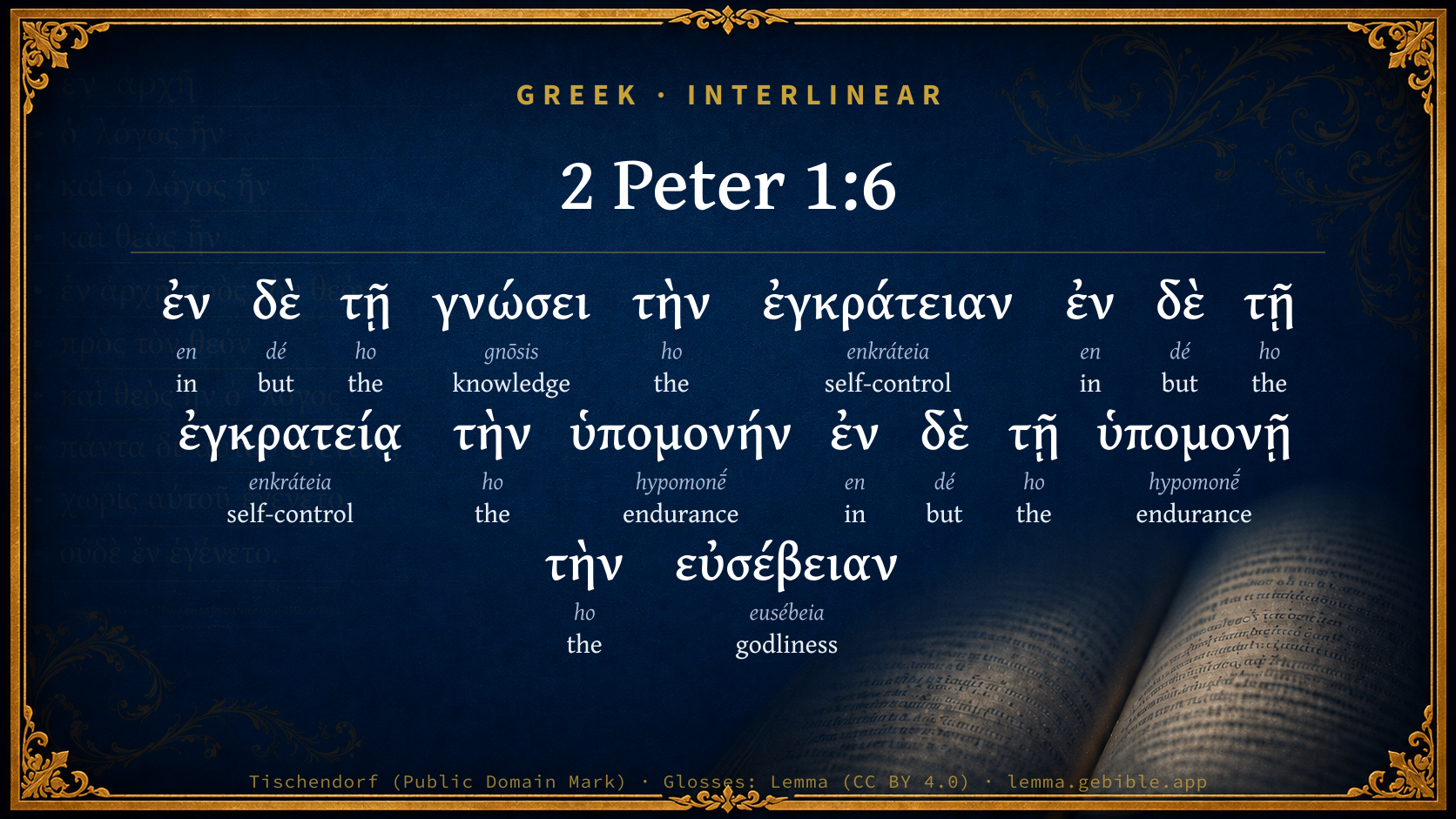
  1. ἐν en G1722 “in” Preposition
  2. δὲ dé G1161 “but” Conjunction
  3. τῇ ho G3588 “the” Article, Dative, Singular, Feminine
  4. γνώσει gnōsis G1108 “knowledge” Noun, Dative, Singular, Feminine
  5. τὴν ho G3588 “the” Article, Accusative, Singular, Feminine
  6. ἐν en G1722 “in” Preposition
  7. δὲ dé G1161 “but” Conjunction
  8. τῇ ho G3588 “the” Article, Dative, Singular, Feminine
  9. ἐγκρατείᾳ enkráteia G1466 “self-control” Noun, Dative, Singular, Feminine
  10. τὴν ho G3588 “the” Article, Accusative, Singular, Feminine
  11. ὑπομονήν hypomonḗ G5281 “endurance” Noun, Accusative, Singular, Feminine
  12. ἐν en G1722 “in” Preposition
  13. δὲ dé G1161 “but” Conjunction
  14. τῇ ho G3588 “the” Article, Dative, Singular, Feminine
  15. ὑπομονῇ hypomonḗ G5281 “endurance” Noun, Dative, Singular, Feminine
  16. τὴν ho G3588 “the” Article, Accusative, Singular, Feminine
  17. εὐσέβειαν eusébeia G2150 “godliness” Noun, Accusative, Singular, Feminine

About this verse

These counts appear in no published source. They are computed here, from the morphology-tagged text and Lemma’s own curated glosses. What Lemma adds →

18
words
7
distinct lemmas
General Epistles
section

Notable vocabulary

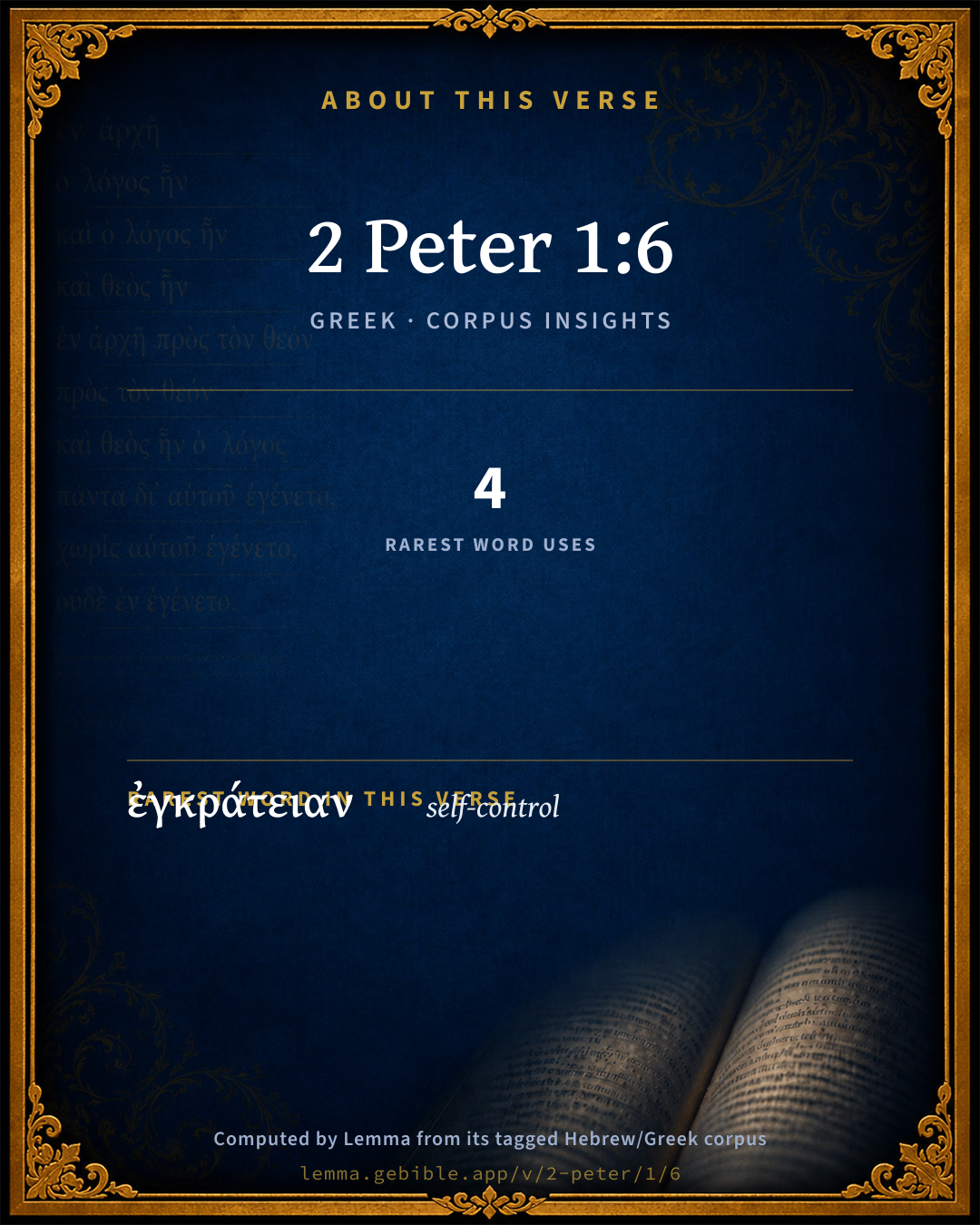
The rarest word here is ἐγκράτειαν self-control G1466 — appearing just 4 times in the whole Greek New Testament.

Shared distinctive vocabulary

ἐγκράτειαν self-control G1466 occurs in 3 verses of the Greek New Testament. Also found in:

Repetition

Words recur within this verse:

  • ἐγκράτειαν self-control G1466 ×2
  • ὑπομονήν endurance G5281 ×2
  • τῇ the G3588 ×6
  • ἐν in G1722 ×3
  • δὲ but G1161 ×3

Cross-references

30

Topical passages linked to 2 Peter 1:6 in the Treasury of Scripture Knowledge — connected by theme and wording, ordered by reader-vote popularity; previews shown in the World English Bible.

  • Hebrews 10:36 For you need endurance so that, having done the will of God, you may receive the promise.
  • Romans 5:3–4 Not only this, but we also rejoice in our sufferings, knowing that suffering works perseverance;
  • Luke 21:19 By your endurance you will win your lives.
  • 2 Peter 1:3 seeing that his divine power has granted to us all things that pertain to life and godliness, through the knowledge of him who called us by his own glory and virtue;
  • Hebrews 12:1 Therefore let us also, seeing we are surrounded by so great a cloud of witnesses, lay aside every weight and the sin which so easily entangles us, and let us run with patience the race that is set before us,
  • 1 Corinthians 9:25 Every man who strives in the games exercises self-control in all things. Now they do it to receive a corruptible crown, but we an incorruptible.
  • 2 Corinthians 6:4 but in everything commending ourselves, as servants of God, in great endurance, in afflictions, in hardships, in distresses,
  • Galatians 5:23 gentleness, and self-control. Against such things there is no law.
  • Titus 2:2 that older men should be temperate, sensible, sober-minded, sound in faith, in love, and in patience:
  • Revelation 14:12 Here is the patience of the saints, those who keep the commandments of God, and the faith of Jesus."
  • Psalms 37:7 Rest in Yahweh, and wait patiently for him. Don't fret because of him who prospers in his way, Because of the man who makes wicked plots happen.
  • Romans 2:7 to those who by patience in well-doing seek for glory and honor and incorruptibility, eternal life;
  • Romans 8:25 But if we hope for that which we don't see, we wait for it with patience.
  • Colossians 1:11 strengthened with all power, according to the might of his glory, for all endurance and perseverance with joy;
  • Titus 1:8 but given to hospitality, as a lover of good, sober-minded, fair, holy, self-controlled;
  • James 5:7–10 Be patient therefore, brothers, until the coming of the Lord. Behold, the farmer waits for the precious fruit of the earth, being patient over it, until it receives the early and late rain.
  • Luke 8:15 That in the good ground, these are such as in an honest and good heart, having heard the word, hold it tightly, and bring forth fruit with patience.
  • Acts 24:25 As he reasoned about righteousness, self-control, and the judgment to come, Felix was terrified, and answered, "Go your way for this time, and when it is convenient for me, I will summon you."
  • 1 Thessalonians 1:3 remembering without ceasing your work of faith and labor of love and patience of hope in our Lord Jesus Christ, before our God and Father.
  • Revelation 2:2 "I know your works, and your toil and perseverance, and that you can't tolerate evil men, and have tested those who call themselves apostles, and they are not, and found them false.
  • Romans 15:4 For whatever things were written before were written for our learning, that through patience and through encouragement of the Scriptures we might have hope.
  • 2 Thessalonians 3:5 May the Lord direct your hearts into the love of God, and into the patience of Christ.
  • 1 Timothy 2:2 for kings and all who are in high places; that we may lead a tranquil and quiet life in all godliness and reverence.
  • 1 Timothy 2:10 but (which becomes women professing godliness) with good works.
  • 1 Timothy 6:6 But godliness with contentment is great gain.
  • 1 Timothy 6:11 But you, man of God, flee these things, and follow after righteousness, godliness, faith, love, patience, and gentleness.
  • 2 Timothy 3:5 holding a form of godliness, but having denied the power thereof. Turn away from these, also.
  • Hebrews 6:12 that you won't be sluggish, but imitators of those who through faith and patience inherited the promises.
  • Hebrews 6:15 Thus, having patiently endured, he obtained the promise.
  • 2 Peter 3:11 Therefore since all these things are thus to be destroyed, what manner of persons ought you to be in holy living and godliness,

Cross-references courtesy of OpenBible.info (CC BY 4.0).

Commentary

Notes on 2 Peter 1:6 from classic Christian and Jewish commentators (each source and its license shown beneath its notes). The classic Christian expositions comment on the surrounding passage and are grouped to its opening verse, so a note may address several verses; the Jewish commentaries on the Tanakh (Rashi and others) are per-verse, so they appear only where the commentator wrote on this verse.

Lemma curates 59 commentaries, every one of them public domain or Creative Commons licensed, each selected and text-cleaned for this edition rather than reprinted as found. About our sources →

Joseph Benson's Commentary

2Pe 1:6-7. And to knowledge, temperance — This virtue consists in a confirmed habit of ruling all the affections, passions, and appetites of our nature in a proper manner, by placing our affections on proper objects; by restraining our angry, peevish, envious, and unholy tempers, and by using moderation in gratifying our appetites. Christian temperance, indeed, includes the voluntary abstaining from all pleasure which does not lead to God, extending to all things inward and outward, and implying the due government of our thoughts and imaginations, as well as of our desires and designs. It is the using the world properly: so to use all outward, and so to restrain all inward things, that they may become a means of what is spiritual; a scaling-ladder to ascend to what is above. Intemperance is to abuse the world. He that uses any thing below, looking no higher, and getting no farther, is intemperate. He that uses the creature only so as to attain to more of the Creator, is alone temperate in all things, and walks as Christ himself walked; and to temperance, patience — Bear as well as forbear; sustain as well as abstain; take up your cross, as well as deny yourself, daily; and the more knowledge you have, do this the more: the more steadily and resolutely renounce your own will; submit to, and acquiesce in, the will of God; and indulge yourself the less. Knowledge puffeth up; and the great boasters of knowledge, the Gnostics, were those that turned the grace of God into wantonness, being lovers of pleasure more than lovers of God, and of course effeminate and unprepared to encounter any opposition, or to endure any hardship on account of truth and a good conscience. But see that your knowledge be attended with temperance, and your temperance with patience; and to patience, godliness — Its proper support; a continual sense of God’s wisdom, power, and goodness; of his holiness, truth, justice, and mercy; of his presence and providence, with a reverential, awful, filial, and loving fear of, and confidence in him. Otherwise your patience may be pride, surliness, stoicism; but it will not be Christianity. And to godliness, brotherly kindness — Sullenness, sternness, moroseness, are not consistent with genuine godliness. Sour godliness, so called, is of the devil. Of Christian godliness it may always be said:

“Mild, sweet, serene, and tender is her mood,

Nor grave with sternness, nor with lightness free;

Against example resolutely good,

Fervent in zeal, and warm in charity.”

And to brotherly kindness, love — The pure and perfect love of God and of all mankind. The apostle here makes an advance upon the preceding article, brotherly kindness, which seems only to relate to the love of Christians toward one another.

Joseph Benson's Commentary on the Old and New Testaments (1811–1818) — public domain. Text from a community e-Sword module.

Bengel's Gnomon

Johann Albrecht Bengel

2Pe 1:6. Ἐγκράτειαν, abstinence) which avoids evil desires. Abstain.—ὑπομονὴν, patience) by which adversities and adversaries are endured. Sustain [have endurance].—εὐσέβειαν, godliness) By which the faithful look to God above all things. Εὐσέβεια may be affection towards relatives, parents, brothers, etc.; but it is a sanctified affection. Comp. 1Ti 5:4.

Bengel's Gnomon of the New Testament — English translation (T&T Clark, Edinburgh, 1860) — public domain. Text from a community e-Sword module.

Expositor's Greek Testament

ed. W. Robertson Nicoll

2Pe 1:6 . ἐγκράτειαν : “self-control”: accompanied by, and arising from, knowledge, and not a mere product of fear or submission to authority. ὑπομονήν : “steadfastness” not turned aside from the faith by trial and suffering ( cf. Luk 8:15 , Rom 5:3 ff.). The desponding doctrine of the false teachers would itself call for ὑπομονή in the readers. Mayor compares the Aristotelian καρτερία ( cf. Heb 11:27 ). εὐσέβειαν . In the Epistle the false teachers are ἀσεβεῖς ( cf. note on 2Pe 1:3 ).

The Expositor's Greek Testament, edited by W. Robertson Nicoll (1897–1910) — public domain. Text from a community e-Sword module.

Geneva Bible (1599)

Geneva Bible translators

He reckoneth up certain and other principal virtues, whereof some pertain to the first Table of the Law, others to the last.

Geneva Bible (1599) marginal notes — public domain. Text via Bolls.life.

Jamieson, Fausset & Brown

Robert Jamieson, A. R. Fausset & David Brown

Greek, "And in your knowledge self-control." In the exercise of Christian knowledge or discernment of God's will, let there be the practical fruit of self-control as to one's lusts and passions. Incontinence weakens the mind; continence, or self-control, moves weakness and imparts strength And in your self-control patient endurance" amidst sufferings, so much dwelt on in the First Epistle, second, third, and fourth chapters. "And in your patient endurance godliness"; it is not to be mere stoical endurance, but united to [and flowing from] God-trusting [ALFORD].

Jamieson, Fausset & Brown — Commentary Critical and Explanatory on the Whole Bible (1871) — public domain (CC PDM 1.0). Text via the HelloAO Bible API.

Adam Clarke's Commentary

Verse 6. Temperance] A proper and limited use of all earthly enjoyments, keeping every sense under proper restraints, and never permitting the animal part to subjugate the rational.

Patience] Bearing all trials and difficulties with an even mind, enduring in all, and persevering through all.

Godliness] Piety towards God; a deep, reverential, religious fear; not only worshipping God with every becoming outward act, but adoring, loving, and magnifying him in the heart: a disposition indispensably necessary to salvation, but exceedingly rare among professors.

Adam Clarke's Commentary on the Bible (1810–1826) — public domain. Text from a community e-Sword/MySword module.

Ellicott's Commentary for English Readers

(6) And to knowledge temperance; and to temperance patience; and to patience godliness.—And in your knowledge [supply] self control, and in your self-control, patience, and in your patience, godliness. In other words, your discerning between good and evil must lead to avoiding the evil and choosing the good—i.e., to the control of your own lawless propensities; and in restraining these you must endure difficulties patiently; and your patience must not be the stolid defiance of the savage, or the self-reliant and self-satisfied endurance of the Stoic, but a humble and loving trust in God. Virtue and knowledge are energetic and progressive; they are exercised in developing the powers implanted in us. Self-control and patience are restrictive and disciplinary; they are exercised in checking and regulating the conflicting claims of many co-existing powers, so as to reduce all to harmony. There is special point in “self-control” being placed as the consequence of “knowledge.” The false teachers would insist that knowledge led to liberty, which with them meant emancipation from all control whatever. Self-mastery is to the world at large the opposite of liberty; to the Christian it is another name for it—that service which is perfect freedom. Patience to the world is to accept loss and suffering; to the Christian it is to win the best of prizes—“in your patience ye shall win your souls.”

A Bible Commentary for English Readers, edited by Charles John Ellicott (1878–1897) — public domain. Text from a community e-Sword module.

The Cambridge Bible for Schools and Colleges

gen. ed. J. J. S. Perowne

6. and to knowledge temperance] Better, as before, and by knowledge temperance. The word for “temperance” has a wider range than the modern sense of the English term. “Self-government” or “self-control” would be better equivalents. In Sir_18:30 we have, under the heading in the LXX. of “self-control of the soul” (ἐγκράτεια ψυχῆς), what may almost be called a definition in the form of a precept, “Go not after thy lusts, but refrain thyself from thine appetites.” The word is not common in the New Testament, but appears in Act_24:25; Gal_5:23.

and to temperance patience] Better, endurance, the Greek noun expressing a more active phase of character than the English, bearing up against evils, and continuing steadfast under them. The cognate verb is translated “endure” in Mat_10:22 and elsewhere.

to patience godliness] See note on 2Pe_1:3 for the latter word.

The Cambridge Bible for Schools and Colleges (gen. ed. J. J. S. Perowne; Cambridge University Press, 1878–1918) — public domain. Text from a community e-Sword module.

John Gill's Exposition

And to knowledge, temperance,.... Avoiding all excess in eating and drinking, and all impure and unclean lusts; for it signifies nothing what a man knows, or professes to know, if his life is a scene of intemperance and debauchery: this seems to be levelled against the followers or Simon Magus, who ascertained salvation to knowledge, though the life was ever so impure, Moreover, this may include abstinence, not only from hurtful lusts, but from the use of things indifferent, when the peace and comfort of a weak brother are endangered; for then to knowledge must be added love, otherwise that knowledge will not be right, at least not rightly used; see Co1 8:1,

and to temperance, patience; which is necessary to the running of the Christian race, which is attended with many difficulties and exercises; and under affliction from the hand of God, that there be no murmuring nor repining; and under reproaches and persecutions from men, that they faint not, and are not discouraged by them; and in the expectation of the heavenly glory: this is proper to be superadded to the former, because there may be intemperance in passion, as well as in the use of the creatures; a man may be inebriated with wrath and anger, and overcome with impatience, as well as with wine and strong drink:

and to patience, godliness; either internal, which is distinguished from bodily exercise, or outward worship, and lies in the inward and powerful exercise of grace, as faith, hope, love, fear, &c. and the Syriac version here renders it, "the fear of God": or rather external, and intends the whole worship of God, as prayer, praise, hearing of the word, and attendance on all ordinances.

John Gill's Exposition of the Whole Bible (1746–1763) — public domain (CC PDM 1.0). Text via the HelloAO Bible API.

Trapp's Complete Commentary

John Trapp

6 And to knowledge temperance; and to temperance patience; and to patience godliness;

Ver. 6. And to knowledge, temperance] That ye be wise to sobriety, not curiously searching into those things whereof ye can neither have proof nor profit. Some are as wise as Galileo, who used telescope to discover mountains on the moon; and lest they should not be reputed to know something unknown to others, they profess skill beyond the periphery of possible knowledge.

And to temperance, patience] Those that will be temperate, as said before, and not pass the bounds of sobriety in searching after curiosities, shall be looked upon by the wits of the world as dull fellows (Mr Perkins was esteemed by Mr Bolton before his conversion, a dry preacher, &c.), and therefore they have need of patience. Only they must add to their

Patience, godliness] In the power of it; not suffering themselves to be mocked out of their religion. Moderation in this case is but mopishness. And though in our own cause we must show all longsufferance, yet when God’s glory is concerned, it is our duty to be blessedly blown up with zeal for his name, as Moses was at the sight of the golden calf; and as Zuingllus told Servetus, taxing him for his sharp invectives against him: In other things, saith he, I can bear as much as another; but in case of God’s dishonour, I have no patience.

John Trapp, A Commentary or Exposition upon All the Books of the Old and New Testament (1647–1656) — public domain. Text from a community e-Sword module.

Albert Barnes' Notes on the Bible

And to knowledge temperance - On the meaning of the word “temperance,” see the Act 24:25 note, and 1Co 9:25 note. The word here refers to the mastery over all our evil inclinations and appetites. We are to allow none of them to obtain control over us. See the notes at 1Co 6:12. This would include, of course, abstinence from intoxicating drinks; but it would also embrace all evil passions and propensities. Everything is to be confined within proper limits, and to no propensity of our nature are we to give indulgence beyond the limits which the law of God allows.

And to temperance patience - Notes, Jam 1:4.

And to patience godliness - True piety. Notes, 2Pe 1:3. Compare 1Ti 2:2; 1Ti 3:16; 1Ti 4:7-8; 1Ti 6:3, 1Ti 6:5-6, 1Ti 6:11.

Albert Barnes' Notes on the Bible (1834–1885) — public domain. Text from a community e-Sword/MySword module.

Matthew Poole's English Annotations

Temperance; a grace which represseth, and curbs in, not only sensual lusts, but all inordinate appetites, Gal 5:22; Tit 1:8.

Patience; that Christian fortitude whereby we hear afflictions and injuries, so as to persevere in our duty without being moved by the evils that attend us in the doing of it.

Godliness; which respects our immediate duty to God, and comprehends all the duties of the first table. This is joined to

patience, as being that which teacheth us, in all we suffer, to acknowledge God’s providence, and promises of deliverance and recompence.

Matthew Poole's English Annotations on the Holy Bible (1683–1685) — public domain. Text from a community e-Sword/MySword module.

Whedon's Commentary on the Bible

Daniel D. Whedon

6. Knowledge, perverted, may become conceited and self-indulgent, as in the idol feasts at Corinth, (1Co_8:1; 1Co_8:10,) and in the teachings of the Gnostics; in your knowledge, therefore, furnish temperance— self-control—by which all desires and passions shall be held in proper check, often even to total abstinence, as, for instance, in intoxicating drinks. The question of amusements falls under this rule. But as severe self-control may become ascetic and intolerant, it must be tempered by patience, or patient endurance; and in exercising patience, to guard against a stoical apathy or indifference, furnish godliness, fearing, trusting, and communing with God.

Daniel D. Whedon (gen. ed.), Commentary on the Old and New Testaments (1874–1909) — public domain. Text from a community e-Sword module.

The Pulpit Commentary

And to knowledge temperance; rather, self-control (ejgkrateia). The words ejkrateia yuchv are the heading of a section in the Greek of Ecc 18:30, and are followed immediately by the maxim, "Go not after thy lusts, but refrain thyself from thine appetites." This self-control extends over the whole of life, and consists in the government of all the appetites; it must be learned in the exercise of that practical knowledge which discerns between good and evil. True knowledge leads on to self-control, to that perfect freedom which consists in the service of God; not to that liberty promised by the false teachers, which is licentiousness. And to temperance patience; and to patience godliness. The practice of self-control will result in patient endurance; but that endurance will not be mere stoicism; it will be a conscious submission of our human will to the holy will of God, and so will tend to develop and strengthen eujsebeia, reverence and piety towards God (see note on verse 3).

The Pulpit Commentary (1880–1919), ed. H.D.M. Spence-Jones & Joseph S. Exell — public domain. Text from a community e-Sword module.

John Wesley's Explanatory Notes

And to your knowledge temperance; and to your temperance patience - Bear and forbear; sustain and abstain; deny yourself and take up your cross daily. The more knowledge you have, the more renounce your own will; indulge yourself the less. "Knowledge puffeth up," and the great boasters of knowledge (the Gnostics) were those that "turned the grace of God into wantonness." But see that your knowledge be attended with temperance. Christian temperance implies the voluntary abstaining from all pleasure which does not lead to God. It extends to all things inward and outward: the due government of every thought, as well as affection. "It is using the world," so to use all outward, and so to restrain all inward things, that they may become a means of what is spiritual; a scaling ladder to ascend to what is above. Intemperance is to abuse the world. He that uses anything below, looking no higher, and getting no further, is intemperate. He that uses the creature only so as to attain to more of the Creator, is alone temperate, and walks as Christ himself walked. And to patience godliness - Its proper support: a continual sense of God's presence and providence, and a filial fear of, and confidence in, him; otherwise your patience may be pride, surliness, stoicism; but not Christianity.

John Wesley, Explanatory Notes Upon the Whole Bible (1754–1765) — public domain. Text via the GEBible commentary corpus.

The People's New Testament

B. W. Johnson

6. Temperance. Self control. Patience. Unflinching, patient endurance. Godliness. A reverence for things divine shown by growing more and more into the divine likeness.

B. W. Johnson's The People's New Testament with Notes (1889–1891) — public domain. Electronic text from the Christian Classics Ethereal Library (CCEL) ThML edition.

Cambridge Greek Testament for Schools and Colleges

6. γνῶσις. Mayor well compares Joh 7:17 ἐάν τις θέλῃ τὸ θέλημα αὐτοῦ ποιεῖν, γνώσεται περὶ τῆς διδαχῆς. Only, here, the knowledge that will come of ἀρετή is not only knowledge about God, but knowledge of Him and of His will.

ἐγκράτεια. Control over self in all matters.

ὑπομονή. On this St James lays great stress (2Pe 1:3-4; 2Pe 1:12), and so does St John in the Apocalypse (e.g. 2Pe 1:9, 2Pe 2:2-3; 2Pe 2:19, etc.). We may think of it as meaning to the early Christians two things in particular—endurance under persecution, and patient waiting for the Return of the Lord. Perhaps the latter meaning was the one more present to the writer’s mind: he speaks at length about it in the third chapter.

εὐσέβεια, like ἀρετή, is so general a word that it is puzzling. We have it in 1Ti 6:11, along with other words of this list: δίωκε δὲ δικαιοσύνην, εὐσέβειαν, πίστιν, ἀγάπην, ὑπομονήν, πραϋπαθίαν. Our author has used it in 2Pe 1:3, and we shall not be far wrong if we render it in both places as “godly conduct.”

Cambridge Greek Testament for Schools and Colleges (Cambridge University Press, 1896; 21 vols, various authors incl. Carr, Maclear, Plummer, Farrar, Lumby, Moule, M. R. James, Simcox) — public domain. Text from a community e-Sword module.

Alford’s Greek Testament

Henry Alford

6.] and in your knowledge, self-restraint (ἐγκράτεια, τὸ μηδενὶ ἀποσύρεσθαι πάθει, as Œc. “Temperance” is now too much used of one sort only of self-restraint, fully to express the word. The Commentators compare Sir. 18:30, where under the head ἐγκράτεια ψυχῆς is said, ὀπίσω τῶν ἐπιθυμιῶν σου μὴ πορεύου, καὶ ἀπὸ τῶν ὀρέξεών σου κωλύου. The connexion is: let such discriminating knowledge not be without its fruit, of steady holding in hand of the passions and tempers), and in your self-restraint, patient endurance (in afflictions and trials), and in your patient endurance, godliness (i. e. it is not to be mere brute Stoical endurance, but united with God-fearing and God-trusting. Or it may perhaps be used without direct reference to God, as in Dio Cass. xlviii. 5, διὰ τὴν πρὸς τὸν ἀδελφὸν εὐσέβειαν: but the other is much more likely in the N. T.: especially as the social virtues follow),

Henry Alford, The Greek Testament (1849–1861) — public domain. Text from a community e-Sword module.

Vincent's Word Studies in the New Testament

Marvin R. Vincent

Temperance [εγκρατεια] . Self - control; holding the passions and desires in hand. See 1Co 9:25.

Patience [υπομονην] . Lit., remaining behind or staying, from menw, to wait. Not merely endurance of the inevitable, for Christ could have relieved himself of his sufferings (Heb 12:2, 3; compare Mt 26:53); but the heroic, brave patience with which a Christian not only bears but contends. Speaking of Christ 's patience, Barrow remarks, "Neither was it out of a stupid insensibility or stubborn resolution that he did thus behave himself; for he had a most vigorous sense of all those grievances, and a strong (natural) aversation from under going them;... but from a perfect submission to the divine will, and entire command over his passions, an excessive charity toward mankind, this patient and meek behavior did spring." The same writer defines patience as follows : "That virtue which qualifieth us to bear all conditions and all events, by God 's disposal incident to us, with such apprehensions and persuasions of mind, such dispositions and affections of heart, such external deportment and practices of life as God requireth and good reason directeth (Sermon 42," On Patience ").

Godliness. See on ver. 3. The quality is never ascribed to God.

Brotherly kindness [φιλαδελφιαν] . Rev. renders, literally, love of the brethren.

Charity [αγαπην] . There seems at first an infelicity in the rendering of the Rev., in your love of the brethren love. But this is only apparent. In the former word Peter contemplates Christian fellow - believers as naturally and properly holding the first place in our affections (compare Gal 6:10, "Especially unto them which are of the household of faith "). But he follows this with the broader affection which should characterize Christians, and which Paul lauds in 1 Corinthians 13, the love of men as men. It may be remarked here that the entire rejection by the Rev. of charity as the rendering of ajgaph is wholesome and defensible. Charity has acquired two peculiar meanings, both of which are indeed included or implied in love, but neither of which expresses more than a single phase of love - tolerance or beneficence. The A. V. in the great majority of cases translates love; always in the Gospels, and mostly elsewhere. There is no more reason for saying" charity suffereth long, "than for saying," the charity of God is shed abroad in our hearts, "or" God is charity. "

Marvin R. Vincent, Word Studies in the New Testament (1887–1900) — public domain. Text from a community e-Sword/MySword module.

Lesson kit

Teaching starters — assembled from the data on this page, not authored interpretation. Every prompt links to the verse data it draws on. Edit before teaching.

2 Peter, in the General Epistles, opens this verse with 18 words (7 distinct Greek lemmas). Its most distinctive word is enkráteia (“self-control”). A historical commentator’s framing appears above. Read the whole chapter for the surrounding context.

Discussion questions

  1. How does “self-control” (enkráteia) shape what this verse is saying?
  2. How does Acts 24:25, which shares the word «self-control», read alongside this verse?
  3. What does the repetition of “self-control” (2× in this one verse) do in this verse?
  4. These translations render this verse differently. What is at stake in choosing one wording over another?
  5. Compare how Joseph Benson's Commentary and Bengel's Gnomon read this verse. Where do they agree or differ?

Things to notice

  • These translations choose different wording for 4 words in this verse.
  • “self-control” occurs 2× in this single verse.
  • 7 distinct Greek lemmas span 18 words in this verse.

Reading settings

Reading text

Shown beneath each verse's original-language words.

Old Testament
Old Testament edition

Read the OT as the Masoretic Hebrew (MT) or the Greek Septuagint (LXX).

English shown for the Greek Septuagint (in the Hebrew ↔ Greek comparison).

Comparing translations? Open the Compare panel on any verse page to stack up to four side by side.