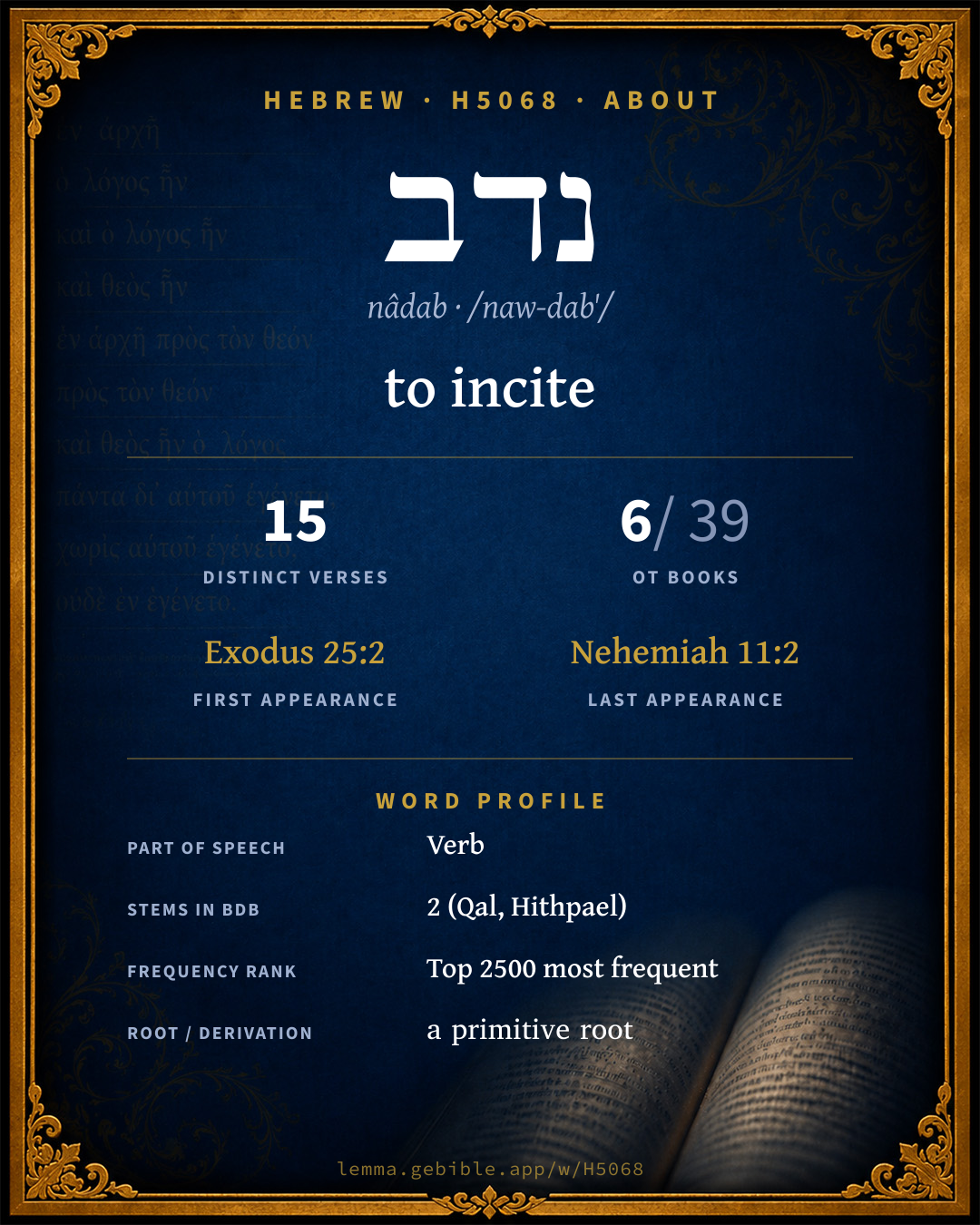
נָדַב
to incite
also: impel, make willing fuller range ↓
Full lexicon entry — Brown-Driver-Briggs (BDB)
From Brown-Driver-Briggs (BDB)
Where this word appears
See every Hithpael verb in the Hebrew Bible →
Grammar key — what these labels mean
Part of speech
- Verb
- An action or state-of-being word.
Stem
- Hithpael
- The reflexive or reciprocal stem (the subject acts on itself). Here: ‘volunteer for war Ju 5’
- Qal
- The basic, simple active stem — the plain form of the verb (“he wrote”).
Form
- Infinitive Construct
- A bound verbal noun, frequently with prepositions (“to write / in writing”).
- Participle Active
- A verbal adjective expressing ongoing or characteristic action (“writing / one who writes”).
- Perfect
- A completed action or state — Hebrew marks aspect (completeness) more than strict tense (“he wrote”).
- Sequential Imperfect
- An imperfect with prefixed waw — the standard past-narrative form (waw-consecutive imperfect).
- Imperfect
- An incomplete, ongoing, or future action (“he will / would write”).
State
- Absolute
- The independent form of a noun, not bound to a following word.
Person
- 3rd Person
- The one spoken about (“he / she / it / they”).
- 1st Person
- The speaker (“I / we”).
Gender
- Masculine
- Grammatically masculine.
- Common
- Either gender — not distinguished for this form.
- Feminine
- Grammatically feminine.
Number
- Plural
- More than one (in Hebrew, generally three or more).
- Singular
- One.
Grammatical forms 9 distinct
- Verb, Hithpael, Infinitive Construct 5 times (29%)
- Verb, Hithpael, Participle Active, Masculine, Singular, Absolute 3 times (18%)
- Verb, Hithpael, Participle Active, Masculine, Plural, Absolute 2 times (12%)
- Verb, Hithpael, Perfect, 3rd Person, Common, Plural 2 times (12%)
- Verb, Hithpael, Sequential Imperfect, 3rd Person, Masculine, Plural 1 time (6%)
- Verb, Qal, Imperfect, 3rd Person, Masculine, Singular 1 time (6%)
- Verb, Qal, Perfect, 3rd Person, Feminine, Singular 1 time (6%)
- Verb, Qal, Perfect, 3rd Person, Masculine, Singular 1 time (6%)
+1 more form (1 occurrence)
Parsed forms decoded from the imported morphology (morphhb / Westminster Leningrad Codex — WLC text public domain, morphhb tagging CC BY 4.0), counted across 17 parsed occurrences — not distinct verses.
Every verse where H5068 appears — 15 distinct verses across 6 books. Click any verse to open its interlinear word-by-word view. Verse text shown in the World English Bible for context — . Each verse’s Hebrew form is shown with its reference; the English is not keyword-highlighted, since the data carries no word-level English alignment. Use “Compare translations” on any verse to read it across multiple English versions. This concordance covers the Hebrew Bible; Septuagint (Greek Old Testament) occurrences are not indexed here.
Exodus 3 verses
- Exodus 25:2 יִדְּבֶ֣/נּוּ Qal impf 3ms + sfx pers 3ms "Speak to the children of Israel, that they take an offering for me. From everyone whose heart makes him willing you shall take my offering.
- Exodus 35:21 נָדְבָ֨ה Qal pf 3fs They came, everyone whose heart stirred him up, and everyone whom his spirit made willing, and brought Yahweh's offering, for the work of the tent of meeting, and for all of its service, and for the holy garments.
- Exodus 35:29 נָדַ֣ב Qal pf 3ms The children of Israel brought a freewill offering to Yahweh; every man and woman, whose heart made them willing to bring for all the work, which Yahweh had commanded to be made by Moses.
Judges 2 verses
- Judges 5:2 בְּ/הִתְנַדֵּ֖ב prep + Hithpael inf.cs For that the leaders took the lead in Israel, For that the people offered themselves willingly, Bless you Yahweh.
- Judges 5:9 הַ/מִּֽתְנַדְּבִ֖ים ptcl def.art + Hithpael ptcp.act mp My heart is toward the governors of Israel, Who offered themselves willingly among the people: Bless you Yahweh.
1 Chronicles 5 verses
- 1 Chronicles 29:5 מִתְנַדֵּ֔ב Hithpael ptcp.act ms of gold for the [things of] gold, and of silver for the [things of] silver, and for all manner of work [to be made] by the hands of artificers. Who then offers willingly to consecrate himself this day to Yahweh?
- 1 Chronicles 29:6 וַ/יִּֽתְנַדְּבוּ֩ conj + Hithpael wimpf 3mp Then the princes of the fathers' [houses], and the princes of the tribes of Israel, and the captains of thousands and of hundreds, with the rulers over the king's work, offered willingly;
- 1 Chronicles 29:9 הִֽתְנַדְּבָ֔/ם הִֽתְנַדְּב֖וּ Hithpael inf.cs + sfx pers 3mp Hithpael pf 3cp Then the people rejoiced, because they offered willingly, because with a perfect heart they offered willingly to Yahweh: and David the king also rejoiced with great joy.
- 1 Chronicles 29:14 לְ/הִתְנַדֵּ֖ב prep + Hithpael inf.cs But who am I, and what is my people, that we should be able to offer so willingly as this? For all things come of you, and of your own have we given you.
- 1 Chronicles 29:17 הִתְנַדַּ֣בְתִּי לְ/הִֽתְנַדֶּב Hithpael pf 1cs prep + Hithpael inf.cs I know also, my God, that you try the heart, and have pleasure in uprightness. As for me, in the uprightness of my heart I have willingly offered all these things: and now have I seen with joy your people, that are present here, offer willingly to you.
2 Chronicles 1 verse
Ezra 3 verses
- Ezra 1:6 הִתְנַדֵּֽב Hithpael inf.cs All those who were round about them strengthened their hands with vessels of silver, with gold, with goods, and with animals, and with precious things, besides all that was willingly offered.
- Ezra 2:68 הִֽתְנַדְּבוּ֙ Hithpael pf 3cp Some of the heads of fathers' [houses], when they came to the house of Yahweh which is in Jerusalem, offered willingly for the house of God to set it up in its place:
- Ezra 3:5 מִתְנַדֵּ֥ב Hithpael ptcp.act ms and afterward the continual burnt-offering, and [the offerings] of the new moons, and of all the set feasts of Yahweh that were consecrated, and of everyone who willingly offered a freewill-offering to Yahweh.
Nehemiah 1 verse
About this entry
At a glance — auto-summarized from this page’s data, not written by a person. Every figure links to its source below. This summary describes the numbers; it doesn’t interpret them.
נדב — transliterated nâdab — is a Hebrew verb carrying the sense “to incite.” It first appears in Exodus 25:2. With 15 verses in 6 books, it is an uncommon word in the Hebrew Bible. Its uses concentrate in 1 Chronicles (33% of all occurrences). As a verb its force shifts by stem, across 2 stems (Qal, Hithpael, and more). Each statement above links to its evidence; the full detail follows below.
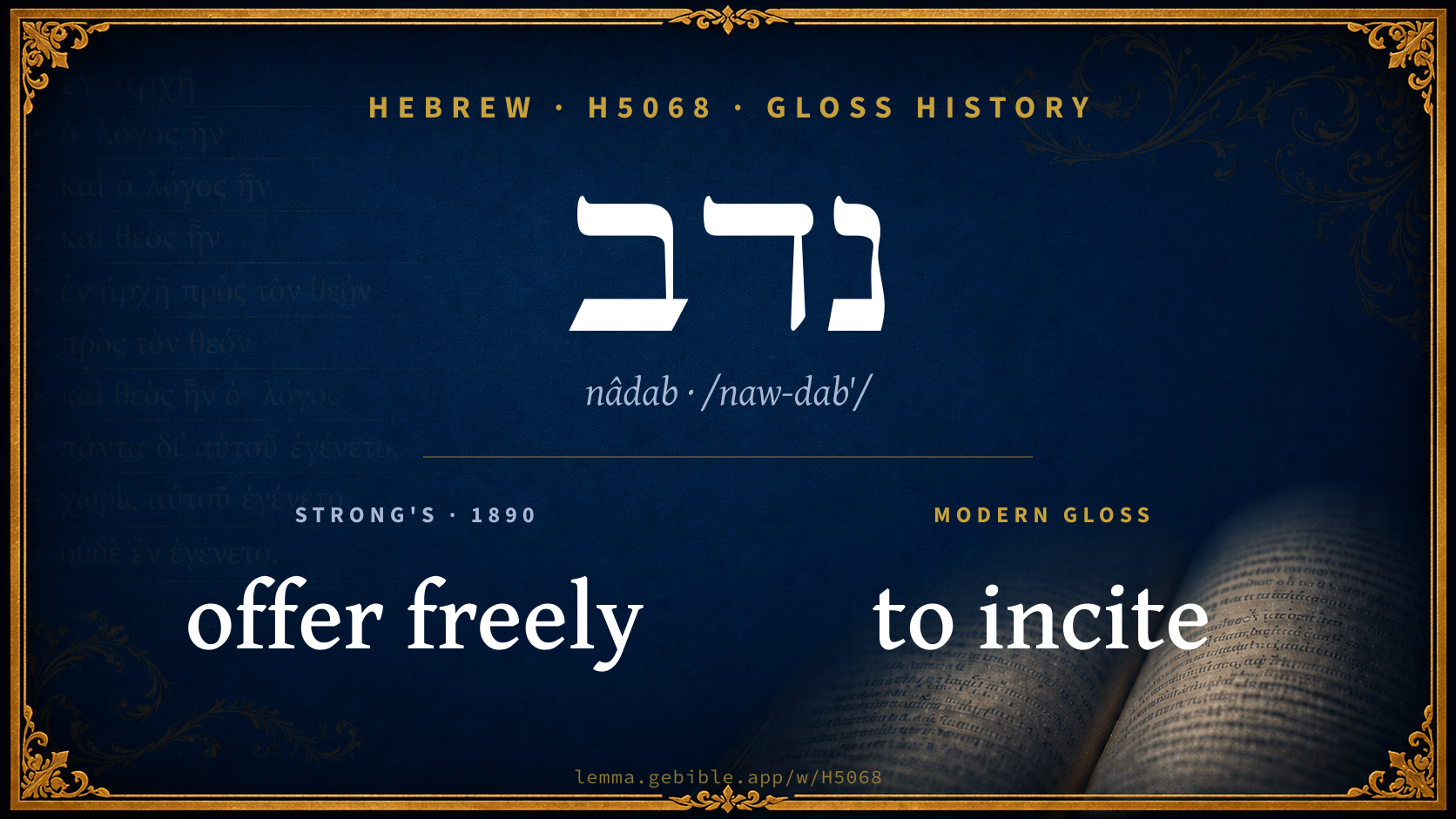
Gloss history
Strong's 1890 vs modern scholarship
About this word
Strong's H5068 catalogs a Hebrew word from the Hebrew Old Testament.
These counts are not copied from any lexicon or concordance. They are computed here, from the morphology-tagged Hebrew Old Testament. What Lemma adds →
- 15
- distinct verses
- The word appears in 15 distinct verses.
- 6 / 39
- OT books
- The word appears in 6 of 39 Old Testament books.
- #1,671
- by frequency
- Top 2500 most frequent Hebrew words (rank 1,671 of 8,640 Hebrew words by occurrence).
View all 15 occurrences in the concordance →
Most concentrated in
- 1 Chronicles 5 verses 33%
- Exodus 3 verses 20%
- Ezra 3 verses 20%
By section of the Old Testament
By traditional corpus
Conventional, traditional groupings — biblical authorship is debated, so this is a traditional corpus grouping, not an authorship claim. Each share is this word’s portion of its verses in that division of the Hebrew canon. Each figure is a share of the word’s 15 distinct verses.
- Writings (Ketuvim) 10 verses · 67%
- Torah (Pentateuch) 3 verses · 20%
- Prophets (Nevi'im) 2 verses · 13%
How translations render this word
Counts come from each version’s own published word-to-Strong’s tagging or interlinear alignment — an approximate guide to how each version renders this word, not a word-level alignment the data otherwise carries. Because each total is that version’s own tagged count, the per-version totals vary from one another and need not match the appearance or distinct-verse counts above. These counts may also differ from a printed concordance because Lemma counts each distinctly tagged rendering and does not collapse phrase taggings into a single head-word total. This is a fixed set of word-tagged versions (KJV, ASV, BSB, ULT) and does not change with the reading translation you choose elsewhere. Each version’s license is shown beside its name below (and on Sources).
- King James Version: Willingly offered 3×, They offered willingly 2×
- American Standard Version: Offered willingly 2×, They offered willingly 2×, Willingly offered 2×
- Berean Standard Bible: Prompted 2×, Volunteer 2×
- unfoldingWord Literal Text: Impelled 2×, Offer freely 2×, They had offered freely 2×
King James Version Public Domain
Renders H5068 across 17 tagged occurrences — most commonly:
Plus 12 renderings that appear only once — usually multi-word phrases or single function words the recovered tagging swept in, not distinct renderings.
American Standard Version Public Domain
Renders H5068 across 17 tagged occurrences — most commonly:
Plus 11 renderings that appear only once — usually multi-word phrases or single function words the recovered tagging swept in, not distinct renderings.
Berean Standard Bible Public Domain
Renders H5068 across 17 tagged occurrences — most commonly:
Plus 13 renderings that appear only once — usually multi-word phrases or single function words the recovered tagging swept in, not distinct renderings.
unfoldingWord Literal Text CC BY-SA 4.0
Renders H5068 across 18 tagged occurrences — most commonly:
Plus 12 renderings that appear only once — usually multi-word phrases or single function words the recovered tagging swept in, not distinct renderings.
Senses in the full BDB
Hebrew verbs can shift meaning by stem (binyan): Qal is the basic action, Niphal is often passive or reflexive, Piel often intensifies or makes it factitive, and Hiphil is typically causative. The senses below are grouped under the stem BDB assigns to each. This entry also uses Hithpael (reflexive or reciprocal).
What do BDB’s symbols mean?
BDB uses these scholarly abbreviations:
| Symbol | Meaning |
|---|---|
| 𝔊 | the Septuagint (the ancient Greek translation, LXX) |
| 𝔙 | the Vulgate (the Latin translation) |
| 𝔖 | the Syriac version (the Peshitta) |
| 𝔗 | the Targum (the Aramaic translation) |
| ψ | the Psalms |
| √ | root (the underlying root or stem) |
| ‖ | parallel passage (a synonymous or contrasted parallel) |
| † | the dagger: every passage where the word occurs is cited |
The 4 senses and sub-senses the full Brown-Driver-Briggs lexicon distinguishes for this word, in lexicon order (not ranked by frequency), with BDB’s own verbatim wording and sub-sense lettering. Shown in Hebrew script with BDB’s own scholarly abbreviations. The condensed entry is in the Lexicon Entry tab. See also the Forms in the corpus table below.
Qal
- Pf. 3 ms. נָדַב Ex 35:29; 3 fs. נָֽדְבָה v 21; Impf. 3 ms. sf. יִדְּבֶנּוּ 25:2;—אֲשֶׁר נָדַב לִבָּם 35:29 whose heart incited, cf. 25:2; subj. רוּחַ 35:21 (all P). e.g. Exodus 35:29
Hithpael
- Pf. 1 s. הִתְנַדַּבְתִּי 1 Ch 29:17; 3 mpl. הִתְנַדְּבוּ Ezr 2:68 1 Ch 29:9; Impf. 3 mpl. יִתְנַדְּבוּ v 6; Inf. הִתְנַדֵּב Ju 5:2 + 2 times; הִתְנַדֶּב־ 1 Ch 29:17; sf. הִתְנַדְּבָם v 9; Pt. מִתְנַדֵּב Ezr 3:5 + 2 times; pl. מִתְנַדְּבִים Ju 5:9 Ne 11:2;— e.g. 1 Chronicles 29:17
- 1. volunteer for war Ju 5:2, 9; for service of other kinds 2 Ch 17:16 Ne 11:2. e.g. Judges 5:2
- 2. offer free-will-offerings for the first temple 1 Ch 29:5, 6, 9(×2), 14, 17(×2); for the second Ezr 1:6; 2:68; 3:5 (cf. Biblical Aramaic). e.g. 1 Chronicles 29:5
Senses from the full Brown-Driver-Briggs lexicon (Brown, Driver, Briggs; Oxford 1906 — public domain), digitized via Sefaria, supplemented by the OpenScriptures HebrewLexicon (CC BY 4.0). Full attribution on Sources.
Word origin
vb. incite, impel (NH id.; Arabic نَدَبَ call, impel, incite (نَدُبَ be noble, willing, generous, is denom. from [نَدْبٌ cf.] נָדִיב according to BaNB § 125 e); viii. ندب ready, willing; Assyrian nidbu, freewill-offering DlHWB 448; Aramaic נְדַב be willing Pa. Ithpa.; Zinj. נדב inciting, instigation DHMSendsch. 60);—
— Brown-Driver-Briggs (Oxford 1906, public domain), digitized via Sefaria, supplemented by the OpenScriptures HebrewLexicon (CC BY 4.0). See Sources.
Origin: a primitive root
Jastrow Dictionary
A second Hebrew/Aramaic lexicon for comparison, covering Aramaic and post-biblical (Talmudic, Targumic, Midrashic) usage that the biblical-Hebrew BDB does not. Matched by lemma rather than by Strong’s number, so a lemma may carry more than one Jastrow headword (shown separately below), and the entries cover usage well beyond the Bible.
נָדַב
- (b. h.)
- 1. to make willing, to prompt. Tanḥ. T’rum. 3 (ref. to Ex. XXV, 2) יצא … שאין לבו נוֹדְבוֹ this excludes the insane whom his heart (reason) cannot prompt; (Tanḥ. ed. Bub. ib. 2 שאינו מתנדב בלבו).—2) (denom. of נְדָבָה) to offer willingly, donate, consecrate, contrad. to נָדַר (v. נְדָבָה). Ned. 9ᵇ (ref. to Mish. ib. I, 1) תני נ׳ בנזיר וכ׳ read nadab (in place of nadar), he made a noble vow &c. Ib. 10ᵃ תני נוֹדֵב וכ׳ read nodeb (in place of נודר), he dedicates the sacrifice and fulfills (offers it). e.g. Exodus 25:2
- to be donated, dedicated. Meg. I, 10 כל שהוא נידר ונ׳ whatever sacrifice is dependent on vow or dedication; Zeb. 117ᵃ כל הנדר ונ׳ Ms. M.; Sifré Deut. 65; Tem. 14ᵇ. Ib. נזיר לאו נדר ונ׳ הוא the sacrifices of the Nazarite are not to be classified among the vowed or free-will offerings; a. e.
- to be prompted; to vow a free-will offering; to donate. Tosef. Ned. I, 1 אין הרשעים מִתְנַדְּבִים wicked men do not vow offerings. Ib. מתנדבים נזירות used to vow to be Nazarites. Men. XII, 3 לא ה׳ כדרך המתנדבים he did not make his vow in the ordinary way of vowing people. Ib. 4 מִתְנַדֵּב אדם וכ׳ a man may vow a meal offering of sixty &c. Tanḥ. ed. Bub. l. c. מתנדב בלבו is prompted by his heart, v. supra. Arakh. 6ᵇ עכו"ם שה׳ מנורה וכ׳ if a gentile donated a lamp to a synagogue. Sifra Tsav, Milluim, Par. 1 בשעה שצוה … להִתְנַדֵּב וכ׳ when the Lord of the world ordered free-will donations for the sanctuary; שלא יִתְנַדֵּב אדם גזל וכ׳ that no man must donate what is forced out of him, i.e. no pressure may be used for contributions for a sacred purpose; Yalk. Lev. 515. Snh. 43ᵃ נשים … מִתְנַדְּבוֹת וכ׳ worthy women … volunteered their services and brought them (benumbing drinks for the culprits); a. fr.
נְדַב
- , ch. Pa. נַדֵּב, Ithpa. אִתְנַדֵּב, אִינַּ׳ same, to donate; to be devoted to. Targ. Is. XIII, 2 מְנַדְּבִין ed. Lag. (oth. ed. מִתְנַ׳; h. text נדיבים). Targ. Ps. CX, 3.—Pes. 50ᵃ מתעתרי … ומִתְנַדְּבֵי Israelites will grow rich and offer donations. Arakh. 6ᵇ אינ׳ שרגא וכ׳ donated a lamp &c.
A Dictionary of the Targumim, the Talmud Babli and Yerushalmi, and the Midrashic Literature (Marcus Jastrow; London, Luzac, 1903) — Public Domain. Digitized via Sefaria. Digitized via Sefaria. Full attribution on Sources.
Forms in the corpus
The 17 distinct written forms H5068 takes in the Hebrew Bible, most frequent first — each parse links to that stem’s occurrences in the concordance. Hebrew forms include their vowel points and cantillation, so a single lemma takes many written forms.
Same root — word family
Other BDB entries built from the same root as H5068, grouped by Strong’s listed origin. These share a root / origin per the lexicon — not necessarily a shared meaning. Each links to that word’s own entry.
Derived from this word
Proper names from this root
People and places named from this root — a name, not an additional meaning of the word.
Compare all same-root words → Showing 4 of 7 — not the complete family. 3 of the same-root words are proper names (people or places). They share a root, not necessarily a meaning.
Septuagint verse parallels
This word appears in 14 verses that also exist in the Greek Old Testament (Septuagint), out of the 15 Hebrew verses it occurs in. You can read those verses in Greek by switching the Old Testament edition to the Septuagint.
Read these verses in the Septuagint
This is a verse-level parallel only — the same verses exist in both the Hebrew and Greek Old Testaments. No word-level Hebrew↔Greek correspondence is claimed: the data carries no such alignment, so no Greek word is shown as this Hebrew word’s translation. Coverage is not total — the Septuagint omits the deuterocanon and renumbers the Psalms, so some Hebrew verses have no direct Greek parallel.