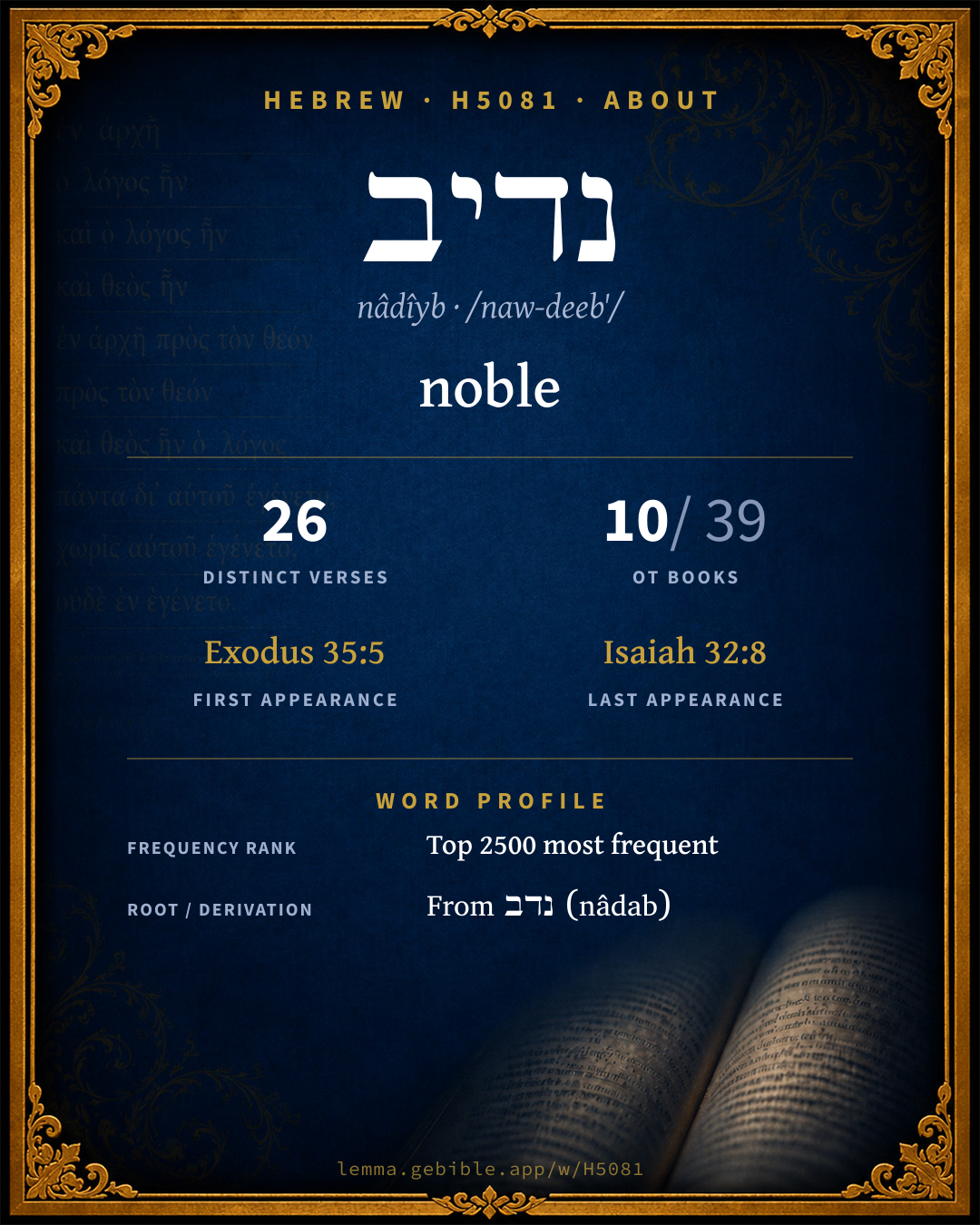
נָדִיב
noble
also: inclined, willing, generous fuller range ↓
Full lexicon entry — Brown-Driver-Briggs (BDB)
From Brown-Driver-Briggs (BDB)
Where this word appears
See every Absolute-state word in the Hebrew Bible →
Grammar key — what these labels mean
Part of speech
- Adjective
- A word that describes or qualifies a noun.
- Noun
- A naming word — a person, place, thing, or idea.
Noun type
- Common
- A common noun — a general class of person, place, or thing (“king,” “city,” “water”), not a specific name.
State
- Absolute
- The independent form of a noun, not bound to a following word.
- Construct
- A noun bound to a following noun in a possessive / “of” relationship (the construct chain).
Gender
- Masculine
- Grammatically masculine.
- Feminine
- Grammatically feminine.
Number
- Plural
- More than one (in Hebrew, generally three or more).
- Singular
- One.
Grammatical forms
- Adjective, Adjective, Masculine, Plural, Absolute 10 times (34%)
- Adjective, Adjective, Masculine, Singular, Absolute 9 times (31%)
- Adjective, Adjective, Masculine, Plural, Construct 4 times (14%)
- Adjective, Adjective, Masculine, Singular, Construct 3 times (10%)
- Noun, Common, Feminine, Plural, Absolute 2 times (7%)
- Adjective, Adjective, Feminine, Singular, Absolute 1 time (3%)
Parsed forms decoded from the imported morphology (morphhb / Westminster Leningrad Codex — WLC text public domain, morphhb tagging CC BY 4.0), counted across 29 parsed occurrences — not distinct verses.
Every verse where H5081 appears — 26 distinct verses across 10 books. Click any verse to open its interlinear word-by-word view. Verse text shown in the World English Bible for context — . Each verse’s Hebrew form is shown with its reference; the English is not keyword-highlighted, since the data carries no word-level English alignment. Use “Compare translations” on any verse to read it across multiple English versions. This concordance covers the Hebrew Bible; Septuagint (Greek Old Testament) occurrences are not indexed here.
Exodus 2 verses
- Exodus 35:5 נְדִ֣יב adj Adjective ms cs 'Take from among you an offering to Yahweh. Whoever is of a willing heart, let him bring it, Yahweh's offering: gold, silver, brass,
- Exodus 35:22 נְדִ֣יב adj Adjective ms cs They came, both men and women, as many as were willing-hearted, and brought brooches, ear-rings, signet-rings, and armlets, all jewels of gold; even every man who offered an offering of gold to Yahweh.
Numbers 1 verse
1 Samuel 1 verse
1 Chronicles 1 verse
2 Chronicles 1 verse
Job 3 verses
- Job 12:21 נְדִיבִ֑ים adj Adjective mp He pours contempt on princes, And loosens the belt of the strong.
- Job 21:28 נָדִ֑יב adj Adjective ms For you say, 'Where is the house of the prince? Where is the tent in which the wicked lived?'
- Job 34:18 נְדִיבִֽים adj Adjective mp Who says to a king, 'Vile!' Or to nobles, 'Wicked!'
Psalms 7 verses
- Psalms 47:9 נְדִ֘יבֵ֤י adj Adjective mp cs The princes of the peoples are gathered together, The people of the God of Abraham. For the shields of the earth belong to God. He is greatly exalted!
- Psalms 51:12 נְדִיבָ֣ה adj Adjective fs Restore to me the joy of your salvation. Uphold me with a willing spirit.
- Psalms 83:11 נְ֭דִיבֵ/מוֹ adj Adjective mp cs + sfx pers 3mp Make their nobles like Oreb and Zeeb; Yes, all their princes like Zebah and Zalmunna;
- Psalms 107:40 נְדִיבִ֑ים adj Adjective mp He pours contempt on princes, And causes them to wander in a trackless waste.
- Psalms 113:8 נְדִיבִ֑ים נְדִיבֵ֥י adj Adjective mp adj Adjective mp cs That he may set him with princes, Even with the princes of his people.
- Psalms 118:9 בִּ/נְדִיבִֽים prep + Adjective Adjective mp It is better to take refuge in Yahweh, Than to put confidence in princes.
- Psalms 146:3 בִ/נְדִיבִ֑ים prep + Adjective Adjective mp Don't put your trust in princes, Each a son of man in whom there is no help.
Proverbs 5 verses
- Proverbs 8:16 וּ֝/נְדִיבִ֗ים conj + Adjective Adjective mp By me princes rule; Nobles, and all the righteous rulers of the earth.
- Proverbs 17:7 לְ/נָדִ֥יב prep + Adjective Adjective ms Arrogant speech isn't fitting for a fool, Much less do lying lips fit a prince.
- Proverbs 17:26 נְדִיבִ֣ים adj Adjective mp Also to punish the righteous is not good, Nor to flog officials for their integrity.
- Proverbs 19:6 נָדִ֑יב adj Adjective ms Many will entreat the favor of a ruler, And everyone is a friend to a man who gives gifts.
- Proverbs 25:7 נָדִ֑יב adj Adjective ms For it is better that it be said to you, "Come up here," Than that you should be put lower in the presence of the prince, Whom your eyes have seen.
Song of Solomon 2 verses
- Song of Solomon 6:12 נָדִֽיב adj Adjective ms Without realizing it, My desire set me with my royal people's chariots. Friends
- Song of Solomon 7:1 נָדִ֑יב adj Adjective ms How beautiful are your feet in sandals, prince's daughter! Your rounded thighs are like jewels, The work of the hands of a skillful workman.
Isaiah 3 verses
- Isaiah 13:2 נְדִיבִֽים adj Adjective mp Set up an ensign on the bare mountain, lift up the voice to them, wave the hand, that they may go into the gates of the nobles.
- Isaiah 32:5 נָדִ֑יב adj Adjective ms The fool shall be no more called noble, nor the scoundrel be highly respected.
- Isaiah 32:8 וְ/נָדִ֖יב נְדִיב֣וֹת נְדִיב֥וֹת conj + Adjective Adjective ms n c fp n c fp But the noble devises noble things; and in noble things shall he continue.
About this entry
At a glance — auto-summarized from this page’s data, not written by a person. Every figure links to its source below. This summary describes the numbers; it doesn’t interpret them.
“noble” is the headline sense of the Hebrew word נדיב (nâdîyb). Scripture first uses it in Exodus 35:5. With 26 verses in 10 books, it is a moderately common word in the Hebrew Bible. It concentrates in Psalms, which alone accounts for 27% of its uses. Not a single-sense word: its full sense range also takes in “inclined”, “willing”, and “generous”. See the sense tree, 26-verse concordance, and the renderings breakdown below.
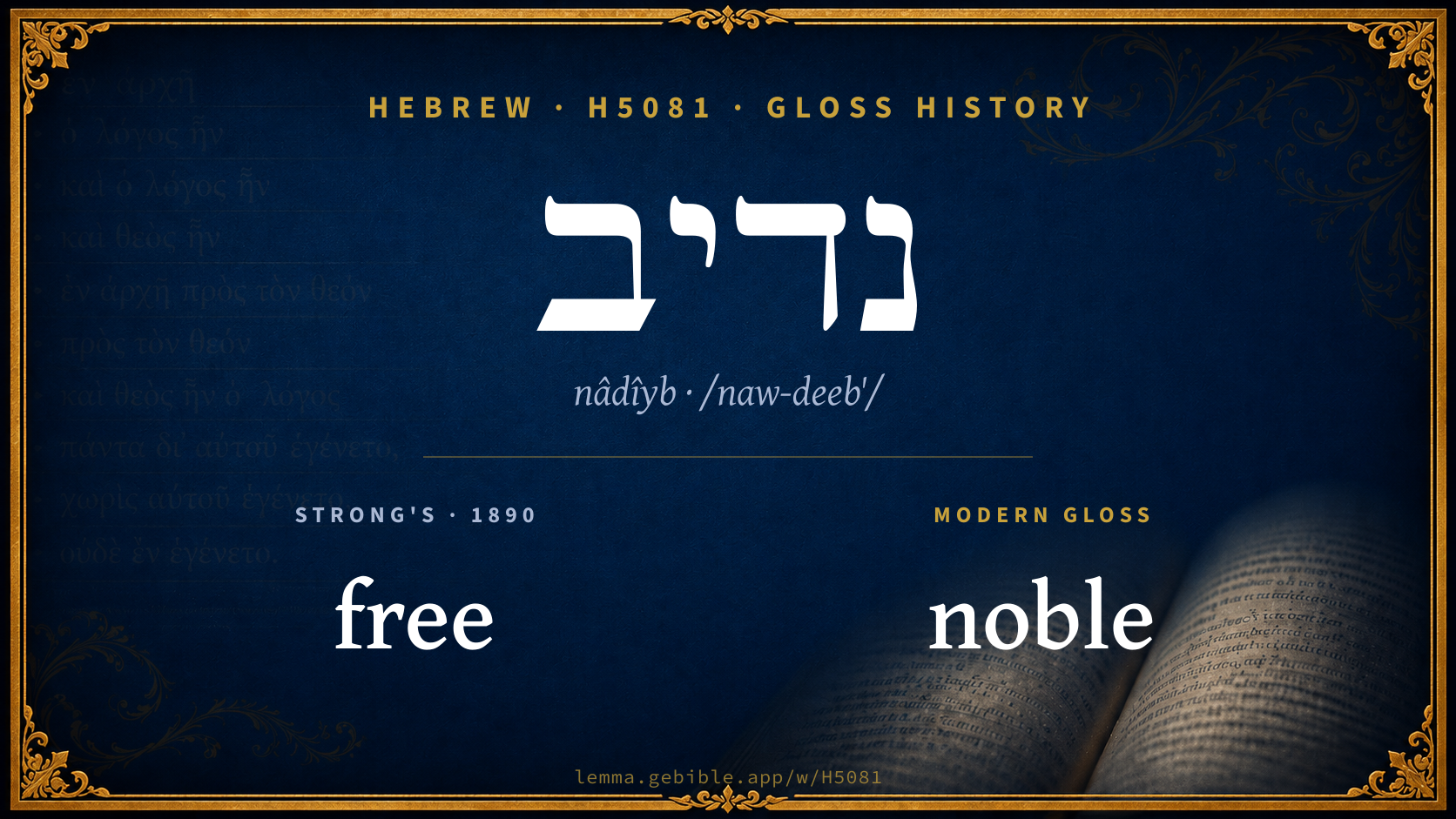
Gloss history
Strong's 1890 vs modern scholarship
About this word
Strong's H5081 catalogs a Hebrew word from the Hebrew Old Testament.
These counts are not copied from any lexicon or concordance. They are computed here, from the morphology-tagged Hebrew Old Testament. What Lemma adds →
- 26
- distinct verses
- The word appears in 26 distinct verses.
- 10 / 39
- OT books
- The word appears in 10 of 39 Old Testament books.
- #1,160
- by frequency
- Top 2500 most frequent Hebrew words (rank 1,160 of 8,640 Hebrew words by occurrence).
View all 26 occurrences in the concordance →
By section of the Old Testament
By traditional corpus
Conventional, traditional groupings — biblical authorship is debated, so this is a traditional corpus grouping, not an authorship claim. Each share is this word’s portion of its verses in that division of the Hebrew canon. Each figure is a share of the word’s 26 distinct verses.
- Writings (Ketuvim) 19 verses · 73%
- Prophets (Nevi'im) 4 verses · 15%
- Torah (Pentateuch) 3 verses · 12%
How translations render this word
Counts come from each version’s own published word-to-Strong’s tagging or interlinear alignment — an approximate guide to how each version renders this word, not a word-level alignment the data otherwise carries. Because each total is that version’s own tagged count, the per-version totals vary from one another and need not match the appearance or distinct-verse counts above. These counts may also differ from a printed concordance because Lemma counts each distinctly tagged rendering and does not collapse phrase taggings into a single head-word total. This is a fixed set of word-tagged versions (KJV, ASV, BSB, ULT) and does not change with the reading translation you choose elsewhere. Each version’s license is shown beside its name below (and on Sources).
- King James Version: Princes 9×, Nobles 4×, Prince 4×
- American Standard Version: Princes 8×, Noble 4×, Nobles 4×
- Berean Standard Bible: Nobles 9×, Princes 4×, Prince 3×
- unfoldingWord Literal Text: Nobles 9×, Noble 6×, Princes 3×
King James Version Public Domain
Renders H5081 across 28 tagged occurrences — most commonly:
Plus 7 renderings that appear only once — usually multi-word phrases or single function words the recovered tagging swept in, not distinct renderings.
American Standard Version Public Domain
Renders H5081 across 29 tagged occurrences — most commonly:
Plus 9 renderings that appear only once — usually multi-word phrases or single function words the recovered tagging swept in, not distinct renderings.
Berean Standard Bible Public Domain
Renders H5081 across 29 tagged occurrences — most commonly:
Plus 11 renderings that appear only once — usually multi-word phrases or single function words the recovered tagging swept in, not distinct renderings.
unfoldingWord Literal Text CC BY-SA 4.0
Renders H5081 across 30 tagged occurrences — most commonly:
Plus 8 renderings that appear only once — usually multi-word phrases or single function words the recovered tagging swept in, not distinct renderings.
Senses in the full BDB
What do BDB’s symbols mean?
BDB uses these scholarly abbreviations:
| Symbol | Meaning |
|---|---|
| 𝔊 | the Septuagint (the ancient Greek translation, LXX) |
| 𝔙 | the Vulgate (the Latin translation) |
| 𝔖 | the Syriac version (the Peshitta) |
| 𝔗 | the Targum (the Aramaic translation) |
| ψ | the Psalms |
| √ | root (the underlying root or stem) |
| ‖ | parallel passage (a synonymous or contrasted parallel) |
| † | the dagger: every passage where the word occurs is cited |
The 3 senses and sub-senses the full Brown-Driver-Briggs lexicon distinguishes for this word, in lexicon order (not ranked by frequency), with BDB’s own verbatim wording and sub-sense lettering. Shown in Hebrew script with BDB’s own scholarly abbreviations. The condensed entry is in the Lexicon Entry tab. See also the Forms in the corpus table below.
- 1. incited, inclined, willing, נְדִיב לֵב Ex 35:5, 22 (P), 2 Ch 29:31 (v. נָדַב Qal), נָדִיב בְחָכְמָה 28:21; רוּחַ נְדִיבָה ψ 51:14 a willing spirit. e.g. Exodus 35:5
- 2. noble, princely, in rank 1 S 2:8 (poem), Jb 12:21 = ψ 107:40, Jb 34:18 Pr 8:16 ψ 47:10; 83:12; 113:8(×2); 118:9; 146:3; פְּנֵי נדיב Pr 19:6; 25:7; בית נ׳ Jb 21:28; פתחי נ׳ Is 13:2; בת נ׳ Ct 7:2; נְדִיבֵי הָעָם Nu 21:18 (poem). e.g. 1 Samuel 2:8
- 3. noble in mind and character ‖ צדּיק Pr 17:7, 26; opp. נָבָל Is 32:5, 8. On Ct 6:12 s. עַמִּינָדִיב (p. 770). e.g. Proverbs 17:7
Senses from the full Brown-Driver-Briggs lexicon (Brown, Driver, Briggs; Oxford 1906 — public domain), digitized via Sefaria, supplemented by the OpenScriptures HebrewLexicon (CC BY 4.0). Full attribution on Sources.
Word origin
adj. and n.m. Is 32:8 inclined, generous, noble;—abs. נ׳ Is 32:5 + 6 times; cstr. נְדִיב Ex 35:5 + 2 times; f. נְדִיבָה ψ 51:14; pl. נְדִיבִים Is 13:2 + 9 times; cstr. נְדִיבֵי Nu 21:18 + 2 times; sf. נְדִיבֵמוֹ ψ 83:12;—
— Brown-Driver-Briggs (Oxford 1906, public domain), digitized via Sefaria, supplemented by the OpenScriptures HebrewLexicon (CC BY 4.0). See Sources.
Derived from נדב (nâdab) (H5068) — to incite.
Forms in the corpus
The 21 distinct written forms H5081 takes in the Hebrew Bible, most frequent first — each parse links to that state’s occurrences in the concordance. Hebrew forms include their vowel points and cantillation, so a single lemma takes many written forms.
Same root — word family
Other BDB entries built from the same root as H5081, grouped by Strong’s listed origin. These share a root / origin per the lexicon — not necessarily a shared meaning. Each links to that word’s own entry.
Derives from
Shares the same root
Derived from this word
Proper names from this root
People and places named from this root — a name, not an additional meaning of the word.
Compare all same-root words → Showing 4 of 8 — not the complete family. 3 of the same-root words are proper names (people or places). They share a root, not necessarily a meaning.
Septuagint verse parallels
This word appears in 24 verses that also exist in the Greek Old Testament (Septuagint), out of the 26 Hebrew verses it occurs in. You can read those verses in Greek by switching the Old Testament edition to the Septuagint.
Read these verses in the Septuagint
- Exodus 35:5
- Numbers 21:18
- 1 Samuel 2:8
- 1 Chronicles 28:21
- 2 Chronicles 29:31
- Job 12:21
- Psalms 47:9
- Proverbs 8:16
- Song of Solomon 6:12
- Isaiah 13:2
This is a verse-level parallel only — the same verses exist in both the Hebrew and Greek Old Testaments. No word-level Hebrew↔Greek correspondence is claimed: the data carries no such alignment, so no Greek word is shown as this Hebrew word’s translation. Coverage is not total — the Septuagint omits the deuterocanon and renumbers the Psalms, so some Hebrew verses have no direct Greek parallel.