
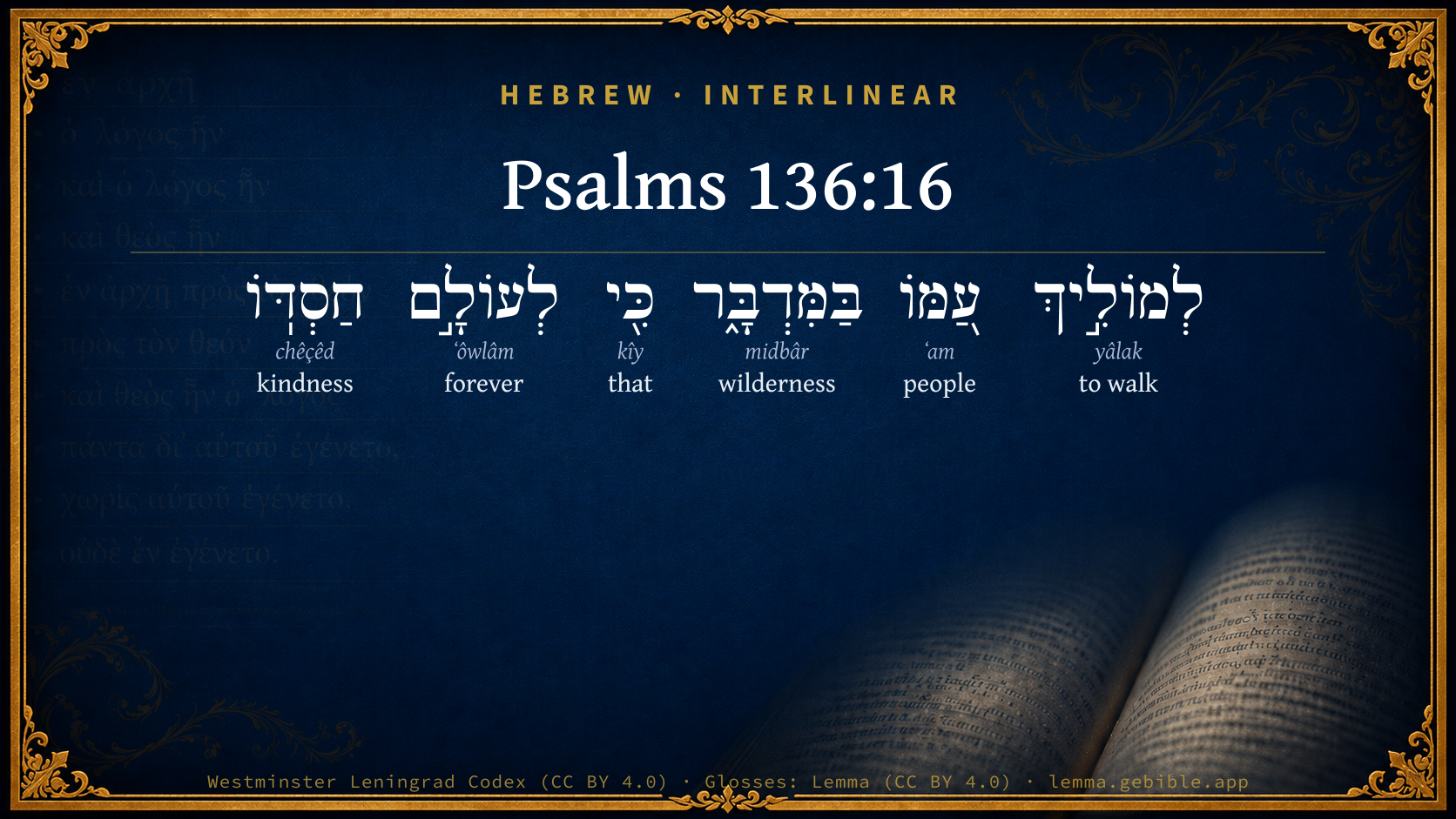
Psalms 136:16

Hebrew (Westminster Leningrad Codex) Psalms 136:16 appears in the Hebrew Old Testament. The text above is from the Westminster Leningrad Codex. Each word links to its Strong’s number, a concise gloss, and parsing drawn from the Open Scriptures Hebrew Bible morphology. Click any word for its full Brown-Driver-Briggs (BDB) entry.
Download image
Cite this verse

Psalms 136:16 (World English Bible). Public Domain. Lemma interlinear Bible study tool, https://lemma.gebible.app/v/psalms/136/16.

Show BibTeX & RIS
BibTeX
RIS
English Translation
To him who led his people through the wilderness; For his loving kindness endures forever:
World English Bible · Public Domain
Download a study sheet

One document with this verse’s original text, its word-by-word gloss line, the meaning frame, cross-references with their text, attributed commentary, and full source and license credits — printable, and it pastes into notes with its structure intact.

This verse Autodidact and up

Study sheet (.html) Plain text (.txt)

A passage Seminary Student

Up to 50 verses in one chapter. A passage sheet keeps up to 6 commentary sources and 12 cross-references per verse, in the order this page ranks them, and says so on the sheet whenever that leaves anything out. Ask for a single verse and you get the Autodidact verse sheet above.

Everything on this page stays free to read, with no account — the sheet is a download of what is already on screen, not access to it.

Want to remove ads? Support Godless Engineer
Compare translations 3

The same verse in 3 English versions, stacked beneath the original-language interlinear above. Click any original word for its lexicon entry.

Each is an independent rendering of the whole verse — the interlinear is not word-aligned to these translations.

Highlighted words mark where these versions differ — a whole-verse word diff, not a word-by-word alignment.

  • World English Bible Public Domain
    To him who led his people through the wilderness; For his loving kindness endures forever:
  • King James Version Public Domain
    To him which led his people through the wilderness: for his mercy endureth for ever.
  • unfoldingWord Literal Text CC BY-SA 4.0
    To the one leading his people in the wilderness, for his covenant faithfulness to forever.

unfoldingWord Literal Text — © unfoldingWord, licensed CC BY-SA 4.0. Word-aligned USFM3 via Door43 (git.door43.org/unfoldingWord/en_ult).

Versions to compare (up to 4)

3 of 4 selected

Show all 18 translations

Every available English version of this verse, each an independent rendering of the whole verse.

  • World English Bible Public Domain
    To him who led his people through the wilderness; For his loving kindness endures forever:
  • Berean Standard Bible Public Domain
    He led His people through the wilderness. His loving devotion endures forever.
  • Majority Standard Bible Public Domain
    He led His people through the wilderness. His loving devotion endures forever.
  • King James Version Public Domain
    To him which led his people through the wilderness: for his mercy endureth for ever.
  • American Standard Version (1901) Public Domain
    To him that led his people through the wilderness; For his lovingkindness `endureth' for ever:
  • Revised Version (1885) Public Domain
    To him which led his people through the wilderness: for his mercy endureth for ever.
  • Geneva Bible (1599) Public Domain
    Which led his people through the wildernes: for his mercie endureth for euer:
  • Douay-Rheims (1899) Public Domain
    They have a mouth, but they speak not: they have eyes, but they see not.
  • Young's Literal Translation Public Domain
    To Him leading His people in a wilderness, For to the age `is' His kindness.
  • Literal Standard Version CC BY-SA 4.0
    To Him leading His people in a wilderness, || For His kindness [is] for all time.
  • Unlocked Literal Bible CC BY-SA 4.0
    Give thanks to him who led his people through the wilderness, for his covenant faithfulness endures forever—
  • unfoldingWord Literal Text CC BY-SA 4.0
    To the one leading his people in the wilderness, for his covenant faithfulness to forever.
  • Darby Bible Public Domain
    To him that led his people through the wilderness, for his loving-kindness [endureth] for ever;
  • World Messianic Bible Public Domain
    to him who led his people through the wilderness, for his loving kindness endures forever;
  • Webster's Bible Public Domain
    To him who led his people through the wilderness: for his mercy endureth for ever.
  • Free Bible Version CC BY-SA 4.0
    To him who led his people through the wilderness. For his trustworthy love lasts forever.
  • Bible in Basic English Public Domain
    To him who took his people through the waste land: for his mercy is unchanging for ever.
  • JPS Tanakh (1917) Public Domain
    To Him that led His people through the wilderness, for His mercy endureth for ever.

Literal Standard Version (2020), Covenant Press — licensed CC BY-SA 4.0. Text via the HelloAO Bible API (eBible.org). Unlocked Literal Bible (unfoldingWord) — licensed CC BY-SA 4.0. Text via the HelloAO Bible API (eBible.org). unfoldingWord Literal Text — © unfoldingWord, licensed CC BY-SA 4.0. Word-aligned USFM3 via Door43 (git.door43.org/unfoldingWord/en_ult). Free Bible Version, Dr. Jonathan Gallagher — licensed CC BY-SA 4.0. Text via the HelloAO Bible API (eBible.org).

Word by word

More ways to search: Search by grammar → Find every occurrence → Compare this word →

Practice this passage: Drill this verse → Learn its vocabulary →

About this verse

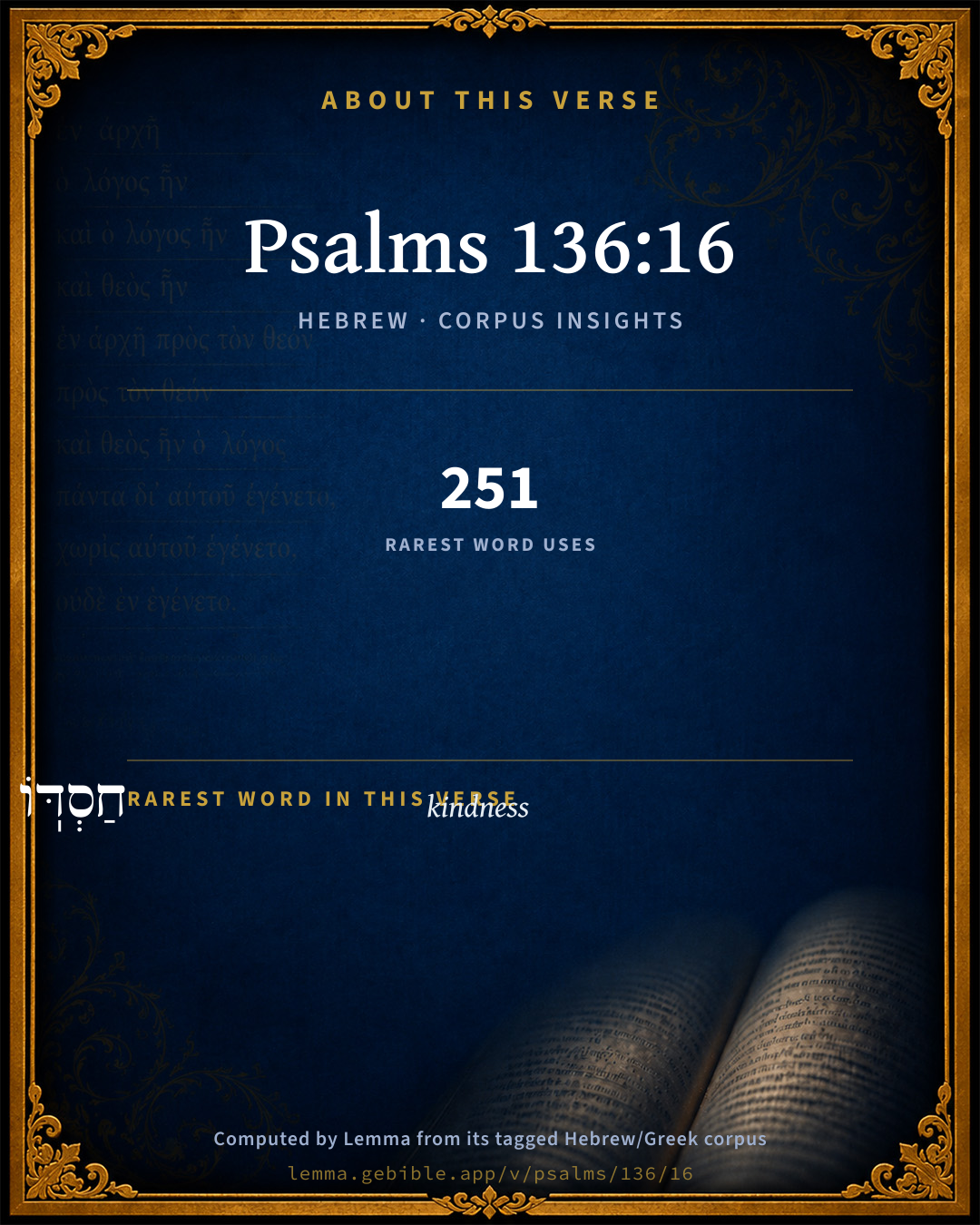
These counts appear in no published source. They are computed here, from the morphology-tagged text and Lemma’s own curated glosses. What Lemma adds →

6
words
6
distinct lemmas
Wisdom
section

Grammatical profile

  • 1 verb
  • 4 nouns
  • 1 conjunction

Verb forms

  • לְמוֹלִ֣יךְ Hiphil · Participle Active

Hebrew & Septuagint length

In English translation the verse runs 15 words from the Hebrew and 15 from the Septuagint (LXX English) — the same length.

A rough comparison of the two English renderings, which tokenize alike — not a word-level alignment.

Word counts can differ between the Hebrew and the Greek without any difference in meaning — e.g. the Hebrew direct-object marker אֵת has no separate Greek word, and Greek often adds the article ὁ.

Cross-references

10

Topical passages linked to Psalms 136:16 in the Treasury of Scripture Knowledge — connected by theme and wording, ordered by reader-vote popularity; previews shown in the World English Bible.

  • Deuteronomy 8:15 who led you through the great and terrible wilderness, [in which were] fiery serpents and scorpions, and thirsty ground where was no water; who brought you forth water out of the rock of flint;
  • Exodus 13:18 but God led the people around by the way of the wilderness by the Red Sea; and the children of Israel went up armed out of the land of Egypt.
  • Exodus 15:22 Moses led Israel onward from the Red Sea, and they went out into the wilderness of Shur; and they went three days in the wilderness, and found no water.
  • Deuteronomy 8:2 You shall remember all the way which Yahweh your God has led you these forty years in the wilderness, that he might humble you, to prove you, to know what was in your heart, whether you would keep his commandments, or not.
  • Psalms 77:20 You led your people like a flock, By the hand of Moses and Aaron.
  • Numbers 9:17–22 Whenever the cloud was taken up from over the Tent, then after that the children of Israel traveled; and in the place where the cloud remained, there the children of Israel encamped.
  • Nehemiah 9:12 Moreover in a pillar of cloud you led them by day; and in a pillar of fire by night, to give them light in the way in which they should go.
  • Nehemiah 9:19 yet you in your manifold mercies didn't forsake them in the wilderness: the pillar of cloud didn't depart from over them by day, to lead them in the way; neither the pillar of fire by night, to show them light, and the way in which they should go.
  • Isaiah 49:10 They shall not hunger nor thirst; neither shall the heat nor sun strike them: for he who has mercy on them will lead them, even by springs of water will he guide them.
  • Isaiah 63:11–14 Then he remembered the days of old, Moses [and] his people, [saying], Where is he who brought them up out of the sea with the shepherds of his flock? where is he who put his holy Spirit in the midst of them?

Cross-references courtesy of OpenBible.info (CC BY 4.0).

Hebrew and Greek witnesses Masoretic Hebrew ↔ Greek Septuagint

The same verse in the two great witnesses to the Old Testament, shown verse-for-verse.

You’re reading Greek Psalm 135 (Hebrew Psalm 136). The Septuagint counts the superscription, so verse numbers can differ from the Hebrew — chapter-level alignment, not verse-by-verse. Numbering follows Rahlfs.

These are two independent witnesses, not word-aligned to each other, and the Septuagint is shown in lemma (dictionary) form.

Hebrew Psalms 136:16 Masoretic · Westminster Leningrad Codex

לְמוֹלִ֣יךְ עַ֭מּוֹ בַּמִּדְבָּ֑ר כִּ֖י לְעוֹלָ֣ם חַסְדּֽוֹ

To him who led his people through the wilderness; For his loving kindness endures forever:

World English Bible · Public Domain

Greek LXX Greek Psalm 135:16 Septuagint · lemma form

ὁ διαἄγω ὁ λαός αὐτός ἐν ὁ ἔρημος ὅτι εἰς ὁ αἰών ὁ ἔλεος αὐτός ὁ ἐκἄγω ὕδωρ ἐκ πέτρα ἀκρότομος ὅτι εἰς ὁ αἰών ὁ ἔλεος αὐτός

To him who led his people through the wilderness: for his mercy endures for ever.

LXX2012 (modern English Septuagint) · Public Domain

Hebrew: Westminster Leningrad Codex (CC BY 4.0). Greek: Septuagint (public domain); English from LXX2012 (modern English Septuagint) (Public Domain). How the Septuagint differs from the Hebrew →

Commentary

Notes on Psalms 136:16 from classic Christian and Jewish commentators (each source and its license shown beneath its notes). The classic Christian expositions comment on the surrounding passage and are grouped to its opening verse, so a note may address several verses; the Jewish commentaries on the Tanakh (Rashi and others) are per-verse, so they appear only where the commentator wrote on this verse.

Lemma curates 59 commentaries, every one of them public domain or Creative Commons licensed, each selected and text-cleaned for this edition rather than reprinted as found. About our sources →

Trapp's Complete Commentary

John Trapp

Psa 136:16 To him which led his people through the wilderness: for his mercy [endureth] for ever.

Ver. 16. To him which led his people] As a horse, that they should not stumble, Isa 63:13; as a shepherd his sheep; providing for them so, as never was any prince so served in his greatest pomp.

John Trapp, A Commentary or Exposition upon All the Books of the Old and New Testament (1647–1656) — public domain. Text from a community e-Sword module.

J. A. Alexander on Psalms

Joseph Addison Alexander

16. (Psa 136:16) To him that led his people in the wilderness—for unto eternity (is) his mercy. Led, literally, caused to go. See above, Psa 125:5. The participial construction is again resumed.

Joseph Addison Alexander, The Psalms Translated and Explained (1850) — public domain. Text from a community e-Sword module.

Geneva Bible (1599)

Geneva Bible translators

Where for the space of forty years he showed infinite and most strange wonders.

Geneva Bible (1599) marginal notes — public domain. Text via Bolls.life.

Adam Clarke's Commentary

Verse 16. Which led his people through the wilderness] It was an astonishing miracle of God to support so many hundreds of thousands of people in a wilderness totally deprived of all necessaries for the life of man, and that for the space of forty years.

Adam Clarke's Commentary on the Bible (1810–1826) — public domain. Text from a community e-Sword/MySword module.

The Cambridge Bible for Schools and Colleges

gen. ed. J. J. S. Perowne

16. Cp. Deu_8:15.

16–22. Jehovah the Giver of the promised land. Cp. Psa_135:10 ff.

The Cambridge Bible for Schools and Colleges (gen. ed. J. J. S. Perowne; Cambridge University Press, 1878–1918) — public domain. Text from a community e-Sword module.

John Gill's Exposition

To him which led his people through the wilderness,.... Where there was no path. This the Lord did by going before them in a pillar of cloud by day, and in a pillar of fire by night, to show them the way in which they should go, Exo 13:21; see Psa 78:14;

for his mercy endureth for ever; among the manifold mercies of God, shown to Israel in the wilderness, this is one taken notice of by Nehemiah, Neh 9:19; that the pillar of cloud and fire, to direct them, never departed from them while in it: and this act of "leading" them not only includes the guidance of them in the way, but the provision made for them; of water out of the rock, and of manna that fell about their tents every day; and of flesh and feathered fowl, like dust, so that they wanted nothing; and also the protection of them from their enemies: all which were proofs of his constant care over them, and continual mercy to them; see Psa 78:15.

John Gill's Exposition of the Whole Bible (1746–1763) — public domain (CC PDM 1.0). Text via the HelloAO Bible API.

Albert Barnes' Notes on the Bible

To him which led his people through the wilderness - For all the manifestations of his care during a period of forty years.

For his mercy ... - That is, his mercy was to be measured by all the protection extended over them; by all the provision made for their needs; by all that God did to defend them; by all his interposition when attacked by their enemies; by safely bringing them to the land to which he had promised to conduct them.

Albert Barnes' Notes on the Bible (1834–1885) — public domain. Text from a community e-Sword/MySword module.

Matthew Poole's English Annotations

Through the wilderness; through that vast howling wilderness, where there was neither way nor provision; through which none but the Almighty God could have safely conducted them.

Matthew Poole's English Annotations on the Holy Bible (1683–1685) — public domain. Text from a community e-Sword/MySword module.

The Treasury of David

Charles H. Spurgeon

Ver. 16. To him which led his people through the wilderness. He led them into it, and therefore he was pledged to lead them through it. They were "his people", and yet they must go into the wilderness, and the wilderness must remain as barren as ever it was; but in the end they must come out of it into the promised land. God's dealings are mysterious, but they must be right, simply because they are his. The people knew nothing of the way, but they were led; they were a vast host, yet they were all led; there were neither roads nor tracks, but being led by unerring wisdom they never lost their way. He who brought them out of Egypt, also led them through the wilderness. By Moses, and Aaron, and Jethro, and the pillar of cloud he led them. What a multitude of mercies are comprehended in the conduct of such an enormous host through a region wherein there was no provision even for single travellers; yet the Lord by his infinite power and wisdom conducted a whole nation for forty years through a desert land, and their feet did not swell, neither did their garments wax old in all the journey.

For his mercy endureth for ever. Their conduct in the wilderness tested his mercy most severely, but it bore the strain; many a time he forgave them; and though he smote them for their transgressions, yet he waited to be gracious and speedily turned to them in compassion. Their faithfulness soon failed, but his did not: the fiery, cloudy pillar which never ceased to lead the van was the visible proof of his immutable love

"For his, mercy, changing never,

Still endureth, sure for ever."

Ver. 16. Led his people through the wilderness.

When Israel, of the Lord beloved,

Out of the land of bondage came,

Her father's God before her moved,

An awful guide, in smoke and flame.

By day, along the astonished lands,

The cloudy pillar glided slow;

By night Arabia's crimsoned sands

Returned the fiery columun's glow.

Sir Walter Scott, 1771-1832.

Ver. 16. He led his people through the wilderness. It was an astonishing miracle of God to support so many hundreds of thousands of people in a wilderness totally deprived of all necessaries for the life of man, and that for the space of forty years. Adam Clarke.

Ver. 16. He led his people through the wilderness, etc. It is a very sweet truth which is enunciated in this verse, and one which I think we need very much to realize. His own people, his peculiar people, his chosen, loved, and favoured ones, whom he cherished as the apple of his eye, who were graven on the palms of his hands, and loved with an everlasting love, even these he led through the wilderness; and all this because "His mercy endureth for ever." In another Psalm it is said, "He leadeth them beside the still waters, he maketh them to lie down in green pastures"; but the barren wilderness has no green pastures, the parched and arid desert has no still waters. And yet "in the wilderness shall waters break out, and streams in the desert, and an highway shall be there; and the ransomed of the Lord shall return, and come to Zion with songs and everlasting joy upon their heads." "Who is this that cometh up from the wilderness, leaning upon her beloved?" It is one of the Lord's sweet truths that so perplex those that are without, but which are so full of consolation to his own children, that the wilderness and mercy are linked together of God in indissoluble union here. "I will allure her", saith the Lord, "and bring her into the wilderness, and speak comfortably unto her." Barton Bouchier.

Ver. 16. Who led his people. Note that in what precedes this, in this verse itself, and in what follows, God's three ways of leading are set forth. He leads out, he leads through, and he leads into; out of sin, through the world, into heaven; out by faith, through by hope, into by love. Michael Ayguan (1416), in Neale and Littledale.

Ver. 16.

1. Personal care: "To him which led."

2. Peculiar interest: "His people."

3. Persevering goodness: "Through the wilderness."

Ver. 16. Led through the Wilderness.

1. God's people must enter the wilderness for trial, for self knowledge, for development of graces, for preparation for Canaan.

2. God leads his people while in the wilderness. Their route, their provision, their discipline, their protection.

3. God will bring his people out of the wilderness.

C.A.D.

Psalms 136:17*

Charles H. Spurgeon's The Treasury of David (1869–1885) — public domain. Psalms only. Text from a community e-Sword/MySword module.

Whedon's Commentary on the Bible

Daniel D. Whedon

16. See Exo_13:18; Deu_8:15. Leading the people in the desert was as great a miracle as the exodus or the overthrow of the kings.

Daniel D. Whedon (gen. ed.), Commentary on the Old and New Testaments (1874–1909) — public domain. Text from a community e-Sword module.

The Pulpit Commentary

To him which led his people through the wilderness. (Exo_13:20-22 Exo_40:36-38 Deu_8:15) For his mercy, etc.

Providential guidance.

"Which led his people." The addition, "through the wilderness," is significant and suggestive, because a wilderness is distinctly a pathless region, in which mere human skill is baffled. And it reminds us that Israel was provided for and guided for thirty-eight long years in such a region. Surely Israel ought to have said, "God"s providence is mine inheritance." Is it a gain or a loss that we have ceased to recognize or to speak much of God"s providence? It was a very real thing to our fathers; it is not very real to us. At least, this might appear to be the fact. We are, however, disposed to argue that the truth and fact are as truly preserved and valued as ever they were, only they have gained a new setting and new shaping.

I THE IDEA OF PROVIDENCE FITTED THE OLDER CONCEPTION OF GOD. It belongs to the apprehension of God as Creator, Sustainer, Ruler. He is Lord of the whole world of things, and is thought of as controlling all things in the interest of his own special people. He is the Universal Provider, and our fathers delighted in stories of remarkable providential interpositions, guidances, and arrangements. And still no man can read his own life, or watch the lives of others, without being impressed with the wonder-working ways of Divine providence, which make the "unexpected" the thing that happens. Constantly in life we find things are brought round for us which we could in no way have mastered or arranged. "There"s a divinity that shapes our ends, Rough-hew them how we will.

II THE NEWER CONCEPTION OF GOD GLORIFIES HIS PROVIDENCE. Christ has brought to men a comprehensive name for God. It includes the very essence of every previous conception and name, but puts man into a new and more directly personal and affectionate relation with God. He is our Father. And his providence is his fatherly care of our every interest. Has a child any such providence as his father is to him? And yet a child never thinks of, or speaks of, his father as providence. And in the measure in which we can enter into the idea of God as our Father, we shall find that we lose out of use the term "providence," but keep all the reality of it, and indeed glorify it, as we lose the impersonal and therefore cold element, and see it to be the wisdom and power and activity of our Father, which is beautified and sanctified by his love for us his sons. R.T.

The Pulpit Commentary (1880–1919), ed. H.D.M. Spence-Jones & Joseph S. Exell — public domain. Text from a community e-Sword module.

unfoldingWord translationNotes

Door43 World Missions Community

for his covenant faithfulness endures forever

The abstract noun "faithfulness" can be translated with an adjective. See how you translated this in Psalms 136:1. AT: "because he remains faithful to his covenant forever" (See: Abstract Nouns)

translationWords

people of God

desert

king

unfoldingWord translationNotes — © Distant Shores Media and the Door43 World Missions Community, licensed CC BY-SA 4.0. Source: git.door43.org/Door43/en_tn.

Lesson kit

Teaching starters — assembled from the data on this page, not authored interpretation. Every prompt links to the verse data it draws on. Edit before teaching.

Psalms, in the Wisdom, opens this verse with 6 words (6 distinct Hebrew lemmas). Its most distinctive word is chêçêd (“kindness”). A historical commentator’s framing appears above. Read the whole chapter for the surrounding context.

Discussion questions

  1. The word chêçêd carries the sense “kindness.” How does it shape the verse?
  2. How does Deuteronomy 8:15, which shares this passage’s theme, read alongside this verse?
  3. The translations on this page render this verse differently — a whole-verse word diff, not a word-by-word alignment. What might account for the different wordings?
  4. «לְמוֹלִ֣יךְ» is a Hiphil Participle Active verb. How does that grammatical form shape the action described?
  5. Compare how Trapp's Complete Commentary and J. A. Alexander on Psalms read this verse. Where do they agree or differ?

Things to notice

Reading settings

Reading text

Shown beneath each verse's original-language words.

Old Testament
Old Testament edition

Read the OT as the Masoretic Hebrew (MT) or the Greek Septuagint (LXX).

English shown for the Greek Septuagint (in the Hebrew ↔ Greek comparison).

Comparing translations? Open the Compare panel on any verse page to stack up to four side by side.