
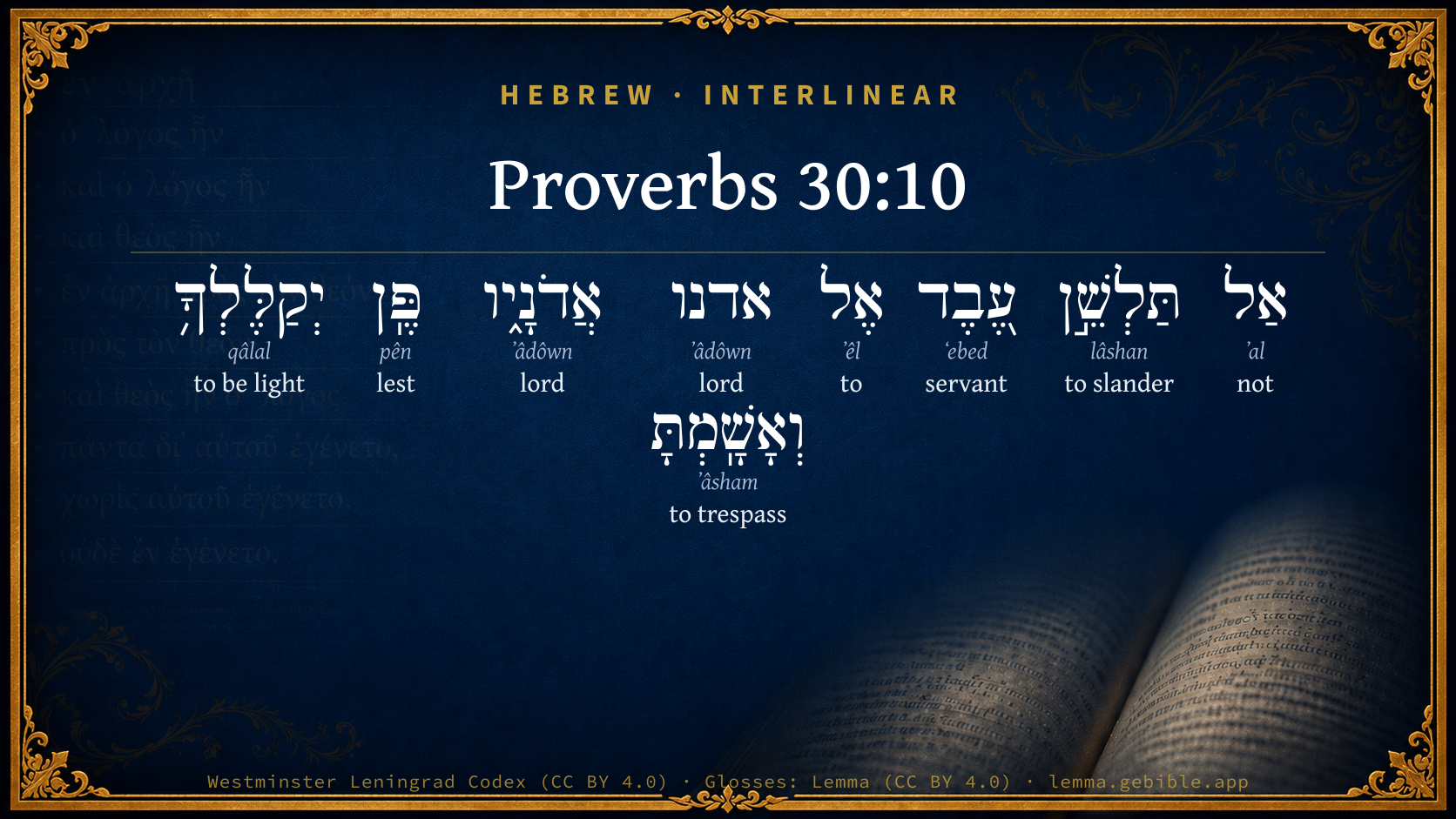
Proverbs 30:10

Hebrew (Westminster Leningrad Codex) Proverbs 30:10 appears in the Hebrew Old Testament. The text above is from the Westminster Leningrad Codex. Each word links to its Strong’s number, a concise gloss, and parsing drawn from the Open Scriptures Hebrew Bible morphology. Click any word for its full Brown-Driver-Briggs (BDB) entry.
Download image
Cite this verse

Proverbs 30:10 (World English Bible). Public Domain. Lemma interlinear Bible study tool, https://lemma.gebible.app/v/proverbs/30/10.

Show BibTeX & RIS
BibTeX
RIS
English Translation
"Don't slander a servant to his master, Lest he curse you, and you be held guilty.
World English Bible · Public Domain
Download a study sheet

One document with this verse’s original text, its word-by-word gloss line, the meaning frame, cross-references with their text, attributed commentary, and full source and license credits — printable, and it pastes into notes with its structure intact.

This verse Autodidact and up

Study sheet (.html) Plain text (.txt)

A passage Seminary Student

Up to 50 verses in one chapter. A passage sheet keeps up to 6 commentary sources and 12 cross-references per verse, in the order this page ranks them, and says so on the sheet whenever that leaves anything out. Ask for a single verse and you get the Autodidact verse sheet above.

Everything on this page stays free to read, with no account — the sheet is a download of what is already on screen, not access to it.

Want to remove ads? Support Godless Engineer
Compare translations 3

The same verse in 3 English versions, stacked beneath the original-language interlinear above. Click any original word for its lexicon entry.

Each is an independent rendering of the whole verse — the interlinear is not word-aligned to these translations.

Highlighted words mark where these versions differ — a whole-verse word diff, not a word-by-word alignment.

  • World English Bible Public Domain
    "Don't slander a servant to his master, Lest he curse you, and you be held guilty.
  • King James Version Public Domain
    Accuse not a servant unto his master, lest he curse thee, and thou be found guilty.
  • unfoldingWord Literal Text CC BY-SA 4.0
    Do not slander a slave to his master, lest he curse you, and you be found guilty.

unfoldingWord Literal Text — © unfoldingWord, licensed CC BY-SA 4.0. Word-aligned USFM3 via Door43 (git.door43.org/unfoldingWord/en_ult).

Versions to compare (up to 4)

3 of 4 selected

Show all 18 translations

Every available English version of this verse, each an independent rendering of the whole verse.

  • World English Bible Public Domain
    "Don't slander a servant to his master, Lest he curse you, and you be held guilty.
  • Berean Standard Bible Public Domain
    Do not slander a servant to his master, or he will curse you, and you will bear the guilt.
  • Majority Standard Bible Public Domain
    Do not slander a servant to his master, or he will curse you, and you will bear the guilt.
  • King James Version Public Domain
    Accuse not a servant unto his master, lest he curse thee, and thou be found guilty.
  • American Standard Version (1901) Public Domain
    Slander not a servant unto his master, Lest he curse thee, and thou be held guilty.
  • Revised Version (1885) Public Domain
    Slander not a servant unto his master, lest he curse thee, and thou be held guilty.
  • Geneva Bible (1599) Public Domain
    Accuse not a seruant vnto his master, lest he curse thee, when thou hast offended.
  • Douay-Rheims (1899) Public Domain
    Accuse not a servant to his master, lest he curse thee, and thou fall.
  • Young's Literal Translation Public Domain
    Accuse not a servant unto his lord, Lest he disesteem thee, and thou be found guilty.
  • Literal Standard Version CC BY-SA 4.0
    Do not accuse a servant to his lord, || Lest he disapprove of you, and you are found guilty.
  • Unlocked Literal Bible CC BY-SA 4.0
    Do not slander a slave before his master, or he will curse you and you will be held guilty.
  • unfoldingWord Literal Text CC BY-SA 4.0
    Do not slander a slave to his master, lest he curse you, and you be found guilty.
  • Darby Bible Public Domain
    Speak not too much about a servant to his master, lest he curse thee, and thou be held guilty.
  • World Messianic Bible Public Domain
    “Don’t slander a servant to his master, lest he curse you, and you be held guilty.
  • Webster's Bible Public Domain
    Accuse not a servant to his master, lest he curse thee, and thou be found guilty.
  • Free Bible Version CC BY-SA 4.0
    Don't slander a servant to his master, or he will curse you and you'll suffer for it.
  • Bible in Basic English Public Domain
    Do not say evil of a servant to his master, or he will put a curse on you, and you will get into trouble.
  • JPS Tanakh (1917) Public Domain
    Slander not a servant unto his master, lest he curse thee, and thou be found guilty.

Literal Standard Version (2020), Covenant Press — licensed CC BY-SA 4.0. Text via the HelloAO Bible API (eBible.org). Unlocked Literal Bible (unfoldingWord) — licensed CC BY-SA 4.0. Text via the HelloAO Bible API (eBible.org). unfoldingWord Literal Text — © unfoldingWord, licensed CC BY-SA 4.0. Word-aligned USFM3 via Door43 (git.door43.org/unfoldingWord/en_ult). Free Bible Version, Dr. Jonathan Gallagher — licensed CC BY-SA 4.0. Text via the HelloAO Bible API (eBible.org).

Word by word

More ways to search: Search by grammar → Find every occurrence → Compare this word →

Practice this passage: Drill this verse → Learn its vocabulary →

About this verse

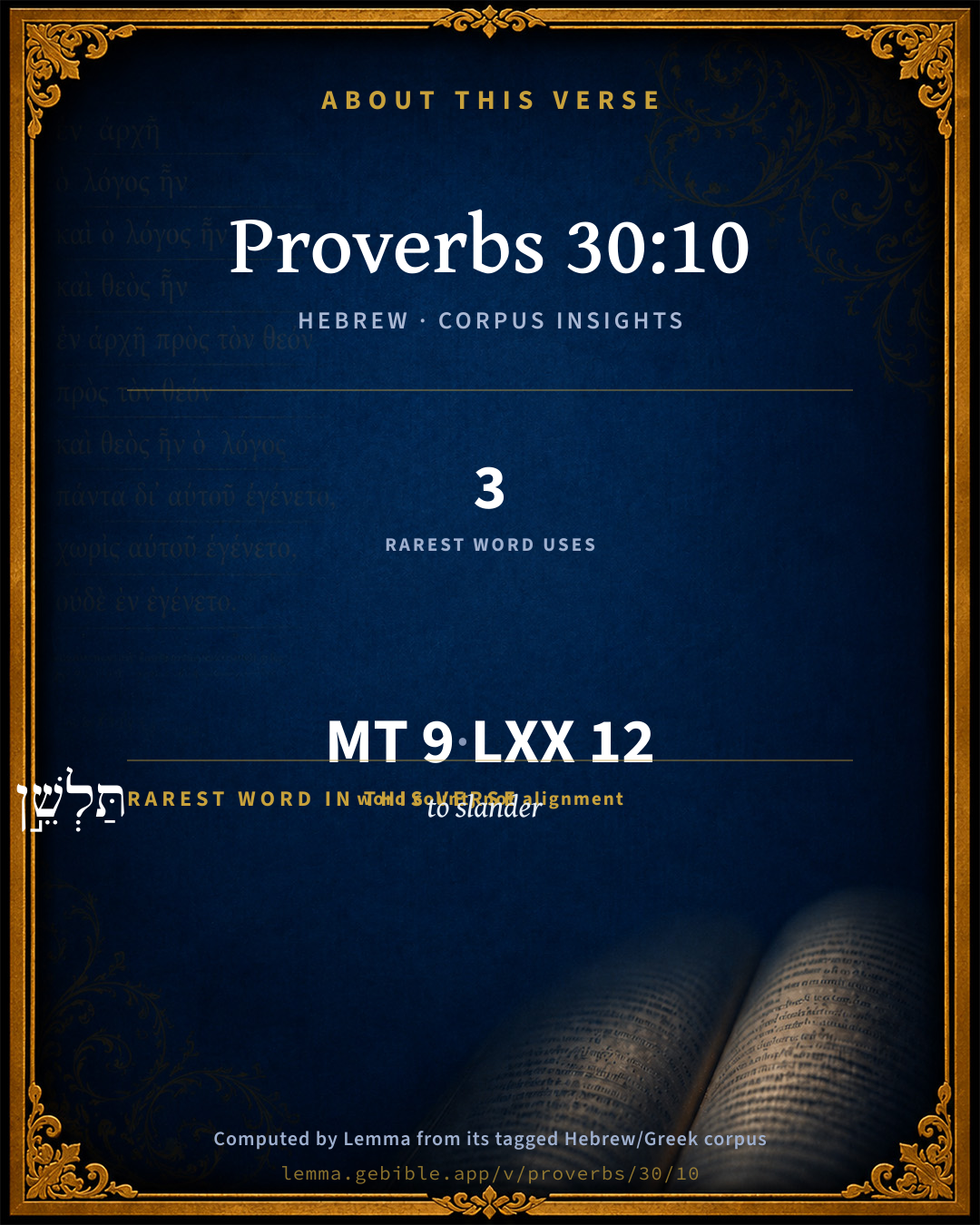
These counts appear in no published source. They are computed here, from the morphology-tagged text and Lemma’s own curated glosses. What Lemma adds →

9
words
8
distinct lemmas
Wisdom
section

Notable vocabulary

The rarest word here is תַּלְשֵׁ֣ן to slander H3960 — appearing just 3 times in the whole Hebrew Bible.

Shared distinctive vocabulary

תַּלְשֵׁ֣ן to slander H3960 occurs in 2 verses of the Hebrew Bible. Also found in:

Grammatical profile

  • 3 verbs
  • 3 nouns
  • 1 preposition
  • 1 conjunction
  • 1 particle

Verb forms

  • תַּלְשֵׁ֣ן Hiphil · Jussive
  • יְקַלֶּלְךָ֥ Piel · Imperfect
  • וְאָשָֽׁמְתָּ Qal · Sequential Perfect

Repetition

A word recurs within this verse — often emphatic in Hebrew:

  • אדנו lord H113 ×2

Hebrew & Septuagint length

In English translation the verse runs 16 words from the Hebrew and 19 from the Septuagint (LXX English) — closely comparable.

A rough comparison of the two English renderings, which tokenize alike — not a word-level alignment.

Word counts can differ between the Hebrew and the Greek without any difference in meaning — e.g. the Hebrew direct-object marker אֵת has no separate Greek word, and Greek often adds the article ὁ.

In the original languages it is 9 Hebrew tokens and 12 Greek tokens — but the two are counted differently (Hebrew bundles its prefixes and suffixes into one token; the Greek is in lemma form), so that isn’t a like-for-like length.

Cross-references

17

Topical passages linked to Proverbs 30:10 in the Treasury of Scripture Knowledge — connected by theme and wording, ordered by reader-vote popularity; previews shown in the World English Bible.

  • Ecclesiastes 7:21 Also don't take heed to all words that are spoken, lest you hear your servant curse you;
  • Romans 14:4 Who are you who judge another's servant? To his own lord he stands or falls. Yes, he will be made to stand, for God has power to make him stand.
  • 2 Samuel 19:26–27 He answered, My lord, O king, my servant deceived me: for your servant said, I will saddle me a donkey, that I may ride thereon, and go with the king; because your servant is lame.
  • 2 Chronicles 24:22–24 Thus Joash the king didn't remember the kindness which Jehoiada his father had done to him, but killed his son. When he died, he said, Yahweh look on it, and require it.
  • Proverbs 24:23–24 These also are sayings of the wise. To show partiality in judgment is not good.
  • Daniel 3:8–18 Therefore at that time certain Chaldeans came near, and brought accusation against the Jews.
  • Daniel 6:13 Then answered they and said before the king, That Daniel, who is of the children of the captivity of Judah, doesn't regard you, O king, nor the interdict that you have signed, but makes his petition three times a day.
  • Daniel 6:24 The king commanded, and they brought those men who had accused Daniel, and they cast them into the den of lions, them, their children, and their wives; and the lions had the mastery of them, and broke all their bones in pieces, before they came to the bottom of the den.
  • Deuteronomy 23:15 You shall not deliver to his master a servant who is escaped from his master to you:
  • 1 Samuel 22:9–10 Then answered Doeg the Edomite, who stood by the servants of Saul, and said, I saw the son of Jesse coming to Nob, to Ahimelech the son of Ahitub.
  • 1 Samuel 24:9 David said to Saul, Why listen you to men's words, saying, Behold, David seeks your hurt?
  • 1 Samuel 26:19 Now therefore, please let my lord the king hear the words of his servant. If it be Yahweh that has stirred you up against me, let him accept an offering: but if it be the children of men, cursed be they before Yahweh: for they have driven me out this day that I shouldn't cling to Yahweh's inheritance, saying, Go, serve other gods.
  • 1 Samuel 30:15 David said to him, Will you bring me down to this troop? He said, Swear to me by God, that you will neither kill me, nor deliver me up into the hands of my master, and I will bring you down to this troop.
  • 2 Samuel 16:1–4 When David was a little past the top [of the ascent], behold, Ziba the servant of Mephibosheth met him, with a couple of donkeys saddled, and on them two hundred loaves of bread, and one hundred clusters of raisins, and one hundred summer fruits, and a bottle of wine.
  • Proverbs 11:26 People curse someone who withholds grain, But blessing will be on the head of him who sells it.
  • Deuteronomy 15:9 Beware that there not be a base thought in your heart, saying, The seventh year, the year of release, is at hand; and your eye be evil against your poor brother, and you give him nothing; and he cry to Yahweh against you, and it be sin to you.
  • Proverbs 28:27 One who gives to the poor has no lack; But one who closes his eyes will have many curses.

Cross-references courtesy of OpenBible.info (CC BY 4.0).

Hebrew and Greek witnesses Masoretic Hebrew ↔ Greek Septuagint

The same verse in the two great witnesses to the Old Testament, shown verse-for-verse.

These are two independent witnesses, not word-aligned to each other, and the Septuagint is shown in lemma (dictionary) form.

Hebrew Proverbs 30:10 Masoretic · Westminster Leningrad Codex

אַל תַּלְשֵׁ֣ן עֶ֭בֶד אֶל אדנו אֲדֹנָ֑יו פֶּֽן יְקַלֶּלְךָ֥ וְאָשָֽׁמְתָּ

"Don't slander a servant to his master, Lest he curse you, and you be held guilty.

World English Bible · Public Domain

Greek LXX Proverbs 30:10 Septuagint · lemma form

μή παραδίδωμι οἰκέτης εἰς χείρ δεσπότης μήποτε καταἀράομαι σύ καί ἀπο ἀναἵζω

Deliver not a servant into the hands of his master, lest he curse you, and you be utterly destroyed.

LXX2012 (modern English Septuagint) · Public Domain

On this verse, Haydock's Catholic Bible Commentary discusses the Septuagint’s reading. Read the note in Commentary ↓

Hebrew: Westminster Leningrad Codex (CC BY 4.0). Greek: Septuagint (public domain); English from LXX2012 (modern English Septuagint) (Public Domain). How the Septuagint differs from the Hebrew →

Commentary

Notes on Proverbs 30:10 from classic Christian and Jewish commentators (each source and its license shown beneath its notes). The classic Christian expositions comment on the surrounding passage and are grouped to its opening verse, so a note may address several verses; the Jewish commentaries on the Tanakh (Rashi and others) are per-verse, so they appear only where the commentator wrote on this verse.

Lemma curates 59 commentaries, every one of them public domain or Creative Commons licensed, each selected and text-cleaned for this edition rather than reprinted as found. About our sources →

Matthew Henry's Commentary

Here is, I. A caution not to abuse other people's servants any more than our own, nor to make mischief between them and their masters, for it is an ill office, invidious, and what will make a man odious, Pro 30:10. Consider, 1. It is an injury to the servant, whose poor condition makes him an object of pity, and therefore it is barbarous to add affliction to him that is afflicted: Hurt not a servant with thy tongue (so the margin reads it); for it argues a sordid disposition to smite any body secretly with the scourge of the tongue, especially a servant, who is not a match for us, and whom we should rather protect, if his master be severe with him, than exasperate him more. 2. "It will perhaps be an injury to thyself. If a servant be thus provoked, perhaps he will curse thee, will accuse thee and bring thee into trouble, or give thee an ill word and blemish thy reputation, or appeal to God against thee, and imprecate his wrath upon thee, who is the patron and protector of oppressed innocency."

II. An account, upon occasion of this caution, of some wicked generations of men, that are justly abominable to all that are virtuous and good. 1. Such as are abusive to their parents, give them bad language and wish them ill, call them bad names and actually injure them. There is a generation of such; young men of that black character commonly herd together, and irritate one another against their parents. A generation of vipers those are who curse their natural parents, or their magistrates, or their ministers, because they cannot endure the yoke; and those are near of kin to them who, though they have not yet arrived at such a pitch of wickedness as to curse their parents, yet do not bless them, cannot give them a good word, and will not pray for them. 2. Such as are conceited of themselves, and, under a show and pretence of sanctity, hide from others, and perhaps from themselves too, abundance of reigning wickedness in secret (Pro 30:12); they are pure in their own eyes, as if they were in all respects such as they should be. They have a very good opinion of themselves and their own character, that they are not only righteous, but rich and increased with goods (Rev 3:17), and yet are not cleansed from their filthiness, the filthiness of their hearts, which they pretend to be the best part of them. They are, it may be, swept and garnished, but they are not washed, nor sanctified; as the Pharisees that within were full of all uncleanness, Mat 23:25, Mat 23:26. 3. Such as are haughty and scornful to those about them, Pro 30:13. He speaks of them with amazement at their intolerable pride and insolence: "Oh how lofty are their eyes! With what disdain do they look upon their neighbours, as not worthy to be set with the dogs of their flock! What a distance do they expect every body should keep; and, when they look upon themselves, how do they strut and vaunt like the peacock, thinking they make themselves illustrious when really they make themselves ridiculous!" There is a generation of such, on whom he that resists the proud will pour contempt. 4. Such as are cruel to the poor and barbarous to all that lie at their mercy (Pro 30:14); their teeth are iron and steel, swords and knives, instruments of cruelty, with which they devour the poor with the greatest pleasure imaginable, and as greedily as hungry men cut their meat and eat it. God has so ordered it that the poor we shall always have with us, that they shall never cease out of the land; but there are those who, because they hate to relieve them, would, if they could, abolish them from the earth, from among men, especially God's poor. Some understand it of those who wound and ruin others by slanders and false accusations, and severe censures of their everlasting state; their tongues, and their teeth too (which are likewise organs of speech), are as swords and knives, Psa 57:4.

Matthew Henry's Commentary on the Whole Bible (1708–1710) — public domain (CC PDM 1.0). Text via the HelloAO Bible API.

Trapp's Complete Commentary

John Trapp

Pro 30:10 Accuse not a servant unto his master, lest he curse thee, and thou be found guilty.

Ver. 10. Accuse not a servant unto his master.] Unless it be in an ordinance, for the benefit of both. Much less may we falsely accuse wives to their husbands - as Stephen Gardiner and other courtparasites did King Henry VIII his wives to him of adultery, heresy, conspiracy, &c.; children to their parents - as the Jesuits, the Pope’s bloodhounds, did Charles, eldest son of Philip, King of Spain, for suspicion of heresy, whereupon he was murdered by the cruel Inquisition; one friend to another; a sin that David could not endure; {Psa 101:5} and Christ, the Son of David, as deeply disliked it in the Pharisees, those mischief makers, that by accusing his disciples to him one while, and him to his disciples another while, sought to make a breach in his family, by setting off the one from the other.

Lest he curse thee, and thou be found guilty.] Lest to cry quittance with thee he rip up thy faults, such as it will be for thy shame, -

“Et dici potuisse, et non potuisse refelli.”

He that speaketh what he should not, shall hear of what he would not. Put them in mind to speak evil of no man falsely and rashly, without cause and necessity. And why? "For we ourselves also" - even I Paul, and thou Titus - "were sometimes foolish, disobedient," &c., {Tit 3:1-3} and may haply hear of it to our shame and sorrow, if we irritate others thereunto by way of recrimination.

John Trapp, A Commentary or Exposition upon All the Books of the Old and New Testament (1647–1656) — public domain. Text from a community e-Sword module.

Joseph Benson's Commentary

Pro 30:10. Accuse not a servant unto his master — Without sufficient cause, for otherwise, in some cases, this may be a duty. As if he had said, A servant’s condition is in itself mean and miserable, and therefore thou shouldest not make it worse without great and apparent necessity. Lest he curse thee — Desire God to punish thee, which, though it might be sinful in him, yet, being deserved by thee, thou wouldst have reason to fear and expect; and thou be found guilty — By God, who is always ready to plead the cause of the afflicted.

Joseph Benson's Commentary on the Old and New Testaments (1811–1818) — public domain. Text from a community e-Sword module.

Geneva Bible (1599)

Geneva Bible translators

In accusing him without cause.

Geneva Bible (1599) marginal notes — public domain. Text via Bolls.life.

Jamieson, Fausset & Brown

Robert Jamieson, A. R. Fausset & David Brown

Accuse not--Slander not (Psa 10:7).

curse . . . guilty--lest, however lowly, he be exasperated to turn on thee, and your guilt be made to appear.

Jamieson, Fausset & Brown — Commentary Critical and Explanatory on the Whole Bible (1871) — public domain (CC PDM 1.0). Text via the HelloAO Bible API.

Adam Clarke's Commentary

Verse 10. Accuse not a servant] Do not bring a false accusation against a servant, lest thou be found guilty of the falsehood, and he curse thee for having traduced his character, and in his turn traduce thine. In general, do not meddle with other people's servants.

Adam Clarke's Commentary on the Bible (1810–1826) — public domain. Text from a community e-Sword/MySword module.

Ellicott's Commentary for English Readers

(10) Accuse not a servant—i.e., a slave, thus making his already hard life still more intolerable.

And thou be found guilty before God of having wronged him, and so have to bear the punishment.

A Bible Commentary for English Readers, edited by Charles John Ellicott (1878–1897) — public domain. Text from a community e-Sword module.

The Cambridge Bible for Schools and Colleges

gen. ed. J. J. S. Perowne

10. Accuse not] Lit. tongue not; i.e. use not thy tongue against. Comp. Psa_101:5, where the same Heb. word is used in the same sense.

lest he curse thee &c.] lest thy charge against him being not truth but “slander,” he imprecate upon thee a curse, which being not “causeless” (Pro_26:2) will come upon thee because thou art “held guilty.”

The Cambridge Bible for Schools and Colleges (gen. ed. J. J. S. Perowne; Cambridge University Press, 1878–1918) — public domain. Text from a community e-Sword module.

John Gill's Exposition

Accuse not a servant unto his master,.... Wrongly, rashly, and without any foundation, nor for any trifling thing; unless it be in a case of moment and importance, when his master's business is sadly neglected, or he is injured in his property by him: especially care should be taken not to calumniate a servant, to abuse him with the tongue, as the word (g) signifies; the circumstance he is in should be considered, as a servant; and how severe masters are apt to be towards them, and therefore little matters should be hid from them; and much less should they be aggravated, and least of all should falsehoods be told of them. So Doeg the Edomite accused David to Saul, and the Pharisees accused the disciples of Christ to their Master, Sa1 22:9; the apostle's advice is good, and agrees with Agur's, Rom 14:4;

lest he curse thee, and thou be found guilty; or, "and thou shouldest sin" (h); that is, afterwards; and so the curse come upon thee he has wished for: or the sense is, lest he should curse thee before men, and hurt thy character and reputation; or imprecate a curse from the Lord, which he may suffer to come upon thee for sin. Aben Ezra interprets this of a servant, that flies from Heathen countries to the land of Israel, to be made a proselyte of; who should not be discovered, and returned to his old master.

(g) "ne crimineris lingua", Montanus. (h) "et delinquas", Pagninus, Montanus, Mercerus, Gejerus; "q. d. peccabis", Vatablus.

John Gill's Exposition of the Whole Bible (1746–1763) — public domain (CC PDM 1.0). Text via the HelloAO Bible API.

Albert Barnes' Notes on the Bible

Accuse not a servant - The prayer in Pro 30:8 does not shut out, sympathy with those who are less favored. Even the slave has a right to protection against frivolous or needless accusation. Others, however, render the words Make not a slave to accuse his master, i. e., Do not make him discontented with his lot, lest he afterward curse thee for having made it worse than it was.

Albert Barnes' Notes on the Bible (1834–1885) — public domain. Text from a community e-Sword/MySword module.

Haydock's Catholic Bible Commentary

Accuse. Septuagint, "deliver not" to an idolater, Deuteronomy xxiii. 15. (Rabbins) --- Servant. Add not to his affliction. (Worthington) --- We must suppose that the accusation is frivolous or false. (Lyranus) --- A servant may do a person much injury: but this ought not to deter the other from performing what justice and charity require.

George Leo Haydock (1774–1849), Haydock's Catholic Family Bible and Commentary, 1859 edition — public domain. Excludes Psalms (Douay-Rheims chapter numbering differs from Protestant) and Deuterocanonical books (Catholic canon only).

Matthew Poole's English Annotations

Accuse not a servant, to wit, maliciously, rashly, or without just and sufficient cause; for otherwise, in some cases, this may be not only lawful, but a duty, as when a servant lives wickedly, or robs his master, or the like,

A servant; whose condition is in itself mean and miserable, and therefore thou shouldst not make it worse without great and apparent necessity.

Curse thee; desire God to curse and punish thee, which though it may be sinful in him, yet being deserved by thee, thou hast reason to fear and expect.

Be found guilty by God, who is ready to plead the cause of the afflicted, and upon strict search shall find thee guilty, and punish thee accordingly.

Matthew Poole's English Annotations on the Holy Bible (1683–1685) — public domain. Text from a community e-Sword/MySword module.

Whedon's Commentary on the Bible

Daniel D. Whedon

10. Accuse not a servant… master — It is not entirely certain that our Authorized Version gives the sense here. Stuart, Zockler, and others render: “Thou shalt not cause a servant to slander his master, lest he should curse thee,” etc. Literally rendered, the first clause might read, Do not incite a servant to tongue (be-tongue or tongue-lash) his master.

Lest he — It cannot be determined from the construction whether this refers to the servant or to the master. Conant translates “Slander not a servant to his master,” and refers the latter clause to the master. Miller: “Give not tongue service, as a servant to his master;” giving it, of course, a spiritual sense, as does also Ewald. The word translated accuse is found only once elsewhere, Psa_101:5, and is there read slandereth. The Septuagint has, “Deliver not a servant to his master, lest,” etc.

Daniel D. Whedon (gen. ed.), Commentary on the Old and New Testaments (1874–1909) — public domain. Text from a community e-Sword module.

The Pulpit Commentary

Accuse not a servant unto his master. Calumniate, slander not; mh katalalhshv , Theodotion; mh diabalhv , Symmachus. Do not secretly bring a charge against a man"s slave, and make his master suspicious of him; have a kind feeling for those in lowly condition, and do not render their lot more unbearable by insinuating false or frivolous accusations against them. Ewald and others would render, "Entice not a servant to slander his master;" but there is no need so to take the expression, as the hiph. of the verb is used in post-biblical Hebrew in the sense of "to calumniate." The Septuagint has, "Deliver not a servant into the hands of his master," which seems to refer to the treatment of runaway slaves. (Deu_23:15) Lest he curse thee, and thou be found guilty, and have to atone for it. The slandered slave imprecates a curse on his slanderer, and, as the latter has incurred vengeance by his word or action, the curse will not fall harmless; (Pro_26:2) God"s righteous retribution will overtake him, and he shall suffer for it.

Caution in the use of the tongue.

I THE THOUGHTS ONE FEARS EXPRESS HIMSELF ONE MAY BE TEMPTED TO ELICIT FROM ANOTHER.

II IT IS BASE TO TEMPT AN HONEST HEART TO THOUGHTS AND WORDS OF DISCONTENT. One of the most active forms of evil consists in the "putting into the head" of others feelings towards their employers or superiors which would not otherwise have arisen.

III THE BITER MAY THUS BE BIT; THE TEMPTER THUS BRING A RECOIL UPON HIMSELF. (Comp. Pro_26:2) J.

The Pulpit Commentary (1880–1919), ed. H.D.M. Spence-Jones & Joseph S. Exell — public domain. Text from a community e-Sword module.

John Wesley's Explanatory Notes

Accuse not - Without sufficient cause: for otherwise, in some cases this may be a duty. Curse thee - Desire God to punish thee. Guilty - By God, who is ready to plead the cause of the afflicted.

John Wesley, Explanatory Notes Upon the Whole Bible (1754–1765) — public domain. Text via the GEBible commentary corpus.

Keil & Delitzsch

C. F. Keil & F. Delitzsch

10 Calumniate not a servant with his master,

Lest he curse thee, and thou must atone for it.

Incorrectly Ewald: entice not a servant to slander against his master; and Hitzig: "Make not a servant tattle regarding his master." It is true that the Poel לושׁן (to pierce with the tongue, lingu petere) occurs twice in the sense of to calumniate; but that הלשׁין means nothing else, is attested by the post-bibl. Hebrew; the proverb regarding schismatics (בּרכּת המּינים) in the Jewish Schemone-Esre (prayer of the eighteen benedictions) began with ולמלשינים, "and to the calumniators" (delatoribus). Also in the Arab. âlsana signifies pertulit verba alicujus ad alterum, to make a babbler, rapporteur (Fleischer). That the word also here is not to be otherwise interpreted, is to be concluded from אל with the causative rendering. Rightly Symmachus, μὴ διαβάλῃς; Theodotion, μὴ καταλαλήσῃς; and according to the sense also, Jerome, ne accuses; the Venet. μὴ καταμηνύσῃς (give not him); on the contrary, Luther, verrate nicht [betray not], renders הלשׁין with the lxx, Syr. in the sense of the Aram. אשׁלם and the Arab. âslam (tradere, prodere). One should not secretly accuse (Psa 101:5) a servant with his master, and in that lies the character of slander (לשׁון הרע) when one puts suspicion upon him, or exaggerates the actual facts, and generally makes the person suspected - one thereby makes a man, whose lot in itself is not a happy one, at length and perhaps for ever unhappy, and thereby he brings a curse on himself. But it is no matter of indifference to be the object of the curse of a man whom one has unrighteously and unjustly overwhelmed in misery: such a curse is not without its influence, for it does not fruitlessly invoke the righteous retribution of God, and thus one has sorrowfully to atone for the wanton sins of the tongue (veaschāmta, for ve-aschamtá as it is would be without pause).

Keil & Delitzsch — Biblical Commentary on the Old Testament (1861–1891) — public domain (CC PDM 1.0). Text via the HelloAO Bible API. (Old Testament only.)

Bridges on Proverbs

Charles Bridges

Let not this Proverb be a shelter for unfaithfulness. How much evil goes on in a family, because those that are privy to it, and ought to inform, shrink from accusing a servant to his master! ’They must not make mischief in the house, or bring themselves into trouble.’ But we owe it alike to master and to servant†1 not to wink at sin. We may owe it to ourselves to accuse the servant to his master for injury to ourselves. (Gen 21:25-26 .) Yet let a fellow-servant first observe our Lord’s rule of privacy. (Mat 18:15 .) Let every exercise of faithfulness be in the spirit of love. Beware of the busy wantonness of the talebearer. (Lev 19:16 .) Never make trouble for trifles; or accuse the servant, when he may not have the full liberty and power to defend himself. When conscience does not constrain us to speak, the law of love always supplies a reason for silence. The Jewish servants were ordinarily slaves, for the most part crushed by their masters’ oppression. Cruel therefore would it be without strong cause to heap degradation upon a sinking fellow-creature, for whom the Mosaic law prescribed kindness and protection. (Deu 23:15 .)

The rule however may be more generally applied. David suffered severely from unkind accusations to his royal master.†2 Those who take the most eager pleasure in finding fault are usually those, who can least bear the retort upon themselves. Take heed, lest, while thou art exposing "the mote in thy brother’s eye," thou be reminded to thy deeper disgrace of "the beam that is in thine own eye." (Mat 7:3-5 .) A curse from thy injured brother may not "come causeless to thee."†3 The motive, which plainly actuated the accusation of the adulteress, only retorted shame upon the accusers. "The conviction of their own consciences" brought their own guilt to mind. (Joh 8:3-9 .) Should not this remembrance constrain us to "speak evil" needlessly "of no man"? (Tit 3:2 .) Should not the covering of our infinitely provoking offenses induce us gladly to cast a covering over our offending brother, where the honor of God did not forbid concealment?†4

Footnotes:

†1 Mat 7:12. Lev 19:17 .

†2 1Sa 22:9-10 ; 1Sa 26:19 .

†3 Compare Pro 26:2 . Deu 15:9 . 1Sa 26:19 . Compare Jas 2:13 .

†4 Eph 4:31-32. Col 3:12-13 .

Charles Bridges, An Exposition of the Book of Proverbs (1846) — public domain. Text from a community e-Sword module.

unfoldingWord translationNotes

Door43 World Missions Community

slander

speak falsely about another person with the desire to harm him

he will curse

"the servant will curse"

you will be held guilty

This can be translated in active form. AT: "people will hold you guilty" (See: Active or Passive)

translationWords

slander

servant

lord

curse

guilt

unfoldingWord translationNotes — © Distant Shores Media and the Door43 World Missions Community, licensed CC BY-SA 4.0. Source: git.door43.org/Door43/en_tn.

Rashi

Rabbi Shlomo Yitzchaki (Rashi)

Do not inform Do not deliver your case against a person to complain about him to the Holy One, blessed be He, even if he is wicked, who curses his father and possesses all the abominations mentioned here, and the proof of the matter is from Hosea son of Beeri, as is stated in Pesachim (87b) in the chapter entitled “The Woman,” that he informed on lsrael and said, “Exchange them for another nation.” Replied the Holy One, blessed be He, “Go, take yourself a wife of harlotry” (Hos. 1:2).

Rashi on the Tanakh — English translations: “The Judaica Press complete Tanach with Rashi, translated by A. J. Rosenberg” (CC BY 4.0); “Pentateuch with Rashi's commentary by M. Rosenbaum and A.M. Silbermann, 1929-1934” (public domain); “The Metsudah Tanach series, Lakewood, N.J” (CC BY 4.0); and “The Book of Joshua, Metsudah Publications, 1997” (CC BY 4.0). Text via Sefaria.

Lesson kit

Teaching starters — assembled from the data on this page, not authored interpretation. Every prompt links to the verse data it draws on. Edit before teaching.

Proverbs, in the Wisdom, opens this verse with 9 words (8 distinct Hebrew lemmas). Its most distinctive word is lâshan (“to slander”). A historical commentator’s framing appears above. Read the whole chapter for the surrounding context.

Discussion questions

  1. The word lâshan carries the sense “to slander.” How does it shape the verse?
  2. How does Psalms 101:5, which shares the word «to slander», read alongside this verse?
  3. What does the repetition of “lord” (2× in this one verse) do in this verse?
  4. These translations render this verse differently; the difference is in the English rendering, not the original. What questions does that raise?
  5. «תַּלְשֵׁ֣ן» is a Hiphil Jussive verb. How does that grammatical form shape the action described?
  6. Compare how Matthew Henry's Commentary and Trapp's Complete Commentary read this verse. Where do they agree or differ?

Things to notice

Reading settings

Reading text

Shown beneath each verse's original-language words.

Old Testament
Old Testament edition

Read the OT as the Masoretic Hebrew (MT) or the Greek Septuagint (LXX).

English shown for the Greek Septuagint (in the Hebrew ↔ Greek comparison).

Comparing translations? Open the Compare panel on any verse page to stack up to four side by side.