
Psalms 56:12

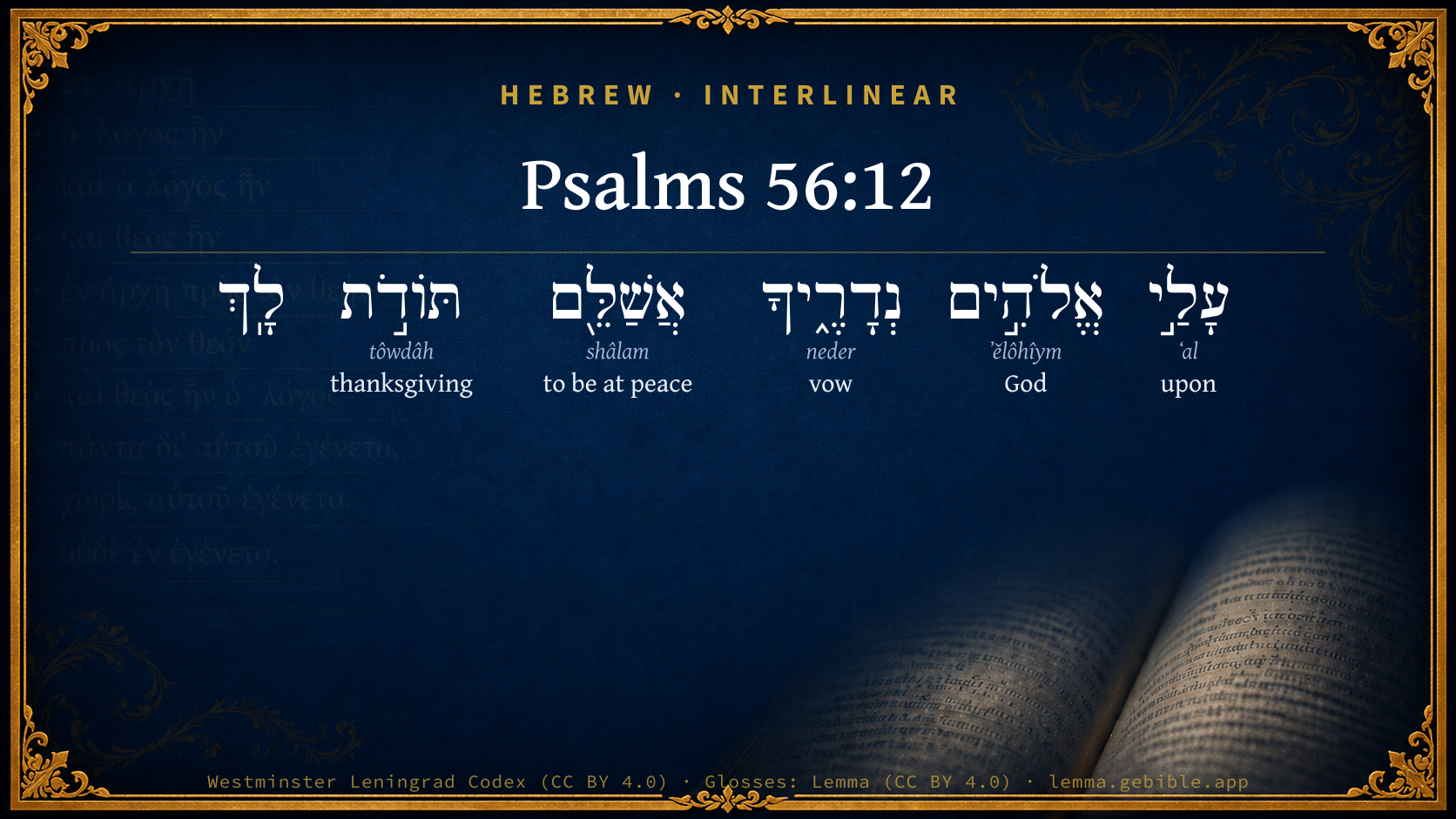
Hebrew (Westminster Leningrad Codex) Psalms 56:12 appears in the Hebrew Old Testament. The text above is from the Westminster Leningrad Codex. Each word links to its Strong’s number, a concise gloss, and parsing drawn from the Open Scriptures Hebrew Bible morphology. Click any word for its full Brown-Driver-Briggs (BDB) entry.
Download image
Cite this verse

Psalms 56:12 (World English Bible). Public Domain. Lemma interlinear Bible study tool, https://lemma.gebible.app/v/psalms/56/12.

Show BibTeX & RIS
BibTeX
RIS
English Translation
Your vows are on me, God. I will give thank offerings to you.
World English Bible · Public Domain
Download a study sheet

One document with this verse’s original text, its word-by-word gloss line, the meaning frame, cross-references with their text, attributed commentary, and full source and license credits — printable, and it pastes into notes with its structure intact.

This verse Autodidact and up

Study sheet (.html) Plain text (.txt)

A passage Seminary Student

Up to 50 verses in one chapter. A passage sheet keeps up to 6 commentary sources and 12 cross-references per verse, in the order this page ranks them, and says so on the sheet whenever that leaves anything out. Ask for a single verse and you get the Autodidact verse sheet above.

Everything on this page stays free to read, with no account — the sheet is a download of what is already on screen, not access to it.

Want to remove ads? Support Godless Engineer
Compare translations 3

The same verse in 3 English versions, stacked beneath the original-language interlinear above. Click any original word for its lexicon entry.

Each is an independent rendering of the whole verse — the interlinear is not word-aligned to these translations.

Highlighted words mark where these versions differ — a whole-verse word diff, not a word-by-word alignment.

  • World English Bible Public Domain
    Your vows are on me, God. I will give thank offerings to you.
  • King James Version Public Domain
    Thy vows are upon me, O God: I will render praises unto thee.
  • unfoldingWord Literal Text CC BY-SA 4.0
    Your vows on me, God. I will pay a thank-offering to you.

unfoldingWord Literal Text — © unfoldingWord, licensed CC BY-SA 4.0. Word-aligned USFM3 via Door43 (git.door43.org/unfoldingWord/en_ult).

Versions to compare (up to 4)

3 of 4 selected

Show all 18 translations

Every available English version of this verse, each an independent rendering of the whole verse.

  • World English Bible Public Domain
    Your vows are on me, God. I will give thank offerings to you.
  • Berean Standard Bible Public Domain
    Your vows are upon me, O God; I will render thank offerings to You.
  • Majority Standard Bible Public Domain
    Your vows are upon me, O God; I will render thank offerings to You.
  • King James Version Public Domain
    Thy vows are upon me, O God: I will render praises unto thee.
  • American Standard Version (1901) Public Domain
    Thy vows are upon me, O God: I will render thank-offerings unto thee.
  • Revised Version (1885) Public Domain
    Thy vows are upon me, O God: I will render thank offerings unto thee.
  • Geneva Bible (1599) Public Domain
    Thy vowes are vpon me, O God: I will render prayses vnto thee.
  • Douay-Rheims (1899) Public Domain
    In me, O God, are vows to thee, which I will pay, praises to thee:
  • Young's Literal Translation Public Domain
    On me, O God, `are' Thy vows, I repay thank-offerings to Thee.
  • Literal Standard Version CC BY-SA 4.0
    On me, O God, [are] Your vows, || I repay thank-offerings to You.
  • Unlocked Literal Bible CC BY-SA 4.0
    The duty to fulfill my vows to you is on me, God; I will give thank offerings to you.
  • unfoldingWord Literal Text CC BY-SA 4.0
    Your vows on me, God. I will pay a thank-offering to you.
  • Darby Bible Public Domain
    Thy vows are upon me, O God: I will render thanks unto thee.
  • World Messianic Bible Public Domain
    Your vows are on me, God. I will give thank offerings to you.
  • Webster's Bible Public Domain
    \\56:11\\In God have I put my trust: I will not be afraid what man can do to me.
  • Free Bible Version CC BY-SA 4.0
    God, I will keep my promises to you. I will give thank offerings to you,
  • Bible in Basic English Public Domain
    I keep the memory of my debt to you, O God; I will give you the offerings of praise.
  • JPS Tanakh (1917) Public Domain
    (56-13) Thy vows are upon me, O God; I will render thank-offerings unto Thee.

Literal Standard Version (2020), Covenant Press — licensed CC BY-SA 4.0. Text via the HelloAO Bible API (eBible.org). Unlocked Literal Bible (unfoldingWord) — licensed CC BY-SA 4.0. Text via the HelloAO Bible API (eBible.org). unfoldingWord Literal Text — © unfoldingWord, licensed CC BY-SA 4.0. Word-aligned USFM3 via Door43 (git.door43.org/unfoldingWord/en_ult). Free Bible Version, Dr. Jonathan Gallagher — licensed CC BY-SA 4.0. Text via the HelloAO Bible API (eBible.org).

Word by word

More ways to search: Search by grammar → Find every occurrence → Compare this word →

Practice this passage: Drill this verse → Learn its vocabulary →

תּוֹדֹ֣ת
tôwdâh
H8426
“thanksgivings”
Noun, Common, Feminine, Plural, Absolute
Part of Speech
Noun
Type
Common
Gender
Feminine
Number
Plural
State
Absolute
Full BDB Definition

Origin: from H3034

TWOT: 847b

confession, praise, thanksgiving - give praise to God - thanksgiving in songs of liturgical worship, hymn of praise - thanksgiving choir or procession or line or company - thank-offering, sacrifice of thanksgiving - confession
  1. עָלַ֣י ʻal H5921 “upon · me” Preposition + Suffix, Personal, 1st Person, Common, Singular
  2. אֱלֹהִ֣ים ʼĕlôhîym H430 “God(s)” Noun, Common, Masculine, Plural, Absolute
  3. נְדָרֶ֑יךָ neder H5088 “vows · your” Noun, Common, Masculine, Plural, Construct + Suffix, Personal, 2nd Person, Masculine, Singular
  4. אֲשַׁלֵּ֖ם shâlam H7999 “to be at peace” Verb, Piel, Imperfect, 1st Person, Common, Singular

About this verse

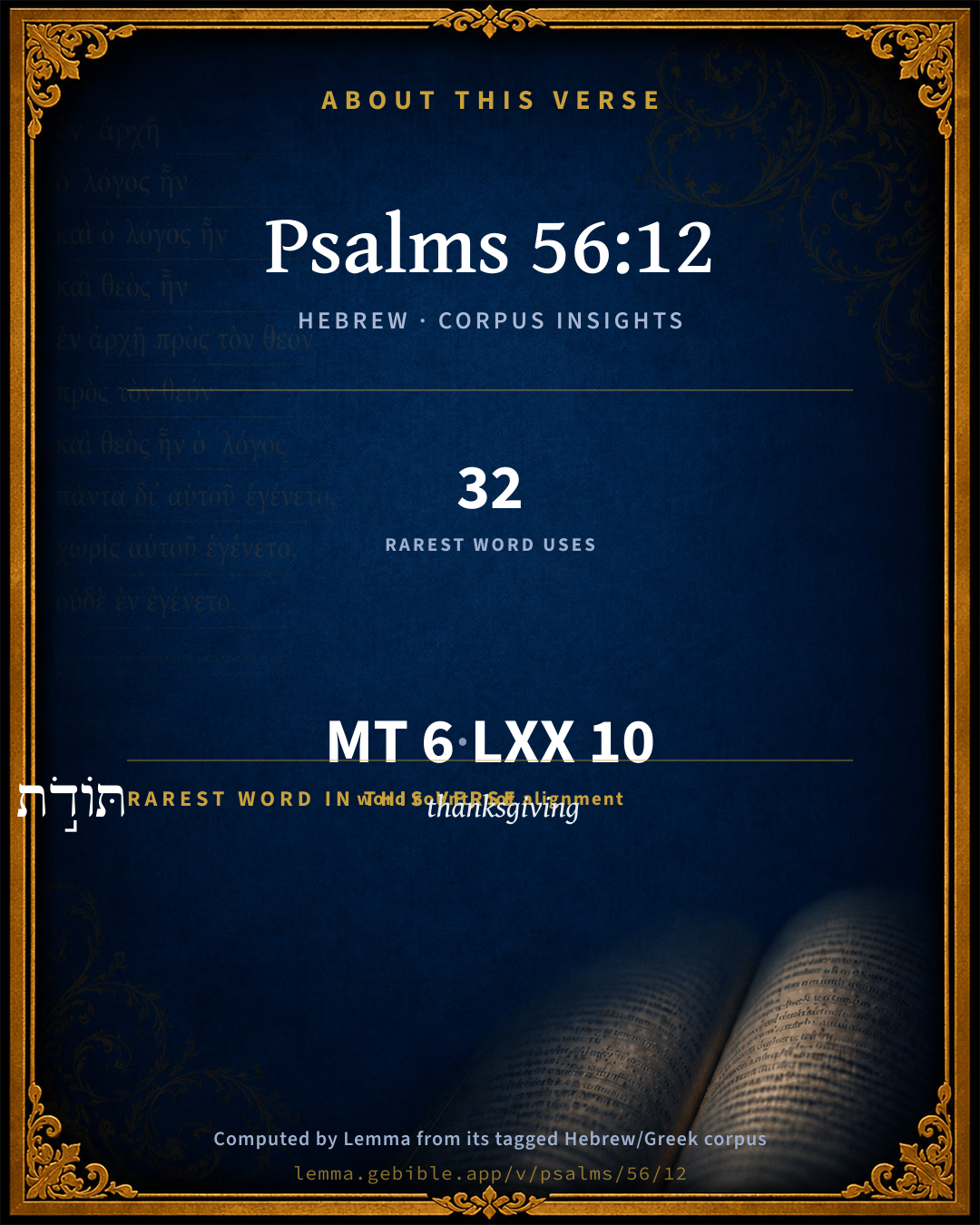
These counts appear in no published source. They are computed here, from the morphology-tagged text and Lemma’s own curated glosses. What Lemma adds →

6
words
5
distinct lemmas
Wisdom
section

Shared distinctive vocabulary

תּוֹדֹ֣ת thanksgiving H8426 occurs in 30 verses of the Hebrew Bible. Also found in:

Grammatical profile

  • 1 verb
  • 3 nouns
  • 2 prepositions

Verb forms

  • אֲשַׁלֵּ֖ם Piel · Imperfect

Hebrew & Septuagint length

In English translation the verse runs 13 words from the Hebrew and 14 from the Septuagint (LXX English) — closely comparable.

A rough comparison of the two English renderings, which tokenize alike — not a word-level alignment.

Word counts can differ between the Hebrew and the Greek without any difference in meaning — e.g. the Hebrew direct-object marker אֵת has no separate Greek word, and Greek often adds the article ὁ.

In the original languages it is 6 Hebrew tokens and 10 Greek tokens — but the two are counted differently (Hebrew bundles its prefixes and suffixes into one token; the Greek is in lemma form), so that isn’t a like-for-like length.

Cross-references

15

Topical passages linked to Psalms 56:12 in the Treasury of Scripture Knowledge — connected by theme and wording, ordered by reader-vote popularity; previews shown in the World English Bible.

  • Psalms 9:1–3 I will give thanks to Yahweh with my whole heart. I will tell of all your marvelous works.
  • 1 Samuel 1:24–28 When she had weaned him, she took him up with her, with three bulls, and one ephah of meal, and a bottle of wine, and brought him to the house of Yahweh in Shiloh: and the child was young.
  • Psalms 50:14 Offer to God the sacrifice of thanksgiving. Pay your vows to the Most High.
  • Numbers 30:2–16 When a man vows a vow to Yahweh, or swears an oath to bind his soul with a bond, he shall not break his word; he shall do according to all that proceeds out of his mouth.
  • Psalms 76:11 Make vows to Yahweh your God, and fulfill them! Let all of his neighbors bring presents to him who is to be feared.
  • Psalms 119:106 I have sworn, and have confirmed it, That I will obey your righteous ordinances.
  • Ecclesiastes 5:4–6 When you vow a vow to God, don't defer to pay it; for he has no pleasure in fools. Pay that which you vow.
  • Genesis 28:20–22 Jacob vowed a vow, saying, "If God will be with me, and will keep me in this way that I go, and will give me bread to eat, and clothing to put on,
  • Genesis 35:1–3 God said to Jacob, "Arise, go up to Bethel, and live there. Make there an altar to God, who appeared to you when you fled from the face of Esau your brother."
  • 1 Samuel 1:11 She vowed a vow, and said, Yahweh of hosts, if you will indeed look on the affliction of your handmaid, and remember me, and not forget your handmaid, but will give to your handmaid a man-child, then I will give him to Yahweh all the days of his life, and there shall no razor come on his head.
  • Psalms 21:13 Be exalted, Yahweh, in your strength, So we will sing and praise your power.
  • Psalms 59:16–17 But I will sing of your strength. Yes, I will sing aloud of your loving kindness in the morning. For you have been my high tower, A refuge in the day of my distress.
  • Psalms 66:13–14 I will come into your temple with burnt offerings. I will pay my vows to you,
  • Psalms 116:14–19 I will pay my vows to Yahweh, Yes, in the presence of all his people.
  • Isaiah 12:1 In that day you will say, "I will give thanks to you, Yahweh; for though you were angry with me, your anger has turned away and you comfort me.

Cross-references courtesy of OpenBible.info (CC BY 4.0).

Hebrew and Greek witnesses Masoretic Hebrew ↔ Greek Septuagint

The same verse in the two great witnesses to the Old Testament, shown verse-for-verse.

You’re reading Greek Psalm 55 (Hebrew Psalm 56). The Septuagint counts the superscription, so verse numbers can differ from the Hebrew — chapter-level alignment, not verse-by-verse. Numbering follows Rahlfs.

These are two independent witnesses, not word-aligned to each other, and the Septuagint is shown in lemma (dictionary) form.

Hebrew Psalms 56:12 Masoretic · Westminster Leningrad Codex

עָלַ֣י אֱלֹהִ֣ים נְדָרֶ֑יךָ אֲשַׁלֵּ֖ם תּוֹדֹ֣ת לָֽךְ

Your vows are on me, God. I will give thank offerings to you.

World English Bible · Public Domain

Greek LXX Greek Psalm 55:12 Septuagint · lemma form

ἐπί ὁ θεός ἐλπίζω οὐ φοβέω τίς ποιέω ἐγώ ἄνθρωπος

The vows of your praise, O God, which I will pay, are upon me.

LXX2012 (modern English Septuagint) · Public Domain

On this verse, Keil & Delitzsch discusses the Septuagint’s reading. Read the note in Commentary ↓

Hebrew: Westminster Leningrad Codex (CC BY 4.0). Greek: Septuagint (public domain); English from LXX2012 (modern English Septuagint) (Public Domain). How the Septuagint differs from the Hebrew →

Commentary

Notes on Psalms 56:12 from classic Christian and Jewish commentators (each source and its license shown beneath its notes). The classic Christian expositions comment on the surrounding passage and are grouped to its opening verse, so a note may address several verses; the Jewish commentaries on the Tanakh (Rashi and others) are per-verse, so they appear only where the commentator wrote on this verse.

Lemma curates 59 commentaries, every one of them public domain or Creative Commons licensed, each selected and text-cleaned for this edition rather than reprinted as found. About our sources →

Trapp's Complete Commentary

John Trapp

Psa 56:12 Thy vows [are] upon me, O God: I will render praises unto thee.

Ver. 12. Thy vows are upon me, O God] Sunt tua post, quam vovi (Arab.). I am a votary ever since I was at Gath, there and then I vowed, that if the Lord would vouchsafe to bring me out of that brake I would do as became a thankful man every way. And now I am Damnatus votorum, as the Latin expression is; vow I must, and pay to the Lord my God; Ecce ego Domine, Lord, I am ready, do thou but set me up an altar, and I will offer a sacrifice; restore me to thy sanctuary, and I will do it exactly, in the ceremonies and formalities thereof; meanwhile, mine heart and lips shall not be wanting to give thee praise in spirit and truth, I will render praises unto thee.

John Trapp, A Commentary or Exposition upon All the Books of the Old and New Testament (1647–1656) — public domain. Text from a community e-Sword module.

The Biblical Illustrator

Joseph S. Exell

Psa_56:12-13

Thy vows are upon me, O God: I will render praises unto Thee.

The Christians vows and praises

I. A solemn obligation acknowledged. Thy vows are upon me, O God.

1. Vows made in public.

(1) Entered into in baptism.

(2) Ratified in confirmation.

(3) Renewed in the Lords Supper.

2. Vows made in private.

II. A holy determination made. I will render praises unto Thee.

1. In the public acknowledgment of mercy (Heb_13:15; 1Pe_2:5; Hos_14:2).

2. In the eloquent language of the life (Rom_12:1; Heb_11:5). In conclusion, let each ask--

1. How have I hitherto fulfilled my vows?

2. How may I henceforth do so? (J. D. Lane, M. A,)

Christian vows

A vow may be defined as a promise made more solemn by a special appeal to God. It is as respects purpose, what an oath is as regards fact. And the appeal may be of different kinds. It may be expressed in the form of a prayer to God to punish or be propitious ha the maker of the promise, according as he breaks or keeps his word. It may be again in the form of a prayer for some present blessing, for which some specified return of gratitude is promised. Or lastly, it may be merely an appeal implied in the solemnity of the occasion, or of the expression of the promise, by which it is understood that the maker of it sets himself consciously in the Divine presence, and calls upon God to witness that promise. We have instances of all these three kinds in the Old Testament. The expression So do God to me and more also, so often accompanying an intimation of purpose, constitutes a vow of the first kind. Jacobs vow in Bethel is an example of the second kind. And of the third, we have a noble instance at the end of the Book of Joshua, where at a solemn concourse of the tribes at Shechem, the people expressly took Jehovah for their God, and devoted themselves to Him. It is manifest, however, that this is a matter in which Old Testament practice is no rule for Christians. Gods people of old were kept shut up under a system of special ordinances, whose obligation has now ceased, Now, of the three kinds of vows which have been mentioned, the two former must by their very terms be generally excluded from a Christian mans practice. We have left, then, for our consideration our third class, consisting of promises made with more than ordinary solemnity, accompanied by an expressed or implied appeal to God. Of these vows, as a class, we cannot but admit the legitimacy. They are by implication recognized in the New Testament, in those passages where St. Paul reminds Timothy of the good confession which he had made before many witnesses; as also in the very fact of baptism following upon a profession of faith, in which we have the virtual promise necessarily involved, and the solemnity clearly combined with it. But here everything depends upon the nature of the promise made. And it is this part of our inquiry which carries with it for us the things which are lawful. But such are not vows of celibacy, nor of total abstinence from alcoholic drinks, nor the vows of the monastic orders. Our ordination vows are net such, because they bind us not so much to the office as in the office. We are not by them tied down to any rule of life other than the requirements of our duty as Christian ministers primarily necessitate. And thus it seems to me that, while speaking on a particular case, we have in reality met with that description of a lawful Christian vow, of which we were in search. And the description will be this: Such vow must not bind a man to a course of conduct first marked out by its terms, and devised for it, but must constitute an additional obligation to a course of conduct already, for other reasons, incumbent upon him. The vow must be made for the duty, not the duty for the vow. We have, I think, now prepared the way to speak of the great lifelong promise and vow which the Church requires of her members. The points contained in it are every one of them plain Christian duties for every man. They remain the same, be the vow taken or not. They are no artificial narrowing of the limits of blameless and godly life--to which we have no right to bind any man; but describe it in its fullest extension. Beyond their limits, there is no allowable latitude; short of their prescription, no safe walking before God. The whole operation, then, of our vow is on the subject, not on the object of it. The object, a godly life, remaining one and the same for all, we strive to ensure the accomplishment of this object by intensifying the apprehension of it in the minds of the subjects on whom we have to work. Thy vows are upon me, O God. How blessed a thing, could we be anchored safe by this assurance, while so many are making shipwreck of their faith! I am not my own, but devoted to Thee and Thy work; all I am and have, to be used not for myself, but for Thee. How would such a persuasion simplify for us the difficulties of life; cut off the occasion of half our falls into worldliness and sin; brighten the light of our examples, and win souls for Christ! (Dean Alford.)

The Biblical Illustrator, edited by Joseph S. Exell (c. 1880s–1900s) — public domain. Text from a community e-Sword module.

The Treasury of David

Charles H. Spurgeon

Ver. 12. Thy vows are upon me, O God. Vows made in his trouble he does not lightly forget, nor should we. We voluntarily made them, let us cheerfully keep them. All professed Christians are men under vows, but especially those who in hours of dire distress have rededicated themselves unto the Lord.

I will render praises unto thee. With heart, and voice, and gift, we should cheerfully extol the God of our salvation. The practice of making solemn vows in times of trouble is to be commended, when it is followed by the far less common custom of fulfilling them when the trouble is over.

Ver. 12. Thy vows are upon me, O God. Whoever is conversant with the Psalms of David, will find him frequently making vows, and careful in paying them. When these words dropped from him he was just delivered out of a pressing danger among the Philistines, with whom he took shelter from the rage of King Saul, who unweariedly pursued him; but he soon found that the remembrance of his past achievements to their damage was still so fresh amongst them, and they so exasperated thereupon, that his life was in constant danger. In his distress he flies to God, his wonted refuge, and sends up earnest addresses to him, vowing if he would open a way for his deliverance out of these new straits, he would show his grateful sense of so signal a mercy, by the exactness and accuracy of his future obedience. God hears and succours him; and he thereupon grateful looks back, endeavours to renew the sense of his former obligation to his great Deliverer, and to stir up himself by suitable returns, and so cries out, Thy vows are upon me, O God; as if he should say, I resolve, O Lord, not to forget what was transacted while I was under my fears. Thou hast heard my cries, and I own myself firmly bound by my vows. I was serious and in earnest when I made them, and I will endeavour to show that I was so by my care to perform them. Thy vows, O God, made indeed on my part, but justly to be exacted on thine, are upon me, they do in reality hold me fast, and I desire not to be released. I am sensible I deserve to be stigmatised for a perfidious wretch if I ever forget them. This temper of holy David with reference to the vows he made on this occasion, should be ours with reference to all the sacred vows we any way come under. All Christians, as such, are necessarily under vows to the blessed God: and particular circumstances may make it expedient for us to come under special engagements to him. But wherever they are such as that they may justly be denominated vows of God, i.e., are such as his word will warrant; we should make holy David, as speaking in this text, our pattern, and set ourselves to imitate him, in seriously owning their binding force, and endeavouring to answer and pay them. Edmund Calamy, in "A Practical Discourse Concerning Vows, "1704.

Ver. 12. Thy vows are upon me, O God. A well composed vow will make thee more circumspect and wary in the general course of thy life. Such an influence it hath, as doth more directly work on one particular part, yet is not terminated to that particular only. Thus it was with David. These vows were made when he was in danger of his life, as it seemeth from Ps 56:13; for when God heard him, he delivered his soul from death: for this he vowed praises in particular, and he will render them. But, withal he takes himself to be hereby engaged to a more exact and circumspect walk before God in all duties: so he expresses himself in the latter part of Ps 56:13. Henry Hurst (1629-1696), in "The Morning Exercise at Cripplegate, "1661.

Ver. 12-13. Thy vows are upon me, O God. Passively, vows made to God, not by God; or the obligations of those vows and prayers which I have made and upon which I have received answers. Sacrifices of thanksgiving were called vows, as having been vowed to God upon the want, and to be paid upon the receipt, of mercy. Le 1:1, "If the sacrifice that is offered be a vow." Thy vows are upon me; the fruit of my vows, so that I stand indebted to God for the return of praise. Thou hast delivered. He understands some great danger wherein he had sunk had not God stood by him, and from a greater mercy, the deliverance of his soul from death, argues for a less, the keeping his feet from falling. That I may walk before God in the light of the living. By light of the living is meant life, which is called being enlightened with the "light of the living." Job 33:30. Sometimes eternal life in heaven. Joh 8:12, "He that follows me shall not walk in darkness, but shall have the light of life." "To walk before God." To walk obediently in the sight of God; with a respect to his presence; a walking unto all well pleasing. This is the last argument in the Psalm whereon he builds his strongest plea, as if he knew not what to urge if this should fail him; as if he should have said, Lord, I have had experience of thy wisdom in contriving, thy power in effecting, thy mercy in bestowing deliverance upon me, thy goodness in answering my vows and prayers. "Thou hast delivered from death, "a danger as great and unavoidable as death itself. O Lord, art not thou the same as thou wert? Art not thou still as wise to design, and as gracious to confer further mercy? Wilt thou not as certainly also deliver my feet from falling? The one contains his experience, the other the inference or conclusion he draws from it. Mercies received are in a special manner to be remembered. Mercies received are encouragements to ask, and strong grounds to hope for the mercies we want. Stephen Charnock.

Ver. 12. Here is--

I. Past dedication.

II. Present consecration.

III. Future glorification. G. R.

Ver. 12-13. You have here--

1. The commemoration of former mercies: Thou hast delivered.

2. The confidence of future: Wilt not thou.

3. The end of all: To walk before God in the light of the living. Stephen Charnock.

Psalms 56:13*

Ver. 12-13. Thy vows are upon me, O God. See Psalms on "Ps 56:12" for further information.

Ver. 12-13. You have here--

1. The commemoration of former mercies: Thou hast delivered.

2. The confidence of future: Wilt not thou.

3. The end of all: To walk before God in the light of the living. Stephen Charnock.

Charles H. Spurgeon's The Treasury of David (1869–1885) — public domain. Psalms only. Text from a community e-Sword/MySword module.

Joseph Benson's Commentary

Psa 56:12-13. Thy vows are upon me — As I have prayed to thee, and am assured that thou wilt deliver me, so, in confidence thereof, I have made vows to express my gratitude to thee, and I acknowledge myself obliged thereby, and do resolve to perform them. For thou hast delivered my soul from death — Which my enemies designed to bring upon me, and of which I was in extreme danger. Wilt thou not deliver my feet from falling? — I am confident that thou wilt, because of thy promises, and my former experience; that I may walk before God — That I may please, serve, and glorify thee, which is the great end for which I desire life; in the light of the living — In this life here, which is opposed to the death last mentioned; and in heaven hereafter.

Joseph Benson's Commentary on the Old and New Testaments (1811–1818) — public domain. Text from a community e-Sword module.

J. A. Alexander on Psalms

Joseph Addison Alexander

13. (Psa 56:12). Upon me, O God, (are) thy vows; I will pay thanksgiving unto thee. The first clause represents his vows or voluntary obligations as incumbent on himself and due to God, and he resolves to discharge them by thanksgivings, not merely verbal acknowledgments, but sacrificial tokens of his gratitude, such as were familiar to the ancient saints and recognised in the Law of Moses.

Joseph Addison Alexander, The Psalms Translated and Explained (1850) — public domain. Text from a community e-Sword module.

Geneva Bible (1599)

Geneva Bible translators

Having received that which I required, I am bound to pay my vows of thanksgiving, as I promised.

Geneva Bible (1599) marginal notes — public domain. Text via Bolls.life.

Jamieson, Fausset & Brown

Robert Jamieson, A. R. Fausset & David Brown

I will render praises--will pay what I have vowed.

Jamieson, Fausset & Brown — Commentary Critical and Explanatory on the Whole Bible (1871) — public domain (CC PDM 1.0). Text via the HelloAO Bible API.

Adam Clarke's Commentary

Verse 12. Thy vows are upon me] I have promised in the most solemn manner to be thy servant; to give my whole life to thee; and to offer for my preservation sacrifices of praise and thanksgiving.

Reader, what hast thou vowed to God? To renounce the devil and all his works, the pomps and vanities of this wicked world, and all the sinful desires of the flesh; to keep God's holy word and commandment, and to walk before him all the days of thy life. These things hast thou vowed; and these vows are upon thee. Wilt thou pay them?

Adam Clarke's Commentary on the Bible (1810–1826) — public domain. Text from a community e-Sword/MySword module.

John Calvin's Commentaries

12. Thy vows are upon me, O God! I hinted, from the outset, that it is probable this psalm was written by David after he had escaped the dangers which he describes; and this may account for the thanksgiving here appended to it. At the same time, we have evidence that he was ever ready to engage in this exercise even when presently suffering under his afflictions. He declares that the vows of God were upon him; by which he means, that he was bound to pay them, as, among the Romans, a person who had obtained what he sought, under engagement of a vow, was said to be voti damnatus — condemned of his vow If we have promised thanks, and our prayers have been heard, an obligation is contracted. He calls them the vows of God — thy vows; for the money in my hand may be said to be my creditor’s, being, as I am, in his debt. He views his deliverance as having come from God; and the condition having been performed, he acknowledges himself to be burdened with the vows which he had contracted. We learn from the second part of the verse what was the nature of the vows to which he adverts, and, by attending to this, may preserve ourselves from the mistake of imagining that he sanctions any such vows as those which are practiced among Papists. He says that he would render praises, or sacrifices of praise; for the word is applied to sacrifices, which were the outward symbols of thanksgiving. David knew well that God attached no value to sacrifices considered in themselves, or irrespectively of the design and spirit of the person offering them; but we may believe that he would not neglect the sacred ceremonies of the Law which was imposed upon the Church at that time; and that he speaks of some solemn expression of gratitude, such as was customary among the Jews upon the reception of a signal Divine favor.

John Calvin's Commentaries (1540-1563) — public domain. Text from the Calvin Translation Society English edition (1840s-50s) via the Christian Classics Ethereal Library (ccel.org). Calvin's coverage is partial (roughly two-thirds of the Bible); uncommented books and verses are honest gaps, never fabricated. The 19th-century editor's footnotes and remarks are omitted so the notes are faithfully Calvin's own voice.

Ellicott's Commentary for English Readers

(12) Thy vows—i.e., vows made to Thee, but the form is most unusual. For the thought comp. Psa_22:25; Psa_50:14.

I will render—i.e., in fulfilment of the vows.

A Bible Commentary for English Readers, edited by Charles John Ellicott (1878–1897) — public domain. Text from a community e-Sword module.

The Cambridge Bible for Schools and Colleges

gen. ed. J. J. S. Perowne

12. Thy vows &c.] Vows made to Thee. The Psalmist acknowledges his obligations. Cp. Psa_66:13; Act_21:23.

praises] R.V., thank offerings, in addition to the votive offerings.

12, 13. Concluding vows of thanksgiving.

The Cambridge Bible for Schools and Colleges (gen. ed. J. J. S. Perowne; Cambridge University Press, 1878–1918) — public domain. Text from a community e-Sword module.

John Gill's Exposition

Thy vows are upon me, O God,.... Which he had made to him in the time of his distress and trouble, and which he looked upon himself under obligation to perform; they were debts upon him he ought to pay off; they were with him; they were fresh in his mind and memory; he had not forgot them, which is often the case when trouble is over; and he found his heart inclined to make them good;

I will render praises unto thee; which explains what he meant by his vows; namely, sacrifices of praise and thanksgiving to the Lord: when he was in distress, he had vowed and promised, that, if the Lord would deliver him, he would praise his name, and give him all the glory; and now he resolves to fulfil what he had promised.

John Gill's Exposition of the Whole Bible (1746–1763) — public domain (CC PDM 1.0). Text via the HelloAO Bible API.

Albert Barnes' Notes on the Bible

Thy vows are upon me, O God - The word “vow” means something promised; some obligation under which we have voluntarily brought ourselves. It differs from duty, or obligation in general, since that is the result of the divine command, while this is an obligation arising from the fact that we have “voluntarily” taken it upon ourselves. The extent of this obligation, therefore, is measured by the nature of the promise or vow which we have made; and God will hold us responsible for carrying out our vows. Such voluntary obligations or vows were allowable, as an expression of thanksgiving, or as a means of exciting to a more strict religious service, under the Mosaic dispensation Gen 28:20; Num 6:2; Num 30:2-3; Deu 23:21; 1Sa 1:11; and they cannot be wrong under any dispensation. They are not of the nature of “merit,” or works of supererogation, but they are

(a) a “means” of bringing the obligations of religion to bear upon us more decidedly, and

(b) a proper expression of gratitude.

Such vows are those which all persons take upon themselves when they make a profession of religion; and when such a profession of religion is made, it should be a constant reflection on our part, that “the vows of God are upon us,” or that we have voluntarily consecrated all that we have to God. David had made such a vow

(a) in his general purpose to lead a religious life;

(b) very probably in some specific act or promise that he would devote himself to God if he would deliver him, or as an expression of his gratitude for deliverance. Compare the notes at Act 18:18; notes at Act 21:23-24.

I will render praises unto thee - literally, “I will recompense praises unto thee;” that is, I will “pay” what I have vowed, or I will faithfully perform my vows.

Albert Barnes' Notes on the Bible (1834–1885) — public domain. Text from a community e-Sword/MySword module.

Matthew Poole's English Annotations

As I have prayed to thee, and am assured that thou wilt deliver me; so in confidence thereof I have made vows to express my gratitude to thee, and I acknowledge myself obliged and do resolve to perform them.

Matthew Poole's English Annotations on the Holy Bible (1683–1685) — public domain. Text from a community e-Sword/MySword module.

Whedon's Commentary on the Bible

Daniel D. Whedon

12. Thy vows are upon me—He reaffirms all his previous vows. They are as sacredly binding here in Gath as in his own land—in exile as in the congregation of the saints. This reminding God that he still held to his vows, leaves the fulfilment of the promises wholly depending upon the divine veracity.

I will render praises—The form of speech—offer thanksgiving—is sacrificial, meaning praise or thanksgiving as a sacrifice, or, as in Hos_14:2, “the calves of our lips.” See Heb_13:15. As the promise of “thank offering” immediately follows the mention of his vows, it is probably the votive offering which he promises, which was due after the condition of the vow had been met, and the blessing prayed for granted. This David waits for in faith.

Daniel D. Whedon (gen. ed.), Commentary on the Old and New Testaments (1874–1909) — public domain. Text from a community e-Sword module.

The Pulpit Commentary

Vers. 12, 13. The psalm ends with an expression of thankfulness to God for the deliverance, which is so confidently expected, that it is looked upon as assured, and even spoken of as past (ver. 13).

Thy vows are upon me, O God. The psalmist, under his affliction, has made vows to God; i.e. promises of thank offerings if God would come to his aid, and save him from his enemies. These vows he considers to be now due, and himself to be under the obligation of paying them. Accordingly, he announces his intention of speedily discharging his obligationI will render praises (rather, thank offerings) unto thee.

Vows.

The first time we read of vows in the Bible is in Gen_28:20, where it is said, "And Jacob vowed a vow." Sometimes vows were made at special times and for special purposes; but, in the deepest sense, God"s people felt that to them life was a vow; at every moment and through all changes they were under the law of consecration to God. The words of the psalmist may be held as appropriate to the period of entering upon a new year. This is a fitting time

I FOR THANKFUL ACKNOWLEDGMENT OF GOD"S MERCIES. The eye is upon the past, and as the memory calls up God"s deeds of love, the heart glows with gratitude. "I will render praises unto thee." How just and reasonable! thou hast delivered my soul from death.

II EARNEST PRAYER TO GOD FOR SPIRITUAL HELP. The future has its dangers. The biographies of good men, our own experiences, and the circumstances of our lot, warn us that we are liable to fall. In our weakness and fear we cry to God, "Wilt not thou deliver my feet from falling?" Fails are hurtful to ourselves and to others. Therefore our cry should be the more urgent to him who is "able to keep us from falling". (Jud_1:24) The deliverances of the past are a strong plea for deliverance in the future. As Cowper has said of gifts, we may say of deliverances"The best return for one like me, So wretched and so poor, Is from his gifts to draw a plea, And ask him still for more.

III RENEWAL OF OUR COVENANT ENGAGEMENTS. "Thy vows." It is well for us to consecrate ourselves afresh to God.

1. To walk before God.

2. In the light of the living.

Christ is the Living One. (Rev_1:18) The saints are the living. (1Th_5:10) It is in the light of Christ, and in fellowship with his people, that we can best fulfil our course here, and best prepare for the services of eternity. How sweet the light instead of the darkness! and how blessed life instead of death! W.F.

The Pulpit Commentary (1880–1919), ed. H.D.M. Spence-Jones & Joseph S. Exell — public domain. Text from a community e-Sword module.

John Wesley's Explanatory Notes

Thy vows - I had made vows to express my gratitude, and resolve to perform them.

John Wesley, Explanatory Notes Upon the Whole Bible (1754–1765) — public domain. Text via the GEBible commentary corpus.

Keil & Delitzsch

C. F. Keil & F. Delitzsch

In prospect of his deliverance the poet promises beforehand to fulfil the duty of thankfulness. עלי, incumbent upon me, as in Pro 7:14; Sa2 18:11. נדריך, with an objective subject, are the vows made to God; and תּודות are distinguished from them, as e.g., in Ch2 29:31. He will suffer neither the pledged שׁלמי נדר nor the שׁלמי תּודה to be wanting; for - so will he be then able to sing and to declare - Thou hast rescued, etc. The perfect after כּי denotes that which is then past, as in Psa 59:17, cf. the dependent passage Psa 116:8. There the expression is ארצות החיּים instead of אור החיּים (here and in Elihu's speech, Job 33:30). Light of life (Joh 8:12) or of the living (lxx τῶν ζώντων) is not exclusively the sun-light of this present life. Life is the opposite of death in the deepest and most comprehensive sense; light of life is therefore the opposite of the night of Hades, of this seclusion from God and from His revelation in human history.

Keil & Delitzsch — Biblical Commentary on the Old Testament (1861–1891) — public domain (CC PDM 1.0). Text via the HelloAO Bible API. (Old Testament only.)

unfoldingWord translationNotes

Door43 World Missions Community

The duty to fulfill my vows to you is on me

Being obligated to do something is spoken of as if the duty to do something is on a person. AT: "I must fulfill my vows to you" or "I must do what I promised you I would do" (See: Metaphor)

you have kept my feet from falling

The feet here represent the person. Falling here probably represents being killed by his enemies. AT: "you have kept me from falling" or "you have kept me from being killed by my enemies" (See: Synecdoche)

so that I may walk before God

Living and being seen by God is spoken of as walking before God. AT: "so that I may live in God's presence" (See: Metaphor)

in the light of the living

Here "the light of the living" probably represents God's enabling people to live. AT: "with the life that you give" or "because you enable me to live" (See: Metonymy)

translationWords

fulfill

vow

sacrifice

die

walk

light

life

unfoldingWord translationNotes — © Distant Shores Media and the Door43 World Missions Community, licensed CC BY-SA 4.0. Source: git.door43.org/Door43/en_tn.

Lesson kit

Teaching starters — assembled from the data on this page, not authored interpretation. Every prompt links to the verse data it draws on. Edit before teaching.

Psalms, in the Wisdom, opens this verse with 6 words (5 distinct Hebrew lemmas). Its most distinctive word is tôwdâh (“thanksgiving”). A historical commentator’s framing appears above. Read the whole chapter for the surrounding context.

Discussion questions

  1. What does “thanksgiving” (tôwdâh) contribute to the verse as a whole?
  2. Leviticus 7:12 shares the word «thanksgiving» with this verse. How do the two illuminate each other?
  3. These translations render this verse differently. What is at stake in choosing one wording over another?
  4. The verb «אֲשַׁלֵּ֖ם» is Piel Imperfect. How does its form color the action?
  5. Reading how Trapp's Complete Commentary and The Biblical Illustrator read this verse, where do the two commentators agree and where do they part?

Things to notice

Reading settings

Reading text

Shown beneath each verse's original-language words.

Old Testament
Old Testament edition

Read the OT as the Masoretic Hebrew (MT) or the Greek Septuagint (LXX).

English shown for the Greek Septuagint (in the Hebrew ↔ Greek comparison).

Comparing translations? Open the Compare panel on any verse page to stack up to four side by side.