
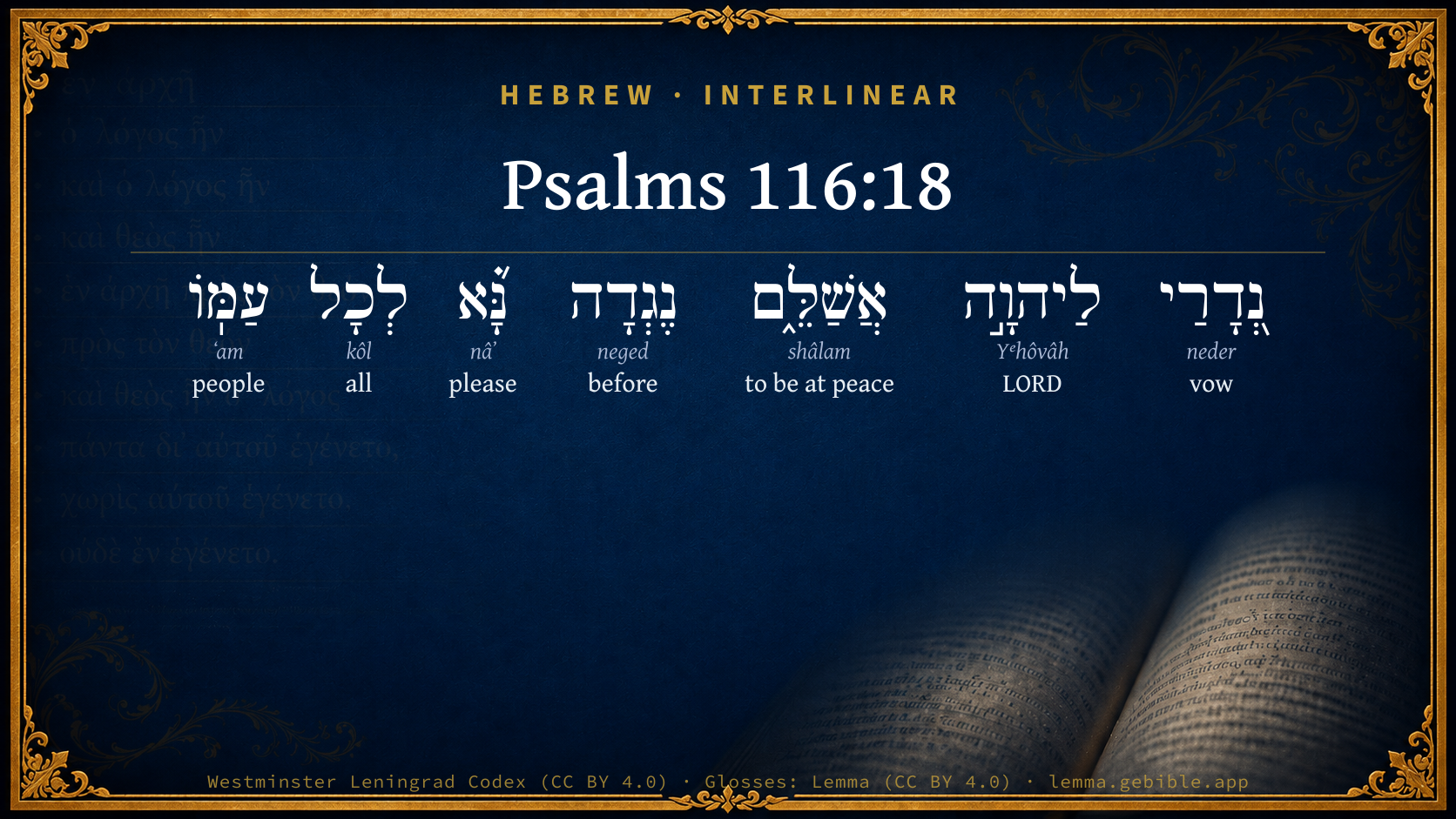
Psalms 116:18

Hebrew (Westminster Leningrad Codex) Psalms 116:18 appears in the Hebrew Old Testament. The text above is from the Westminster Leningrad Codex. Each word links to its Strong’s number, a concise gloss, and parsing drawn from the Open Scriptures Hebrew Bible morphology. Click any word for its full Brown-Driver-Briggs (BDB) entry.
Download image
Cite this verse

Psalms 116:18 (World English Bible). Public Domain. Lemma interlinear Bible study tool, https://lemma.gebible.app/v/psalms/116/18.

Show BibTeX & RIS
BibTeX
RIS
English Translation
I will pay my vows to Yahweh, Yes, in the presence of all his people,
World English Bible · Public Domain
Download a study sheet

One document with this verse’s original text, its word-by-word gloss line, the meaning frame, cross-references with their text, attributed commentary, and full source and license credits — printable, and it pastes into notes with its structure intact.

This verse Autodidact and up

Study sheet (.html) Plain text (.txt)

A passage Seminary Student

Up to 50 verses in one chapter. A passage sheet keeps up to 6 commentary sources and 12 cross-references per verse, in the order this page ranks them, and says so on the sheet whenever that leaves anything out. Ask for a single verse and you get the Autodidact verse sheet above.

Everything on this page stays free to read, with no account — the sheet is a download of what is already on screen, not access to it.

Want to remove ads? Support Godless Engineer
Compare translations 3

The same verse in 3 English versions, stacked beneath the original-language interlinear above. Click any original word for its lexicon entry.

Each is an independent rendering of the whole verse — the interlinear is not word-aligned to these translations.

Highlighted words mark where these versions differ — a whole-verse word diff, not a word-by-word alignment.

  • World English Bible Public Domain
    I will pay my vows to Yahweh, Yes, in the presence of all his people,
  • King James Version Public Domain
    I will pay my vows unto the LORD now in the presence of all his people.
  • unfoldingWord Literal Text CC BY-SA 4.0
    I will fulfill my vows to Yahweh right in front of all of his people,

unfoldingWord Literal Text — © unfoldingWord, licensed CC BY-SA 4.0. Word-aligned USFM3 via Door43 (git.door43.org/unfoldingWord/en_ult).

Versions to compare (up to 4)

3 of 4 selected

Show all 18 translations

Every available English version of this verse, each an independent rendering of the whole verse.

  • World English Bible Public Domain
    I will pay my vows to Yahweh, Yes, in the presence of all his people,
  • Berean Standard Bible Public Domain
    I will fulfill my vows to the LORD in the presence of all His people,
  • Majority Standard Bible Public Domain
    I will fulfill my vows to the LORD in the presence of all His people,
  • King James Version Public Domain
    I will pay my vows unto the LORD now in the presence of all his people.
  • American Standard Version (1901) Public Domain
    I will pay my vows unto Jehovah, Yea, in the presence of all his people,
  • Revised Version (1885) Public Domain
    I will pay my vows unto the LORD, yea, in the presence of all his people.
  • Geneva Bible (1599) Public Domain
    I will pay my vowes vnto the Lord, euen nowe in the presence of all his people,
  • Douay-Rheims (1899) Public Domain
    I will pay my vows to the Lord in the sight of all his people:
  • Young's Literal Translation Public Domain
    My vows to Jehovah let me complete, I pray you, before all His people,
  • Literal Standard Version CC BY-SA 4.0
    Let me complete my vows to YHWH, || Now, before all His people,
  • Unlocked Literal Bible CC BY-SA 4.0
    I will fulfill my vows to Yahweh in the presence of all his people,
  • unfoldingWord Literal Text CC BY-SA 4.0
    I will fulfill my vows to Yahweh right in front of all of his people,
  • Darby Bible Public Domain
    I will perform my vows unto Jehovah, yea, before all his people,
  • World Messianic Bible Public Domain
    I will pay my vows to the LORD, yes, in the presence of all his people,
  • Webster's Bible Public Domain
    I will pay my vows to the LORD now in the presence of all his people,
  • Free Bible Version CC BY-SA 4.0
    I will keep my promises to the Lord so everyone can see,
  • Bible in Basic English Public Domain
    I will make the offerings of my oath, even before all his people;
  • JPS Tanakh (1917) Public Domain
    I will pay my vows unto the LORD, yea, in the presence of all His people;

Literal Standard Version (2020), Covenant Press — licensed CC BY-SA 4.0. Text via the HelloAO Bible API (eBible.org). Unlocked Literal Bible (unfoldingWord) — licensed CC BY-SA 4.0. Text via the HelloAO Bible API (eBible.org). unfoldingWord Literal Text — © unfoldingWord, licensed CC BY-SA 4.0. Word-aligned USFM3 via Door43 (git.door43.org/unfoldingWord/en_ult). Free Bible Version, Dr. Jonathan Gallagher — licensed CC BY-SA 4.0. Text via the HelloAO Bible API (eBible.org).

Word by word

More ways to search: Search by grammar → Find every occurrence → Compare this word →

Practice this passage: Drill this verse → Learn its vocabulary →

About this verse

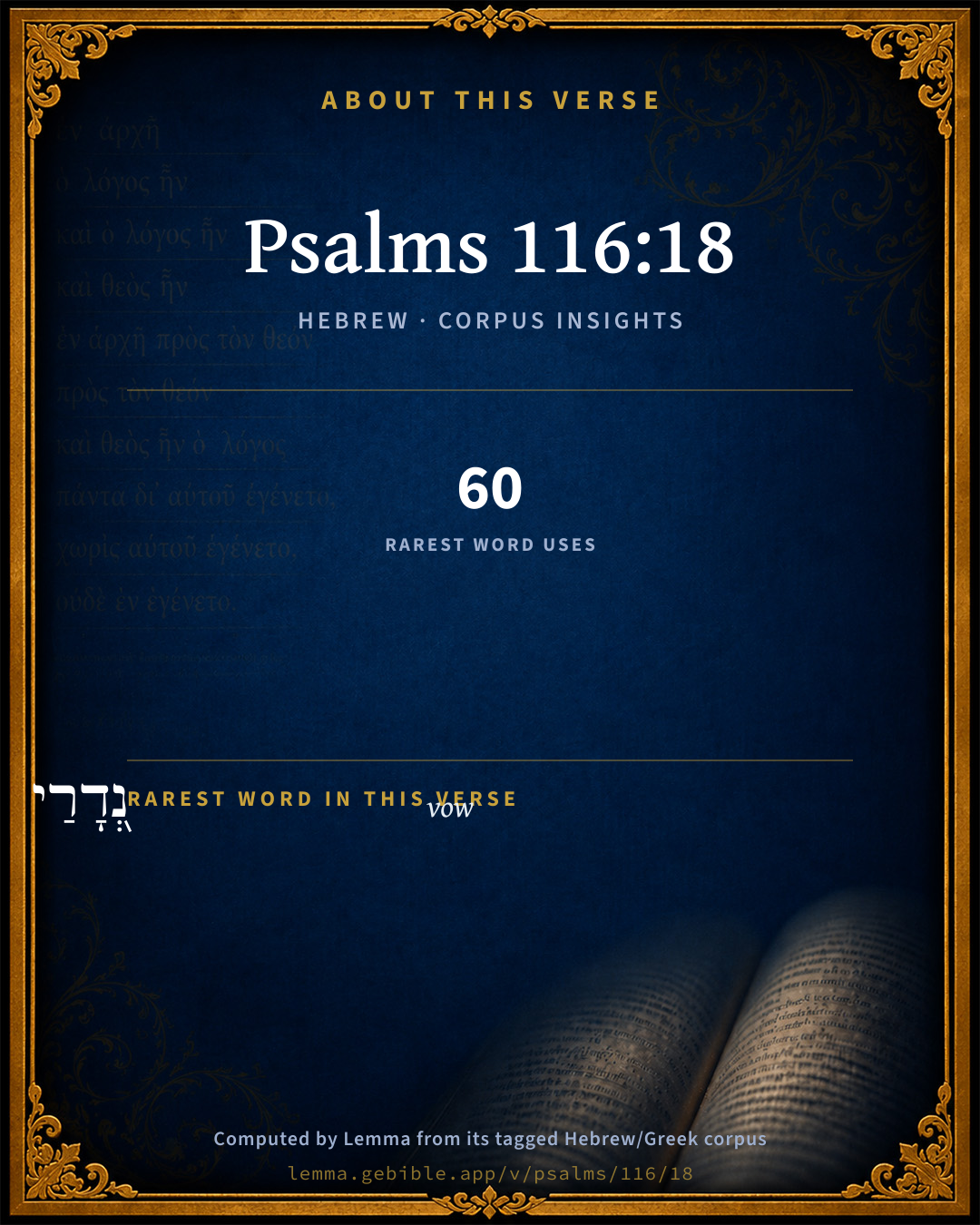
These counts appear in no published source. They are computed here, from the morphology-tagged text and Lemma’s own curated glosses. What Lemma adds →

7
words
7
distinct lemmas
Wisdom
section

Shared distinctive vocabulary

נְ֭דָרַי vow H5088 occurs in 57 verses of the Hebrew Bible. Also found in:

Grammatical profile

  • 1 verb
  • 4 nouns
  • 1 preposition
  • 1 particle

Verb forms

  • אֲשַׁלֵּ֑ם Piel · Imperfect

Hebrew & Septuagint length

In English translation the verse runs 15 words from the Hebrew and 13 from the Septuagint (LXX English) — closely comparable.

A rough comparison of the two English renderings, which tokenize alike — not a word-level alignment.

Word counts can differ between the Hebrew and the Greek without any difference in meaning — e.g. the Hebrew direct-object marker אֵת has no separate Greek word, and Greek often adds the article ὁ.

Cross-references

4

Topical passages linked to Psalms 116:18 in the Treasury of Scripture Knowledge — connected by theme and wording, ordered by reader-vote popularity; previews shown in the World English Bible.

  • Psalms 116:14 I will pay my vows to Yahweh, Yes, in the presence of all his people.
  • Psalms 22:25 Of you comes my praise in the great assembly. I will pay my vows before those who fear him.
  • Psalms 76:11 Make vows to Yahweh your God, and fulfill them! Let all of his neighbors bring presents to him who is to be feared.
  • Ecclesiastes 5:5 It is better that you should not vow, than that you should vow and not pay.

Cross-references courtesy of OpenBible.info (CC BY 4.0).

Hebrew and Greek witnesses Masoretic Hebrew ↔ Greek Septuagint

The same verse in the two great witnesses to the Old Testament, shown verse-for-verse.

You’re reading Greek Psalm 114 (Hebrew Psalm 116). The Septuagint counts the superscription, so verse numbers can differ from the Hebrew — chapter-level alignment, not verse-by-verse. Numbering follows Rahlfs.

These are two independent witnesses, not word-aligned to each other, and the Septuagint is shown in lemma (dictionary) form.

Hebrew Psalms 116:18 Masoretic · Westminster Leningrad Codex

נְ֭דָרַי לַיהוָ֣ה אֲשַׁלֵּ֑ם נֶגְדָה נָּ֝֗א לְכָל עַמּֽוֹ

I will pay my vows to Yahweh, Yes, in the presence of all his people,

World English Bible · Public Domain

Greek LXX Greek Psalm 114:18 Septuagint · lemma form
But we, the living, will bless the Lord, from henceforth and for ever.

LXX2012 (modern English Septuagint) · Public Domain

Hebrew: Westminster Leningrad Codex (CC BY 4.0). Greek: Septuagint (public domain); English from LXX2012 (modern English Septuagint) (Public Domain). How the Septuagint differs from the Hebrew →

Commentary

Notes on Psalms 116:18 from classic Christian and Jewish commentators (each source and its license shown beneath its notes). The classic Christian expositions comment on the surrounding passage and are grouped to its opening verse, so a note may address several verses; the Jewish commentaries on the Tanakh (Rashi and others) are per-verse, so they appear only where the commentator wrote on this verse.

Lemma curates 59 commentaries, every one of them public domain or Creative Commons licensed, each selected and text-cleaned for this edition rather than reprinted as found. About our sources →

Trapp's Complete Commentary

John Trapp

Psa 116:18 I will pay my vows unto the LORD now in the presence of all his people,

Ver. 18. I will pay] See Psa 116:14.

Now] Vows were to be paid without either diminution or delays, Deu 23:21; Deu 23:23. And herein Jacob (who is by the Hebrews called Votorum Pater, the father of vows) was too short; for it was long ere he went up to Bethel.

In the presence of all his people] For good example’ sake. This also was prince-like, Eze 46:10, the king’s seat in the sanctuary was open, that all might see him there, 2Ki 11:14; 2Ki 23:3.

John Trapp, A Commentary or Exposition upon All the Books of the Old and New Testament (1647–1656) — public domain. Text from a community e-Sword module.

The Biblical Illustrator

Joseph S. Exell

Psa_116:18-19

In the courts of the Lords house.

The duty and blessing of public worship

I. An urgent duty. That God should receive the adoration of His creatures is the first dictate of all theology. We are told, in the earliest periods of sacred history, of altars erected and sacrifices offered. It was not until natural religion degenerated into idolatry that the manner of their service was specially revealed. The light of nature had led them together into Gods presence. The throne of grace, the song of praise, the Word of God--by means like these His people find Him, and they can come even to His seat. They are to us the patriarchs ladder, connecting earth and heaven; and if ours is the true spirit of devotion, we too shall be encompassed with messages of Divine approval, and shall leave its scenes of gracious manifestation, exclaiming, It was none other than the house of God; it was the gate of heaven.

II. An invaluable privilege. The truth, that all duty is privilege, applies here with special force. The holy city drew forth the desires of the pious Hebrew, because it was the place of the visible presence of the Most High, where His favour was to be obtained. Within the gates of Jerusalem He was to be found; and the psalmist therefore longed, yea, even fainted for the courts of the Lord. Surely the Christian cannot lag behind the Jew, when he reckons up the benefits that flow from united approach to the place where prayer is wont to be made. What are all the ordinances of Christian faith, its simple sacraments, the Sabbath institution, the house of God, our perpetual access to the Throne--what are all these but our Jerusalem?

III. A scene of hallowed enjoyment. It is impossible to read this psalm without being struck with its cheerful, happy tone. It expresses feelings very unlike the repulsive gloom with which some have invested the sanctuary and its services. Gods worship inspired those who of old engaged in it with most enviable dispositions, if one may judge of them by their record here. How comprehensive its sympathies! How tender its affections! Love to God and man, to His Word, and to His people, breathes through every verse; and whenever God is worshipped in truth, the same experience is realized. Our feet stand on holy ground. Far hence be banished all profane thoughts and ungenial tempers, with the dark crowd of lusts that war against the soul. Here contrition mourns over sin; humility owns unworthiness; trustfulness casts herself on sovereign mercy; and love awakens love, as devotion enkindles her sacred fires. Let such feelings be in our hearts on one day of the week, and every other will own their influence; while the communion of saints is deepened in the place where the rich and poor meet together, and the Lord is the Maker of them all. Let it be something to us to belong to the company of those who worship God. Let our brethren be to us co-heirs of the grace of life, with whose joys and sorrows we seek to sympathize; and let our fellow-worshippers have a place in our kind regards and unfailing prayers. Let the very church we worship in be dear to us as the scene of sacred fellowship. (A. MacEwen, D.D.)

.

Psa_117:1-2

The Biblical Illustrator, edited by Joseph S. Exell (c. 1880s–1900s) — public domain. Text from a community e-Sword module.

J. A. Alexander on Psalms

Joseph Addison Alexander

18. (Psa 116:18) My vows to Jehovah will I pay in the presence (I entreat) of all his people. An exact repetition of Psa 116:14, with all its singularities of form.

Joseph Addison Alexander, The Psalms Translated and Explained (1850) — public domain. Text from a community e-Sword module.

Geneva Bible (1599)

Geneva Bible translators

I will thank him for his benefits, for that is a just payment, to confess that we owe all to God.

Geneva Bible (1599) marginal notes — public domain. Text via Bolls.life.

The Cambridge Bible for Schools and Colleges

gen. ed. J. J. S. Perowne

18. As in Psa_22:25 stress is laid upon the public confession of gratitude. Cp. Psa_66:13.

The Cambridge Bible for Schools and Colleges (gen. ed. J. J. S. Perowne; Cambridge University Press, 1878–1918) — public domain. Text from a community e-Sword module.

Albert Barnes' Notes on the Bible

I will pay my vows ... - See Psa 116:14.

Albert Barnes' Notes on the Bible (1834–1885) — public domain. Text from a community e-Sword/MySword module.

Matthew Poole's English Annotations

And as I said before, so I now repeat my promise, for the greater assurance, and to lay the stricter obligation upon myself.

Matthew Poole's English Annotations on the Holy Bible (1683–1685) — public domain. Text from a community e-Sword/MySword module.

The Treasury of David

Charles H. Spurgeon

Ver. 18. I will pay my vows unto the Lord now in the presence of all his people. He repeats the declaration. A good thing is worth saying twice. He thus stirs himself up to greater heartiness, earnestness, and diligence in keeping his vow, really paying it at the very moment that he is declaring his resolution to do so. The mercy came in secret, but the praise is rendered in public; the company was, however, select; he did not cast his pearls before swine, but delivered his testimony before those who could understand and appreciate it.

Ver. 18. Vows. Are well composed vows such promoters of religion? and are they to be made so warily? and do they bind so strictly? Then be sure to wait until God give you just and fit seasons for vowing. Be not over hasty to vow: it is an inconsiderate and foolish haste of Christians to make more occasions of vowing than God doth make for them. Make your vows, and spare not, so often as God bids you; but do not do it oftener. You would wonder I should dissuade you from vowing often, when you have such constant mercies; and wonder well you might, if God did expect your extraordinary bond and security for every ordinary mercy: but he requires it not; he is content with ordinary security of gratitude for ordinary mercies; when he calls for extraordinary security and acknowledgment, by giving extraordinary mercies, then give it and do it. Henry Hurst.

Ver. 18. Now. God gave an order that no part of the thank offering should be kept till the third day, to teach us to present our praises when benefits are newly received, which else would soon wax stale and putrefy as fish doth. "I will pay my vows now, "saith David. Samuel Clarke (1599-1682) in "A Mirror or Looking glass, both for Saints and Sinners."

Ver. 18. In the presence of all his people. For good example's sake. This also was prince like, Eze 46:10. The king's seat in the sanctuary was open, that all might see him there, 2Ki 11:14, and 2Ki 23:3. John Trapp.

Ver. 18. In the presence of all his people. Be bold, be bold, ye servants of the Lord, in sounding forth the praises of your God. Go into presses of people; and in the midst of them praise the Lord. Wicked men are over bold in pouring forth their blasphemies to the dishonour of God; they care not who hear them. They stick not to do it in the midst of cities. Shall they be more audacious to dishonour God, than ye zealous to honour him? Assuredly Christ will shew himself as forward to confess you, as you are, or can be to confess him. Mt 10:32. This holy boldness is the ready way to glory. William Gouge.

Ver. 18.

1. How vows may be paid in public. By going to public worship as the first thing we do when health is restored. By uniting heartily in the song. By coming to the communion. By special thank offering. By using fit opportunities for open testimony to the Lord's goodness.

2. The special difficulty in the matter. To pay them to the Lord, and not in ostentation or as an empty form.

3. The peculiar usefulness of the public act. It interests others, touches their hearts, reproves, encourages, etc.

Psalms 116:19*

Charles H. Spurgeon's The Treasury of David (1869–1885) — public domain. Psalms only. Text from a community e-Sword/MySword module.

The Pulpit Commentary

I will pay my vows unto the Lord now in the presence of all his people. Compare the comment on ver. 14, whereof this is a repetition.

The Pulpit Commentary (1880–1919), ed. H.D.M. Spence-Jones & Joseph S. Exell — public domain. Text from a community e-Sword module.

unfoldingWord translationNotes

Door43 World Missions Community

General Information:

The person who made this song continues to speak.

I will fulfill ... all his people

See how you translated Psalms 116:14.

in the courts of Yahweh's house

The word "house" refers to Yahweh's temple. AT: "in the courtyards of Yahweh's temple" (See: Metonymy)

in your midst, Jerusalem

The writer speaks to Jerusalem as though it were a person. AT: "in Jerusalem" (See: Personification and Apostrophe)

translationWords

court

house

Jerusalem

praise

unfoldingWord translationNotes — © Distant Shores Media and the Door43 World Missions Community, licensed CC BY-SA 4.0. Source: git.door43.org/Door43/en_tn.

Rashi

Rabbi Shlomo Yitzchaki (Rashi)

my vows The sacrifices that I vowed.

Rashi on the Tanakh — English translations: “The Judaica Press complete Tanach with Rashi, translated by A. J. Rosenberg” (CC BY 4.0); “Pentateuch with Rashi's commentary by M. Rosenbaum and A.M. Silbermann, 1929-1934” (public domain); “The Metsudah Tanach series, Lakewood, N.J” (CC BY 4.0); and “The Book of Joshua, Metsudah Publications, 1997” (CC BY 4.0). Text via Sefaria.

Lesson kit

Teaching starters — assembled from the data on this page, not authored interpretation. Every prompt links to the verse data it draws on. Edit before teaching.

Psalms, in the Wisdom, opens this verse with 7 words (7 distinct Hebrew lemmas). Its most distinctive word is neder (“vow”). A historical commentator’s framing appears above. Read the whole chapter for the surrounding context.

Discussion questions

  1. What does “vow” (neder) contribute to the verse as a whole?
  2. How does Genesis 28:20, which shares the word «vow», read alongside this verse?
  3. These translations render this verse differently. What is at stake in choosing one wording over another?
  4. «אֲשַׁלֵּ֑ם» is a Piel Imperfect verb. How does that grammatical form shape the action described?
  5. Compare how Trapp's Complete Commentary and The Biblical Illustrator read this verse. Where do they agree or differ?

Things to notice

Reading settings

Reading text

Shown beneath each verse's original-language words.

Old Testament
Old Testament edition

Read the OT as the Masoretic Hebrew (MT) or the Greek Septuagint (LXX).

English shown for the Greek Septuagint (in the Hebrew ↔ Greek comparison).

Comparing translations? Open the Compare panel on any verse page to stack up to four side by side.