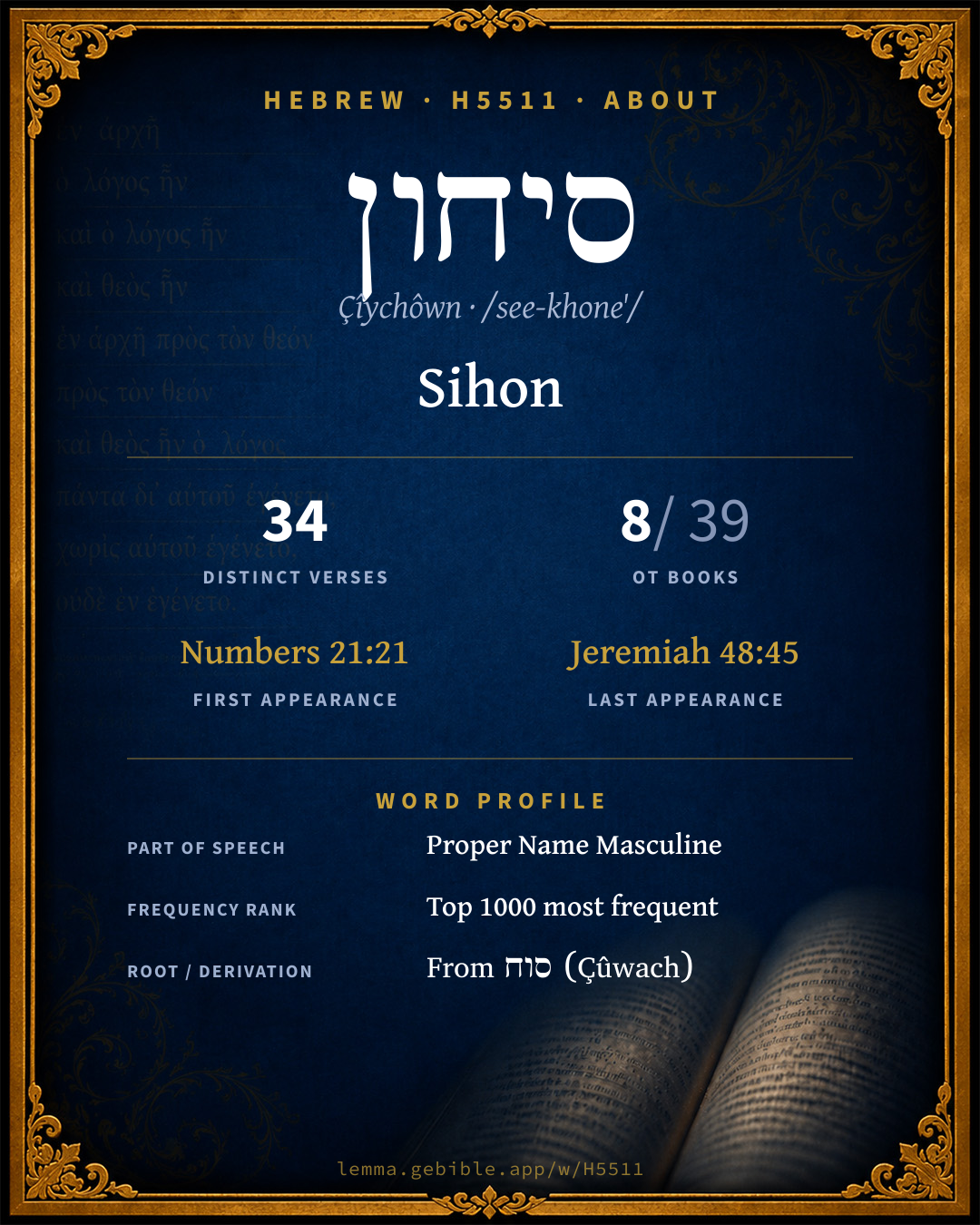
סִיחוֹן
Sihon
BDB lists 2 entries for ‘Sihon’ fuller range ↓
Full lexicon entry — Brown-Driver-Briggs (BDB)
From Brown-Driver-Briggs (BDB)
Where this word appears
Grammar key — what these labels mean
Part of speech
- Noun
- A naming word — a person, place, thing, or idea.
Noun type
- Proper
- A name of a specific person, place, or people (e.g. Abraham, Zion, Israel).
Every verse where H5511 appears — 34 distinct verses across 8 books. Click any verse to open its interlinear word-by-word view. Verse text shown in the World English Bible for context — . Each verse’s Hebrew form is shown with its reference; the English is not keyword-highlighted, since the data carries no word-level English alignment. Use “Compare translations” on any verse to read it across multiple English versions. This concordance covers the Hebrew Bible; Septuagint (Greek Old Testament) occurrences are not indexed here.
Numbers 8 verses
- Numbers 21:21 סִיחֹ֥ן n Proper Israel sent messengers to Sihon king of the Amorites, saying,
- Numbers 21:23 סִיחֹ֣ן סִיחֹ֜ן n Proper n Proper Sihon would not allow Israel to pass through his border: but Sihon gathered all his people together, and went out against Israel into the wilderness, and came to Jahaz; and he fought against Israel.
- Numbers 21:26 סִיחֹ֛ן n Proper For Heshbon was the city of Sihon the king of the Amorites, who had fought against the former king of Moab, and taken all his land out of his hand, even to the Arnon.
- Numbers 21:27 סִיחֽוֹן n Proper Therefore those who speak in proverbs say, Come you to Heshbon; Let the city of Sihon be built and established:
- Numbers 21:28 סִיחֹ֑ן n Proper For a fire is gone out of Heshbon, A flame from the city of Sihon: It has devoured Ar of Moab, The lords of the high places of the Arnon.
- Numbers 21:29 סִיחֽוֹן n Proper Woe to you, Moab! You are undone, people of Chemosh: He has given his sons as fugitives, His daughters into captivity, To Sihon king of the Amorites.
- Numbers 21:34 לְ/סִיחֹן֙ prep + n Proper Yahweh said to Moses, Don't fear him: for I have delivered him into your hand, and all his people, and his land; and you shall do to him as you did to Sihon king of the Amorites, who lived at Heshbon.
- Numbers 32:33 סִיחֹן֙ n Proper Moses gave to them, even to the children of Gad, and to the children of Reuben, and to the half-tribe of Manasseh the son of Joseph, the kingdom of Sihon king of the Amorites, and the kingdom of Og king of Bashan, the land, according to the cities of it with [their] borders, even the cities of the land round about.
Deuteronomy 11 verses
- Deuteronomy 1:4 סִיחֹן֙ n Proper after he had struck Sihon the king of the Amorites, who lived in Heshbon, and Og the king of Bashan, who lived in Ashtaroth, at Edrei.
- Deuteronomy 2:24 סִיחֹ֨ן n Proper Rise up, take your journey, and pass over the valley of the Arnon: behold, I have given into your hand Sihon the Amorite, king of Heshbon, and his land; begin to possess it, and contend with him in battle.
- Deuteronomy 2:26 סִיח֖וֹן n Proper I sent messengers out of the wilderness of Kedemoth to Sihon king of Heshbon with words of peace, saying,
- Deuteronomy 2:30 סִיחֹן֙ n Proper But Sihon king of Heshbon would not let us pass by him; for Yahweh your God hardened his spirit, and made his heart obstinate, that he might deliver him into your hand, as at this day.
- Deuteronomy 2:31 סִיחֹ֖ן n Proper Yahweh said to me, Behold, I have begun to deliver up Sihon and his land before you: begin to possess, that you may inherit his land.
- Deuteronomy 2:32 סִיחֹ֨ן n Proper Then Sihon came out against us, he and all his people, to battle at Jahaz.
- Deuteronomy 3:2 לְ/סִיחֹן֙ prep + n Proper Yahweh said to me, Don't fear him; for I have delivered him, and all his people, and his land, into your hand; and you shall do to him as you did to Sihon king of the Amorites, who lived at Heshbon.
- Deuteronomy 3:6 לְ/סִיחֹ֖ן prep + n Proper We utterly destroyed them, as we did to Sihon king of Heshbon, utterly destroying every inhabited city, with the women and the little ones.
- Deuteronomy 4:46 סִיחֹן֙ n Proper beyond the Jordan, in the valley over against Beth Peor, in the land of Sihon king of the Amorites, who lived at Heshbon, whom Moses and the children of Israel struck, when they came forth out of Egypt.
- Deuteronomy 29:7 סִיחֹ֣ן n Proper When you came to this place, Sihon the king of Heshbon, and Og the king of Bashan, came out against us to battle, and we struck them:
- Deuteronomy 31:4 לְ/סִיח֥וֹן prep + n Proper Yahweh will do to them as he did to Sihon and to Og, the kings of the Amorites, and to their land; whom he destroyed.
Joshua 7 verses
- Joshua 2:10 לְ/סִיחֹ֣ן prep + n Proper For we have heard how Yahweh dried up the water of the Red Sea before you, when you came out of Egypt; and what you did to the two kings of the Amorites, who were beyond the Jordan, to Sihon and to Og, whom you utterly destroyed.
- Joshua 9:10 לְ/סִיחוֹן֙ prep + n Proper and all that he did to the two kings of the Amorites, who were beyond the Jordan, to Sihon king of Heshbon, and to Og king of Bashan, who was at Ashtaroth.
- Joshua 12:2 סִיחוֹן֙ n Proper Sihon king of the Amorites, who lived in Heshbon, and ruled from Aroer, which is on the edge of the valley of the Arnon, and [the city that is in] the middle of the valley, and half Gilead, even to the river Jabbok, the border of the children of Ammon;
- Joshua 12:5 סִיח֥וֹן n Proper and ruled in Mount Hermon, and in Salecah, and in all Bashan, to the border of the Geshurites and the Maacathites, and half Gilead, the border of Sihon king of Heshbon.
- Joshua 13:10 סִיחוֹן֙ n Proper and all the cities of Sihon king of the Amorites, who reigned in Heshbon, to the border of the children of Ammon;
- Joshua 13:21 סִיחוֹן֙ סִיח֔וֹן n Proper n Proper and all the cities of the plain, and all the kingdom of Sihon king of the Amorites, who reigned in Heshbon, whom Moses struck with the chiefs of Midian, Evi, and Rekem, and Zur, and Hur, and Reba, the princes of Sihon, who lived in the land.
- Joshua 13:27 סִיחוֹן֙ n Proper and in the valley, Beth Haram, and Beth Nimrah, and Succoth, and Zaphon, the rest of the kingdom of Sihon king of Heshbon, the Jordan and the border [of it], to the uttermost part of the sea of Chinnereth beyond the Jordan eastward.
Judges 3 verses
- Judges 11:19 סִיח֥וֹן n Proper Israel sent messengers to Sihon king of the Amorites, the king of Heshbon; and Israel said to him, Let us pass, we pray you, through your land to my place.
- Judges 11:20 סִיח֤וֹן סִיחוֹן֙ n Proper n Proper But Sihon didn't trust Israel to pass through his border; but Sihon gathered all his people together, and encamped in Jahaz, and fought against Israel.
- Judges 11:21 סִיח֧וֹן n Proper Yahweh, the God of Israel, delivered Sihon and all his people into the hand of Israel, and they struck them: so Israel possessed all the land of the Amorites, the inhabitants of that country.
1 Kings 1 verse
Nehemiah 1 verse
Psalms 2 verses
Jeremiah 1 verse
About this entry
At a glance — auto-summarized from this page’s data, not written by a person. Every figure links to its source below. This summary describes the numbers; it doesn’t interpret them.
סיחון (Çîychôwn) is a Hebrew name most often rendered “Sihon.” It first appears in Numbers 21:21. With 34 verses in 8 books, it is a moderately common word in the Hebrew Bible. It concentrates in Deuteronomy, which alone accounts for 32% of its uses. The sections below give every occurrence and version rendering.
Gloss history
Strong's 1890 vs modern scholarship
About this word
Strong's H5511 catalogs a Hebrew word from the Hebrew Old Testament.
These counts are not copied from any lexicon or concordance. They are computed here, from the morphology-tagged Hebrew Old Testament. What Lemma adds →
- 34
- distinct verses
- The word appears in 34 distinct verses.
- 8 / 39
- OT books
- The word appears in 8 of 39 Old Testament books.
- #967
- by frequency
- Top 1000 most frequent Hebrew words (rank 967 of 8,640 Hebrew words by occurrence).
View all 34 occurrences in the concordance →
Most concentrated in
- Deuteronomy 11 verses 32%
- Numbers 8 verses 24%
- Joshua 7 verses 21%
By section of the Old Testament
By traditional corpus
Conventional, traditional groupings — biblical authorship is debated, so this is a traditional corpus grouping, not an authorship claim. Each share is this word’s portion of its verses in that division of the Hebrew canon. Each figure is a share of the word’s 34 distinct verses.
- Torah (Pentateuch) 19 verses · 56%
- Prophets (Nevi'im) 12 verses · 35%
- Writings (Ketuvim) 3 verses · 9%
How translations render this word
Counts come from each version’s own published word-to-Strong’s tagging or interlinear alignment — an approximate guide to how each version renders this word, not a word-level alignment the data otherwise carries. Because each total is that version’s own tagged count, the per-version totals vary from one another and need not match the appearance or distinct-verse counts above. These counts may also differ from a printed concordance because Lemma counts each distinctly tagged rendering and does not collapse phrase taggings into a single head-word total. This is a fixed set of word-tagged versions (KJV, ASV, BSB, ULT) and does not change with the reading translation you choose elsewhere. Each version’s license is shown beside its name below (and on Sources).
- King James Version: Sihon 37×
- American Standard Version: Sihon 35×
- Berean Standard Bible: Sihon 35×
- unfoldingWord Literal Text: Sihon 35×
King James Version Public Domain
Renders H5511 across 37 tagged occurrences — most commonly:
American Standard Version Public Domain
Renders H5511 across 37 tagged occurrences — most commonly:
Plus 2 renderings that appear only once — usually multi-word phrases or single function words the recovered tagging swept in, not distinct renderings.
Berean Standard Bible Public Domain
Renders H5511 across 37 tagged occurrences — most commonly:
Plus 2 renderings that appear only once — usually multi-word phrases or single function words the recovered tagging swept in, not distinct renderings.
unfoldingWord Literal Text CC BY-SA 4.0
Renders H5511 across 35 tagged occurrences — most commonly:
Senses in BDB
The 2 senses BDB distinguishes for this word, in lexicon order (not ranked by frequency or importance). The full entry — with sub-senses — is in the Lexicon Entry tab.
- Sihon = "warrior"
- king of the Amorites at the time of the conquest and defeated by Moses in Transjordan
Word origin
n.pr.m. Sihon (on format. cf. LagBN 198);—סִיחוֹן Nu 21:27 + 18 times, סִיחֹן v 21 + 17 times;—king of Amorites, Nu 21:21 + 7 times Nu 21 (JE), 32:33 (R) Dt 1:4 + 10 times Dt, Ju 2:10 + 4 times Ju (D) + 13:21(×2), 27 (P), 11:19, 20(×2), 21 Je 48:45 1 K 4:19 Ne 9:22 ψ 135:11; 136:19. 𝔊 Σηων, 𝔊L Σιων.
— Brown-Driver-Briggs (Oxford 1906, public domain), digitized via Sefaria, supplemented by the OpenScriptures HebrewLexicon (CC BY 4.0). See Sources.
Derived from סוח (Çûwach) (H5477) — Suah.
Jastrow Dictionary
A second Hebrew/Aramaic lexicon for comparison, covering Aramaic and post-biblical (Talmudic, Targumic, Midrashic) usage that the biblical-Hebrew BDB does not. Matched by lemma rather than by Strong’s number, so a lemma may carry more than one Jastrow headword (shown separately below), and the entries cover usage well beyond the Bible.
סִיחוֹן
- (b. h.) pr. n. m. Sihon, King of the Amorites. Ḥull. 60ᵇ; Gitt. 38ᵃ עמון זמואב טהרו בס׳ the districts of Ammon and Moab became permitted (a legitimate conquest) to the Israelites through Sihon (who had conquered them from Ammon and Moab, and from whom Israel took them by the right of conquest). B. Bath. 78ᵇ, v. סִיחָה; a. fr.—[Gen. R. s. 12 כפר סיחון (some ed. סיחין; oth. שיחין), v. שִׁיחִין.]
A Dictionary of the Targumim, the Talmud Babli and Yerushalmi, and the Midrashic Literature (Marcus Jastrow; London, Luzac, 1903) — Public Domain. Digitized via Sefaria. Digitized via Sefaria. Full attribution on Sources.
Forms in the corpus
The 24 distinct written forms H5511 takes in the Hebrew Bible, most frequent first — each parse links to that state’s occurrences in the concordance. Hebrew forms include their vowel points and cantillation, so a single lemma takes many written forms.
| Form | Parsing | Example | Uses |
|---|---|---|---|
| סִיחוֹן֙ | Noun, Proper | Joshua 12:2 | 5 |
| סִיחֹן֙ | Noun, Proper | Deuteronomy 1:4 | 4 |
| לְ/סִיחֹן֙ | Noun, Proper | Deuteronomy 3:2 | 2 |
| סִיח֔וֹן | Noun, Proper | Jeremiah 48:45 | 2 |
| סִיח֥וֹן | Noun, Proper | Joshua 12:5 | 2 |
| סִיחֹ֣ן | Noun, Proper | Deuteronomy 29:7 | 2 |
| סִיחֹ֨ן | Noun, Proper | Deuteronomy 2:24 | 2 |
| סִיחֽוֹן | Noun, Proper | Numbers 21:27 | 2 |
| לְ/סִיח֤וֹן | Noun, Proper | Psalms 135:11 | 1 |
| לְ/סִיח֥וֹן | Noun, Proper | Deuteronomy 31:4 | 1 |
| לְ/סִיחֹ֖ן | Noun, Proper | Deuteronomy 3:6 | 1 |
| לְ/סִיחֹ֣ן | Noun, Proper | Joshua 2:10 | 1 |
| לְ/סִיחוֹן֙ | Noun, Proper | Joshua 9:10 | 1 |
| לְ֭/סִיחוֹן | Noun, Proper | Psalms 136:19 | 1 |
| סִיח֖וֹן | Noun, Proper | Deuteronomy 2:26 | 1 |
| סִיח֗וֹן | Noun, Proper | Nehemiah 9:22 | 1 |
| סִיח֣וֹן | Noun, Proper | 1 Kings 4:19 | 1 |
| סִיח֤וֹן | Noun, Proper | Judges 11:20 | 1 |
| סִיח֧וֹן | Noun, Proper | Judges 11:21 | 1 |
| סִיחֹ֑ן | Noun, Proper | Numbers 21:28 | 1 |
| סִיחֹ֖ן | Noun, Proper | Deuteronomy 2:31 | 1 |
| סִיחֹ֛ן | Noun, Proper | Numbers 21:26 | 1 |
| סִיחֹ֜ן | Noun, Proper | Numbers 21:23 | 1 |
| סִיחֹ֥ן | Noun, Proper | Numbers 21:21 | 1 |
Same root — word family
Other BDB entries built from the same root as H5511, grouped by Strong’s listed origin. These share a root / origin per the lexicon — not necessarily a shared meaning. Each links to that word’s own entry.
Derives from
Shares the same root
Compare all same-root words → 1 of the same-root words is a proper name (a person or place). They share a root, not necessarily a meaning.
Bible dictionary
Public-domain dictionary articles matched to this entry by name (Sihon). A biblical name can be shared by more than one person or place, so an article may treat several.
Easton's Bible Dictionary · M. G. Easton, 1897
Striking down. The whole country on the east of Jordan, from the Arnon to the Jabbok, was possessed by the Amorites, whose king, Sihon, refused to permit the Israelites to pass through his territory, and put his army in array against them. The Israelites went forth against him to battle, and gained a complete victory. The Amorites were defeated; Sihon, his sons, and all his people were smitten with the sword, his walled towns were captured, and the entire country of the Amorites was taken possession of by the Israelites (Num. 21:21-30; Deut. 2:24-37).
The country from the Jabbok to Hermon was at this time ruled by Og, the last of the Rephaim. He also tried to prevent the progress of the Israelites, but was utterly routed, and all his cities and territory fell into the hands of the Israelites (comp. Num. 21:33-35; Deut. 3:1-14; Ps. 135: 10-12; 136:17-22).
These two victories gave the Israelites possession of the country on the east of Jordan, from the Arnon to the foot of Hermon. The kingdom of Sihon embraced about 1,500 square miles, while that of Og was more than 3,000 square miles.
Smith's Bible Dictionary · William Smith, 1863
(warrior) king of the Amorites when Israel arrived on the borders of the promised land. (Numbers 21:21) (B.C. 1451.) Shortly before the time of Israel's arrival he had dispossessed the Moabites of a splendid territory, driving them south of the natural bulwark of the Amen. Ibid. (Numbers 21:26-29) When the Israelite host appeared, he did not hesitate or temporize like Balak, but at once gathered his people together and attacked them. But the battle was his last. He and all his host were destroyed, and their district from Amen to Jabbok became at once the possession of the conqueror.
Hitchcock's Bible Names Dictionary · Roswell D. Hitchcock, 1869
rooting out; conclusion
Classic public-domain reference works; full attribution on Sources.
Septuagint verse parallels
This word appears in 31 verses that also exist in the Greek Old Testament (Septuagint), out of the 34 Hebrew verses it occurs in. You can read those verses in Greek by switching the Old Testament edition to the Septuagint.
Read these verses in the Septuagint
This is a verse-level parallel only — the same verses exist in both the Hebrew and Greek Old Testaments. No word-level Hebrew↔Greek correspondence is claimed: the data carries no such alignment, so no Greek word is shown as this Hebrew word’s translation. Coverage is not total — the Septuagint omits the deuterocanon and renumbers the Psalms, so some Hebrew verses have no direct Greek parallel.