
Psalms 114:8

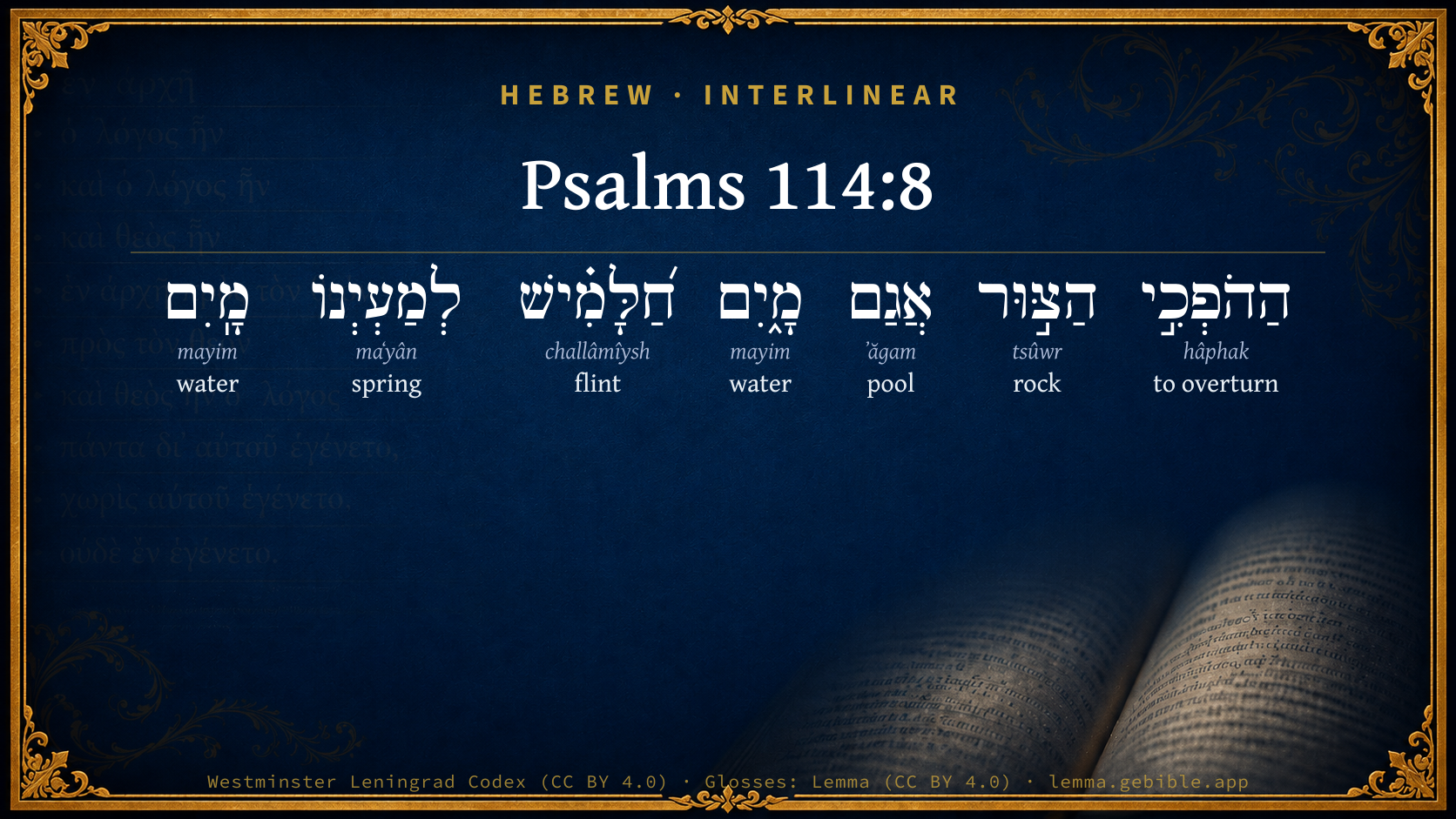
Hebrew (Westminster Leningrad Codex) Psalms 114:8 appears in the Hebrew Old Testament. The text above is from the Westminster Leningrad Codex. Each word links to its Strong’s number, a concise gloss, and parsing drawn from the Open Scriptures Hebrew Bible morphology. Click any word for its full Brown-Driver-Briggs (BDB) entry.
Download image
Cite this verse

Psalms 114:8 (World English Bible). Public Domain. Lemma interlinear Bible study tool, https://lemma.gebible.app/v/psalms/114/8.

Show BibTeX & RIS
BibTeX
RIS
English Translation
Who turned the rock into a pool of water, The flint into a spring of waters.
World English Bible · Public Domain
Download a study sheet

One document with this verse’s original text, its word-by-word gloss line, the meaning frame, cross-references with their text, attributed commentary, and full source and license credits — printable, and it pastes into notes with its structure intact.

This verse Autodidact and up

Study sheet (.html) Plain text (.txt)

A passage Seminary Student

Up to 50 verses in one chapter. A passage sheet keeps up to 6 commentary sources and 12 cross-references per verse, in the order this page ranks them, and says so on the sheet whenever that leaves anything out. Ask for a single verse and you get the Autodidact verse sheet above.

Everything on this page stays free to read, with no account — the sheet is a download of what is already on screen, not access to it.

Want to remove ads? Support Godless Engineer
Compare translations 3

The same verse in 3 English versions, stacked beneath the original-language interlinear above. Click any original word for its lexicon entry.

Each is an independent rendering of the whole verse — the interlinear is not word-aligned to these translations.

Highlighted words mark where these versions differ — a whole-verse word diff, not a word-by-word alignment.

  • World English Bible Public Domain
    Who turned the rock into a pool of water, The flint into a spring of waters.
  • King James Version Public Domain
    Which turned the rock into a standing water, the flint into a fountain of waters.
  • unfoldingWord Literal Text CC BY-SA 4.0
    the one turning the rock into a pool of water, flint into a spring of water!

unfoldingWord Literal Text — © unfoldingWord, licensed CC BY-SA 4.0. Word-aligned USFM3 via Door43 (git.door43.org/unfoldingWord/en_ult).

Versions to compare (up to 4)

3 of 4 selected

Show all 18 translations

Every available English version of this verse, each an independent rendering of the whole verse.

  • World English Bible Public Domain
    Who turned the rock into a pool of water, The flint into a spring of waters.
  • Berean Standard Bible Public Domain
    who turned the rock into a pool, the flint into a fountain of water!
  • Majority Standard Bible Public Domain
    who turned the rock into a pool, the flint into a fountain of water!
  • King James Version Public Domain
    Which turned the rock into a standing water, the flint into a fountain of waters.
  • American Standard Version (1901) Public Domain
    Who turned the rock into a pool of water, The flint into a fountain of waters.
  • Revised Version (1885) Public Domain
    Which turned the rock into a pool of water, the flint into a fountain of waters.
  • Geneva Bible (1599) Public Domain
    Which turneth the rocke into waterpooles, and the flint into a fountaine of water.
  • Douay-Rheims (1899) Public Domain
    Who turned the rock into pools of water, and the stony hill into fountains of waters.
  • Young's Literal Translation Public Domain
    He is turning the rock to a pool of waters, The flint to a fountain of waters!
  • Literal Standard Version CC BY-SA 4.0
    He is turning the rock to a pool of waters, || The flint to a fountain of waters!
  • Unlocked Literal Bible CC BY-SA 4.0
    He turned the rock into a pool of water, the hard rock into a spring of water.
  • unfoldingWord Literal Text CC BY-SA 4.0
    the one turning the rock into a pool of water, flint into a spring of water!
  • Darby Bible Public Domain
    Who turned the rock into a pool of water, the flint into a fountain of waters.
  • World Messianic Bible Public Domain
    who turned the rock into a pool of water, the flint into a spring of waters.
  • Webster's Bible Public Domain
    Who turned the rock into a standing water, the flint into a fountain of waters.
  • Free Bible Version CC BY-SA 4.0
    He is the one who turned the rock into a pool of water; making water flow from the hard rock.
  • Bible in Basic English Public Domain
    Who made the rock into a water-spring, and the hard stone into a fountain.
  • JPS Tanakh (1917) Public Domain
    Who turned the rock into a pool of water, the flint into a fountain of waters.

Literal Standard Version (2020), Covenant Press — licensed CC BY-SA 4.0. Text via the HelloAO Bible API (eBible.org). Unlocked Literal Bible (unfoldingWord) — licensed CC BY-SA 4.0. Text via the HelloAO Bible API (eBible.org). unfoldingWord Literal Text — © unfoldingWord, licensed CC BY-SA 4.0. Word-aligned USFM3 via Door43 (git.door43.org/unfoldingWord/en_ult). Free Bible Version, Dr. Jonathan Gallagher — licensed CC BY-SA 4.0. Text via the HelloAO Bible API (eBible.org).

Word by word

More ways to search: Search by grammar → Find every occurrence → Compare this word →

Practice this passage: Drill this verse → Learn its vocabulary →

About this verse

These counts appear in no published source. They are computed here, from the morphology-tagged text and Lemma’s own curated glosses. What Lemma adds →

7
words
6
distinct lemmas
Wisdom
section

Notable vocabulary

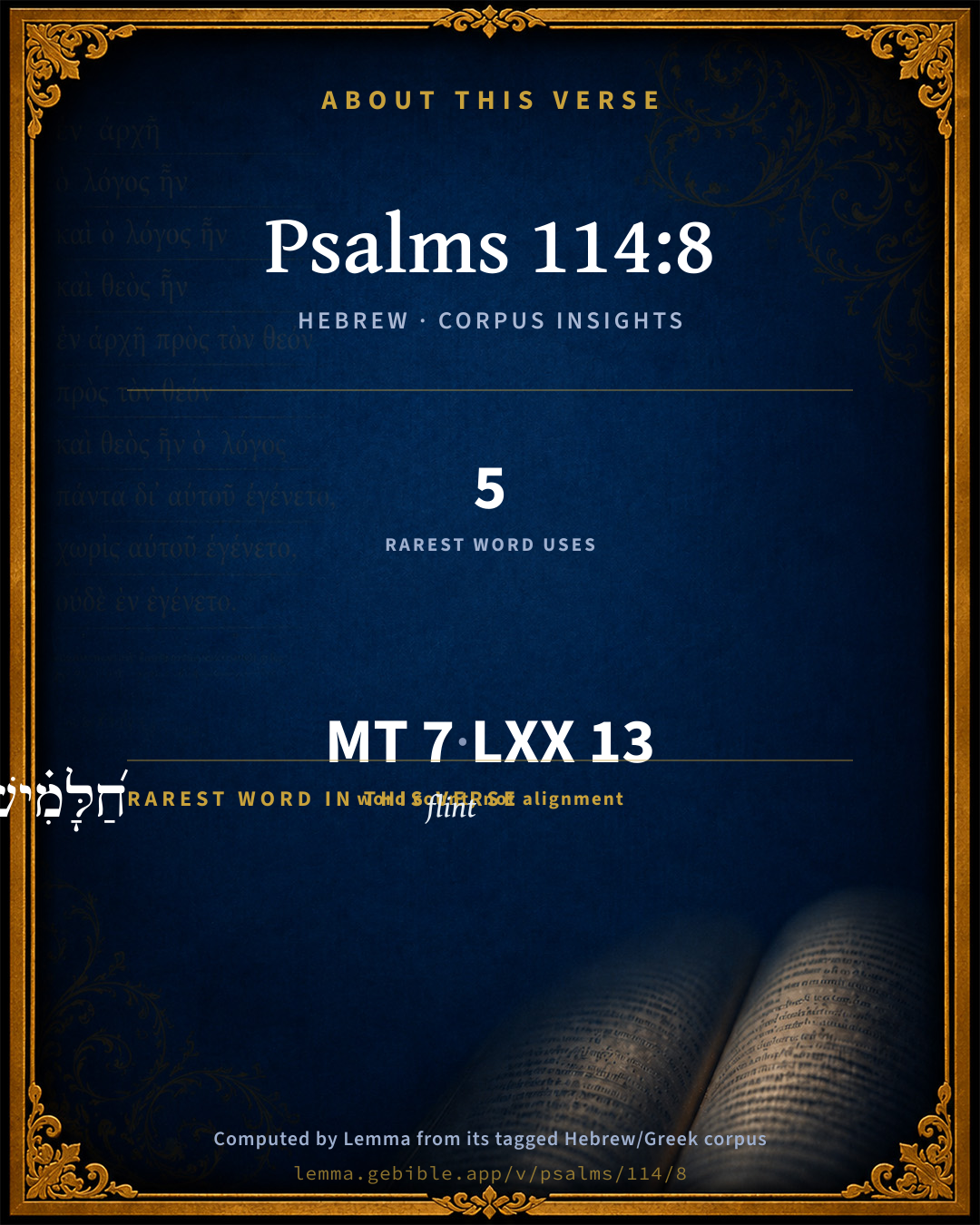
The rarest word here is חַ֝לָּמִ֗ישׁ flint H2496 — appearing just 5 times in the whole Hebrew Bible.

Shared distinctive vocabulary

חַ֝לָּמִ֗ישׁ flint H2496 occurs in 5 verses of the Hebrew Bible. Also found in:

Grammatical profile

  • 1 verb
  • 6 nouns

Verb forms

  • הַהֹפְכִ֣י Qal · Participle Active

Repetition

A word recurs within this verse — often emphatic in Hebrew:

  • מָ֑יִם water H4325 ×2

Hebrew & Septuagint length

In English translation the verse runs 16 words from the Hebrew and 15 from the Septuagint (LXX English) — closely comparable.

A rough comparison of the two English renderings, which tokenize alike — not a word-level alignment.

Word counts can differ between the Hebrew and the Greek without any difference in meaning — e.g. the Hebrew direct-object marker אֵת has no separate Greek word, and Greek often adds the article ὁ.

In the original languages it is 7 Hebrew tokens and 13 Greek tokens — but the two are counted differently (Hebrew bundles its prefixes and suffixes into one token; the Greek is in lemma form), so that isn’t a like-for-like length.

Cross-references

8

Topical passages linked to Psalms 114:8 in the Treasury of Scripture Knowledge — connected by theme and wording, ordered by reader-vote popularity; previews shown in the World English Bible.

  • Deuteronomy 8:15 who led you through the great and terrible wilderness, [in which were] fiery serpents and scorpions, and thirsty ground where was no water; who brought you forth water out of the rock of flint;
  • Psalms 107:35 He turns a desert into a pool of water, And a dry land into water springs.
  • Numbers 20:11 Moses lifted up his hand, and struck the rock with his rod twice: and water came forth abundantly, and the congregation drank, and their cattle.
  • Exodus 17:6 Behold, I will stand before you there on the rock in Horeb. You shall strike the rock, and water will come out of it, that the people may drink." Moses did so in the sight of the elders of Israel.
  • Psalms 105:41 He opened the rock, and waters gushed out. They ran as a river in the dry places.
  • 1 Corinthians 10:4 and all drank the same spiritual drink. For they drank of a spiritual rock that followed them, and the rock was Christ.
  • Psalms 78:15–16 He split rocks in the wilderness, And gave them drink abundantly as out of the depths.
  • Nehemiah 9:15 and gave them bread from the sky for their hunger, and brought forth water for them out of the rock for their thirst, and commanded those who they should go in to possess the land which you had sworn to give them.

Cross-references courtesy of OpenBible.info (CC BY 4.0).

Hebrew and Greek witnesses Masoretic Hebrew ↔ Greek Septuagint

The same verse in the two great witnesses to the Old Testament, shown verse-for-verse.

You’re reading Greek Psalm 113 (Hebrew Psalm 114). The Septuagint counts the superscription, so verse numbers can differ from the Hebrew — chapter-level alignment, not verse-by-verse. Numbering follows Rahlfs.

These are two independent witnesses, not word-aligned to each other, and the Septuagint is shown in lemma (dictionary) form.

Hebrew Psalms 114:8 Masoretic · Westminster Leningrad Codex

הַהֹפְכִ֣י הַצּ֣וּר אֲגַם מָ֑יִם חַ֝לָּמִ֗ישׁ לְמַעְיְנוֹ מָֽיִם

Who turned the rock into a pool of water, The flint into a spring of waters.

World English Bible · Public Domain

Greek LXX Greek Psalm 113:8 Septuagint · lemma form

ὁ στρέφω ὁ πέτρα εἰς λίμνη ὕδωρ καί ὁ ἀκρότομος εἰς πηγή ὕδωρ

who turned the rock into pools of water, and the flint into fountains of water.

LXX2012 (modern English Septuagint) · Public Domain

On this verse, Albert Barnes' Notes on the Bible discusses the Septuagint’s reading. Read the note in Commentary ↓

Hebrew: Westminster Leningrad Codex (CC BY 4.0). Greek: Septuagint (public domain); English from LXX2012 (modern English Septuagint) (Public Domain). How the Septuagint differs from the Hebrew →

Commentary

Notes on Psalms 114:8 from classic Christian and Jewish commentators (each source and its license shown beneath its notes). The classic Christian expositions comment on the surrounding passage and are grouped to its opening verse, so a note may address several verses; the Jewish commentaries on the Tanakh (Rashi and others) are per-verse, so they appear only where the commentator wrote on this verse.

Lemma curates 59 commentaries, every one of them public domain or Creative Commons licensed, each selected and text-cleaned for this edition rather than reprinted as found. About our sources →

Adam Clarke's Commentary

Verse 8. The flint] I have translated חלמיש challamish, GRANITE; for such is the rock of Horeb, a piece of which now lies before me.

This short and apparently imperfect Psalm, for elegance and sublimity, yields to few in the whole book.

It is so well translated in the old Psalter, that I think I shall gratify the reader by laying it before him.

Ps 114:1. In gangyng of Isrel oute of Egipt,

Of the house of Jacob fra hethen folke.

Ps 114:2. Made is Jude his halawyng

Isrel might of hym.

Ps 114:3. The se sawe and fled,

Jurdan turned is agayne;

Ps 114:4. Hawes gladed als wethers,

And hilles als lambes of schepe.

Ps 114:5. What is to the se, that thou fled?

And thou Jordane that thou ert turned agayne?

Ps 114:6. Hawes gladded als wethers?

And hils als lambs of schepe.

Ps 114:7. Fra the face of Lorde styrde is the erth,

Fra the face of God of Jabob;

Ps 114:8. That turnes the stane in stank of waters,

And roche in wels of waters.

And, as a still more ancient specimen of our language, I shall insert the Anglo-Saxon, with a literal reading, line for line, as near to the Saxon as possible, merely to show the affinity of the languages.

Ps 114:1. [Anglo-Saxon]

Ps 114:2. [Anglo-Saxon]

Ps 114:3. [Anglo-Saxon]

Ps 114:4. [Anglo-Saxon]

Ps 114:5. [Anglo-Saxon]

Ps 114:6. [Anglo-Saxon]

Ps 114:7. [Anglo-Saxon]

Ps 114:8. [Anglo-Saxon]

Ps 114:1. On outgang Israel of Egypt,

House Jacob of folk foreigners;

Ps 114:2. Made is Jacob holyness his;

Israel andweald (government) his.

Ps 114:3. Sea saw, and flew!

Jordan turned underback!

Ps 114:4. Mounts they fain (rejoiced) so (as) rams,

And burghs (hillocks) so (as) lamb-sheep.

Ps 114:5. What is the sea, that thou flew?

And thou river for that thou turned is underback?

Ps 114:6. Mounts ye fained (rejoiced) so so rams;

And hills so so lambs-sheep.

Ps 114:7. From sight Lord's stirred is earth;

From sight God of Jacob.

Ps 114:8. Who turned stone in mere waters;

And cliffs in wells waters.

I have retained some words above in nearly their Saxon form, because they still exist in our old writers; or, with little variation, in those of the present day: -

Ps 114:2. Andweald, government. Hence weal and wealth, commonweal or wealth; the general government, that which produces the welfare of the country.

Ps 114:4. Faegnodon, fained - desired fervently, felt delight in expectation.

Ps 114:4. Burgh, a hill - a mound or heap of earth, such as was raised up over the dead. Hence a barrow; and hence the word bury, to inhume the dead.

Ps 114:8. Mere, or meer, a large pool of water, a lake, a lough, still in use in the north of England. Gentlemen's ponds, or large sheets of water so called; and hence Winander-mere. a large lake in Westmoreland. Mere also signifies limit or boundary; hence the Mersey, the river which divides Lancashire from Cheshire, and serves as a boundary to both counties. The mere that spreads itself out to the sea.

Instead of cludas, which signifies rocks, one MS. has [Anglo-Saxon] clyf, which signifies a craggy mountain or broken rock.

The reader will see from this specimen how much of our ancient language still remains in the present; and perhaps also how much, in his opinion, we have amplified and improved our mother tongue.

ANALYSIS OF THE HUNDRED AND FOURTEENTH PSALM

David in this Psalm chants forth the wonderful works and miracles that God wrought, when he brought forth Israel out of Egypt.

This Psalm has two parts: -

I. A narration of Israel's deliverance, amplified by the state they were in, Ps 114:1; the state to which they were brought, Ps 114:2; the miracles then done, Ps 114:3; and the law given, Ps 114:4.

II. A prosopopoeia set down by way of dialogue: 1. The prophet asks the sea and Jordan why they fled, Ps 114:5-6. 2. To which the answer is, that "the earth trembled," c., Ps 114:7-8.

I. In the narration, Israel's condition is set down by way of comparison, in order that their deliverance might make the deeper impression. We must recollect that Jacob and Judah in this place signify the whole nation of the Israelites that descended out of Jacob's loins but of the house of Jacob there is made particular mention, because with him they came into Egypt; and of Judah, because from him they were called Jews. This being premised. 1. We are presented with the condition of the Jews before their deliverance; before they were formed into a state or Church; they were among "a people of a strange language."

2. The condition of the Jews after their deliverance: "When Israel went out of Egypt," c., then "Judah was his sanctuary," c. 1. "His sanctuary: " A people sanctified and adopted by him, consecrated to his worship as holy temples and sanctuaries, and having a holy priest to govern them in points of piety. 2. "His dominion:" In which he reigned as King by his laws and Spirit, and appointed godly magistrates to rule them in matters of policy for the government was a theocracy, till they cast it off by choosing a king.

The prophet explains the manner of their deliverance, which was by miracles and signs and gives us these instances: -

1. "The sea saw it, and fled," as the people advanced to it. "At the presence of the Lord it turned back all night," Ex 14:21. In a poetical strain he attributes this to the sense of the sea. "The sea saw," c.

2. "Jordan was driven back," &c. Forty years after, when they were entering the promised land, then Jordan suffered a long reflux, Jos 3:15-17.

3. At Sinai, when the law was given, then the mountains and hills quaked: "The mountains skipped like rams," &c.

II. This Psalm abounds with poetical imagery and having related the wonderful deliverances wrought for God's people, the psalmist expostulates with the sea and mountains, and interrogates them as to what so strangely altered their course. "What ailed thee, O thou sea, c. ?. - Ye mountains that ye skipped like rams," &c.

To which, in the person of the earth speaking to herself, the prophet answers thus making both a prosopopoeia and an apostrophe.

1. "Tremble, thou earth, at the presence of the Lord," c. As if it had been said, Would you know the reason why we fly? The cause is, the Lord has appeared and showed his force and power, and laid his commands upon us and therefore, not abiding his presence, the mountains are moved, &c.

2. Of his power this miracle is sufficient for an instance: "Which turned the rock into a standing water, the flint into a fountain of waters." Causing not only waters to flow from thence, but turning the very substance of a flint, which is apter to yield fire than water, into that fluid element, Nu 20:11. See Clarke on Ps 114:8.

Adam Clarke's Commentary on the Bible (1810–1826) — public domain. Text from a community e-Sword/MySword module.

Trapp's Complete Commentary

John Trapp

Psa 114:8 Which turned the rock [into] a standing water, the flint into a fountain of waters.

Ver. 8. Which turned the rock into a standing water] Set the rock of Rephidim abroach, and made it not only a standing water ( stagnum , as here), but a running river; for the rock followed them: and that rock was Christ, 1Co 10:4, with Joh 4:14; Joh 7:38.

The flint into a fountain of waters] Still God worketh for his people, in oppositis mediis (as Luther expresseth it), by contrary means; and rather than they shall want necessaries, he both can and will work miracles.

John Trapp, A Commentary or Exposition upon All the Books of the Old and New Testament (1647–1656) — public domain. Text from a community e-Sword module.

J. A. Alexander on Psalms

Joseph Addison Alexander

8. (Psa 114:8) Turning the rock (into) a pool of water, the flint to springs of water. This refers to the miraculous supply of water in the desert. See above, on Psa 107:35, and compare Exo 17:6, Num 20:11, Deu 8:15; Deu 32:13, Isa 41:18. The connection with the preceding verse is still more marked in the original, the first words of which strictly mean the (one) turning, etc. The reader is left to draw for himself the natural and obvious conclusion, that the God, who thus drew water from a flinty rock for the supply of Israel, can still educe the richest blessings from what seem to be the hardest and most inauspicious situations. When this thought is supplied, the psalm no longer seems unfinished or abrupt in its conclusion.

Joseph Addison Alexander, The Psalms Translated and Explained (1850) — public domain. Text from a community e-Sword module.

Tyndale Open Study Notes

Tyndale Open Resources

114:8 The Lord miraculously provided for his people in hard times after the Exile, just as he had done in the wilderness after the Exodus.

Tyndale Open Study Notes — © Tyndale Open Resources, licensed CC BY-SA 4.0. Text via the HelloAO Bible API.

Geneva Bible (1599)

Geneva Bible translators

That is, caused miraculously water to come out of the rock in most abundance, Exod. 17:6.

Geneva Bible (1599) marginal notes — public domain. Text via Bolls.life.

The Cambridge Bible for Schools and Colleges

gen. ed. J. J. S. Perowne

8. Which turned &c.] Who turneth the rock into a pool of water. The participle in the Heb. is independent of time. It denotes not merely a historic fact but an attribute expressed in the terms of historic fact. He Who made water flow from the rock in Rephidim and the cliff in Kadesh (Exo_17:6; Num_20:8 ff.; cp. Psa_78:15-16; Psa_78:20) can still provide streams of blessing for His people. The verse combines reminiscences of Isa_41:18 (‘pool of water,’ ‘fountain’), and Deu_8:15 (‘flint’): cp. Psa_107:35.

The Cambridge Bible for Schools and Colleges (gen. ed. J. J. S. Perowne; Cambridge University Press, 1878–1918) — public domain. Text from a community e-Sword module.

John Gill's Exposition

Which turned the rock into a standing water,.... Both at Rephidim and at Kadesh; which being smitten, streams of water flowed out like rivers, as if the rock itself was changed into water; and which came a constant and continual supply for the Israelites, for it is said to follow them; see Exo 17:6.

The flint into a fountain of waters; referring to the same thing, the rocks were flinty ones. This was a type of Christ the Rock; who has an abiding fulness of grace in him; is the fountain of it, from whence it flows in great abundance for the supply of his people's wants, while passing through this wilderness to Canaan's land.

Next: Psalms Chapter 115

John Gill's Exposition of the Whole Bible (1746–1763) — public domain (CC PDM 1.0). Text via the HelloAO Bible API.

Albert Barnes' Notes on the Bible

Which turned the rock into a standing water - That is, Before him who could do this, the earth should tremble; the inhabited world should stand in awe of such amazing power. The words rendered “a standing water,” mean properly a pool of water. They indicate nothing in regard to the permanency of that pool; they do not imply that it remained as a standing pool during the sojourn of the Israelites in the wilderness - whatever may have been the fact in regard to that. The simple idea is, that, at the time referred to, the rock was converted into a pool; that is, the waters flowed from the rock, constituting such a pool.

The flint - Another name for the rock - used here to describe the greatness of the miracle.

Into a fountain of waters - That is, The waters flowed from the rock as from a fountain. The Bible is a book of miracles, and there is nothing more improbable in this miracle than in any other.

In the Septuagint, the Latin Vulgate, the Syriac, the Arabic, and in many manuscripts, there is no division of the psalm here, but the following psalm is united with this, as if they were a single poem. Why, in those versions, the division of the Heb. was not followed, cannot now be ascertained. The division in the Hebrew is a natural division, and was evidently made in the original composition.

Albert Barnes' Notes on the Bible (1834–1885) — public domain. Text from a community e-Sword/MySword module.

The Treasury of David

Charles H. Spurgeon

Ver. 8. Which turned the rock into a standing water. Into a pool. The divine poet represents the very substance of the rock as being converted into water, not literally, but poetically; thus ornamenting his sketch of the wondrous power displayed on this occasion. William Walford.

Ver. 8. The remarkable rock in Sinai which tradition regards as the one which Moses smote, is at least well chosen in regard to its situation, whatever opinion we may form of the truth of that tradition, which it seems to be the disposition of late travellers to regard with more respect than was formerly entertained. It is an isolated mass of granite, nearly twenty feet square and high, with its base concealed in the earthwe are left to conjecture to what depth. In the face of the rock are a number of horizontal fissures, at unequal distances from each other; some near the top, and others at a little distance from the surface of the ground. An American traveller (Dr. Olin) says: "The colour and whole appearance of the rock are such that, if seen elsewhere, and disconnected from all traditions, no one would hesitate to believe that they had been produced by water flowing from these fissures. I think it would be extremely difficult to form these fissures or produce these appearances by art. It is not less difficult to believe that a natural fountain should flow at the height of a dozen feet out of the face of an isolated rock. Believing, as I do, that the water was brought out of a rock belonging to this mountain, I can see nothing incredible in the opinion that this is the identical rock, and that these fissures, and the other appearances, should be regarded as evidences of the fact." John Kitto.

Ver. 8. Shall the hard rock be turned into a standing water, and the flint stone into a springing well? and shall not our hard and flinty hearts, in consideration of our own miseries, and God's unspeakable mercies in delivering us from evil, (if not gush forth into fountains of tears) express so much as a little standing water in our eyes? It is our hard heart indeed, quod nec compunctione scinditur, nec pietate mollitur, nec movetur precibus, minis non cedit, flagellis duratur, etc. (Bernard). O Lord, touch thou the mountains and they shall smoke, touch our lips with a coal from thine altar, and our mouth shall show forth thy praise. Smite, Lord, our flinty hearts as hard as the nether millstone, with the hammer of thy word, and mollify them also with the drops of thy mercies and dew of thy Spirit; make them humble, fleshy, flexible, circumcised, soft, obedient, new, clean, broken, and then "a broken and a contrite heart, O God, shalt thou not despise." Ps 51:17. "O Lord my God, give me grace from the very bottom of my heart to desire thee; in desiring, to seek thee; in seeking, to find; in finding, to love thee; in loving, utterly to loathe my former wickedness; "that living in thy fear, and dying in thy favour, when I have passed through this Egypt and wilderness of this world, I may possess the heavenly Canaan and happy land of promise, prepared for all such as love thy coming, even for every Christian one, which is thy dominion, and sanctuary. (Augustine). John Boys.

Ver. 8. The same almighty power that turned waters into a rock to be a wall to Israel (Ex 14:22), turned the rock into waters to be a well to Israel. As they were protected, so they were provided for, by miracles, standing miracles; for such was the standing water, that fountain of waters, into which the rock, the flinty rock, was turned, "and that rock was Christ, "1Co 10:4. For he is a fountain of living waters to his Israel, from whom they receive grace for grace. Matthew Henry.

Ver. 8. The flint into a fountain of waters. The causing of water to gush forth out of the flinty rock is a practical proof of unlimited omnipotence and of the grace which converts death into life. Let the earth then tremble before the Lord, the God of Jacob. It has already trembled before him, and before him let it tremble. For that which he has been he still ever is; and as he came once he will come again. Franz Delitzsch.

Ver. 8. Wonders akin to the miracle at the rock.

1. Christ's death the source of life.

2. Adversity a means of prosperity.

3. Hard hearts made penitent.

4. Barrenness of soul turned into abundance.

Ver. 8. Divine supplies.

1. Surefor he will fetch them even from a rock.

2. Plentiful"a mere or standing water."

3. Continual "fountain of waters."

4. Instructive. Should create in us holy awe at the power, etc., of the Lord.

Charles H. Spurgeon's The Treasury of David (1869–1885) — public domain. Psalms only. Text from a community e-Sword/MySword module.

Whedon's Commentary on the Bible

Daniel D. Whedon

8. The flint into a fountain— “Flint” is parallel to rock in the preceding line, and means no more than hard rock, as Deu_8:15; Deu_32:13. The Septuagint has it sharp rock, as if it were a crag.

Fountain of waters—Corresponds to standing water, both indicating a permanent and abundant supply. It refers, probably, to the rock Horeb, where the miraculous supply of water continued nearly a year. See notes on Psa_78:15-16.

Daniel D. Whedon (gen. ed.), Commentary on the Old and New Testaments (1874–1909) — public domain. Text from a community e-Sword module.

The Pulpit Commentary

Which turned the rook into a standing water, the flint into a fountain of waters. (see Exo_17:6 Num_20:11) Miracles of mercy, showing at once God"s almightiness and his care for Israel.

The natural and the supernatural.

"Which turned the rock into a pool of water, the flint into a fountain of waters" (Revised Version). Wollaston tells us that "on the north-eastern face of Mount Sinai (Jebel Sufsafeh), in the Wady Shubeib, is a protruding mass of rock, about fifty feet in diameter, much water and weather-worn, and presenting a smooth and striking appearance. It forms a part of the solid granite cliff which rises twelve hundred feet above it. In the lower part of this protuberance is a fissure of a semicircular, or rather horse-shoe, shape, about four feet tong and four inches wide. Oat of this fissure, inside which a small shrub is growing, runs a perpetual stream of the purest spring water, clear as crystal, and of delicious coolness and flavor, which, according to the testimony of the Arabs, has never been known to fail. The water thus flowing out of the very heart of the living rock of Sinai is received into an artificial basin, thence it descends to a succession of small and rudely constructed terraces, where the Bedouins cultivated a few fruit trees and vegetables, and is ultimately absorbed in the gravelly hollow at the base of the mountain." The incident is, no doubt, thus poetically recalled to the mind of the restored exiles, in order to assure them that God, in his power to provide, and his power to meet emergencies, was all that he had ever been; and this suggests a very suitable subject of meditation, which may be very effectively applied to our times and needs. But a less usual topic is suggested by the discovery of what is probably the very spring that Moses brought to light. As our knowledge advances, we are coming more and more fully to apprehend that the natural and the supernatural are inextricably blended in human life, and that in God"s working out of his purposes the natural and the super natural are one. See how this is suggested by the smiting of the rock and the result which followed. No one would suggest that God put the water into the rock specially and on purpose for the Israelites. It was there. It was its natural habitat. The fountains of water, the pools into which the waters drain, are always in the rocks. Miners have to be careful lest they let in upon them the floods of waters that are stored in the rocks. Our towns are often supplied with water that is pumped up from the reservoirs of the rocks. It was quite natural for the water to be in the rock. And man brings the water out of the rock by smiting the rock. Just now the workmen of our town have been engaged in tunneling the chalk rock to get a fresh supply of water; and the other day a workman, smiting with his pick, opened a fissure, from which a stream is pouring abundantly. To get water out of the rock by smiting the rock was also quite natural. It is fancy that makes Moses only give the rock a gentle pat. He smote it; on the second occasion he even roughly smote it twice before the fissure opened. So far the provision was natural, and the method of obtaining it also natural. But how evidently the supernatural was blended with the natural! Direct Divine direction fitted the time and the place. No mere human wisdom could have thus immediately discovered the exact spot where the rock would yield to a single smiting, and send forth its treasures. Only a divinely ordered man would think of such a way of relieving the necessities of a caravan. The supernatural character of the incident comes at once to view if we think of the leader of an ordinary caravan in that Sinaitic district going about tapping the rocks, hoping to meet with a fissure in which was a water-store. God directed Moses, and he went straight to the place. And the marvel that grows ever greater to devout souls, as they pass through the experiences of life, is not the mere presence of supernatural forces, but the way in which the super natural blends with the natural, until the deepest feeling is that the natural is lost in the supernatural and God, working everywhere, in everything and through every thing, becomes the most cherished thought. Men make sharp lines of distinction between the natural and the supernatural. When men come experimentally to know what God can do in their own souls and in their own lives, they cease to feel any interest in those sharp lines of distinction, for their sphere is the sphere of God. To them there is no natural. God is in it all, and his presence and actual working makes it all supernatural. R.T.

The Pulpit Commentary (1880–1919), ed. H.D.M. Spence-Jones & Joseph S. Exell — public domain. Text from a community e-Sword module.

unfoldingWord translationNotes

Door43 World Missions Community

He turned the rock into a pool of water, the hard rock into a spring of water

These two phrases are parallel. The writer describes Yahweh causing water to flow from the rock as if he turned the rock into water. (See: Parallelism and Metaphor)

the hard rock into a spring of water

The verb may be supplied from the previous phrase. AT: "He turned the hard rock into a spring of water" (See: Ellipsis)

translationWords

fountain

unfoldingWord translationNotes — © Distant Shores Media and the Door43 World Missions Community, licensed CC BY-SA 4.0. Source: git.door43.org/Door43/en_tn.

Rashi

Rabbi Shlomo Yitzchaki (Rashi)

into a fountain of water Heb. למעינו. The “vav” is superfluous, as the “vav” in (above 104:11, 20) “the beasts (חיתו) of the forest.”

Rashi on the Tanakh — English translations: “The Judaica Press complete Tanach with Rashi, translated by A. J. Rosenberg” (CC BY 4.0); “Pentateuch with Rashi's commentary by M. Rosenbaum and A.M. Silbermann, 1929-1934” (public domain); “The Metsudah Tanach series, Lakewood, N.J” (CC BY 4.0); and “The Book of Joshua, Metsudah Publications, 1997” (CC BY 4.0). Text via Sefaria.

Lesson kit

Teaching starters — assembled from the data on this page, not authored interpretation. Every prompt links to the verse data it draws on. Edit before teaching.

Psalms, in the Wisdom, opens this verse with 7 words (6 distinct Hebrew lemmas). Its most distinctive word is challâmîysh (“flint”). A historical commentator’s framing appears above. Read the whole chapter for the surrounding context.

Discussion questions

  1. The word challâmîysh carries the sense “flint.” How does it shape the verse?
  2. Deuteronomy 8:15 shares the word «flint» with this verse. How do the two illuminate each other?
  3. “water” occurs 2× in this one verse. What is the effect of the repetition?
  4. These translations render this verse differently; the difference is in the English rendering, not the original. What questions does that raise?
  5. The verb «הַהֹפְכִ֣י» is Qal Participle Active. How does its form color the action?
  6. Reading how Adam Clarke's Commentary and Trapp's Complete Commentary read this verse, where do the two commentators agree and where do they part?

Things to notice

Reading settings

Reading text

Shown beneath each verse's original-language words.

Old Testament
Old Testament edition

Read the OT as the Masoretic Hebrew (MT) or the Greek Septuagint (LXX).

English shown for the Greek Septuagint (in the Hebrew ↔ Greek comparison).

Comparing translations? Open the Compare panel on any verse page to stack up to four side by side.