
Numbers 20:7

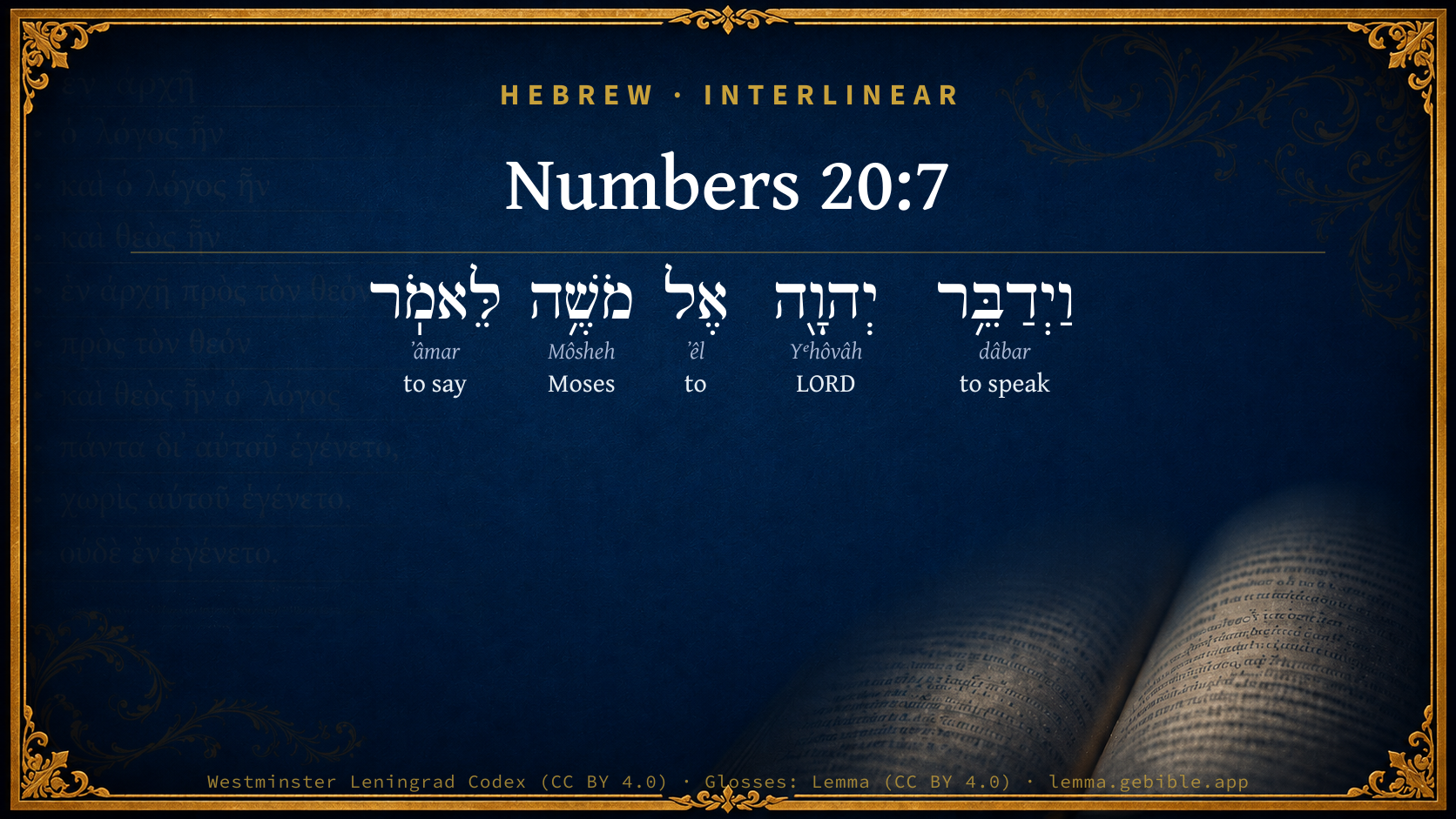
Hebrew (Westminster Leningrad Codex) Numbers 20:7 appears in the Hebrew Old Testament. The text above is from the Westminster Leningrad Codex. Each word links to its Strong’s number, a concise gloss, and parsing drawn from the Open Scriptures Hebrew Bible morphology. Click any word for its full Brown-Driver-Briggs (BDB) entry.
Download image
Cite this verse

Numbers 20:7 (World English Bible). Public Domain. Lemma interlinear Bible study tool, https://lemma.gebible.app/v/numbers/20/7.

Show BibTeX & RIS
BibTeX
RIS
English Translation
Yahweh spoke to Moses, saying,
World English Bible · Public Domain
Download a study sheet

One document with this verse’s original text, its word-by-word gloss line, the meaning frame, cross-references with their text, attributed commentary, and full source and license credits — printable, and it pastes into notes with its structure intact.

This verse Autodidact and up

Study sheet (.html) Plain text (.txt)

A passage Seminary Student

Up to 50 verses in one chapter. A passage sheet keeps up to 6 commentary sources and 12 cross-references per verse, in the order this page ranks them, and says so on the sheet whenever that leaves anything out. Ask for a single verse and you get the Autodidact verse sheet above.

Everything on this page stays free to read, with no account — the sheet is a download of what is already on screen, not access to it.

Want to remove ads? Support Godless Engineer
Compare translations 3

The same verse in 3 English versions, stacked beneath the original-language interlinear above. Click any original word for its lexicon entry.

Each is an independent rendering of the whole verse — the interlinear is not word-aligned to these translations.

Highlighted words mark where these versions differ — a whole-verse word diff, not a word-by-word alignment.

  • World English Bible Public Domain
    Yahweh spoke to Moses, saying,
  • King James Version Public Domain
    And the LORD spake unto Moses, saying,
  • unfoldingWord Literal Text CC BY-SA 4.0
    And Yahweh spoke to Moses, saying,

unfoldingWord Literal Text — © unfoldingWord, licensed CC BY-SA 4.0. Word-aligned USFM3 via Door43 (git.door43.org/unfoldingWord/en_ult).

Versions to compare (up to 4)

3 of 4 selected

Show all 18 translations

Every available English version of this verse, each an independent rendering of the whole verse.

  • World English Bible Public Domain
    Yahweh spoke to Moses, saying,
  • Berean Standard Bible Public Domain
    And the LORD said to Moses,
  • Majority Standard Bible Public Domain
    And the LORD said to Moses,
  • King James Version Public Domain
    And the LORD spake unto Moses, saying,
  • American Standard Version (1901) Public Domain
    And Jehovah spake unto Moses, saying,
  • Revised Version (1885) Public Domain
    And the LORD spake unto Moses, saying,
  • Geneva Bible (1599) Public Domain
    And the Lord spake vnto Moses, saying,
  • Douay-Rheims (1899) Public Domain
    And the Lord spoke to Moses, saying:
  • Young's Literal Translation Public Domain
    And Jehovah speaketh unto Moses, saying,
  • Literal Standard Version CC BY-SA 4.0
    And YHWH speaks to Moses, saying,
  • Unlocked Literal Bible CC BY-SA 4.0
    Yahweh spoke to Moses and said,
  • unfoldingWord Literal Text CC BY-SA 4.0
    And Yahweh spoke to Moses, saying,
  • Darby Bible Public Domain
    And Jehovah spoke to Moses, saying,
  • World Messianic Bible Public Domain
    The LORD spoke to Moses, saying,
  • Webster's Bible Public Domain
    And the LORD spoke to Moses, saying,
  • Free Bible Version CC BY-SA 4.0
    The Lord told Moses,
  • Bible in Basic English Public Domain
    And the Lord said to Moses,
  • JPS Tanakh (1917) Public Domain
    And the LORD spoke unto Moses, saying:

Literal Standard Version (2020), Covenant Press — licensed CC BY-SA 4.0. Text via the HelloAO Bible API (eBible.org). Unlocked Literal Bible (unfoldingWord) — licensed CC BY-SA 4.0. Text via the HelloAO Bible API (eBible.org). unfoldingWord Literal Text — © unfoldingWord, licensed CC BY-SA 4.0. Word-aligned USFM3 via Door43 (git.door43.org/unfoldingWord/en_ult). Free Bible Version, Dr. Jonathan Gallagher — licensed CC BY-SA 4.0. Text via the HelloAO Bible API (eBible.org).

Word by word

More ways to search: Search by grammar → Find every occurrence → Compare this word →

Practice this passage: Drill this verse → Learn its vocabulary →

About this verse

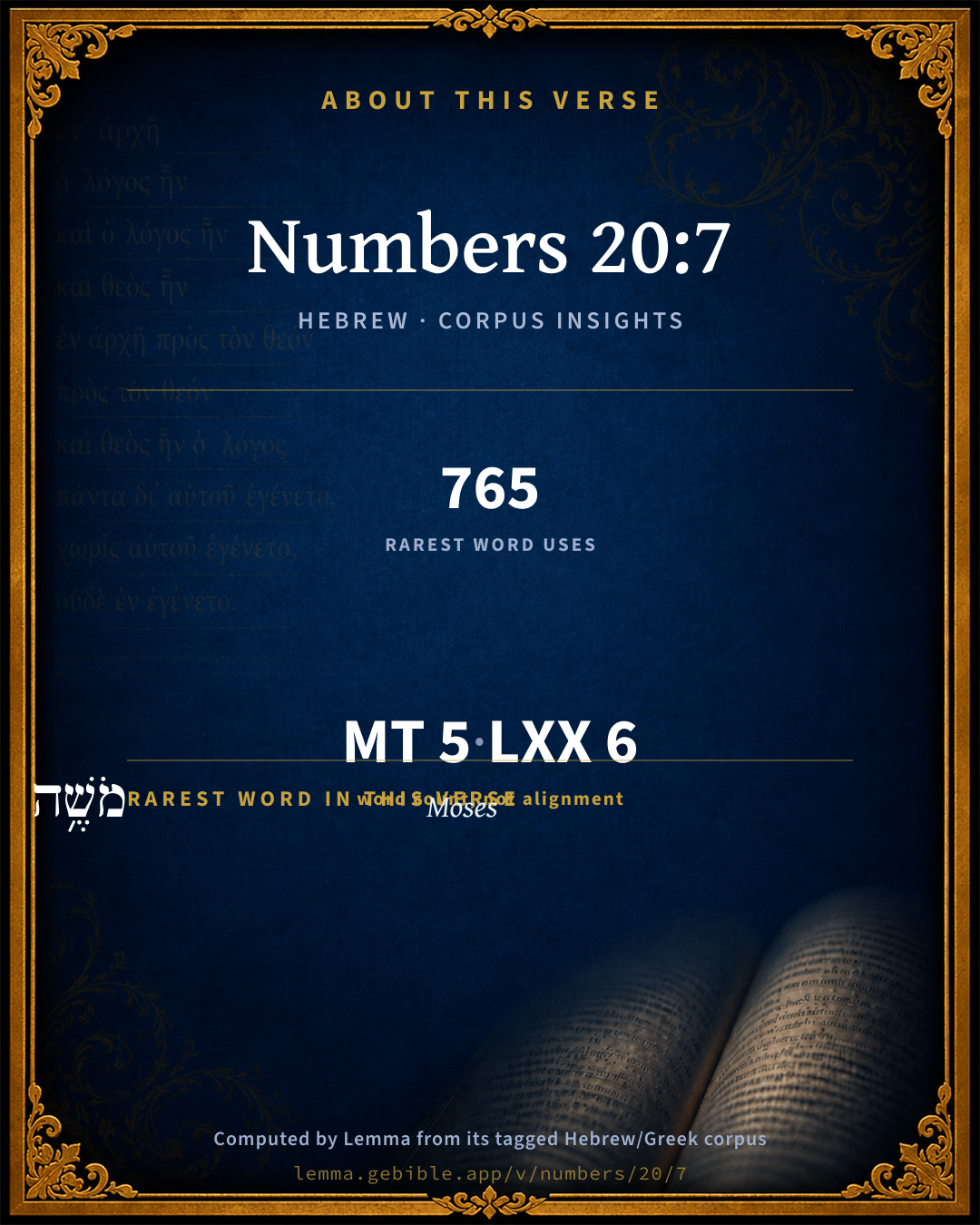
These counts appear in no published source. They are computed here, from the morphology-tagged text and Lemma’s own curated glosses. What Lemma adds →

5
words
5
distinct lemmas
Pentateuch
section

Grammatical profile

  • 2 verbs
  • 2 nouns
  • 1 preposition

Verb forms

  • וַיְדַבֵּ֥ר Piel · Sequential Imperfect
  • לֵּאמֹֽר Qal · Infinitive Construct

Hebrew & Septuagint length

In English translation the verse runs 5 words from the Hebrew and 7 from the Septuagint (LXX English) — closely comparable.

A rough comparison of the two English renderings, which tokenize alike — not a word-level alignment.

Word counts can differ between the Hebrew and the Greek without any difference in meaning — e.g. the Hebrew direct-object marker אֵת has no separate Greek word, and Greek often adds the article ὁ.

In the original languages it is 5 Hebrew tokens and 6 Greek tokens — but the two are counted differently (Hebrew bundles its prefixes and suffixes into one token; the Greek is in lemma form), so that isn’t a like-for-like length.

Hebrew and Greek witnesses Masoretic Hebrew ↔ Greek Septuagint

The same verse in the two great witnesses to the Old Testament, shown verse-for-verse.

These are two independent witnesses, not word-aligned to each other, and the Septuagint is shown in lemma (dictionary) form.

Hebrew Numbers 20:7 Masoretic · Westminster Leningrad Codex

וַיְדַבֵּ֥ר יְהוָ֖ה אֶל מֹשֶׁ֥ה לֵּאמֹֽר

Yahweh spoke to Moses, saying,

World English Bible · Public Domain

Greek LXX Numbers 20:7 Septuagint · lemma form

καί λαλέω κύριος πρός μωυσῆς λέγω

And the Lord spoke to Moses, saying,

LXX2012 (modern English Septuagint) · Public Domain

Hebrew: Westminster Leningrad Codex (CC BY 4.0). Greek: Septuagint (public domain); English from LXX2012 (modern English Septuagint) (Public Domain). How the Septuagint differs from the Hebrew →

Targum (Aramaic paraphrase)

2

The Targum is the ancient Jewish Aramaic paraphrase of the Hebrew Scriptures — an interpretive translation, not the Hebrew text itself. Onkelos (literal) and Pseudo-Jonathan (expansive) render the Torah, and Jonathan the Prophets. Coverage is partial: where no permissively-licensed English translation exists for a verse, only the Aramaic is shown. This is verse-level text, not a word-by-word alignment to the Hebrew.

  1. Targum Onkelos Torah (Genesis–Deuteronomy)
    וּמַלֵיל יְיָ עִם משֶׁה לְמֵימָר

    (no public-domain English translation for this verse)

    Targum Onkelos — Aramaic: “Onkelos Genesis” (public domain); “Onkelos Exodus” (public domain); “Onkelos Leviticus” (public domain); “Onkelos Numbers” (public domain); “Onkelos Deuteronomy” (public domain). English: “Sefaria Community Translation” (CC0 1.0 (public-domain dedication)); “J.W. Etheridge. The Targums of Onkelos and Jonathan Ben Uzziel on the Pentateuch. London: Longmans, Green, 1862” (public domain). Text via Sefaria.

  2. Targum Pseudo-Jonathan Torah (Genesis–Deuteronomy)
    וּמַלֵיל יְיָ עִם משֶׁה לְמֵימָר

    And the Lord spake with Mosheh, saying:

    Targum Pseudo-Jonathan — Aramaic: “Targum Jonathan on Genesis” (public domain); “Targum Jonathan on Exodus” (public domain); “Targum Jonathan on Leviticus” (public domain); “Targum Jonathan on Numbers” (public domain); “Targum Jonathan on Deuteronomy” (public domain). English: “The Targum of Jonathan ben Uzziel, trans. J. W. Etheridge, London, 1862” (public domain). Text via Sefaria.

Commentary

Notes on Numbers 20:7 from classic Christian and Jewish commentators (each source and its license shown beneath its notes). The classic Christian expositions comment on the surrounding passage and are grouped to its opening verse, so a note may address several verses; the Jewish commentaries on the Tanakh (Rashi and others) are per-verse, so they appear only where the commentator wrote on this verse.

Lemma curates 59 commentaries, every one of them public domain or Creative Commons licensed, each selected and text-cleaned for this edition rather than reprinted as found. About our sources →

Tyndale Open Study Notes

Tyndale Open Resources

20:7-9 God heard Israel’s complaints, regarded them as legitimate, and commanded Moses to solve the problem.

Tyndale Open Study Notes — © Tyndale Open Resources, licensed CC BY-SA 4.0. Text via the HelloAO Bible API.

John Gill's Exposition

And the Lord spake unto Moses,.... Out of what was the token of his glory, which perhaps was the cloud, with an uncommon lustre and brightness in it: saying; as follows.

And the Lord spake unto Moses,.... Out of what was the token of his glory, which perhaps was the cloud, with an uncommon lustre and brightness in it: saying; as follows.

Numbers 20:8

num 20:8

num 20:8

num 20:8Take thy rod,.... The rod of miracles, as the Targum of Jonathan; not the rod of Aaron, miraculous for its blossom and fruit, as some Jewish writers think; but the rod of Moses, with which he had done many wonders in Egypt, and at the Red sea, and in the wilderness, and particularly by smiting the rock at Horeb, when the Israelites wanted water, as they did now:

and gather thou the assembly together, thou, and Aaron thy brother; not only the heads of the people, but the body of them, as many as could be got together to see the miracle, and to receive the benefit of it:

and speak ye unto the rock before their eyes; which was near, but a little way off, within sight, and might be pointed to: it was not the same rock that was smote before; that was in Horeb, this in the extremity of the land of Edom, as Aben Ezra observes; this was to be spoken to, and by a word speaking it would give out water; which was a trial of the faith of Moses and Aaron, as well as of the people, before whom, in a public manner, the rock was to be addressed, as if it was intelligent and all-sufficient:

and it shall give forth his water; not as though there was a fountain of water in it, but that water should flow from it, or God by it give water:

and thou shalt bring forth to them water out of the rock; by speaking to it: so thou shalt give the congregation and their beasts drink; sufficient for them both.

John Gill's Exposition of the Whole Bible (1746–1763) — public domain (CC PDM 1.0). Text via the HelloAO Bible API.

Keil & Delitzsch

C. F. Keil & F. Delitzsch

The Lord relieved the want of water. Moses was to take the staff, and with Aaron to gather together the congregation, and speak to the rock before their eyes, when it would give forth water for the congregation and their cattle to drink.

Keil & Delitzsch — Biblical Commentary on the Old Testament (1861–1891) — public domain (CC PDM 1.0). Text via the HelloAO Bible API. (Old Testament only.)

Kretzmann's Popular Commentary

Paul E. Kretzmann

Water Out of the Rock. —

v. 7. And the Lord spake unto Moses, saying,

v. 8. Take the rod, the same shepherd’s staff which had already figured so largely in various miracles, Exo 17:5, and gather thou the assembly together, thou and Aaron, thy brother, and speak ye unto the rock before their eyes, in an address which was equivalent to a command and must yield results; and it shall give forth his water, and thou shalt bring forth to them water out of the rock; so thou shalt give the congregation and their beasts drink. So the Lord chose to overlook the people’s sin of grumbling and to treat them with a kindness which they did not deserve.

v. 9. And Moses took the rod from before the Lord, for it had probably been deposited in the Sanctuary, as He commanded him.

v. 10. And Moses and Aaron gathered the congregation together before the rock, and he, Moses, said unto them, Hear now, ye rebels, must we fetch you water out of this rock? The thought seems to be implied: Your attitude is one of such perpetual nagging and grumbling that there is some doubt in my mind whether we really ought, and whether we shall be able, to provide you with water.

v. 11. And Moses lifted up his hand, and with his rod he smote the rock twice; and the water came out abundantly, and the congregation drank and their beasts also. So God proved Himself the patient and merciful Lord, and Jesus Christ, the spiritual Rock, who accompanied the host, made them a gift of the water.

v. 12. And the Lord spake unto Moses and Aaron, Because ye believed Me not, because they had not firmly, unconditionally, and confidently placed their humble trust in His word, to sanctify Me in the eyes of the children of Israel, to give evidence before the eyes of the children of Israel that He was the Holy One, therefore ye shall not bring this congregation into the land which I have given them. Neither of them would have this privilege, since by their fleshly zeal and disgust they had distorted and obscured before the eyes of the people the image of Jehovah Himself; neither of them would enter the Land of Promise. The occasional discontent which manifests itself in the lives of Christians, though usually a sin of weakness, is highly displeasing in the sight of the Lord, and often brings some evidence of His displeasure upon the offenders.

v. 13. This is the water of Meribah (strife), because the children of Israel strove with the Lord, in murmuring against His dispensations, and He was sanctified in them, both by exposing the unbelief of the people and by punishing the weakness of Moses and Aaron. Cf Psa 106:32-33. This incident is a warning, lest any one become secure. Even firm and tested Christians are not safe against temptation and falling, against disobedience, foolishness, doubt, unbelief. It is fortunate that the merciful God does not desert His children at such times, but renews faith in their hearts and keeps them safe unto the end.

Paul E. Kretzmann, Popular Commentary of the Bible (1921–1924) — public domain. Text from a community e-Sword module.

unfoldingWord translationNotes

Door43 World Missions Community

before their eyes

Here the people are represented by their "eyes" to emphasize what they see. AT: "while they watch you" (See: Synecdoche)

from before Yahweh

This represents Yahweh's tent. AT: "from Yahweh's tent" (See: Metonymy)

translationWords

Yahweh

Moses

staff

Aaron

cow

command

unfoldingWord translationNotes — © Distant Shores Media and the Door43 World Missions Community, licensed CC BY-SA 4.0. Source: git.door43.org/Door43/en_tn.

Lesson kit

Teaching starters — assembled from the data on this page, not authored interpretation. Every prompt links to the verse data it draws on. Edit before teaching.

Numbers, in the Pentateuch, opens this verse with 5 words (5 distinct Hebrew lemmas). Its most distinctive word is Môsheh (“Moses”). A historical commentator’s framing appears above. Read the whole chapter for the surrounding context.

Discussion questions

  1. The word Môsheh carries the sense “Moses.” How does it shape the verse?
  2. These translations render this verse differently; the difference is in the English rendering, not the original. What questions does that raise?
  3. «וַיְדַבֵּ֥ר» is a Piel Sequential Imperfect verb. How does that grammatical form shape the action described?
  4. Compare how Tyndale Open Study Notes and John Gill's Exposition read this verse. Where do they agree or differ?

Things to notice

Reading settings

Reading text

Shown beneath each verse's original-language words.

Old Testament
Old Testament edition

Read the OT as the Masoretic Hebrew (MT) or the Greek Septuagint (LXX).

English shown for the Greek Septuagint (in the Hebrew ↔ Greek comparison).

Comparing translations? Open the Compare panel on any verse page to stack up to four side by side.