

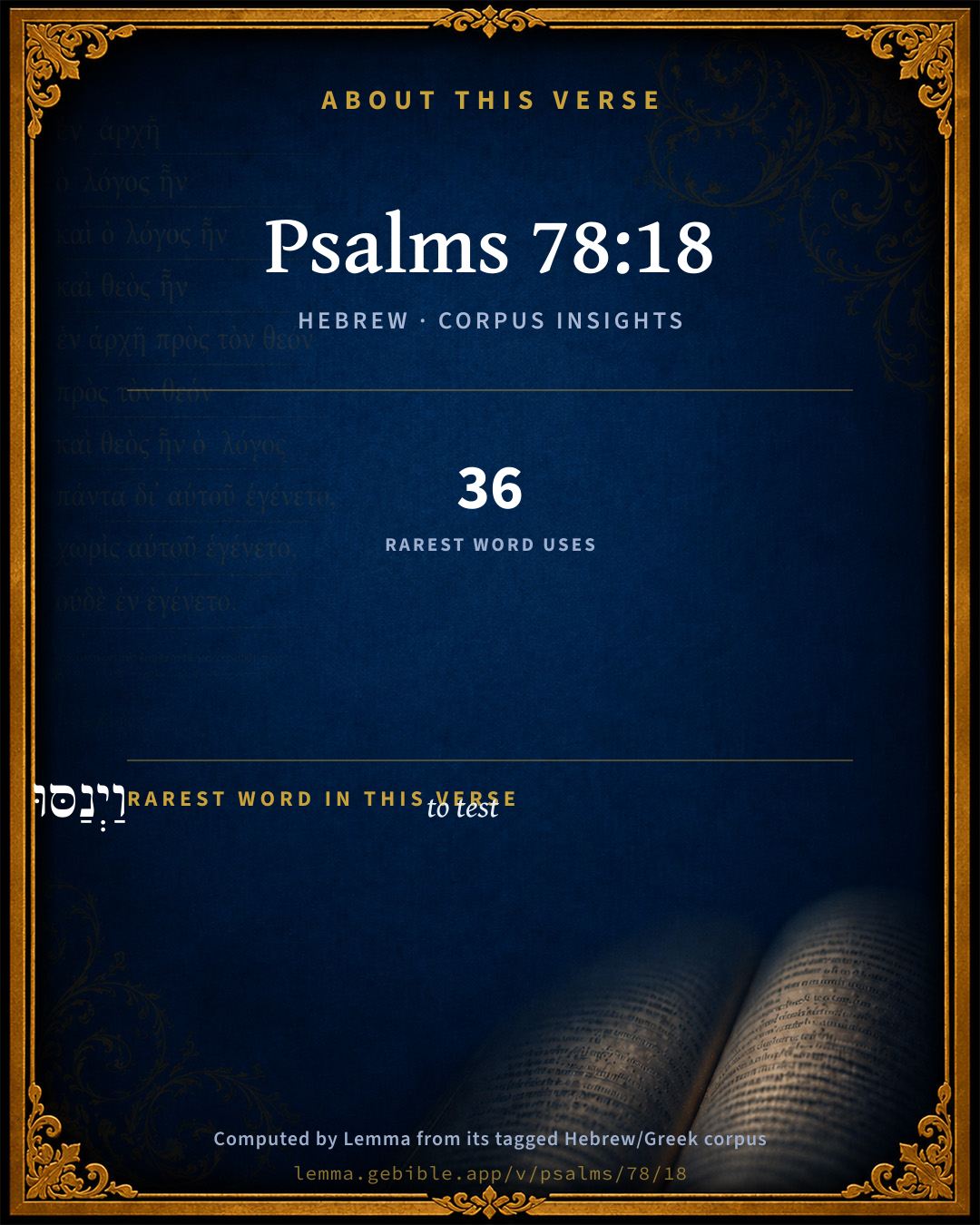
Psalms 78:18

Hebrew (Westminster Leningrad Codex) Psalms 78:18 appears in the Hebrew Old Testament. The text above is from the Westminster Leningrad Codex. Each word links to its Strong’s number, a concise gloss, and parsing drawn from the Open Scriptures Hebrew Bible morphology. Click any word for its full Brown-Driver-Briggs (BDB) entry.
Download image
Cite this verse

Psalms 78:18 (World English Bible). Public Domain. Lemma interlinear Bible study tool, https://lemma.gebible.app/v/psalms/78/18.

Show BibTeX & RIS
BibTeX
RIS
English Translation
They tempted God in their heart By asking food according to their desire.
World English Bible · Public Domain
Download a study sheet

One document with this verse’s original text, its word-by-word gloss line, the meaning frame, cross-references with their text, attributed commentary, and full source and license credits — printable, and it pastes into notes with its structure intact.

This verse Autodidact and up

Study sheet (.html) Plain text (.txt)

A passage Seminary Student

Up to 50 verses in one chapter. A passage sheet keeps up to 6 commentary sources and 12 cross-references per verse, in the order this page ranks them, and says so on the sheet whenever that leaves anything out. Ask for a single verse and you get the Autodidact verse sheet above.

Everything on this page stays free to read, with no account — the sheet is a download of what is already on screen, not access to it.

Want to remove ads? Support Godless Engineer
Compare translations 3

The same verse in 3 English versions, stacked beneath the original-language interlinear above. Click any original word for its lexicon entry.

Each is an independent rendering of the whole verse — the interlinear is not word-aligned to these translations.

Highlighted words mark where these versions differ — a whole-verse word diff, not a word-by-word alignment.

  • World English Bible Public Domain
    They tempted God in their heart By asking food according to their desire.
  • King James Version Public Domain
    And they tempted God in their heart by asking meat for their lust.
  • unfoldingWord Literal Text CC BY-SA 4.0
    And they tested God in their hearts by asking food for their appetite.

unfoldingWord Literal Text — © unfoldingWord, licensed CC BY-SA 4.0. Word-aligned USFM3 via Door43 (git.door43.org/unfoldingWord/en_ult).

Versions to compare (up to 4)

3 of 4 selected

Show all 18 translations

Every available English version of this verse, each an independent rendering of the whole verse.

  • World English Bible Public Domain
    They tempted God in their heart By asking food according to their desire.
  • Berean Standard Bible Public Domain
    They willfully tested God by demanding the food they craved.
  • Majority Standard Bible Public Domain
    They willfully tested God by demanding the food they craved.
  • King James Version Public Domain
    And they tempted God in their heart by asking meat for their lust.
  • American Standard Version (1901) Public Domain
    And they tempted God in their heart By asking food according to their desire.
  • Revised Version (1885) Public Domain
    And they tempted God in their heart by asking meat for their lust.
  • Geneva Bible (1599) Public Domain
    And tempted God in their heartes in requiring meate for their lust.
  • Douay-Rheims (1899) Public Domain
    And they tempted God in their hearts, by asking meat for their desires.
  • Young's Literal Translation Public Domain
    And they try God in their heart, To ask food for their lust.
  • Literal Standard Version CC BY-SA 4.0
    And they try God in their heart, || To ask food for their lust.
  • Unlocked Literal Bible CC BY-SA 4.0
    They challenged God in their hearts by asking for food to satisfy their appetites.
  • unfoldingWord Literal Text CC BY-SA 4.0
    And they tested God in their hearts by asking food for their appetite.
  • Darby Bible Public Domain
    And they tempted ùGod in their heart, by asking meat for their lust;
  • World Messianic Bible Public Domain
    They tempted God in their heart by asking food according to their desire.
  • Webster's Bible Public Domain
    And they tempted God in their heart by asking food for their desire.
  • Free Bible Version CC BY-SA 4.0
    They deliberately provoked God by demanding the foods they longed for.
  • Bible in Basic English Public Domain
    Testing God in their hearts, requesting meat for their desire.
  • JPS Tanakh (1917) Public Domain
    And they tried God in their heart by asking food for their craving.

Literal Standard Version (2020), Covenant Press — licensed CC BY-SA 4.0. Text via the HelloAO Bible API (eBible.org). Unlocked Literal Bible (unfoldingWord) — licensed CC BY-SA 4.0. Text via the HelloAO Bible API (eBible.org). unfoldingWord Literal Text — © unfoldingWord, licensed CC BY-SA 4.0. Word-aligned USFM3 via Door43 (git.door43.org/unfoldingWord/en_ult). Free Bible Version, Dr. Jonathan Gallagher — licensed CC BY-SA 4.0. Text via the HelloAO Bible API (eBible.org).

Word by word

More ways to search: Search by grammar → Find every occurrence → Compare this word →

Practice this passage: Drill this verse → Learn its vocabulary →

About this verse

These counts appear in no published source. They are computed here, from the morphology-tagged text and Lemma’s own curated glosses. What Lemma adds →

6
words
6
distinct lemmas
Wisdom
section

Shared distinctive vocabulary

וַיְנַסּוּ to test H5254 occurs in 34 verses of the Hebrew Bible. Also found in:

Grammatical profile

  • 2 verbs
  • 4 nouns

Verb forms

  • וַיְנַסּוּ Piel · Sequential Imperfect
  • לִֽשְׁאָל Qal · Infinitive Construct

Hebrew & Septuagint length

In English translation the verse runs 13 words from the Hebrew and 16 from the Septuagint (LXX English) — closely comparable.

A rough comparison of the two English renderings, which tokenize alike — not a word-level alignment.

Word counts can differ between the Hebrew and the Greek without any difference in meaning — e.g. the Hebrew direct-object marker אֵת has no separate Greek word, and Greek often adds the article ὁ.

Cross-references

8

Topical passages linked to Psalms 78:18 in the Treasury of Scripture Knowledge — connected by theme and wording, ordered by reader-vote popularity; previews shown in the World English Bible.

  • Numbers 11:4 The mixed multitude that was among them lusted exceedingly: and the children of Israel also wept again, and said, Who shall give us flesh to eat?
  • Deuteronomy 6:16 You shall not tempt Yahweh your God, as you tempted him in Massah.
  • 1 Corinthians 10:9 Neither let us test the Lord, as some of them tested, and perished by the serpents.
  • Psalms 106:14–15 But gave in to craving in the desert, And tested God in the wasteland.
  • 1 Corinthians 10:6 Now these things were our examples, to the intent we should not lust after evil things, as they also lusted.
  • Psalms 95:9 When your fathers tempted me, Tested me, and saw my work.
  • James 4:2–3 You lust, and don't have. You kill, covet, and can't obtain. You fight and make war. You don't have, because you don't ask.
  • Exodus 16:2–3 The whole congregation of the children of Israel murmured against Moses and against Aaron in the wilderness;

Cross-references courtesy of OpenBible.info (CC BY 4.0).

Hebrew and Greek witnesses Masoretic Hebrew ↔ Greek Septuagint

The same verse in the two great witnesses to the Old Testament, shown verse-for-verse.

You’re reading Greek Psalm 77 (Hebrew Psalm 78). The Septuagint counts the superscription, so verse numbers can differ from the Hebrew — chapter-level alignment, not verse-by-verse. Numbering follows Rahlfs.

These are two independent witnesses, not word-aligned to each other, and the Septuagint is shown in lemma (dictionary) form.

Hebrew Psalms 78:18 Masoretic · Westminster Leningrad Codex

וַיְנַסּוּ אֵ֥ל בִּלְבָבָ֑ם לִֽשְׁאָל אֹ֥כֶל לְנַפְשָֽׁם

They tempted God in their heart By asking food according to their desire.

World English Bible · Public Domain

Greek LXX Greek Psalm 77:18 Septuagint · lemma form

καί ἐκπειράζω ὁ θεός ἐν ὁ καρδία αὐτός ὁ αἰτέω βρῶμα ὁ ψυχή αὐτός

And they tempted God in their hearts, in asking meat for the desire of their souls.

LXX2012 (modern English Septuagint) · Public Domain

Hebrew: Westminster Leningrad Codex (CC BY 4.0). Greek: Septuagint (public domain); English from LXX2012 (modern English Septuagint) (Public Domain). How the Septuagint differs from the Hebrew →

Commentary

Notes on Psalms 78:18 from classic Christian and Jewish commentators (each source and its license shown beneath its notes). The classic Christian expositions comment on the surrounding passage and are grouped to its opening verse, so a note may address several verses; the Jewish commentaries on the Tanakh (Rashi and others) are per-verse, so they appear only where the commentator wrote on this verse.

Lemma curates 59 commentaries, every one of them public domain or Creative Commons licensed, each selected and text-cleaned for this edition rather than reprinted as found. About our sources →

Trapp's Complete Commentary

John Trapp

Psa 78:18 And they tempted God in their heart by asking meat for their lust.

Ver. 18. And they tempted God in their heart] In their hearts first, but afterwards also with their lips. The psalmist here striketh at the root of their wickedness.

By asking meat for their lust] Not for their necessity (that had been more excusable, Pro 6:30), but to satisfy their inordinate appetite, to gratify their licorish palate.

John Trapp, A Commentary or Exposition upon All the Books of the Old and New Testament (1647–1656) — public domain. Text from a community e-Sword module.

The Biblical Illustrator

Joseph S. Exell

Psa_78:18-22

And they tempted God in their heart by asking meat for their lust.

The conduct of God towards the world, and the worlds conduct to Him

I. Gods dispensations towards depraved man.

1. Wonderful mercies (Psa_78:12-15; Psa_78:24-25; Psa_78:27; Psa_78:44, etc.). There are Divine deliverances, guidances, protections, and rich and varied supplies of goodness in the life of every individual man, as well as in every family, community, country, age. His mercy is in every breath of air, in every ray of light, in every pulsation of health, in every particle of food, in every pleasant sensation, in every happy thought, in every uplifting hope.

2. Disciplinary chastisements (Psa_78:21; Psa_78:34; Psa_78:44-51; Psa_78:61, etc.) ever mingle with all His mercies towards man--physical pain, social bereavement, secular trials, intellectual anxieties.

II. The conduct of depraved man towards God.

1. They insulted Him (Psa_78:18).

2. They slandered Him (Psa_78:19).

3. They doubted His truthfulness (Psa_78:22).

4. They hypocritically praised Him (Psa_78:36-37). Alas! how prevalent is this sin. What a contrast between the weakly conduct of men in relation to God and the words of adoration and praise which they address to Him on Sunday in the devotional services of their Church!

5. They apostatized from Him (Psa_78:41-42).

(1) They turned back in their hearts. Often did they express their desire to return to the flesh-pots of Egypt.

(2) In doing this they practically limited the power of God to help them through.

(3) This they did because they practically ignored His past mercies. Is not this apostasy of heart an evil almost as wide as the race?

6. They persisted in their rebellious conduct like their ancestors (Psa_78:56-57).

III. The retributive principle in human history (Psa_78:29-30; Psa_78:61-64, etc.).

1. It often works through material nature. Furious beasts, poisonous reptiles, pestiferous atmospheres, withering blights, devastating Storms, etc., the retributive principle of the Divine government is ever acting through these.

2. It works always for beneficent purposes.

(1) To prevent the spread of sin.

(2) To reform the sinner. Prevention and reformation, these are the two great elements In Gods retributive government.

3. Its greatest prodigies often fail in converting souls (Psa_78:17; Psa_78:32). Sin cannot be crushed, nor virtue generated by coercion. Blocks of ice defy the face of the mightiest storms that ever shook the earth; but before the gentle sunbeam they give way and run into sparkling streams. (Homilist.)

The Biblical Illustrator, edited by Joseph S. Exell (c. 1880s–1900s) — public domain. Text from a community e-Sword module.

The Treasury of David

Charles H. Spurgeon

Ver. 18. And they tempted God in their heart. He was not tempted, for he cannot be tempted by any, but they acted in a manner calculated to tempt him, and it always just to charge that upon men which is the obvious tendency of their conduct. Christ cannot die again, and yet many crucify him afresh, because such would be the legitimate result of their behaviour if its effects were not prevented by other forces. The sinners in the wilderness would have had the Lord change his wise proceedings to humour their whims, hence they are said to tempt him.

By asking meat for their lust. Would they have God become purveyor for their greediness? Was there nothing for it but that he must give them whatever their diseased appetites might crave? The sin began in their hearts, but it soon reached their tongues. What they at first silently wished for, they soon loudly demanded with menaces, insinuations, and upbraidings.

Ver. 18. They tempted God. We know that, although "God cannot be tempted with evil, "he may justly be said to be tempted, whensoever men, by being dissatisfied with his dealings, virtually ask that he will alter those dealings, and proceed in a way more congenial with their feelings. If you reflect a little, you can hardly fail to perceive, that in a very strict sense, this and the like may be said to be a tempting of God. Suppose a man to be discontented with the appointments of Providence; suppose him to murmur and repine at what the Almighty allots him to do or to bear: is he not to be charged with provoking God to change his purpose? and what is this if it be not "tempting" God--a striving to induce him to swerve from his plans, though every one of those plans has been settled by infinite wisdom? Or, again, if any one of us, notwithstanding multiplied proofs of the Divine lovingkindness, doubt or question whether God do indeed love him; of what is he guilty, if not of tempting the Lord, seeing that he solicits God to give additional evidence, as though there were deficiency, and challenges him to fresh demonstrations of what he has already abundantly displayed? This would be called tempting amongst men. If a child were to show by his actions that he doubted or disbelieved the affection of his parents, he would be considered as thereby striving to extort from them fresh proofs of that affection, though they had already done as much as either in justice or in wisdom they ought to have done; this would be a clear tempting of them, and that too in the ordinary sense of the term. In short, unbelief of every kind and degree may be said to be a tempting of God; for not to believe on the evidence which he has seen fit to give, is to tempt him to give more than he has already given--offering our possible assent, if proof were increased, as an inducement to him to go beyond what his wisdom has prescribed... You cannot distrust God, and not accuse him of a want either of power or of goodness; you cannot repine --no, not even in thought--without virtually telling him that his plans are not the best, nor his dispensations the wisest, which might have been appointed in respect of yourselves. So that your fear, or your despondency, or your anxiety in circumstances of perplexity, or of peril, is nothing less than a call upon God to depart from his fixed course, --a suspicion, or rather an assertion, that he might proceed in a manner more worthy of himself, and therefore a challenge to him to alter his dealings, if he would prove that he possesses the attributes which he claims. You may not intend thus to accuse, or provoke God, whenever you murmur; but your murmuring does all this, and cannot fail to do it. You cannot be dissatisfied, without virtually saying that God might order things better; you cannot say that he might order things better, without virtually demanding that he change his course of acting, and give other proofs of his infinite perfections. And thus you tempt him, tempt him even as did the Israelites in the wilderness. Henry Melvill.

Ver. 18. Asking meat for their lusts. God had given them meat for their hunger in the manna, wholesome, pleasant food, and in abundance; he had given them meat for their faith, out of the heads of Leviathan which he brake in pieces, Ps 74:14. But all this would not serve, they must have meat for their lust; dainties and varieties to gratify a luxurious appetite. Nothing is more provoking to God, than our quarrelling with our allotment, and indulging the desires of the flesh. Matthew Henry.

Ver. 18. Meat for their lust. In what respects temporal mercies may be so sought and so become.

Ver. 18-21. The progress of evil.

I. They are drawn away by their lust: Ps 78:18.

II. Lust having conceived bringeth forth sin:

Ps 78:19-20.

III. Sin being finished bringeth forth death: Ps 78:21.

"Their carcases fell." C. D.

Psalms 78:19*

Ver. 18-21. The progress of evil.

I. They are drawn away by their lust: Ps 78:18.

II. Lust having conceived bringeth forth sin:

Ps 78:19-20.

III. Sin being finished bringeth forth death: Ps 78:21.

"Their carcases fell." C. D.

Ver. 18-21. The progress of evil.

I. They are drawn away by their lust: Ps 78:18.

II. Lust having conceived bringeth forth sin:

Ps 78:19-20.

III. Sin being finished bringeth forth death: Ps 78:21.

"Their carcases fell." C. D.

Psalms 78:21*

Ver. 18-21. The progress of evil.

I. They are drawn away by their lust: Ps 78:18.

II. Lust having conceived bringeth forth sin: Ps 78:19-20.

III. Sin being finished bringeth forth death: Ps 78:21.

"Their carcases fell." C. D.

Charles H. Spurgeon's The Treasury of David (1869–1885) — public domain. Psalms only. Text from a community e-Sword/MySword module.

J. A. Alexander on Psalms

Joseph Addison Alexander

18. (Psa 78:18) And tempted God in their heart, to ask food for their soul. To tempt God is to require unnecessary proof of what should be believed without it. Instead of trusting in his bounty to supply them, they anxiously demanded what they looked upon as necessary for their sustenance. In their heart describes the first conception of the sin, as distinguished from its outward commission in the next verse. To ask, by asking, or rather, so as to ask. Such was their impious distrust of God, that they actually asked, etc. For their soul, for themselves; or, for their appetite, to gratify their inordinate desire of bodily indulgence; or, for their life, as absolutely necessary to preserve it.

Joseph Addison Alexander, The Psalms Translated and Explained (1850) — public domain. Text from a community e-Sword module.

Geneva Bible (1599)

Geneva Bible translators

Then to require more than is necessary, and to separate God’s power from his will, is to tempt God.

Geneva Bible (1599) marginal notes — public domain. Text via Bolls.life.

Adam Clarke's Commentary

Verse 18. By asking meat for their lust.] לנפשם lenaphsham, "for their souls," i.e., for their lives; for they said in their hearts that the light bread, the manna, was not sufficient to sustain their natural force, and preserve their lives. It seems, however, from the expression, that they were wholly carnal; that they had no spirituality of mind; they were earthly, animal, and devilish.

Adam Clarke's Commentary on the Bible (1810–1826) — public domain. Text from a community e-Sword/MySword module.

John Calvin's Commentaries

18. And they tempted God in their heart. This is the provocation of which mention is made in the preceding verse. Not that it was unlawful for them simply to ask food, when constrained to do so by the cravings of hunger. Who can impute blame to persons, when being hungry, they implore God to supply their necessities? The sin with which the Israelites were chargeable consisted in this, that not content with the food which He had appointed them, they gave loose reins to their lusts. He, at that time, had begun to feed them with manna, as we shall again see by and by. It was their loathing of that sustenance which impelled them eagerly to desire new food, as if they disdained the allowance assigned them by their heavenly Father. This is what is meant when it is said that they asked food for their soul They were not reduced to the necessity of asking it by hunger; but their lust was not satisfied with living on the provision which God had appointed for them. On this account, it is declared, that they tempted God, overpassing, as they did, the bounds within which he had limited them. Whoever, undervaluing and despising the permission or license which He grants, gives full scope to his own intemperate lust, and desires more than is lawful, is said to tempt God. He acts as if he would subject Him to his own caprice, or questioned whether He could do more than he is pleased really to do. God has power to accomplish whatever he wills; and assuredly, the person who would separate the power of God from his will, or represent him as unable to do what he wills, does all he can to rend him in pieces. Those are chargeable with doing this, who are set upon trying whether he will grant more than he has given them permission to ask. That, therefore, the lust of the flesh may not stir us up to tempt him, let us learn to impose a restraint upon our desires, and humbly to rest contented within the limits which are prescribed to us. If the flesh is allowed to indulge itself without control, we will not be satisfied with ordinary bread, but will often, and in many ways, murmur against God.

John Calvin's Commentaries (1540-1563) — public domain. Text from the Calvin Translation Society English edition (1840s-50s) via the Christian Classics Ethereal Library (ccel.org). Calvin's coverage is partial (roughly two-thirds of the Bible); uncommented books and verses are honest gaps, never fabricated. The 19th-century editor's footnotes and remarks are omitted so the notes are faithfully Calvin's own voice.

The Cambridge Bible for Schools and Colleges

gen. ed. J. J. S. Perowne

18. by asking &c.] By asking food for their appetite: a different word from that rendered lust in Psa_78:30. The allusion is not to the demand for flesh, but to the doubt whether God could provide food for the people at all (Exo_16:2 ff.). In the verses which follow, the murmurings which preceded the first sending of manna and quails (Exodus 16) are fused with those which preceded the second sending of quails (Numbers 11).

The Cambridge Bible for Schools and Colleges (gen. ed. J. J. S. Perowne; Cambridge University Press, 1878–1918) — public domain. Text from a community e-Sword module.

John Gill's Exposition

Yea, they spoke against God,.... Not only thought ill of him, and tempted him in their hearts, but they expressed with their mouths what was in their hearts, and spoke against him, his power, and his providence, in plain words, though he had been so good and gracious to them, and had done such wonderful things for them: they said,

can God furnish a table in the wilderness? these are the words which they spoke against him, and by which they tempted him, questioning his power and his goodness, and expressing their dissatisfaction with their present and daily allowance; they were not content with the manna they had every day, but they wanted to have a table ordered and spread with all kind of dainties. The sense of the question is, can the Lord do this for us? give us a plentiful table in the wilderness, as well as drop the manna about our tents? if he can, why does not he? if he does not, it must be either for want in himself, or want of good will to us; and thus tried and tempted the Lord.

John Gill's Exposition of the Whole Bible (1746–1763) — public domain (CC PDM 1.0). Text via the HelloAO Bible API.

Albert Barnes' Notes on the Bible

And they tempted God in their heart - Exo 16:2. The heart was the source of the evil. They were not satisfied with what he gave them. They asked for that which would be more agreeable to them, and they did it with a complaining and a murmuring spirit. It is not wrong in itself to ask of God that which will be better than what we now possess, for that is the object of all our prayers; but this may be done from a wrong motive - for mere self-gratification, as was the case here; or it may be with a complaining and dissatisfied spirit, such as was evinced on this occasion. In such a case we cannot expect the prayer to be answered “except as a punishment.”

By asking meat for their lust - Food. The word “meat” here does not necessarily denote animal food, as it does with us. They asked another kind of food than manna; and they did it, not because this was “necessary” to sustain life, but in order to gratify their appetites. The original word here, however, is not “lusts,” but “souls;” that is, “they asked food for themselves.”

Albert Barnes' Notes on the Bible (1834–1885) — public domain. Text from a community e-Sword/MySword module.

Matthew Poole's English Annotations

Tempted; desired a trial and proof of God’s power, as the next verse plainly showeth. See Num 11:4.

For their lust; not for their necessary subsistence, for which they had manna, but out of an inordinate and luxurious appetite.

Matthew Poole's English Annotations on the Holy Bible (1683–1685) — public domain. Text from a community e-Sword/MySword module.

Whedon's Commentary on the Bible

Daniel D. Whedon

18. Tempted God— “They wished to put God to the proof, with a view to renounce him altogether, in case he should not give them what they wanted.”—Hengstenberg. And this was at their first permanent halting-place after leaving Sinai. So soon (after three days’ march, Num_10:33) were effaced the awful impressions at the giving of the law!

Asking meat for their lust—The complaint began with the “mixed multitude” which had followed them out of Egypt. Num_11:4. The manna sufficed for temperate and healthful desert life, but meat was demanded as a luxury. The history says “they lusted a lust,” that is, they lusted inordinately. Blind appetite, in man or brute, is unreasoning, impatient, and rebellious.

Daniel D. Whedon (gen. ed.), Commentary on the Old and New Testaments (1874–1909) — public domain. Text from a community e-Sword module.

The Pulpit Commentary

And they tempted God in their heart by asking meat for their lust; rather, by asking food (Kay, Cheyne, Alexander). The term used (lka) is wide enough to include both bread ( and flesh (rav). "For their lust" (literally, "for their soul") means for the gratification of their carnal appetites. (comp. Exo_16:3 Num_11:5)

Heart tempting of God.

Prayer book Version, "And provoked the Most Highest in the wilderness." The idea is that, in their urgent entreaty for meat, which became, in fact, a demand, and an expression of masterful self-willedness, the people made it necessary for God to do what he would gladly have been spared from doingcorrect them by means of severe judgments. "They required meat for their lust. " God provided for their need; they wanted him to provide for their self-indulgence; and this no man has ever any right to expect of God, though, in fact, he does give us "all things richly to enjoy." But notice this point. The mere request the people made did not appear to be wrong in itself. The wrong is seen when the heart, the purpose, prompting the request, is clearly recognized. "God looketh on the heart." Compare the request of Simon Magus. (Act_8:21) Simon Peter recognized heart tempting of God, and firmly declared, "Thy heart is not right in the sight of God.

I OUR REQUESTS CAN NEVER STAND ALONE. We can usually only judge the propriety or impropriety of a request. God never separates the request from the person who makes it. Even we look anxiously for signs of sincerity and earnestness. God finds all the interest of a request in the state of mind it expresses. What prompts the request is the question of supreme importance. God answers the man, not the man"s words. Show in how many ways there may be divorce between the man and his request. Illustrate by Augustine"s prayer, "Lord, convert me," which sounds well, and can be approved. When he added, "but not yet," he let his heart speak, and spoiled his prayer. When God read his heart, he heard this, "Don"t convert me, Lord." If we look at the heart behind the request of the Israelites, we can see the unbelief which would put God to the test, and say, "He can give us this light bread, he cannot give us good meat." Plead for searchings of heart before offering petitions to God, because he will answer the heart, not the petition, so we must see to it that the petition expresses the heart. God is provoked by insincerity to correct through judgments (vers. 30, 31).

II OUR REQUESTS MAY REALLY BE INSULTS. None of us can come aright to God unless "we believe that he is, and that he is the Rewarder of those who diligently seek him." God asks for trust. "Believe that ye receive them, and ye shall have them." The supreme offence to God is "doubting him," "suspecting him." These men offered insult to Jehovah when in effect they said, "Give us flesh to eat; we know you cannot do that. R.T.

The Pulpit Commentary (1880–1919), ed. H.D.M. Spence-Jones & Joseph S. Exell — public domain. Text from a community e-Sword module.

John Wesley's Explanatory Notes

Tempted - Desired a proof of God's power. Lust - Not for their necessary subsistence, but out of an inordinate and luxurious appetite.

John Wesley, Explanatory Notes Upon the Whole Bible (1754–1765) — public domain. Text via the GEBible commentary corpus.

Lesson kit

Teaching starters — assembled from the data on this page, not authored interpretation. Every prompt links to the verse data it draws on. Edit before teaching.

Psalms, in the Wisdom, opens this verse with 6 words (6 distinct Hebrew lemmas). Its most distinctive word is nâçâh (“to test”). A historical commentator’s framing appears above. Read the whole chapter for the surrounding context.

Discussion questions

  1. The word nâçâh carries the sense “to test.” How does it shape the verse?
  2. Genesis 22:1 shares the word «to test» with this verse. How do the two illuminate each other?
  3. The translations on this page render this verse differently — a whole-verse word diff, not a word-by-word alignment. What might account for the different wordings?
  4. The verb «וַיְנַסּוּ» is Piel Sequential Imperfect. How does its form color the action?
  5. Reading how Trapp's Complete Commentary and The Biblical Illustrator read this verse, where do the two commentators agree and where do they part?

Things to notice

Reading settings

Reading text

Shown beneath each verse's original-language words.

Old Testament
Old Testament edition

Read the OT as the Masoretic Hebrew (MT) or the Greek Septuagint (LXX).

English shown for the Greek Septuagint (in the Hebrew ↔ Greek comparison).

Comparing translations? Open the Compare panel on any verse page to stack up to four side by side.