
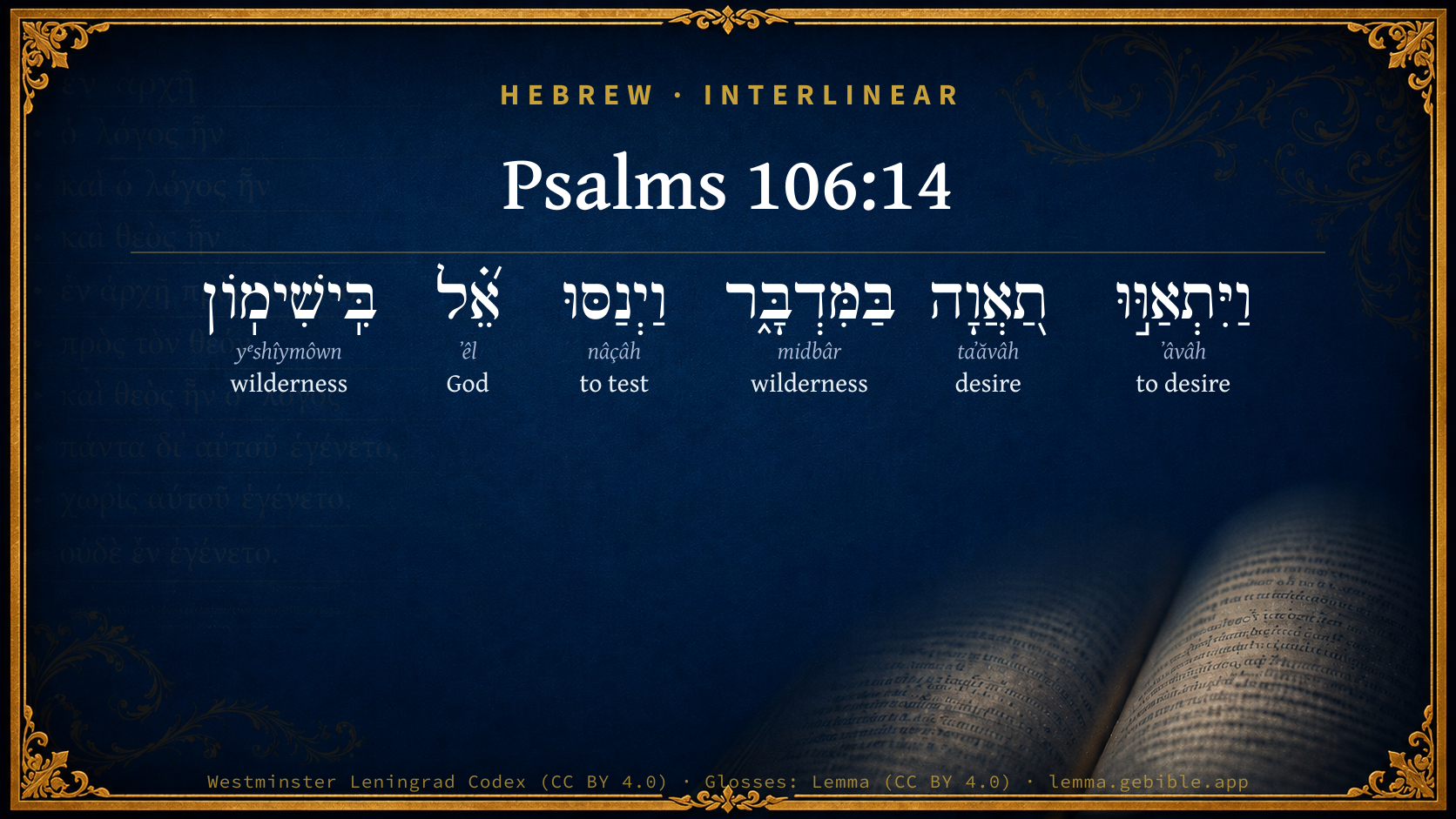
Psalms 106:14

Hebrew (Westminster Leningrad Codex) Psalms 106:14 appears in the Hebrew Old Testament. The text above is from the Westminster Leningrad Codex. Each word links to its Strong’s number, a concise gloss, and parsing drawn from the Open Scriptures Hebrew Bible morphology. Click any word for its full Brown-Driver-Briggs (BDB) entry.
Download image
Cite this verse

Psalms 106:14 (World English Bible). Public Domain. Lemma interlinear Bible study tool, https://lemma.gebible.app/v/psalms/106/14.

Show BibTeX & RIS
BibTeX
RIS
English Translation
But gave in to craving in the desert, And tested God in the wasteland.
World English Bible · Public Domain
Download a study sheet

One document with this verse’s original text, its word-by-word gloss line, the meaning frame, cross-references with their text, attributed commentary, and full source and license credits — printable, and it pastes into notes with its structure intact.

This verse Autodidact and up

Study sheet (.html) Plain text (.txt)

A passage Seminary Student

Up to 50 verses in one chapter. A passage sheet keeps up to 6 commentary sources and 12 cross-references per verse, in the order this page ranks them, and says so on the sheet whenever that leaves anything out. Ask for a single verse and you get the Autodidact verse sheet above.

Everything on this page stays free to read, with no account — the sheet is a download of what is already on screen, not access to it.

Want to remove ads? Support Godless Engineer
Compare translations 3

The same verse in 3 English versions, stacked beneath the original-language interlinear above. Click any original word for its lexicon entry.

Each is an independent rendering of the whole verse — the interlinear is not word-aligned to these translations.

Highlighted words mark where these versions differ — a whole-verse word diff, not a word-by-word alignment.

  • World English Bible Public Domain
    But gave in to craving in the desert, And tested God in the wasteland.
  • King James Version Public Domain
    But lusted exceedingly in the wilderness, and tempted God in the desert.
  • unfoldingWord Literal Text CC BY-SA 4.0
    And they craved a craving in the wilderness, and they tested God in the wasteland.

unfoldingWord Literal Text — © unfoldingWord, licensed CC BY-SA 4.0. Word-aligned USFM3 via Door43 (git.door43.org/unfoldingWord/en_ult).

Versions to compare (up to 4)

3 of 4 selected

Show all 18 translations

Every available English version of this verse, each an independent rendering of the whole verse.

  • World English Bible Public Domain
    But gave in to craving in the desert, And tested God in the wasteland.
  • Berean Standard Bible Public Domain
    They craved intensely in the wilderness and tested God in the desert.
  • Majority Standard Bible Public Domain
    They craved intensely in the wilderness and tested God in the desert.
  • King James Version Public Domain
    But lusted exceedingly in the wilderness, and tempted God in the desert.
  • American Standard Version (1901) Public Domain
    But lusted exceedingly in the wilderness, And tempted God in the desert.
  • Revised Version (1885) Public Domain
    But lusted exceedingly in the wilderness, and tempted God in the desert.
  • Geneva Bible (1599) Public Domain
    But lusted with concupiscence in the wildernes, and tempted God in the desert.
  • Douay-Rheims (1899) Public Domain
    And they coveted their desire in the desert: and they tempted God in the place without water.
  • Young's Literal Translation Public Domain
    And they lust greatly in a wilderness, And try God in a desert.
  • Literal Standard Version CC BY-SA 4.0
    And they lust greatly in a wilderness, || And try God in a desert.
  • Unlocked Literal Bible CC BY-SA 4.0
    They had insatiable cravings in the wilderness, and they challenged God in the desert.
  • unfoldingWord Literal Text CC BY-SA 4.0
    And they craved a craving in the wilderness, and they tested God in the wasteland.
  • Darby Bible Public Domain
    And they lusted exceedingly in the wilderness, and tempted ùGod in the desert.
  • World Messianic Bible Public Domain
    but gave in to craving in the desert, and tested God in the wasteland.
  • Webster's Bible Public Domain
    But lusted exceedingly in the wilderness, and tempted God in the desert.
  • Free Bible Version CC BY-SA 4.0
    They were filled with desperate cravings in the wilderness; they provoked God in the desert.
  • Bible in Basic English Public Domain
    They gave way to their evil desires in the waste land, and put God to the test in the dry places.
  • JPS Tanakh (1917) Public Domain
    But lusted exceedingly in the wilderness, and tried God in the desert.

Literal Standard Version (2020), Covenant Press — licensed CC BY-SA 4.0. Text via the HelloAO Bible API (eBible.org). Unlocked Literal Bible (unfoldingWord) — licensed CC BY-SA 4.0. Text via the HelloAO Bible API (eBible.org). unfoldingWord Literal Text — © unfoldingWord, licensed CC BY-SA 4.0. Word-aligned USFM3 via Door43 (git.door43.org/unfoldingWord/en_ult). Free Bible Version, Dr. Jonathan Gallagher — licensed CC BY-SA 4.0. Text via the HelloAO Bible API (eBible.org).

Word by word

More ways to search: Search by grammar → Find every occurrence → Compare this word →

Practice this passage: Drill this verse → Learn its vocabulary →

About this verse

These counts appear in no published source. They are computed here, from the morphology-tagged text and Lemma’s own curated glosses. What Lemma adds →

6
words
6
distinct lemmas
Wisdom
section

Notable vocabulary

The rarest word here is בִּֽישִׁימֽוֹן wilderness H3452 — appearing just 13 times in the whole Hebrew Bible.

Shared distinctive vocabulary

בִּֽישִׁימֽוֹן wilderness H3452 occurs in 13 verses of the Hebrew Bible. Also found in:

Grammatical profile

  • 2 verbs
  • 4 nouns

Verb forms

  • וַיִּתְאַוּ֣וּ Hithpael · Sequential Imperfect
  • וַיְנַסּוּ Piel · Sequential Imperfect

Hebrew & Septuagint length

In English translation the verse runs 14 words from the Hebrew and 14 from the Septuagint (LXX English) — the same length.

A rough comparison of the two English renderings, which tokenize alike — not a word-level alignment.

Word counts can differ between the Hebrew and the Greek without any difference in meaning — e.g. the Hebrew direct-object marker אֵת has no separate Greek word, and Greek often adds the article ὁ.

Cross-references

12

Topical passages linked to Psalms 106:14 in the Treasury of Scripture Knowledge — connected by theme and wording, ordered by reader-vote popularity; previews shown in the World English Bible.

  • 1 Corinthians 10:9 Neither let us test the Lord, as some of them tested, and perished by the serpents.
  • Exodus 17:2 Therefore the people quarreled with Moses, and said, "Give us water to drink." Moses said to them, "Why do you quarrel with me? Why do you test Yahweh?"
  • Numbers 11:4 The mixed multitude that was among them lusted exceedingly: and the children of Israel also wept again, and said, Who shall give us flesh to eat?
  • 1 Corinthians 10:6 Now these things were our examples, to the intent we should not lust after evil things, as they also lusted.
  • Hebrews 3:8–10 Don't harden your hearts, as in the provocation, Like as in the day of the trial in the wilderness,
  • Numbers 11:33–34 While the flesh was yet between their teeth, before it was chewed, the anger of Yahweh was kindled against the people, and Yahweh struck the people with a very great plague.
  • Numbers 14:22 because all those men who have seen my glory, and my signs, which I worked in Egypt and in the wilderness, yet have tempted me these ten times, and have not listened to my voice;
  • Deuteronomy 9:22 At Taberah, and at Massah, and at Kibroth-hattaavah, you provoked Yahweh to wrath.
  • Psalms 78:18–20 They tempted God in their heart By asking food according to their desire.
  • Psalms 78:30 They didn't turn from their cravings. Their food was yet in their mouths,
  • Psalms 78:40–41 How often they rebelled against him in the wilderness, And grieved him in the desert!
  • Psalms 95:8–9 Don't harden your heart, as at Meribah, As in the day of Massah in the wilderness,

Cross-references courtesy of OpenBible.info (CC BY 4.0).

Hebrew and Greek witnesses Masoretic Hebrew ↔ Greek Septuagint

The same verse in the two great witnesses to the Old Testament, shown verse-for-verse.

You’re reading Greek Psalm 105 (Hebrew Psalm 106). The Septuagint counts the superscription, so verse numbers can differ from the Hebrew — chapter-level alignment, not verse-by-verse. Numbering follows Rahlfs.

These are two independent witnesses, not word-aligned to each other, and the Septuagint is shown in lemma (dictionary) form.

Hebrew Psalms 106:14 Masoretic · Westminster Leningrad Codex

וַיִּתְאַוּ֣וּ תַ֭אֲוָה בַּמִּדְבָּ֑ר וַיְנַסּוּ אֵ֝֗ל בִּֽישִׁימֽוֹן

But gave in to craving in the desert, And tested God in the wasteland.

World English Bible · Public Domain

Greek LXX Greek Psalm 105:14 Septuagint · lemma form

καί ἐπιθυμέω ἐπιθυμία ἐν ὁ ἔρημος καί πειράζω ὁ θεός ἐν ἄνυδρος

And they lusted exceedingly in the wilderness, and tempted God in the dry land.

LXX2012 (modern English Septuagint) · Public Domain

Hebrew: Westminster Leningrad Codex (CC BY 4.0). Greek: Septuagint (public domain); English from LXX2012 (modern English Septuagint) (Public Domain). How the Septuagint differs from the Hebrew →

Commentary

Notes on Psalms 106:14 from classic Christian and Jewish commentators (each source and its license shown beneath its notes). The classic Christian expositions comment on the surrounding passage and are grouped to its opening verse, so a note may address several verses; the Jewish commentaries on the Tanakh (Rashi and others) are per-verse, so they appear only where the commentator wrote on this verse.

Lemma curates 59 commentaries, every one of them public domain or Creative Commons licensed, each selected and text-cleaned for this edition rather than reprinted as found. About our sources →

Trapp's Complete Commentary

John Trapp

Psa 106:14 But lusted exceedingly in the wilderness, and tempted God in the desert.

Ver. 14. But lusted exceedingly] Heb. lusted a lust. See Num 11:1-35, they had a sufficiency, but must have superfluities, as belly-gods; not want, but wantonness, set them a lusting, and that in the wilderness, where they knew that in an ordinary way it was not to be had.

And tempted God] Whom they should have trusted rather, since he waiteth to be gracious, and being a God of judgment, knoweth best when to deal forth his favours, Isa 30:18; Isa 49:8.

John Trapp, A Commentary or Exposition upon All the Books of the Old and New Testament (1647–1656) — public domain. Text from a community e-Sword module.

J. A. Alexander on Psalms

Joseph Addison Alexander

14. (Psa 106:14) And they lusted a lust in the wilderness and tempted God in the desert. The confession now passes from their sins in Egypt to their sins in the wilderness. The strong expression in the first clause relates to their wanton craving of animal food. See Num 11:4; Num 11:34. With the last clause compare Psa 78:18. The two words for wilderness and desert are the same as those in Psa 78:40. See also Psa 68:7.

Joseph Addison Alexander, The Psalms Translated and Explained (1850) — public domain. Text from a community e-Sword module.

John Calvin's Commentaries

14. And they lusted He goes on, according to the history, to mention the sin which, agreeably to the duty of his office as a teacher, he had briefly noticed. Should any one inquire in what way they did not attend to God’s counsel, he answers, because they had indulged in the gratification of their lusts; for the only way of acting with proper moderation is, when God rules and presides over our affections. It is therefore the more necessary to bridle that strong tendency to fleshly lusts which naturally rage within us. For whoever allows himself to desire more than is needful, openly sets himself in direct opposition to God, inasmuch as all fleshly lusts are directly opposed to him.

To tempt God is not to acquiesce in his will, but to desire more than he is willing to grant. And since there are a variety of modes of tempting God, the prophet here adverts to one mode of doing so, namely, that the people had been so presumptuous as to limit God to means of their own devising; and thus, in rejecting the way which they ought to have followed, they ascribed to God a property altogether novel, as much as to say, If God do not feed us with flesh we will not regard him as God. He gave them the food which ought to have satisfied them. And though God is not limited by any means whatsoever, yet it is his will that our minds be rendered subservient to the means which he has appointed. For instance, although he can nourish us without bread, nevertheless it is his will that our life be sustained by such provision; and if we neglect it, and wish to point out to him another way of nourishing us, we tempt his power.

John Calvin's Commentaries (1540-1563) — public domain. Text from the Calvin Translation Society English edition (1840s-50s) via the Christian Classics Ethereal Library (ccel.org). Calvin's coverage is partial (roughly two-thirds of the Bible); uncommented books and verses are honest gaps, never fabricated. The 19th-century editor's footnotes and remarks are omitted so the notes are faithfully Calvin's own voice.

Ellicott's Commentary for English Readers

(14) Lusted.—See margin.

A Bible Commentary for English Readers, edited by Charles John Ellicott (1878–1897) — public domain. Text from a community e-Sword module.

The Cambridge Bible for Schools and Colleges

gen. ed. J. J. S. Perowne

14. A glance at yet another occasion of murmuring and its punishment The phrase and they fell a lusting, is taken from Num_11:4; cp. Psa_78:29-30. They tempted God, i.e. tested Him, put Him to the proof, by questioning His will and ability to provide for them (Psa_78:18).

The Cambridge Bible for Schools and Colleges (gen. ed. J. J. S. Perowne; Cambridge University Press, 1878–1918) — public domain. Text from a community e-Sword module.

John Gill's Exposition

But lusted exceedingly in the wilderness,.... Or, "lusted a lust" (p) as in Num 11:4 to which story there related this refers; they were not content with the manna they had every day, though very nourishing and of a sweet taste; they lusted after the fish and flesh of Egypt, and other things they ate there; so that this was not a natural lust, or craving after food and drink, to satisfy nature, which would not have been criminal; but a voluptuous last to gratify their appetite: it was lusting after evil tidings, as the apostle interprets it, Co1 10:6, lust after sinful things, or any unlawful object, or after anything in an unlawful way, is sin.

And tempted God in the desert; which is expressly forbidden by a law which our Lord referred to when he was tempted by Satan in the wilderness: a very ungrateful action this, since God tempts no man to sin; a very daring impiety, a sin of the first magnitude, and which lay in making experiments, in trying whether the presence of God was among them or not; and putting God as it were on proving that he had power sufficient to provide for them in the wilderness; see Exo 17:7. It seems it was Jesus Christ whom they tempted, from whence it appears that he is truly God, Co1 10:9. Both in this and the preceding clause an emphasis lies on the place where all this was done, the wilderness or desert, where God had done such great things for them, and where they could not help themselves, but were wholly and immediately dependent on him.

(p) "concupierunt concupiscentiam", V. L. Pagninus, Montanus, &c.

John Gill's Exposition of the Whole Bible (1746–1763) — public domain (CC PDM 1.0). Text via the HelloAO Bible API.

Albert Barnes' Notes on the Bible

But lusted exceedingly in the wilderness - Margin, as in Hebrew, “lusted a lust.” The reference is to their desire of better food than the manna.

And tempted God in the desert - Tried God, whether he “could” provide for them food and drink. Psa 78:19-20.

Albert Barnes' Notes on the Bible (1834–1885) — public domain. Text from a community e-Sword/MySword module.

Matthew Poole's English Annotations

Lusted exceedingly, to wit, for flesh, as the next verse showeth.

Matthew Poole's English Annotations on the Holy Bible (1683–1685) — public domain. Text from a community e-Sword/MySword module.

The Treasury of David

Charles H. Spurgeon

Ver. 14. But lusted exceedingly in the wilderness. Though they would not wait God's will, they are hot to have their own. When the most suitable and pleasant food was found them in abundance, it did not please them long, but they grew dainty and sniffed at angel's food, and must needs have flesh to eat, which was unhealthy diet for that warm climate, and for their easy life. This desire of theirs they dwelt upon till it became a mania with them, and, like a wild horse, carried away its rider. For a meal of meat they were ready to curse their God and renounce the land which floweth with milk and honey. What a wonder that the Lord did not take them at their word! It is plain that they vexed him greatly,

And tempted God in the desert. In the place where they were absolutely dependent upon him and were everyday fed by his direct provision, they had the presumption to provoke their God. They would have him change the plans of his wisdom, supply their sensual appetites, and work miracles to meet their wicked unbelief: these things the Lord would not do, but they went as far as they could in trying to induce him to do so. They failed not in their wicked attempt because of any goodness in themselves, but because God "cannot be tempted, "temptation has no power over him, he yields not to man's threats or promises.

Ver. 14. In the wilderness. When God by circumstances of time and place doth call for moderation of carnal appetite, the transgression is more heinous and offensive unto God: "They lusted exceedingly in the wilderness", where they should have contented themselves with any sort of provision. David Dickson.

Ver. 14. In the wilderness. There, where they had bread enough and to spare, yet nothing would serve them but they must have flesh to eat. They were now purely at God's finding; so that this was a reflection upon the wisdom and goodness of their Creator. They were now, in all probability, within a step of Canaan, yet had not patience to stay for dainties till they came thither. They had flocks and herds of their own, but they will not kill them; God must give them flesh as he gave them bread, or they will never give him credit or their good word: they did not only wish for flesh, "but" they "lusted exceedingly" after it. A desire even of lawful things, when it is inordinate and violent, becomes sinful; and therefore this is called "lusting after evil things", (1Co 10:6), though the quails as God's gift, were good things, and were so spoken of, Ps 105:40. Yet this was not all, "they tempted God in the desert", where they had had such experience of his goodness and power, and questioned whether he could and would gratify them therein. See Ps 78:19-20. Matthew Henry.

Ver. 14. The wickedness of inordinate desires.

1. They are out of place"in the wilderness."

2. They are assaults upon God"and tempted God."

3. They are despisers of former merciessee preceding verses.

4. They involve solemn dangersee following verse.

Psalms 106:15*

Charles H. Spurgeon's The Treasury of David (1869–1885) — public domain. Psalms only. Text from a community e-Sword/MySword module.

Whedon's Commentary on the Bible

Daniel D. Whedon

14. Tempted God—See note on Psa_78:18

Daniel D. Whedon (gen. ed.), Commentary on the Old and New Testaments (1874–1909) — public domain. Text from a community e-Sword module.

The Pulpit Commentary

But lusted exceedingly in the wilderness; literally, "lusted a lust." The expression is taken from Num_11:4, where it is translated in the Authorized Version by "fell a-lusting." The lust was for "flesh," and for "the fish, the cucumbers, the melons, and the leeks, and the onions, and the garlic, which they did eat in Egypt freely". (Num_11:5) And tempted God in the desert. (comp. Psa_78:18)

The Pulpit Commentary (1880–1919), ed. H.D.M. Spence-Jones & Joseph S. Exell — public domain. Text from a community e-Sword module.

John Wesley's Explanatory Notes

Lusted - For flesh.

John Wesley, Explanatory Notes Upon the Whole Bible (1754–1765) — public domain. Text via the GEBible commentary corpus.

Rashi

Rabbi Shlomo Yitzchaki (Rashi)

They craved a lust (Num. 11:4) “Who will give us meat to eat?”

Rashi on the Tanakh — English translations: “The Judaica Press complete Tanach with Rashi, translated by A. J. Rosenberg” (CC BY 4.0); “Pentateuch with Rashi's commentary by M. Rosenbaum and A.M. Silbermann, 1929-1934” (public domain); “The Metsudah Tanach series, Lakewood, N.J” (CC BY 4.0); and “The Book of Joshua, Metsudah Publications, 1997” (CC BY 4.0). Text via Sefaria.

Lesson kit

Teaching starters — assembled from the data on this page, not authored interpretation. Every prompt links to the verse data it draws on. Edit before teaching.

Psalms, in the Wisdom, opens this verse with 6 words (6 distinct Hebrew lemmas). Its most distinctive word is yᵉshîymôwn (“wilderness”). A historical commentator’s framing appears above. Read the whole chapter for the surrounding context.

Discussion questions

  1. How does “wilderness” (yᵉshîymôwn) shape what this verse is saying?
  2. Numbers 21:20 shares the word «wilderness» with this verse. How do the two illuminate each other?
  3. These translations render this verse differently; the difference is in the English rendering, not the original. What questions does that raise?
  4. The verb «וַיִּתְאַוּ֣וּ» is Hithpael Sequential Imperfect. How does its form color the action?
  5. Reading how Trapp's Complete Commentary and J. A. Alexander on Psalms read this verse, where do the two commentators agree and where do they part?

Things to notice

Reading settings

Reading text

Shown beneath each verse's original-language words.

Old Testament
Old Testament edition

Read the OT as the Masoretic Hebrew (MT) or the Greek Septuagint (LXX).

English shown for the Greek Septuagint (in the Hebrew ↔ Greek comparison).

Comparing translations? Open the Compare panel on any verse page to stack up to four side by side.