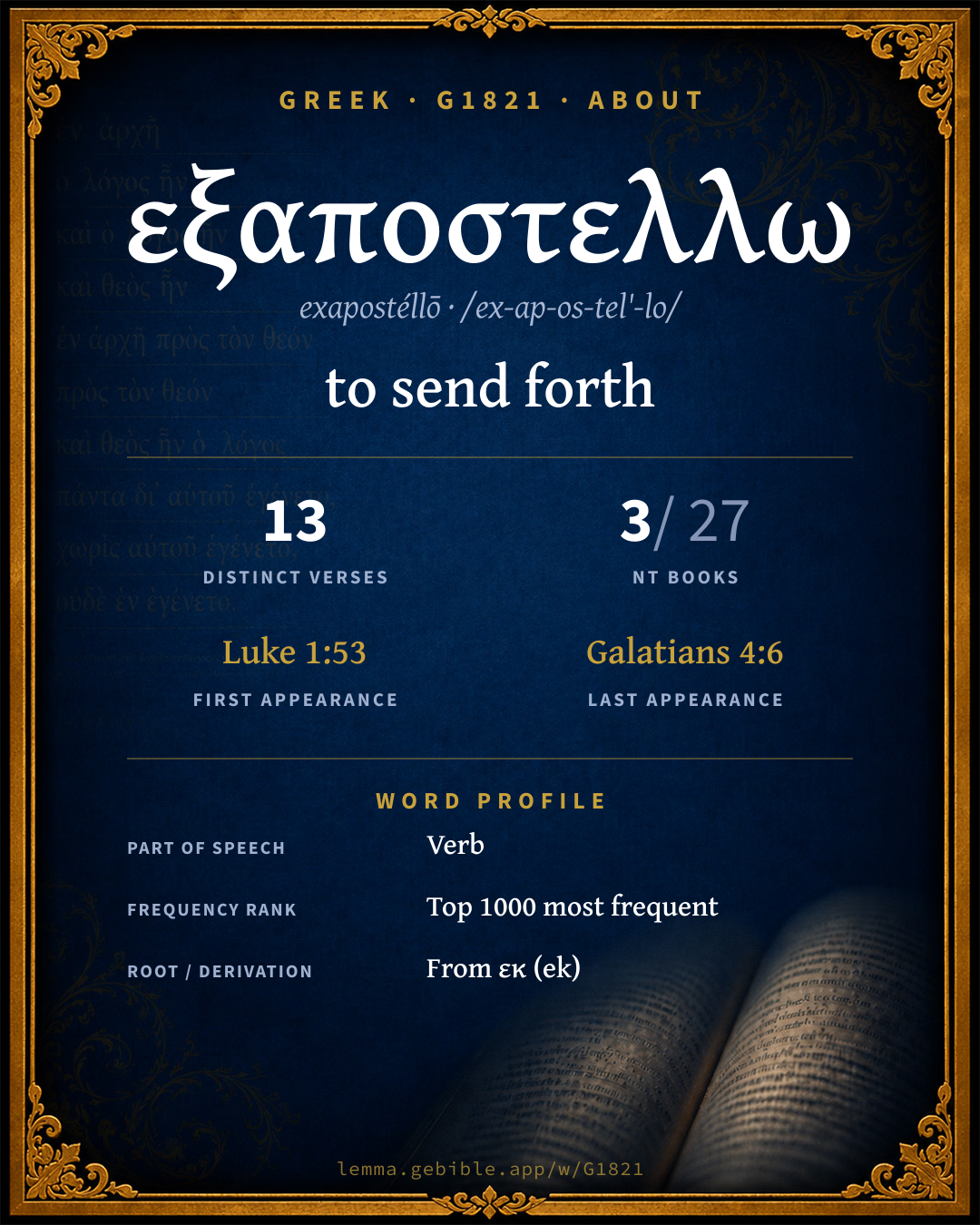
ἐξαποστέλλω
to send forth
‘to send forth’ is one of 2 main senses fuller range ↓
Full lexicon entry — Thayer's Greek Lexicon
From Thayer's Greek Lexicon
Where this word appears
See every Aorist-tense verb in the Greek New Testament →
Grammar key — what these labels mean
Part of speech
- Verb
- An action or state-of-being word.
Tense
- Aorist
- Action viewed as a simple whole, without regard to duration — often past (perfective aspect).
- Future
- Action expected in future time.
- Present
- Ongoing or general action in present time (imperfective aspect).
Voice
- Active
- The subject performs the action.
- Passive
- The subject receives the action.
Mood
- Indicative
- States a fact or asks a factual question (the mood of reality).
Person
- 3rd person
- The one spoken about (“he / she / it / they”).
- 1st person
- The speaker (“I / we”).
Number
- Plural
- More than one.
- Singular
- One.
Grammatical forms
- Verb, Aorist, Active, Indicative, 3rd person, Plural 5 times (38%)
- Verb, Aorist, Active, Indicative, 3rd person, Singular 5 times (38%)
- Verb, Aorist, Passive, Indicative, 3rd person, Singular 1 time (8%)
- Verb, Future, Active, Indicative, 1st person, Singular 1 time (8%)
- Verb, Present, Active, Indicative, 1st person, Singular 1 time (8%)
Parsed forms decoded from the imported morphology (Robinson–Tischendorf, public domain), counted across 13 parsed occurrences — not distinct verses.
Every verse where G1821 appears — 13 distinct verses across 3 books. Click any verse to open its interlinear word-by-word view. Verse text shown in the World English Bible for context — . Each verse’s Greek form is shown with its reference; the English is not keyword-highlighted, since the data carries no word-level English alignment. Use “Compare translations” on any verse to read it across multiple English versions. This concordance covers the Greek New Testament; Septuagint (Greek Old Testament) occurrences of this word are not indexed here.
Luke 4 verses
- Luke 1:53 ἐξαπέστειλεν aor act ind 3sg He has filled the hungry with good things. He has sent the rich away empty.
- Luke 20:10 ἐξαπέστειλαν aor act ind 3pl At the proper season, he sent a servant to the farmers to collect his share of the fruit of the vineyard. But the farmers beat him, and sent him away empty.
- Luke 20:11 ἐξαπέστειλαν aor act ind 3pl He sent yet another servant, and they also beat him, and treated him shamefully, and sent him away empty.
- Luke 24:49 ἐξαποστέλλω pres act ind 1sg Behold, I send forth the promise of my Father on you. But wait in the city of Jerusalem until you are clothed with power from on high."
Acts 7 verses
- Acts 7:12 ἐξαπέστειλεν aor act ind 3sg But when Jacob heard that there was grain in Egypt, he sent out our fathers the first time.
- Acts 9:30 ἐξαπέστειλαν aor act ind 3pl When the brothers knew it, they brought him down to Caesarea, and sent him off to Tarsus.
- Acts 11:22 ἐξαπέστειλαν aor act ind 3pl The report concerning them came to the ears of the assembly which was in Jerusalem. They sent out Barnabas to go as far as Antioch,
- Acts 12:11 ἐξαπέστειλεν aor act ind 3sg When Peter had come to himself, he said, "Now I truly know that the Lord has sent out his angel and delivered me out of the hand of Herod, and from everything the Jewish people were expecting."
- Acts 13:26 ἐξαπεστάλη aor pass ind 3sg Brothers, children of the stock of Abraham, and those among you who fear God, the word of this salvation is sent out to you.
- Acts 17:14 ἐξαπέστειλαν aor act ind 3pl Then the brothers immediately sent out Paul to go as far as to the sea, and Silas and Timothy still stayed there.
- Acts 22:21 ἐξαποστελῶ fut act ind 1sg "He said to me, 'Depart, for I will send you out far from here to the Gentiles.'"
Galatians 2 verses
About this entry
At a glance — auto-summarized from this page’s data, not written by a person. Every figure links to its source below. This summary describes the numbers; it doesn’t interpret them.
At its core, εξαποστελλω (exapostéllō) means “to send forth.” Its uses cluster heavily in Acts (54% of all occurrences). With 13 verses in 3 books, it is an uncommon word in the Greek New Testament. First canonically at Luke 1:53, it enters the text early. Catalogued under 2 senses, its meaning is not single-sense. Dig into 13-verse concordance and the renderings breakdown below.
Gloss history
Strong's 1890 vs modern scholarship

About this word
Strong's G1821 catalogs a Greek word from the Greek New Testament.
These counts are not copied from any lexicon or concordance. They are computed here, from the morphology-tagged Greek New Testament. What Lemma adds →
- 13
- distinct verses
- The word appears in 13 distinct verses.
- 3 / 27
- NT books
- The word appears in 3 of 27 New Testament books.
- #863
- by frequency
- Top 1000 most frequent Greek words (rank 863 of 5,347 Greek words by occurrence).
View all 13 occurrences in the concordance →
By section of the New Testament
By traditional corpus
Conventional, traditional groupings — biblical authorship is debated, so this is a traditional corpus grouping, not an authorship claim. Some books belong to more than one corpus (Luke is in both the Gospels and the Lukan corpus, and so on), so these shares overlap and need not total 100%. Each figure is a share of the word’s 13 distinct verses.
- Lukan (Luke–Acts) 11 verses · 85%
- Gospels 4 verses · 31%
- Pauline corpus 2 verses · 15%
How translations render this word
Counts come from each version’s own published word-to-Strong’s tagging or interlinear alignment — an approximate guide to how each version renders this word, not a word-level alignment the data otherwise carries. Because each total is that version’s own tagged count, the per-version totals vary from one another and need not match the appearance or distinct-verse counts above. These counts may also differ from a printed concordance because Lemma counts each distinctly tagged rendering and does not collapse phrase taggings into a single head-word total. This is a fixed set of word-tagged versions (KJV, ASV, BSB, ULT) and does not change with the reading translation you choose elsewhere. Each version’s license is shown beside its name below (and on Sources).
- King James Version: Sent him away 2×
- American Standard Version: Away 3×, Sent 3×, Sent forth 3×
- Berean Standard Bible: Sent 3×, Has sent 2×
- unfoldingWord Literal Text: Sent 6×, Away 4×
King James Version Public Domain
Renders G1821 across 13 tagged occurrences — most commonly:
Plus 11 renderings that appear only once — usually multi-word phrases or single function words the recovered tagging swept in, not distinct renderings.
American Standard Version Public Domain
Renders G1821 across 15 tagged occurrences — most commonly:
Plus 6 renderings that appear only once — usually multi-word phrases or single function words the recovered tagging swept in, not distinct renderings.
Berean Standard Bible Public Domain
Renders G1821 across 12 tagged occurrences — most commonly:
Plus 7 renderings that appear only once — usually multi-word phrases or single function words the recovered tagging swept in, not distinct renderings.
unfoldingWord Literal Text CC BY-SA 4.0
Renders G1821 across 16 tagged occurrences — most commonly:
Plus 6 renderings that appear only once — usually multi-word phrases or single function words the recovered tagging swept in, not distinct renderings.
Senses in Thayer's
The 2 senses Thayer's distinguishes for this word, in lexicon order (not ranked by frequency or importance). The full entry — with sub-senses — is in the Lexicon Entry tab.
- to send forth
- to send away
Word origin
Derived from εκ (ek) (G1537) — from.
Forms in the corpus
The 5 distinct written forms G1821 takes in the Greek New Testament, most frequent first — each parse links to that tense’s occurrences in the concordance.
| Form | Parsing | Example | Uses |
|---|---|---|---|
| ἐξαπέστειλαν exapésteilan | Verb, Aorist, Active, Indicative, 3rd person, Plural | Luke 20:10 | 5 |
| ἐξαπέστειλεν exapésteilen | Verb, Aorist, Active, Indicative, 3rd person, Singular | Luke 1:53 | 5 |
| ἐξαπεστάλη exapestálē | Verb, Aorist, Passive, Indicative, 3rd person, Singular | Acts 13:26 | 1 |
| ἐξαποστέλλω exapostéllō | Verb, Present, Active, Indicative, 1st person, Singular | Luke 24:49 | 1 |
| ἐξαποστελῶ exapostelō̂ | Verb, Future, Active, Indicative, 1st person, Singular | Acts 22:21 | 1 |
Same root — word family
Other Thayer's entries built from the same root as G1821, grouped by Strong’s listed origin. These share a root / origin per the lexicon — not necessarily a shared meaning. Each links to that word’s own entry.
Derives from
Shares the same root
- εκβαλλω ekbállō G1544 to cast out
- εκβασις ékbasis G1545 exit
- εκγαμιζω ekgamízō G1547 to give in marriage
- εκγαμισκω ekgamískō G1548 to give in marriage
- εκγονον ékgonon G1549 offspring
- εκδαπαναω ekdapanáō G1550 to spend
- εκδεχομαι ekdéchomai G1551 to receive
- εκδηλος ékdēlos G1552 evident
- εκδημεω ekdēméō G1553 to depart
- εκδιδωμι ekdídōmi G1554 to give out
- εκδιηγεομαι ekdiēgéomai G1555 to relate
- εκδικος ékdikos G1558 without justice
- εκδιωκω ekdiṓkō G1559 to banish
- εκδοτος ékdotos G1560 delivered up
- εκδυω ekdýō G1562 to put off
- εκζητεω ekzētéō G1567 to seek out
- εκθαμβος ékthambos G1569 astonished
- εκθετος ékthetos G1570 exposed
- εκκαθαιρω ekkathaírō G1571 to cleanse
- εκκαιω ekkaíō G1572 to burn
- εκκακεω ekkakéō G1573 to be exhausted
- εκκεντεω ekkentéō G1574 to pierce
- εκκλαω ekkláō G1575 to cut off
- εκκλειω ekkleíō G1576 to shut out
+88 more words share this root (not shown).
Compare all same-root words → Showing 4 of 114 — not the complete family. They share a root, not necessarily a meaning.