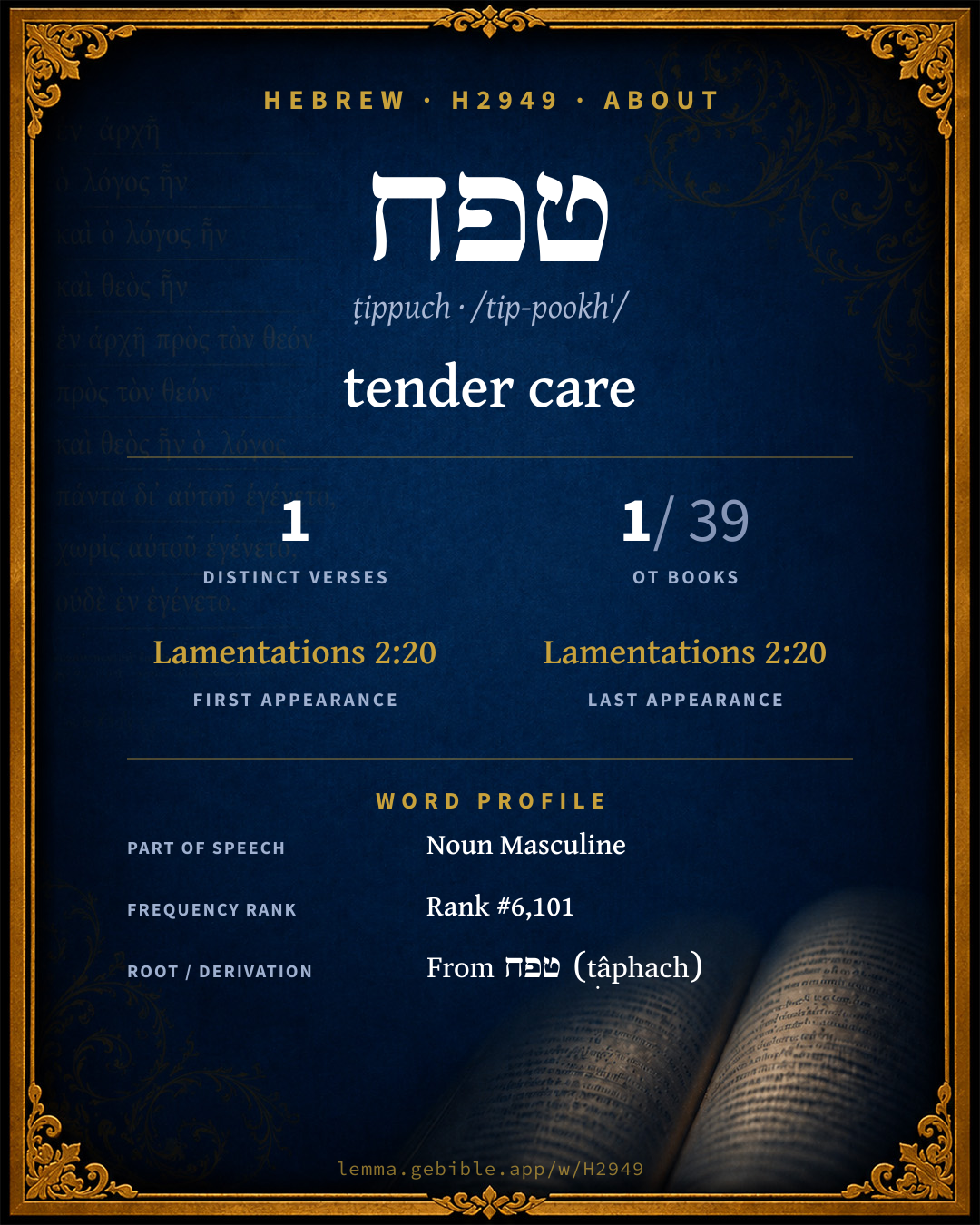
טִפֻּחִים
tender care
Full lexicon entry — Brown-Driver-Briggs (BDB)
From Brown-Driver-Briggs (BDB)
Where this word appears
Grammar key — what these labels mean
Part of speech
- Noun
- A naming word — a person, place, thing, or idea.
Noun type
- Common
- A common noun — a general class of person, place, or thing (“king,” “city,” “water”), not a specific name.
State
- Absolute
- The independent form of a noun, not bound to a following word.
Gender
- Masculine
- Grammatically masculine.
Number
- Plural
- More than one (in Hebrew, generally three or more).
Every verse where H2949 appears — 1 distinct verse across 1 book. Click any verse to open its interlinear word-by-word view. Verse text shown in the World English Bible for context — . Each verse’s Hebrew form is shown with its reference; the English is not keyword-highlighted, since the data carries no word-level English alignment. Use “Compare translations” on any verse to read it across multiple English versions. This concordance covers the Hebrew Bible; Septuagint (Greek Old Testament) occurrences are not indexed here.
Lamentations 1 verse
About this entry
At a glance — auto-summarized from this page’s data, not written by a person. Every figure links to its source below. This summary describes the numbers; it doesn’t interpret them.
טפח — transliterated ṭippuch — is a Hebrew noun carrying the sense “tender care.” With only 1 verse it sits in the long tail of Hebrew Bible vocabulary. More than three-quarters of its appearances fall in Lamentations. It occurs only once, in Lamentations 2:20. From the same root come טפח, טפח and טפח. Dig into 1-verse concordance and the renderings breakdown below.
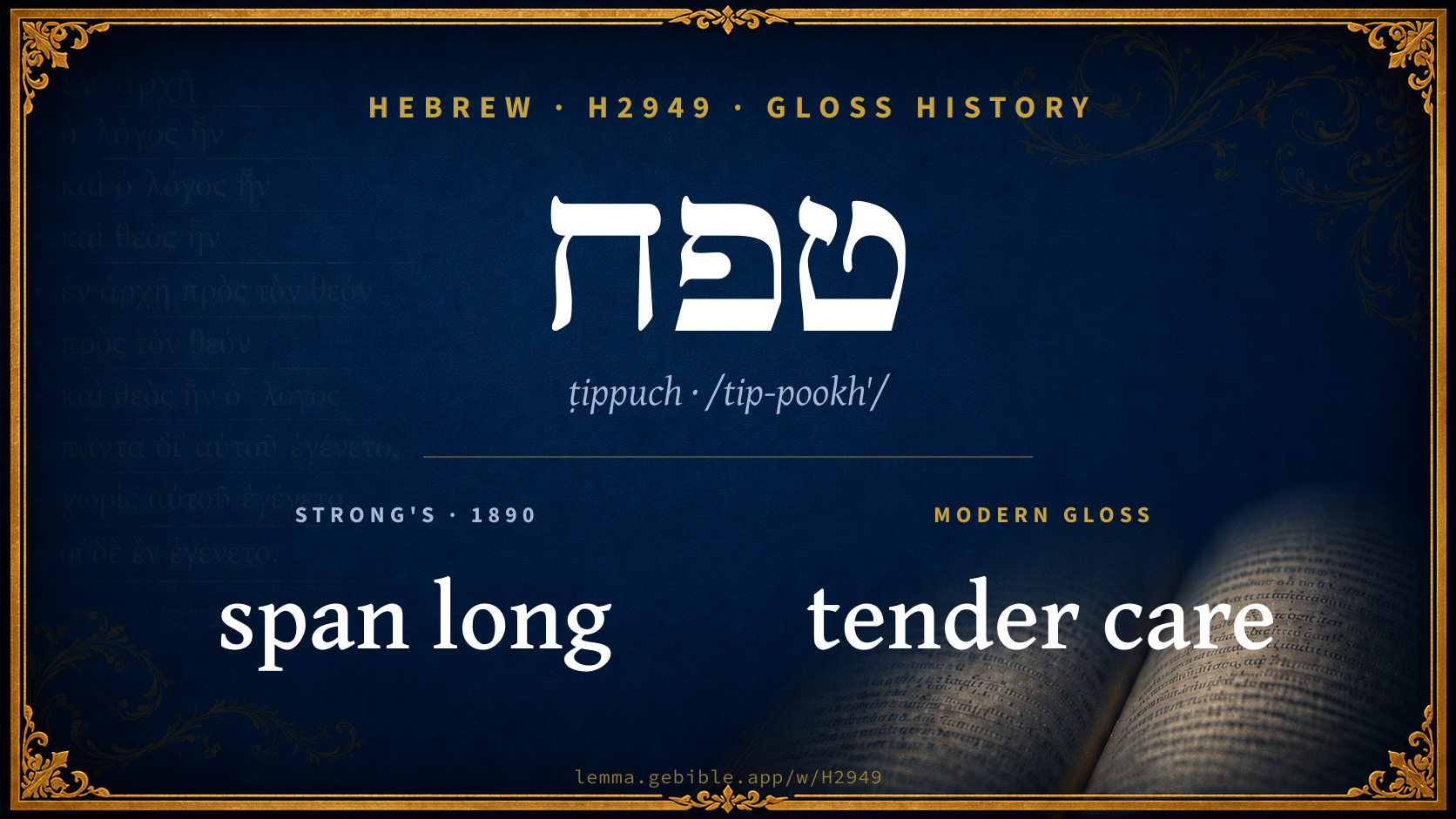
Gloss history
Strong's 1890 vs modern scholarship
About this word
Strong's H2949 catalogs a Hebrew word from the Hebrew Old Testament.
These counts are not copied from any lexicon or concordance. They are computed here, from the morphology-tagged Hebrew Old Testament. What Lemma adds →
- 1
- distinct verses
- The word appears in 1 distinct verse.
- 1 / 39
- OT books
- The word appears in 1 of 39 Old Testament books.
- #6,101
- by frequency
- Rank #6,101 (rank 6,101 of 8,640 Hebrew words by occurrence).
View all 1 occurrence in the concordance →
Most concentrated in
- Lamentations 1 verse 100%
By section of the Old Testament
By traditional corpus
Conventional, traditional groupings — biblical authorship is debated, so this is a traditional corpus grouping, not an authorship claim. Each share is this word’s portion of its verses in that division of the Hebrew canon. Each figure is a share of the word’s 1 distinct verse.
- Writings (Ketuvim) 1 verse · 100%
How translations render this word
Counts come from each version’s own published word-to-Strong’s tagging or interlinear alignment — an approximate guide to how each version renders this word, not a word-level alignment the data otherwise carries. Because each total is that version’s own tagged count, the per-version totals vary from one another and need not match the appearance or distinct-verse counts above. These counts may also differ from a printed concordance because Lemma counts each distinctly tagged rendering and does not collapse phrase taggings into a single head-word total. This is a fixed set of word-tagged versions (KJV, ASV, BSB, ULT) and does not change with the reading translation you choose elsewhere. Each version’s license is shown beside its name below (and on Sources).
- King James Version: Span long 1×
- American Standard Version: Are dandled 1×
- Berean Standard Bible: They have nurtured 1×
- unfoldingWord Literal Text: Nursing 1×, Of 1×
King James Version Public Domain
Renders H2949 across 1 tagged occurrence — most commonly:
American Standard Version Public Domain
Renders H2949 across 1 tagged occurrence — most commonly:
Berean Standard Bible Public Domain
Renders H2949 across 1 tagged occurrence — most commonly:
unfoldingWord Literal Text CC BY-SA 4.0
Renders H2949 across 2 tagged occurrences — most commonly:
Senses in BDB
The 1 sense BDB distinguishes for this word, in lexicon order (not ranked by frequency or importance). The full entry — with sub-senses — is in the Lexicon Entry tab.
- tender care, dandling
Word origin
n.[m.] pl. abstr. dandling, עֹלֲלֵי ט׳ La 2:20.
— Brown-Driver-Briggs (Oxford 1906, public domain), digitized via Sefaria, supplemented by the OpenScriptures HebrewLexicon (CC BY 4.0). See Sources.
Derived from טפח (ṭâphach) (H2946) — to dandle.
Jastrow Dictionary
A second Hebrew/Aramaic lexicon for comparison, covering Aramaic and post-biblical (Talmudic, Targumic, Midrashic) usage that the biblical-Hebrew BDB does not. Matched by lemma rather than by Strong’s number, so a lemma may carry more than one Jastrow headword (shown separately below), and the entries cover usage well beyond the Bible.
טָפַח I
- [to join closely, whence טֶפַח (cmp. קוֹמֶץ) joined fingers, hand-breadth,] to come in close contact; (cmp. נָקַשׁ) to strike, knock. B. Kam. 32ᵇ נתזה בקעת וטָפְחָה לו על פניו Ms. M. a chip flew off and struck him in the face. Ib. נתזו … וטָפְחוּ לו וכ׳ Ms. M. sparks flew off and hit him &c.; a. fr.—Esp. (denom. of טֶפַח) טָפַח, a.
- 1. to strike with the flat hand, to slap. Gen. R. s. 22, end התחיל אדה"ר מְטַפֵּחַ על פניו Adam slapped his own face; Lev. R. s. 10 טוֹפֵחַ. Kidd. 31ᵃ טָפְחָה לו על ראשו slapped him on his head. Gen. R. s. 45 טְפָחַתָּהּ וכ׳ (Yalk. ib. 79 קפחתה) she slapped her face with her shoe. Y. Kil. VIII, 31ᶜ top טי׳ כנגד וכ׳ (Kidd. 24ᵇ הכהו) if he struck him over his eye and blinded him. Ab. Zar. IV, 10 היה מְטַפֵּחַ על וכ׳ (Bab. ed. 60ᵇ מַטְפִּיחַ, Y. ed. מתפח) he slapped upon the fermenting barrel (to check fermentation). Toh. III, 8 שדרך התינוק לטַפֵּחַ a child likes to slap (dough &c., to dabble); a. e.
- 2. to clap hands to a certain tune in rejoicing or mourning, v. טִיפּוּחַ. Bets. V, 2 לא מְטַפְּחִין וכ׳ we must not clap hands, or strike upon the knees, or stamp on the Holy Day. M. Kat. III, 8 מענות אבל לא מְטַפְּחוֹת may sing the dirge but must not clap. Ib. 9. Num. R. s. 4 … שהיה מקיש וטוֹפַחַ he knocked his hands against each other and clapped; ib. וטפח. Cant. R. to II, 14 מְטַפַּחַת באגפיה clapped her wings.
- 3. to collect the contents of a broken vessel by palming, to wipe with the palm. Ter. XI, 7. Sabb. 143ᵇ ולא יְטַפֵּחַ בשמן must not use the palm for collecting oil in the broken vessel.
- same. Ab. Zar. 60ᵇ, v. supra.
טְפַח
- , Pa. טַפֵּחַ ch. same,
- 1. to close carefully. B. Kam. 23ᵃ לא ט׳ באפיה (Ms. H. טפא, v. טְפֵי IV) he did not carefully close (the stable) before him.
- 2. to slap, strike with hand, stamp with foot. Targ. II Kings XIX, 24; Is. XXXVII, 25. Targ. Ez. XXI, 17; 19; a. fr.—Targ. Jon. IV, 8 ט׳ שמשא וכ׳ the sun beat upon &c.—B. Kam. 32ᵇ ט׳ ליה רבא בסנדליה Raba struck him upon his (R. Shimi’s) sandal (to silence him); M. Kat. 25ᵃ; B. Bath. 22ᵃ; a. e. e.g. Isaiah 37:25
- 3. to clap hands. Y. Snh. II, beg. 19ᵈ; Y. Hor. III, beg. 47ᵃ שרי ט׳ בחדא וכ׳ he made the motion of clapping with one hand; ובחדא טַפְחִין do people clap with one hand?; a. e.
- 4. to strike, forge. Targ. Ps. CXLI, 5; Targ. Is. XLI, 7 (h. text הלם).
טָפַח II
- (cmp. טָפַף II) to drip, be moist. Sabb. 17ᵃ עדיין משקה טוֹפֵחַ וכ׳ moisture is still dripping on them. Yoma 78ᵃ טוֹפֵחַ ע"מ להַטְפִּיחַ moist enough to moisten other objects; Ab. Zar. 60ᵇ טופח ע"מ להטפיח Ms. M. (ed. ט׳ להט׳). Toh. VIII, 9; a. fr.—2) (cmp. דאב, דוי) to melt, decay, ferment (of a running and fermenting dough). B. Mets. 59ᵇ אף בצק … ט׳ (Ms. R. 2 תפח, v. תָּפַח) even the dough under the hands of the kneading women fermented.—Y. Yeb. XII, end, 13ᵃ וטפח רוחי עלי; Yalk. Prov. 964 טָפְחָה וכ׳ my mind in me became fermenting, i.e. I felt proud (v. טוּף).—Part. pass. טָפוּחַ decaying, languishing (from starvation). Sifra B’ḥuck. Par. 2, ch. VI טְפוּחֵי רעב (v. תָּפַח).
- to moisten, wet. Yoma 78ᵃ טינא מַטְפַּחַת clay which makes wet (those sitting on it). Ib.; Ab. Zar. 60ᵇ להַטְפִּיחַ, v. supra. Ber. 25ᵃ כל זמן שמַטְפִּיחִין as long as the spot is wet enough to moisten.
טֶפַח
- v. טָפַח I) hand-breadth, breadth of four fingers joined. Succ. 4ᵇ, a. fr. ארון תשעה וכפרת ט׳ the Ark was nine handbreadths high, and the lid one. Ib. 7ᵃ ט׳ שוחק a liberal hand-breadth (four fingers not closely joined). v. אַמָּה.—Yoma 55ᵃ top טִיפְחָהּ של כפורת Ar. a. Ms. M. 2 a. Ms. O. (v. Rabb. D. S. a. l. note 9, ed. עוביה) the hand-breadth, i.e. the hight, of the lid, v. supra.; a. v. fr.—Pl. טְפָחִים, Du. טְפָחַיִים. Taan. 25ᵇ; a. v. fr. [טְפָחִין, or טִפְחִין, v. טְפִיחַ II.]
תָּפַח
- II = טָפַח I.
- to slap. Ab. Zar. IV, 10 (11) מְתַפֵּחַ Y. ed., v. טָפַח I
A Dictionary of the Targumim, the Talmud Babli and Yerushalmi, and the Midrashic Literature (Marcus Jastrow; London, Luzac, 1903) — Public Domain. Digitized via Sefaria. Digitized via Sefaria. Full attribution on Sources.
Same root — word family
Other BDB entries built from the same root as H2949, grouped by Strong’s listed origin. These share a root / origin per the lexicon — not necessarily a shared meaning. Each links to that word’s own entry.
Derives from
Shares the same root
Compare all same-root words → Showing 4 of 5 — not the complete family. They share a root, not necessarily a meaning.
Septuagint verse parallels
This word appears in 1 verse that also exists in the Greek Old Testament (Septuagint), out of the 1 Hebrew verse it occurs in. You can read those verses in Greek by switching the Old Testament edition to the Septuagint.
Read these verses in the Septuagint
This is a verse-level parallel only — the same verses exist in both the Hebrew and Greek Old Testaments. No word-level Hebrew↔Greek correspondence is claimed: the data carries no such alignment, so no Greek word is shown as this Hebrew word’s translation. Coverage is not total — the Septuagint omits the deuterocanon and renumbers the Psalms, so some Hebrew verses have no direct Greek parallel.