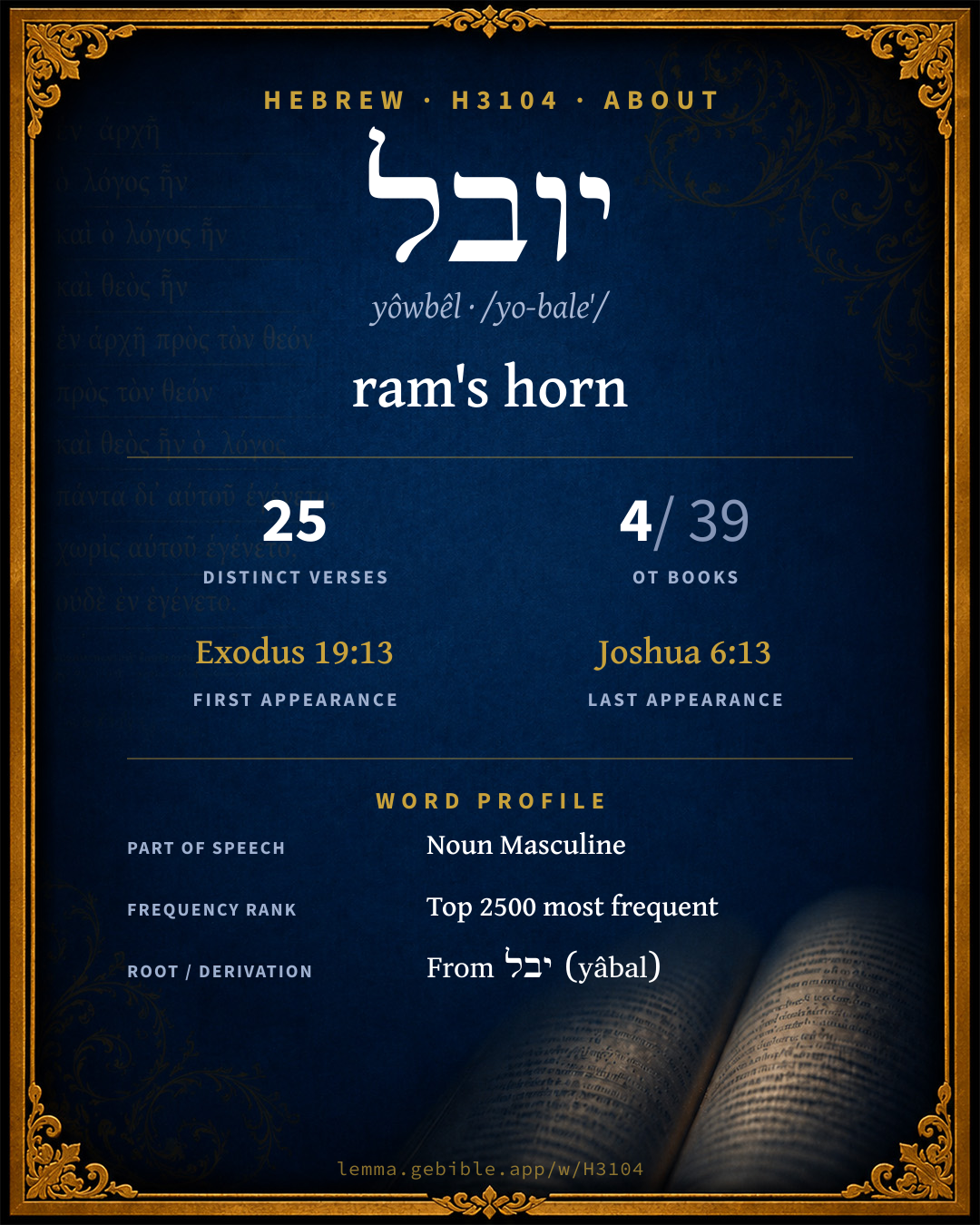
יוֹבֵל
ram's horn
also: ram, trumpet, cornet fuller range ↓
Full lexicon entry — Brown-Driver-Briggs (BDB)
From Brown-Driver-Briggs (BDB)
Where this word appears
Grammar key — what these labels mean
Part of speech
- Noun
- A naming word — a person, place, thing, or idea.
Noun type
- Common
- A common noun — a general class of person, place, or thing (“king,” “city,” “water”), not a specific name.
State
- Absolute
- The independent form of a noun, not bound to a following word.
Gender
- Masculine
- Grammatically masculine.
Number
- Singular
- One.
- Plural
- More than one (in Hebrew, generally three or more).
Grammatical forms
- Noun, Common, Masculine, Singular, Absolute 23 times (85%)
- Noun, Common, Masculine, Plural, Absolute 4 times (15%)
Parsed forms decoded from the imported morphology (morphhb / Westminster Leningrad Codex — WLC text public domain, morphhb tagging CC BY 4.0), counted across 27 parsed occurrences — not distinct verses.
Every verse where H3104 appears — 25 distinct verses across 4 books. Click any verse to open its interlinear word-by-word view. Verse text shown in the World English Bible for context — . Each verse’s Hebrew form is shown with its reference; the English is not keyword-highlighted, since the data carries no word-level English alignment. Use “Compare translations” on any verse to read it across multiple English versions. This concordance covers the Hebrew Bible; Septuagint (Greek Old Testament) occurrences are not indexed here.
Exodus 1 verse
Leviticus 18 verses
- Leviticus 25:10 יוֹבֵ֥ל n c ms You shall make the fiftieth year holy, and proclaim liberty throughout the land to all its inhabitants. It shall be a jubilee to you; and each of you shall return to his own property, and each of you shall return to his family.
- Leviticus 25:11 יוֹבֵ֣ל n c ms That fiftieth year shall be a jubilee to you. In it you shall not sow, neither reap that which grows of itself, nor gather from the undressed vines.
- Leviticus 25:12 יוֹבֵ֣ל n c ms For it is a jubilee; it shall be holy to you. You shall eat of its increase out of the field.
- Leviticus 25:13 הַ/יּוֹבֵ֖ל ptcl def.art + n c ms "'In this Year of Jubilee each of you shall return to his property.
- Leviticus 25:15 הַ/יּוֹבֵ֔ל ptcl def.art + n c ms According to the number of years after the Jubilee you shall buy from your neighbor. According to the number of years of the crops he shall sell to you.
- Leviticus 25:28 הַ/יּוֹבֵ֑ל בַּ/יֹּבֵ֔ל ptcl def.art + n c ms prep det + n c ms But if he isn't able to get it back for himself, then what he has sold shall remain in the hand of him who has bought it until the Year of Jubilee: and in the Jubilee it shall be released, and he shall return to his propery.
- Leviticus 25:30 בַּ/יֹּבֵֽל prep det + n c ms If it isn't redeemed within the space of a full year, then the house that is in the walled city shall be made sure in perpetuity to him who bought it, throughout his generations. It shall not be released in the Jubilee.
- Leviticus 25:31 וּ/בַ/יֹּבֵ֖ל conj + prep det + n c ms But the houses of the villages which have no wall round about them shall be reckoned with the fields of the country: they may be redeemed, and they shall be released in the Jubilee.
- Leviticus 25:33 בַּ/יֹּבֵ֑ל prep det + n c ms The Levites may redeem the house that was sold, and the city of his possession, and it shall be released in the Jubilee; for the houses of the cities of the Levites are their possession among the children of Israel.
- Leviticus 25:40 הַ/יֹּבֵ֖ל ptcl def.art + n c ms As a hired servant, and as a sojourner, he shall be with you; he shall serve with you until the Year of Jubilee:
- Leviticus 25:50 הַ/יֹּבֵ֑ל ptcl def.art + n c ms He shall reckon with him who bought him from the year that he sold himself to him to the Year of Jubilee: and the price of his sale shall be according to the number of years; according to the time of a hired servant shall he be with him.
- Leviticus 25:52 הַ/יֹּבֵ֖ל ptcl def.art + n c ms If there remain but a few years to the year of jubilee, then he shall reckon with him; according to his years of service he shall give back the price of his redemption.
- Leviticus 25:54 הַ/יֹּבֵ֔ל ptcl def.art + n c ms "'If he isn't redeemed by these means, then he shall be released in the Year of Jubilee, he, and his children with him.
- Leviticus 27:17 הַ/יֹּבֵ֖ל ptcl def.art + n c ms If he dedicates his field from the Year of Jubilee, according to your valuation it shall stand.
- Leviticus 27:18 הַ/יֹּבֵל֮ הַ/יֹּבֵ֑ל ptcl def.art + n c ms ptcl def.art + n c ms But if he dedicates his field after the Jubilee, then the priest shall reckon to him the money according to the years that remain to the Year of Jubilee; and an abatement shall be made from your valuation.
- Leviticus 27:21 בַ/יֹּבֵ֗ל prep det + n c ms but the field, when it goes out in the Jubilee, shall be holy to Yahweh, as a field devoted; it shall be owned by the priests.
- Leviticus 27:23 הַ/יֹּבֵ֑ל ptcl def.art + n c ms then the priest shall reckon to him the worth of your valuation up to the Year of Jubilee; and he shall give your valuation on that day, as a holy thing to Yahweh.
- Leviticus 27:24 הַ/יּוֹבֵל֙ ptcl def.art + n c ms In the Year of Jubilee the field shall return to him from whom it was bought, even to him to whom the possession of the land belongs.
Numbers 1 verse
Joshua 5 verses
- Joshua 6:4 הַ/יּֽוֹבְלִים֙ ptcl def.art + n c mp Seven priests shall bear seven trumpets of rams' horns before the ark: and the seventh day you shall compass the city seven times, and the priests shall blow the trumpets.
- Joshua 6:5 הַ/יּוֹבֵ֗ל ptcl def.art + n c ms It shall be that when they make a long blast with the ram's horn, and when you hear the sound of the trumpet, all the people shall shout with a great shout; and the wall of the city shall fall down flat, and the people shall go up every man straight before him.
- Joshua 6:6 יוֹבְלִ֔ים n c mp Joshua the son of Nun called the priests, and said to them, Take up the ark of the covenant, and let seven priests bear seven trumpets of rams' horns before the ark of Yahweh.
- Joshua 6:8 הַ/יּֽוֹבְלִים֙ ptcl def.art + n c mp It was so, that when Joshua had spoken to the people, the seven priests bearing the seven trumpets of rams' horns before Yahweh passed on, and blew the trumpets: and the ark of the covenant of Yahweh followed them.
- Joshua 6:13 הַ/יֹּבְלִ֗ים ptcl def.art + n c mp The seven priests bearing the seven trumpets of rams' horns before the ark of Yahweh went on continually, and blew the trumpets: and the armed men went before them; and the rearward came after the ark of Yahweh, [the priests] blowing the trumpets as they went.
About this entry
At a glance — auto-summarized from this page’s data, not written by a person. Every figure links to its source below. This summary describes the numbers; it doesn’t interpret them.
The Hebrew noun יובל centers on the idea of “ram's horn.” Leviticus dominates its distribution — 18 of 25 verses. The Hebrew Bible uses it across 25 verses — uncommon. Alongside “ram's horn” the lexicon also lists “ram”, “trumpet”, and “cornet” — part of its full sense range. Its English rendering has broadened — “jubile” classically, “jubilee” (Berean Standard Bible) in modern versions; see the renderings breakdown. Dig into 25-verse concordance and the renderings breakdown below.
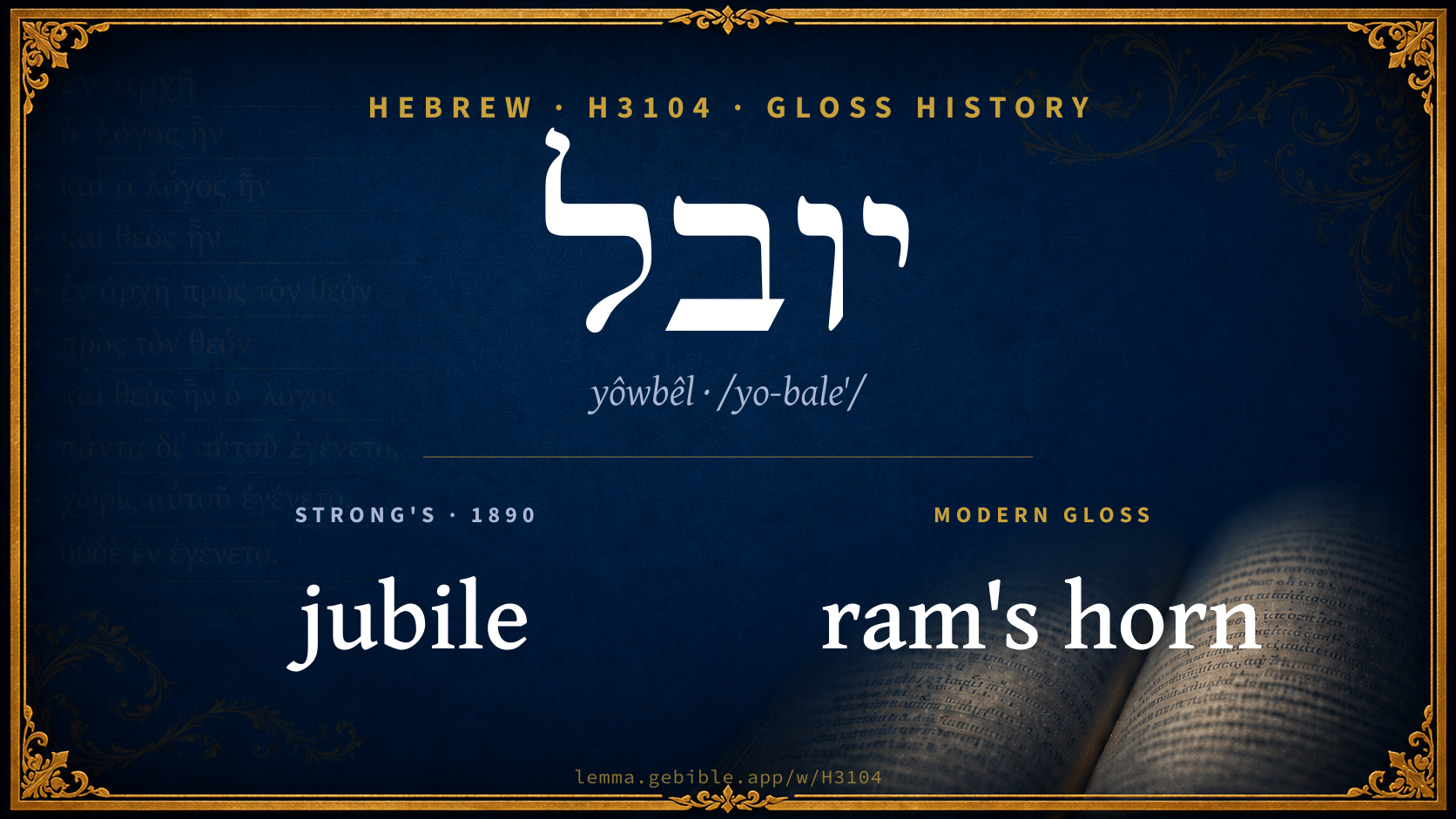
Gloss history
Strong's 1890 vs modern scholarship
About this word
Strong's H3104 catalogs a Hebrew word from the Hebrew Old Testament.
These counts are not copied from any lexicon or concordance. They are computed here, from the morphology-tagged Hebrew Old Testament. What Lemma adds →
- 25
- distinct verses
- The word appears in 25 distinct verses.
- 4 / 39
- OT books
- The word appears in 4 of 39 Old Testament books.
- #1,226
- by frequency
- Top 2500 most frequent Hebrew words (rank 1,226 of 8,640 Hebrew words by occurrence).
View all 25 occurrences in the concordance →
By section of the Old Testament
By traditional corpus
Conventional, traditional groupings — biblical authorship is debated, so this is a traditional corpus grouping, not an authorship claim. Each share is this word’s portion of its verses in that division of the Hebrew canon. Each figure is a share of the word’s 25 distinct verses.
- Torah (Pentateuch) 20 verses · 80%
- Prophets (Nevi'im) 5 verses · 20%
How translations render this word
Counts come from each version’s own published word-to-Strong’s tagging or interlinear alignment — an approximate guide to how each version renders this word, not a word-level alignment the data otherwise carries. Because each total is that version’s own tagged count, the per-version totals vary from one another and need not match the appearance or distinct-verse counts above. These counts may also differ from a printed concordance because Lemma counts each distinctly tagged rendering and does not collapse phrase taggings into a single head-word total. This is a fixed set of word-tagged versions (KJV, ASV, BSB, ULT) and does not change with the reading translation you choose elsewhere. Each version’s license is shown beside its name below (and on Sources).
- King James Version: Jubile 18×, Rams' horns 4×
- American Standard Version: Jubilee 19×, Rams 4×
- Berean Standard Bible: Jubilee 20×, Rams’ horns 4×
- unfoldingWord Literal Text: Jubilee 21×, Rams 4×
King James Version Public Domain
Renders H3104 across 27 tagged occurrences — most commonly:
Plus 5 renderings that appear only once — usually multi-word phrases or single function words the recovered tagging swept in, not distinct renderings.
American Standard Version Public Domain
Renders H3104 across 27 tagged occurrences — most commonly:
Plus 4 renderings that appear only once — usually multi-word phrases or single function words the recovered tagging swept in, not distinct renderings.
Berean Standard Bible Public Domain
Renders H3104 across 27 tagged occurrences — most commonly:
Plus 3 renderings that appear only once — usually multi-word phrases or single function words the recovered tagging swept in, not distinct renderings.
unfoldingWord Literal Text CC BY-SA 4.0
Renders H3104 across 27 tagged occurrences — most commonly:
Plus 2 renderings that appear only once — usually multi-word phrases or single function words the recovered tagging swept in, not distinct renderings.
Senses in the full BDB
What do BDB’s symbols mean?
BDB uses these scholarly abbreviations:
| Symbol | Meaning |
|---|---|
| 𝔊 | the Septuagint (the ancient Greek translation, LXX) |
| 𝔙 | the Vulgate (the Latin translation) |
| 𝔖 | the Syriac version (the Peshitta) |
| 𝔗 | the Targum (the Aramaic translation) |
| ψ | the Psalms |
| √ | root (the underlying root or stem) |
| ‖ | parallel passage (a synonymous or contrasted parallel) |
| † | the dagger: every passage where the word occurs is cited |
The 2 senses and sub-senses the full Brown-Driver-Briggs lexicon distinguishes for this word, in lexicon order (not ranked by frequency), with BDB’s own verbatim wording and sub-sense lettering. Shown in Hebrew script with BDB’s own scholarly abbreviations. The condensed entry is in the Lexicon Entry tab. See also the Forms in the corpus table below.
- 1. ram, only in combin.: בִּמְשֹׁךְ בְּקֶרֶן הַיּ׳ Jos 6:5 the ram’s horn, as wind-instrument; so שׁוֹפְרוֹת (ה)י(ו)בלים Jos 6:4, 6, 8, 13 rams’ horns (v. BenzArchäol. 276); יֹבֵל alone, בִּמְשֹׁךְ הַיֹּבֵל Ex 19:13 at the sounding of the ram(’s horn). e.g. Joshua 6:5
- 2. designation of 50th year, marked by blowing of cornets, AV ‘jubile’ (so NH יוֹבֵל, 𝔗 יובֵילָא, as loan-word); orig. no doubt שְׁנַת הַיּוֹבֵל year of the ram(’s horn), as Lv 25:13, 28, 40, 50, 52, 54 (all H), 27:17, 18, 23, 24 (all P), but then, without שׁנת, as יוֹבֵל הִוא תִּהְיֶה לָכֶם 25:10 a ram(’s horn blowing) shall it be to you; so v 11, 12, 15, 28, 30, 31, 33 (all H), 27:18, 21 Nu 36:4 (both P). e.g. Leviticus 25:13
Senses from the full Brown-Driver-Briggs lexicon (Brown, Driver, Briggs; Oxford 1906 — public domain), digitized via Sefaria, supplemented by the OpenScriptures HebrewLexicon (CC BY 4.0). Full attribution on Sources.
Word origin
n.m. Nu 36:4 ram, ram’s horn, cornet (Ph. יבל ram; cf. Di Lv 25:10 DlPr 124)—abs. יוֹבֵל Jos 6:5 + 7 times; יֹבֵל Ex 19:13 + 13 times; pl. יוֹבְלִים Jos 6:4 + 2 times; יֹבְלִים Jos 6:13;—
— Brown-Driver-Briggs (Oxford 1906, public domain), digitized via Sefaria, supplemented by the OpenScriptures HebrewLexicon (CC BY 4.0). See Sources.
Derived from יבל (yâbal) (H2986) — to bring.
Jastrow Dictionary
A second Hebrew/Aramaic lexicon for comparison, covering Aramaic and post-biblical (Talmudic, Targumic, Midrashic) usage that the biblical-Hebrew BDB does not. Matched by lemma rather than by Strong’s number, so a lemma may carry more than one Jastrow headword (shown separately below), and the entries cover usage well beyond the Bible.
יוֹבֵל
- 1. (cmp. בַּרְחָא, נָגוֹדָא) leader, bellwether, ram. Y. Ber. IX, 13ᶜ top (ref. to קרן יובל, Josh. VI, 5) בערביא … יובלא in Arabia they call a ram yubla; R. Hash. 26ᵃ e.g. Joshua 6:5
- 2. (ellipt. for קֶרֶן הַיּ׳) ram’s horn. Mekh. Yithro, Baḥod., s. 3 (ref. to Ex. XIX, 14) בשימשוך הי׳ את קולו when the horn prolongs its sound; Yalk. Ex. 281. e.g. Exodus 19:14
- 3. c. (ellipt. for שְׁנַת הַיּ׳) Jubilee, Yobel-year, the fiftieth year, the year following the succession of seven Sabbatical years (Lev. XXV, 8—16; 23—24). R. Hash. III, 5 שוה הי׳ לר"ה the proclamation of the Jubilee resembles that of the New Year as to blowing &c.—Arakh. 12ᵇ בתחלת הי׳ at the beginning of the Jubilee cycle; a. fr.—Pl. יוֹבְלוֹת. R. Hash. l. c. Arakh. l. c. י"ז י׳ מנו וכ the Israelites counted seventeen jubilee cycles from their entrance into the Holy Land to their leaving it. e.g. Leviticus 25:8
A Dictionary of the Targumim, the Talmud Babli and Yerushalmi, and the Midrashic Literature (Marcus Jastrow; London, Luzac, 1903) — Public Domain. Digitized via Sefaria. Digitized via Sefaria. Full attribution on Sources.
Forms in the corpus
The 19 distinct written forms H3104 takes in the Hebrew Bible, most frequent first — each parse links to that state’s occurrences in the concordance. Hebrew forms include their vowel points and cantillation, so a single lemma takes many written forms.
| Form | Parsing | Example | Uses |
|---|---|---|---|
| הַ/יֹּבֵ֑ל | Noun, Common, Masculine, Singular, Absolute | Leviticus 25:50 | 3 |
| הַ/יֹּבֵ֖ל | Noun, Common, Masculine, Singular, Absolute | Leviticus 25:40 | 3 |
| הַ/יֹּבֵ֔ל | Noun, Common, Masculine, Singular, Absolute | Exodus 19:13 | 2 |
| הַ/יֹּבֵל֮ | Noun, Common, Masculine, Singular, Absolute | Leviticus 27:18 | 2 |
| הַ/יּֽוֹבְלִים֙ | Noun, Common, Masculine, Plural, Absolute | Joshua 6:4 | 2 |
| יוֹבֵ֣ל | Noun, Common, Masculine, Singular, Absolute | Leviticus 25:11 | 2 |
| בַ/יֹּבֵ֗ל | Noun, Common, Masculine, Singular, Absolute | Leviticus 27:21 | 1 |
| בַּ/יֹּבֵ֑ל | Noun, Common, Masculine, Singular, Absolute | Leviticus 25:33 | 1 |
| בַּ/יֹּבֵ֔ל | Noun, Common, Masculine, Singular, Absolute | Leviticus 25:28 | 1 |
| בַּ/יֹּבֵֽל | Noun, Common, Masculine, Singular, Absolute | Leviticus 25:30 | 1 |
| הַ/יֹּבְלִ֗ים | Noun, Common, Masculine, Plural, Absolute | Joshua 6:13 | 1 |
| הַ/יּוֹבֵ֑ל | Noun, Common, Masculine, Singular, Absolute | Leviticus 25:28 | 1 |
| הַ/יּוֹבֵ֔ל | Noun, Common, Masculine, Singular, Absolute | Leviticus 25:15 | 1 |
| הַ/יּוֹבֵ֖ל | Noun, Common, Masculine, Singular, Absolute | Leviticus 25:13 | 1 |
| הַ/יּוֹבֵ֗ל | Noun, Common, Masculine, Singular, Absolute | Joshua 6:5 | 1 |
| הַ/יּוֹבֵל֙ | Noun, Common, Masculine, Singular, Absolute | Leviticus 27:24 | 1 |
| וּ/בַ/יֹּבֵ֖ל | Noun, Common, Masculine, Singular, Absolute | Leviticus 25:31 | 1 |
| יוֹבְלִ֔ים | Noun, Common, Masculine, Plural, Absolute | Joshua 6:6 | 1 |
| יוֹבֵ֥ל | Noun, Common, Masculine, Singular, Absolute | Leviticus 25:10 | 1 |
Same root — word family
Other BDB entries built from the same root as H3104, grouped by Strong’s listed origin. These share a root / origin per the lexicon — not necessarily a shared meaning. Each links to that word’s own entry.
Derives from
Shares the same root
- אובל ʼûwbâl H180 stream
- יבול yᵉbûwl H2981 produce
- יבל yᵉbal H2987 to bring
- יבל yâbâl H2988 stream
- יבל yabbêl H2990 running sore
- יובל yûwbal H3105 stream
- מבול mabbûwl H3999 flood
- תבל têbêl H8398 world
Proper names from this root
People and places named from this root — a name, not an additional meaning of the word.
Compare all same-root words → Showing 4 of 12 — not the complete family. 2 of the same-root words are proper names (people or places). They share a root, not necessarily a meaning.
Septuagint verse parallels
This word appears in 24 verses that also exist in the Greek Old Testament (Septuagint), out of the 25 Hebrew verses it occurs in. You can read those verses in Greek by switching the Old Testament edition to the Septuagint.
Read these verses in the Septuagint
This is a verse-level parallel only — the same verses exist in both the Hebrew and Greek Old Testaments. No word-level Hebrew↔Greek correspondence is claimed: the data carries no such alignment, so no Greek word is shown as this Hebrew word’s translation. Coverage is not total — the Septuagint omits the deuterocanon and renumbers the Psalms, so some Hebrew verses have no direct Greek parallel.