
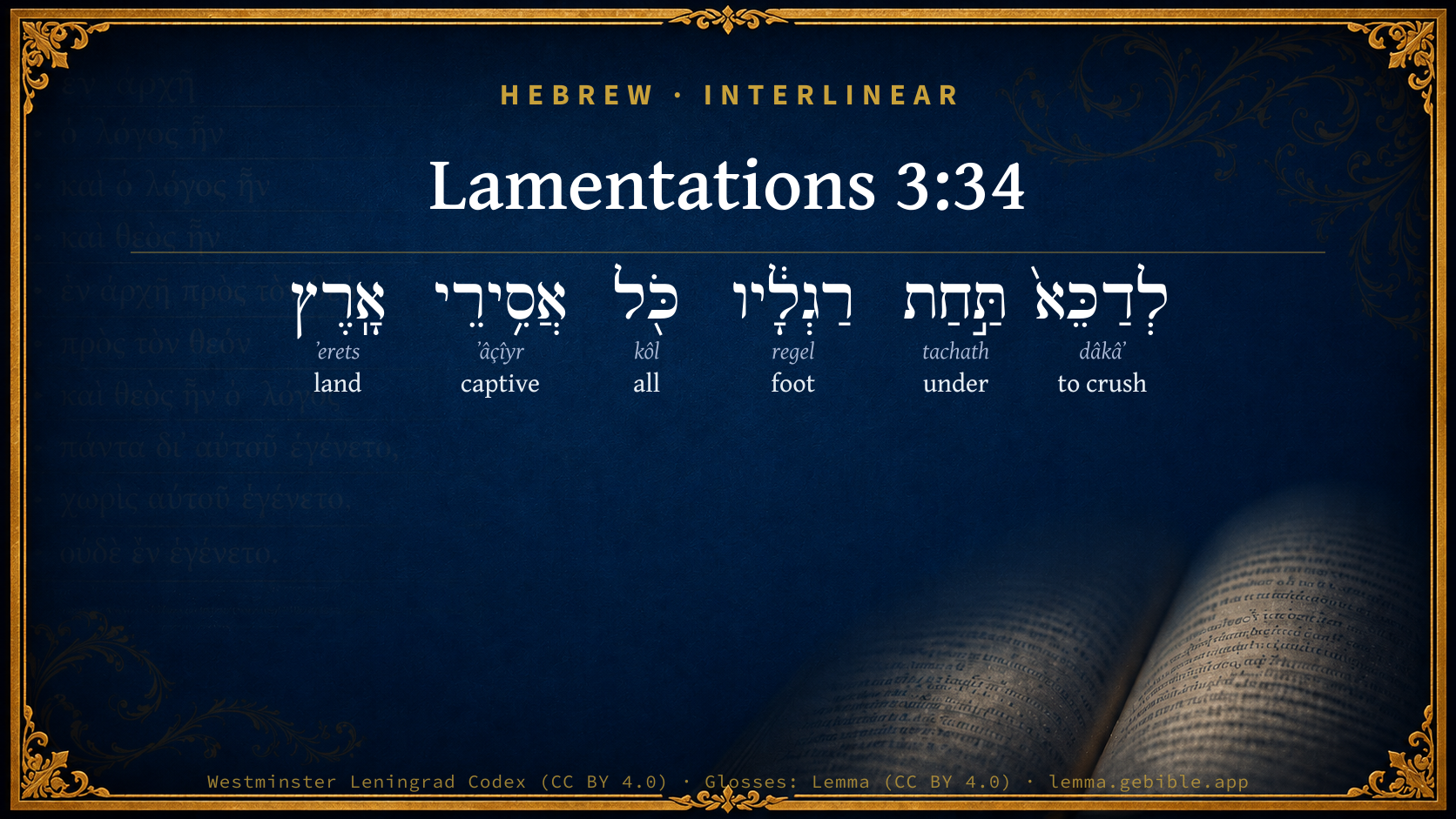
Lamentations 3:34

Hebrew (Westminster Leningrad Codex) Lamentations 3:34 appears in the Hebrew Old Testament. The text above is from the Westminster Leningrad Codex. Each word links to its Strong’s number, a concise gloss, and parsing drawn from the Open Scriptures Hebrew Bible morphology. Click any word for its full Brown-Driver-Briggs (BDB) entry.
Download image
Cite this verse

Lamentations 3:34 (World English Bible). Public Domain. Lemma interlinear Bible study tool, https://lemma.gebible.app/v/lamentations/3/34.

Show BibTeX & RIS
BibTeX
RIS
English Translation
To crush under foot all the prisoners of the earth,
World English Bible · Public Domain
Download a study sheet

One document with this verse’s original text, its word-by-word gloss line, the meaning frame, cross-references with their text, attributed commentary, and full source and license credits — printable, and it pastes into notes with its structure intact.

This verse Autodidact and up

Study sheet (.html) Plain text (.txt)

A passage Seminary Student

Up to 50 verses in one chapter. A passage sheet keeps up to 6 commentary sources and 12 cross-references per verse, in the order this page ranks them, and says so on the sheet whenever that leaves anything out. Ask for a single verse and you get the Autodidact verse sheet above.

Everything on this page stays free to read, with no account — the sheet is a download of what is already on screen, not access to it.

Want to remove ads? Support Godless Engineer
Compare translations 3

The same verse in 3 English versions, stacked beneath the original-language interlinear above. Click any original word for its lexicon entry.

Each is an independent rendering of the whole verse — the interlinear is not word-aligned to these translations.

Highlighted words mark where these versions differ — a whole-verse word diff, not a word-by-word alignment.

  • World English Bible Public Domain
    To crush under foot all the prisoners of the earth,
  • King James Version Public Domain
    To crush under his feet all the prisoners of the earth.
  • unfoldingWord Literal Text CC BY-SA 4.0
    To crush under his feet all the prisoners of earth,

unfoldingWord Literal Text — © unfoldingWord, licensed CC BY-SA 4.0. Word-aligned USFM3 via Door43 (git.door43.org/unfoldingWord/en_ult).

Versions to compare (up to 4)

3 of 4 selected

Show all 18 translations

Every available English version of this verse, each an independent rendering of the whole verse.

  • World English Bible Public Domain
    To crush under foot all the prisoners of the earth,
  • Berean Standard Bible Public Domain
    To crush underfoot all the prisoners of the land,
  • Majority Standard Bible Public Domain
    To crush underfoot all the prisoners of the land,
  • King James Version Public Domain
    To crush under his feet all the prisoners of the earth.
  • American Standard Version (1901) Public Domain
    To crush under foot all the prisoners of the earth,
  • Revised Version (1885) Public Domain
    To crush under foot all the prisoners of the earth,
  • Geneva Bible (1599) Public Domain
    In stamping vnder his feete all the prisoners of the earth,
  • Douay-Rheims (1899) Public Domain
    Lamed. To crush under his feet all the prisoners of the land,
  • Young's Literal Translation Public Domain
    To bruise under one's feet any bound ones of earth,
  • Literal Standard Version CC BY-SA 4.0
    To bruise under one’s feet any bound ones of earth,
  • Unlocked Literal Bible CC BY-SA 4.0
    To crush underfoot all the prisoners of the earth,
  • unfoldingWord Literal Text CC BY-SA 4.0
    To crush under his feet all the prisoners of earth,
  • Darby Bible Public Domain
    To crush under foot all the prisoners of the earth,
  • World Messianic Bible Public Domain
    To crush under foot all the prisoners of the earth,
  • Webster's Bible Public Domain
    To crush under his feet all the prisoners of the earth,
  • Free Bible Version CC BY-SA 4.0
    Whether it's mistreating all the prisoners of the land,
  • Bible in Basic English Public Domain
    In a man's crushing under his feet all the prisoners of the earth,
  • JPS Tanakh (1917) Public Domain
    To crush under foot all the prisoners of the earth,

Literal Standard Version (2020), Covenant Press — licensed CC BY-SA 4.0. Text via the HelloAO Bible API (eBible.org). Unlocked Literal Bible (unfoldingWord) — licensed CC BY-SA 4.0. Text via the HelloAO Bible API (eBible.org). unfoldingWord Literal Text — © unfoldingWord, licensed CC BY-SA 4.0. Word-aligned USFM3 via Door43 (git.door43.org/unfoldingWord/en_ult). Free Bible Version, Dr. Jonathan Gallagher — licensed CC BY-SA 4.0. Text via the HelloAO Bible API (eBible.org).

Word by word

More ways to search: Search by grammar → Find every occurrence → Compare this word →

Practice this passage: Drill this verse → Learn its vocabulary →

About this verse

These counts appear in no published source. They are computed here, from the morphology-tagged text and Lemma’s own curated glosses. What Lemma adds →

6
words
6
distinct lemmas
Prophets
section

Notable vocabulary

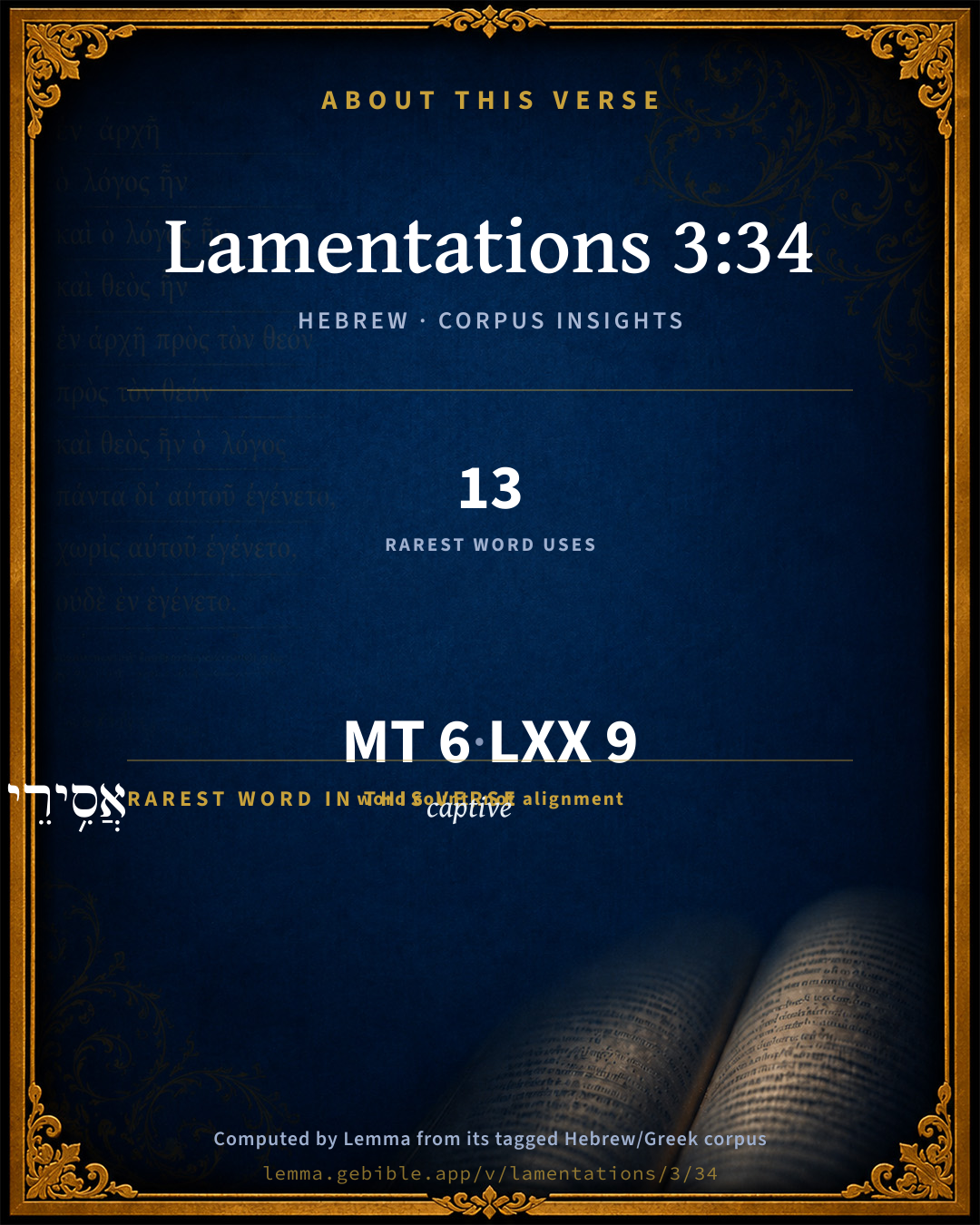
The rarest word here is אֲסִ֥ירֵי captive H615 — appearing just 13 times in the whole Hebrew Bible.

Shared distinctive vocabulary

אֲסִ֥ירֵי captive H615 occurs in 13 verses of the Hebrew Bible. Also found in:

Grammatical profile

  • 1 verb
  • 4 nouns
  • 1 preposition

Verb forms

  • לְדַכֵּא֙ Piel · Infinitive Construct

Hebrew & Septuagint length

In English translation the verse runs 10 words from the Hebrew and 13 from the Septuagint (LXX English) — closely comparable.

A rough comparison of the two English renderings, which tokenize alike — not a word-level alignment.

Word counts can differ between the Hebrew and the Greek without any difference in meaning — e.g. the Hebrew direct-object marker אֵת has no separate Greek word, and Greek often adds the article ὁ.

In the original languages it is 6 Hebrew tokens and 9 Greek tokens — but the two are counted differently (Hebrew bundles its prefixes and suffixes into one token; the Greek is in lemma form), so that isn’t a like-for-like length.

Cross-references

10

Topical passages linked to Lamentations 3:34 in the Treasury of Scripture Knowledge — connected by theme and wording, ordered by reader-vote popularity; previews shown in the World English Bible.

  • Zechariah 9:11–12 As for you also, Because of the blood of your covenant, I have set free your prisoners from the pit in which is no water.
  • Isaiah 51:22–23 Thus says your Lord Yahweh, and your God who pleads the cause of his people, Behold, I have taken out of your hand the cup of staggering, even the bowl of the cup of my wrath; you shall no more drink it again:
  • Psalms 69:33 For Yahweh hears the needy, And doesn't despise his captive people.
  • Psalms 102:20 To hear the groans of the prisoner; To free those who are condemned to death;
  • Isaiah 49:9 saying to those who are bound, Go forth; to those who are in darkness, Show yourselves. They shall feed in the ways, and on all bare heights shall be their pasture.
  • Jeremiah 51:33–36 For thus says Yahweh of hosts, the God of Israel: The daughter of Babylon is like a threshing floor at the time when it is trodden; yet a little while, and the time of harvest shall come for her.
  • Psalms 79:11 Let the sighing of the prisoner come before you. According to the greatness of your power, preserve those who are sentenced to death;
  • Isaiah 14:17 who made the world as a wilderness, and overthrew the cities of it; who didn't let loose his prisoners to their home?"
  • Jeremiah 50:17 Israel is a hunted sheep; the lions have driven him away: first, the king of Assyria devoured him; and now at last Nebuchadrezzar king of Babylon has broken his bones.
  • Jeremiah 50:33–34 Thus says Yahweh of hosts: The children of Israel and the children of Judah are oppressed together; and all who took them captive hold them fast; they refuse to let them go.

Cross-references courtesy of OpenBible.info (CC BY 4.0).

Hebrew and Greek witnesses Masoretic Hebrew ↔ Greek Septuagint

The same verse in the two great witnesses to the Old Testament, shown verse-for-verse.

These are two independent witnesses, not word-aligned to each other, and the Septuagint is shown in lemma (dictionary) form.

Hebrew Lamentations 3:34 Masoretic · Westminster Leningrad Codex

לְדַכֵּא֙ תַּ֣חַת רַגְלָ֔יו כֹּ֖ל אֲסִ֥ירֵי אָֽרֶץ

To crush under foot all the prisoners of the earth,

World English Bible · Public Domain

Greek LXX Lamentations 3:34 Septuagint · lemma form

ὁ ταπεινόω ὑπό ὁ πούς αὐτός πᾶς δέσμιος γῆ

LAMED. To bring down under his feet all the prisoners of the earth,

LXX2012 (modern English Septuagint) · Public Domain

On this verse, Joseph Benson's Commentary discusses the Septuagint’s reading. Read the note in Commentary ↓

Hebrew: Westminster Leningrad Codex (CC BY 4.0). Greek: Septuagint (public domain); English from LXX2012 (modern English Septuagint) (Public Domain). How the Septuagint differs from the Hebrew →

Commentary

Notes on Lamentations 3:34 from classic Christian and Jewish commentators (each source and its license shown beneath its notes). The classic Christian expositions comment on the surrounding passage and are grouped to its opening verse, so a note may address several verses; the Jewish commentaries on the Tanakh (Rashi and others) are per-verse, so they appear only where the commentator wrote on this verse.

Lemma curates 59 commentaries, every one of them public domain or Creative Commons licensed, each selected and text-cleaned for this edition rather than reprinted as found. About our sources →

Adam Clarke's Commentary

Verse 34. To crush under his feet] He can neither gain credit nor pleasure in trampling upon those who are already bound, and in suffering; such he knows to be the state of man here below. From which it most assuredly follows, that God never afflicts us but for our good, nor chastises but that we may be partakers of his holiness.

All the prisoners of the earth] By the prisoners of the earth, or land, Dr. Blayney understands those insolvent debtors who were put in prison, and there obliged to work out the debt. Yet this is mercy in comparison with those who put them in prison, and keep them there, when they know that it is impossible, from the state of the laws, to lessen the debt by their confinement.

In La 3:34-36, certain acts of tyranny, malice, and injustice are specified, which men often indulge themselves in the practice of towards one another, but which the Divine goodness is far from countenancing or approving by any similar conduct. - Blayney.

Adam Clarke's Commentary on the Bible (1810–1826) — public domain. Text from a community e-Sword/MySword module.

Trapp's Complete Commentary

John Trapp

Lam 3:34 To crush under his feet all the prisoners of the earth,

Ver. 34. To crush under his feet all the prisoners of the earth,] i.e., All those that are in misery, to lay more load upon them, and so to crush them to pieces, yea, to grind them to powder. This he could as easily do as bid it be done: but he takes no such delight in severity and harshness.

John Trapp, A Commentary or Exposition upon All the Books of the Old and New Testament (1647–1656) — public domain. Text from a community e-Sword module.

Joseph Benson's Commentary

Lam 3:34-36. To crush under his feet, &c. — In these verses certain acts of tyranny, malice, and injustice are specified, in the practice of which men are prone to indulge themselves one toward another, but which the divine goodness is far from countenancing or approving by any similar conduct. By the prisoners of the earth, or of the land, as the words may be properly rendered, Blaney thinks are meant the poor insolvent debtors, whom their creditors among the Jews, as well as in other nations, were empowered to cast into prison, and to oblige to work out their debts; a power too often exerted with great rigour and inhumanity: see Isa 58:3; Mat 18:30; Mat 18:34. To turn aside the right of a man — To prevent his obtaining, or to deprive him of, his just rights; before the face of the Most High — In the presence of the just and holy God, and under his all-seeing eye, who takes particular notice of all acts of injustice, and will severely punish them. The word עליון, here used, undoubtedly often means the most high God, and is so understood here, both by the LXX. and the Vulgate. Many commentators, however, prefer the marginal reading, a superior, understanding thereby a magistrate. And Blaney thinks it cannot here mean God, because, “though a person may be made to suffer greatly by having his judgment turned aside, that is, by being calumniated and misrepresented before an earthly superior, yet all such malicious attempts must fail and come to nothing where God is the judge, who cannot be deceived or imposed upon.” This is certainly true: but it does not appear that the prophet referred to this circumstance, but rather to the effrontery and daring wickedness of those who could be guilty of such injustice, when they knew they were before the omnipresent God, and that his eye was upon them, thus, as it were, bidding him defiance. To subvert a man in his cause — That is, to prevent his having justice done him, in a law-suit or controversy, by any undue interference; as by bearing or suborning false witness, or exerting any kind of influence in opposition to truth and right: the Lord approveth not — Hebrew, לא ראה, seeth not: that is, hates such conduct, and turns away his face from it with abhorrence and disgust. Thus we read, Hab 1:13, Thou art of purer eyes than to behold evil; and canst not look on iniquity. The general sense of the passage is, as God takes no pleasure in oppressing the poor and helpless, so neither will he suffer any men to escape unpunished that are guilty of such acts of injustice and cruelty, who never consider that all the wrongs they do are committed in the sight of the Supreme Judge of the world; and although for a time he thinks fit to prosper such oppressors, yet, in due time, he will call them to a severe account for their wickedness.

Joseph Benson's Commentary on the Old and New Testaments (1811–1818) — public domain. Text from a community e-Sword module.

The Preacher's Complete Homiletical Commentary

Joseph S. Exell (gen. ed.)

EXEGETICAL NOTES.—

(ל) Lam_3:34-36. The Lord does not afflict willingly, yet He is not indifferent to the injustice of man to man. All the details of human procedure are regarded by Him, and he would have men to know that He is on the throne judging right, that they may trust Him entirely, and that there is no evil needing to be grieved over but sin. Such is the intimation in this triad of verses, the three parts of which depend on the last clause: To trample under his feet—the feet of the oppressor—all prisoners of the earth; an allusion to the cruelties of the Chaldeans. Jews in exile, Jews in prisons, yes, and outraged captives everywhere, are referred to. He hears the sighing of the prisoner. To turn aside the right of a man, that which is grounded in the far-reaching nature of things formed by the Righteous One, before the face of the Most High. This phrase is illustrated by the wilderness legislation as to matters of trespass, The cause of both parties shall come before [God] Elohim, he whom Elohim shall condemn, &c. (Exo_22:9). The phraseology obviously designates judges as acting in place of the Judge of all the earth, and is found used in later times (Psa_82:6). To subvert a man in his cause, to act unfairly towards another in the ordinary pursuits of life, the Lord approveth not. Questioning this translation, Keil renders, Doth not the Lord look [to such doings as these]?

HOMILETICS

GOD AND HUMAN WRONG

(Lam_3:34-36)

I. God approves not wanton cruelty towards prisoners of war. “To crush under His feet all the prisoners of the earth” (Lam_3:34). Jeremiah was probably a daily witness of cruelties suffered by the captives. One of the greatest horrors of ancient warfare was the inhuman treatment of prisoners. Any exception to this, history does not fail to record as a remarkable example of clemency and forbearance. Few men can be trusted with unrestricted power. Where there is no fear of immediate consequences to himself, man rapidly develops into a monster of cruelty. The helplessness of captives appeals to the pity of the tyrant. Every act of inhumanity God not only disapproves, but will certainly punish.

II. God approves not the base attempt to procure an unjust sentence before any legal tribunal. “To turn aside the right of a man before the face of the Most High (Lam_3:35), of a superior, or before a legal tribunal acting in the name of God (Exo_21:6; Exo_22:8-9). An oppressor who would hesitate to commit an act of cruelty in public does not scruple to stoop to the basest arts in secret to pervert the course of justice. Happy is the nation where the judgment-seat is beyond the reach of corruption.

III. God approves not the perversion of justice in any case, or in any degree. “To subvert a man in his cause, the Lord approveth not” (Lam_3:36). No act of wrong, whether open or secret, can escape the All-seeing Jehovah, nor can it escape punishment. Tyranny is not supreme, and its reign is always short-lived. God is the implacable foe of all injustice; and the oppressed everywhere are sure to be relieved and vindicated.

LESSONS.—

1. Man’s inhumanity to man makes countless thousands mourn.

2. God is not an indifferent spectator of the wrong inflicted by one man upon another.

3. God will certainly interfere to redress all human wrongs.

GERM NOTES ON THE VERSES

Lam_3:34-36. The Divine character.

1. Gives dignity and significance to every legal tribunal.

2. Is a perpetual protest against every act of cruelty and injustice.

3. Is a guarantee that justice will be ultimately triumphant.

ILLUSTRATIONS.—The beginning of wrong. An old writer says, “A man who goes to law finds the court full of invisible hooks. First his cloak, then the skirts of his coat, then his sleeves, till everything is torn from him, and, like a gypsy, he escapes because there is no further hold upon him.” The youth who crosses the threshold of the court of vice will find those invisible hooks sharper and in greater abundance than in courts of law. Once caught, he will be hooked in every direction. One tempter will succeed another, each handing him over to the next. Thus snared and dragged from vice to vice, until denuded of every virtue, he will at last, in all probability, perish in unutterable woe.—Dr. Wise.

Justice expedited. Juvenalis, a widow, complained to Theodoric, king of the Romans, that a suit of hers had been in court three years. The king being informed who were her judges, gave orders that they should give all expedition to the poor woman’s cause, and in two days it was decided to her satisfaction. Theodoric then summoned the judges before him, and inquired how it was that they had done in two days what they had delayed for three years. “When I put you in office,” said the king, “did I not consign all pleas and proceedings to you? You deserve death for having delayed that justice for three years which two days could accomplish.” He commanded them to be beheaded.

Injustice and anger. There is an anger that is damnable: it is the anger of selfishness. There is an anger that is majestic as the frown of Jehovah’s brow: it is the anger of truth and love. If man meets with injustice, it is not required that he shall not be roused to meet it; but if he is angry after he has had time to think upon it, that is sinful. The flame is not wrong, but the coals are.—Beecher.

Suffering preferred to injustice. While Athens was ruled by the thirty tyrants, Socrates was summoned to the senate-house and ordered to go with some other persons to seize one Leon, a man of rank and fortune, whom they determined to put out of the way that they might enjoy his estate. The commission Socrates flatly refused, and, not satisfied therewith, added also his reasons for such refusal. “I will never willingly,” said he, “assist in an unjust act.” Cherides sharply replied, “Dost thou think, Socrates, to talk always in this style and not to suffer?” “Far from it,” added he, “I expect to suffer a thousand ills, but none so great as to do unjustly.”

The Preacher's Complete Homiletical Commentary (gen. ed. Joseph S. Exell; Funk & Wagnalls, c. 1892) — public domain (pre-1929). A full-Bible homiletical/sermon-outline anthology covering 65 of 66 books (2 John is absent from the source module). Text from a community e-Sword module.

Tyndale Open Study Notes

Tyndale Open Resources

3:34-36 The people of Judah were doing such things before Jerusalem was destroyed (see Jer 5:26-31; 21:11-14; 23:10-14; Mic 3).

Tyndale Open Study Notes — © Tyndale Open Resources, licensed CC BY-SA 4.0. Text via the HelloAO Bible API.

Jamieson, Fausset & Brown

Robert Jamieson, A. R. Fausset & David Brown

This triplet has an infinitive in the beginning of each verse, the governing finite verb being in the end of Lam 3:36, "the Lord approveth not," which is to be repeated in each verse. Jeremiah here anticipates and answers the objections which the Jews might start, that it was by His connivance they were "crushed under the feet" of those who "turned aside the right of a man." God approves (literally, "seeth," Hab 1:13; so "behold," "look on," that is, look on with approval) not of such unrighteous acts; and so the Jews may look for deliverance and the punishment of their foes.

Jamieson, Fausset & Brown — Commentary Critical and Explanatory on the Whole Bible (1871) — public domain (CC PDM 1.0). Text via the HelloAO Bible API.

John Calvin's Commentaries

Many interpreters think that these three verses are connected with the previous doctrine, and show the connection thus, — that God does not see, that is, does not know what it is to pervert the good cause of a man, and to oppress the innocent; and, doubtless, God is said not to know what iniquity is, because he abhors all evil; for what is the nature of God but the perfection of justice? It may then be truly said, that. God knows not what it is to turn man aside in judgment. Others take not to see, as meaning, not to approve.

If we subscribe to the opinion of those who say that injustice is contrary to the nature of God, there is here an exhortation to patience; as though the Prophet had said that afflictions ought to be borne with resignation, because the Jews had fully deserved them. For the liberty taken to complain arises from this, that men imagine that they are without fault; but he who is convicted dares not thus to rise up against God; for the chief thing in humility is the acknowledgment of sin. This, then, is one meaning. But they who give this explanation, that God does not approve of those who pervert judgment, think that there is here a ground of consolation, because God would at length succor the miserable who were unjustly oppressed. And doubtless it avails not a little to encourage patience when we are persuaded that God will be an avenger, so that he will at length help us, after having for a time suffered us to be severely treated.

But these expositions seem to me to be too remote; we may give a correcter explanation by supposing a concession to be made, as though the Prophet had said, “It is indeed true that the wicked take much license, for they imagine that God is blind to all evil deeds.” For this madness is often ascribed to the ungodly, that they think that they can sin with impunity, because God, as they suppose, cares not for the affairs of men. They then imagine that God is asleep, and in a manner dead, and hence they break out into all kinds of wickedness. And for this reason it was that David so vehemently rebuked them:

“He who has formed the ear, will he not hear? He who has created the heaven, will he not see?” (Psalm 94:9.)

This explanation also I cannot approve of, it being forced and not obvious.

I therefore think that the reference is to the impious words of those who complain that God is not moved by any compassion. For this thought almost lays hold on us wheel pressed down by adversities, — that God has forgotten us, that he is either asleep or lies down inactive. In short, there is nothing more difficult to be assured of than this truth, that God governs the world by his counsel, and that nothing happens without a design. This is indeed what almost all confess; but when a trial comes, this doctrine vanishes, and every one is carried away by some perverted and erroneous thoughts, even that all things roll round fortuitously through blind fate, that men are not the objects of God’s care. Nor is there a doubt but that in Jeremiah’s time words of this kind were flying about; and it appears evident from the context that those Jews were reproved who thought that their miseries were disregarded by God, and hence they clamored; for men are necessarily carried away into a furious state of mind, when they do not believe that they have to do with God. The Prophet, then, refers to such impious words, or if they dared not to express in language what they thought, he refers to what was believed almost by all, — that the wicked perverted the judgment of man, that they turned aside a man in his cause, that they tore under their feet all the bound of the earth; that is, that all those things were done by the connivance of God. The plain meaning, then, is, that judgment is perverted before the face of the Most High, — that the bound of the earth such as are helpless, are despised, trodden under foot by the wicked, — that a man in his cause is unjustly dealt with, and that all this is done because God does not see We now, then, perceive what the Prophet means.

But whence came such madness? even because the Jews, as I have said, would not humble themselves under the mighty hand of God; for hypocrisy had so blinded them, that they proudly clamored against God, thinking that they were chastised with unjust severity,. As then, they thus flattered themselves in their sins, this expostulation arose which the Prophet mentions, that man’s judgment was perverted, that the innocent failed in a good cause, that the miserable were trodden under foot; and whence all this? because God did not see, or did not regard these things. Now follows the reproof of this delirious impiety, —

John Calvin's Commentaries (1540-1563) — public domain. Text from the Calvin Translation Society English edition (1840s-50s) via the Christian Classics Ethereal Library (ccel.org). Calvin's coverage is partial (roughly two-thirds of the Bible); uncommented books and verses are honest gaps, never fabricated. The 19th-century editor's footnotes and remarks are omitted so the notes are faithfully Calvin's own voice.

Ellicott's Commentary for English Readers

(34-36) To crush . . .—The triplet of verses forms one sentence dependent upon the final clause, “The Lord approveth not,” literally, doth not look on. By some critics the literal meaning is kept in the form of a question: Doth not the Lord look on this? The fact that the righteous judgment of God is against those who, unlike Him, cause wilful and needless suffering is another ground of hope to the sufferer. The three forms of evil specified are (1) the cruel treatment of prisoners of war, such as Jeremiah had witnessed daily at the hands of the Chaldeans; (2) the perversion of justice in a public tribunal acting in the name of God (Exo_23:6); (3) every form even of private injustice.

A Bible Commentary for English Readers, edited by Charles John Ellicott (1878–1897) — public domain. Text from a community e-Sword module.

The Cambridge Bible for Schools and Colleges

gen. ed. J. J. S. Perowne

34–36. Three species of wrong-doing on the part of the victorious oppressor are here enumerated; (a) To treat prisoners with cruelty, (b) To give an unrighteous decision at law: for the judges as representing God were called by His name (e.g. Exo_21:6 with mg.; see Psa_82:1; Psa_82:6), and hence the expression “before the face of the Most High,” (c) To defraud a man of his legal rights (which might be done without an actual trial). The sense of the whole will depend upon the view we take of the last words. They may be rendered either, (i) as a question, Doth not the Lord regard (such acts)? so Löhr, following Böttcher and Nöldeke, or (ii) as R.V. mg. seeth not. Hesitation as to rendering the Heb. verb thus might be met by the change of one consonant (raẓah = approve for ra’ah, see).

The Cambridge Bible for Schools and Colleges (gen. ed. J. J. S. Perowne; Cambridge University Press, 1878–1918) — public domain. Text from a community e-Sword module.

John Gill's Exposition

Who is he that saith, and it cometh to pass?.... Or, "who that says this shall be, and it cometh to pass?" or, "who is he that saith this shall come to pass?" (i) this, or that, or the other thing, he wills and desires, and his heart is set upon:

when the Lord commandeth it not? has not willed and decreed it, but determined the contrary; for nothing escapes his knowledge and foreknowledge; or can resist his will; or control his power; or frustrate his councils, and counterwork his designs; whatever schemes men form to get riches, obtain honour, do mischief to others, prolong life to themselves, and perpetuate their names to posterity, being contrary to the purpose of God, never succeed; whenever they do succeed in any of the above instances, it is because God has commanded, or he has determined, it should be so; as in the instances of Joseph's brethren, in their usage of him; and of the Jews, in the crucifixion of Christ, Pro 16:9. The Targum is,

"who is the man that saith, and evil is done in the world; but because they have done what was not commanded from the mouth of the Lord?''

(i) So some in Gataker.

John Gill's Exposition of the Whole Bible (1746–1763) — public domain (CC PDM 1.0). Text via the HelloAO Bible API.

Albert Barnes' Notes on the Bible

Neither does God approve of wanton cruelty inflicted by one man on another. Three examples are given: the treatment of prisoners of war; the procuring an unjust sentence before a legal tribunal acting in the name of God (see Exo 21:6); and the perversion of justice generally.

Albert Barnes' Notes on the Bible (1834–1885) — public domain. Text from a community e-Sword/MySword module.

Whedon's Commentary on the Bible

Daniel D. Whedon

34-36. To crush… to turn aside… to subvert, etc. — The infinitive form of the three verses, all of which depend on the clause with which the last verse terminates, is well fitted to bring out vividly and incisively the practices which are here condemned. The mention of these implies the writer’s acquaintance with them as facts of human experience. Probably in the fearful time of Jerusalem’s downfall Jeremiah had personally witnessed the trampling under foot of prisoners of war; as in the corrupt and evil times in which his lot was cast he had repeatedly seen justice perverted, as specified in Lam_3:35-36.

Daniel D. Whedon (gen. ed.), Commentary on the Old and New Testaments (1874–1909) — public domain. Text from a community e-Sword module.

The Pulpit Commentary

Vers. 34-39. These two triads form a transition to the renewed complaints and appeals for help in the following verses. The first triad is probably an amplification of the statement that "the Lord doth not afflict willingly." This being the ease, the injustice which darkens human life cannot be approved by him.

To crush, etc. With manifest reference to the cruelties of the Babylonian conquerors of the Jews.

The Pulpit Commentary (1880–1919), ed. H.D.M. Spence-Jones & Joseph S. Exell — public domain. Text from a community e-Sword module.

unfoldingWord translationNotes

Door43 World Missions Community

General Information:

The author wrote in general terms about what is true for all people, but it shows God's concern for his people, the people of Israel, who were being mistreated by their enemies.

To crush ... to deny a man justice ... to deny justice

"If people crush ... if they deny a man justice ... if they deny justice"

To crush underfoot

Here "crush underfoot" represents abusing and mistreating people. AT: "To abuse" or "To mistreat" (See: Metaphor)-

to deny a man justice

This refers to not allowing a person to have what he deserves. AT: "to deny a person his rights" or "to keep a person from having what he deserves"

in the presence of the Most High

Doing something "in the presence of the Most High" represents doing it while knowing that God sees it. AT: "knowing that the Most High sees it" (See: Metonymy)

to deny justice to a person

Here "deny justice" refers to not making a just decision for a person in a legal concern. AT: "to judge a person wrongly in court" or "to keep a person who goes to a judge from getting what is right"

translationWords

prison

earth

just

Most High

lord

unfoldingWord translationNotes — © Distant Shores Media and the Door43 World Missions Community, licensed CC BY-SA 4.0. Source: git.door43.org/Door43/en_tn.

Rashi

Rabbi Shlomo Yitzchaki (Rashi)

[Or] crush under His feet This refers back to, “For He does not willingly afflict to crush under His feet, etc., or pervert the righteous judgment of a man, or distort a man’s dispute, etc.” All these the Lord did not approve. He did not approve of them, and it did not enter His thoughts to do so.

Rashi on the Tanakh — English translations: “The Judaica Press complete Tanach with Rashi, translated by A. J. Rosenberg” (CC BY 4.0); “Pentateuch with Rashi's commentary by M. Rosenbaum and A.M. Silbermann, 1929-1934” (public domain); “The Metsudah Tanach series, Lakewood, N.J” (CC BY 4.0); and “The Book of Joshua, Metsudah Publications, 1997” (CC BY 4.0). Text via Sefaria.

Lesson kit

Teaching starters — assembled from the data on this page, not authored interpretation. Every prompt links to the verse data it draws on. Edit before teaching.

Lamentations, in the Prophets, opens this verse with 6 words (6 distinct Hebrew lemmas). Its most distinctive word is ʼâçîyr (“captive”). A historical commentator’s framing appears above. Read the whole chapter for the surrounding context.

Discussion questions

  1. How does “captive” (ʼâçîyr) shape what this verse is saying?
  2. How does Genesis 39:20, which shares the word «captive», read alongside this verse?
  3. The translations on this page render this verse differently — a whole-verse word diff, not a word-by-word alignment. What might account for the different wordings?
  4. «לְדַכֵּא֙» is a Piel Infinitive Construct verb. How does that grammatical form shape the action described?
  5. Compare how Adam Clarke's Commentary and Trapp's Complete Commentary read this verse. Where do they agree or differ?

Things to notice

Reading settings

Reading text

Shown beneath each verse's original-language words.

Old Testament
Old Testament edition

Read the OT as the Masoretic Hebrew (MT) or the Greek Septuagint (LXX).

English shown for the Greek Septuagint (in the Hebrew ↔ Greek comparison).

Comparing translations? Open the Compare panel on any verse page to stack up to four side by side.