
Isaiah 23:6

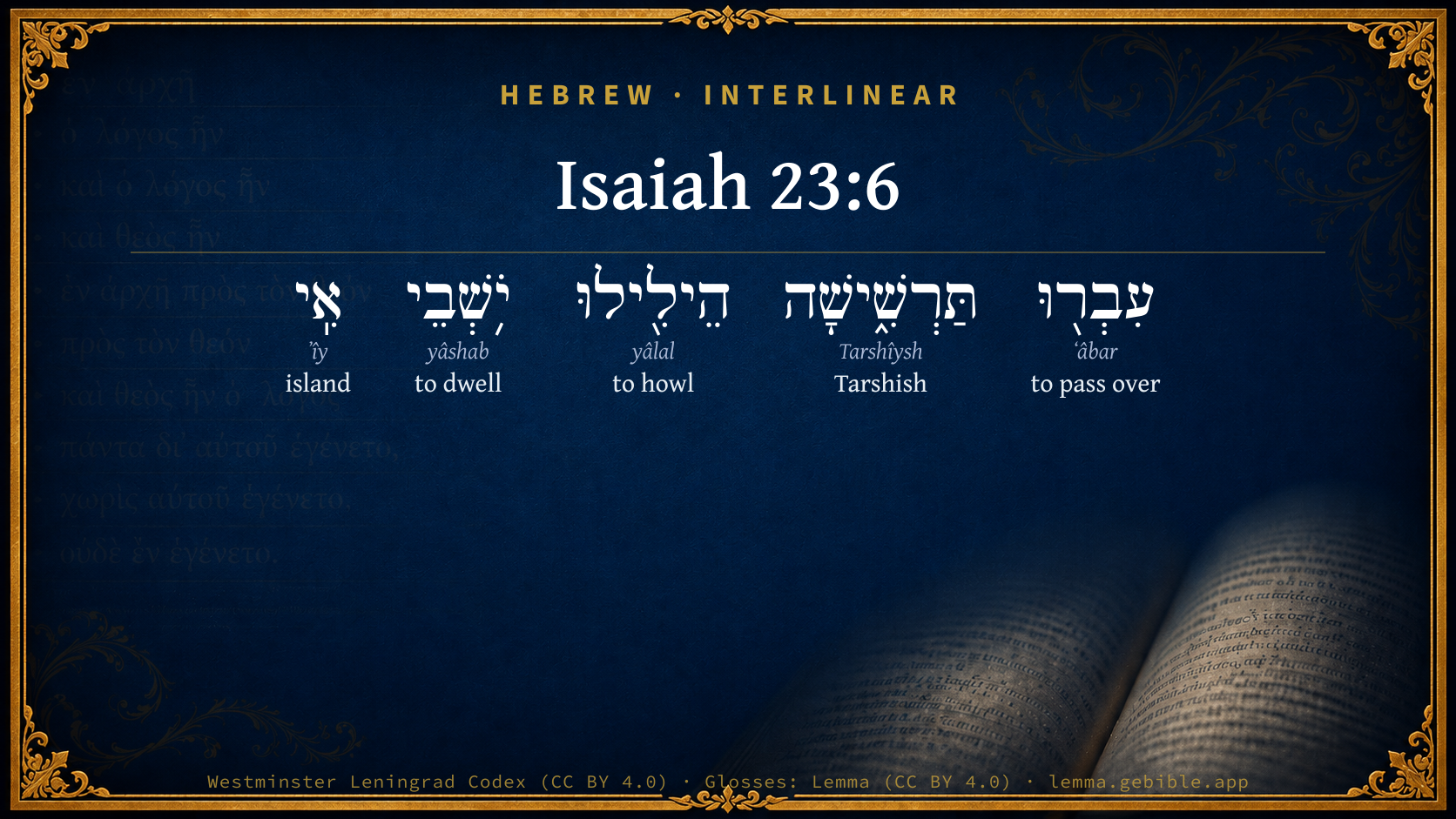
Hebrew (Westminster Leningrad Codex) Isaiah 23:6 appears in the Hebrew Old Testament. The text above is from the Westminster Leningrad Codex. Each word links to its Strong’s number, a concise gloss, and parsing drawn from the Open Scriptures Hebrew Bible morphology. Click any word for its full Brown-Driver-Briggs (BDB) entry.
Download image
Cite this verse

Isaiah 23:6 (World English Bible). Public Domain. Lemma interlinear Bible study tool, https://lemma.gebible.app/v/isaiah/23/6.

Show BibTeX & RIS
BibTeX
RIS
English Translation
Pass over to Tarshish; wail, you inhabitants of the coast.
World English Bible · Public Domain
Download a study sheet

One document with this verse’s original text, its word-by-word gloss line, the meaning frame, cross-references with their text, attributed commentary, and full source and license credits — printable, and it pastes into notes with its structure intact.

This verse Autodidact and up

Study sheet (.html) Plain text (.txt)

A passage Seminary Student

Up to 50 verses in one chapter. A passage sheet keeps up to 6 commentary sources and 12 cross-references per verse, in the order this page ranks them, and says so on the sheet whenever that leaves anything out. Ask for a single verse and you get the Autodidact verse sheet above.

Everything on this page stays free to read, with no account — the sheet is a download of what is already on screen, not access to it.

Want to remove ads? Support Godless Engineer
Compare translations 3

The same verse in 3 English versions, stacked beneath the original-language interlinear above. Click any original word for its lexicon entry.

Each is an independent rendering of the whole verse — the interlinear is not word-aligned to these translations.

Highlighted words mark where these versions differ — a whole-verse word diff, not a word-by-word alignment.

  • World English Bible Public Domain
    Pass over to Tarshish; wail, you inhabitants of the coast.
  • King James Version Public Domain
    Pass ye over to Tarshish; howl, ye inhabitants of the isle.
  • unfoldingWord Literal Text CC BY-SA 4.0
    Cross over toward Tarshish; wail, dwellers of the coastland!

unfoldingWord Literal Text — © unfoldingWord, licensed CC BY-SA 4.0. Word-aligned USFM3 via Door43 (git.door43.org/unfoldingWord/en_ult).

Versions to compare (up to 4)

3 of 4 selected

Show all 18 translations

Every available English version of this verse, each an independent rendering of the whole verse.

  • World English Bible Public Domain
    Pass over to Tarshish; wail, you inhabitants of the coast.
  • Berean Standard Bible Public Domain
    Cross over to Tarshish; wail, O inhabitants of the coastland!
  • Majority Standard Bible Public Domain
    Cross over to Tarshish; wail, O inhabitants of the coastland!
  • King James Version Public Domain
    Pass ye over to Tarshish; howl, ye inhabitants of the isle.
  • American Standard Version (1901) Public Domain
    Pass ye over to Tarshish; wail, ye inhabitants of the coast.
  • Revised Version (1885) Public Domain
    Pass ye over to Tarshish; howl, ye inhabitants of the isle.
  • Geneva Bible (1599) Public Domain
    Goe you ouer to Tarshish: howle, yee that dwell in the yles.
  • Douay-Rheims (1899) Public Domain
    Pass over the seas, howl, ye inhabitants of the island.
  • Young's Literal Translation Public Domain
    Pass over to Tarshish, howl, ye inhabitants of the isle,
  • Literal Standard Version CC BY-SA 4.0
    Pass over to Tarshish, howl, you inhabitants of the island,
  • Unlocked Literal Bible CC BY-SA 4.0
    Cross over to Tarshish; wail, you inhabitants of the coast.
  • unfoldingWord Literal Text CC BY-SA 4.0
    Cross over toward Tarshish; wail, dwellers of the coastland!
  • Darby Bible Public Domain
    Pass over to Tarshish; howl, ye inhabitants of the coast!
  • World Messianic Bible Public Domain
    Pass over to Tarshish! Wail, you inhabitants of the coast!
  • Webster's Bible Public Domain
    Pass ye over to Tarshish; howl, ye inhabitants of the isle.
  • Free Bible Version CC BY-SA 4.0
    Sail across to Tarshish! Howl, people of the coastlands!
  • Bible in Basic English Public Domain
    Go over to Tarshish; give cries of sorrow, O men of the sea-land.
  • JPS Tanakh (1917) Public Domain
    Pass ye over to Tarshish; howl, ye inhabitants of the coast-land.

Literal Standard Version (2020), Covenant Press — licensed CC BY-SA 4.0. Text via the HelloAO Bible API (eBible.org). Unlocked Literal Bible (unfoldingWord) — licensed CC BY-SA 4.0. Text via the HelloAO Bible API (eBible.org). unfoldingWord Literal Text — © unfoldingWord, licensed CC BY-SA 4.0. Word-aligned USFM3 via Door43 (git.door43.org/unfoldingWord/en_ult). Free Bible Version, Dr. Jonathan Gallagher — licensed CC BY-SA 4.0. Text via the HelloAO Bible API (eBible.org).

Word by word

More ways to search: Search by grammar → Find every occurrence → Compare this word →

Practice this passage: Drill this verse → Learn its vocabulary →

תַּרְשִׁ֑ישָׁה
Tarshîysh
H8659
“Tarshish · toward”
Noun, Proper + Suffix, Demonstrative
Part of Speech
Noun
Type
Proper
Full BDB Definition

Origin: probably the same as H8658 (as the region of the stone, or the reverse)

TWOT: 2547

Tarshish or Tharshish = "yellow jasper" - son of Javan (noun proper masculine) - a Benjamite, son of Bilhan (noun proper masculine) - one of the wise men close to king Ahasuerus of Persia (noun proper masculine) - a city of the Phoenicians in a distant part of the Mediterranean Sea to which the prophet Jonah was trying to flee (noun proper locative) - site unknown but perhaps in Cyprus or Spain - a city somewhere near and accessible to the Red Sea to which ships constructed at Ezion-geber on the Elanitic Gulf on the Red Sea were to sail (noun proper locative)
  1. עִבְר֖וּ ʻâbar H5674 “pass over” Verb, Qal, Imperative, 2nd Person, Masculine, Plural
  2. הֵילִ֖ילוּ yâlal H3213 “howl” Verb, Hiphil, Imperative, 2nd Person, Masculine, Plural
  3. יֹ֥שְׁבֵי yâshab H3427 “dwelling” Verb, Qal, Participle Active, Masculine, Plural, Construct
  4. אִֽי ʼîy H339 “island” Particle, Interjection

About this verse

These counts appear in no published source. They are computed here, from the morphology-tagged text and Lemma’s own curated glosses. What Lemma adds →

5
words
5
distinct lemmas
Prophets
section

Shared distinctive vocabulary

תַּרְשִׁ֑ישָׁה Tarshish H8659 occurs in 24 verses of the Hebrew Bible. Also found in:

Grammatical profile

  • 3 verbs
  • 1 noun
  • 1 particle

Verb forms

  • עִבְר֖וּ Qal · Imperative
  • הֵילִ֖ילוּ Hiphil · Imperative
  • יֹ֥שְׁבֵי Qal · Participle Active

Hebrew & Septuagint length

In English translation the verse runs 10 words from the Hebrew and 11 from the Septuagint (LXX English) — closely comparable.

A rough comparison of the two English renderings, which tokenize alike — not a word-level alignment.

Word counts can differ between the Hebrew and the Greek without any difference in meaning — e.g. the Hebrew direct-object marker אֵת has no separate Greek word, and Greek often adds the article ὁ.

Cross-references

5

Topical passages linked to Isaiah 23:6 in the Treasury of Scripture Knowledge — connected by theme and wording, ordered by reader-vote popularity; previews shown in the World English Bible.

  • Isaiah 23:12 He said, You shall no more rejoice, you oppressed virgin daughter of Sidon: arise, pass over to Kittim; even there shall you have no rest.
  • Isaiah 16:7 Therefore shall Moab wail for Moab, everyone shall wail: for the raisin-cakes of Kir Hareseth shall you mourn, utterly stricken.
  • Isaiah 21:15 For they fled away from the swords, from the drawn sword, and from the bent bow, and from the heat of battle.
  • Isaiah 23:10 Pass through your land as the Nile, daughter of Tarshish; there is no restraint any more.
  • Isaiah 23:1–2 The burden of Tyre. Howl, you ships of Tarshish; for it is laid waste, so that there is no house, no entering in: from the land of Kittim it is revealed to them.

Cross-references courtesy of OpenBible.info (CC BY 4.0).

Hebrew and Greek witnesses Masoretic Hebrew ↔ Greek Septuagint

The same verse in the two great witnesses to the Old Testament, shown verse-for-verse.

These are two independent witnesses, not word-aligned to each other, and the Septuagint is shown in lemma (dictionary) form.

Hebrew Isaiah 23:6 Masoretic · Westminster Leningrad Codex

עִבְר֖וּ תַּרְשִׁ֑ישָׁה הֵילִ֖ילוּ יֹ֥שְׁבֵי אִֽי

Pass over to Tarshish; wail, you inhabitants of the coast.

World English Bible · Public Domain

Greek LXX Isaiah 23:6 Septuagint · lemma form

ἀποἔρχομαι εἰς καρχηδών ὀλολύζω ὁ ἐνοἰκέω ἐν ὁ νήσος οὗτος

Depart you⌃ to Carthage; howl, you⌃ that dwell in this island.

LXX2012 (modern English Septuagint) · Public Domain

On this verse, Trapp's Complete Commentary discusses the Septuagint’s reading. Read the note in Commentary ↓

Hebrew: Westminster Leningrad Codex (CC BY 4.0). Greek: Septuagint (public domain); English from LXX2012 (modern English Septuagint) (Public Domain). How the Septuagint differs from the Hebrew →

Targum (Aramaic paraphrase)

1

The Targum is the ancient Jewish Aramaic paraphrase of the Hebrew Scriptures — an interpretive translation, not the Hebrew text itself. Onkelos (literal) and Pseudo-Jonathan (expansive) render the Torah, and Jonathan the Prophets. Coverage is partial: where no permissively-licensed English translation exists for a verse, only the Aramaic is shown. This is verse-level text, not a word-by-word alignment to the Hebrew.

  1. Targum Jonathan Prophets (Joshua–Malachi)
    גְלוֹ לִמְדִינַת יַמָא אֵילִילוּ יָתְבֵי גִיסָא:

    They have gone to a province of the sea. Howl, O inhabitants of the island!

    Targum Jonathan — Aramaic: “Mikraot Gedolot” (public domain). English: “Sefaria Community Translation” (CC0 1.0 (public-domain dedication)); “London "Chaldee Paraphrase," 1871” (public domain). Text via Sefaria.

Commentary

Notes on Isaiah 23:6 from classic Christian and Jewish commentators (each source and its license shown beneath its notes). The classic Christian expositions comment on the surrounding passage and are grouped to its opening verse, so a note may address several verses; the Jewish commentaries on the Tanakh (Rashi and others) are per-verse, so they appear only where the commentator wrote on this verse.

Lemma curates 59 commentaries, every one of them public domain or Creative Commons licensed, each selected and text-cleaned for this edition rather than reprinted as found. About our sources →

Trapp's Complete Commentary

John Trapp

Isa 23:6 Pass ye over to Tarshish; howl, ye inhabitants of the isle.

Ver. 6. Pass ye over to Tarshish.] Tyrii migrate coloni, be packing any whither, and make any shift to save your lives, Ultra Sauromatas fugite hinc, &c. To Carthage many of them went, say some; and the Septuagint; for ships of Tarshish {Isa 23:1} have ships of Carthage.

John Trapp, A Commentary or Exposition upon All the Books of the Old and New Testament (1647–1656) — public domain. Text from a community e-Sword module.

Joseph Benson's Commentary

Isa 23:6-7. Pass ye over to Tarshish — Flee from your own country to Tartessus in Spain, and there bewail your calamity. Or, betake yourselves for refuge to some of the parts to which you used to traffic. The LXX. say, εις Καρχηδονα, to Carthage, which was a colony transplanted from Tyre. Howl, ye inhabitants of the isle — Of Tyre, as Isa 23:2. Is this your joyous city? — That formerly lived in so much pomp, and pleasure, and security? Whose antiquity is of ancient days — See on Isa 23:1. Tyre, though not so old as Zidon, yet certainly was of very high antiquity. Justin, in the passage above quoted, had dated the building of it at a certain number of years before the taking of Troy; but the number is lost in the present copies. Her own feet shall carry her — Whereas before, like a delicate lady, she would not set her foot to the ground, but used to be carried in stately chariots; afar off to sojourn — To seek for new habitations.

Joseph Benson's Commentary on the Old and New Testaments (1811–1818) — public domain. Text from a community e-Sword module.

Geneva Bible (1599)

Geneva Bible translators

Tyre willeth other merchants to go to Cilicia, and to come no more there.

Geneva Bible (1599) marginal notes — public domain. Text via Bolls.life.

Jamieson, Fausset & Brown

Robert Jamieson, A. R. Fausset & David Brown

Pass . . . over--Escape from Tyre to your colonies as Tarshish (compare Isa 23:12). The Tyrians fled to Carthage and elsewhere, both at the siege under Nebuchadnezzar and that under Alexander.

Jamieson, Fausset & Brown — Commentary Critical and Explanatory on the Whole Bible (1871) — public domain (CC PDM 1.0). Text via the HelloAO Bible API.

Ellicott's Commentary for English Readers

(6) Pass ye over to Tarshish . . .—The words have the ring of a keen irony. The Tyrians are told to go to Tarshish, the extreme point of their commerce; not, as before, to bring back their wealth, but to seek safety there as exiles. No nearer asylum would give them safety. So, in the siege of Tyre by Alexander the Great, the Tyrians sent their old men, women, and children to Carthage (Diod. Sic. xvii. 41). So Layard (Nineveh, plate 71) represents enemies of the Assyrians taking refuge in ships (Cheyne). The “isle” or “coast” is, as before, Tyre, and. its neighbourhoods.

A Bible Commentary for English Readers, edited by Charles John Ellicott (1878–1897) — public domain. Text from a community e-Sword module.

The Cambridge Bible for Schools and Colleges

gen. ed. J. J. S. Perowne

6. The second strophe commences here with a summons to the Phœnicians to betake themselves to their Spanish colony for refuge, their own country being at the mercy of the invader. So the Tyrians, when attacked by Alexander the Great, sent all those unfit for war to Carthage, another western colony. Gesenius instances also the projected emigration of the Dutch merchants to Batavia in 1672 if the independence of Holland should be overthrown.

The Cambridge Bible for Schools and Colleges (gen. ed. J. J. S. Perowne; Cambridge University Press, 1878–1918) — public domain. Text from a community e-Sword module.

John Gill's Exposition

Pass ye over to Tarshish,.... Either to Tartessus in Spain, or to Tarsus in Cilicia, which lay over against them, and to which they might transport themselves, families, and substance, with greater ease; or "to a province of the sea", as the Targum, any other seaport; the Septuagint says to Carthage, which was a colony of the Tyrians; and hither the Assyrian (u) historians say they did transport themselves; though Kimchi thinks this is spoken, not to the Tyrians, but to the merchants that traded with them, to go elsewhere with their merchandise, since their goods could no more be disposed of in that city as usual.

Howl, ye inhabitants of the isle: of Tyre, as in Isa 23:2 or of every isle, as Aben Ezra, which traded here, because now their commerce was at an end; so Kimchi.

(u) Apud Hieron. in loc.

John Gill's Exposition of the Whole Bible (1746–1763) — public domain (CC PDM 1.0). Text via the HelloAO Bible API.

Albert Barnes' Notes on the Bible

Pass ye over - That is, ye inhabitants of tyre. This is an address to Tyre, in view of her approaching destruction; and is designed to signify that when the city was destroyed, its inhabitants would flee to its colonies, and seek refuge and safety there. As Tarshish was one of its principal colonies, and as the ships employed by Tyre would naturally sail to Tarshish, the inhabitants are represented as fleeing there on the attack of Nebucbadnezzar. That the inhabitants of Tyre did fire in this manner, is expressly asserted by Jerome upon the authority of Assyrian histories which are now lost. ‘We have read,’ says he, ‘in the histories of the Assyrians, that when the Tyrians were besieged, after they saw no hope of escaping, they went on board their ships, and fled to Cartilage, or to some islands of the Ionian and AEgean Sea’ (Jerome in loc.) And again (on Ezek. 29) he says, ‘When the Tyrians saw that the works for carrying on the siege were perfected, and the foundations of the walls were shaken by the battering rams, whatever precious things in gold, silver, clothes, and various kinds of furniture the nobility had, they put them on board their ships, and carried to the islands. So that the city being taken, Nebuchadnezzar found nothing worthy of his labor.’ Diodorus (xvii. 41) relates the same thing of the Tyrians during the siege of Alexander the Great, where he says that they took their wives and children to Carthage.

Howl - Deep grief among the Orientals was usually expressed by a loud, long, and most dismal howl or shriek (see the note at Isa 15:2).

Ye inhabitants of the isle - Of Tyre. The word ‘isle,’ however, may be taken as in Isa 20:6 (see the note on that place), in, the sense of coast, or maritime country in general, and possibly may be intended to denote Old Tyre, or the coast of Phenicia in general, though most naturally it applies to the city built on the island.

Albert Barnes' Notes on the Bible (1834–1885) — public domain. Text from a community e-Sword/MySword module.

Haydock's Catholic Bible Commentary

Seas. The rich Tyrians did so. (St. Jerome) --- Septuagint, "to Carthage." Hebrew Tharsis, is Cilicia. (Calmet) --- Hence Nabuchodonosor did not find a sufficient reward, Ezechiel xxix. 18.

George Leo Haydock (1774–1849), Haydock's Catholic Family Bible and Commentary, 1859 edition — public domain. Excludes Psalms (Douay-Rheims chapter numbering differs from Protestant) and Deuterocanonical books (Catholic canon only).

Matthew Poole's English Annotations

Pass ye over to Tarshish; flee from your own country to Tarsus of Cilicia, and there bewail your calamities. Or rather, as others render the place, Pass over the sea, which is oft called Tarshish; of which See Poole "Isa 23:1".

Of the isle; of Tyrus, as before, Isa 23:2.

Matthew Poole's English Annotations on the Holy Bible (1683–1685) — public domain. Text from a community e-Sword/MySword module.

Whedon's Commentary on the Bible

Daniel D. Whedon

6. Tarshish — Tyre’s remote colonies, especially Tartessus, near the Straits of Gibraltar. In the stress upon Tyre her people are advised to seek refuge there. The siege by Nebuchadnezzar, and still more by Alexander, was sufficient occasion for such advice.

Daniel D. Whedon (gen. ed.), Commentary on the Old and New Testaments (1874–1909) — public domain. Text from a community e-Sword module.

The Pulpit Commentary

Pass ye over to Tarshish. The advice was good, and may, perhaps, have been followed to some extent. When Sennacherib attacked Elulaeus of Sidon (B.C. 701), that monarch fled across the sea ("Records of the Past," vol. 1. p. 35), probably to Cyprus. When Alexander finally ruined Tyre, a part of the population made its escape on shipboard to Carthage (Arrian," Exp. Alex.," 2:24, An escape of the kind is represented in the Assyrian sculptures (Layard, "Monuments of Nineveh," first series, pl. 71).

The Pulpit Commentary (1880–1919), ed. H.D.M. Spence-Jones & Joseph S. Exell — public domain. Text from a community e-Sword module.

Keil & Delitzsch

C. F. Keil & F. Delitzsch

The inhabitants of Tyre, who desired to escape from death or transportation, are obliged to take refuge in the colonies, and the farther off the better: not in Cyprus, not in Carthage (as at the time when Alexander attacked the insular Tyre), but in Tartessus itself, the farthest off towards the west, and the hardest to reach. "Pass ye over to Tarshish; howl, ye inhabitants of the coast! Is this your fate, thou full of rejoicing, whose origin is from the days of the olden time, whom her feet carried far away to settle? Who hath determined such a thing concerning Tzor, the distributor of crowns, whose merchants are princes, whose traders are the chief men of the earth? Jehovah of hosts hath determined it, to desecrate the pomp of every kind of ornament, to dishonour the chief men of the earth, all of them." The exclamation "howl ye" (hēillu) implies their right to give themselves up to their pain. In other cases complaint is unmanly, but here it is justifiable (compare Isa 15:4). In Isa 23:7 the question arises, whether ‛allizâh is a nominative predicate, as is generally assumed ("Is this, this deserted heap of ruins, your formerly rejoicing city?"), or a vocative. We prefer the latter, because there is nothing astonishing in the omission of the article in this case (Isa 22:2; Ewald, 327, a); whereas in the former case, although it is certainly admissible (see Isa 32:13), it is very harsh (compare Isa 14:16), and the whole expression a very doubtful one to convey the sense of לכם אשר עליזה קריה הזאת. To ‛allizâh there is attached the descriptive, attributive clause: whose origin (kadmâh, Eze 16:55) dates from the days of the olden time; and then a second "whose feet brought her far away (raglaim construed as a masculine, as in Jer 13:16, for example) to dwell in a foreign land. This is generally understood as signifying transportation by force into an enemy's country. But Luzzatto very properly objects to this, partly on the ground that רגליה יבלוּה (her feet carried her) is the strongest expression that can be used for voluntary emigration, to which lâgūr (to settle) also corresponds; and partly because we miss the antithetical ועתּה, which we should expect with this interpretation. The reference is to the trading journeys which extended "far away" (whether by land or sea), and to the colonies, i.e., the settlements founded in those distant places, that leading characteristic of the Tyro-Phoenician people (this is expressed in the imperfect by yobiluâh, quam portabant; gur is the most appropriate word to apply to such settlements: for mērâchōk, see at Isa 17:13). Sidon was no doubt older than Tyre, but Tyre was also of primeval antiquity. Strabo speaks of its as the oldest Phoenician city "after Sidon;" Curtius calls it vetustate originis insignis; and Josephus reckons the time from the founding of Tyre to the building of Solomon's temple as 240 years (Ant. viii. 3, 1; compare Herod. ii. 44). Tyre is called hammaēatirâh, not as wearing a crown (Vulg. quondam coronata), but as a distributor of crowns (Targum). Either would be suitable as a matter of fact; but the latter answers better to the hiphil (as hikrı̄n, hiphrı̄s, which are expressive of results produced from within outwards, can hardly be brought into comparison). Such colonies as Citium, Tartessus, and at first Carthage, were governed by kings appointed by the mother city, and dependent upon her. Her merchants were princes (compare Isa 10:8), the most honoured of the earth; נכבּדּי acquires a superlative meaning from the genitive connection (Ges. 119, 2). From the fact that the Phoenicians had the commerce of the world in their hands, a merchant was called cena‛ani or cena‛an (Hos 12:8; from the latter, not from cin‛âni, the plural cin‛ânim which we find here is formed), and the merchandise cin‛âh. The verb chillēl, to desecrate or profane, in connection with the "pomp of every kind of ornament," leads us to think more especially of the holy places of both insular and continental Tyre, among which the temple of Melkarth in the new city of the former was the most prominent (according to the Arrian, Anab. ii. 16, παλαιότατον ὧν μνήμη ἀνθρωπίνη διασώζεται). These glories, which were thought so inviolable, Jehovah will profane. "To dishonour the chief men:" lehâkēl (ad ignominiam deducere, Vulg.) as in Isa 8:22.

Keil & Delitzsch — Biblical Commentary on the Old Testament (1861–1891) — public domain (CC PDM 1.0). Text via the HelloAO Bible API. (Old Testament only.)

J. A. Alexander on Isaiah

Joseph Addison Alexander

“Pass over to Tarshish; howl, ye inhabitants of the isle (or coast).” The mother country is exhorted to take refuge in her distant colonies.

Joseph Addison Alexander, The Prophecies of Isaiah (1846–1847; New York: Scribner, 1870–1878) — public domain. Text from a community e-Sword module.

unfoldingWord translationNotes

Door43 World Missions Community

Cross over to Tarshish

"Make your way to Tarshish." Tarshish was the farthest land the people of Tyre traveled to do business. It will be the only place of safety for those who escape from Tyre.

Has this happened to you, the joyful city, whose origin is from ancient times ... to settle?

Yahweh uses a question to mock Tyre. This rhetorical questions can be translated as a statement. AT: "This has indeed happened to you who were full of joy in the ancient city of Tyre ... to settle." (See: Rhetorical Question)

the joyful city

Here "city" represents the people. AT: "the joyful people who live in the city of Tyre" (See: Metonymy)

whose feet carried her far away to foreign places to settle

Here "feet" represents the whole person. AT: "who went to distant places to live and make money" (See: Synecdoche)

her far away

Here "her" refers to the city of Tyre which represents the people of Tyre. (See: Metonymy)

translationWords

Tarshish

joy

alien

unfoldingWord translationNotes — © Distant Shores Media and the Door43 World Missions Community, licensed CC BY-SA 4.0. Source: git.door43.org/Door43/en_tn.

Rashi

Rabbi Shlomo Yitzchaki (Rashi)

Proceed you inhabitants of Tyre, to flee to Tarshish.

Rashi on the Tanakh — English translations: “The Judaica Press complete Tanach with Rashi, translated by A. J. Rosenberg” (CC BY 4.0); “Pentateuch with Rashi's commentary by M. Rosenbaum and A.M. Silbermann, 1929-1934” (public domain); “The Metsudah Tanach series, Lakewood, N.J” (CC BY 4.0); and “The Book of Joshua, Metsudah Publications, 1997” (CC BY 4.0). Text via Sefaria.

Ibn Ezra

Rabbi Abraham ibn Ezra

אל תרשיש ═ תרשישה To Tarshish.

כל אי ═ אי Every island.

Ibn Ezra on the Tanakh — English translations: “Sefaria Community Translation” (CC0 1.0 (public-domain dedication)); “Yalkut, Sifsei Chachomim Chumash, Metsudah Publications, 2009” (CC BY 4.0); and “Commentary of Ibn Ezra on Isaiah - trans. by M. Friedlander, 1873” (public domain). Text via Sefaria.

Lesson kit

Teaching starters — assembled from the data on this page, not authored interpretation. Every prompt links to the verse data it draws on. Edit before teaching.

Isaiah, in the Prophets, opens this verse with 5 words (5 distinct Hebrew lemmas). Its most distinctive word is Tarshîysh (“Tarshish”). A historical commentator’s framing appears above. Read the whole chapter for the surrounding context.

Discussion questions

  1. What does “Tarshish” (Tarshîysh) contribute to the verse as a whole?
  2. Genesis 10:4 shares the word «Tarshish» with this verse. How do the two illuminate each other?
  3. The translations on this page render this verse differently — a whole-verse word diff, not a word-by-word alignment. What might account for the different wordings?
  4. The verb «עִבְר֖וּ» is Qal Imperative. How does its form color the action?
  5. Reading how Trapp's Complete Commentary and Joseph Benson's Commentary read this verse, where do the two commentators agree and where do they part?

Things to notice

Reading settings

Reading text

Shown beneath each verse's original-language words.

Old Testament
Old Testament edition

Read the OT as the Masoretic Hebrew (MT) or the Greek Septuagint (LXX).

English shown for the Greek Septuagint (in the Hebrew ↔ Greek comparison).

Comparing translations? Open the Compare panel on any verse page to stack up to four side by side.