
Jeremiah 32:31

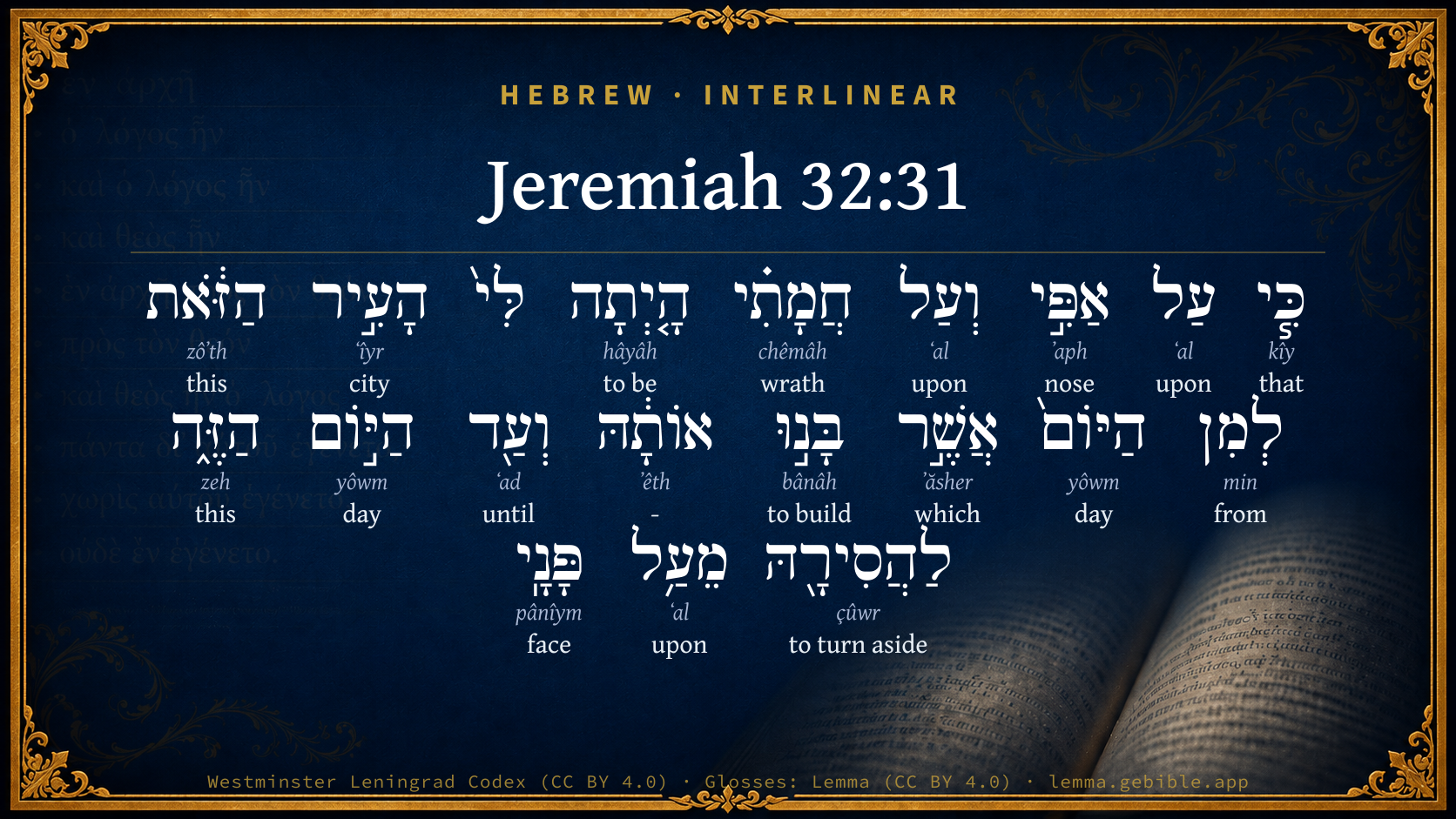
Hebrew (Westminster Leningrad Codex) Jeremiah 32:31 appears in the Hebrew Old Testament. The text above is from the Westminster Leningrad Codex. Each word links to its Strong’s number, a concise gloss, and parsing drawn from the Open Scriptures Hebrew Bible morphology. Click any word for its full Brown-Driver-Briggs (BDB) entry.
Download image
Cite this verse

Jeremiah 32:31 (World English Bible). Public Domain. Lemma interlinear Bible study tool, https://lemma.gebible.app/v/jeremiah/32/31.

Show BibTeX & RIS
BibTeX
RIS
English Translation
For this city has been to me a provocation of my anger and of my wrath from the day that they built it even to this day; that I should remove it from before my face,
World English Bible · Public Domain
Download a study sheet

One document with this verse’s original text, its word-by-word gloss line, the meaning frame, cross-references with their text, attributed commentary, and full source and license credits — printable, and it pastes into notes with its structure intact.

This verse Autodidact and up

Study sheet (.html) Plain text (.txt)

A passage Seminary Student

Up to 50 verses in one chapter. A passage sheet keeps up to 6 commentary sources and 12 cross-references per verse, in the order this page ranks them, and says so on the sheet whenever that leaves anything out. Ask for a single verse and you get the Autodidact verse sheet above.

Everything on this page stays free to read, with no account — the sheet is a download of what is already on screen, not access to it.

Want to remove ads? Support Godless Engineer
Compare translations 3

The same verse in 3 English versions, stacked beneath the original-language interlinear above. Click any original word for its lexicon entry.

Each is an independent rendering of the whole verse — the interlinear is not word-aligned to these translations.

Highlighted words mark where these versions differ — a whole-verse word diff, not a word-by-word alignment.

  • World English Bible Public Domain
    For this city has been to me a provocation of my anger and of my wrath from the day that they built it even to this day; that I should remove it from before my face,
  • King James Version Public Domain
    For this city hath been to me as a provocation of mine anger and of my fury from the day that they built it even unto this day; that I should remove it from before my face,
  • unfoldingWord Literal Text CC BY-SA 4.0
    Yahweh declares that this city has been a provocation of my wrath and fury since the day that they built it. It has been that right up to this present day. So I will remove it from before my face

unfoldingWord Literal Text — © unfoldingWord, licensed CC BY-SA 4.0. Word-aligned USFM3 via Door43 (git.door43.org/unfoldingWord/en_ult).

Versions to compare (up to 4)

3 of 4 selected

Show all 18 translations

Every available English version of this verse, each an independent rendering of the whole verse.

  • World English Bible Public Domain
    For this city has been to me a provocation of my anger and of my wrath from the day that they built it even to this day; that I should remove it from before my face,
  • Berean Standard Bible Public Domain
    For this city has aroused My wrath and fury from the day it was built until now. Therefore I will remove it from My presence
  • Majority Standard Bible Public Domain
    For this city has aroused My wrath and fury from the day it was built until now. Therefore I will remove it from My presence
  • King James Version Public Domain
    For this city hath been to me as a provocation of mine anger and of my fury from the day that they built it even unto this day; that I should remove it from before my face,
  • American Standard Version (1901) Public Domain
    For this city hath been to me a provocation of mine anger and of my wrath from the day that they built it even unto this day; that I should remove it from before my face,
  • Revised Version (1885) Public Domain
    For this city hath been to me a provocation of mine anger and of my fury from the day that they built it even unto this day; that I should remove it from before my face:
  • Geneva Bible (1599) Public Domain
    Therefore this citie hath bene vnto me as a prouocation of mine anger, and of my wrath, from the day, that they built it, euen vnto this day, that I should remoue it out of my sight,
  • Douay-Rheims (1899) Public Domain
    For this city hath been to me a provocation and indignation from the day that they built it, until this day, in which it shall be taken out of my sight.
  • Young's Literal Translation Public Domain
    `For a cause of Mine anger, and a cause of My fury, hath this city been to Me, even from the day that they built it, and unto this day -- to turn it aside from before My face,
  • Literal Standard Version CC BY-SA 4.0
    “For this city has been a cause of My anger and a cause of My fury, even from the day that they built it, and to this day—to turn it aside from before My face,
  • Unlocked Literal Bible CC BY-SA 4.0
    Yahweh declares that this city has been a provocation of my wrath and fury since the day that they built it. It has been that right up to this present day. So I will remove it from before my face
  • unfoldingWord Literal Text CC BY-SA 4.0
    Yahweh declares that this city has been a provocation of my wrath and fury since the day that they built it. It has been that right up to this present day. So I will remove it from before my face
  • Darby Bible Public Domain
    For this city hath been to me [a provocation] of mine anger and of my fury from the day that they built it even unto this day; that I should remove it from before my face,
  • World Messianic Bible Public Domain
    For this city has been to me a provocation of my anger and of my wrath from the day that they built it even to this day, so that I should remove it from before my face,
  • Webster's Bible Public Domain
    For this city hath been to me as a provocation of my anger and of my fury from the day that they built it even to this day; that I should remove it from before my face,
  • Free Bible Version CC BY-SA 4.0
    This city has been such a source of anger and frustration from the time it was built right up till now. So I'm going to get rid of it,
  • Bible in Basic English Public Domain
    For this town has been to me a cause of wrath and of burning passion from the day of its building till this day, so that I put it away from before my face:
  • JPS Tanakh (1917) Public Domain
    For this city hath been to Me a provocation of Mine anger and of My fury from the day that they built it even unto this day, that I should remove it from before My face;

Literal Standard Version (2020), Covenant Press — licensed CC BY-SA 4.0. Text via the HelloAO Bible API (eBible.org). Unlocked Literal Bible (unfoldingWord) — licensed CC BY-SA 4.0. Text via the HelloAO Bible API (eBible.org). unfoldingWord Literal Text — © unfoldingWord, licensed CC BY-SA 4.0. Word-aligned USFM3 via Door43 (git.door43.org/unfoldingWord/en_ult). Free Bible Version, Dr. Jonathan Gallagher — licensed CC BY-SA 4.0. Text via the HelloAO Bible API (eBible.org).

Word by word

More ways to search: Search by grammar → Find every occurrence → Compare this word →

Practice this passage: Drill this verse → Learn its vocabulary →

חֲמָתִ֗י
chêmâh
H2534
“wrath · my”
Noun, Common, Feminine, Singular, Construct + Suffix, Personal, 1st Person, Common, Singular
Part of Speech
Noun
Type
Common
Gender
Feminine
Number
Singular
State
Construct
Full BDB Definition

Origin: from H3179

TWOT: 860a

heat, rage, hot displeasure, indignation, anger, wrath, poison, bottles - heat - fever - venom, poison (figuratively) - burning anger, rage
  1. כִּ֧י kîy H3588 “that” Conjunction
  2. עַל ʻal H5921 “upon” Preposition
  3. אַפִּ֣י ʼaph H639 “nose · my” Noun, Common, Masculine, Singular, Construct + Suffix, Personal, 1st Person, Common, Singular
  4. וְעַל ʻal H5921 “and · upon” Conjunction + Preposition
  5. הָ֤יְתָה hâyâh H1961 “to be” Verb, Qal, Perfect, 3rd Person, Feminine, Singular
  6. הָעִ֣יר ʻîyr H5892 “the · city” Particle, Definite Article + Noun, Common, Feminine, Singular, Absolute
  7. הַזֹּ֔את zôʼth H2063 “the · this” Particle, Definite Article + Pronoun, Demonstrative, Feminine, Singular
  8. לְמִן min H4480 “to/for · from” Preposition + Preposition
  9. הַיּוֹם֙ yôwm H3117 “the · day” Particle, Definite Article + Noun, Common, Masculine, Singular, Absolute
  10. אֲשֶׁ֣ר ʼăsher H834 “which” Particle, Relative
  11. בָּנ֣וּ bânâh H1129 “to build” Verb, Qal, Perfect, 3rd Person, Common, Plural
  12. אוֹתָ֔הּ ʼêth H853 “- · her” Particle, Direct Object + Suffix, Personal, 3rd Person, Feminine, Singular
  13. וְעַ֖ד ʻad H5704 “and · until” Conjunction + Preposition
  14. הַיּ֣וֹם yôwm H3117 “the · day” Particle, Definite Article + Noun, Common, Masculine, Singular, Absolute
  15. הַזֶּ֑ה zeh H2088 “the · this” Particle, Definite Article + Pronoun, Demonstrative, Masculine, Singular
  16. לַהֲסִירָ֖הּ çûwr H5493 “to turn aside · her” Preposition + Verb, Hiphil, Infinitive Construct + Suffix, Personal, 3rd Person, Feminine, Singular
  17. מֵעַ֥ל ʻal H5921 “from · upon” Preposition + Preposition
  18. פָּנָֽי pânîym H6440 “face(s) · my” Noun, Common, Both, Plural, Construct + Suffix, Personal, 1st Person, Common, Singular

About this verse

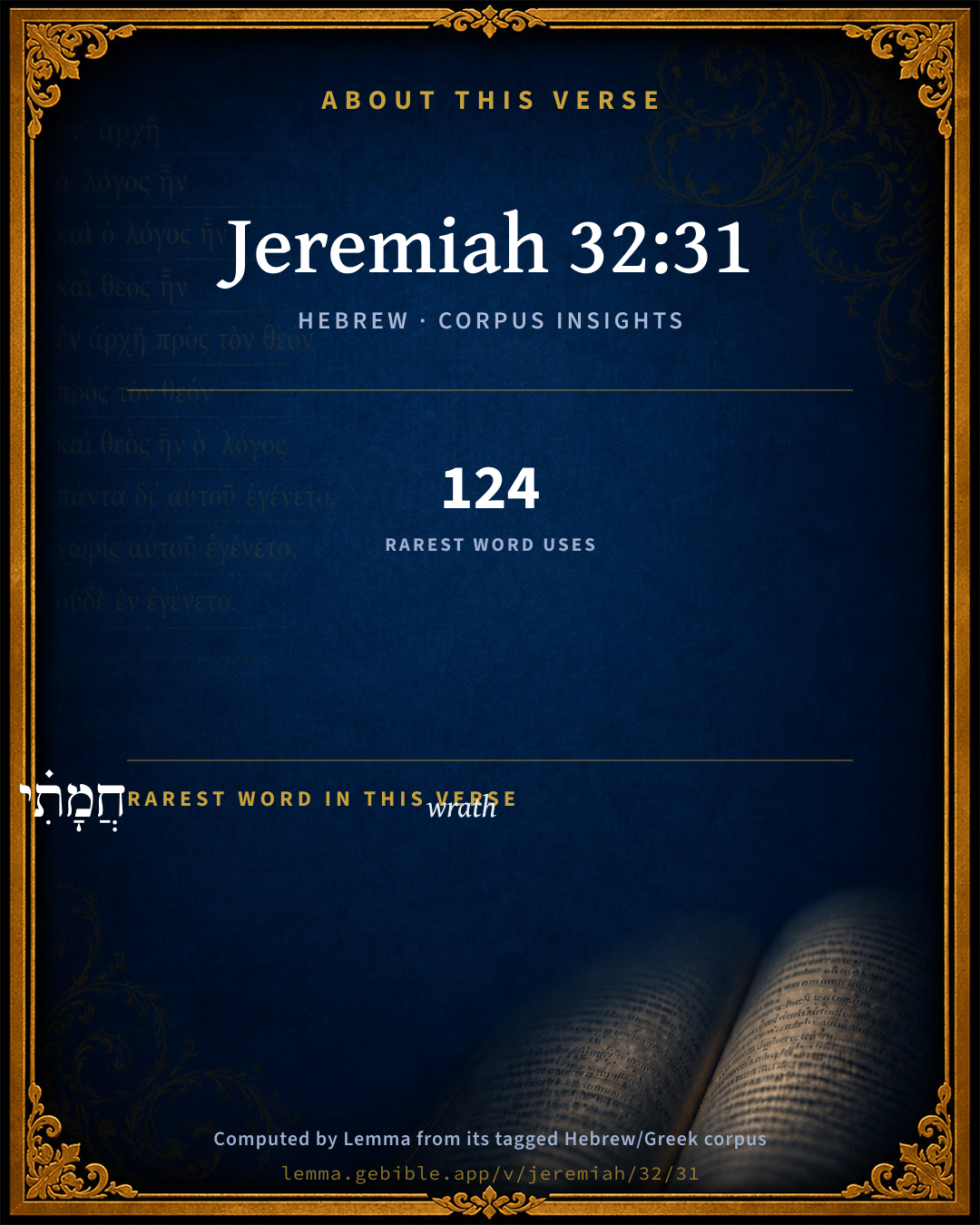
These counts appear in no published source. They are computed here, from the morphology-tagged text and Lemma’s own curated glosses. What Lemma adds →

20
words
16
distinct lemmas
Prophets
section

Grammatical profile

  • 3 verbs
  • 6 nouns
  • 2 pronouns
  • 6 prepositions
  • 1 conjunction
  • 2 particles

Verb forms

  • הָ֤יְתָה Qal · Perfect
  • בָּנ֣וּ Qal · Perfect
  • לַהֲסִירָ֖הּ Hiphil · Infinitive Construct

Repetition

Words recur within this verse — often emphatic in Hebrew:

  • עַל upon H5921 ×3
  • הַיּוֹם֙ day H3117 ×2

Cross-references

15

Topical passages linked to Jeremiah 32:31 in the Treasury of Scripture Knowledge — connected by theme and wording, ordered by reader-vote popularity; previews shown in the World English Bible.

  • 2 Kings 23:27 Yahweh said, I will remove Judah also out of my sight, as I have removed Israel, and I will cast off this city which I have chosen, even Jerusalem, and the house of which I said, My name shall be there.
  • 1 Kings 11:7–8 Then did Solomon build a high place for Chemosh the abomination of Moab, on the mountain that is before Jerusalem, and for Molech the abomination of the children of Ammon.
  • 2 Kings 21:4–7 He built altars in the house of Yahweh, of which Yahweh said, In Jerusalem will I put my name.
  • 2 Kings 21:16 Moreover Manasseh shed innocent blood very much, until he had filled Jerusalem from one end to another; besides his sin with which he made Judah to sin, in doing that which was evil in the sight of Yahweh.
  • 2 Kings 24:3–4 Surely at the commandment of Yahweh came this on Judah, to remove them out of his sight, for the sins of Manasseh, according to all that he did,
  • Jeremiah 5:9–11 Shall I not visit for these things? says Yahweh; and shall not my soul be avenged on such a nation as this?
  • Jeremiah 6:6–7 For thus has Yahweh of Hosts said, Hew you down trees, and cast up a mound against Jerusalem: this is the city to be visited; she is wholly oppression in the midst of her.
  • Jeremiah 27:10 for they prophesy a lie to you, to remove you far from your land, and that I should drive you out, and you should perish.
  • Matthew 23:37 "Jerusalem, Jerusalem, who kills the prophets, and stones those who are sent to her! How often would I have gathered your children together, even as a hen gathers her chickens under her wings, and you would not!
  • 2 Kings 22:16–17 Thus says Yahweh, Behold, I will bring evil on this place, and on the inhabitants of it, even all the words of the book which the king of Judah has read.
  • 2 Kings 23:15 Moreover the altar that was at Bethel, and the high place which Jeroboam the son of Nebat, who made Israel to sin, had made, even that altar and the high place he broke down; and he burned the high place and beat it to dust, and burned the Asherah.
  • Jeremiah 23:14–15 In the prophets of Jerusalem also I have seen a horrible thing: they commit adultery, and walk in lies; and they strengthen the hands of evil-doers, so that none does return from his wickedness: they are all of them become to me as Sodom, and the inhabitants of it as Gomorrah.
  • Lamentations 1:8 Jerusalem has grievously sinned; therefore she is become as an unclean thing; All who honored her despise her, because they have seen her nakedness: Yes, she sighs, and turns backward.
  • Ezekiel 22:2–22 You, son of man, will you judge, will you judge the bloody city? then cause her to know all her abominations.
  • Luke 13:33–34 Nevertheless I must go on my way today and tomorrow and the next day, for it can't be that a prophet perish outside of Jerusalem.'

Cross-references courtesy of OpenBible.info (CC BY 4.0).

Hebrew and Greek witnesses Masoretic Hebrew ↔ Greek Septuagint

The same verse in the two great witnesses to the Old Testament, shown verse-for-verse.

These are two independent witnesses, not word-aligned to each other, and the Septuagint is shown in lemma (dictionary) form.

Hebrew Jeremiah 32:31 Masoretic · Westminster Leningrad Codex

כִּ֧י עַל אַפִּ֣י וְעַל חֲמָתִ֗י הָ֤יְתָה לִּי֙ הָעִ֣יר הַזֹּ֔את לְמִן הַיּוֹם֙ אֲשֶׁ֣ר בָּנ֣וּ אוֹתָ֔הּ וְעַ֖ד הַיּ֣וֹם הַזֶּ֑ה לַהֲסִירָ֖הּ מֵעַ֥ל פָּנָֽי

For this city has been to me a provocation of my anger and of my wrath from the day that they built it even to this day; that I should remove it from before my face,

World English Bible · Public Domain

Greek LXX Structure differs

In the Septuagint, Jeremiah is about an eighth shorter than the Hebrew and arranges its material differently — the Oracles Against the Nations (Hebrew chapters 46–51) appear in the middle of the Greek book, after 25:13. Because the chapter and verse boundaries do not line up, a verse-for-verse comparison with the Hebrew is not shown.

A verse-for-verse comparison isn’t shown here because the chapters and verses don’t line up. Switch to the LXX edition with the MT / LXX toggle above to read the Greek directly.

Hebrew: Westminster Leningrad Codex (CC BY 4.0). Greek: Septuagint (public domain); English from a public-domain English Septuagint. How the Septuagint differs from the Hebrew →

Targum (Aramaic paraphrase)

1

The Targum is the ancient Jewish Aramaic paraphrase of the Hebrew Scriptures — an interpretive translation, not the Hebrew text itself. Onkelos (literal) and Pseudo-Jonathan (expansive) render the Torah, and Jonathan the Prophets. Coverage is partial: where no permissively-licensed English translation exists for a verse, only the Aramaic is shown. This is verse-level text, not a word-by-word alignment to the Hebrew.

  1. Targum Jonathan Prophets (Joshua–Malachi)
    אֲרֵי רוּגְזִי וְחֵימְתִי חַל בְּקַרְתָּא הָדָא לְמִן יוֹמָא דִבְנוֹ יָתָהּ וְעַד יוֹמָא הָדֵין לְאַגְלְיוּתָהּ מִקָבֵיל מֵימְרִי:

    (no public-domain English translation for this verse)

    Targum Jonathan — Aramaic: “Mikraot Gedolot” (public domain). English: “Sefaria Community Translation” (CC0 1.0 (public-domain dedication)); “London "Chaldee Paraphrase," 1871” (public domain). Text via Sefaria.

Commentary

Notes on Jeremiah 32:31 from classic Christian and Jewish commentators (each source and its license shown beneath its notes). The classic Christian expositions comment on the surrounding passage and are grouped to its opening verse, so a note may address several verses; the Jewish commentaries on the Tanakh (Rashi and others) are per-verse, so they appear only where the commentator wrote on this verse.

Lemma curates 59 commentaries, every one of them public domain or Creative Commons licensed, each selected and text-cleaned for this edition rather than reprinted as found. About our sources →

Trapp's Complete Commentary

John Trapp

Jer 32:31 For this city hath been to me [as] a provocation of mine anger and of my fury from the day that they built it even unto this day; that I should remove it from before my face,

Ver. 31. From the day that they built it.] Ever since Solomon beautified it, and made it the metropolis. Nevertheless Hegesippus was out, in saying that Jerusalem was so called quasi ιερον Sολομωντος. Solomon made it famous by his magnificence; but odious by his idolatry there.

John Trapp, A Commentary or Exposition upon All the Books of the Old and New Testament (1647–1656) — public domain. Text from a community e-Sword module.

Tyndale Open Study Notes

Tyndale Open Resources

32:31 The time this city was built refers to the reigns of David and Solomon, when Jerusalem became the capital city of Israel. During the history of the northern kingdom of Israel, every king promoted worship of false gods. In the kingdom of Judah, only a few kings encouraged worship of the Lord, usually without lasting success (e.g., 2 Chr 14:3; 17:6; 29:5; 33:15-16; 34:3, 31-32). The northern kingdom had already been destroyed (2 Kgs 17:5-12), and now the Lord had decided to get rid of the southern kingdom of Judah (see Deut 8:19-20).

Tyndale Open Study Notes — © Tyndale Open Resources, licensed CC BY-SA 4.0. Text via the HelloAO Bible API.

Jamieson, Fausset & Brown

Robert Jamieson, A. R. Fausset & David Brown

provocation of mine anger--literally, "for mine anger." CALVIN, therefore, connects those words with those at the end of the verse, "this city has been to me an object for mine anger (namely, by reason of the provocations mentioned, Jer 32:30, &c.), that I should remove it," &c. Thus, there will not be the repetition of the sentiment, Jer 32:30, as in English Version; the Hebrew also favors this rendering. However, Jeremiah delights in repetitions. In English Version the words, "that I should remove it," &c., stand independently, as the result of what precedes. The time is ripe for taking vengeance on them (Kg2 23:27).

from the day that they built it--Solomon completed the building of the city; and it was he who, first of the Jewish kings, turned to idolatry. It was originally built by the idolatrous Canaanites.

Jamieson, Fausset & Brown — Commentary Critical and Explanatory on the Whole Bible (1871) — public domain (CC PDM 1.0). Text via the HelloAO Bible API.

John Calvin's Commentaries

He confirms what we have just said, even that God, however, severely he might punish the Jews, would not yet exceed due limits in his judgment, because their iniquity had reached the highest pitch. It was a dreadful judgment when the city was wholly demolished by fire, and the Temple destroyed. Hence the atrocity of the punishment might have driven many to complain that God was too severe. Here he checks all such complaints, and says, that the city had been built as it were for this end, even to provoke him, as we say in French, Elle a este faite pour me depiter, pour me facher. Some read, “Reduced to me has been the city;” but they pervert and obscure the meaning. It might more properly be rendered, “The city has been destined to me for my wrath and indignation.” But the meaning which I have given is simpler. Thus the words אפי, aphi, and חמתי chemeti, are to be taken passively, even that the city Jerusalem had been in a manner devoted to this madness, so that it ceased not to inflame more and more against itself the vengeance of God. In a word, he repeats in other words what he had before said, even that the children of Israel did nothing else than provoke God by their misdeeds.

There is then nothing new said here, but as it was a thing difficult to be believed, the Prophet dwells on it, and says, that the city Jerusalem had been for the wrath and indignation of God, from the time in which it had been founded And we may gather from the end of the verse that this is the true meaning, for he says, Even to this day, that I should remove it from my sight; as though he had said, that the Jews had made no end of sinning, so that it was now quite the time to punish a people so wicked, whose impiety was un-healable. And he points out their persistency when he says, even to this day For the people had not only begun to sin in the wilderness, but they pursued in a regular course, so to speak, their impiety, so that at no age, in no year, in no day, did they cease from their vices. Here then is pointed out their constant habit of sinning. It follows —

John Calvin's Commentaries (1540-1563) — public domain. Text from the Calvin Translation Society English edition (1840s-50s) via the Christian Classics Ethereal Library (ccel.org). Calvin's coverage is partial (roughly two-thirds of the Bible); uncommented books and verses are honest gaps, never fabricated. The 19th-century editor's footnotes and remarks are omitted so the notes are faithfully Calvin's own voice.

Ellicott's Commentary for English Readers

(31) From the day that they built it . . .—The words confirm the inference already drawn in the preceding note, that the thoughts of the prophet turn to the time when Israel was yet one people under David and Solomon. Even then, he seems to say, the city had fallen far short of the holiness which it ought to have attained. and which David sought for it (Psalms 15-24), and had only been for anger and for fury to the Lord. There is no Hebrew word answering to “provocation.” It is noticeable that the prophet, as if forgetting that Jerusalem had been a Jebusite city before David took possession (2Sa_5:6-10), speaks as if it had been built by Israel. It is obvious, however, that it was so much enlarged and altered after this capture, that the words which so describe it may have been not only practically, but almost literally, true.

A Bible Commentary for English Readers, edited by Charles John Ellicott (1878–1897) — public domain. Text from a community e-Sword module.

The Cambridge Bible for Schools and Colleges

gen. ed. J. J. S. Perowne

31. from the day that they built it] a somewhat loose expression (as it existed in Canaanitish times; see 2Sa_5:6 ff.) for its earliest days as an Israelitish city.

The Cambridge Bible for Schools and Colleges (gen. ed. J. J. S. Perowne; Cambridge University Press, 1878–1918) — public domain. Text from a community e-Sword module.

John Gill's Exposition

Because of all the evil of the children of Israel and of the children of Judah,.... His anger and fury were because of their sins, and so his carrying them captive:

which they have done to provoke me to anger; which was done, as if they had done it on purpose to provoke him; and which was done, not by a few, but by them all; not by the lower people only, but by men of every rank and order; as follows:

they, their kings, their princes, their priests, and their prophets; that is, their false prophets, as the Targum; yea, all the inhabitants of the land, both in city and country:

and the men of Judah, and the inhabitants of Jerusalem: the "metropolis" of the nation; the seat of the kings of Judah; and where the temple was, the priests ministered, and the prophets taught, and the people came up to worship.

John Gill's Exposition of the Whole Bible (1746–1763) — public domain (CC PDM 1.0). Text via the HelloAO Bible API.

Haydock's Catholic Bible Commentary

Built it. The Jebusites polluted it. David himself offended, as well as Solomon, and under all the kings many crimes were committed, (Calmet) which is always the case in large cities. These general terms only denote a great corruption, tough some would be virtuous. (Haydock)

George Leo Haydock (1774–1849), Haydock's Catholic Family Bible and Commentary, 1859 edition — public domain. Excludes Psalms (Douay-Rheims chapter numbering differs from Protestant) and Deuterocanonical books (Catholic canon only).

Matthew Poole's English Annotations

Solomon finished the building of Jerusalem, and he at least suffered idolatry in it, 1Ki 11:4,8. People have always been so fond of worshipping God according to their own fancies and inventions, that even in Judah (except in David’s time) the worship of God could hardly be preserved pure during the entire reign of one king. As if they had done it on purpose to provoke me to destroy the city, and cast the people of it out. Nothing more easy than for people to keep close to the Divine rule, as to external acts in worship; nothing is more provocative of God than their doing the contrary. Yet nothing hath been more rarely done in any nation, as if men had set themselves to dare a jealous God.

Matthew Poole's English Annotations on the Holy Bible (1683–1685) — public domain. Text from a community e-Sword/MySword module.

Whedon's Commentary on the Bible

Daniel D. Whedon

31. For this city hath been to me… a provocation — The construction here is unusual and difficult. The exact force of the original is, For upon my anger and upon my fury was for me this city, etc. The meaning seems to be, Jerusalem has been a burden on my wrath; that is, it has called it forth, so that it has been hard to bear with it.

From the day that they built it — An individualizing phrase for “from the earliest times.” Of course the meaning is limited to Jerusalem as a Jewish city.

Daniel D. Whedon (gen. ed.), Commentary on the Old and New Testaments (1874–1909) — public domain. Text from a community e-Sword module.

The Pulpit Commentary

From the day that they built it. It is useless to tell an impassioned orator that his words are not strictly consistent with primitive history. The Israelites may not have built Jerusalem, but Jeremiah was not to be debarred from the strongest form of expression open to him for such a reason. He means "from the earliest times.

Vers. 31-33. Love"s labour apparently lost.

As we read this record (ver. 33) of the persevering and earnest, but nevertheless fruitless, labours of God"s servants, and remember that they were sent by the Lord, we are almost led to ask, "To what purpose is this waste?" We can understand loving, earnest labour persevered in, though nothing may come of it, when those who so toil are sustained by hope, even though it may be sometimes hoping against hope. But "love hopeth all things, believeth all things, endureth all things," and "never faileth." How many and how pathetic are the stories that might be told where such love has toiled to save some reprobate from the doom be would persist in bringing on himself! the loving wife, sister, mother, striving to save those who won"t be saved! How full this weary world is of such eases! But it is evident that these continue to labour and pray because they cannot know that they shall fail, and their hope is that they shall succeed. How David fasted and wept whilst his child was yet alive! but when the child was dead, David arose and ate, anointed himself, and put on his royal robes. And when his servants asked him wherefore he so altered his behaviour, he said, "Whilst he was alive I fasted and wept: for I said, Who can tell if God will be gracious to me, that the child may live? But now he is dead, wherefore should I fast? Can I bring him back again?" It was hope that sustained the sorrowing king; but when hope was gone, he gave over his fruitless toil. Now, all this we can understand and sympathize with. But in the long continued ministry of Jeremiah and others like him, when all the while God knew what the end would be, how apparently wasted it would all be, when he could never have any hope of a different result from that which actually occurred, the inquiry is suggested Wherefore did God commission, and wherefore does he still, such fruitless toil? "Known unto God are all his works from the beginning." There can be nothing contingent with him. Hope is a mental condition impossible to God; he cannot be said to hope for anything. It is entirely human; but to an omniscient and omnipotent Being who "ordereth all things after the counsel of his own will," hope, or doubt, or uncertainty of any kind cannot be. Therefore, knowingly, with full certainty that all his servant"s severe labour would not bring the people to repentance, as in fact it did not, nevertheless God commissioned him and his fellow servants to go and speak to them. How are we to explain this? Reasons suggest themselves in connection with

I THE PROPHET HIMSELF.

1. That his trust in God might not fail. Had the career of the guilty nation been cut short because God foresaw what the certain end would be, such certain foresight being impossible to any but God, the faith of his servants would have been severely strained. They had ever heard of God as the long suffering God. They would have found it hard to believe that, if but more time had bean given, and a longer ministry allowed, and the whole truth had been put before the people perseveringly and earnestly, they would after all have remained unrepentant. The miserable paralysis of doubt as to the Divine equity would have fastened on them, and their power as his prophets would have thenceforth ceased.

2. That trust and love might be greatly increased. This could not but be when the prophet saw that the long suffering of God was no mere word, but a reality, a reality greater than could have been conceived. What human authority would endure to be despised and set at nought as God endured that his should be? "Who is a God like unto thee, that pardoneth iniquity," etc.? Such was once and again the adoring exclamation of those who witnessed and marveled at the all but infinite patience of God. And this too when all the while God knew, as his prophet did not, that there was no hope. "We are saved by hope;" but there is no such salvation for God. He goes on blessing and doing good to those whom he knows will turn upon him in defiance and black ingratitude to the last day of their lives. It is wonderful The Saviour went about doing good amongst a people whom he knew would crucify him. What an added conception of the Divine love does this fact give! Now that his servants the prophets might yet more know and rejoice in the God in whom they believed, God was and is long suffering to those whom nevertheless he is compelled to condemn.

3. The prophet"s own spiritual improvement. Such labour, severe though it be, is not lost on him who engages in it. Was not "the Captain of our salvation made perfect through sufferings," and those of a kindred kind? And for the discipline and development of the spiritual powers of his servants, to further in them that which is well pleasing in his sight, and for which process the unseen and eternal world will, in all probability, have constant though blessed employ, for such reasons God keeps his servants in the world, and spares the world, guilty and ready for condemnation though it be.

II THE WITNESSES AND ALL THEY WHO SHOULD AFTERWARDS HEAR OF HIS JUDGMENTS ON THE GUILTY NATION.

1. The righteousness of God would be vindicated. All would see that it was not without cause God dealt with them as he did.

2. Sinners in all ages would be warned not to presume on the long-suffering of God. St. Paul says of these ancient records, "All these things were written for our learning.

3. Sin would be seen to be exceeding sinful Men are ready to attribute their sorrows to any and every cause but sin. But by thus branding sin with God"s mark of sore displeasure, men would be better able to resist its attractions and overcome its power.

III THE UNREPENTANT PEOPLE THEMSELVES. God having borne with them so long, now that at length his judgment had come, the remembrance of that long suffering would:

1. Silence them. All would feel that God was just when he spoke against them, and clear when he condemned them. That Psalm 51 and other penitential psalms bear many marks of having been adapted to, if not produced by, the sorrows of the Exile; cf. too Ezra"s confession and prayer.

2. Humble them. Jeremiah declares once and again that it is their "pride" which was causing them to persist in their evil ways. (cf. Jer_13:17) They had trusted in their national descent, on the possession of so many and so great privileges; cf. "The temple of the Lord, The temple of the Lord,... are these". (Jer 7) As they realized their present misery they would see the worthlessness of all those lying words in which they had so fondly trusted, and they would be bowed down with shame, as they now knew what their pride had brought upon themselves and their children. "Humbled in the dust" would be the fitting description of them as they thought of the way in which they had despised the long continued and loving warnings of God.

3. Convert them. For God intended that they should be restored; he would bring them again, give them a heart to know him (cf. vers. 36-44). And no means could be more adapted to subserve this end than those which God employed. Had they been cut off in their guilt, or had the Exile taken place much earlier, there could not have been the feeling which we know was aroused, and which was so salutary that they were without excuse. The wise physician knows that there are fit times and seasons for the successful administration of his medicines, and till such times all administration of those medicines would be of no avail. And so, until a right condition of mind was brought about in the exiled people, no real conversion could take place. They must be without excuse before they could be made to feel that they were so, and therefore a further reason why God bore with them so long, that this their utter inexcusableness and their undeniable guilt might be the more deeply felt and more contritely and sincerely confessed.

4. Accomplish the number of his elect amongst them. For it is not to be thought that the prophet"s ministry was utterly lost. The better part of the people were called out, educated, and prepared for the purifying discipline which awaited them by means of it. And it was that which brought the exiles back sadder but yet wiser men. And during the Exile the souls of the people were nurtured by the prophet"s words which, during this prolonged ministry, he had spoken to them. That ministry was one proof out of so many more that God"s Word shall not return to him void, although, in regard to immediate and much desired effect, it may seem as if all were apparently lost. Now, all these considerations which apply to Jeremiah and his ministry and the long suffering of God with Judah, apply with equal force to like long suffering of God now for God often repeats his mercies and judgments both and happy shall we be if the gracious purposes of God in his forbearance are realized by us. C.

The Pulpit Commentary (1880–1919), ed. H.D.M. Spence-Jones & Joseph S. Exell — public domain. Text from a community e-Sword module.

unfoldingWord translationNotes

Door43 World Missions Community

Connecting Statement:

Yahweh continues speaking to Jeremiah.

this city has been a provocation of my wrath and fury since the day that they built it

Here "city" is a metonym for the people that live there. The words "wrath" and "fury" mean basically the same thing and emphasize how very angry he is. AT: "the people of Jerusalem have made me very angry since the day they built their city" (See: Metonymy and Doublet)

has been a provocation of

The abstract noun "provocation" can be translated as a verb. AT: "has been something that has provoked" (See: Abstract Nouns)

It has been that right up to this present day

"They continue to make me angry even now"

from before my face

The face is a metonym for the person's presence. AT: "from my presence" or "completely" (See: Personification and Metonymy)

translationWords

wrath

face

king

prince

priest

prophet

unfoldingWord translationNotes — © Distant Shores Media and the Door43 World Missions Community, licensed CC BY-SA 4.0. Source: git.door43.org/Door43/en_tn.

Rashi

Rabbi Shlomo Yitzchaki (Rashi)

since the day they built it On the day that the Temple was founded, Solomon married Pharaoh’s daughter.

Rashi on the Tanakh — English translations: “The Judaica Press complete Tanach with Rashi, translated by A. J. Rosenberg” (CC BY 4.0); “Pentateuch with Rashi's commentary by M. Rosenbaum and A.M. Silbermann, 1929-1934” (public domain); “The Metsudah Tanach series, Lakewood, N.J” (CC BY 4.0); and “The Book of Joshua, Metsudah Publications, 1997” (CC BY 4.0). Text via Sefaria.

Lesson kit

Teaching starters — assembled from the data on this page, not authored interpretation. Every prompt links to the verse data it draws on. Edit before teaching.

Jeremiah, in the Prophets, opens this verse with 20 words (16 distinct Hebrew lemmas). Its most distinctive word is chêmâh (“wrath”). A historical commentator’s framing appears above. Read the whole chapter for the surrounding context.

Discussion questions

  1. What does “wrath” (chêmâh) contribute to the verse as a whole?
  2. 2 Kings 23:27 shares this passage’s theme. How do the two illuminate each other?
  3. “upon” occurs 3× in this one verse. What is the effect of the repetition?
  4. The translations on this page render this verse differently — a whole-verse word diff, not a word-by-word alignment. What might account for the different wordings?
  5. The verb «הָ֤יְתָה» is Qal Perfect. How does its form color the action?
  6. Reading how Trapp's Complete Commentary and Tyndale Open Study Notes read this verse, where do the two commentators agree and where do they part?

Things to notice

Reading settings

Reading text

Shown beneath each verse's original-language words.

Old Testament
Old Testament edition

Read the OT as the Masoretic Hebrew (MT) or the Greek Septuagint (LXX).

English shown for the Greek Septuagint (in the Hebrew ↔ Greek comparison).

Comparing translations? Open the Compare panel on any verse page to stack up to four side by side.